PART2:
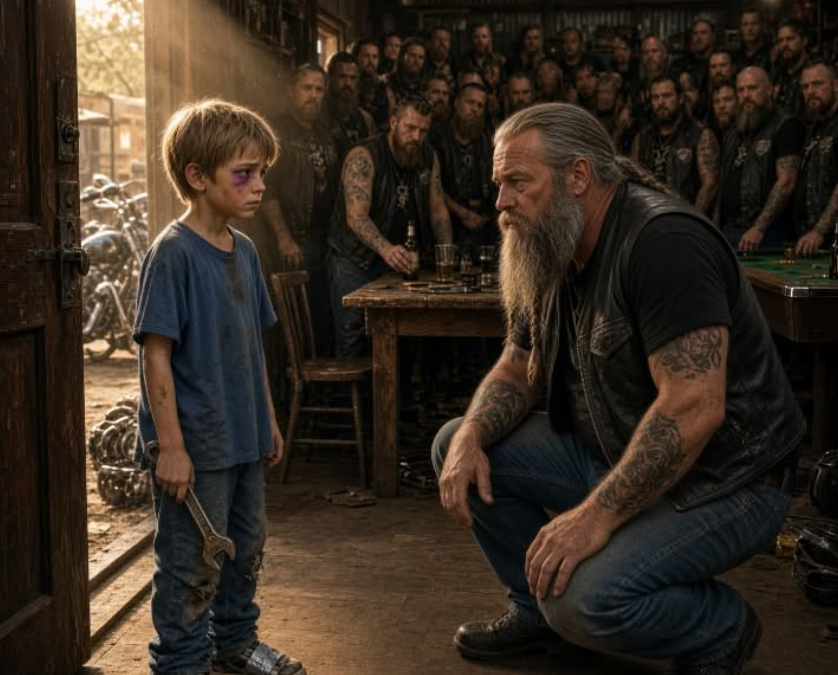
He took one careful step inside.
“I can work,” he said, a little louder. “I can sweep. I can clean tools. I know how to use a wrench. I just… I need to work.”
Leon’s voice came low from the bar.
“Where are your parents, boy?”
The reaction was immediate.
The kid flinched like the question had hit him.
His shoulders jumped.
His good eye widened.
He took half a step back toward the door, and the wrench lifted slightly in his hand.
“No parents,” he said too quickly. “I just want to work. Please. I won’t be in the way.”
Mike pulled his phone from his pocket.
“I’m calling the cops, Frank. Kid needs an ambulance.”
The boy broke.
“No!”
He screamed so hard his voice cracked. The wrench dropped from his hand and clattered across the concrete floor. He lunged forward, panic taking over his whole body.
“No cops! Please, mister, no cops. I’ll leave. Don’t call them. Please.”
His chest heaved.
For the first time, tears spilled from his good eye.
I raised one hand.
Mike froze.
Nobody disobeyed that hand in my clubhouse.
“Put the phone away,” I said.
Mike looked at me.
“Frank—”
“Put it away.”
He did.
I stood and walked around the table.
The boy immediately threw both arms over his head.
That told me more than any story could have.
A kid who has been hit once backs up.
A kid who has been hit often covers his head before the blow comes.
I stopped several feet from him.
Then I crouched.
My knees hated me for it, but I made myself smaller until I was eye-level with the boy.
“Nobody is calling the cops,” I said slowly. “What’s your name?”
He peeked through his arms.
“Leo.”
“Leo what?”
“Leo Bennett.”
“Well, Leo Bennett,” I said, nodding toward the wrench on the floor, “you pick that up. A man doesn’t drop his tools.”
He blinked at me.
Confused.
Still scared.
But listening.
Slowly, he lowered one arm, bent down, and grabbed the wrench again.
I pointed toward the bar.
“You go over there and get a plate of whatever Wrench cooked today. Then you can sweep the shop floor.”
His mouth parted slightly.
“We pay cash,” I added. “And we pay fair. But you eat first. Understand?”
He stared at me like I had just spoken a language he had forgotten existed.
Then he nodded.
That was how Leo Bennett got his first job with the Oildale charter.
For the next two hours, the clubhouse became the strangest place on earth.
Nobody said anything sentimental.
Nobody crowded him.
Nobody asked questions.
But every man in that room watched.
Leo sat on a barstool too tall for him and ate ribs like a starving animal trying to stay polite. He tore meat from the bone, chewed fast, then slowed down as if afraid someone might notice how hungry he was.
Halfway through the plate, he stopped.
Carefully, he wrapped three ribs and a square of cornbread in napkins.
Then he shoved the little bundle deep into his oversized pocket.
Leon looked at me.
I looked back.
Neither of us said a word.
You only save food when you are not sure tomorrow will feed you.
After eating, Leo took a push broom from the corner.
He did not sweep like a kid doing a chore.
He swept like his life depended on it.
Every corner.
Every crack.
Around every boot.
Under every table.
When he came near one of the boys, the man lifted his feet without being asked.
I watched men with felony records and broken knuckles move gently around a bruised nine-year-old who was terrified of leaving dust behind.
That kind of thing tells you what a room really is.
Not what people call it.
What it protects.
When the sun began dipping low, I walked over and handed Leo a twenty-dollar bill.
His good eye widened.
“For me?”
“Good work today.”
He held the bill like it was gold.
“Thank you, sir.”
“You come back tomorrow if you want,” I said. “Floors get dirty every day.”
A little bit of life entered his face.
“I’ll be here.”
He left through the heavy oak door with the wrench in one hand and the food hidden in his pocket.
The moment the door closed, the warmth left my voice.
“Leon.”
He stepped beside me.
“Follow him. Keep distance. I want to know where that boy sleeps. And I want to know who put that handprint on his face.”
Leon nodded.
“On it, boss.”
For four days, Leo came back.
Every afternoon at 3:30 sharp, right after school let out.
The swelling in his face started going down. The bruise changed from purple to greenish yellow. But his shoulders stayed tight, like he was always bracing for impact.
We gave him work.
Real work, or at least work that felt real to him.
Bobby taught him how to sort sockets by drive size.
Mike showed him how to polish chrome pipes properly.
Dallas let him hold a flashlight while he worked on an old knucklehead, though Dallas did most of the actual work and pretended Leo was essential.
Wrench made too much food every day and then complained loudly that somebody had better eat it before it went to waste.
The boys started “dropping” five-dollar bills near Leo’s broom.
Leo always tried to return them.
Every time, somebody said, “Not mine.”
By the third day, Leo had learned to tuck the money into his sock instead of his pocket.
Smart kid.
Sad reason.
I watched him more than I let on.
He had the nervous habits of a child who had learned adults changed without warning. If a man laughed too loud, Leo’s shoulders jumped. If someone moved too quickly, he backed away. If Wrench dropped a pan in the kitchen, Leo ducked behind the pool table so fast half the room had to look away to keep from showing what it did to us.
But he also watched everything.
The placement of tools.
The way engines came apart.
The way Leon stood near doors.
The way Mike checked exits without thinking.
The way nobody touched my chair.
He was not just scared.
He was learning the map of safety.
By the fourth night, Leon came into my office and closed the door.
I knew from his face I was not going to like what he had found.
“Talk,” I said.
Leon stood in front of my desk, jaw tight.
“He walks two miles to Whispering Pines Trailer Park. Lot 42.”
“That dump near the canal?”
“Yeah. Mother’s there. Saw her once. Looks strung out or medicated. Barely functioning.”
“And the father?”
“Stepfather.”
Leon paused.
I felt the air change.
“Name?”
“Gregory Mitchell.”
I went still.
Deputy Gregory Mitchell.
Kern County Sheriff’s Department.
Corrupt to the bone and proud of it.
Mitchell had hated us for years, and the feeling was mutual. Five years earlier, he had planted narcotics in a prospect’s vehicle and sent the kid to prison. We knew it. Half the county knew it. But a deputy’s word in Oildale carried weight, and ours carried suspicion.
Mitchell wore a badge like a weapon.
He pulled people over for sport.
Took cash during searches.
Protected dealers who paid him.
Beat men in alleys and called it resisting.
And now he had his hands on Leo Bennett.
“You’re sure?” I asked.
Leon’s eyes were flat.
“I watched him pull up in a county cruiser. Leo was sitting on the trailer steps. Mitchell didn’t even speak to him. Just grabbed him by the neck and threw him through the door.”
My hand closed slowly around the glass on my desk.
Leon continued, voice lower.
“I heard shouting from the street. Took everything I had not to kick that door in.”
“You did right.”
He looked at me like he hated that answer.
“Did I?”
“Yes,” I said, though it tasted bitter.
Because here was the trap.
If Mitchell had been some drunk stepfather with no badge, half the club would already be parked outside his trailer.
But a deputy was different.
A dirty deputy was still a deputy.
If one of my men touched him, the county would have every excuse it wanted. Gang task force. Federal warrants. Clubhouse raid. Asset seizures. Men in prison. And Leo still might end up back behind that same trailer door.
We could not solve this with fists.
That was the part people never understood.
Real power is knowing when violence helps and when it gives your enemy exactly what he wants.
Leon paced once.
“If we call child services, dispatch routes through county. Mitchell hears about it before a file even opens.”
“I know.”
“He’ll know the kid talked.”
“I know.”
“The boy will pay for it.”
“I know.”
Leon stopped.
“So what do we do?”
I looked at the wall behind him, at an old photo of our charter from twenty years back. Younger faces. Dead men. Prison men. Men still riding. Men gone soft around the middle pretending not to be.
“We destroy him,” I said.
Leon’s eyes sharpened.
“Frank.”
“Not with fists.”
He waited.
“Mitchell thinks he’s untouchable because he wears a badge. Men like that always have secrets. Money. Women. Drugs. Favors. Something.”
I opened the bottom drawer of my desk and pulled out a notebook.
“We find what the badge is hiding. Every bar. Every card room. Every side hustle. Every enemy. I want eyes in every corner of Oildale.”
Leon nodded slowly.
“If he breathes, we document it.”
“Exactly.”
Before he could answer, an engine screamed outside.
Not a Harley.
Too high.
Too sharp.
A police cruiser.
Leon moved to the blinds and looked through the narrow gap.
His face hardened.
“He’s here.”
Red and blue lights flashed across the clubhouse walls.
The room outside went quiet.
I stepped into the main room.
Every man was standing.
Tools had stopped moving. Pool balls sat still. Cigarettes burned between fingers.
Near the back, Leo stood frozen with a dirty shop rag in one hand.
His face had gone white.
“He followed me,” he whispered.
I looked at Mike.
“Get him out of sight.”
Mike moved quickly, but gently.
Leo backed up as if his legs no longer knew how to work.
I turned to the room.
“Nobody comes outside. No weapons. Nobody makes a move unless I say so.”
Then I looked at Leon.
“You’re with me.”
I opened the clubhouse doors and stepped into the heat.
Deputy Gregory Mitchell leaned against the hood of his cruiser like he owned the street.
Late forties.
Broad shoulders.
Pressed uniform.
Mirrored aviators even though the sun was going down.
One hand rested near his holstered weapon.
He smiled when he saw me.
“Evening, Frank.”
“Deputy.”
“Quiet night for the local chapter of miscreants?”
“It was.”
He pushed away from the cruiser.
“I’m looking for a runaway.”
“Then you’re lost.”
His smile thinned.
“Nine-year-old boy. Skinny. Name’s Leo.”
I kept my voice flat.
“Children don’t come to the bar. Bad for business.”
Mitchell stepped closer.
“Don’t play games with me, Castellano. That boy is my stepson. He did not come home from school. I know he’s in there.”
“If you believe that, get a warrant.”
His hand shifted against his weapon.
“You want me to arrest you for kidnapping?”
I looked down at his hand.
Then up at the cruiser.
Dash camera.
Good.
“This property is privately owned,” I said clearly. “It is closed to the public. If you want to cross that line, produce a warrant signed by a judge. If you draw that weapon on an unarmed man standing on private property, my lawyers will own your pension by sunrise.”
Mitchell’s jaw tightened.
He knew I was right.
That made him angrier.
“You think you’re untouchable because you wear leather.”
“No,” I said. “That’s your problem, Deputy. You think you’re untouchable because you wear a badge.”
For a second, his face changed.
There he was.
The man behind the uniform.
“You keep that boy,” he hissed, leaning close, “and I will tear this place apart. I’ll pull over every bike. Raid you every week. I’ll choke this club until it dies.”
I smiled without warmth.
“Have a good night, Deputy.”
Then I turned my back on him.
You want to insult a man like Mitchell, you don’t shout.
You dismiss him.
He spat on the pavement, climbed into his cruiser, and tore away hard enough to leave rubber on the road.
When I walked back inside, Leo was gone.
“Where is he?”
Mike pointed toward the shop.
I found Leo wedged under a steel workbench, knees pulled to his chest, shaking so hard his teeth clicked together.
I crouched near him.
“Leo.”
He covered his head.
“He knows I’m here.”
“He’s gone.”
“He’s going to kill me, Mr. Frank. He told my mom if I ever ran, he’d bury me in the desert and nobody would care.”
The room behind me went dangerously still.
I kept my voice soft.
“He’s not touching you.”
Leo’s good eye stared at me.
“You can’t stop him. He’s the police.”
I nodded once.
“That means we stop him the right way.”
He did not understand.
He did not need to.
I held out my hand.
After a long moment, he crawled out from beneath the bench.
“You are under the protection of this patch now,” I said. “But I need you to be brave a little longer. Can you do that?”
His lip trembled.
Then he nodded.
That night, we locked the gates.
Nobody rode alone.
Nobody drank enough to get stupid.
And every ear we had in town opened.
People think outlaw clubs only know violence.
They are wrong.
A club survives on information.
Bartenders hear things.
Mechanics see vehicles nobody reports.
Waitresses remember who pays in cash.
Tow truck drivers know where cars go after midnight.
Dealers brag.
Crooked cops get sloppy because nobody has dared to watch them closely.
For forty-eight hours, Oildale talked to us.
The break came from Dallas.
He worked security at a private poker game outside the county line, the kind of place where money moved without receipts and nobody asked where it came from.
He came into my office with grainy photos and a grin sharp enough to cut glass.
“Mitchell has a side hustle.”
He spread the pictures across my desk.
Deputy Mitchell outside an auto salvage yard.
Mitchell with Caleb Foster, the owner.
Mitchell carrying a black duffel bag.
Foster counting cash.
“What’s in the bag?” I asked.
“Product,” Dallas said. “Confiscated from the evidence room before it gets logged. Mitchell skims it, Foster moves it, they split profit.”
“Proof?”
“Foster drinks too much and talks too loud. Drop happens every Friday, eleven p.m. Straight from the trunk of Mitchell’s cruiser.”
It was Thursday.
We had one day.
Local internal affairs would bury it. Mitchell had friends. Too many.
We needed someone outside the county.
Someone with teeth.
I pulled a burner phone from my desk and dialed a number I had not used in eight years.
Special Agent William Harrison.
FBI public corruption task force.
Harrison and I were not friends. He had tried to put me away twice. I had made his life complicated more than once. But we had one thing in common.
When we gave a word, we kept it.
He answered on the fourth ring.
“Castellano,” he said. “I assume you’re not calling to confess.”
“I’ve got a gift for you.”
“I don’t accept gifts from bikers.”
“You will accept this one. Dirty sheriff’s deputy. Evidence tampering. Narcotics distribution. Public corruption.”
A pause.
“What’s your angle?”
“He’s beating a nine-year-old boy half to death and hiding behind the badge.”
Another pause.
Longer this time.
“You have proof?”
“I will by tomorrow night. Eleven p.m. Salvage yard off County Route 18. My people provide surveillance. You bring the team.”
“Why not handle it yourself?”
“Because I want him in federal custody, not dead in a ditch.”
Harrison exhaled.
“Give me the address.”
Friday night came hot and heavy.
The salvage yard sat beneath flickering sodium lights, surrounded by stacked cars, crushed metal, and oil-black dirt. Leon and Mike were hidden near a pile of wrecked sedans, camera trained on the office.
I sat three miles away in a blacked-out pickup with Dallas and a radio.
At 11:05, Mitchell arrived.
Not in uniform.
But in his county cruiser.
Arrogant.
Stupid.
Untouchable men often are.
He parked where he thought the road could not see him. Opened the trunk. Removed a heavy black duffel bag. Walked into the salvage office.
Mike’s voice came over the radio.
“Target inside with package.”
I picked up the phone.
“Move.”
Two minutes later, the salvage yard became daylight.
FBI tactical vehicles smashed through the gate.
Unmarked SUVs sealed every exit.
Agents poured out in body armor.
Mitchell kicked open the office door with his gun drawn, then froze as a dozen laser sights landed on his chest.
“Federal agents!” Harrison’s voice boomed through a megaphone. “Drop the weapon!”
For once in his life, Gregory Mitchell had no badge big enough to hide behind.
The gun hit the ground.
Then Mitchell did.
By sunrise, the whole county knew.
Deputy Gregory Mitchell arrested by federal agents.
Evidence room scandal.
Drug distribution.
Public corruption.
Child abuse investigation opened.
Sheriff’s department under federal review.
Oildale shook like someone had kicked the foundation out from under it.
But Leo did not care about headlines.
He cared about the trailer.
That same night, while the FBI processed Mitchell, we moved on the only other thing that mattered.
Leo’s mother.
Her name was Marcy Bennett.
She was not innocent in the way people like simple stories to be innocent. She had failed her son. She had stayed medicated, absent, and afraid while Mitchell hurt him. That truth could not be softened.
But she was also sick.
Addicted.
Controlled.
Terrified.
And Leo loved her.
So we did what Leo needed, not what anger wanted.
The club arranged a private bed in a rehabilitation center two counties over, paid cash for a full year. An ambulance took Marcy out of Whispering Pines while she cried and asked if Leo hated her.
He did not go with her that night.
He was not ready.
But he sent the food he had saved in our clubhouse, wrapped in napkins, because children sometimes love with whatever they have.
I rode my chopper to lot 42 just after the ambulance left.
Leo sat on the rusted trailer steps with a small backpack at his feet.
His face was still bruised, but the swelling had faded. He looked smaller without fear holding him upright.
He stood when he saw me.
I killed the engine.
“It’s over, kid.”
He stared.
“Mitchell is in federal custody. He’s not coming back tonight. Or tomorrow. Or ever, if I have anything to say about it.”
His mouth trembled.
“And my mom?”
“She’s getting help.”
“Will she get better?”
I did not lie to him.
“I hope so. But that part is up to her.”
He looked down at the dirt.
Then something in him cracked.
For the first time since he walked through our doors, Leo Bennett acted like a child.
He dropped the backpack, ran forward, and wrapped his skinny arms around my waist.
I froze.
I was not a man used to hugs.
Not from children.
Not from anyone, really.
Then slowly, carefully, I placed one hand on the back of his head.
“You did good, Leo,” I muttered.
His body shook against my vest.
“You did real good.”
There were legal steps after that.
Of course there were.
There always are.
Emergency placement.
Court orders.
Medical exams.
Therapy appointments.
Interviews with people who suddenly wanted to know why nobody had noticed earlier.
Some tried to paint us as dangerous influences.
Some said Leo had been safer with the state than near a motorcycle club.
Then Leo told a judge, in a clear voice, “They fed me. They paid me. They didn’t hit me. And when I was scared, they hid me.”
That quieted the room.
He was placed with a temporary foster family connected to one of our attorneys—good people, steady people, people who understood trauma and did not ask a battered child to become normal overnight.
He still came to the clubhouse after school.
Not because he needed money anymore.
Because the floors still got dusty.
Because Bobby still needed help sorting sockets.
Because Dallas still “accidentally” bought too many burgers.
Because Leon still pretended not to care while checking whether Leo had eaten.
Because a child who had lived in fear needed places where adults kept their promises.
Marcy stayed in treatment.
It was not smooth.
Recovery rarely is.
She relapsed once.
Then went back.
She wrote letters to Leo with help from her counselor. At first, he did not read them. Then he did. Then he wrote one back.
Short.
Messy.
Careful.
I’m okay. I hope you get okay too.
That was enough for then.
Mitchell’s case got worse.
The FBI found more evidence.
More money.
More missing drugs.
More victims of his badge.
When men like Mitchell fall, they usually pull a lot of rot into the light with them.
He eventually took a federal plea because the evidence was too strong and his friends scattered the moment cameras turned their way.
He was sentenced to prison.
Not county jail.
Not probation.
Federal prison.
The day the sentence came down, Leo asked one question.
“Can he get me from there?”
“No,” I said.
“Promise?”
I looked him straight in the eye.
“Promise.”
One year after Leo first walked into our clubhouse, we held a Saturday barbecue.
The place was loud again.
Engines outside.
Classic rock from the speakers.
Smoke from the grill.
Men arguing about bikes, ribs, and whether Leon’s chili was too spicy.
The difference was Leo.
He stood beside my picnic table wearing boots that fit, jeans without holes, and a black T-shirt that was finally his size. His face was healthy now, sun-browned from summer, both eyes bright and open.
No bruises.
No swelling.
No handprint.
He held a push broom and leaned on it like he owned the place.
“Floors are looking dusty, boss,” he said.
I looked around at the outdoor lot.
“Kid, we’re outside.”
“So?”
The boys laughed.
I pulled out a twenty and tossed it to him.
“Get to work. You’re holding up production.”
Leo caught it easily, folded it, and tucked it into his pocket.
Not his sock.
His pocket.
That mattered.
He started sweeping the concrete near the shop while thirty outlaws watched over him without making it obvious.
He was still a kid with a long road ahead.
Healing does not happen because one villain gets arrested.
It happens in smaller ways.
Sleeping through the night.
Eating without saving half the plate.
Flinching less.
Laughing louder.
Trusting that when an adult says, “Come back tomorrow,” the door will actually open.
Leo had learned the difference between fear and respect.
Between power and protection.
Between a man who uses authority to hurt and men with terrible reputations who still know where the line is.
People still tell that story in Oildale.
They tell it like a legend.
The bruised boy with the wrench.
The outlaw clubhouse.
The dirty deputy.
The FBI raid.
The barbecue one year later.
They always make it sound like we saved Leo.
Maybe we did.
But I think Leo saved something in us too.
It is easy for men like us to believe the world only sees monsters when it looks our way. After a while, some men stop trying to be anything else.
Then a child walks through your door with a broken face and asks for work.
Not help.
Not pity.
Work.
Because the world has taught him nothing comes free.
And suddenly every man in the room has to decide what kind of monster he is going to be.
The kind a child runs from.
Or the kind he runs to.
Leo ran to us because every other door had failed him.
That is not something I will ever be proud of.
A town should not need outlaws to protect a boy from a deputy.
But I am proud of what happened after.
We did not hand him back.
We did not look away.
We did not let Gregory Mitchell’s badge become a shield for cruelty.
We fought smarter than anger.
We let truth do what fists could not.
And when the dust settled, Leo Bennett had something he had never had before.
A safe place.
A job if he wanted one.
Food he did not have to hide.
Men who kept their voices low when he was scared.
And a whole room full of dangerous people willing to become gentle because a child needed them to be.
That is what shook the town.
Not the motorcycles.
Not the FBI raid.
Not the deputy in handcuffs.
What shook Oildale was the sight of a bruised boy walking into a room everyone feared and finding the first place in his life where nobody raised a hand against him.
That is the truth people still argue about.
That is the part they cannot make fit inside their clean little boxes.
Sometimes monsters wear uniforms.
Sometimes criminals keep promises.
Sometimes the law arrives late.
Sometimes protection looks like a scarred man crouching on bad knees in front of a child and saying, “Nobody is calling the cops.”