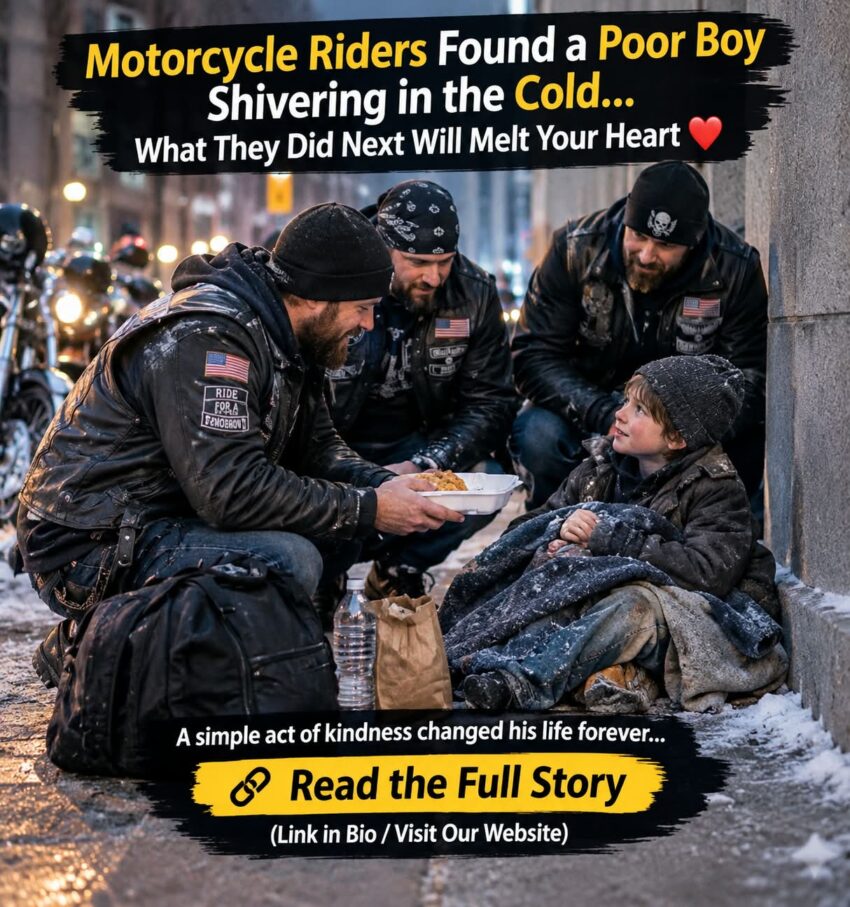
A Group of American Bikers Stopped for a Little Boy Outside a Grocery Store—What Happened Next Was Unforgettable
The sun was beginning to set when a group of motorcycle riders traveled along a busy American street. They had spent the afternoon riding together and were heading toward a local restaurant when something caught one rider’s attention.
A young boy was sitting on the pavement outside a closed grocery store.
He had a small backpack beside him and kept looking toward the road as if he were waiting for someone. People walked past without stopping. The boy appeared tired, and the evening air was getting colder.
One of the riders slowed down.
“Let’s check whether that kid is okay,” he told his friends.
The group pulled over a safe distance away and approached the boy calmly. They did not want to frighten him, so one rider crouched down nearby and introduced himself.
“Hey, buddy. Are you waiting for someone? Do you need help?”
The boy looked up but said very little at first.
A Difficult Day for a Young Boy
After a few gentle questions, the riders learned that the boy was having a difficult day. His family was going through financial problems, and he had been trying to find someone who could help him get some basic school supplies.
He explained that he had been carrying his backpack around because he did not want to lose the few things he owned.
The riders exchanged concerned looks.
They could have simply given him some money and continued their journey. Instead, they decided to understand what kind of help would actually make a difference.
One rider offered him a meal. Another asked whether there was a trusted adult or family member they could contact.
The boy slowly began to feel more comfortable.
For the first time that day, someone had stopped to listen rather than rushing past him.
The Bikers Made a Different Plan
The riders decided to postpone their evening plans.
With appropriate adult assistance, they worked to make sure the boy was safe and that a responsible person could help him. They also discussed how they might help his family obtain school supplies and other everyday necessities through local community organizations.
Their goal was not to embarrass the child or make him feel that he owed them anything.
They wanted him to understand that asking for help was nothing to be ashamed of.
One of the riders told him that difficult circumstances did not determine what kind of future he could have.
The boy listened quietly.
Sometimes, a child does not need a grand speech. Sometimes, what matters most is knowing that an adult is willing to take their concerns seriously.
More Than a Motorcycle Club
Motorcycle groups are often associated with long rides, powerful engines, leather jackets, and friendships built on the open road.
But some riders also participate in community service, charity rides, fundraising activities, and donations for families facing hardship.
These efforts demonstrate that a person’s appearance does not tell the whole story.
Someone who looks intimidating from a distance may be the first person to offer assistance when a stranger needs it.
The riders in this fictional story represent an important idea: helping people is not about looking like a hero. It is about noticing a problem and taking responsible action.
A meal may ease someone’s hunger. School supplies may help a child participate in class. Connecting a family with community resources may provide support beyond a single evening.
Small actions can become the beginning of something meaningful.
Why Children Need More Than Sympathy
Children experiencing financial hardship may face challenges that other children rarely think about. They may worry about school materials, transportation, clothing, meals, or whether their family can afford basic necessities.
These difficulties can affect their confidence and make them feel isolated.
Compassion matters, but practical assistance matters too.
Communities can help by supporting school supply drives, food banks, youth programs, and organizations that work with families experiencing financial difficulties.
Adults should also make sure that children are safe and that appropriate guardians or qualified services are involved whenever a child appears to be alone or in danger.
Helping a child should always protect their dignity, privacy, and safety.
A Lesson That Goes Beyond the Road
Imagine how different that evening might have been if the riders had continued without stopping.
They would have reached their destination, enjoyed their meal, and perhaps forgotten the brief moment when they noticed the boy.
Instead, they chose to pause and pay attention.
That choice is the heart of this story.
We often imagine that changing someone’s life requires a large donation, a special talent, or extraordinary resources. In reality, meaningful help can begin with something much simpler: noticing another person and asking what they need.
Not everyone can solve another family’s financial problems. Not everyone has the resources to provide ongoing support.
But people can offer kindness, contact appropriate services, donate useful supplies, or help connect someone with organizations that are equipped to assist.
Those actions matter.
What Would You Have Done?
The bikers had their own plans that evening, but they chose to spend time making sure a vulnerable child could receive appropriate help.
Their example invites us to think about the people we pass every day.
Would we stop and pay attention? Would we offer assistance respectfully? Would we take the time to connect someone with the right support?
The world does not become kinder through words alone. It becomes kinder when people turn concern into thoughtful action.
Sometimes, the most memorable part of a journey is not where the road takes you. It is the person you decide not to leave unnoticed.
Editorial note: This is a fictional, illustrative story created to highlight compassion and community support. It is not a verified report of a specific event.