PART2:
Caleb had been on the transplant list for fourteen months, and every month took something from him. First his color. Then his energy. Then the easy way he used to laugh. Then school. Then work. Then the future, or at least the shape he had imagined for it.
By the time the transplant coordinator called on a Thursday afternoon, my wife Marjorie and I had become people who lived by numbers.
Creatinine.
Potassium.
Blood pressure.
Hemoglobin.
Wait time.
Compatibility.
Chance.
That Thursday, I was in the kitchen trying to fix a cabinet hinge I had no business fixing, mostly because if my hands weren’t busy, my mind went to places I couldn’t stand. Marjorie was at the table with three folders open in front of her: insurance paperwork, medical bills, and a notebook where she wrote down every question she wanted to ask every doctor because fear had turned her into a better secretary than anyone deserved to be.
The phone rang.
She looked at the screen.
Then at me.
“It’s the hospital.”
The screwdriver slipped in my hand.
She answered on speaker because we had stopped taking medical calls alone.
“This is Marjorie Gates.”
I heard the transplant coordinator’s voice, calm but different. Brighter around the edges.
“Mrs. Gates, we have a potential living donor match for Caleb.”
Marjorie pressed one hand to her chest.
I put both palms flat on the counter.
The room tilted.
The coordinator kept talking. Blood type compatible. Crossmatch favorable. Final tests pending. Surgery possible next week if everything held. Donor wished to remain anonymous for now. We would receive more information when allowed.
Marjorie started crying before the call ended.
I did not.
I stood there holding a screwdriver and staring at a cabinet hinge while my entire life rearranged itself.
When she hung up, Marjorie turned toward me, her face wet, her hand over her mouth.
“Ronnie,” she whispered.
I crossed the kitchen in two steps and pulled her against me.
That was the first time in months I let myself imagine Caleb walking across a campus again. Caleb eating without calculating what it would do to his body. Caleb sleeping without a machine or fear beside him. Caleb turning twenty-one. Twenty-five. Thirty.
Hope is dangerous when you have been starving for it.
You grab too much at once.
The next week moved like a dream badly edited by someone cruel.
Pre-op appointments.
Bloodwork.
Consent forms.
Surgeons.
Instructions.
Risks.
Possible rejection.
Possible complications.
Possible failure.
Possible life.
Caleb tried to joke because that was his way.
“Well,” he said from the exam table while a nurse checked his blood pressure, “if I get somebody else’s kidney, does that make me part stranger?”
Marjorie burst into tears.
Caleb looked horrified.
“Mom, I was kidding.”
She waved him off and cried harder.
I laughed because if I didn’t, I was going to break something.
Caleb looked at me.
“Dad?”
“Yeah?”
“If the kidney comes with any weird hobbies, I’m blaming the donor.”
“Fair.”
“If I wake up liking jazz or kale, unplug me.”
“Noted.”
He smiled.
It was tired.
But it was a smile.
The night before surgery, I could not sit still.
Caleb had finally fallen asleep after pretending for an hour that he wasn’t scared. Marjorie was in the chair beside his bed, her head tilted against the wall, eyes closed, but I knew she wasn’t sleeping. Mothers do not sleep the night before someone cuts into their child. They only close their eyes so the child doesn’t have to watch them panic.
I stepped into the hallway.
Hospitals at night have their own weather.
Dim lights. Rubber soles. Distant beeping. Nurses moving like ghosts who know where every tragedy is stored. Families whispering near vending machines. Someone crying behind a curtain. Someone laughing too loudly because fear sometimes wears the wrong coat.
I walked because if I stopped moving, I thought I might fold in half.
That was when I saw him.
Four doors down.
The door was partly open. A man sat in bed wearing a hospital gown, reading a paperback with the cover half torn off. His arms were bare. There was a nurse’s bracelet on his wrist.
At first, he was just another patient.
Then he moved his hand.
The tattoo showed.
Wings.
Denise.
My breath stopped.
Three years earlier, I had stood in my own rental building on Maple Street with an eviction notice in my hand and that same tattoo in front of me.
Back then, Dale Mercer had looked bigger. Not fat. Solid. Thick through the shoulders. Gray beard down to his chest. Black motorcycle boots. Faded jeans. Leather vest with patches I didn’t understand and didn’t want to. He rented the ground-floor unit in my two-family building and paid on the first of every month without fail.
That should have been enough.
It wasn’t.
The truth, the real truth, is that I didn’t like the look of him.
The Harley gave me an excuse.
It was loud, yes. When he started it early in the morning, the pipes cracked through the little parking lot behind the building and echoed off the brick. The first time, I told myself I would talk to him if it continued. The second time, I drove past the building and saw him sitting on the bike without going anywhere, just letting it idle, both hands on the bars, head bowed. The third time, I got angry because anger is easier than curiosity.
I told myself I had other tenants to think about.
There were no other tenants.
The upstairs unit was vacant.
I told myself he was disturbing the peace.
Mostly, he disturbed the picture I had of the property. The building had fresh paint, trimmed hedges, white blinds in every window. I wanted quiet renters, clean cars, people who looked like they belonged in a brochure from a credit union.
Dale looked like a man who came with stories I didn’t want near my investment.
So I knocked on his door on a Tuesday in July.
He opened it wearing a black T-shirt and jeans, beard loose, eyes tired enough that I noticed and ignored it. The apartment behind him was neat. I remember that now. At the time, I barely registered it. No beer cans. No trash. No damage. A folded blanket on the couch. A framed photograph on the side table. A stack of western paperbacks by the chair.
“Mr. Mercer,” I said.
“Ronnie.”
I hated that he called me Ronnie, though I had never told him not to. It felt too familiar coming from someone I had already decided to keep at a distance.
“We need to talk about the motorcycle.”
He looked past me toward the parking lot.
“What about it?”
“The noise has become a problem.”
He was quiet.
“Anybody complain?”
I had prepared for that.
“It’s disruptive to the property.”
“That ain’t what I asked.”
I felt heat rise in my face.
“It’s my property.”
He looked at me then. Not angry. Not aggressive. Just steady.
“Yes, it is.”
I handed him the paper.
“This is a thirty-day notice to vacate.”
He looked down at it. Read the top line. Then read it again.
He did not argue.
That is the part that stuck even then.
He didn’t shout. He didn’t threaten. He didn’t call me names. He didn’t tell me I was being unfair.
He only nodded once and said, “Understood.”
I expected a fight.
Instead, I got dignity.
Somehow that made me resent him more.
He was out in three weeks instead of four. Left the place spotless. Keys in an envelope. Rent paid through the end of the month. No forwarding address.
I told myself the building was better without him.
Now he was four doors down from my son with a hospital bracelet on his wrist.
“Your boy doing okay?” Dale asked again.
My mouth had gone dry.
“What are you doing here?”
His face did not change.
“Getting some things checked.”
“What things?”
He looked down at his hands.
They were rough hands. Scarred knuckles. Thick fingers. A hospital ID band on his left wrist. IV tape on the back of his right hand.
“Dale,” I said. “Tell me you’re not the one.”
The hallway behind me seemed to stretch into silence.
He rubbed his palms together slowly.
“I saw the flyer at the gas station,” he said. “The one your wife put up. Boy’s face looked like my grandson’s.”
I grabbed the doorframe.
Marjorie had made those flyers herself. She had printed them at the library because our printer kept streaking. Caleb’s picture at the top. Smiling, taken before he got sick. Information about living kidney donation. A number for the hospital transplant office. A line that said, PLEASE SHARE. HELP US SAVE OUR SON.
She had taped them anywhere people would let her.
Church bulletin boards.
Diners.
Laundromats.
Pharmacies.
The Shell station on Route 6.
“You called?” I asked.
Dale nodded.
“Got tested through my doctor at the VA first. Then the hospital did the rest.”
“For Caleb?”
“For your boy, yeah.”
I stepped into the room because my legs were no longer entirely trustworthy.
“You’re the donor?”
He looked at the floor.
“I ain’t got much use for two of them,” he said. “And I figured after what you did to me, you’d never take it if you knew it was mine. So I told them to keep me anonymous.”
I do not remember sitting down.
I remember the chair being under me all of a sudden. I remember my hands shaking. I remember Dale watching me with that same steady look he had given me three years earlier in the hallway of my own building.
His book was face-down on the tray table. A beat-up Louis L’Amour western with the cover half torn off. There was a photograph tucked into the pages, the corner sticking out. I could see part of a woman’s face and part of a little boy’s.
“Your wife?” I asked, because I could not think of anything else to say.
“Yeah. Denise.” He picked up the book and slid the photograph the rest of the way in. “Passed in 2011.”
“I’m sorry.”
“That’s her with our grandson Marcus.”
He touched the book once.
“Marcus is gone too now. Motorcycle wreck outside Amarillo, three years back.”
Three years.
Right around the time I evicted him.
I think he saw me do the math, because he gave this small tired shrug.
“Yeah,” he said. “That’s why the pipes were loud that summer. I couldn’t sleep for nothing. I’d get on the bike at four in the morning just to have something to do with my hands. Wasn’t trying to bother nobody.”
Something rose in my throat that I could not swallow.
“You never said anything.”
He looked at me.
“You didn’t ask.”
That was the whole thing right there.
He was right.
I knew it.
And there was nothing I could do about it now.
I had knocked on his door with a piece of paper. I had stood in the hallway of my own building and told a sixty-one-year-old man that his motorcycle was a problem for tenants who did not exist. I had looked at his boots, his cut, his gray beard, his tattoos, and decided he did not fit the picture I had of my property.
I never asked why he was starting the bike before sunrise.
Never asked if he was all right.
Never noticed that grief had been sitting in front of me with both hands on handlebars because sleep had become impossible.
He hadn’t argued because maybe grief had already taken the fight out of him.
Or maybe he had more dignity than I did.
“Where did you go after that?” I asked.
“Rented a room above a mechanic’s shop on the west side for a while. Then my sister got sick and I moved in with her. She passed in the spring.”
He said it plainly.
Like a man reading weather.
“Been on my own again since.”
I stared at him.
A man I had pushed out of a home had lost his wife, his grandson, and then his sister.
And now he was giving my son a kidney.
“How did you know it was Caleb?” I asked.
“Flyer had his picture.”
“My wife put those everywhere.”
“She’s got a nice smile. Hard to forget.”
I almost broke then.
Dale continued.
“I saw it at the Shell station on Route 6. There’s a table by the coffee where folks leave notices. Lost dogs, yard sales, church suppers, that kind of thing. Your boy’s flyer was there. Somebody had already taken most of the pull tabs, so I couldn’t tell if it was still current. I called the hospital instead.”
“And you just walked in and offered?”
“No. I got tested first. My doctor at the VA ran the panel. Once I knew I might match, I called the coordinator and told her I wanted to donate to that specific patient. Then they did the rest of the workup.”
“For eleven months.”
“For eleven months.”
Eleven months.
While Caleb weakened.
While Marjorie prayed.
While I cursed traffic, bills, doctors, God, and every unknown stranger who wasn’t calling.
Dale had been quietly showing up for tests. Blood draws. Urine collections. Imaging. Counseling. Physicals. More bloodwork. Questions about mental health, finances, support, medical risk. He had been doing all that alone because he thought I would refuse if I knew.
I did not have a word for what I felt.
It wasn’t gratitude, not yet. Gratitude was too clean. Too bright. What I felt was closer to shame, but shame does not cover it either. It was like realizing you had been walking around your whole life with a hole torn through the back of your shirt and everyone had seen it but you.
“Why?” I asked.
He knew what I meant.
Not why donate.
Why us?
Why my son?
Why give anything to the man who had looked at you and seen a problem to remove?
Dale looked at the ceiling for a long while.
“My boy Marcus,” he said, “he was on a list too.”
“Your grandson?”
He nodded.
“Not a kidney. Heart. He was born with a bad one. Denise and me, we sat by that phone for four years waiting for it to ring. Every time it rang after ten at night, she’d stop breathing. Every time it didn’t, she’d pretend she wasn’t disappointed.”
He rubbed his thumb over the edge of the blanket.
“Phone never rang.”
I sat very still.
“He made it longer than they said,” Dale continued. “Got his license. Got his bike. I thought maybe he’d have a little time, you know? Just a little time to be a young man. Then a truck ran the red outside Amarillo and that was that.”
He stopped and cleared his throat.
His voice never shook.
That made it worse.
“I always figured if I ever got the chance to be the phone call for somebody else, I’d take it. Didn’t matter who was on the other end. When I saw your boy’s face on that flyer, that was the chance.”
He said all this like he was telling me where he bought tires.
No performance.
No accusation.
Just a man laying out what he had done and why.
I sat in that plastic hospital chair and cried like I had not cried in twenty years. Not dignified crying. Not a few tears. I cried the way you cry when somebody hands you a thing you know you didn’t earn and can’t pay back and don’t deserve.
Dale did not say anything.
He just reached for the tissue box on the tray table and handed it to me.
That nearly ruined me.
Even then, he was giving me what I needed.
After a while, a nurse came in to check his vitals. She looked from Dale to me and smiled the soft, exhausted smile nurses use when they have seen humans collapse under the weight of grace before.
“Surgery is still on for six a.m. sharp,” she said. “Mr. Mercer needs rest.”
I stood up.
My legs did not want to work right.
At the door, I turned back.
“Dale.”
He looked at me.
“I’m sorry. For the eviction. For all of it.”
He shook his head.
“Don’t. That’s not why I’m here.”
“I know. But I need to say it.”
“Then say it and let it be. I don’t need it hanging in the room tomorrow.”
So I said it.
“I was wrong about you. I treated you badly. I used that motorcycle as an excuse because I didn’t like what I thought you were. I’m sorry.”
He held my eyes for a second.
Then nodded once.
“Let it be.”
I walked back down the hallway to my son’s room, and I sat beside Caleb’s bed and held his hand while he slept.
I did not sleep.
Around five, Marjorie came in from the parking garage with wet hair and a travel mug of coffee she had forgotten to drink. I met her by the elevators because I couldn’t tell her in front of Caleb while he was still sleeping.
We stood near a vending machine buzzing under fluorescent light, and I told her everything.
The room.
The tattoo.
Dale.
The eviction.
Denise.
Marcus.
The flyer at the Shell station.
Eleven months of testing.
Marjorie listened without moving.
When I finished, she put both hands over her mouth and stood there in the cold hospital hallway for maybe two full minutes.
Then she said, “Ronnie. What did you do?”
Not what did he do.
What did you do?
That is marriage.
The person who loves you enough not to let you hide from yourself.
“I know,” I whispered.
“No. I don’t think you do.”
“I’m going to make it right.”
Her eyes filled.
“You can’t make that right.”
She was correct.
But I had to try anyway.
They took Dale and Caleb back around the same time. Different operating rooms, same wing. Caleb tried to look brave as they wheeled him away. His face was thin and gray against the pillow.
“Hey, Dad,” he said.
I leaned in.
“Yeah?”
“If I wake up with a craving for biker music, we’ll know why.”
I laughed because he needed me to.
“I’ll buy you leather pants.”
“Don’t make me reject the kidney on purpose.”
Marjorie kissed his forehead.
“Be kind to the nurses.”
“I’m always kind.”
One of the nurses smiled.
“Debatable.”
Caleb grinned faintly.
Then they wheeled him through the double doors.
A minute later, Dale came down the hall on another gurney.
No family beside him.
No one holding his hand.
No one crying over him.
Just a nurse pushing the bed and Dale staring at the ceiling with that same quiet expression.
Marjorie stepped forward.
“Dale?”
He turned his head.
She took his hand.
He looked surprised.
“I’m Marjorie,” she said. “Caleb’s mom.”
“Yes, ma’am.”
“I don’t know how to thank you.”
“Don’t have to.”
“I’m going to anyway.”
His eyes flicked toward me.
Then back to her.
“All right.”
She bent down and kissed his knuckles.
Dale closed his eyes.
The nurse looked away.
I did too.
Some moments are too intimate for witnesses, even when they happen in public hallways.
The surgeries took six hours.
There is no time longer than waiting outside an operating room for your child.
Not prison time.
Not grief time.
Not the minutes between a phone ringing at night and hearing the voice on the other end.
Surgery waiting room time is made of every mistake you have ever made, replayed under bad lighting.
Marjorie prayed. I paced. Ruthless television hosts smiled silently on a muted screen. A family across from us ate crackers from a vending machine and cried quietly. Every time a surgeon came out, everyone looked up. Every time it was not ours, we sank back into our chairs.
I thought about Dale alone in pre-op.
I thought about him leaving my building with his boxes three years earlier.
I thought about my own son, who had done nothing to deserve any of this, carrying inside him a chance I had almost disqualified because I did not like a man’s vest.
At 12:43, the surgeon came out.
Caleb’s surgery had gone well.
The kidney pinked up almost immediately.
Urine output already starting.
No complications.
Marjorie made a sound I had never heard from her before. A sob, a laugh, a prayer, and a collapse all in one. I caught her before she hit the floor.
“Dale?” I asked.
The surgeon nodded.
“Donor surgery went smoothly too. He’s in recovery.”
I covered my face.
I do not remember what I said.
Maybe nothing.
Maybe thank you.
Maybe God forgive me.
Around three that afternoon, they let us see Caleb.
His color was already different. Not healthy yet. Not pink. But not that terrible gray that had been living under his skin for months. There was warmth in him again, like someone had turned a light back on behind his face.
Marjorie touched his hair and cried.
I stood at the foot of the bed and tried to breathe.
Caleb woke fully that evening.
His eyes opened slowly.
He looked confused, then aware, then scared, then relieved.
“Did it work?” he whispered.
Marjorie leaned over him.
“Yes.”
He closed his eyes.
A tear slid sideways into his hair.
“Whose was it?” he asked.
Marjorie looked at me.
I pulled a chair close.
“There’s something I need to tell you.”
I told him all of it.
The bike at five in the morning.
The eviction notice.
My prejudice.
The flyer.
The hospital room.
Dale’s grandson Marcus.
The anonymous donation.
His face went through six different things before settling on something I could not read.
When I finished, Caleb stared at the ceiling.
“He knew you evicted him?”
“Yes.”
“And he still did it?”
“Yes.”
“Why?”
“Because he’s a better man than I was.”
Caleb turned his head toward me.
“Than you were?”
I swallowed.
“Than I’ve been.”
He watched me for a long moment.
Then said, “I want to meet him.”
“He’s four doors down.”
“Now?”
“When you can walk.”
It took Caleb three days to walk.
Three days of nurses making him sit up. Three days of pain medication and careful breathing. Three days of checking numbers, checking incisions, checking fluids, checking the new kidney like it was a tiny miracle with a schedule.
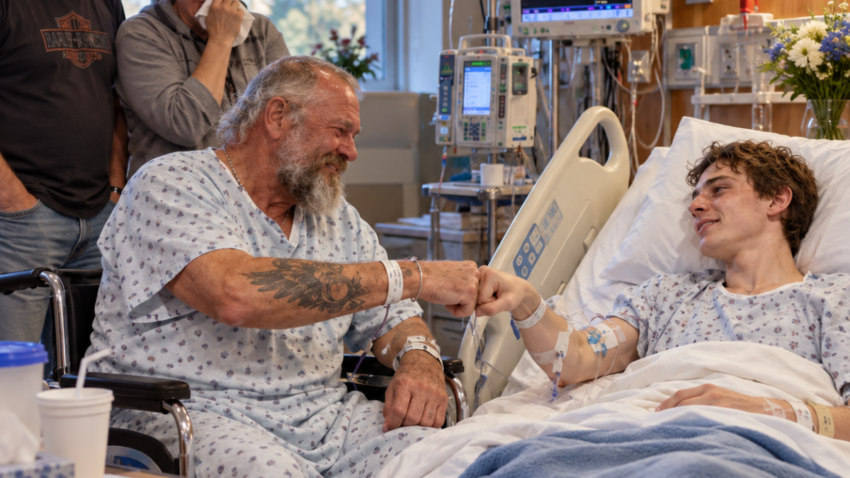
On the third day, he shuffled down that hallway with an IV pole, a hospital sock on each foot, and his gown gaping open in the back. I walked behind him holding the pole. Marjorie walked in front like she was guiding a sacred procession.
When we got to Dale’s door, she knocked once and pushed it open.
Dale was sitting up eating chocolate pudding.
He looked up.
He saw Caleb.
His whole face changed.
Not dramatically.
Dale was not a dramatic man.
But something opened in him.
“There he is,” he said.
Caleb walked to the bed. He was pale and thin and twenty years old with somebody else’s kidney inside him. He stood beside that biker and gripped the rail because standing still cost him more than he wanted us to know.
“Sir,” Caleb said, “I don’t know what to say to you.”
Dale set the pudding down.
“You don’t got to say nothing.”
“I want to.”
“Then say thank you and go take care of it. That’s all I want out of this.”
Caleb’s mouth trembled.
“Thank you.”
Dale nodded.
Then Caleb did something I did not expect.
He leaned down and hugged him.
Careful around the tubes.
Careful around the incision.
Careful and not careful at all.
Dale froze for half a second.
Then his arms came up around my son.
He closed his eyes and held on for a good long while.
When Caleb straightened, his face was wet.
Dale’s face was wet too.
Marjorie leaned against the doorframe with her hand over her mouth again.
“You look like my grandson,” Dale said.
“Dad told me. About Marcus.”
“Yeah.”
“I’m sorry, sir.”
“Nothing for you to be sorry about.”
Caleb sat in the visitor chair because he could not stand that long.
They talked for twenty minutes.
Motorcycles, mostly.
Caleb had ridden a little dirt bike in high school before he got sick. Dale told him about a trip to Sturgis in ’96, back when his knees worked right and Denise still rode behind him with both arms around his middle. He talked about roads like other men talk about churches. Highway 50 through Nevada. Rain outside Tulsa. Sunrise in South Dakota. A little diner in New Mexico where the waitress called everyone baby and made the best pie in three states.
Caleb listened like Dale was describing a world he had just been given permission to enter.
When we left, Dale caught my arm.
“Ronnie. One thing.”
“Anything.”
“Don’t make this into some big thing. Don’t put it on Facebook. Don’t call the news. I did what I did, and I’d like to go home when they let me and get on with it.”
I nodded.
“Okay.”
“I mean it.”
“I mean it too.”
He let go of my arm.
He looked past me at Caleb.
“You take care of that kid. That’s all.”
“We will.”
“No,” he said. “You will.”
The difference mattered.
Caleb went home four days later.
Dale went home the day after that.
I drove him because he didn’t have anybody to pick him up.
That is another sentence that still shames me.
A man gave my son a kidney, and when discharge came, there was no family in the waiting area, no friend circling the pickup lane, no one holding a coat or a bag of clean clothes. Just Dale sitting in a wheelchair with a plastic hospital bag on his lap and a nurse asking, “Your ride here yet?”
I stepped forward.
“I’m his ride.”
Dale looked like he might argue.
The nurse looked like she would kill him if he tried.
He let me drive.
He lived in a one-bedroom apartment above a paint store on the west side. The stairs were outside, metal, steep, and slick from rain. They looked dangerous for a healthy man and insane for someone five days out from surgery.
I carried his overnight bag.
He took each step slowly, jaw tight, one hand gripping the railing.
“Dale,” I said halfway up, “this is ridiculous.”
“Stairs usually are.”
“You can’t recover here.”
“Watch me.”
The apartment was clean but small. A couch. A recliner. A tiny kitchen. Western paperbacks stacked on a milk crate. A photograph on the end table of a young man on a motorcycle with a big grin.
Marcus.
He did look a little like Caleb if you squinted.
Not really.
But grief does not need exact resemblance.
It only needs a doorway.
I made Dale coffee because I did not know what else to do.
He sat on the couch carefully, one hand near his incision, face pale.
“What else can I do?” I asked.
“Nothing. Go home to your family.”
“Dale.”
He looked tired.
I took a breath.
“I own three rental properties.”
His face closed immediately.
“There’s a unit open on Maple Street right now,” I continued. “Same building you used to live in. Ground floor. No stairs. It’s yours if you want it.”
He stared at me.
“Rent free. As long as you want.”
He shook his head.
“I don’t need charity.”
“It’s not charity.”
“It is if you don’t charge rent.”
“You paid on the first for four years and never missed. I threw you out for reasons that had nothing to do with rent or damage or anything real. That apartment should have stayed yours.”
“I’ve got this place.”
“You’ve got outdoor stairs that damn near killed you today.”
“I manage.”
“I know. But you shouldn’t have to.”
He looked toward Marcus’s photograph.
I softened my voice.
“Maple Street is ground floor. Same layout you know. Porch out front. Parking spot close to the door. Caleb and I can move your things.”
His jaw worked.
“I’ll pay rent.”
“Fine.”
“Market rate.”
“No.”
“Ronnie.”
“What you paid before.”
“That was three years ago. Rent’s gone up.”
“Not for you.”
He looked at me a long time.
“Trying to buy forgiveness?”
The question hit me clean.
I deserved it.
“I don’t know,” I said. “Maybe. Some of it. But I’m also trying to keep the man who saved my son from falling down a set of stairs after surgery.”
He snorted.
“Truth don’t make a thing less stupid.”
“No, but it makes it cleaner.”
That almost got a smile.
Almost.
Finally, he said, “Okay. But I’m bringing the Harley.”
I laughed before I could stop myself.
“Dale, bring the Harley. Fire it up at four in the morning if you want. I’ll come out and wave at you.”
He looked at me.
Then he laughed.
It was the first time I had heard him laugh. It came out rusty, like a door that had not been opened in years.
Three weeks later, he moved back into the Maple Street apartment.
Caleb insisted on helping.
He was still weak, still moving like an old man in a young man’s body, but he put on a mask, pulled a sweatshirt over his incision, and stood in the parking lot ready to carry boxes.
Marjorie tried to stop him.
Dale tried to stop him.
I tried to stop him.
Caleb ignored all of us.
“He carried part of me,” he said. “I can carry his toaster.”
Dale stared at him for a second.
Then handed him the lightest box in the truck.
“Fine. Don’t drop my coffee mugs.”
“Are they emotionally significant?”
“No. I just don’t want to buy more.”
They worked together all afternoon.
Dale carried less than he wanted. Caleb carried less than he thought. I carried most of it and deserved to. Marjorie wiped down cabinets, stocked the refrigerator, and pretended she wasn’t crying every time she saw Dale’s books go back onto the same shelf where they had sat three years earlier.
When the Harley rolled into the parking spot, I stood at the curb and listened.
Loud as ever.
Maybe louder.
For the first time, it sounded like life.
That evening, after everyone left, I knocked on Dale’s door.
He opened it wearing an old undershirt, looking worn out.
“What?”
I held out a key.
He frowned.
“You already gave me keys.”
“This one’s for the storage shed out back. I cleaned it out. For the bike gear. Tools. Whatever.”
He took it slowly.
“Thanks.”
I nodded.
Then I said, “I lied to you.”
He looked up.
“There were no upstairs tenants. When I evicted you.”
He said nothing.
“The unit was empty. I said I had other tenants to think about because it sounded better than the truth.”
“And the truth was?”
“I didn’t like the way you looked.”
His face did not change.
Not enough to hide that the words landed.
“I know.”
Two words.
Not angry.
Worse.
Tired.
I looked down.
“I’m sorry.”
“You said that already.”
“I’ll probably say it again.”
“Probably won’t help.”
“No.”
We stood there in the doorway.
Then he opened the door wider.
“I made coffee.”
It was not forgiveness.
Not yet.
Maybe not ever in the way people think of forgiveness as a magic eraser.
But it was an invitation.
I stepped inside.
Dale’s life became woven into ours in ways that happened so gradually I did not notice until they were already true.
At first, it was practical.
I checked on him during recovery. Marjorie brought soup. Caleb texted him questions about medication side effects. Dale hated fussing, so we pretended not to fuss while fussing constantly.
Then it became habit.
Dale came to dinner one Wednesday because Marjorie made too much pot roast. He came again two weeks later because she made it on purpose. He brought root beer because he didn’t drink anymore. He sat at our table and told stories about Denise and Marcus and highways with names that sounded like songs.
Caleb called him Mr. Dale.
Dale told him to knock it off.
Caleb did not knock it off.
Sometimes they sat in the garage and talked about engines while I pretended to understand. Sometimes Dale let Caleb polish the Harley, which was apparently a sacred act. Sometimes they said nothing at all, just sat in lawn chairs with root beer bottles between them while evening moved across the driveway.
I watched them through the kitchen window once.
Marjorie came up behind me.
“You’re staring.”
“I know.”
“Good.”
I looked at her.
She folded a dish towel.
“You need to look at what grace costs.”
That was Marjorie.
She could turn a sentence into a church service without raising her voice.
A year and a half later, Caleb was twenty-two. His labs were perfect. He had gone back to school and was studying nursing. Not business like he had planned before he got sick. Nursing.
“I want transplant floor,” he said.
I asked him once if that was because of Dale.
He shrugged.
“Partly.”
“What’s the other part?”
He looked embarrassed.
“I know what it feels like to wait for someone to call.”
There was nothing to say to that.
Dale was sixty-three by then. He rode on Sundays when the weather was good. He came to dinner every other Wednesday. He complained about Marjorie fussing over his salt intake and then ate whatever she put in front of him. He kept a framed photo of Marcus on his mantel and added one of Caleb beside it, taken the day Caleb helped him move back into Maple Street.
He never called Caleb his grandson.
Caleb never called him family.
They did not need the words.
A few months after Dale moved back, he had a scare with his remaining kidney. He was tired all the time, his numbers were off, and he tried to hide it because men like Dale would rather fight a bear than admit fatigue.
Caleb noticed first.
“You look gray,” he told him at dinner.
Dale frowned.
“That’s just my face.”
“No, that’s your stubborn face. Under it, you look gray.”
“I’m fine.”
Caleb pulled out his phone.
“When was your last lab?”
“Don’t start.”
“When?”
Marjorie looked at me.
I looked at my plate.
No man in that house was brave enough to get between Caleb and kidney function.
It turned out to be a mild infection. Cleared with antibiotics. Nothing serious.
But Caleb drove him to every appointment. Sat in every waiting room. Read the lab reports before Dale did. Organized his pills. Called the doctor twice. Nearly drove Dale insane with hydration reminders.
One night after Dale went home, I found Caleb rinsing dishes in the kitchen.
“You know you don’t have to worry that much,” I said. “He’s tough.”
Caleb turned off the water.
“Dad, he gave me a piece of himself. If something happens to that piece, I want to be there.”
I did not have anything to say to that.
Last Sunday, I was in Dale’s kitchen fixing a dripping faucet.
He sat at the little table by the window drinking coffee and reading the paper. He had reading glasses low on his nose and wore an old undershirt. I could see the surgery scar on his side, thin and pink and healed clean.
The Harley sat outside under a cover. Maple Street traffic moved beyond the window. Somewhere down the block, a kid rode a skateboard over cracked sidewalk. A dog barked two houses over.
A normal Sunday morning in a normal neighborhood.
“Dale,” I said.
“Yeah?”
“Can I ask you something?”
“You already are.”
“That day I evicted you. Did you know? That someday you’d end up doing this?”
He looked at me over his glasses.
“Ronnie, that day you evicted me, I didn’t know if I’d still be alive a year later. That was a bad summer.”
“So this wasn’t some big plan.”
“Wasn’t any plan. I saw a flyer at a gas station and made a call.”
I went back to the faucet.
He went back to his paper.
After a minute, he said, “You know what I think about sometimes, though?”
“What?”
“I think if you hadn’t put me out of that building, I wouldn’t have moved in with my sister. If I hadn’t moved in with my sister, I wouldn’t have been using that Shell station on Route 6 because it was closest to her place. I never would’ve seen the flyer. Somebody else might have donated, sure. But probably not, on account of I was a real good match.”
He turned a page.
“So in a real roundabout way,” he said, “you evicting me is the reason your boy’s alive.”
I stood there with a wrench in my hand and looked at him.
This man I had handed a notice to in a hallway.
This man I had reduced to leather and noise.
This man whose grief I had mistaken for inconvenience.
This man who was now closer to my family than most of my own blood.
“Dale,” I said, “that’s a hell of a thing to say.”
He shrugged without looking up.
“It’s the truth. Truth don’t care how it sounds.”
I finished the faucet. Washed my hands in his sink. Poured myself a cup of coffee from his pot and sat across from him.
We sat there a long time not saying much.
That is one of the things Dale taught me too.
Not every silence is empty.
Some silences are full of everything words would only make smaller.
I thought about the first time I saw him. Not really saw him. Looked at him. Judged him. Sorted him into a category that made it easy to treat him badly.
I thought about Caleb four miles away, alive because of him.
I thought about Denise’s name on Dale’s arm. Marcus’s photograph in his book. Marjorie’s flyers. The Shell station. The hospital room. The kidney inside my son. The Harley in the parking lot. The eviction notice in my hand.
I do not know what to do with a story like that.
I do not know how to fit it neatly inside my head.
All I know is that I was wrong about a man once, in a hallway, on a Tuesday in July, and it almost cost me the only son I have.
The only reason it didn’t is that the man I was wrong about was a better man than I was.
I think about that every morning now.
When I hear a motorcycle go by, I think about it.
When Caleb calls to say he passed a test, I think about it.
When I sign a lease with a new tenant, I think about it.
I ask more questions now.
Not because asking fixes everything.
It doesn’t.
But because not asking nearly cost me the chance to know a man before I needed him.
I never asked Dale for anything he did not want to give.
He gave me my son back anyway.
And every other Wednesday, when he sits at our table with a bottle of root beer and calls Caleb “kid,” I hear that Harley in my memory, loud at four in the morning, and I finally understand what I should have understood three years ago.
Sometimes noise is not disrespect.
Sometimes noise is grief trying not to die in silence.
Sometimes the man you want gone is the man who will one day save everything you love.