Don’t move—or I’ll take her!” the kidnapper warned, unaware that a retired military K9 watching silently would later shatter his carefully crafted alibi with a single, unblinking stare in the courtroom that changed the entire case.
“Don’t move—or I’ll take her!”
That was the sentence the neighbor across the street swore he heard, though he later admitted under oath that it might have been something else, that memory does strange things when fear gets into it, stretching some details until they snap and shrinking others until they vanish altogether, and by the time it reached the courtroom months later it had hardened into a quote everyone repeated as if it had been carved into stone.
But the truth of that day—like most truths worth telling—was messier, more human, and far less cinematic than the headlines made it sound
Caleb Rourke did not come home from Afghanistan a hero in the way people expect heroes to return, with brass bands and unshakable smiles and neat, tidy trauma that fits inside polite conversation. He came home with a right knee that locked up when the weather shifted, a permanent notch in his hearing from too many concussive blasts, and a mind that refused to power down even when the house was silent and safe and warm. He had been a Staff Sergeant once, a handler in a specialized K9 unit, and if there was one thing in his life that still made sense when everything else felt disjointed, it was Atlas.
Atlas was a retired military working dog, a sable German Shepherd with a scar that cut through one ear and a chest broad enough to make strangers instinctively step back. He had tracked insurgents across dry riverbeds, alerted on explosives hidden in walls, and learned to read Caleb’s breathing patterns the way some men read maps. When Caleb left the service, Atlas came with him, because the Army sometimes understood that certain partnerships were not tactical conveniences but lifelines.
Civilian life in Loudoun County, Virginia, looked peaceful on the surface. The lawns were trimmed, the mailboxes identical, and children rode scooters in lazy circles on cul-de-sacs that smelled faintly of cut grass and charcoal grills. Caleb rented a modest two-story house with white shutters and a porch that creaked slightly when you stepped on the third board from the left. It was there, on that porch, that his six-year-old daughter, Lila, liked to sit with sidewalk chalk, drawing uneven rainbows and stick-figure families with hair that stuck straight up.
On the morning everything changed, the sky was painfully clear, the kind of bright blue that makes you squint and think, irrationally, that nothing bad could possibly happen under such an honest color. Caleb had been icing his knee at the kitchen table, trying to ignore the dull ache that pulsed when he stood too long. Atlas lay near the sliding glass door, eyes half-closed but ears alert in that subtle way only trained dogs manage, resting without ever truly switching off.
“Stay where I can see you,” Caleb called through the screen door as Lila skipped down the driveway with her chalk bucket.
“I will, Daddy,” she sang back, already kneeling on the concrete.
He watched her for a few minutes, letting himself believe in the simplicity of the scene, in the way her ponytail bounced when she shifted from one drawing to another, in the fact that Atlas’s tail thumped lightly each time she giggled. Then the ice pack slipped from his knee onto the floor, and he muttered under his breath, pushing himself up to grab another towel from the freezer.
He was inside for less than forty seconds.
That was all it took.
The sound came first—a scuff of shoes, a sharp intake of breath that did not belong to laughter. Caleb’s body reacted before his mind caught up, instincts snapping into place as if someone had flipped a switch inside his spine. He dropped the freezer door open and moved toward the front door at a speed his knee protested but could not override.
When he burst onto the porch, the scene in front of him did not make immediate sense, because the brain resists the idea that something impossible is happening in your own driveway.
A man he had never seen before stood near the old sycamore tree at the edge of the yard. He was tall but hunched, as if trying to shrink himself, wearing a gray windbreaker despite the warmth and dark jeans stained at the cuffs. One arm was wrapped around Lila’s torso, pulling her backward against him. His other hand hovered near her mouth.
Lila’s eyes were wide in a way Caleb had never seen before—not crying, not screaming, just shocked
Atlas was already there.
The dog stood between Caleb and the stranger, muscles coiled, teeth bared just enough to show intent but not yet action. He did not lunge. He did not bark wildly. He waited.
That waiting was not hesitation; it was discipline.
“Let her go,” Caleb said, and his voice was not loud but it carried something unarguable in it.
The man tightened his grip and hissed, “Don’t move—or I’ll take her!”
The sentence sliced through the quiet neighborhood like a broken bottle.
Caleb noticed everything at once, because that is what training does to you when your heart is trying to explode out of your chest: the chemical tang in the air, sharp and synthetic, like industrial cleaner; the scrape of Lila’s sneakers against concrete; the faint tremor in the man’s hand that betrayed nerves he was trying to mask.
He stepped forward.
Atlas moved in the same instant, not with uncontrolled fury but with a calculated strike, slamming his shoulder into the man’s thigh with enough force to destabilize him without ripping flesh. The grip broke. Lila stumbled free, and Caleb was there, scooping her up so fast she barely touched the ground.
The stranger swore, shoved at Atlas, and bolted toward the street, cutting between two parked cars and vanishing down the block before Caleb could give chase. His knee flared in protest when he tried to run, pain locking the joint just enough to slow him.
He stood there, daughter clutched against his chest, Atlas vibrating at his side, memorizing the retreating figure—the slight drag in the left leg, the way the windbreaker flapped open to reveal a faded blue work shirt beneath.
Sirens arrived faster than Caleb expected. Neighbors emerged from houses in various states of shock. Statements were taken. Descriptions recorded. A patrol car cruised the surrounding streets, lights flashing but siren off, as if the quiet suburban air might shatter if it were pierced by too much noise.
That night, Lila did not speak.
She did not cry, either. She sat at the kitchen table with a glass of water and stared at the condensation sliding down the side as if it were the most fascinating thing in the world. When Caleb asked if she was hungry, she nodded. When he asked if she wanted her favorite cartoon, she shrugged.
But no words came.
The pediatric psychologist he contacted the next morning called it trauma-induced mutism, explained gently that sometimes a child’s brain decides silence is safer than sound, that language can feel like a risk when the world has suddenly proven itself unpredictable. Caleb listened, nodded, took notes he did not need because he had memorized every word.
Atlas did not leave Lila’s side.
He slept outside her bedroom door, nose pointed toward the hallway. He placed himself between her and every delivery driver, every repairman, even well-meaning neighbors who stopped by with casseroles and awkward sympathy. If Caleb moved too quickly toward her without announcing himself, Atlas’s head would snap up, not aggressive but ready.
Weeks passed.
Then the detective called.
They had a suspect.
His name was Victor Hale, a subcontractor who worked at a distribution warehouse less than ten miles away. He had prior charges—trespassing, petty theft—but nothing that would immediately connect him to child abduction. Still, someone had reported a man matching his description lingering near a playground two days before the incident.
There was one problem.
Hale had an alibi.
According to time-stamped records and a supervisor’s signed statement, he had been on-site at the warehouse during the exact window of the attempted kidnapping. Security cameras placed him inside the building. Two coworkers confirmed it.
Without Lila’s testimony, the prosecutor warned, the case would be thin.
Caleb felt the old frustration rise, the one he had known in other contexts when paperwork and doubt threatened to undo something he knew, in his bones, to be true.
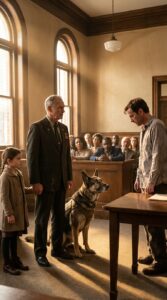
The first day of trial arrived heavy and humid. Caleb wore a suit that fit slightly looser than it had before deployment. Lila held his hand with one small fist, silent but steady. Atlas walked at heel, vest clipped on, identification papers in order because the court had debated whether a retired military dog should even be allowed inside.
Across the courtroom, Victor Hale sat at the defense table, jaw set, hair neatly combed as if that might rewrite his history. When Lila entered, his eyes flicked toward her.
Atlas froze.
Not in fear.
In alert.
His body went rigid, head lifting a fraction, ears forward. He did not growl. He did not bark. He simply locked onto Hale with a stillness that Caleb recognized instantly.
In Afghanistan, that posture had meant one thing: target confirmed.
The bailiff shifted, hand hovering near his belt. “Sir, control your dog.”
“He is under control,” Caleb replied quietly.
The judge peered over her glasses. “Mr. Rourke, if the animal disrupts proceedings—”
“He won’t,” Caleb said.
Atlas relaxed when given the command, then tensed again the moment Hale adjusted in his chair.
It happened three times.
The defense attorney noticed. “Your Honor, this is prejudicial. The dog’s behavior is clearly influencing the jury.”
The judge frowned. “The jury will disregard the animal’s posture.”
But Caleb saw the prosecutor, Dana Whitfield, take note.
During recess, Dana pulled Caleb aside. “Explain it to me like I’ve never seen a working dog,” she said.
“He alerts by freezing,” Caleb replied. “It’s a trained response to a recognized scent. Explosives. Individuals. Specific chemical signatures. He doesn’t guess.”
“Could he be reacting to your tension?” she asked.
Caleb considered it. “He’s seen combat. He doesn’t react to nerves. He reacts to stimulus.”
Dana nodded slowly. “We can’t put a dog on the stand. But maybe we don’t have to.”
What followed was not dramatic, not a sudden confession under bright lights, but something far more methodical.
Dana petitioned the court for permission to re-examine the warehouse alibi, citing new behavioral observations that warranted further scrutiny. The judge allowed limited inquiry.
Detectives revisited the warehouse.
They discovered that one security camera had a blind spot of nineteen minutes due to a “maintenance glitch.” The supervisor who had signed Hale’s time sheet admitted, under pressure, that Hale had asked him to “punch him in” early that morning in exchange for covering an upcoming shift.
More importantly, forensic analysis of Lila’s T-shirt from that day revealed trace amounts of a specific degreasing solvent used exclusively at that warehouse, a brand not commonly available in retail stores.
Hale had denied ever being near her.
The fibers told a different story.
When Hale returned to the stand, Dana did not mention Atlas at first. She walked the jury through timelines, camera gaps, chemical residue, inconsistent statements. She let the facts accumulate like steady rain.
Then, almost casually, she asked, “Mr. Hale, do you use industrial solvent X-47 at your workplace?”
“Yes,” he replied.
“Is it available to the general public?”
“No.”
“And you’ve never been near Lila Rourke?”
“Never.”
Dana held up the lab report. “Then can you explain how residue of X-47 was found embedded in the fabric of her shirt?”
Hale’s composure cracked.
He glanced, involuntarily, toward Caleb.
Atlas stiffened again.
The courtroom felt charged, like the air before lightning strikes.
Under cross-examination, Hale’s alibi unraveled. The coworker who had vouched for him admitted to lying. The maintenance log for the camera gap turned out to be falsified.
By the third day, before the jury could even deliberate, Hale’s attorney requested a conference.
A plea deal followed.
Attempted kidnapping. Evidence tampering. Obstruction.
As Hale was led away in handcuffs, he muttered something under his breath—something bitter and self-pitying—but Caleb did not care. He cared about the fact that the man would no longer walk free in neighborhoods where children drew chalk flowers in driveways.
And yet.
Justice in a courtroom did not immediately restore what had been taken.
At home, Lila still moved quietly. She answered with nods and shakes of her head. Atlas remained her shadow, aging but vigilant.
Caleb began volunteering with a local veteran support organization, helping other handlers transition retired working dogs into civilian life. He learned more about scent memory, about how trauma imprints not just on humans but on animals trained to detect fear and chemicals and subtle shifts in air.
One evening, months later, as autumn light filtered through the living room window and painted everything gold, Lila sat on the rug beside Atlas. She traced the scar along his shoulder, the one he had earned in a different country, in a different kind of battle.
Caleb watched from the couch, pretending to read.
Lila leaned forward, pressing her forehead against Atlas’s neck.
Her lips parted.
“Daddy,” she whispered.
The word was fragile, like something that might crumble if touched too roughly.
Caleb did not rush her.
“I’m here,” he said softly.
She looked at him, then at Atlas.
“He knew,” she added, voice still quiet but clearer now. “He knew it was him.”
Caleb swallowed.
“Yes,” he said. “He did.”
In that moment, he understood something he had not fully grasped before: Atlas had not broken an alibi through magic or instinct alone. He had done what he had been trained to do—observe, detect, signal—and trusted the humans beside him to act with integrity.
The lesson, if there is one, is not that dogs are heroes while people fail, nor that justice depends on dramatic gestures in courtrooms. It is that truth often hides in small, disciplined responses—in a dog’s stillness, in a prosecutor’s persistence, in a father’s refusal to ignore what he knows. Silence, whether from trauma or restraint, does not mean absence. Sometimes it is simply a pause before courage returns.
And sometimes, the ones who seem silent are the ones holding the line.