PART3:
Kayla opened her door.
“Because engines don’t work like cartoons.”
Piper looked unconvinced.
Kayla smiled despite herself.
“I’m serious.”
She stepped out.
Opened the hood carefully.
Steam billowed.
Piper shrank into the seat.
Kayla examined what she could.
She was no mechanic.
But she knew enough to recognize a split coolant hose.
She returned to Piper’s window.
Her face had changed.
Piper saw it immediately.
“What?”
“I need help.”
“Call somebody.”
“No signal.”
Piper held up Kayla’s phone.
Empty bars.
“Why?”
“Mountains.”
“That’s stupid.”
“Yes.”
Kayla looked north along the highway.
She knew the little corner market was less than a mile ahead.
She had stopped there before.
Landline.
Coolant.
Maybe someone with tools.
The alternative was sitting beside a highway and hoping help appeared before dark.
She looked at Piper.
Then the road.
Trucks blasted through that section fast.
No sidewalk.
Narrow shoulder.
She could not safely take a six-year-old along.
Kayla crouched by the open passenger window.
“Listen to me.”
Piper tightened her grip on Biscuit.
“I’m going to the market.”
“No.”
“Baby.”
“No.”
“I’m coming back.”
“What if it explodes?”
“It won’t.”
“You don’t know.”
“I do.”
Piper’s eyes filled.
Kayla opened the door.
Knelt.
Put both hands on Piper’s shoulders.
“You stay inside.”
“Okay?”
Piper nodded reluctantly.
“Lock both doors.”
“Yes.”
“Keep Biscuit with you.”
“Yes.”
“If anybody stops?”
“Don’t open.”
“If they knock?”
“Don’t open.”
“If somebody says they’re police?”
Piper thought.
“Look for the car.”
“Good.”
“If you still don’t know them?”
“Don’t open.”
“And if you get scared?”
Piper whispered:
“Hide.”
Kayla kissed her forehead.
“That’s right.”
“I’m going to be gone twenty minutes.”
Piper shook her head.
“Fifteen.”
Kayla smiled.
“I’ll run.”
“You hate running.”
“I know.”
That made Piper almost smile.
Kayla stepped away.
Locked the passenger door from outside.
Checked.
Checked again.
Then began walking fast down the highway shoulder.
Piper watched until her mother became smaller.
Then turned once.
Waved.
Then disappeared around the bend.
For fourteen minutes Piper did exactly what she was told.
She sat.
Biscuit in her lap.
Doors locked.
The truck hissed.
Metal ticked beneath the hood as the engine cooled.
A semi passed close enough to rock the Ranger.
Piper gasped.
The steam thickened.
She whispered:
“It’s okay.”
Biscuit did not answer.
Another truck passed.
Then came the sound.
POP.
Sharp.
Metallic.
Steam exploded against the windshield.
Piper screamed.
Every lesson her mother had taught her collided at once.
Stay inside.
But danger.
Hide.
But the truck.
Don’t go toward strangers.
Road full of strangers.
Don’t get hit.
Run away from road.
At 5:34, Piper made a six-year-old decision.
It was wrong.
It was also completely logical from inside her frightened mind.
She unlocked the passenger door.
Climbed out.
And ran away from the truck.
Not toward the highway.
Away.
Down the back slope.
Biscuit under one arm.
Black canvas sneakers tearing through dust.
She ran through sagebrush.
Slid.
Got up.
Ran again.
The highway noise faded.
The truck vanished behind terrain.
Then Piper stopped.
Turned.
Saw nothing familiar.
No blue Ranger.
No pullout.
No road.
Just brown hills.
Dry wash.
Brush.
Long shadows.
“Mom?”
The desert swallowed the word.
Piper started crying.
Then remembered another rule.
If you get lost, stay put.
She looked around.
The place where she stood felt exposed.
Wind.
Dark coming.
She saw a deep wash below.
Something black.
Round.
A pipe.
Hide.
Piper went toward it.
Thirty miles south, four hundred motorcycles were preparing to move.
They had gathered beside the Columbia River in a gravel lot near Wenatchee.
Men.
Women.
Old riders.
Young riders.
Black leather.
Winged skull patches.
Chrome.
Road grime.
The public noticed.
Of course they did.
A woman pushing a stroller changed sides of the path when she saw them.
A teenage couple stopped taking selfies.
An older man looked once at the rows of bikes and locked his pickup.
Nobody in the group reacted.
Most of them had seen that their entire lives.
Fear arrives before introductions.
They were there for Lester “Tiny” Sumner.
Tiny had been six feet seven.
Three hundred twenty pounds.
Retired lineman.
Loved stray dogs.
Hated onions.
Carried peppermint candy in his vest pockets for children at charity rides.
Cancer had eaten him down to a hundred sixty pounds before he died.
His final request:
Take me to the lake.
So they came.
Seattle.
Spokane.
Boise.
Missoula.
Yakima.
Portland.
Small towns nobody outside the Northwest would recognize.
Four hundred riders.
The memorial box with Tiny’s ashes rode in a black saddlebag at the front.
At the very back of the column sat Conrad Fairchild.
Sixty-two.
Gray beard to mid-chest.
Gray ponytail.
Heavy shoulders.
Steel watch.
Old boots cracked at the toes.
Faded cross tattooed on his right forearm.
His vest fit him like a second skin.
He rode sweep.
Last bike.
People assumed sweep meant slowest.
It did not.
Sweep meant responsible for everything behind the group.
Breakdowns.
Dropped gear.
Mechanical trouble.
Medical trouble.
Anything everyone else missed.
Conrad liked that position.
He had spent most of his adult life noticing what people missed.
Twenty-seven years with U.S. Border Patrol.
Tucson Sector.
Tracker.
Sign cutter.
Instructor.
He had retired five years earlier.
He rarely talked about it.
The club knew he had worked federal law enforcement.
They did not know much more.
Only Stanley Penrose, the road captain, knew why Conrad no longer tracked people.
Stan had been there the night Conrad finally told him.
He never repeated it.
At 6:20, four hundred engines started.
The sound rolled up the river valley like distant thunder.
People turned.
Phones came out.
Conrad watched the road behind them.
At exactly the same time, Kayla returned to the pullout.
She was sitting in Nadine Cooper’s minivan.
Coolant jug in her lap.
Nadine owned the corner market.
Sixty-one.
Short silver hair.
Practical shoes.
She had listened to Kayla’s panicked explanation and said:
“Get in.”
They reached the Ranger at 5:56.
Kayla saw the passenger door open.
At first she did not understand.
Then she screamed.
“Piper!”
She jumped out before the van stopped.
Passenger seat empty.
Biscuit gone.
Door open.
She checked behind the truck.
Under it.
Inside.
“Piper!”
Nothing.
Nadine called 911 from the market landline because cell coverage remained unreliable.
A truck driver named Bert Fowler phoned in a sighting.
Little girl.
Denim jacket.
Brown stuffed bear.
Near the guardrail.
Maybe 5:50.
He had seen her while driving north.
By the time he found a turnaround and came back, she was gone.
Deputy Jared Styles arrived at 6:21.
Thirty-three.
Eleven years in law enforcement.
Competent.
Fit.
Generally respected.
And already aware of every minute disappearing into the mountains.
He established command.
Marked last known point.
Requested county search and rescue.
Called for K9.
The tracking dog was two hours away on another operation.
Bad luck.
Volunteers arrived.
Orange vests.
Radios.
Flashlights.
Maps.
They moved fast.
Good people.
Trained people.
By 7:00, twelve volunteers were sweeping the slope.
No Piper.
Kayla stood at the gravel edge wrapped in one of the deputy’s blankets.
She could no longer feel her hands.
Wind sharpened.
Temperature dropped.
Then the ground began to vibrate.
At first she thought truck.
Then many trucks.
A rumble grew from the south.
Headlights appeared over the grade.
One.
Ten.
Fifty.
Hundreds.
Motorcycles.
A line so long it looked less like traffic than migration.
Kayla stiffened.
Every story she had ever heard arrived at once.
Gang.
Violence.
Drugs.
Gunfights.
People like that.
She moved behind Styles.
“Please.”
“What?”
“Don’t let them near her.”
Styles looked at the column.
His stomach tightened.
Older deputies had told stories.
Motorcycle club traffic stops that became standoffs.
Funeral runs.
Bars.
Territory.
He had always suspected exaggeration.
Four hundred bikes approaching an active search scene made those stories suddenly believable.
“I’ve got it.”
The front riders slowed.
Pulled off.
More behind them.
And more.
Eventually motorcycles filled the shoulder in both directions.
Engines idled.
Styles stepped forward.
Hand near his belt.
Raised the other.
“Gentlemen, active emergency scene.”
Stanley Penrose dismounted first.
Around sixty.
White-streaked beard.
Heavy build.
President patch.
Hands visible.
“Deputy.”
“Need you to keep moving north.”
Stan looked toward the volunteers.
“What happened?”
Styles did not owe him details.
But a mother behind him was crying.
“Six-year-old girl missing.”
Something moved through the riders.
Not sound.
Stillness.
One by one engines began shutting off.
The roar dropped.
Ticking metal.
Wind.
Stan said:
“How long?”
“Ninety minutes.”
Vic Ransom came forward.
Road captain.
Lean.
Sunburned.
“How old?”
“Six.”
“What’s she wearing?”
Styles looked at him sharply.
“Search is organized.”
Stan nodded.
“We can help.”
“No.”
Stan did not react.
Styles continued.
“I have trained volunteers on that hillside.”
“I am not putting four hundred people down there.”
“We haven’t moved.”
“And you’re not going to.”
Stan looked at the slope.
Then back.
“Understood.”
That irritated Styles somehow.
He had expected argument.
Instead he got compliance.
A truck driver nearby, Bert Fowler, muttered:
“Good call.”
Loud enough.
“Last thing that girl needs is that crowd.”
A younger biker named Brock Hadley heard him.
Twenty-seven.
Hot-blooded.
Braid.
He stepped forward.
Vic caught his vest.
One shake.
No.
Brock stopped.
No argument.
Conrad arrived last.
He had been moving up the shoulder from the rear of the column.
Four minutes.
All four spent looking down.
Tire marks.
Boot prints.
Gravel.
Dust.
He reached the pullout.
Stopped thirty feet from the Ranger.
Stared at the ground.
Styles noticed him.
“Sir.”
Conrad looked up.
“Back with your group.”
“Yes, sir.”
That response surprised Styles.
Conrad pointed toward Kayla.
“One question for the mother.”
Styles almost refused.
Kayla stepped forward.
Conrad did not move closer.
“Ma’am.”
She looked at him.
“What shoes?”
“What?”
“Your daughter.”
“What shoes is she wearing?”
“Black canvas.”
“White rubber toes.”
“Size?”
Kayla tried to think.
“Eleven.”
“Kids.”
“Yes.”
“Carrying anything?”
“Bear.”
“Brown.”
“Name?”
Kayla stared.
“Biscuit.”
“Anything distinctive?”
“Missing an ear.”
Conrad nodded.
Then looked at the dirt.
“She ran.”
Styles stiffened.
“What?”
“She ran from the truck.”
“How do you know?”
Conrad pointed.
“Right front wheel.”
Styles looked.
Saw nothing.
Conrad did not cross the scene.
He explained.
“Small print.”
“About seven inches.”
“Diamond tread.”
“Toe digs deeper than heel.”
“Next print nearly three feet away.”
“A six-year-old doesn’t stride that far walking.”
“She was moving hard.”
He pointed again.
“Passenger side.”
“Away from road.”
“She wasn’t going toward something.”
“She was getting away.”
Kayla whispered:
“The steam.”
Everyone looked at her.
“The hood.”
“She thinks things explode.”
Conrad nodded once.
Styles stared at the dust.
Then at Conrad.
“Who are you?”
“Conrad Fairchild.”
“That doesn’t answer the question.”
“No.”
Styles looked at the vest.
The skull patch.
The club colors.
“I don’t know what’s under that vest.”
Conrad’s face did not change.
“I understand.”
“And with a child missing, I’m not finding out.”
Conrad nodded.
“Fair enough.”
He stepped backward.
Exactly as ordered.
Styles walked away.
It should have ended there.
Instead, the image of Conrad staring at the ground stayed in his mind.
At 7:14, sunset touched the ridge.
Orange light stretched across the bowl below.
Search volunteers continued side by side.
Calling.
“Piper!”
“Piper Lawson!”
“Piper, it’s okay!”
Every call disappeared.
Clarence Odum sat at the search radio trailer.
Eighty-one.
Canvas cap.
Retired apple grower.
Forty-four years volunteering with county search and rescue.
He had found dementia patients in orchards.
Children in cornfields.
Lost hunters.
A woman who spent a night under a log after breaking her ankle.
Clarence watched Conrad.
Not the vest.
His feet.
The man never stepped on disturbed ground unnecessarily.
When others walked forward, he moved sideways.
When he crouched, he crouched outside tracks.
Clarence knew that language.
Very few people did.
He poured coffee.
Walked toward him.
Conrad accepted the steel thermos cap.
“Thanks.”
Clarence said:
“You’re irritating me.”
Conrad raised an eyebrow.
“Why?”
“Because you’ve been looking at the ground for twenty minutes like it owes you money.”
Conrad almost smiled.
Clarence continued.
“I’ve known three men could really read sign.”
“One taught me.”
“One’s dead.”
“You look like the third.”
Conrad looked away.
Clarence waited.
“Who taught you?”
Long pause.
“Border Patrol.”
Clarence’s eyes sharpened.
“How long?”
“Twenty-seven years.”
“What job?”
“Agent.”
“That’s not what I asked.”
Conrad sighed.
“Sign cutting.”
Clarence became still.
“Tracker?”
“Yes.”
“Instructor?”
“Eventually.”
Clarence looked toward the slope.
“Why aren’t you down there?”
Conrad’s right hand trembled.
He closed it.
Clarence saw.
“Because I stopped.”
“Why?”
Conrad took a drink.
The coffee had gone bitter.
“Last kid.”
Clarence did not ask immediately.
Conrad spoke anyway.
“Sixteen years ago.”
“Arizona.”
“Girl about Piper’s age.”
“Crossing desert with family.”
“Group got separated at night.”
“We got the call late.”
“Nineteen hours late.”
Clarence said nothing.
“I found her trail.”
Conrad stared at nothing.
“Small sandal.”
“Then bare foot.”
“Then knee prints.”
“Then…”
He stopped.
Clarence knew.
“Too late.”
Conrad nodded.
“I walked to the shelter myself.”
“Told her mother.”
“She spoke almost no English.”
“I spoke bad Spanish.”
“We stood there holding hands because there wasn’t anything else.”
Clarence let the silence remain.
Then:
“This one’s been gone two hours.”
Conrad looked at him.
“Different ground.”
“Different kid.”
“Yes.”
Clarence took back the coffee cup.
“Then maybe don’t make one child answer for another.”
Conrad stared at him.
The old man limped toward the radio.
Conrad hated him instantly.
Which meant the old man was probably right.
Kayla approached before Conrad could decide.
Her borrowed blanket dragged slightly.
“You said she ran.”
“Yes.”
“You knew.”
“I saw sign.”
“Can you find her?”
He wanted to say yes.
Desperately.
He knew what mothers needed in that moment.
Certainty.
Promise.
Control.
But Conrad had seen promises become knives.
So he said:
“I’ll try.”
Kayla’s face collapsed slightly.
“That’s all?”
“That’s all I can honestly give you.”
Something in that honesty steadied her more than false confidence would have.
Clarence keyed the radio.
“Neil.”
Sergeant Neil Tilly answered from the substation.
Clarence explained.
Twenty-seven-year Border Patrol tracker.
Instructor.
Conrad Fairchild.
Pause.
Sergeant Tilly asked:
“Patch on his back?”
“Yes.”
Clarence looked toward Styles.
“And I’d still hand him my granddaughter.”
Long silence.
“Put Styles on.”
Deputy Styles took the microphone.
“Yes, Sergeant.”
He listened.
“Yes.”
His face changed.
“Yes, sir.”
He lowered the radio.
Then keyed his shoulder mic.
“All search teams.”
“Hold position.”
“Stop movement.”
Volunteers looked up.
Styles repeated:
“Come off the slope.”
A retired teacher frowned.
“We have maybe forty minutes before full dark.”
“I know.”
“Why?”
Styles looked toward Conrad.
“We’re changing method.”
The woman followed his gaze.
“We’re taking direction from a biker now?”
Styles hated the phrasing because it matched his own thoughts too closely.
“We’re taking direction from Sergeant Tilly.”
“Off the slope.”
Volunteers returned.
Some angry.
Some confused.
Conrad nodded to each one.
Nobody nodded back.
Styles approached.
“Fifteen minutes.”
“Understood.”
“You walk next to me.”
“Fine.”
“You touch nothing without telling me.”
“Fine.”
“You go where I say.”
Conrad considered.
“Until I see the trail.”
Styles frowned.
“That wasn’t the deal.”
Conrad looked at him.
“If you want me to read the ground, you don’t tell the ground where to be.”
The deputy clenched his jaw.
“Fine.”
Conrad looked at Stanley.
“Stan.”
The club president stepped forward.
“How many riders do you trust with a key and a kickstand?”
“All of them.”
“I need them.”
Styles stiffened.
“For what?”
Conrad pointed toward the disappearing sun.
“Light.”
“I have flashlights.”
“Wrong angle.”
Conrad looked at the bowl.
“Footprints are shadows.”
“Sun’s nearly gone.”
“I need to make a new sun.”
Styles stared.
Conrad spoke to Stanley.
“Turn every bike sideways to the slope.”
“Ten feet apart.”
“Low beams.”
“Point down.”
“Engines off.”
“Nobody talks unless asked.”
Stan did not question him.
“Four hundred?”
“Every one.”
Stan turned.
Raised one arm.
The order moved through the column by voice, gesture, and rider instinct.
Motorcycles turned.
Slow.
Heavy.
Chrome reflecting the last red light.
Kickstands clanked.
Front wheels angled toward the bowl.
Ten feet apart.
Along the pullout.
Down the shoulder.
Around the bend.
Hundreds.
Drivers trapped in slowed traffic got out to watch.
Some filmed.
Bert Fowler stopped talking.
At 7:38, the last engines shut off.
Silence arrived.
Then four hundred headlights came on.
The hillside changed.
Not brighter exactly.
Different.
Low beams raked across the dirt sideways.
Every pebble cast a shadow.
Every depression became dark on one edge.
Raised soil glowed on the other.
Footprints appeared.
Dozens at first.
Boots from searchers.
Deputies.
Kayla.
Then Conrad lowered himself almost flat to the ground.
Styles crouched beside him.
“Turn your flashlight off.”
“What?”
“Off.”
Styles clicked it off.
Conrad moved his face within a foot of the dirt.
His voice changed.
Slower.
Everything around him disappeared.
“Here.”
Styles looked.
Nothing.
Conrad pointed.
“Small print.”
Styles squinted.
Then suddenly saw it.
A tiny diamond pattern.
Canvas shoe.
Another.
Another.
Running downhill.
“My God.”
Conrad whispered:
“She was moving fast.”
Styles followed.
“How do you tell?”
“Stride.”
“Toe depth.”
“Heels barely touching.”
“She’s on the front of her feet.”
“Fear run.”
Styles looked at him.
“Fear run?”
“People run different when chasing something than running from something.”
“How?”
“Body tells you.”
Styles started to ask more.
Conrad lifted one finger.
“Not now.”
They moved beside the trail.
Never on it.
Conrad pointed.
“Here she slows.”
“How?”
“Stride shortened.”
“More heel.”
“Here she turns.”
A circular set of marks.
Small.
Confused.
“She didn’t know direction.”
Styles swallowed.
He had walked within feet of those signs earlier.
Seen nothing.
Above them, four hundred bikers held perfectly still.
No voices.
No revs.
No laughter.
Each headlight was one line in a giant search instrument.
At 7:43, Conrad stopped.
“Fall.”
Two small handprints.
One knee.
Slide mark.
Tuft of brown fur.
Kayla, following twenty yards behind with another deputy, gasped.
“Biscuit.”
Conrad did not touch the fur.
“Bear.”
He looked at the tracks.
“Still carrying it afterward.”
“How do you know?”
“Left prints lighter.”
“One arm occupied.”
Kayla began crying.
“She didn’t lose him.”
Conrad looked at her.
“No.”
“She kept him.”
Piper, meanwhile, was deep inside a steel culvert.
She had crawled farther than she meant to.
The pipe was forty inches across.
Corrugated.
Cold.
Dry on the bottom except for patches of old mud.
Tumbleweeds blocked the mouth.
At first she hid just inside.
Then voices came.
Men.
Women.
“Piper!”
“Piper Lawson!”
She hugged Biscuit.
Mom said strangers.
Hide.
A flashlight swept through the pipe.
Piper flattened herself behind a pile of weeds.
Someone called:
“Piper!”
She covered Biscuit’s face.
Footsteps moved away.
A deputy had looked directly into the pipe at 6:52.
Piper had seen his light.
She had not seen his uniform clearly.
Only a bright circle.
A man’s voice.
Stranger.
Hide.
For two hours, she believed she was doing exactly what her mother wanted.
That was the tragedy.
Not disobedience.
Obedience without context.
By 7:46, Conrad reached the wash.
Tracks led toward the culvert.
He stopped.
Styles looked at the pipe.
“I checked it.”
“When?”
“Six-fifty-two.”
“Inside?”
“Light all the way through.”
“Called her.”
“Yes.”
“Response?”
“No.”
Tracks disappeared beneath tumbleweeds.
Conrad crouched.
No exit tracks visible.
“Check other side.”
Styles radioed.
Volunteer responded ninety seconds later.
“Exit apron clean.”
“No small prints.”
Conrad exhaled.
“She’s inside.”
Styles shook his head.
“No.”
“The trail goes in.”
“She didn’t come out.”
“She’s in.”
“I looked.”
Conrad looked at him gently.
“You were a stranger.”
Styles froze.
“What?”
“What did Mom tell her?”
Styles turned toward Kayla.
She had come closer.
Conrad asked:
“What did you tell Piper if a stranger came?”
Kayla’s face changed.
“Hide.”
“Anyone specific?”
“If she didn’t know them.”
“What about police?”
“I said look for the car.”
Styles closed his eyes.
The pipe.
Dark.
Flashlight.
Voice.
No car visible.
He had walked right past her.
“Oh God.”
Conrad said:
“You did your job.”
“No.”
“You did what training said.”
“I was feet from her.”
“Wrong voice.”
Styles looked at the pipe.
For the first time all evening, authority disappeared from his face.
He was just a man who had almost found a child and did not know it.
Conrad said:
“We need her mother.”
Kayla moved forward.
Styles started to stop her.
Then lowered his hand.
Conrad crouched beside her.
“Don’t yell.”
“What?”
“Talk normal.”
“She’s scared.”
“Normal is safe.”
Kayla nodded.
“Tell her it’s you.”
“Tell her truck is safe.”
“Then wait.”
“How long?”
“As long as she needs.”
Kayla knelt in dirt.
Four hundred headlights illuminated the bowl above.
The highway hummed overhead.
The pipe entrance remained black.
Kayla leaned toward it.
“Piper?”
Conrad touched her arm.
“Lower.”
Kayla swallowed.
Then said softly:
“Baby.”
Nothing.
“It’s Mama.”
No response.
Kayla’s voice shook.
“I’m here.”
Silence.
“The truck didn’t explode.”
A truck rolled across the highway above.
The pipe boomed.
Kayla flinched.
Deep inside, Piper did too.
Kayla continued.
“It was just a hose.”
“I should’ve explained better.”
“I’m sorry.”
Nothing.
“I’m right here.”
“I’m not going anywhere.”
Conrad held one hand up behind him.
Nobody speak.
Nobody move.
Eighteen minutes.
That was how long four hundred riders stayed silent.
Not ceremonially.
Not because someone planned it.
Because one man had raised his hand.
And they understood the assignment.
Even Brock, who could barely sit through five minutes without fidgeting, did not move.
Even Bert Fowler stopped whispering.
The only sounds:
Wind.
Distant traffic.
Cooling engines.
Kayla’s breathing.
Then—
a small scrape.
Kayla froze.
Conrad looked at her.
Wait.
Another sound.
A sniffle.
Then a whisper from the dark.
“Mom?”
Kayla folded.
Her entire body.
“Yes.”
A sob and laugh collided.
“Yes, baby.”
“Is it gonna explode?”
“No.”
“No.”
“Nothing’s exploding.”
“Can you see me?”
“No.”
“I’m right here.”
“I did what you said.”
Kayla pressed both hands to her face.
“I know.”
“I hid.”
“You did exactly what I said.”
“You did perfect.”
“You can come out now.”
Silence.
Then tumbleweeds moved.
A brown shape appeared first.
Biscuit.
One ear missing.
Pushed forward like a scout.
Then black sneakers.
White toes.
Small knees.
Denim.
Dust-covered face.
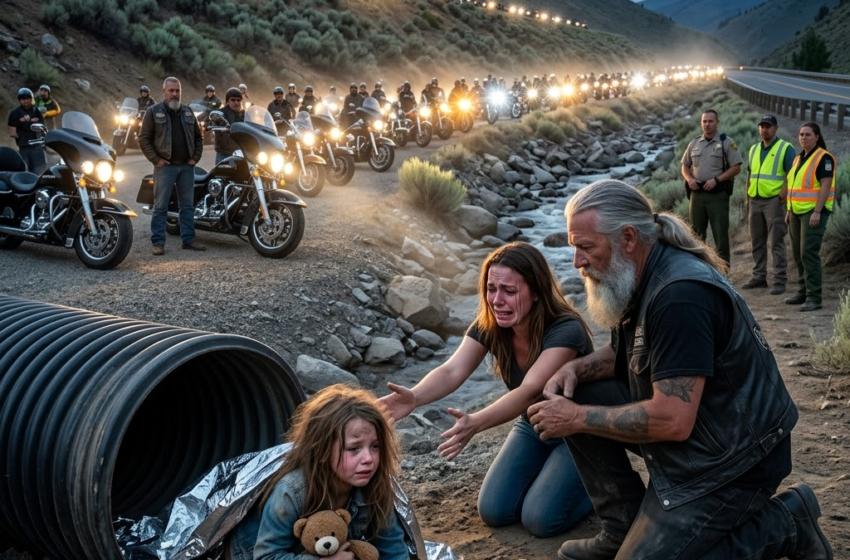
Piper crawled into four hundred beams of light.
Kayla screamed once.
Grabbed her.
Piper disappeared inside her arms.
The sound from the riders was not a cheer.
It was one giant exhale.
Like a storm releasing pressure.
Medics came.
Conrad backed away.
He did not need to be in the center.
Piper had scratches.
Cold hands.
Mild dehydration.
No serious injury.
She refused to let go of Biscuit.
A medic wrapped silver thermal blanket around both.
Kayla kissed her face over and over.
Piper became annoyed.
“Mom.”
“I know.”
“Stop.”
“I can’t.”
“Everybody’s looking.”
Kayla laughed through tears.
“Let them.”
Piper looked uphill.
Four hundred motorcycles.
Four hundred headlights.
Leather silhouettes.
“Who are they?”
Kayla followed her gaze.
She had spent her whole life fearing men who looked like that.
Now her daughter was alive because one of them read a shoeprint she had not even known existed and the others turned themselves into a search grid.
“Friends.”
Piper frowned.
“We know them?”
“Not yet.”
Deputy Styles stood beside his cruiser.
Empty.
Clarence approached.
Thermos under his arm.
Styles stared at the culvert.
“I checked it.”
“I know.”
“I put light straight down.”
“I know.”
“I called her.”
Clarence unscrewed his thermos.
“I did everything right.”
“Yes.”
Styles turned.
“A man I tried to send home found her in nine minutes.”
Clarence poured coffee.
“Son.”
“I’ve been running search radio forty-four years.”
“Lost kids.”
“Dementia.”
Hunters.”
“Bodies too.”
Styles looked down.
Clarence said:
“Nobody ever found anybody with an opinion.”
Styles frowned.
“What?”
“You had an opinion about that vest before the man opened his mouth.”
Styles looked toward Conrad.
Clarence continued.
“A vest tells you who a man rides with.”
“Doesn’t tell you what he carries upstairs.”
“He spent twenty-seven years reading desert sign.”
“You saw leather.”
Styles swallowed.
Clarence looked toward the child.
“Good news is she doesn’t care what lesson you learned.”
“She’s alive.”
“That’s the important part.”
Styles nodded.
Then walked toward Conrad.
Riders watched.
He stopped in front of him.
Conrad had a paper cup of coffee.
Piper and Kayla were near the ambulance.
Styles removed his hat.
“Mr. Fairchild.”
Conrad looked at him.
“I told you to step back.”
“Yes.”
“I was wrong.”
Conrad said nothing.
Styles held out his hand.
“I want you to know I know it.”
Conrad set down the coffee.
Took his hand.
Styles continued.
“Sergeant Tilly’s going to ask.”
“Ask what?”
“How you read those tracks.”
“Whether you’ll teach us.”
Conrad looked toward the slope.
“Maybe.”
“That’s fair.”
A small voice interrupted.
“Mister?”
They turned.
Piper stood behind them.
Blanket slipping.
Biscuit clutched to chest.
Kayla a few steps away.
Conrad lowered himself onto one knee.
Slow.
Nonthreatening.
“Hi.”
Piper stared at his beard.
Then his tattoos.
“Are you a bad guy?”
The entire world seemed to stop again.
Styles looked horrified.
Kayla closed her eyes.
Conrad considered.
“Sometimes I’ve been.”
Piper thought.
“But not tonight?”
“No.”
“Okay.”
She held Biscuit out.
“He wants to say thank you.”
Conrad looked at the bear.
Then took one worn paw between two scarred fingers.
He shook it.
“Tell Biscuit he did good.”
Piper nodded.
“He stayed the whole time.”
Conrad’s voice failed slightly.
“He did.”
Piper hugged the bear again.
Then looked at the line of motorcycles.
“Are those all yours?”
Conrad smiled.
“No.”
“Why’d they turn the lights on?”
“So I could see where you walked.”
Piper looked confused.
“Lights show feet?”
“Sometimes.”
“Can they show Biscuit?”
“Apparently.”
She considered that astonishing.
Then she began crying again.
Quiet.
Exhausted.
Kayla lifted her.
Piper pressed her face into her mother’s neck.
Kayla looked at Conrad.
“I was scared of you.”
Conrad nodded.
“Reasonable.”
“No.”
“You don’t have to make yourself wrong because I helped.”
“I crossed streets.”
“Probably smart sometimes.”
She almost laughed.
“How did you know?”
“Shoes.”
“No.”
“Really.”
“How did you know to look?”
That question was different.
Conrad looked at his hand.
His right hand had stopped trembling.
He noticed.
For the first time in years.
He told her about Arizona.
Not everything.
Enough.
A little girl lost during a border crossing.
Nineteen-hour delay.
Trail.
Heat.
Too late.
Mother.
Hands held without shared language.
Kayla listened.
“I never tracked another kid after that.”
“Why tonight?”
Conrad looked at Piper.
“Because I couldn’t watch good people erase the ground while I knew how to read it.”
Kayla touched his hand.
No words.
The ambulance left at 8:40.
Piper waved through the rear window.
Biscuit waved too.
The riders watched until lights disappeared up the grade.
Stan checked his watch.
“We’re late for Tiny.”
Vic said:
“Tiny would’ve waited.”
At 10:15 that night, four hundred riders stood beside Lake Chelan.
Moon.
Black water.
Cold air.
Tiny Sumner’s ashes rested in a steel box.
Deputy Styles stood at the back.
Off duty.
Hat in hand.
Clarence beside him.
Stan spoke.
Less than one minute.
“Tiny never met a stray he didn’t feed.”
Several people laughed softly.
“He’d have liked tonight.”
Stan opened the box.
Ash lifted into the night air.
Moved over the lake.
Gone.
Styles watched.
He had spent the entire drive thinking about the phrase:
wrong voice.
Sometimes rescue failed not because nobody was trying.
Because help arrived wearing the wrong shape.
That thought followed him home.
At 11:40, he sat at the sheriff’s substation writing his report.
The cursor blinked beside:
PERSONS ASSISTING.
Styles typed:
Conrad Fairchild, retired U.S. Border Patrol.
Then stopped.
Added:
Approximately 400 motorcycle club members provided controlled low-angle illumination at the direction of Mr. Fairchild.
He read the sentence.
Sounded absurd.
True anyway.
Monday morning, Nadine Cooper opened the corner market.
6:00.
Frost on gravel.
Coffee machine gurgling.
Inside a plastic bag on the counter was a crayon drawing Kayla had dropped off Sunday.
Nadine opened it.
Brown bear with one ear.
Little girl.
Long row of yellow circles.
Motorcycles.
At the center:
very tall man.
Gray beard.
Stick hands.
Underneath, in Kayla’s handwriting:
THANK YOU FOR TURNING ON THE LIGHTS.
Nadine taped it by the register.
At 6:17, bell jingled.
A broad man in black leather entered.
She recognized the patch.
Months earlier she might have watched his hands.
Maybe checked where her phone was.
Instead she grabbed a cup.
“Coffee?”
He nodded.
“Black.”
She poured.
“On the house.”
The rider raised an eyebrow.
“Why?”
Nadine looked toward the drawing.
He followed her eyes.
His expression softened.
“Fair enough.”
News spread.
Local paper.
Regional television.
Then national.
Headlines exaggerated.
400 HELL’S ANGELS SAVE LOST GIRL.
Conrad hated it.
“They didn’t find her.”
Stan said:
“We held lights.”
“Exactly.”
“That helped.”
“Headline makes it sound like we stormed the wilderness.”
“You want to call the newspaper?”
“No.”
“Then stop complaining.”
Conrad complained anyway.
Kayla agreed to one interview.
Only because she wanted to correct something.
The reporter asked:
“Did the bikers save Piper?”
Kayla answered:
“A lot of people did.”
Search volunteers.
Deputies.
Clarence.
Nadine.
Truck driver.
Medics.
Riders.
Conrad.
“And Piper.”
The reporter looked surprised.
“What do you mean?”
“She survived because she followed what I taught her.”
Kayla swallowed.
“I taught her badly.”
“I said hide from strangers.”
“I never explained how to know when strangers become helpers.”
That line spread farther than the motorcycle part.
Parents wrote to her.
Teachers.
Search teams.
Experts in child safety.
The county updated public guidance.
If lost:
Stay put if safe.
Make yourself visible.
If uniformed rescuers identify you by name and you can see emergency vehicles, answer.
Teach children a family code word.
Kayla invented theirs.
Blueberry pancakes.
Ridiculous enough Piper would remember.
If a stranger claimed Mom sent them, they had to know the phrase.
Piper loved it.
Deputy Styles changed too.
Quietly.
He invited Conrad to a training session.
Conrad declined.
Styles asked again.
Declined.
Third time, he arrived at the clubhouse with coffee.
Conrad looked at the tray.
“Bribery?”
“Training budget.”
“Government waste.”
“Probably.”
Conrad finally agreed.
First class:
twenty deputies.
Search volunteers.
Conservation officers.
Conrad drew a line in dirt.
“Tracking starts before footprints.”
People frowned.
“What does that mean?”
“People want prints.”
“Prints are easy.”
“Behavior is hard.”
He pointed toward a deputy.
“If your six-year-old is scared of explosions and a car steams, what happens?”
“Runs.”
“Direction?”
“Away.”
“Away from what?”
“Road.”
“Good.”
He pointed at Styles.
“What did you look for first?”
Styles answered honestly.
“Child.”
“Too big.”
Conrad smiled.
“You look for change.”
“Stone overturned.”
“Twig broken.”
“Dust displaced.”
“Grass bent.”
“A question: what happened here that would not have happened if no person passed?”
Students wrote.
Conrad hated that.
“Stop writing.”
They looked up.
“Look.”
He spent six hours teaching.
By the end, Styles could see some tracks he would have ignored before.
Not expert.
Better.
That was enough.
Piper dreamed about the pipe for months.
Sometimes she woke screaming.
Sometimes she woke silently.
Worse.
Kayla found her sitting on the floor with Biscuit.
The first therapist they saw told Kayla to reassure her nothing bad would happen.
Kayla fired that therapist.
Bad things did happen.
Children knew.
The next therapist, Dr. Miriam Lee, was better.
She told Piper:
“You got scared.”
“Yes.”
“You made a plan.”
“I hid.”
“That plan kept you safe until helpers found you.”
Piper frowned.
“But Mom cried.”
“Moms cry.”
“Did I do bad?”
“No.”
“You did what you knew.”
“Now we teach your brain some new things.”
“What things?”
“Like helpers can look scary.”
Piper smiled.
“Conrad looks scary.”
“Does he?”
“He has skulls.”
Dr. Lee nodded seriously.
“Very suspicious.”
Piper laughed.
One month after the rescue, Kayla drove Piper to Gates Avenue.
Not four hundred riders.
Nine bikes.
Saturday morning.
Conrad sat on porch.
Piper held Biscuit.
She stopped at edge of gravel.
Conrad saw fear.
Did not move.
Piper looked at her mother.
“Blueberry pancakes.”
Kayla smiled.
“That’s for strangers claiming to be me.”
“Oh.”
Piper considered.
Then called:
“Conrad!”
He lifted one hand.
She walked forward.
Inside, bikers had prepared something.
Not a party.
Piper hated attention.
A small metal plate.
Engraved:
BISCUIT
HONORARY SWEEP RIDER
STAYED THE WHOLE TIME
Piper read slowly.
Then hugged the bear.
“He gets a patch?”
Stan produced tiny fabric patch.
Winged design modified without club insignia.
Just:
SWEEP.
Piper nearly exploded with happiness.
Kayla cried.
Nobody mentioned it.
Years passed.
The story became town mythology.
People embellished.
Some claimed all 400 riders crawled through desert.
False.
Some said Conrad smelled footprints.
Ridiculous.
Some said bikers ignored police orders and took over.
Opposite.
They followed orders until invited.
Conrad corrected anyone who listened.
Most didn’t.
Stories prefer sharp edges.
Truth has curves.
Bert Fowler, the truck driver who had said “last thing she needs is that crowd,” carried his embarrassment longer than necessary.
Three months later he saw Conrad at the market.
Avoided eye contact.
Conrad noticed.
“Bert.”
The trucker stopped.
“You know my name?”
“Apple truck.”
“Right.”
Silence.
Bert said:
“I said some things.”
“I’ve said things.”
“I judged you.”
“Everybody judges.”
“I was wrong.”
Conrad looked at him.
“You turned around when you saw Piper.”
“What?”
“You were the witness who called.”
“Yeah.”
“You came back.”
Bert shrugged.
“Of course.”
Conrad held out his hand.
“Then maybe we both did one useful thing.”
Bert shook it.
The weight left his face.
Piper started first grade.
Show-and-tell.
Kayla suggested Biscuit.
Piper refused.
Instead she brought a flashlight.
Teacher asked why.
Piper placed it low against floor.
“Light from side shows footprints.”
Class thought this was magical.
For weeks, children shone flashlights across carpet looking for evidence.
Teacher emailed Kayla:
Your daughter may become either a detective or a menace.
Kayla replied:
Probably both.
At eight, Piper learned Conrad had once worn a federal uniform.
She stared.
“You were a cop?”
“Not exactly.”
“Border guy?”
“Yes.”
“Did you arrest people?”
“Yes.”
“Bad people?”
“Sometimes.”
“Good people?”
Conrad looked at her.
“Sometimes.”
That bothered Piper.
“Why?”
“Because laws and people aren’t always simple.”
She frowned.
“Adults say that when they don’t want to explain.”
Conrad laughed.
He explained as best he could.
At ten, Piper asked about the little girl Conrad found too late.
He had never told her.
Kayla had.
Conrad became quiet.
Piper said:
“She’s why you found me.”
“No.”
“Kind of.”
“No.”
“Why not?”
“Because you don’t belong to her.”
Piper stared.
“She didn’t die so I could learn something.”
Conrad’s voice was gentle but firm.
“She deserved her own life.”
“What happened to her was terrible.”
“It didn’t happen for a reason.”
Piper thought.
“Then what do you do with terrible things?”
Conrad looked toward the desert beyond the clubhouse.
“You decide what kind of person they make you next.”
The sentence stayed.
Deputy Styles eventually became sergeant.
On promotion day, someone joked:
“Still taking orders from bikers?”
Styles smiled.
“When they know more than me.”
That answer ended the joke.
He changed search protocols.
Preserve last-known-point sign.
Minimize unnecessary trampling.
Assign perimeter.
Use low-angle illumination when appropriate.
Document child-specific hiding instructions.
Ask parents exactly what the child has been taught.
That last change came directly from Piper.
Because the search had almost failed not because she panicked.
Because she obeyed.
The first time the new protocol mattered, it was a four-year-old boy missing from a campground.
Mother said:
“He hides under things when scared.”
Searchers checked beneath structures first.
Found him under a boat trailer in eleven minutes.
Styles called Conrad.
“Worked.”
Conrad smiled.
“Good.”
No headlines.
Better.
Kayla’s life changed in smaller ways.
She stopped assuming every motorcycle meant danger.
She did not become reckless.
Fear had value.
Conrad himself said so.
But she learned to ask a second question after the first instinct.
What do I actually know?
That question changed more than bikers.
Customers.
Strangers.
People sleeping in cars.
Teenagers with tattoos.
Uniforms.
Men in suits.
She became slower to assign safety based on appearance.
Some dangerous people looked respectable.
Some good people looked frightening.
Most people were mixed.
At twelve, Piper wanted to ride on a motorcycle.
Kayla said no.
Piper asked Conrad.
He said:
“Your mother said no.”
“You’re supposed to be a rebel.”
“I’m sixty-eight.”
“What happened?”
“Back pain.”
At sixteen, Piper asked again.
Kayla allowed it.
Parking lot only.
Full protective gear.
Conrad’s bike.
Piper wore Biscuit’s tiny Sweep patch sewn inside her jacket.
The engine started.
She froze.
Old fear.
Sound.
Vibration.
The truck screaming.
Pipe booming.
Kayla saw her face.
“Stop?”
Piper closed her eyes.
Then opened.
“No.”
Conrad waited.
“Your call.”
Piper nodded.
They moved.
Slow.
One circle.
Two.
When they stopped, Piper laughed.
Not because motorcycles had become harmless.
Because one sound no longer owned all her memories.
At eighteen, she graduated.
Four hundred motorcycles did not arrive.
Thank God.
Twenty did.
Conrad wore a suit jacket over his vest because Kayla insisted.
He looked miserable.
Piper crossed the stage.
Diploma.
Applause.
Styles, now sergeant, sat with the family.
Clarence had died two years earlier at eighty-nine.
His thermos sat on the clubhouse shelf.
Tiny Sumner’s photograph hung nearby.
Life kept moving.
After graduation, Piper told Conrad she wanted to study forensic science.
He said:
“Because of footprints?”
“Because of you.”
He frowned.
“Don’t do that.”
“What?”
“Build your whole life around one night.”
She thought.
“Okay.”
Then smiled.
“Mostly footprints.”
He accepted that.
College was far away.
Before she left, Conrad gave her something.
Small wooden box.
Inside:
steel watch.
The one he wore during search.
She stared.
“No.”
“My hands shake sometimes.”
“I’m not taking your watch.”
“You are.”
“Why?”
“Because clocks matter in searches.”
Piper looked at him.
“That’s a terrible sentimental line.”
“I panicked.”
She hugged him.
Hard.
At twenty-four, Piper returned to Chelan County as a search-and-rescue specialist.
Not full-time law enforcement.
Technical tracking.
GIS.
Forensic scene preservation.
Volunteer coordination.
Modern tools Conrad did not understand.
Drones.
Thermal imaging.
Digital mapping.
She still carried a flashlight.
Used low angles.
Her first major search involved a missing eight-year-old girl.
Night.
Forest.
Everyone looked at Piper.
She felt terror.
What if history repeated?
She heard Conrad in her head:
You don’t belong to the other child.
Different ground.
Different kid.
Piper asked mother:
“What does your daughter do when she’s scared?”
“Hides.”
“Where?”
“Closets.”
“Under beds.”
“Anywhere small.”
Search pattern changed.
They found the girl inside an abandoned culvert.
Piper almost laughed when radio call came.
Not because it was funny.
Because life sometimes rhymed too closely.
She crawled toward the entrance.
Did not yell.
Spoke softly.
“Hi.”
“My name’s Piper.”
“I got lost once too.”
Silence.
Then:
“Really?”
“Yeah.”
“Were you scared?”
“Very.”
“Did people find you?”
“Lots.”
A small face appeared.
Piper cried afterward.
Not during.
Professional first.
Then human.
She called Conrad.
He was eighty.
“What?”
“Found one.”
“Alive?”
“Yes.”
“Good.”
Silence.
Then:
“You okay?”
Piper whispered:
“No.”
“That’s normal.”
“You always say fear is useful.”
“It is.”
“What’s useful about this?”
“Means you care how it ends.”
Conrad died at eighty-three.
Not dramatic.
In sleep.
His club vest hung over a chair.
On the nightstand:
photograph of Piper and Biscuit at the highway pullout years after rescue.
She was six in the picture.
Missing front tooth.
Conrad kneeling.
Bear between them.
At his funeral, hundreds of riders came.
Not exactly four hundred.
Close.
Sergeant Styles spoke.
Kayla spoke.
Piper did not plan to.
Then stood.
She carried Biscuit.
The bear was almost bald.
One ear still missing.
Tiny SWEEP patch faded.
Piper faced the riders.
The sheriff’s department.
Border Patrol retirees.
Search volunteers.
People from town.
Nadine from the market, now in her eighties.
Bert Fowler with gray hair.
Piper said:
“When I was six, Conrad Fairchild found me because he looked down.”
Simple.
Everyone listened.
“A lot of people say four hundred bikers saved me.”
“That isn’t wrong.”
“But it isn’t exactly right.”
“The volunteers were trying.”
“The deputies were trying.”
“My mother was trying.”
“Conrad was trying.”
“The riders gave him light.”
Piper held Biscuit.
“And I was trying too.”
“I was hiding because I thought that was what I was supposed to do.”
She looked at Styles.
“Sometimes everybody can be trying their best and still be missing each other.”
Styles lowered his eyes.
Piper continued.
“That night changed my life because Conrad showed me something bigger than tracking.”
“He showed me that expertise sometimes arrives wearing the wrong clothes.”
“Fear sometimes sounds like good judgment.”
“Authority can be wrong without being evil.”
“And people who frighten you at first glance may be the very people who turn on the lights.”
Several riders cried openly.
Piper smiled.
“Conrad also taught me something he learned the hard way.”
“We don’t turn dead children into lessons.”
“We don’t say terrible things happen for a reason.”
“We just decide what we do next.”
She looked toward Conrad’s casket.
“So this is what I’m doing next.”
“I’m going to keep looking down.”
When the service ended, the riders gathered outside.
At sunset, Styles approached Piper.
Retired now.
Older.
He carried his original incident report.
“Found this.”
She took it.
Paper yellowed.
Persons assisting:
Conrad Fairchild, retired U.S. Border Patrol.
Approximately 400 riders.
Piper smiled.
“You wrote all of them?”
“Seemed accurate.”
She folded it carefully.
Styles looked toward motorcycles.
“I still remember walking to that pipe.”
“Do you?”
“Every night for a while.”
Piper nodded.
“I heard you.”
Styles stared.
“What?”
“I remember the flashlight.”
He swallowed.
“I was right there.”
“I know.”
“I’m sorry.”
Piper touched his arm.
“You were a stranger.”
He laughed painfully.
“Conrad said that.”
“He was right.”
Styles looked at her.
“I should’ve listened sooner.”
“Yes.”
No false comfort.
Piper learned honesty from Conrad too.
Then she added:
“But you listened.”
Styles nodded.
That mattered.
A few months after Conrad’s death, the county dedicated a small tracking training area near the search-and-rescue facility.
Piper fought against naming it after him.
He would have hated that.
Instead they put up one sign.
LOW LIGHT TELLS THE TRUTH.
Beneath:
LOOK BEFORE YOU STEP.
New volunteers trained there.
Deputies.
Firefighters.
Search teams.
Some bikers too.
One young deputy asked Piper:
“Was it really four hundred motorcycles?”
“Yes.”
“All at once?”
“Yes.”
“Why not use portable scene lights?”
Piper laughed.
“We didn’t have four hundred portable scene lights.”
“Did it work exactly like people say?”
“Better.”
She knelt.
Set flashlight low.
A faint boot print appeared.
The deputy’s face changed.
Piper smiled.
“See?”
Years later, the old pullout remained.
The Ranger was long gone.
The original culvert eventually replaced during highway work.
Kayla cried when she heard.
Piper did not.
The pipe had done its job.
It did not need to become a shrine.
Still, one thing remained at the corner market.
The drawing.
Faded.
Crayon yellow headlights.
Brown bear.
Tall man with gray beard.
Nadine had laminated it before retiring.
New owners kept it above the coffee machine.
Customers sometimes asked.
“Who drew that?”
Clerk would say:
“Girl got lost.”
“Bunch of bikers helped find her.”
Story would start.
Usually wrong by third sentence.
That was okay.
Piper knew the true version.
One cold Friday evening in September, a truck overheated.
A mother made a reasonable decision.
A child made another.
A deputy followed training.
Volunteers searched hard.
A group of bikers arrived at exactly the wrong-looking moment.
A tracker saw what others had missed.
An old radio operator recognized skill under leather.
A sergeant chose expertise over pride.
Four hundred riders turned their bikes.
Four hundred engines went quiet.
Four hundred low beams laid sideways across dirt.
And a little girl’s footprints rose out of the ground like handwriting.
The real miracle was not the number of motorcycles.
It was cooperation.
People who distrusted each other doing different pieces correctly.
A mother supplying behavior.
A tracker reading ground.
Riders providing light.
A deputy calling resources.
Medics waiting.
A child staying alive.
Nobody did everything.
Everybody mattered.
That was the part Piper carried into adulthood.
Rescue is rarely one hero.
Usually it is a chain.
And chains fail where pride refuses to connect.
One day, long after Conrad was gone, Piper was teaching a group of high-school students about search science.
A boy in front raised his hand.
“Were you actually the girl?”
“Yes.”
“The six-year-old?”
“I aged.”
Class laughed.
He pointed toward the photograph behind her.
Four hundred headlights on hillside.
“Were you scared of the bikers?”
Piper thought.
“I didn’t really see them until I came out.”
“What did you think?”
“I thought they were very loud.”
More laughter.
“What does it feel like knowing 400 Hell’s Angels came looking for you?”
Piper considered the question.
Then corrected him.
“They didn’t come looking for me.”
The boy frowned.
“They were passing through.”
“They were on their way to a memorial.”
“They stopped.”
“That’s different.”
“Why?”
“Because helping is easier to romanticize if somebody sets out to be a hero.”
She pointed toward the image.
“They didn’t.”
“They had plans.”
“They were grieving their friend.”
“They were late.”
“They had no obligation to me.”
“They stopped anyway.”
The class became quiet.
“That’s more important.”
The boy asked:
“What about Conrad?”
Piper smiled.
“He stopped too.”
“From what?”
“His own fear.”
That was perhaps the truest answer.
Conrad had not been fearless.
He had spent sixteen years refusing to track children because one little girl’s trail ended too late.
On the highway that night, he was afraid before anyone else knew he was.
Afraid of failing again.
Afraid of seeing another tiny footprint disappear.
Afraid of telling another mother no.
Afraid of being nineteen hours late inside his own head even though Piper had only been gone two.
But fear did not stop him from kneeling.
It did not stop him from asking what shoes she wore.
It did not stop him from trusting the ground.
It did not stop him from asking four hundred riders to become light.
That was bravery Piper eventually understood.
Not lack of fear.
Movement with fear sitting beside you.
At the end of every tracking class she taught, Piper gave students the same exercise.
She scattered small marks across dirt.
Boot.
Sneaker.
Dragged branch.
Knee.
Dropped fiber.
Then waited until near sunset.
She asked students what they saw.
Usually not much.
Then she placed the lights low.
The ground transformed.
Every mark gained depth.
Shadows appeared.
Paths became visible.
Students always reacted.
Piper always thought of 7:38 p.m.
Four hundred engines going silent.
Four hundred beams turning on.
Conrad dropping to his knees.
She would tell the class:
“Most evidence doesn’t appear when you add more brightness.”
“It appears when you change the angle.”
Then she would pause.
“People are like that too.”
Students sometimes wrote the sentence down.
Piper pretended not to notice.
At home, Biscuit sat on a shelf in her office.
One ear missing.
Fur worn.
Sweep patch nearly illegible.
Beside him:
Conrad’s steel watch.
Stopped now.
Piper never replaced the battery.
Some objects did not need to function to matter.
On difficult searches, she touched the watch before leaving.
Not superstition.
Memory.
Look before you step.
Ask before you assume.
Listen to parents.
Respect fear.
Preserve sign.
Never promise outcomes you cannot control.
Use every tool.
And never decide what someone knows based on what they wear.
Years after the original rescue, Kayla and Piper returned to the pullout one autumn evening.
No emergency.
No media.
No bikers.
Just mother and daughter.
Kayla was older.
Piper taller.
They stood at edge of slope.
Highway traffic rushed behind them.
Kayla looked toward where the pipe used to be.
“I still hate this place.”
Piper nodded.
“I know.”
“I should never have left you.”
Piper turned.
They had discussed it countless times.
Therapy.
Kitchen.
Cars.
Late nights.
Still guilt returned.
“Mom.”
“I told myself it was safer than walking you beside the road.”
“It was.”
“Then I left.”
“To get help.”
“And you ran.”
“Because I was six.”
Kayla cried.
Piper took her hand.
“You made the best decision you could with what you knew.”
Kayla looked at her.
“That sounds familiar.”
“It should.”
They stood.
Sun lowering.
Shadows lengthening.
Piper looked at the dirt.
Even now, her eyes automatically read ground.
Boot prints.
Tire marks.
Rabbit.
Dog.
Kayla followed her gaze.
“You see anything?”
Piper smiled.
“Always.”
Then headlights appeared over the southern grade.
Motorcycles.
Only three.
Not club colors.
Just riders.
Kayla stiffened for half a second.
Old body memory.
Then relaxed.
The motorcycles passed.
One rider lifted two fingers in greeting.
Piper waved back.
Kayla laughed.
“What?”
“Nothing.”
“Tell me.”
“I used to cross the street.”
“I know.”
“I used to think leather meant danger.”
Piper looked at the disappearing taillights.
“Sometimes it does.”
Kayla nodded.
“Sometimes it doesn’t.”
The sun slipped lower.
Piper pulled a flashlight from her jacket.
Kayla laughed.
“You carry that everywhere?”
“Yes.”
“Conrad ruined you.”
“Enhanced.”
She switched it on.
Held it low.
Sideways.
Tiny marks appeared in dust.
Kayla crouched.
“What am I looking at?”
Piper pointed.
“Deer.”
“That?”
“Dog.”
“That?”
“Your shoe.”
Kayla smiled.
“I can see it.”
“Angle.”
They stayed until dark.
Not because the place needed reclaiming.
Not because trauma had to become beautiful.
Some places simply remained complicated.
That was allowed.
Before leaving, Kayla looked back once.
“Do you ever think about what would’ve happened if the riders hadn’t come?”
Piper did.
Of course she did.
Another hour.
Temperature lower.
Maybe tracking dog eventually arrived.
Maybe someone rechecked pipe.
Maybe not.
The counterfactual had no bottom.
Piper said:
“No.”
Kayla looked surprised.
“Never?”
“I try not to.”
“Why?”
“Because they did.”
That was enough.
The motorcycles came.
Conrad noticed.
Clarence spoke.
Styles listened.
The lights turned on.
Her mother used the right voice.
Piper crawled out.
The story had an ending.
She did not need to punish herself with versions that didn’t.
They walked back to the car.
Behind them, the highway continued through darkness.
No memorial sign marked the slope.
No plaque.
No statue.
Just road.
Wind.
Dirt.
The place where one small girl once disappeared.
And where, for eighteen silent minutes, four hundred people feared by almost everyone on that hill sat motionless on their motorcycles, holding their beams exactly where an old tracker told them to hold them.
They did not shout her name.
They did not storm the brush.
They did not demand credit.
They did not become saints because of one night.
They simply turned on the lights.
That was all.
And sometimes that is what rescue looks like.
Not carrying someone out.
Not fighting danger.
Not even finding the person yourself.
Sometimes your part is smaller.
Hold the light.
Stay quiet.
Trust the person who knows where to look.
Give them enough illumination to read what fear and darkness tried to hide.
Then wait.
On that September night, the town had looked at four hundred black leather vests and seen danger.
Conrad Fairchild looked at four hundred motorcycles and saw something else.
Headlights.
Tools.
Possibility.
He changed the angle.
The ground told the truth.