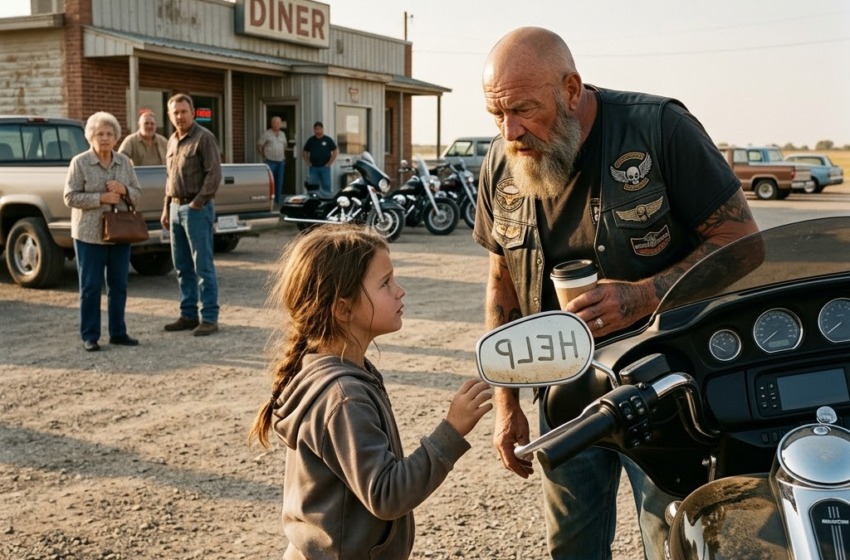
An 8-Year-Old Girl Wrote One Word Backward in the Dust on a Hells Angel’s Motorcycle Mirror—Everyone Thought the Giant Biker Was Threatening Her. But When He Read Her Secret Message, His Eyes Filled With Tears… and What He Did Next Changed Her Life Forever.
For three years, eight-year-old Clara Whitlock had convinced teachers she was stubborn, lazy, and sometimes defiant because admitting the truth—that letters seemed to turn themselves around every time she tried to read—felt worse than being punished.
Then one Friday afternoon she walked up to the biggest, most intimidating biker outside a roadside diner and wrote the only word she trusted herself to spell in the dust covering his motorcycle mirror, every letter facing backward.
Everyone who saw him bend over the frightened little girl assumed he was the danger, but Lowell Prather read her four crooked letters instantly—because fifty-seven years earlier, another terrified child had written the world exactly the same way.
The dust was the color of Oklahoma in October.
Tan.
Fine.
Dry enough to cling to chrome.
For a week, farmers around Enid had been drilling winter wheat, and every county road seemed to throw another thin layer of dirt into the air.
Cars wore it.
Mailboxes wore it.
The motorcycles parked outside the Wheatland Diner wore more than anything else.
There were twelve of them that Friday afternoon.
Big touring bikes.
Old Harleys.
Chrome handlebars.
Black leather saddlebags.
Engines still ticking as they cooled after forty miles of gravel roads.
Clara Whitlock stood beside the last motorcycle in the row and stared at its left mirror.
She had been staring for nearly six minutes.
Long enough for a fly to land on her arm.
Long enough for a pickup truck to leave the diner lot.
Long enough for the courage she had built on the walk from school to disappear twice and come back once.
She was eight years old.
Small for her age.
Brown braid beginning to unravel near her shoulder.
Pink backpack.
One shoelace untied.
And a habit of keeping her chin lowered whenever adults spoke to her, as though the floor might contain the answer to whatever question came next.
The motorcycle belonged to the largest man Clara had ever seen.
She knew because she had been watching him every Friday for nearly a month.
He always arrived sometime after three.
Always took the last stool at the diner counter.
Always ordered coffee and one slice of pecan pie.
Always unfolded a newspaper.
And always did something Clara had never seen another adult do.
He put his finger beneath the words.
Not occasionally.
Every line.
Every word.
A thick scarred finger moving slowly beneath black print.
Sometimes his lips moved too.
Sometimes he stopped.
Went back.
Tried again.
Nobody laughed.
That was the part Clara could not stop thinking about.
At school, if she moved her finger beneath the words, someone noticed.
If she read slowly, someone sighed.
If she guessed wrong, children giggled.
If she refused to read at all, the teacher wrote things.
Reluctant.
Uncooperative.
Defiant.
Defiant was the newest one.
PART2:
Clara had heard her mother read it at the kitchen table Wednesday night.
“She’s becoming increasingly defiant when asked to participate in reading activities.”
Marnie Whitlock had read the sentence twice.
Then pressed one hand against her forehead.
“Clara, why?”
Clara had been sitting across from her with a worksheet face down.
“I don’t know.”
“You do know.”
Silence.
“Are the kids bothering you?”
“No.”
“Is your teacher mean?”
“No.”
“Are you bored?”
“No.”
“Then why won’t you read?”
Because the letters move.
Because sometimes b becomes d.
Because sometimes p becomes q.
Because “was” becomes “saw” before I know what happened.
Because when everybody else reads a sentence, the words stay where they were put.
Mine don’t.
Because I think maybe something is wrong with my brain.
Because if I tell you, you might look at me the same way the teacher does.
Because I hear how tired you are when you think I’m asleep.
Because Dad left before I remember him and you already work two jobs and I don’t want to become one more broken thing you have to fix.
Clara said none of that.
She only whispered:
“My stomach hurts.”
PART3:
Marnie closed her eyes.
“Again?”
Clara nodded.
That ended the conversation.
Stomachaches had saved her for almost two years.
Headaches too.
Bathroom emergencies.
Broken pencils.
Anything to avoid reading out loud.
Anything to keep the secret alive one more day.
But secrets become heavier as children grow.
By third grade, Clara could not hide this one much longer.
Monday morning at 8:15, her mother had a meeting with Principal Bauer.
Clara had heard them talking through the kitchen wall.
“Next steps.”
That phrase frightened her.
Adults used phrases like next steps when the steps had already been chosen.
Maybe another year in third grade.
Maybe a special class.
Maybe everybody finally finding out.
She knew enough words to understand humiliation even if she could not spell it.
So that Friday afternoon, instead of entering the Wheatland Diner and sitting in the rear booth where Marnie made her do homework until her shift ended, Clara stayed outside.
She stood beside the black Road King.
And stared at the mirror.
Dust covered almost all of it.
A perfect writing surface.
She lifted one finger.
Stopped.
Inside the diner, she could see the biker through the window.
Bald.
Gray-brown beard to the middle of his chest.
Black leather vest.
Tattooed arms.
A huge winged skull across his back.
The waitresses moved quickly around him.
Customers gave his group space.
Clara was afraid of him.
Of course she was.
But she had noticed something everybody else seemed to miss.
He struggled with words.
And he did not hide it.
That mattered more.
Clara touched the mirror.
The dust felt soft beneath her fingertip.
She began at the right-hand side.
The way she always wanted to.
First letter.
Then another.
Then another.
Then the last.
Four letters.
She stared.
To anyone else, they were backward.
To her, they looked more natural this way.
H.
E.
L.
P.
Except each one faced the wrong direction.
She had practiced this word.
Not on paper.
Paper could be found.
She practiced it in air.
On blankets.
Against her pillow with one finger while pretending to sleep.
HELP.
The word had become less a word than a shape.
A private prayer.
She finished the final letter.
Then heard boots.
Heavy.
Slow.
Gravel crunching.
Clara turned.
Lowell Prather stood six feet away.
Coffee in one hand.
Folded newspaper under the other arm.
He looked even larger outdoors.
More than six feet.
Broad shoulders.
Scarred knuckles.
Tattooed arms.
Black vest.
Sun behind him.
His eyes dropped to the mirror.
Then to Clara.
His eyebrows drew together.
Clara stopped breathing.
She had touched his motorcycle.
Everybody knew adults became furious when children touched expensive things.
She tried to apologize.
Nothing came out.
Her finger remained lifted.
Dust still clung beneath the nail.
Lowell stepped closer.
Clara backed against the neighboring motorcycle.
He did not reach for her.
He bent toward the mirror.
His beard appeared in the glass beside the word.
He read it.
Less than a second.
That was all.
Something changed in his face.
The hard expression disappeared.
His mouth opened slightly.
Then his eyes filled.
He looked at Clara.
Not angry.
Not confused.
Something worse.
He understood.
“How long?”
His voice was low.
Rough.
Clara stared.
Lowell crouched.
“How long have you been carrying this by yourself?”
Nobody had ever asked her that.
Not:
Why won’t you try?
Not:
What is wrong with your behavior?
Not:
Why are you being difficult?
How long?
Clara’s mouth opened.
Before she could answer, a woman shouted across the parking lot.
“Hey!”
Lowell’s head turned.
“HEY!”
Bev Tolliver, sixty-eight, carrying a grocery sack, stood near the curb.
“You get away from that little girl!”
A man beside a pickup stopped.
Another diner customer came outside.
Someone pulled out a phone.
Lowell looked around.
Then at Clara.
She saw his face harden again.
Not toward her.
Toward something familiar.
Judgment.
The thing that arrives before explanation.
He straightened slowly.
Behind him, several bikers came through the diner doors.
One at a time.
Dwight Roark first.
White mustache.
Thick shoulders.
Then five more.
Then all twelve.
“What’s going on?”
Dwight asked.
Lowell did not turn.
“Nothing.”
Bev pointed.
“I saw him corner that girl.”
“I didn’t corner anybody.”
“She looked terrified.”
Clara wanted to speak.
Couldn’t.
Lowell noticed.
“Everybody back inside.”
Dwight frowned.
“Lowell—”
“Back inside.”
Lowell’s voice did not rise.
It did not need to.
Then somebody shouted:
“Police are coming.”
A siren sounded in the distance.
Clara’s stomach dropped.
This was her fault.
Everything became her fault eventually.
Lowell looked at the dusty mirror.
Then, unexpectedly, raised one large hand.
He wiped the word away.
One slow swipe.
HELP disappeared.
Clara stared.
Why?
She had finally written it.
The siren grew louder.
Lowell looked at her.
“Was that word for everybody?”
Clara shook her head.
“No.”
“Okay.”
He nodded.
“Then nobody else gets it unless you say.”
That was the second thing nobody had ever done.
Let her own the secret.
Deputy Neil Garrity pulled into the parking lot at 3:41.
He was thirty-four.
Tall.
Crew cut.
Square jaw.
The kind of officer who looked as though his uniform had been ironed while he was still wearing it.
He stepped out already watching Lowell.
The call had been simple.
Large motorcycle gang.
Child.
Possible intimidation.
Possible assault.
Lowell fit the picture perfectly.
Huge biker.
Ink.
Leather.
Child pressed beside motorcycles.
Crowd watching.
Garrity’s hand rested near his belt.
“Sir.”
Lowell turned.
“I need you to step away from the girl.”
“Yes, sir.”
“Slowly.”
Lowell lifted both hands.
Stepped aside.
“I’m not armed.”
Garrity’s eyes moved over the biker group.
“Everyone else stays where they are.”
Lowell said:
“Dwight.”
“Yeah.”
“Tell everybody to sit down and shut up.”
Dwight glared at Garrity.
Then Lowell.
Finally:
“You heard him.”
The bikers backed toward the diner.
That mattered to Garrity.
He noticed.
He also noticed the mirror.
Dust everywhere except one broad clean smear.
“Did you wipe something off that mirror?”
“Yes, sir.”
“What?”
Lowell looked toward Clara.
She stood with both hands beneath her arms.
Tiny.
White-faced.
He looked back at Garrity.
“I’m not telling you.”
Wrong answer.
Garrity’s expression hardened.
“Mr.—”
“Prather.”
“Mr. Prather, I have witnesses saying you were intimidating a child, and you destroyed something immediately before I arrived.”
“It wasn’t evidence.”
“You don’t decide that.”
“No, sir.”
“What was it?”
Lowell looked at Clara again.
“It belonged to her.”
Garrity frowned.
“What did?”
“Something she wrote.”
“And you wiped it away?”
“Yes.”
“Why?”
“So nobody else could read it.”
That sounded terrible.
Even Lowell knew.
Garrity stepped closer.
“What did she write?”
Lowell’s jaw tightened.
“I’m not going to tell you without her permission.”
“Mr. Prather—”
“He didn’t do anything.”
The voice was so small Garrity almost missed it.
Everyone turned.
Clara had spoken.
She looked at the deputy.
“I wrote it.”
Garrity softened slightly.
“What did you write?”
Clara looked at Lowell.
Lowell did nothing.
No nod.
No signal.
No pressure.
He waited.
Clara whispered:
“I don’t want everybody to know.”
That changed Garrity.
Not completely.
But enough.
“Okay.”
He lowered his voice.
“Did this man touch you?”
“No.”
“Threaten you?”
“No.”
“Ask you to come over here?”
“No.”
“Did anybody here hurt you?”
“No.”
Then the diner door flew open.
“CLARA!”
Marnie Whitlock came running.
Thirty-one.
Waitress apron.
Coffee stain across the front.
She still carried a glass coffee pot.
She dropped to her knees.
Pulled Clara against her.
“Oh my God.”
Clara wrapped both arms around her neck.
“Are you hurt?”
“No.”
“Did somebody touch you?”
“No.”
“Why is there a police car?”
“I’m sorry.”
“For what?”
“I wrote something.”
Marnie looked around.
“What?”
Lowell spoke.
“Ma’am.”
Marnie pulled Clara closer.
Lowell stopped immediately.
“I’m not going near her.”
He looked at Garrity.
Then Marnie.
“She wrote something on my mirror.”
“What?”
Lowell looked at Clara.
“I’ll tell your mother if you want me to.”
Clara stared at him.
Then nodded.
Lowell crouched.
Not close.
Just lower.
So he would not tower over them.
He spoke quietly.
“She wrote help.”
Marnie froze.
“What?”
“One word.”
Lowell swallowed.
“Help.”
Clara buried her face against her mother.
Marnie looked down.
“Why?”
Lowell continued.
“There’s something else.”
“What?”
“She wrote it backward.”
Garrity frowned.
“Backward?”
“Started on the right.”
Lowell moved one finger in the air.
“Every letter reversed.”
Marnie’s face changed.
“How did you read that?”
Garrity asked.
Lowell answered immediately.
“Because I’ve seen it before.”
“Where?”
Lowell looked at Clara.
Then down at his own hands.
“From the inside.”
Marnie stared.
“What does that mean?”
Lowell rubbed one thumb across the knuckle of his other hand.
“There was a boy fifty-seven years ago who wrote the same way.”
Clara slowly lifted her head.
“Who?”
Lowell smiled sadly.
“Me.”
No one spoke.
The parking lot seemed suddenly enormous.
Wind moved dust along the pavement.
Garrity lowered his notebook.
Marnie’s coffee pot slipped from her fingers.
It hit gravel.
Cracked.
She barely noticed.
Lowell said:
“I’m not a doctor.”
“Then what are you saying?”
Marnie asked.
“I’m saying I know what it feels like when the letters don’t stay put.”
Marnie stared at Clara.
“No.”
Not denial.
Shock.
“I ask her.”
She started crying.
“I ask her all the time.”
Clara clung tighter.
“Mama.”
“Why didn’t you tell me?”
“I don’t know.”
“Baby.”
“I thought you’d be mad.”
Marnie’s face broke.
“Mad?”
Clara nodded.
“Because I can’t do it.”
“Oh, sweetheart.”
“I try.”
“I know.”
“No.”
Clara began crying now.
“I really try.”
Every adult in the parking lot went silent.
“I look at it and I know it and then it changes.”
She held both hands against her temples.
“The letters turn around.”
Marnie pulled her close.
“I thought you didn’t want to read.”
“I do.”
“I thought—”
“I want to.”
That sentence destroyed her mother.
Marnie held the child as though she could physically undo three years.
Lowell looked away.
Garrity watched him.
“You knew from one word?”
“Enough to ask.”
“How?”
“Because she made the same mistakes I made.”
“What do you have?”
Lowell smiled without humor.
“When I was eight?”
He looked toward the diner.
“According to my teacher, stupidity.”
Clara stared.
Lowell continued.
“Today they’d probably call it dyslexia.”
Marnie wiped her face.
“Nobody has ever evaluated her.”
Lowell looked at her.
“Then somebody should.”
“Monday they want to discuss holding her back.”
“Why?”
“They say she refuses to participate.”
Lowell’s expression hardened.
“She’s scared.”
“I know that now.”
Marnie spoke rapidly.
“She freezes.”
“She says her stomach hurts.”
“She won’t raise her hand.”
“They keep telling me behavior.”
“I work two jobs.”
“I keep asking people what I’m supposed to do and everybody talks like I’m not doing enough.”
Lowell listened.
All of it.
No interruption.
Then:
“Come to my shop tomorrow.”
Marnie stopped.
“What?”
“My shop.”
“Why?”
“I want Clara to see something.”
He gave her an address.
1112 East Cherokee.
Marnie looked suspicious immediately.
Reasonable.
“You want me to bring my daughter to a stranger’s shop?”
Lowell nodded.
“That sounds bad when you say it correctly.”
Garrity almost smiled.
Marnie did not.
Lowell pointed toward the deputy.
“He can come too.”
Garrity raised an eyebrow.
“Can I?”
“I’d prefer it.”
“Why?”
“Because I know exactly what I look like.”
That silenced everyone.
Lowell looked at Marnie.
“Bring Clara at nine.”
“What’s there?”
He smiled.
“A room where every letter is backward.”
At 8:52 Saturday morning, Marnie parked outside Prather Press.
She did not turn off the engine.
Clara sat beside her.
Across the street, Deputy Garrity’s cruiser waited.
Engine off.
Window down.
Coffee steaming on the dashboard.
“Mama.”
“I see him.”
“He’s watching.”
“That’s why we’re going in.”
The shop sat behind a small white house.
Cinder block.
Faded hand-painted sign.
PRATHER PRESS.
The door stood open.
Marnie stepped out.
Clara followed.
Inside smelled like oil.
Paper.
Metal.
Ink.
The building looked ancient.
A giant black press dominated the center.
Wooden cabinets lined one wall.
Hundreds of shallow drawers.
Lowell stood near a workbench.
No vest.
No biker patches.
Gray work shirt.
Canvas apron.
Reading glasses pushed onto his bald head.
Without leather, he looked less frightening.
Not small.
Never small.
Just human.
“Morning.”
Marnie nodded.
“Morning.”
Garrity appeared behind them.
“Hope you don’t mind.”
Lowell smiled.
“I’d have been disappointed if you didn’t.”
He looked at Clara.
“Come here.”
Clara hesitated.
Marnie squeezed her hand.
They approached a long wooden table.
Lowell pulled open a drawer.
Inside were hundreds of small gray metal pieces.
Clara leaned closer.
Then stopped.
Her eyes widened.
“They’re wrong.”
Lowell smiled.
“What?”
“The letters.”
She pointed.
“They’re backward.”
Every metal letter faced opposite.
A reversed alphabet.
Clara looked up.
“Why?”
“Because that’s how printing works.”
She frowned.
Lowell picked up a piece of metal.
“This is an A.”
“It’s backward.”
“On the metal.”
He handed it to her.
“When I ink it and press it onto paper, what happens?”
Clara thought.
“It flips.”
“Exactly.”
He pointed to the trays.
“Every letter in this room is backward.”
Clara stared.
Hundreds.
Thousands.
An entire world arranged the way her brain wanted.
“So…”
Her voice became small.
“Backward isn’t always wrong?”
Marnie covered her mouth.
Lowell shook his head.
“No.”
“Then why does everybody say it is?”
“Because they’re trying to read paper.”
He smiled.
“And this is a print shop.”
Clara touched the metal A.
Lowell continued.
“Sometimes being different means you’re doing the wrong thing.”
He paused.
“Sometimes it means everybody else is holding the page the other way.”
Clara looked at him.
Something opened.
Not confidence yet.
Permission.
Lowell pulled out a composing stick.
“Want to print your name?”
Clara nodded.
He showed her the letter compartments.
C.
L.
A.
R.
A.
She found each.
Set them into the stick.
Backwards.
She kept waiting for correction.
None came.
Lowell tightened the type.
Locked it.
Rolled black ink across the surface.
Placed a cream card on the platen.
“Pull.”
Clara grabbed the handle.
The press moved.
Thump.
Lowell removed the card.
Turned it around.
CLARA.
Perfect.
Black.
Straight.
Readable.
Clara stared.
Then laughed.
One burst.
Disbelieving.
She looked at Marnie.
“Mama!”
Marnie was crying.
“My name.”
“I see.”
“I made it backward.”
“I know.”
“And it came out right.”
Marnie nodded.
Clara held the card against her chest.
Garrity stood in the doorway pretending to study the press.
Lowell looked at him.
“You crying, Deputy?”
“No.”
“Good.”
“Allergies.”
“In October?”
“Serious condition.”
Lowell grinned.
That morning Clara printed five words.
CLARA.
MOM.
CAT.
HOME.
HELP.
The last one changed the room.
She arranged the metal letters carefully.
Backward.
Then printed.
HELP appeared perfectly.
Clara touched the card.
“That’s what I wrote.”
“Yes.”
Lowell sat beside her.
“Want to know something?”
She nodded.
“When I was your age, I couldn’t read much either.”
“You can read.”
“Now.”
“You read the newspaper.”
“Slow.”
“But you do it.”
“Yes.”
“Did school help?”
Lowell looked at his scarred hands.
“No.”
He told her.
Second grade.
Garfield County.
Teacher with a wooden ruler.
He confused b and d.
Was and saw.
On and no.
Teacher hit his knuckles.
“Slow.”
That became his word.
Not dyslexic.
Not differently wired.
Slow.
By fourteen, Lowell sat in the back row.
Stopped raising his hand.
Stopped caring whether teachers believed he cared.
Then Hollis Crandall, an old printer on West Maple, hired him to sweep floors.
One afternoon Hollis dropped a tray of type.
Metal letters scattered.
Lowell crouched.
Started sorting.
Fast.
Backward letters meant nothing unusual to him.
He could read them instantly.
Hollis watched.
Then said:
“Son, you’re not slow.”
Lowell looked at Clara.
“He told me I was a compositor.”
“What’s that?”
“Person who sets type.”
“Oh.”
Clara smiled.
“So you got a job because you read wrong.”
Lowell laughed.
“That’s one way to say it.”
Marnie smiled too.
But Lowell became serious.
“I left school at sixteen.”
“Why?”
“I hated it.”
“Did you get in trouble?”
“Constantly.”
Clara looked impressed.
Lowell continued.
“I learned the printing trade.”
“Joined the Navy later.”
“Read plates.”
“Maps.”
“Coordinates.”
“Anything printed backward before it went onto paper.”
He tapped the workbench.
“The thing everybody told me was broken became useful.”
Clara stared.
“But I still had to learn to read forward.”
“When?”
“Forty-one.”
Her eyes widened.
“You were old.”
Marnie laughed through tears.
Lowell glared.
“Thank you.”
“Who taught you?”
“A woman named Agnes Pettibone.”
“Teacher?”
“Best one I ever met.”
“Did she hit you?”
“No.”
“Did she call you slow?”
“No.”
“What did she say?”
Lowell’s face softened.
“She said nobody had ever taught me properly.”
Clara stared at him.
Then whispered:
“Maybe nobody taught me properly.”
Marnie turned away to cry again.
Sunday evening, Marnie called Lowell.
Her voice sounded defeated.
“Mr. Bauer contacted me.”
Lowell sat alone inside the dark print shop.
“What did he want?”
“Monday’s meeting.”
“And?”
“He heard about Friday.”
Lowell smiled bitterly.
“Course he did.”
“He wants it to stay a family meeting.”
“No outsiders.”
Lowell leaned back.
“That probably means me.”
“I’m sorry.”
“Don’t apologize.”
“I wanted you there.”
“But?”
Marnie hesitated.
“If you walk in wearing that vest…”
She stopped.
Lowell waited.
“He’ll stop hearing me.”
No insult.
Just truth.
Lowell had lived with it for sixty-four years.
People saw the body.
Ink.
Beard.
Motorcycle.
Then filtered everything else through fear.
“You’re right.”
Marnie went quiet.
“I am?”
“Yes.”
“I hate that.”
“So do I.”
“I don’t know what to do.”
Lowell looked around the shop.
Backward letters everywhere.
“I might.”
After they hung up, he sat for twenty minutes.
Then called a number he had not used in five years.
A woman answered.
“Agnes Pettibone.”
“Miss Pettibone?”
Silence.
“Lowell?”
“Yes, ma’am.”
“You have a hundred miles of nerve calling me after five years.”
“I know.”
“You dead?”
“No.”
“Then what?”
He told her.
Everything.
Clara.
Mirror.
Backward HELP.
School.
Monday meeting.
When he finished, Agnes remained silent so long he checked the phone.
“Ma’am?”
“I’m thinking.”
“Dangerous.”
“Still rude.”
“Yes, ma’am.”
Agnes sighed.
“Do you remember what I told you when you were forty-one and too proud to point under words?”
“Yes.”
“What?”
“That nothing was wrong with me except nobody had taught me right.”
“Close enough.”
She paused.
“Bring me.”
“What?”
“Monday.”
“You’re seventy-nine.”
“I’m aware.”
“It’s two hours.”
“I know geography, Lowell.”
He smiled.
“Bring Clara’s papers.”
“Okay.”
“Bring your old type.”
“Why?”
“Because principals love documents more than children.”
Lowell laughed.
“And wear a clean shirt.”
Monday.
8:15 a.m.
Prairie View Elementary conference room.
Principal Stanley Bauer sat at the head of the table.
Fifty-two.
Careful haircut.
Careful tie.
Careful folder.
Beside him sat Clara’s teacher, Paige Hendry.
Twenty-nine.
Nervous.
Then Norma Whitcomb from district special services.
Reading glasses on a chain.
Legal pad.
Marnie arrived holding Clara’s hand.
Behind them walked Agnes Pettibone.
Silver hair.
Navy cardigan.
Cane.
Then Lowell.
Pressed gray shirt.
No vest.
Flat cardboard box beneath one arm.
Bauer stood.
“Ms. Whitlock.”
His eyes went immediately to Lowell.
“I thought we agreed this would remain a family conversation.”
Marnie’s hand trembled.
But she had prepared.
“I’m allowed to bring people with knowledge or expertise regarding my child.”
Bauer frowned.
“This gentleman has expertise?”
Lowell sat.
“I read what Clara wrote.”
“You’re the man from the diner.”
“Yes.”
“The motorcycle incident.”
“Yes.”
Bauer’s mouth tightened.
Agnes sat.
“I’m Agnes Pettibone.”
Bauer looked at her.
Something flickered.
“Mrs. Pettibone?”
“Stanley.”
His ears turned red.
“You remember me?”
“I taught sixth grade forty-one years.”
She placed her cane against the chair.
“I remember everybody who cried during fractions.”
Paige Hendry looked down to hide a smile.
The meeting began.
Clara read below grade level.
Refused oral reading.
Failed spelling.
Avoided assignments.
Shut down when called upon.
Marnie listened.
Every description sounded like behavior.
Almost none sounded like fear.
Paige slid worksheets across the table.
Lowell reached.
“May I?”
Bauer hesitated.
Then nodded.
Lowell did not rotate the paper toward himself.
He read it upside down from across the table.
Fast.
His finger moved through errors.
“September twenty-fifth.”
“Twenty-two wrong.”
He pointed.
“Nineteen follow four patterns.”
B for d.
P for q.
Was for saw.
On for no.
Another worksheet.
Same thing.
Another.
Same.
Lowell looked at Paige.
“This isn’t random.”
Paige stared.
“I thought she was guessing.”
“No.”
He turned the page.
“If she was guessing, mistakes would change.”
He tapped the pattern.
“She’s consistent.”
Norma stopped writing.
Lowell continued.
“She is reading something.”
“Just not what you’re seeing.”
Bauer folded his hands.
“Mr. Prather, with respect, you are not a licensed educator.”
“No, sir.”
“What exactly are your qualifications?”
“Printer.”
Bauer blinked.
“A printer.”
“Thirty-one years at Crandall Printing.”
“Twelve years shop foreman.”
“Before that, United States Navy lithographer.”
Bauer looked surprised.
Lowell opened the cardboard box.
Removed an old blue document.
“My shop typeset district forms before you went digital.”
He unfolded it.
“1998 procedural safeguards.”
Norma leaned forward.
Lowell pointed.
“Second paragraph.”
“A parent may request an evaluation for suspected disability in writing at any time.”
He looked at Marnie.
“Did anybody show you this?”
Marnie shook her head.
“No.”
Lowell looked at Bauer.
“Has Clara ever been evaluated for dyslexia?”
Silence.
Paige’s expression changed.
Norma looked down.
Bauer said:
“She has had classroom interventions.”
“That wasn’t my question.”
Agnes spoke.
Softly.
“Answer him.”
Bauer looked toward Norma.
She shook her head.
“No formal evaluation.”
Marnie inhaled sharply.
“So for three years everybody told me behavior.”
Norma started:
“Ms. Whitlock—”
“Three years.”
Marnie’s voice rose.
“My kid comes home sick over reading.”
“She cries.”
“She hides homework.”
“She tells me she’s stupid.”
“And nobody tested her?”
Paige looked devastated.
“I didn’t know she said that.”
“She doesn’t say things.”
Marnie’s eyes filled.
“That’s the problem.”
Lowell looked at Clara.
She sat very still.
He said:
“I need you folks to understand something.”
Everyone looked.
“When I was seven, a teacher called me slow.”
He rubbed one knuckle.
“Hit me with a ruler when I reversed letters.”
“I stopped trying before anybody figured out I wasn’t stupid.”
He paused.
“At fourteen, somebody finally noticed I could read type backward faster than adults who’d worked in printing for years.”
Bauer said nothing.
Lowell continued.
“In 1986, I was a Navy lithographer aboard the USS Coral Sea.”
Clara’s eyes widened.
“Navy?”
Lowell smiled.
“Yes.”
Then back to the adults.
“The night before an operation in the Mediterranean, I was proofing printing plates.”
“Maps.”
“Frequency sheets.”
“Target coordinates.”
He folded his hands.
“One coordinate had two digits transposed.”
Nobody moved.
“I caught it because I read backward easily.”
“Because the way my brain handles symbols—the thing school had called slow—made the error jump off the plate.”
The room became very quiet.
“One pair of digits.”
He paused.
“One mistake like that can put people somewhere they should never be.”
Bauer looked at him differently now.
Lowell saw it.
He did not enjoy it.
“I’m telling you that because I know what you see when you look at me.”
“Biker.”
“Printer.”
“Not educator.”
“All true.”
He pointed toward Clara’s worksheets.
“But I also know what it is to spend childhood thinking your brain is defective because nobody gave you the right tool.”
He looked at Paige.
“This girl cares.”
Paige’s eyes filled.
“She cares so much she’s terrified.”
The teacher covered her mouth.
Lowell’s voice softened.
“She spent three years hiding because being called difficult hurt less than trying in public and failing again.”
Marnie reached for Clara’s hand.
Clara let her.
Lowell continued.
“Friday she found one person she thought might understand.”
“She wrote one word.”
“HELP.”
Clara looked down.
“And the reason I could read it when nobody else could…”
He tapped his temple.
“…is because mine used to look exactly the same.”
Marnie opened her purse.
Took out a pen.
Her hand shook.
She pulled a sheet of paper toward herself.
Wrote the date.
Then:
I am requesting a full evaluation of my daughter, Clara Jean Whitlock, for a suspected specific learning disability in reading, including dyslexia.
She signed.
Slid it toward Norma.
Norma read it.
Wrote the time.
“Received.”
8:41 a.m.
Bauer sat silently.
Then looked at Lowell.
“I think I misunderstood what you were.”
Lowell gave a small smile.
“There usually is a misunderstanding.”
Clara raised her hand.
Everyone stopped.
She had never raised her hand in a school meeting.
“Mama?”
“Yes?”
“Can I show them?”
Lowell opened the box.
Inside was a cream-colored card.
One word printed in black.
HELP.
He placed it before Clara.
She traced the first letter.
Her lips moved.
“H…”
Nobody rushed.
Nobody finished for her.
“Help.”
Barely audible.
Then again.
“Help.”
Louder.
She looked at Paige.
“That’s what I wrote.”
Paige’s face crumpled.
“I thought you were ignoring me.”
Clara shook her head.
“I was scared.”
“I thought you didn’t care.”
“I cared.”
Lowell said quietly:
“She cared enough it was hurting her.”
Paige started crying.
“I’m sorry.”
Clara did not answer.
Adults often want children to forgive immediately because adult guilt is uncomfortable.
Agnes understood that.
She tapped her cane.
“Paige.”
The teacher looked.
“Apologize.”
“I did.”
“No.”
Agnes said.
“Apologize without asking the child to rescue you afterward.”
Paige swallowed.
Then looked directly at Clara.
“I was wrong.”
No excuses.
“I called you things you weren’t.”
Clara listened.
“I’m sorry.”
Clara nodded.
That was enough for now.
Bauer stood.
Walked around the table.
Pulled out an empty chair beside Clara.
Sat so his eyes were level with hers.
He took the HELP card.
Held it carefully.
Then said:
“I owe you an apology too.”
Clara stared.
“I saw what you weren’t doing.”
He swallowed.
“I didn’t ask enough about why.”
Agnes smiled slightly.
Then looked at Bauer.
“Stanley?”
“Yes, Mrs. Pettibone?”
“Do you remember sixth-grade long division?”
His ears went red again.
“Yes.”
“You cried.”
“I remember.”
“You thought you were stupid.”
Bauer looked down.
“I did.”
“You weren’t.”
“No.”
Agnes pointed her cane toward Clara.
“Remember that feeling before you label another quiet child.”
She looked at Lowell.
Then Bauer.
“The loudest-looking thing in a room is rarely automatically the dangerous thing.”
Her eyes returned to Clara.
“And the quietest child is rarely automatically lazy.”
She leaned back.
“Look twice.”
Bauer turned toward Norma.
“Pull the retention recommendation.”
Norma nodded.
“All of it?”
“All.”
“And behavior contract?”
“Gone.”
He looked at Marnie.
“We evaluate first.”
Thirty-one days later, Clara returned to the same conference room.
This time Lowell was invited.
So was Agnes.
A school psychologist sat with them.
Speech-language specialist.
Norma.
Paige.
Bauer.
The psychologist had tested Clara over four sessions.
Phonological processing.
Rapid naming.
Decoding.
Working memory.
Vocabulary.
Listening comprehension.
The final results were clear.
“Dyslexia.”
Marnie covered her mouth.
The psychologist continued.
“Moderate to severe.”
Clara looked frightened.
“What does severe mean?”
“Harder.”
She nodded slowly.
“Does it mean stupid?”
Every adult in the room seemed to stop breathing.
The psychologist leaned closer.
“No.”
“Not even a little?”
“Not even a little.”
Clara watched him.
“Your reasoning scores are above average.”
“Your listening comprehension is excellent.”
“You understand stories very well when decoding print is removed from the task.”
Marnie began crying.
“It has a name.”
No one spoke.
“All this time…”
She pressed both hands over her face.
“It has a name.”
Agnes touched her shoulder.
“And a plan.”
Marnie looked up.
“This isn’t a sentence.”
Agnes smiled.
“It’s a map.”
Clara asked:
“Does it go away?”
Agnes answered.
“No.”
Clara’s face fell.
“But you learn the roads.”
“What roads?”
“Different ones.”
Agnes leaned toward her.
“Everybody else may take Main Street.”
“You might take three side roads.”
“Doesn’t mean you don’t arrive.”
Lowell nodded.
“Sometimes side roads are better.”
Clara smiled.
The plan was specific.
Forty-five minutes each morning with a reading specialist.
Structured literacy.
Explicit sound-letter instruction.
Tracing.
Building words physically.
No surprise oral reading.
Extra time.
Two afternoons a week with Agnes, who came out of retirement despite protesting that she had never technically agreed to do so.
And Saturdays at Prather Press.
Nine to eleven.
Nobody officially called that part therapy.
Clara did.
At first the changes were terrible.
That surprised everybody except Agnes.
People expect answers to make problems immediately easier.
Sometimes answers only give you a new kind of hard.
Clara cried over a worksheet on the third night.
Threw a pencil on the fifth.
Told Marnie:
“I still can’t do it.”
Marnie wanted to say:
Yes, you can.
Agnes stopped her.
Instead:
“Not yet.”
Different sentence.
Clara learned sounds.
Patterns.
How to separate words into pieces.
How to build letters with tiles.
How to slow down without shame.
Paige began attending the print shop.
At first Clara hated that.
“My teacher is here.”
“I noticed.”
“I don’t want her.”
Lowell leaned against the press.
“Why?”
“She knows I’m bad at reading.”
“So?”
Clara glared.
Lowell waited.
Finally:
“She makes me nervous.”
He nodded.
“Tell her.”
“No.”
“Then I will.”
“No!”
“Pick one.”
Clara looked furious.
Then went to Paige.
“Can you sit over there?”
Paige blinked.
“Sure.”
“Don’t watch me.”
“Okay.”
“Not even secretly.”
Paige smiled.
“I’ll do my best.”
That mattered.
A child who had spent years with no control suddenly got to set rules.
Paige respected them.
Week by week, the distance decreased.
One Saturday, Paige asked Clara to show her how to set type.
“You?”
Clara said.
“Yes.”
“You’re the teacher.”
“Not here.”
Clara considered that.
Then:
“Okay.”
Paige set her own name.
P.
A.
I.
G.
E.
She put the I backward twice.
Clara corrected her.
Paige laughed.
“See?”
Clara stared.
“You made a mistake.”
“Yep.”
“And you don’t care?”
“I care enough to fix it.”
That stayed with Clara.
Before Thanksgiving, someone left a pecan pie on Lowell’s steps.
A note on top.
I WAS WRONG.
BEV.
Lowell stood in the cold and ate half the pie directly from the pan.
Dwight found him.
“Classy.”
“Get your own.”
“What’s the note?”
“Nothing.”
Dwight read it anyway.
“Bev.”
“Yep.”
“She called the cops on you.”
“Yep.”
“And brought pie.”
“Yep.”
“Good pie?”
Lowell took another bite.
“Excellent apology.”
Deputy Garrity developed a Friday routine.
He stopped at Wheatland.
Coffee.
Checked motorcycle parking.
Pretended to write warnings.
Never ticketed anyone.
One December Friday, he walked past Lowell’s Road King.
Stopped.
The mirror was dusty again.
Something had been written.
One word.
Garrity leaned closer.
READ.
Left to right.
Correct direction.
Almost.
The final D faced backward.
Garrity smiled.
He did not wipe it.
Inside the diner, Clara sat beside Lowell.
New braid.
Homework open.
Lowell’s newspaper between them.
She was reading a headline.
Slowly.
Finger beneath each word.
Lowell followed.
Sometimes he supplied one.
Sometimes she supplied one for him.
Neither kept score.
Months passed.
Then a year.
Clara did not become the best reader in her class.
That was never the point.
She became a reader.
Slow.
Persistent.
Sometimes exhausted.
Sometimes angry.
She still reversed letters when tired.
Still hated reading aloud without preparation.
Still preferred listening to audiobooks while following the text.
But the stomachaches nearly disappeared.
Her hand began going up.
Not constantly.
Enough.
The word defiant vanished from her reports.
In fourth grade, a substitute teacher wrote:
“Clara seems reluctant to participate.”
Paige crossed it out.
Wrote:
“Ask her what support she needs.”
By fifth grade, Clara could read grade-level books with accommodations.
Not quickly.
But accurately enough.
More importantly, she stopped calling herself stupid.
That took longer than learning vowel patterns.
Shame digs deep.
Sometimes deeper than skill.
On the spring career day, Lowell brought a small tabletop press to Prairie View Elementary.
No vest.
Then changed his mind.
Put it on.
Marnie saw.
“You sure?”
“Yes.”
“Why?”
Lowell looked toward the school entrance.
“Kids ought to learn not to judge uniforms either.”
Clara walked beside him.
Bauer greeted them.
This time he looked at Lowell’s patches.
Then directly into his eyes.
“Good morning.”
“Morning.”
Fifth graders crowded around the press.
Lowell explained mirror writing.
Reverse type.
Printing.
Clara demonstrated.
One boy said:
“That’s weird.”
Clara looked at him.
“So?”
He shrugged.
“Nothing.”
She smiled.
Exactly.
Nothing.
When Clara was twelve, she entered a district writing contest.
That surprised everyone.
Including Clara.
The prompt:
Write about a person who changed how you see yourself.
She wrote about Lowell.
Not the biker.
Not exactly.
The mirror.
The essay began:
The first person who knew I needed help was a man everyone else thought I needed help from.
Her teacher cried reading it.
Clara won second place.
She complained.
“Second?”
Marnie laughed.
“You won.”
“I almost won.”
Lowell said:
“Good.”
Clara glared.
“Why good?”
“Now you stay irritating.”
At fourteen, Clara began helping younger students with dyslexia.
Mostly because she hated the phrase peer mentor and preferred:
“I help kids who think reading hates them.”
One was a seven-year-old boy named Tyler.
He refused to read.
Kicked chairs.
Threw worksheets.
Teachers used words.
Aggressive.
Oppositional.
Clara met him.
Placed metal type on a table.
Backward letters.
Tyler stared.
“They’re wrong.”
Clara smiled.
“No.”
He frowned.
She heard Lowell’s voice inside her own.
“They’re just backward.”
Tyler looked at her.
Clara continued.
“It only looks wrong if you don’t know what you’re looking at.”
Lowell heard about that later.
He sat silently.
Clara asked:
“You okay?”
“Fine.”
“You look weird.”
“Allergies.”
“In January?”
“Serious condition.”
She laughed.
At sixteen, Clara got her learner’s permit.
Marnie refused to teach her parallel parking.
Lowell volunteered.
Terrible idea.
His Road King remained off limits.
But he had an ancient Ford pickup.
Clara drove it around an empty lot.
First attempt.
Cone down.
Second.
Two cones.
Third.
Lowell gripped the dashboard.
“You read better than you drive.”
Clara looked horrified.
“That is so rude.”
“Accurate.”
She passed anyway.
At seventeen, she read her first entire novel without audio support.
It took six weeks.
When she finished, she rode her bicycle to Prather Press.
Walked in.
Dropped the book on the table.
Lowell looked.
“What?”
“I read it.”
“Congratulations.”
“No.”
She pushed it toward him.
“All of it.”
Lowell understood.
His face changed.
He touched the cover.
“What book?”
She told him.
“Good?”
“Not really.”
He laughed.
“You spent six weeks reading a bad book?”
“I had to finish.”
“That sounds like a personal problem.”
Clara smiled.
Then cried.
Lowell hugged her.
The same child who once stood terrified beside his motorcycle had become almost as tall as Marnie.
“You did good, kid.”
“I had help.”
“So?”
She looked at him.
“Thank you.”
Lowell shook his head.
“Don’t thank me for reading one word.”
“You didn’t.”
“What?”
“You read me.”
He could not answer.
At eighteen, Clara graduated high school.
Honor roll.
Not valedictorian.
Not miraculous.
Real.
She needed accommodations through every year.
Extra time.
Audio textbooks.
Structured support.
She worked harder on reading than many classmates ever had to.
She graduated anyway.
At the ceremony, Marnie sat beside Agnes.
Agnes was ninety by then.
Lowell sat on the other side.
Leather vest.
Beard mostly white.
Deputy Garrity, now Sergeant Garrity, sat several rows back.
Paige sat with teachers.
Bauer had retired but came.
When Clara’s name was called, all of them stood.
Clara crossed the stage.
Received the diploma.
Paused.
Then looked toward Lowell.
Raised one finger.
Wrote something backward in the air.
He recognized it instantly.
HELP.
Then she turned the letters around.
THANKS.
Lowell cried.
This time he admitted it.
At college, Clara studied education.
Special education specifically.
Marnie asked:
“Are you sure?”
“Yes.”
“You spent your whole childhood hating school.”
“That’s kind of why.”
Agnes approved.
Lowell pretended not to be proud.
Nobody believed him.
Clara eventually became a reading specialist.
The kind with shelves of letter tiles.
Sound cards.
Colored markers.
Audiobooks.
No rulers.
Never rulers.
The first thing she told parents:
“Difficulty is not defiance.”
The second:
“Reading ability is not intelligence.”
The third:
“Your child needs tools, not shame.”
Sometimes parents cried.
Clara let them.
Then got to work.
She kept one object on her desk.
A motorcycle mirror.
Not Lowell’s original.
He still needed that.
A cheap replacement he found at a swap meet.
He covered it lightly with dust once each school year.
When a child arrived saying:
“I’m stupid,”
Clara sometimes asked:
“Want to see something strange?”
Then she wrote a word backward.
The child would laugh.
“That’s wrong.”
Clara would smile.
“Maybe.”
Then tell the story.
Not every detail.
Just enough.
When Lowell turned seventy-eight, he closed Prather Press.
Digital printing had won decades earlier.
He had kept the shop mostly because he loved it.
And because Saturdays belonged to Clara.
The final day, they printed one card together.
Lowell set the first half.
Clara the second.
Backward metal type.
Ink.
Press.
Thump.
They pulled the card.
LOOK TWICE.
Lowell smiled.
“Agnes would like that.”
“She invented it.”
“Pretty much.”
Agnes had died two years earlier.
Her cane hung in the shop office.
Marnie had wanted Clara to take it.
Clara said no.
“It belongs here.”
Lowell agreed.
The old press was donated to a local museum.
One condition.
Children could use it.
Not just look.
Museums hate that.
Lowell insisted.
“If it becomes furniture, I’m keeping it.”
They agreed.
Clara ran workshops there every spring.
Years later, when Lowell could no longer ride, he sold the Road King.
Clara protested.
“You love that bike.”
“I love my knees too.”
“Who bought it?”
“Dwight’s grandson.”
“Good.”
Before the motorcycle left, Clara stood beside the mirror.
Same left mirror.
Same shape.
Chrome older.
Dusty again.
She lifted one finger.
Lowell watched.
“What are you writing?”
“Private.”
He smiled.
Clara wrote slowly.
Left to right now.
THANK YOU.
Every letter correct.
Then stopped.
Wiped it away herself.
Lowell raised an eyebrow.
“Why’d you erase it?”
Clara looked at him.
“Wasn’t for everybody.”
He understood.
Decades after the first Friday, Clara still remembered exactly how Lowell had wiped HELP from the mirror before the police arrived.
People sometimes misunderstood that part of the story.
Why erase it?
Why destroy evidence?
Why hide a cry for help?
But Lowell had understood something no one else had.
Asking for help did not mean surrendering ownership of your pain.
Clara had trusted one stranger.
He refused to turn that trust into public property.
That was why she trusted him again.
And again.
The town remembered the parking-lot incident differently.
Some remembered the frightening biker.
Some the police call.
Some the story about dyslexia.
Some Lowell’s Navy service.
Over years, details grew.
People claimed there were fifty bikers.
There were twelve.
Some said Clara was ten.
She was eight.
Some said Lowell threatened the principal.
He never did.
Some said he diagnosed her.
He explicitly refused.
The truth was better.
A child saw an adult reading slowly.
She recognized herself.
She tested the possibility that someone might understand.
One word.
A stranger looked twice.
That was all.
Almost every important thing came afterward.
Evaluation.
Instruction.
Apologies.
Work.
Years.
Growth.
No instant miracle.
No magical cure.
Dyslexia stayed.
Lowell’s stayed too.
At eighty, he still read newspapers with his finger beneath the lines.
Clara sometimes read beside him.
Faster now.
But never rushed him.
One evening, not long before Lowell died, they sat on his porch.
No motorcycles.
No press.
Just two chairs.
Newspaper between them.
Clara was thirty-one.
Lowell eighty-three.
His eyesight had worsened.
Hands trembled.
He stopped halfway through an article.
“Your turn.”
Clara continued.
Read aloud.
Clear.
Easy enough.
When she finished, Lowell smiled.
“You got pretty good.”
“So did you.”
“Liar.”
She laughed.
He looked toward the setting sun.
“Do you still write backward?”
“When I’m tired.”
“Good.”
“Good?”
“Means you’re still you.”
Clara swallowed.
Lowell continued.
“World spends too much time trying to turn people into evidence they got fixed.”
He looked at her.
“You didn’t get fixed.”
“I know.”
“You got taught.”
“Yes.”
“Difference matters.”
“It does.”
He nodded.
After a moment, Clara asked:
“Do you remember the mirror?”
Lowell snorted.
“Course.”
“What did you think when you saw the word?”
He considered.
Then answered:
“I thought somebody had finally asked you the right question.”
“What question?”
“Not what’s wrong with you.”
He looked at her.
“What do you need?”
Clara stared at the newspaper.
“That really is different.”
“Most important difference I know.”
Lowell died that winter.
Peacefully.
Sleep.
No drama.
At his funeral, dozens of motorcycles lined the road.
Clara stood near the casket.
Marnie beside her.
Garrity.
Paige.
Former students.
Printers.
Veterans.
People Lowell had frightened before they knew him.
People he had helped afterward.
Clara delivered the eulogy.
She placed the old cream card on the podium.
HELP.
The one from the school meeting.
She had kept it all those years.
“When I was eight,” she began, “I thought the most humiliating thing in the world would be somebody discovering I couldn’t read.”
She looked at the crowd.
“So I became excellent at hiding.”
“I hid behind silence.”
“Stomachaches.”
“Bad behavior.”
“Anything.”
“Then one afternoon I found a motorcycle mirror covered in dust.”
She smiled.
“And the scariest man I had ever seen was sitting inside a diner reading a newspaper with his finger.”
Soft laughter.
“I thought maybe he was like me.”
Her voice tightened.
“I was right.”
She held up the card.
“I wrote this word backward.”
“He read it immediately.”
“And then he did something even more important.”
“He didn’t tell everyone.”
Clara paused.
“He protected my dignity before he knew my last name.”
The room went quiet.
“He was the first adult who saw my mistake and did not treat the mistake as evidence against me.”
“He treated it as information.”
She looked toward Lowell’s casket.
“That changed everything.”
Clara folded the card.
“People remember Lowell because he looked frightening and turned out kind.”
“That is true.”
“But incomplete.”
“He was kind because people had misread him his entire life.”
“He knew what it was to be judged before being understood.”
“He knew what it was to have one visible thing become the whole story.”
“His tattoos.”
“My silence.”
“His motorcycle.”
“My reversed letters.”
“His beard.”
“My stomachaches.”
“We were both being read incorrectly.”
Her voice broke.
“He looked twice.”
She pressed the card against her chest.
“And because he looked twice, eventually everybody else did too.”
After the funeral, Garrity approached.
Gray now.
Retired.
He held something in his hand.
A photograph.
Friday afternoon.
Wheatland Diner.
Row of motorcycles.
Clara eight years old beside the Road King.
Not the frightening moment.
Taken earlier.
Probably by someone photographing the bikes.
The dusty mirror was visible.
No writing yet.
Garrity said:
“I found this in an old case box.”
Clara smiled.
“You kept records?”
“Cops keep everything.”
She looked at the photograph.
“I was so little.”
“You were.”
“I was terrified.”
“I know.”
Garrity hesitated.
“I owe him something too.”
“What?”
“An apology?”
“No.”
He smiled sadly.
“He made me better at the job.”
“How?”
“That parking lot taught me a picture can be factually correct and completely wrong.”
Clara stared.
“Big biker.”
“Scared child.”
“Crowd shouting.”
“All true.”
He shrugged.
“Conclusion wrong.”
Clara nodded.
“Look twice.”
“Exactly.”
Years later, Clara would tell Lowell’s story to new teachers.
Not because bikers make good inspirational material.
Not because every reversed letter means dyslexia.
It does not.
Not because one observant stranger should replace professional evaluation.
He should not.
She told it because adults love explanations that make children easy to categorize.
Lazy.
Defiant.
Careless.
Attention-seeking.
Troublemaker.
Quiet.
Slow.
Labels are efficient.
Understanding is not.
Understanding requires questions.
Time.
Humility.
Sometimes admitting that the adult has misunderstood the child.
Clara taught that the most dangerous question in education could be:
“What is wrong with this kid?”
because once people asked it, they started collecting evidence.
The better question:
“What is happening to this kid?”
Better still:
“What does this kid need?”
Lowell taught her that.
A printer.
A biker.
A man who left school at sixteen.
A man some people crossed the street to avoid.
A man who could read one backward word in less than a second because the world had once been backward for him too.
The original Road King’s mirror eventually ended up with Clara.
Dwight’s grandson replaced it during restoration and asked if she wanted the old one.
She did.
It hangs in her office.
No plaque.
No explanation.
Just scratched chrome.
Most children ask why.
Clara tells them.
Sometimes she dusts it.
Then gives the child her finger.
“Write something.”
Some write names.
Some draw faces.
Some write words.
One seven-year-old once wrote:
BAD.
Clara asked:
“Who?”
The boy pointed at himself.
Her chest tightened.
She crouched.
“Why?”
“Teacher says.”
“What exactly?”
“I’m bad.”
Clara thought of Lowell.
“How long have you been carrying that one?”
The boy started crying.
Clara nearly did too.
She waited.
Looked twice.
That became her work.
Not fixing children.
Reading them carefully.
Sometimes backward.
Sometimes upside down.
Sometimes through behavior everybody else wanted to erase.
She never forgot that the first person who truly understood her was a stranger everyone else misread too.
A man so large and tattooed that a parking lot full of adults assumed danger before checking what was written on the glass.
They saw leather.
Clara saw a finger moving beneath newspaper words.
They saw a child cornered beside a motorcycle.
Lowell saw four letters turned backward.
They saw evidence.
He saw a request.
HELP.
Four letters.
One word.
It had taken Clara two years to become brave enough to write it.
Lowell read it in less than a second.
But the part that mattered most happened immediately afterward.
He did not laugh.
He did not correct the spelling.
He did not ask why she had written it wrong.
He did not tell the crowd.
He looked at an eight-year-old girl and asked the question she had been waiting almost half her life to hear.
How long have you been carrying this by yourself?
View more
For 13 Years, This German Shepherd Searched for Missing People—Then He Ended Up Alone in a Shelter Until We Found the One Person He Never Forgot
19/10/2026
I Wasn’t Going to Adopt a Dog—Then a Six-Year-Old German Shepherd Wrapped Both Paws Around My Leg
19/10/2026
Blind, Toothless, Diabetic, and Abandoned—Bruiser Was Barely Alive When Rescuers Found Him on the Streets. Then the Broken Little Cat Reached Out One Tiny Paw, Begging for Something That Broke Everyone’s Heart.
19/10/2026
And from that moment on, she did not have to carry it alone.