The Biker Asked for Her Name, Then Made One Phone Call: “I Found Her.” What the Waitress Learned About Her Father Changed Everything
The Stranger Outside the Coffee Shop
“Walter, I found her. I found your granddaughter.”
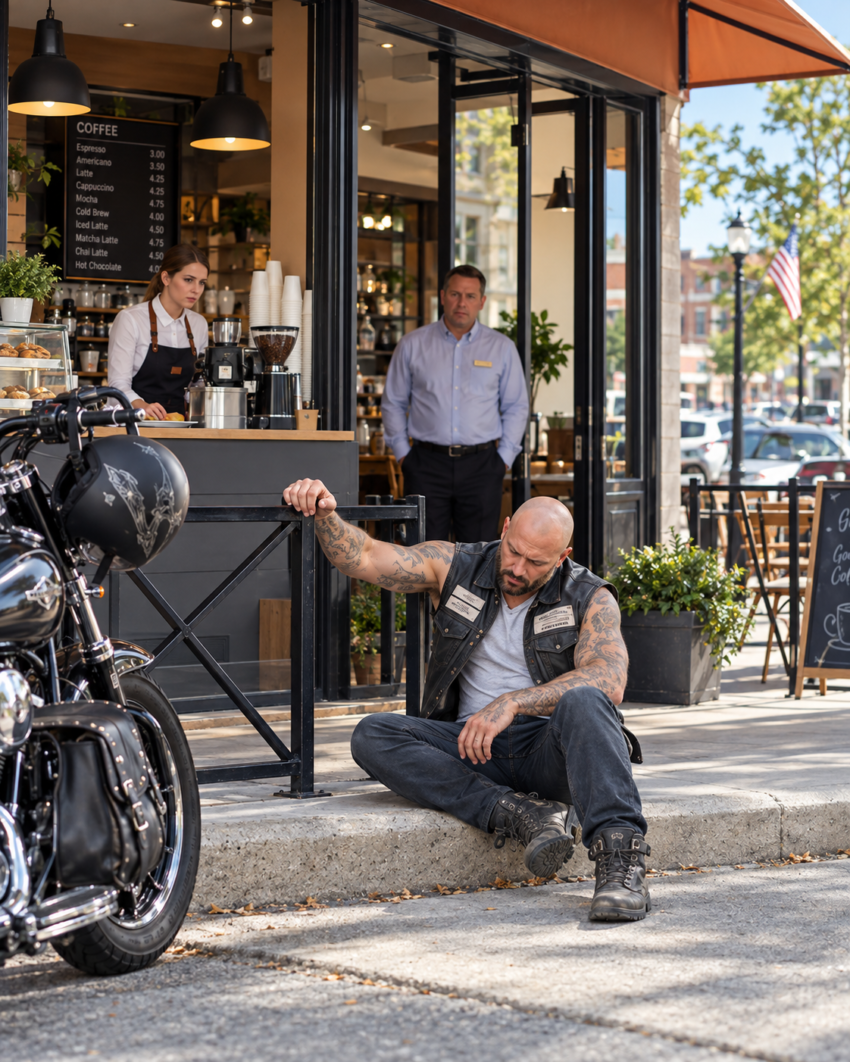
The words came from a broad-shouldered man in a worn leather vest, standing just outside a small coffee shop in Asheville, North Carolina.
Twenty-nine-year-old waitress Brielle Sutton stopped beside him, still holding the bottle of water she had brought from inside.
Only a minute earlier, the stranger had become dizzy near the entrance. Brielle had rushed over to help him sit on a bench.
Now he was talking about someone’s granddaughter.
And somehow, she had the uncomfortable feeling he meant her.
“Excuse me,” she said. “Who exactly are you talking about?”
The man ended his call and slowly looked up.
He was probably in his early fifties, with silver threading through his dark beard and tattoos covering both forearms. His appearance might have frightened some people, but his expression held something Brielle hadn’t expected.
Recognition.
“What’s your name, sweetheart?”
“Brielle Sutton. Why?”
His face changed.
“And your mother’s name is Marianne?”
Brielle tightened her grip on the bottle.
“How do you know my mother?”
The man hesitated before answering.
“Does she still have that little scar above her right eyebrow?”
Brielle stared at him.
Her mother had carried that scar for as long as Brielle could remember. She always claimed she’d gotten it falling from a bicycle as a teenager.
“Who are you?”
“My name is Russell Keene. I knew your father.”
For a moment, the traffic passing along the street seemed to disappear.
Her father.
A man Brielle had spent her entire life trying to imagine.
“My father passed away before I was born.”
Russell’s expression grew heavy.
“Is that what Marianne told you?”
Brielle took a step backward.
“Yes. And I’d appreciate it if you stopped asking questions about my family.”
Russell didn’t move.
“Brielle, there’s something you need to know. Your father was my best friend, and your grandfather has been looking for you for almost two years.”
She shook her head.
“My grandparents are gone.”
“Not all of them.”
Then he said a name she’d never heard before.
“Walter Ashford.”
The Father She Had Never Known
Brielle grew up in a modest two-bedroom apartment outside Asheville.
Her mother worked long hours as a medical receptionist, paid every bill on time, and somehow always managed to make birthdays feel special.
They weren’t wealthy, but Brielle never doubted she was loved.
There was only one subject Marianne refused to discuss.
Her husband, Daniel Sutton.
According to Marianne, Daniel had passed away in a traffic accident shortly before Brielle’s birth.
There were no wedding photographs on the walls, no family albums filled with his childhood memories, and no relatives who stopped by to share stories.
Whenever Brielle asked about him, her mother became quiet.
Eventually, Brielle stopped asking.
Now, sitting beside a stranger wearing motorcycle boots, she wondered how much of her childhood had been built around a story that wasn’t true.
“Tell me how you knew him,” she said.
Russell looked toward the street.
“We worked together at a motorcycle repair shop outside Charlotte. Your dad could fix just about anything with an engine. He wasn’t much of a businessman, but he had the kindest heart of anyone I’ve ever met.”
Brielle swallowed.
“And my grandfather?”
Russell sighed.
“Walter Ashford owned a successful regional trucking company. Your mother was his only daughter. When she fell in love with a mechanic, he wasn’t happy.”
“Because my dad didn’t have money?”
“Pretty much.”
Russell explained that Marianne had grown up surrounded by opportunities Daniel could never have afforded.
Walter expected her to marry someone from a similar background.
Instead, she chose a young mechanic who worked six days a week and drove a truck with mismatched doors.
Then $85,000 disappeared from an account connected to Walter’s company.
Financial records appeared to implicate Daniel.
“Your grandfather believed those documents,” Russell explained. “He accused Daniel of taking the money and told Marianne she had to choose between her family and him.”
“Was my father responsible?”
Russell shook his head.
“No. We know that now.”
Brielle leaned forward.
“What do you mean, now?”
“The man who actually took the money confessed twenty-seven years later.”
Brielle stared at him.
For almost three decades, her father’s name had carried an accusation he didn’t deserve.
And somewhere in North Carolina, a grandfather she’d been told didn’t exist was trying to find her.
“Why would he want me now?”
Russell looked at her gently.
“Because he finally understands what his pride cost him.”
The Question Her Mother Couldn’t Answer
That evening, Brielle drove straight to her mother’s house.
Marianne was standing in the kitchen, preparing vegetables for dinner, when her daughter walked in without knocking.
“Mom, who is Walter Ashford?”
The knife stopped moving.
Marianne slowly placed it on the cutting board.
“Where did you hear that name?”
“From Russell Keene.”
Her mother’s face went pale.
“Russell?”
“He says he knew Dad. He says Walter Ashford is my grandfather.”
Marianne pulled out a chair.
For several seconds, she said nothing.
Then she whispered, “That’s true.”
Brielle felt her chest tighten.
“You told me my grandparents were gone.”
“I know.”
“You told me there wasn’t anyone left on Dad’s side, and that you didn’t have family either.”
Marianne stared at her hands.
“I thought it was better that way.”
“Better for whom?”
Her mother didn’t answer.
Brielle sat across from her.
“Russell told me about the missing money. He said Grandpa accused Dad of something he didn’t do.”
Tears gathered in Marianne’s eyes.
“Your father was a good man, Brielle. He never deserved any of it.”
“Then why didn’t you tell me?”
Marianne took a trembling breath.
“Because I was trying to leave that part of my life behind.”
Brielle looked away.
“You didn’t just leave it behind, Mom. You erased it from mine.”
Marianne began to cry.
And then Brielle asked the question that changed everything.
“Did Dad ever know I existed?”
Her mother covered her mouth.
Brielle felt her stomach sink.
“Mom?”
“Of course he did.”
“But you said he passed away before I was born.”
Marianne lowered her head.
“That wasn’t true.”
The Two Years That Had Been Erased
Brielle sat completely still.
“What are you saying?”
Marianne wiped her cheeks.
“Your father was there when you were born. He held you before anyone else. He used to walk around our little apartment singing to you when you couldn’t sleep.”
Brielle’s eyes filled with tears.
“Then when did he pass away?”
“You were two years old.”
The room seemed to tilt.
For twenty-nine years, Brielle had believed she’d never met her father.
Now she was learning that he had carried her, fed her, comforted her, and loved her for the first two years of her life.
“How could you keep that from me?”
Marianne struggled to answer.
“After his accident, you kept asking when Daddy was coming home. Every night, you waited near the window. I couldn’t bear watching you look for him.”
She paused.
“When you got older, I told you he had passed away before you were born. I thought it would be easier than explaining why someone you loved had disappeared from your life.”
“And you never thought I deserved the truth?”
“I was afraid that if I started telling you the truth, I’d have to tell you everything.”
Brielle’s voice softened.
“What happened to him?”
“He was riding his motorcycle home from work. The road was wet, and he lost control on a curve.”
There had been no elaborate conspiracy surrounding his passing.
Just an ordinary evening that ended in a terrible loss.
Marianne had left Charlotte afterward, taking her daughter to Asheville and cutting ties with everyone connected to the Ashford family.
“Walter tried contacting me once,” she admitted. “I sent his letter back unopened.”
“Why?”
“Because when Daniel needed someone to believe in him, my father chose his reputation instead.”
Brielle understood her mother’s pain.
But understanding didn’t erase the hurt.
“Mom, you had every right to protect yourself. But you should have let me decide whether I wanted to know my grandfather.”
Marianne nodded through her tears.
“You’re right.”
For the first time in Brielle’s life, her mother had no explanation left.
The Confession That Came Twenty-Seven Years Too Late
The following morning, Russell returned to the coffee shop.
This time, he arrived in a pickup truck.
Brielle joined him at an outdoor table during her break.
“I talked to my mother,” she said.
Russell studied her expression.
“How did it go?”
“I learned I knew almost nothing about my own father.”
He looked down.
“I’m sorry.”
“Tell me about the confession.”
Russell explained that Walter’s former financial director, a man named Curtis Bellamy, had contacted him nearly two years earlier.
Curtis had been seriously ill and wanted to correct something he’d hidden for decades.
He admitted diverting company funds and altering records to make Daniel appear responsible.
Walter had trusted those records without asking enough questions.
By the time the truth surfaced, Daniel had been gone for twenty-seven years.
“Walter was devastated,” Russell said. “He had spent years believing he was protecting his daughter from the wrong man. Instead, he’d pushed away a good man and lost his daughter.”
“So he hired someone to find us?”
“He tried private investigators first. Eventually, he contacted me because I knew Daniel and Marianne before everything happened.”
Brielle looked at the tattoos on Russell’s hands.
“Why did you agree to help him?”
Russell was silent for a moment.
“Because I made a mistake back then, too.”
He explained that he’d noticed inconsistencies in the records used against Daniel.
He suspected something was wrong but never spoke up.
He was young, afraid of losing his job, and intimidated by Walter’s influence.
“Daniel never blamed me,” Russell said quietly. “But I blamed myself.”
Brielle considered his words.
“And finding me is supposed to make everything right?”
“No. Nothing can give Daniel those years back. But maybe we can stop making the same mistake.”
She sat quietly for a long time.
Then she asked, “Does Walter really want to meet me?”
“More than anything.”
“Then he needs to understand something. I’m not coming alone.”
The Man Waiting at the End of the Driveway
Three days later, Brielle and Marianne drove to Charlotte.
Russell met them near a quiet residential neighborhood and guided them toward Walter’s home.
Brielle had expected an enormous mansion with iron gates.
Instead, they stopped outside a comfortable brick house surrounded by old oak trees.
An elderly man stood near the front porch, leaning on a wooden cane.
Walter Ashford was seventy-eight.
His hair was completely white, and his shoulders seemed smaller than Brielle had imagined.
When Marianne stepped out of the car, he stopped moving.
“Marianne?”
Her mother nodded.
Walter’s eyes filled with tears.
“I didn’t think I’d ever see you again.”
Marianne said nothing.
Then Walter looked at Brielle.
His expression changed.
“You have Daniel’s eyes.”
Brielle felt something tighten in her throat.
Those were the first words her grandfather had ever spoken to her.
But she hadn’t come for a sentimental reunion.
“Mr. Ashford, I need to ask you something.”
Walter straightened.
“Anything.”
“Did you ever have proof that my father took that money?”
He looked down.
“I thought I did.”
“Did you ever ask him to explain?”
“Not properly.”
“Because you already disliked him?”
Walter closed his eyes.
“Yes.”
Brielle held his gaze.
“He was a good husband and father. You never gave him the chance to prove that.”
Walter’s voice trembled.
“You’re right.”
“And now he’s gone.”
“I know.”
The elderly man looked toward Marianne.
“I spent so many years believing I was protecting my family. I was really protecting my own pride.”
Marianne began crying.
Walter took a small step toward her but stopped.
He didn’t ask for a hug.
He didn’t demand forgiveness.
He simply said, “I’m sorry, sweetheart. I should have trusted you.”
A Photograph Worth More Than Money
Their first lunch together was uncomfortable.
Walter tried to share stories about Marianne’s childhood, but she answered politely and briefly.
Russell helped keep the conversation moving.
Then Brielle asked something she’d been wondering since their first meeting.
“Russell, what was my dad actually like?”
He smiled.
“Daniel loved old motorcycles, terrible country music, and breakfast food he couldn’t cook.”
Brielle laughed unexpectedly.
“He couldn’t cook?”
“Not even a little. He burned eggs so often that your mother bought him a special pan. He managed to ruin that one, too.”
Even Marianne smiled.
Russell reached into his jacket and removed a small envelope.
“I brought you something.”
Inside was an old photograph.
It showed Marianne holding a baby beside the window of a modest apartment.
In the glass, a young man could be seen holding the camera.
Daniel.
Brielle recognized her own eyes in his face.
For several moments, she couldn’t speak.
“That’s him?”
Marianne leaned closer.
“Yes, honey. That’s your daddy.”
Brielle gently touched the edge of the photograph.
For the first time, her father wasn’t an empty space in a family story.
He was a real person.
A young man who smiled while taking pictures of the people he loved.
Walter watched quietly.
Then he cleared his throat.
“Brielle, I know I can’t make up for what happened, but I’d like to help you financially. Perhaps with a home of your own.”
She looked up.
“I appreciate the offer, but I don’t want your money.”
Walter appeared surprised.
“You don’t?”
“I spent my whole life believing I didn’t have a grandfather. I need someone who wants to know me, not someone who wants to buy me an apartment.”
Walter nodded slowly.
“Then perhaps we could start with coffee.”
Brielle smiled.
“Coffee sounds good.”
Learning to Be a Family Again
Nothing changed overnight.
Marianne still carried years of disappointment, and Walter couldn’t erase what he’d done with a few apologies.
For months, she declined his invitations.
Brielle, however, began meeting him at the coffee shop where she worked.
He usually arrived on Thursday afternoons and ordered black coffee with a blueberry muffin.
At first, their conversations were awkward.
They discussed the weather, books, and Brielle’s work.
Eventually, she started asking about her mother’s childhood.
Walter told her how Marianne had once brought home an injured bird and insisted on caring for it.
He remembered how she loved swimming and how she used to sing while helping him wash the family car.
Brielle discovered a version of her mother she’d never known.
Walter learned that his granddaughter loved hiking, had worked her way through community college, and dreamed of managing her own coffee shop.
Their relationship grew slowly, through ordinary conversations rather than grand gestures.
One afternoon, Brielle asked him why he never brought up the money again.
Walter smiled.
“Because you told me what you needed. I thought it was time I finally listened.”
Four months after their reunion, Marianne agreed to visit him.
She didn’t stay long.
There were no dramatic embraces.
But that evening, Brielle received a photograph of her mother and grandfather sitting side by side in the garden.
Neither was smiling broadly.
Still, they were together.
And that was enough for a beginning.
The Four Cups of Coffee
A year after meeting Russell, Brielle received an unexpected opportunity.
Her manager offered her the chance to run a new coffee shop in downtown Asheville.
She accepted.
On opening morning, Russell arrived first.
“I made sure to eat breakfast before coming,” he announced.
Brielle laughed.
“Good. I don’t need you getting dizzy outside another coffee shop.”
Ten minutes later, Walter walked through the door carrying a small bouquet of flowers.
Marianne followed shortly afterward with a homemade cake.
Brielle looked at the three people standing together.
A year earlier, she’d believed her family consisted of only herself and her mother.
Now she had a grandfather, a family friend who could tell her stories about her father, and a photograph she carried everywhere.
She placed four cups of coffee on a table near the window.
Walter glanced around the bright new shop.
“Your father would have been proud of you.”
Brielle smiled.
“I hope so.”
Russell lifted his cup.
“Hard to believe all this started because I nearly passed out in front of your old workplace.”
Brielle shook her head.
“That’s not really where it started.”
Russell raised an eyebrow.
“No?”
She looked at her mother, then at Walter.
“It started thirty years ago, when people let fear and pride become more important than the truth.”
The table grew quiet.
Then she continued.
“But I think something else started that day outside the coffee shop. People finally decided to stop hiding.”
Marianne reached for her daughter’s hand.
Walter looked toward the small framed photograph of Daniel that Brielle had placed near the register.
For a moment, nobody spoke.
Then Russell smiled.
“Daniel would have loved this place.”
“Even the coffee?” Brielle asked.
“Especially the coffee. Although he’d probably have asked you to make him breakfast.”
Everyone laughed.
And for the first time, the laughter didn’t feel like an attempt to cover up years of sadness.
It felt natural.
Brielle knew the past would never be perfect.
Her father would never walk through that door.
Walter couldn’t undo his mistakes, and Marianne couldn’t give back the childhood memories she’d hidden.
But they could choose what happened next.
And as Brielle looked around the table, she realized something important.
A family didn’t have to pretend the past had never happened in order to build a better future.
Sometimes, healing began when everyone finally found the courage to tell the truth.
Messages to Remember
Sometimes the deepest wounds in a family are not caused by strangers, but by the people who believe their pride matters more than understanding the ones they love.
A child deserves to know where they came from, because even painful family stories can become meaningful pieces of the identity they spend a lifetime trying to understand.
Protecting someone from sadness may seem like an act of love, but hiding the truth can also take away their opportunity to make important decisions for themselves.
No amount of money, influence, or professional success can replace the years a parent loses when they allow judgment and stubbornness to stand between themselves and their children.
A sincere apology cannot change yesterday, but it can become the first small step toward a tomorrow where people listen more carefully and treat one another with greater kindness.
The people who love us are not always the ones who make the fewest mistakes, but the ones willing to acknowledge those mistakes and patiently work to become better.
Forgiveness does not mean pretending nothing happened, and rebuilding trust often requires more time, consistency, and humility than the person asking for forgiveness expects.
Every family carries stories that younger generations may never fully understand, which is why honesty, compassion, and the courage to ask difficult questions matter so much.
Sometimes the most valuable inheritance is not a house, a bank account, or a successful business, but a photograph, a forgotten memory, or a simple story about someone we never truly got to know.
Life cannot return the moments we’ve lost, but as long as we are willing to choose truth over pride and love over fear, there may still be time to create beautiful memories with the people who remain.