In early 2026, a major debate erupted in U.S. national media and political circles over newly released federal data on immigration enforcement actions by U.S. Immigration and Customs Enforcement (ICE).
From January 2025 through January 2026. A report published by CBS News sparked controversy by highlighting internal Department of Homeland Security (DHS) figures showing that a small minority.
Fewer than 14% — of the nearly 400,000 immigrants arrested by ICE over the past year had charges or convictions for violent crimes.
The report contradicted repeated statements from the White House and DHS officials that immigration enforcement under President Donald J. Trump was squarely focused on targeting the “worst of the worst” — violent offenders in the United States without lawful status.
The differing interpretations of these statistics have ignited heated discourse among political leaders, civil liberties advocates, law enforcement proponents, news commentators, and researchers — with each side offering contrasting portraits of the scale, focus, and impact of immigration enforcement under Trump’s second term.
Below is a thorough chronicle of the data, claims, rebuttals, context, and what independent analysis says about the state of immigration arrests and criminal records.
1. The CBS Report and What the Internal DHS Figures Show
In February 2026, CBS News obtained an internal Department of Homeland Security document detailing ICE enforcement activity between January 21, 2025 (President Trump’s first full day back in the White House) and January 31, 2026. According to that document:
ICE made roughly 393,000 arrests during this period as part of its interior enforcement and deportation operations.
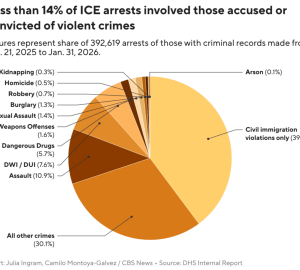
Of those arrested, only around 13.9% had charges or convictions for what DHS classified as “violent crimes” — a categorization that includes offenses such as homicide, robbery, sexual assault, kidnapping, and other serious violent offenses.
About 60% of those arrested had some criminal charge or conviction on record, but most of those were for non-violent offenses.
The remaining nearly 40% had no criminal record at all — meaning they had neither criminal convictions nor pending criminal charges. These individuals were mainly detained for immigration law violations, such as illegal entry or overstaying authorized visas, which are civil infractions under U.S. law.
Breakdown of Charges Among ICE Arrestees
The internal DHS data provides a breakdown of common offenses among those with criminal records:
Homicide charges or convictions: Approximately 2,100 individuals.
Sexual assault charges/convictions: Around 5,400.
Robbery and assault: Tens of thousands combined.
Drug, weapons, DUI, and traffic offenses: Over 70,000 individuals combined, many of which are legally classified as “non-violent.”
Civil immigration violations (no criminal record): Roughly 153,000 arrests.
Experts note that this classification — where crimes such as burglary, fraud, DUI, and distribution of illicit materials are labeled “non-violent” — follows legal definitions in many jurisdictions, but is often controversial because such crimes can still significantly impact public safety.
2. White House and DHS Response to the CBS Reporting
Following the CBS News release, senior Trump administration officials, including representatives of the Department of Homeland Security and the White House, publicly disputed the report’s framing and interpretation of the data:
a. Claim That Most Arrestees Had Criminal Histories
Administration officials argued that:
Approximately 60–70% of those arrested had criminal convictions or pending criminal charges. These numbers are often cited in testimony from DHS spokespersons and were referenced in congressional remarks and press statements.
Many immigrants without a U.S. criminal record — and thus counted as “non-violent” under the CBS classification — may still pose significant threats because they could have been charged or convicted of serious crimes in foreign countries. Officials have said that the internal DHS document did not fully account for such international charges.
Several non-violent offenses (like human smuggling, distribution of child exploitation material, drug trafficking, burglary, or fraud) can still pose considerable danger to public safety even if they don’t meet the legal definition of “violent crimes.” DHS spokespersons emphasized this point in press releases.
The acting DHS leadership narrowed its criticism, asserting that the CBS report’s headline statistic — focusing solely on violent crimes — neglected broader context about criminal involvement, pending charges, and other serious offenses that fall outside narrow “violent crime” labels.
b. Strategic Messaging on Targeting “Worst Offenders”
For months, Trump administration messaging has stressed that interior enforcement prioritizes the “worst of the worst” criminals — including murderers, rapists, gang members, and terrorists DHS officials and White House spokespeople have reiterated this point in interviews and press conferences.
However, critics argue that the internal data CBS obtained undercuts this messaging, showing that a large share of those arrested do not fit the traditional definition of violent or major criminal offenders.
3. Independent Analysis and Expert Perspectives
Independent researchers and immigration policy experts have weighed in, helping interpret the DHS data and broader trends:
a. Civil Liberties and Immigration Scholars
Researchers at institutions such as the Cato Institute and academic compilations like the Deportation Data Project highlight several trends:
The percentage of ICE arrestees without criminal records (civil immigration violations only) has risen significantly over the past year.
Only a small fraction of those detained have convictions for serious violent felonies like murder or rape, with many of those classified as violent stemming from lesser offenses (e.g., bar fights or minor assaults).
The administration’s shift away from earlier prioritization guidelines — which emphasized targeting serious offenders — toward broader arrests has led to increased enforcement of lower-level, non-violent charges.
b. Data Transparency and Reporting Challenges
One of the clearest issues highlighted by analysts is the difficulty in reconciling multiple data sources:
Publicly published ICE data often combines arrests, detentions, and removals with different categories of offenses, no standardized definition of “violent vs. non-violent,” and significant gaps in reporting international criminal history.
Internal DHS documents — like the one leaked to CBS — may contain information not yet reflected in public statistics, making independent verification difficult.
Because of these limitations, researchers stress that simple percentage figures can be misleading without a clear explanation of how offenses are categorized and what counts as a criminal conviction vs. an immigration violation.
4. Broader Context: Immigration Enforcement Trends Under the Trump Administration
To fully understand the significance of this dispute, it’s important to look at the broader landscape of immigration policy and enforcement trends:
a. Surge in ICE Arrests
Since Trump returned to the presidency in January 2025, ICE arrest numbers have soared compared with prior years:
Enforcement actions have increased dramatically, including both interior arrests and border operations.
Some regions saw aggressive local sweeps outside traditional border zones, drawing protests in cities such as Minneapolis, Chicago, Los Angeles, and Washington, D.C.
b. Controversies and Public Backlash
Nationwide, there has been significant political and public response to the expanded enforcement actions:
Protests have erupted in several cities after large raids and targeted operations.
Certain incidents — such as ICE detaining a 5-year-old child alongside his father in Minneapolis — have amplified public scrutiny and raised questions about prioritization and enforcement tactics.
In some locales, local officials have clashed with federal agents over cooperation and enforcement impact.
c. Politicization of Immigration Crime Reporting
Media coverage of immigration and crime statistics has itself become a contentious battleground:
Opponents of the Trump administration argue that emphasizing low percentages of violent criminals among ICE arrestees shows the policy is overly broad and sweeps up many law-abiding individuals or those whose only offense is a civil immigration violation.
Supporters contend that the data misses broader context regarding pending charges, foreign criminal history, and serious non-violent offenses that nonetheless jeopardize public safety.
These conflicting narratives reflect deep political divisions in how immigration policy is discussed in national media and political discourse.
5. What the Numbers Actually Tell Us
When carefully interpreted, the available data — combining both internal DHS figures and independent analysis — suggests a complex picture:
A substantial majority (around 60%) of ICE arrestees had some form of criminal charge or conviction, though this includes a range of offenses from serious to minor.
A much smaller fraction (under 14%) had charges or convictions for violent crimes specifically.
A large portion — nearly 40% — were arrested for civil immigration violations with no criminal record in the U.S. criminal justice system.
Even among those with criminal history, many offenses classified as non-violent (e.g., DUI, burglary, drug possession) are legally distinct from violent crimes but still raise public safety concerns for many observers.
In practical terms, this means that while the majority of individuals ICE is arresting under the current administration are associated with some criminal charge or conviction, the violent criminal subset — those most often invoked in political rhetoric — represents a relatively small share of total arrests.
6. Why This Debate Matters
This controversy is not merely about statistics; it touches on key democratic questions about enforcement priorities, civil liberties, media accountability, and public safety:
Public policy priorities: How should limited enforcement resources be allocated? Should interior enforcement focus narrowly on violent offenders, or broadly on immigration law violations as well?
Media framing and public perception: The way data is reported — emphasizing either raw numbers of criminal histories or proportion of violent offenders — can shape public understanding and political attitudes.
Legal and civil rights implications: Detaining people whose only offense is a civil immigration violation raises constitutional and humanitarian concerns, especially if detention conditions and due process rights are not upheld.
Political messaging vs. policy reality: Discrepancies between political claims and empirical data can erode public trust and fuel polarization.
Conclusion
The recent debate over ICE arrest data — triggered by the CBS News report showing that fewer than 14% of immigrants arrested between January 2025 and January 2026 had violent criminal records — reveals deep differences in how immigration policy is interpreted and communicated.
While the Trump administration insists it is prioritizing violent criminals and “the worst of the worst,” internal data indicates that many of those detained are either charged with non-violent offenses or have no criminal history in the U.S. at all.
Understanding the nuances of this data — including legal definitions, classification methods, and enforcement context — is vital for an informed public discussion about the goals, effectiveness, and consequences of immigration law enforcement in America today
\\