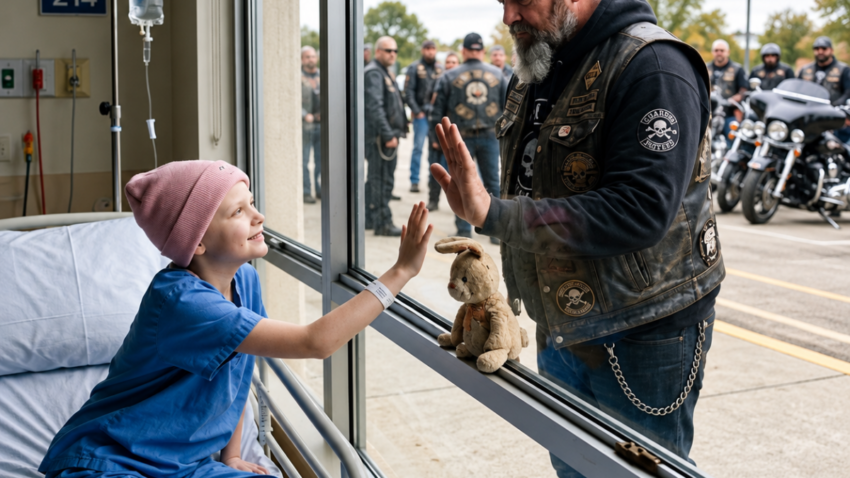
PART2:
Emily shook her head.
The biker reached into his vest.
Hannah immediately stiffened.
He removed something small.
Silver.
A pendant.
He held it up.
Emily gasped.
Laura woke.
“What?”
She sat upright.
“Em?”
Emily pointed.
“Daddy’s.”
Laura looked toward the window.
Every trace of sleep left her face.
The pendant in the biker’s hand was a small silver compass.
Hannah knew because Emily had drawn it once during art therapy.
Her father had worn it around his neck.
Laura stood so quickly the recliner snapped upright behind her.
“No.”
She moved toward the glass.
The biker did not smile.
He lowered his eyes.
Then pressed the pendant against his chest.
Laura’s hand went to her mouth.
“Where did he get that?”
Hannah looked at her.
“You recognize it?”
“That was Jason’s.”
Her voice broke.
“My husband’s.”
Outside, the biker placed the compass back inside his vest.
Then he touched two fingers to his forehead.
A small salute.
He turned.
Walked away.
Emily watched until he disappeared around the garden wall.
Then she said something Hannah had not heard her say in days.
“I’m hungry.”
Laura stared at her.
“What?”
“Can I have toast?”
Hannah looked at the monitor.
Emily’s heart rate, which had been hovering between 120 and 130 all morning, had dropped to 106.
Still elevated.
But better.
Hannah tried not to make meaning out of one number.
Nurses learned quickly not to turn coincidence into medicine.
“Toast I can do.”
Emily added, “With strawberry jelly.”
Laura began crying.
Emily frowned.
“Mom.”
“I’m fine.”
“You’re crying.”
“I know.”
“Why?”
Laura laughed through it.
“I’m just really happy about toast.”
Emily looked unconvinced.
Hannah ordered toast.
The next morning, the biker returned.
8:00 exactly.
Same spot.
Same vest.
Same hand against the glass.
This time Emily was waiting.
She had asked Hannah at 7:43:
“Do you think the motorcycle man is coming?”
“I don’t know.”
“He came yesterday.”
“Yes.”
“People come back twice if they mean it.”
Hannah had no answer to that.
At 8:01, he appeared.
Emily smiled.
Not the polite little smile children sometimes gave nurses because adults needed reassurance.
A real smile.
Her shoulders lifted.
She sat straighter.
The biker pressed his hand to the window.
Emily pressed hers to it.
Five minutes.
Then he left.
The third morning, he brought a stuffed bear wearing a tiny black bandanna.
He held it up.
Emily laughed.
The sound stopped Laura in the middle of brushing her teeth.
“You laughed.”
Emily looked embarrassed.
“No.”
“You did.”
“Did not.”
The biker pointed toward the bear.
Then toward Emily.
He placed it on the garden bench and walked away.
Hospital security collected it.
All outside items entering the pediatric oncology floor required screening.
Hannah expected the bear to disappear into some administrative black hole.
Instead Child Life disinfected it, checked every seam, removed the bandanna, laundered it, and delivered it to Room 417 that afternoon.
Emily named it Roadie.
On the fourth morning, the biker returned without anything.
On the fifth, rain.
He still came.
On the sixth, Emily underwent a bone marrow biopsy.
She cried before transport.
“I don’t want to.”
Laura held her.
“I know.”
“Tell him I’m not here.”
“Who?”
“The motorcycle man.”
Hannah looked toward the window.
“He’ll figure it out.”
Emily grabbed her wrist.
“No.”
Her grip was surprisingly strong.
“He’ll think I left.”
That sentence landed differently.
Hannah knelt beside her.
“Emily, he knows you’re in the hospital.”
“How?”
“I’m sure he does.”
“But what if he thinks I’m gone?”
Laura closed her eyes.
Everyone in Room 417 knew what gone meant.
Hannah said, “I’ll tell him.”
Emily searched her face.
“Promise?”
Hannah hesitated.
She had been a pediatric oncology nurse for eleven years.
She did not promise results.
She did not promise cures.
She did not promise parents that fevers would break or scans would be clear or children would make it home for Christmas.
But this?
“I promise.”
Emily nodded.
At 8:00, the biker appeared.
He looked toward the empty bed.
His body changed immediately.
Hannah saw it from the hall.
His shoulders tensed.
He stepped closer to the glass.
Hannah remembered her promise.
And the rules.
The hospital garden was public during visiting hours.
It was not public at eight in the morning.
Technically, visitors had to check in.
Technically, he should not be there.
Technically, Hannah had no business walking outside to talk to him.
She went anyway.
Cold air hit her scrubs.
The biker turned as she approached.
Up close he was even larger.
His vest bore a circular patch:
IRON VALLEY RIDERS
Beneath it, a smaller rocker read:
ALWAYS COMES HOME
Hannah glanced at it.
Something tightened inside her.
“Emily’s having a procedure.”
The man stared.
“She okay?”
His voice was rough.
Low.
“I’m not allowed to discuss her medical condition.”
“Right.”
“She asked me to tell you she didn’t leave.”
His eyes changed.
Not relief exactly.
Something deeper.
“Thank you.”
Hannah crossed her arms.
“Who are you?”
He looked toward the fourth-floor window.
“Name’s Marcus Dalton.”
“Family?”
“No.”
“Friend?”
He paused.
“Her dad’s.”
Laura had never mentioned him.
Hannah said, “You need to check in before coming onto hospital property.”
“I tried the first day.”
“With whom?”
“Front desk.”
“And?”
“Said I wasn’t on the visitor list.”
“So you came outside.”
“Glass doesn’t ask for a badge.”
Hannah wanted to be irritated.
Instead she almost smiled.
Almost.
“You can’t keep doing this without someone knowing who you are.”
Marcus nodded.
“Okay.”
“That doesn’t mean you can come inside.”
“I’m not asking to.”
“Then why are you here?”
He looked at her.
“Because she looks for me.”
Hannah felt defensive on Emily’s behalf.
“You don’t know what she looks for.”
Marcus looked toward the window again.
“No.”
Then softly:
“But I know what her father asked me to do.”
Hannah stared.
Before she could ask, her pager vibrated.
Emily was returning from procedure.
Hannah pointed toward the lobby.
“Check in tomorrow.”
Marcus nodded.
She turned.
“Hannah.”
She stopped.
She had not told him her name.
He pointed to her badge.
“Tell her I came.”
Hannah looked back.
“I will.”
That afternoon, she asked Laura about Jason Harper.
Not the accident.
Emily’s father.
The man before he became a line in a medical chart.
Laura sat by the window while Emily slept.
“Jason loved motorcycles.”
She smiled faintly.
“I hated them.”
“What kind?”
“I don’t know. Loud.”
Hannah smiled.
“That narrows it down.”
Laura laughed quietly.
“He had a Harley. Black. Chrome everywhere. He spent more time cleaning it than he spent cleaning our kitchen.”
“Was he part of the Iron Valley Riders?”
Laura looked surprised.
“You’ve seen the patch.”
“Yes.”
“Jason rode with them sometimes. It wasn’t really a club.”
“What was it?”
“More like… a community.”
She searched for the word.
“Veterans. Mechanics. Teachers. A couple nurses. People who rode together. Did charity runs. Escorts for military funerals. Stuff like that.”
“Always Comes Home?”
Laura’s face changed.
“That was Jason’s thing.”
“What do you mean?”
“When Emily was three, he left for a weekend ride. She cried because she thought motorcycles took people away.”
Laura swallowed.
“So he crouched in front of her and said, ‘Doesn’t matter where the road goes. Daddy always comes home.’”
Hannah said nothing.
Laura continued.
“After that, every time he left, she’d yell, ‘Always comes home!’”
“And he’d say it back?”
“Every time.”
Laura looked at the garden.
“Until he didn’t.”
Jason died on July 12.
Three months before Emily’s current admission.
Officially, the crash had been straightforward.
Single motorcycle.
Wet road.
Highway 401.
Loss of control.
Jason was pronounced dead after transport.
Laura received the call at 4:26 in the afternoon.
Emily had been sitting on the living-room floor building a Lego hospital.
Laura remembered that detail because grief had a cruel habit of preserving nonsense.
The color of the carpet.
A cereal bowl in the sink.
One sock under the coffee table.
The fact that the dryer buzzer sounded while a police officer explained that her husband was dead.
Jason had been riding home.
He had left that morning to meet friends for a charity event planning breakfast.
He was supposed to be home by two.
At 1:48, he texted Laura:
Tell Em I’m twenty minutes out.
Always comes home.
He never did.
“Did Marcus know him well?” Hannah asked.
“I don’t know Marcus.”
“Never met him?”
“No.”
“What about the pendant?”
Laura’s face went pale again.
“That was on Jason when he died.”
“You’re sure?”
“I gave it to him on our tenth anniversary.”
“Did the hospital return his belongings?”
“Wallet. Phone. Wedding ring. Clothes.”
“The compass?”
Laura shook her head.
“I thought it was lost in the crash.”
Hannah stared toward the hallway.
Something about the story had shifted.
The next morning Marcus checked in properly.
Security called the floor.
“Visitor for Emily Harper. Marcus Dalton.”
Laura said she wanted to meet him.
Emily said no.
Everyone looked at her.
“No?”
“He comes to the window.”
Laura sat beside her.
“Sweetheart, don’t you want him to come inside?”
Emily shook her head.
“Why?”
The girl looked embarrassed.
“He looks like Daddy outside.”
Laura stopped breathing for a moment.
Emily pointed toward the patch in a photograph on her bedside table.
Jason wearing his riding vest.
“He stands like Daddy.”
Laura’s eyes filled.
“If he comes in, he’ll be somebody else.”
Hannah understood.
Children could build complicated bridges out of very little.
Marcus was not Jason.
Emily knew that.
But the silhouette outside the glass belonged to the same world.
Leather.
Boots.
The patch.
A hand lifted.
Someone returning.
Laura told the front desk.
Marcus accepted it without argument.
“Window’s fine.”
So the ritual continued.
Every morning.
8:00.
Sometimes five minutes.
Sometimes ten.
Marcus never overstayed.
He did not wave dramatically.
He never knocked on the glass.
He simply appeared.
Hand up.
Emily’s hand met it.
Then he left.
Something changed in her.
Not magically.
Chemotherapy did not become easier because a biker stood in a garden.
Her nausea remained.
Her mouth sores hurt.
Her blood counts fell.
She developed a fever one night that triggered cultures, antibiotics, and twelve terrifying hours.
But emotionally, she changed.
She began asking for breakfast again.
She cooperated with physical therapy.
She painted.
She made Roadie the bear a paper motorcycle.
On mornings Marcus appeared, Hannah noticed her heart rate often settled afterward.
Her blood pressure improved.
Not dramatically.
Enough to notice.
The hospital psychologist noticed too.
“Predictable ritual,” Dr. Nina Patel said.
“Sense of control.”
Hannah nodded.
“Attachment.”
“Possibly.”
“He’s a stranger.”
“To us.”
“To Emily too.”
Nina looked through the glass.
“Not anymore.”
The trouble began in week three.
A hospital administrator named Leonard Price learned about the biker.
Leonard was vice president of patient operations.
He wore perfectly fitted suits.
Spoke in phrases like risk exposure and policy alignment.
He was not cruel.
Hannah would later make a point of remembering that.
Cruelty was easier to fight.
Leonard was afraid of liability.
Hospitals ran on fear disguised as procedure.
He came to the floor at 9:20 on a Monday.
“Who authorized the motorcycle visitor?”
Hannah looked up from the computer.
“The what?”
“The gentleman outside 417.”
“He checks in.”
“He is not an approved patient visitor.”
“He stays in the garden.”
“The garden is reserved for patients and authorized guests during designated hours.”
“He stands there ten minutes.”
“That doesn’t answer my question.”
Hannah hated administrators who weaponized calm voices.
“Her mother knows.”
“Her mother cannot override hospital security policy.”
“He has never entered the unit.”
“Ms. Cole.”
“Nurse Cole.”
Leonard paused.
“Nurse Cole, this isn’t personal.”
That phrase almost always meant something was about to become very personal.
“We have a vulnerable pediatric population. We cannot allow unidentified individuals to establish unsupervised contact with children through windows.”
“He’s identified.”
“Background checked?”
“No.”
“Relationship verified?”
“He knew her father.”
“Verified?”
Hannah said nothing.
Leonard nodded.
“That is the problem.”
The next morning security intercepted Marcus.
Emily waited.
8:00.
Nothing.
8:05.
Nothing.
8:10.
She stared toward the garden.
“Maybe traffic,” Laura said.
Emily did not answer.
At 8:17 she pushed breakfast away.
At 8:26 Hannah learned what happened.
Security had asked Marcus to leave the grounds.
He had.
No argument.
No scene.
No threat.
He simply walked back to his motorcycle and rode away.
Hannah found Leonard.
“You removed him.”
“We enforced policy.”
“You could’ve told us.”
“This is a hospital, not a social club.”
Hannah stared.
“He matters to her.”
“He is not treatment.”
“No. He’s support.”
“She has licensed psychosocial support.”
Hannah laughed once because the sentence was so absurd she could not help it.
Leonard frowned.
“Something funny?”
“Yes.”
“Hannah.”
“You think seven-year-olds care whether the person making them feel safe has a license?”
“This conversation is over.”
“No.”
He looked surprised.
Hannah rarely fought administrators directly.
She had learned survival.
Document.
Escalate properly.
Choose battles.
But she looked through the hall window toward Emily’s room.
The girl was staring at an empty garden.
“No,” Hannah repeated.
“You can write me up if you want.”
“This is not about discipline.”
“Then listen.”
Leonard’s face hardened.
“I have listened.”
“No. You’ve reviewed a risk.”
Hannah stepped closer.
“You haven’t met the child.”
“I know her case.”
“You know her chart.”
Silence.
“Her father died three months ago.”
“I’m aware.”
“The man you removed was with him.”
That caught Leonard.
“With him?”
“When he died.”
“We have verified this?”
“Not yet.”
“Then it’s a claim.”
Hannah wanted to throw something.
Instead:
“Give me one day.”
“For what?”
“To verify him.”
Leonard shook his head.
“Security policy does not—”
“One day.”
Maybe it was her tone.
Maybe Leonard was less heartless than she wanted him to be.
Maybe administrators, too, sometimes allowed themselves to be interrupted.
“Twenty-four hours.”
Hannah nodded.
She called Marcus.
He answered on the third ring.
“This is Hannah.”
“I know.”
“Where are you?”
“Work.”
“What kind of work?”
“Motorcycle repair.”
Of course.
“Can you come in after five?”
“Why?”
“Because if you’re going to keep standing outside that window, I need to know exactly who you are.”
Silence.
Then:
“Okay.”
Marcus arrived at 5:43.
No vest.
Work shirt.
Jeans.
He looked almost smaller without leather.
Almost.
Hannah took him to an empty family consultation room.
Laura joined them.
For the first time, she sat across from the man carrying her husband’s pendant.
Marcus placed the compass on the table.
Laura stared.
“You had this.”
“Yes.”
“Why?”
Marcus looked at her.
“Jason gave it to me.”
Laura’s face tightened.
“He couldn’t have.”
“He did.”
“When?”
“On the road.”
Silence.
Marcus looked down at his hands.
“I was behind him.”
Laura stopped breathing.
Hannah felt the room contract.
“On Highway 401?” Laura whispered.
Marcus nodded.
“What happened?”
He closed his eyes once.
When he opened them, the biker standing outside a child’s window was gone.
Now Hannah saw a man who had been replaying twenty minutes of his life for three months.
“We were coming back separately.”
“We?”
“Me, Jason, couple others. Charity breakfast broke up around noon. Jason left first because Emily had something.”
“Her clinic appointment,” Laura whispered.
“He told us.”
Marcus nodded.
“I left maybe ten minutes later.”
He rubbed his thumb along a scar on his palm.
“Rain started.”
Laura’s hands clenched.
Marcus continued.
“I saw traffic braking ahead.”
He stopped.
Hannah waited.
“A white delivery van moved into the left lane.”
Marcus swallowed.
“Jason was beside it.”
Laura stared.
“The van drifted.”
“What do you mean drifted?”
“Crossed the line. Not all the way. Enough.”
“Did it hit him?”
“Yes.”
The word fell into the room.
Laura looked stunned.
“The police said Jason lost control.”
Marcus’s jaw tightened.
“I know.”
“You’re telling me another vehicle hit him?”
“Yes.”
“Why didn’t anyone tell me?”
“I told highway patrol.”
Laura stood.
“No.”
“I did.”
“Then why does the report say single vehicle?”
Marcus’s eyes turned hard.
“Because by the time police got there, the van was gone.”
“Gone?”
“Driver didn’t stop.”
Laura put both hands on the table.
Hannah moved toward her.
“I’m okay.”
She wasn’t.
Marcus continued.
“I was maybe six hundred yards back. Saw the side contact. Jason went down. Bike slid. He hit the guardrail.”
Laura’s face collapsed.
“Was he…”
She could not finish.
Marcus answered anyway.
“Alive.”
The room became silent.
Marcus’s voice lowered.
“I stopped.”
Hannah saw his hands shaking now.
“The road was slick. Cars everywhere. I got to him.”
Laura covered her mouth.
“He knew?”
“He knew he was hurt.”
“Did he know he was dying?”
Marcus looked at her for a long moment.
“I don’t know.”
That was mercy and honesty at once.
“He asked for Emily.”
Laura cried without sound.
Marcus looked toward the table.
“He kept saying her name.”
“What did he say?”
“He said he promised.”
Laura’s knees weakened.
Hannah pulled out a chair.
Laura sat.
Marcus continued.
“‘I promised I’d come home.’”
He swallowed.
“Over and over.”
Laura bent forward.
Hannah rested a hand on her shoulder.
Marcus’s voice nearly failed.
“I told him help was coming.”
He looked at the compass.
“He grabbed this.”
He pushed it toward Laura.
“Couldn’t get the chain off. I broke it.”
Laura stared.
“He put it in my hand.”
“What did he say?”
Marcus closed his fist as though remembering the weight.
“‘Give it to Em.’”
Laura sobbed.
“He said, ‘Tell her I tried.’”
Marcus’s eyes filled.
“And then he made me promise she wouldn’t think he left her.”
No one spoke.
Marcus wiped his face angrily.
“I didn’t know how to do that.”
Laura looked up.
“So you stood outside her window.”
“Yes.”
“Why didn’t you just come to me?”
“I tried twice after the funeral.”
Laura looked confused.
“Your sister answered the door once.”
“My sister?”
“She said you weren’t seeing anyone from the club.”
Laura closed her eyes.
That was true.
In the weeks after Jason’s death, Laura had refused contact from almost everyone connected to motorcycles.
The sound made Emily panic.
The leather vests made Laura angry.
She blamed the whole world Jason had loved.
“My sister was protecting me.”
“I figured.”
“You could have called.”
“I did.”
“I changed my number after reporters started calling.”
Marcus nodded.
“I know that now.”
“So you found the hospital.”
“Obituary said Emily was being treated here before Jason died. One of the riders knew someone in maintenance.”
Hannah gave him a look.
“No patient information.”
“He only said your pediatric oncology wing faced the healing garden.”
“That’s still more than I needed to know.”
Marcus almost smiled.
Then Laura asked:
“Why didn’t you give me the pendant the first day?”
Marcus looked toward the wall.
“Because Emily smiled.”
Laura said nothing.
“I held it up.”
“She recognized it.”
“She put her hand on the glass.”
Marcus rubbed his eyes.
“I thought maybe Jason got one thing he asked for.”
Laura broke again.
This time Marcus did too.
He turned away.
Hannah sat across from them and realized the hospital policy problem had become the smallest thing in the room.
Then Marcus reached into his pocket.
“There’s something else.”
He pulled out his phone.
Opened a video.
“I didn’t know I had this until a month after the crash.”
Laura wiped her face.
“What?”
“Helmet camera.”
Hannah leaned forward.
Marcus placed the phone on the table.
Video.
Wet highway.
Motorcycle wind noise.
Traffic.
Time stamp.
Marcus’s viewpoint.
Far ahead, Jason’s black Harley.
A white commercial van.
The van shifted.
Not violently.
Just enough.
Its right side clipped Jason.
The motorcycle snapped sideways.
Jason fell.
The van corrected.
Kept going.
Laura stared.
“Oh my God.”
Marcus paused the video.
Hannah felt cold.
“You gave this to police?”
“The day I found it.”
“And?”
“They reopened the investigation.”
Laura looked at him.
“Why wasn’t I told?”
“They said they contacted family.”
“My old number.”
Marcus nodded.
The betrayal Laura felt was not dramatic enough for screaming.
It was worse.
For three months she had believed Jason caused his own death.
Too fast.
Bad judgment.
A wet road.
She had been angry at him.
Angry enough that some nights she whispered into the dark:
You chose that bike over us.
And now a shaky helmet camera showed something else.
Jason had been riding in his lane.
Someone else crossed into him.
Someone else left.
Laura stood.
“I need air.”
Hannah took her outside.
Marcus remained alone.
He sat with the silver compass on the table.
The next morning, security allowed him back into the garden under a temporary exception.
Leonard Price had watched the video.
He did not apologize elegantly.
Administrators rarely did.
He came to Hannah’s station.
“I reviewed the circumstances.”
Hannah looked up.
“And?”
“The family has requested that Mr. Dalton be permitted supervised access to the garden during designated times.”
“Good.”
“We’ll document it as a therapeutic accommodation.”
Hannah almost laughed.
“Of course we will.”
Leonard hesitated.
“Hannah.”
“Yes?”
“I have a daughter.”
She waited.
He looked uncomfortable.
“I didn’t know.”
Hannah’s anger softened slightly.
“That’s usually the problem.”
At 8:00, Marcus appeared.
Emily had been waiting since 7:42.
She pressed her hand to the glass.
Marcus did the same.
Then he held up the compass.
Emily pointed at herself.
Marcus nodded.
Not yet.
But soon.
That morning Emily ate half a pancake.
The investigation into Jason’s crash reopened quietly.
State police enhanced the helmet footage.
The van had a partial company logo.
Blue lettering.
Two possible firms.
One eliminated immediately.
The other belonged to North Ridge Medical Supply Logistics, a regional contractor that delivered equipment to hospitals, pharmacies, and clinics.
The irony was not lost on anyone.
Investigators obtained fleet records.
One van had been assigned to Highway 401 that afternoon.
Driver: Eric Vaughn.
Forty-three.
No prior serious criminal record.
Three traffic citations.
Company GPS records showed him at the crash location within minutes of Jason’s accident.
His original route log had listed him thirty-seven miles away.
Someone had altered it.
The company denied involvement.
Then a dispatcher came forward.
Vaughn had called at 1:58 p.m.
He said he had “hit something.”
The dispatcher told him to return to the warehouse.
Vaughn arrived with damage to the passenger-side mirror and scrape marks along the van.
Instead of calling police, a supervisor ordered maintenance to replace the mirror before the next morning.
The supervisor later claimed Vaughn told him he had struck road debris.
Maybe he believed it.
Maybe he wanted to.
Either way, evidence had been erased.
When police arrested Eric Vaughn for leaving the scene of a fatal collision and related charges, local media descended.
The original story had been simple:
Father killed in motorcycle accident.
Now:
FATHER OF CHILD CANCER PATIENT KILLED IN ALLEGED HIT-AND-RUN.
The word biker appeared in almost every headline.
Some articles described Jason as a “motorcycle enthusiast.”
Others showed photographs of leather vests and club patches as if those were evidence.
Marcus hated that.
“He had a job.”
Hannah looked at him.
They were standing in the hospital cafeteria.
“He was an electrician.”
“I know.”
“Little League coach two years.”
“I know.”
“Did charity rides.”
“I know.”
“They keep calling him biker like that’s the whole person.”
Hannah stirred bad coffee.
“Headlines need one word.”
“People aren’t one word.”
“No.”
Marcus looked toward the pediatric elevators.
“Emily’s not leukemia.”
Hannah smiled faintly.
“No.”
“Laura’s not widow.”
“No.”
He looked at his hands.
“I’m not biker.”
Hannah raised an eyebrow.
Marcus’s vest hung over the chair.
“You are very much a biker.”
That made him laugh.
It was the first full laugh Hannah had heard from him.
The next week, Emily worsened.
A bloodstream infection.
Fever 104.
Blood pressure unstable.
She transferred to pediatric ICU for two nights.
Marcus came to the garden anyway.
There was no Emily at the window.
He stood five minutes.
Then left.
On day two, Laura found him sitting on his motorcycle in the parking garage.
Helmet on the handlebars.
Hands clasped.
“You can go home.”
Marcus looked up.
“So can you.”
Laura almost smiled.
“Fair.”
She sat on the concrete barrier beside him.
“She’s scared.”
“I know.”
“She asked if she’s going to die like Daddy.”
Marcus’s face tightened.
“What’d you tell her?”
“That we’re not there.”
He nodded.
“She said everybody says that.”
Marcus stared at the garage floor.
Laura looked at him.
“What did Jason say when he was scared?”
“He swore.”
Laura laughed.
“That sounds right.”
“He also got practical.”
“How?”
Marcus thought.
“First time we rode through a bad storm in West Virginia, everybody wanted to push through. Jason said no.”
“Jason?”
“Yeah.”
“He was the reckless one.”
“Not when other people were involved.”
Marcus smiled.
“He said, ‘We only have to get through the next ten feet. Then the next ten.’”
Laura repeated it.
“Next ten feet.”
“He said you don’t survive a mountain by staring at the whole mountain.”
Laura looked toward the hospital tower.
“That actually sounds useful.”
“He stole it from somebody.”
“Probably.”
That evening Laura told Emily.
“We only have to get through the next ten feet.”
Emily frowned.
“There are no feet in here.”
Laura smiled.
“Not those feet.”
She explained.
One fever.
One medicine.
One hour.
One spoonful.
One night.
Emily adopted the phrase.
When Hannah changed a painful dressing:
“Ten feet.”
When the antibiotics made her nauseated:
“Ten feet.”
When she had to stand during physical therapy:
“Ten feet.”
Marcus wrote TEN FEET on a piece of cardboard and held it against the glass.
Emily gave him a thumbs-up.
Four days later she returned from ICU to Room 417.
The nurses applauded quietly.
Emily hated that.
“I didn’t win anything.”
Hannah adjusted her IV.
“No. We’re annoying.”
“That’s true.”
The Pack sign appeared two weeks later.
Rain had been falling since before dawn.
At 7:58, Hannah looked toward the garden.
Marcus stood beneath no umbrella.
Soaked.
His vest nearly black with water.
Emily laughed when she saw him.
“You’re wet!”
He obviously could not hear her.
She pointed.
Marcus shrugged.
Then lifted a cardboard sign.
Thick black letters.
THE PACK IS COMING.
Emily sat up.
“What pack?”
Laura looked confused.
Hannah frowned.
Marcus tapped his wrist.
Tomorrow.
Then held up eight fingers.
8:00.
Hannah went outside.
Rain soaked her shoulders before she reached him.
“You cannot surprise a hospital with whatever this means.”
Marcus looked offended.
“I told you.”
“You wrote three words on cardboard.”
“That’s notice.”
“No, that’s a threat in a bad movie.”
Marcus laughed.
Hannah did not.
“What are you planning?”
“Jason’s people.”
“How many?”
He hesitated.
“Maybe forty.”
Hannah stared.
“Forty what?”
“Riders.”
“No.”
“Emily asked what the patch meant.”
“So you’re bringing forty motorcycles to pediatric oncology?”
“Garden road.”
“No.”
“Engines idle only.”
“No.”
“We cleared it with security.”
Hannah blinked.
“What?”
“And facilities.”
“Leonard?”
Marcus smiled.
“Eventually.”
Hannah turned toward the hospital.
“He approved forty motorcycles?”
“Thirty-eight. Maybe forty.”
“Why?”
Marcus looked at Emily’s window.
“Because Jason promised one person.”
He touched the patch.
“But that promise was bigger than him.”
Hannah’s anger weakened.
Marcus continued.
“She thinks people leave.”
Hannah felt it in her chest.
“Her father died.”
“I know.”
“I can’t fix that.”
“No.”
“So what exactly do you think forty motorcycles fixes?”
Marcus looked at her.
“Nothing.”
That answer stopped her.
“We’re not fixing it.”
Rain ran through his beard.
“We’re showing up.”
The next morning, the hospital knew.
Security barriers were placed along the service lane.
Facilities notified nearby departments.
The ICU requested no revving.
Marcus agreed.
Leonard Price stood near the lobby looking as though every life choice that led him into healthcare administration had betrayed him.
Hannah arrived at Room 417 at 7:45.
Emily was wearing her purple cap.
Laura had helped her sit in the chair by the window.
“What’s a pack?” Emily asked.
“You’ll see.”
“Wolves?”
“Possibly worse.”
At 7:59, the room remained quiet.
Then came the first vibration.
Low.
Distant.
Emily looked toward the window.
“What’s that?”
Laura already knew.
She covered her mouth.
The sound grew.
Not loud in the explosive way of motorcycles racing.
Deep.
Layered.
A rolling mechanical heartbeat moving through city streets.
Then the first bike turned into the service lane.
Black Harley.
Marcus.
Behind him another.
Then another.
Chrome.
Black.
Red.
Blue.
Touring bikes.
Cruisers.
Old machines and new.
Men.
Women.
Gray-haired riders.
A woman with a braid down her back.
A young veteran with a prosthetic left leg.
A middle-school principal.
A mechanic.
Two firefighters.
A retired postal worker.
A nurse from another hospital.
People Jason had ridden with.
People who had ridden with those people.
Thirty-nine motorcycles entered the courtyard lane.
No engines revved.
No horns.
They rolled into position and idled.
Steady.
Rhythmic.
The windows vibrated faintly.
Emily stood.
Hannah grabbed her IV pole.
“Easy.”
Emily pressed both hands against the glass.
Laura began crying.
Outside, riders dismounted.
They lined the garden path.
Leather patches facing the window.
Every vest bore the same words somewhere:
ALWAYS COMES HOME.
Marcus stood in the center.
He held something folded over one arm.
A tiny leather jacket.
Child-sized.
Size seven.
On the back, stitched carefully in white thread:
EMILY
Below it:
ALWAYS COMES HOME
Emily gasped.
“No.”
Laura laughed through tears.
Marcus lifted it.
The riders behind him placed one hand over their hearts.
Not coordinated perfectly.
Not military.
Human.
Some late.
Some awkward.
One wiping his eyes.
Emily put her forehead against the glass.
Marcus placed his palm against the outside.
She put hers over it.
Forty riders stood behind him.
The engines hummed.
For the first time since July, Laura did not hear motorcycles as the sound of the thing that killed her husband.
She heard people.
People who had come back.
The floor staff filled the hallway.
Respiratory therapists.
Nurses.
Residents.
Housekeeping.
A pharmacist.
Even two physicians who pretended they had clinical reasons to be near Room 417.
Then Leonard Price appeared.
The hallway quieted slightly.
Hannah braced herself.
He stared at the courtyard.
At forty motorcycles.
At the riders.
At the little jacket.
Then at Emily.
“Noise level acceptable?” he asked.
Hannah almost laughed.
“Yes.”
“Security?”
“Everything’s controlled.”
Leonard nodded.
The head nurse, Margaret Shaw, stepped into the room.
She was sixty-two and had run pediatric oncology with a terrifying combination of tenderness and absolute authority for twenty-three years.
She looked at the window.
Then picked up a dry-erase marker.
Hannah watched.
Margaret wrote on the inside of the glass in large block letters:
SHE SEES YOU.
Marcus read it.
He nodded.
Margaret turned.
“Somebody tell that biker he has twelve minutes.”
Hannah smiled.
“You want me to tell him visitors aren’t allowed?”
Margaret gave her a look.
“Don’t you dare.”
She glanced at Emily.
“For five minutes, that child is not Room 417.”
Her voice softened.
“She’s somebody’s kid whose family came to see her.”
Emily remained against the glass.
Marcus held the jacket up.
Then pointed toward the hospital entrance.
Question.
Emily looked at Laura.
“Can he come in?”
Laura crouched.
“Do you want him to?”
Emily considered.
This time she nodded.
Marcus entered Room 417 at 8:24.
He stopped inside the doorway.
Without the glass, he looked enormous.
Emily suddenly seemed uncertain.
Marcus noticed.
He did not approach.
“Hi, Emily.”
She stared.
“You talk.”
He smiled.
“Unfortunately.”
That made her smile.
“You’re Marcus.”
“I am.”
“Mom told me.”
He nodded.
Emily pointed toward his vest.
“You knew Daddy.”
Marcus swallowed.
“Yes.”
“Were you his best friend?”
“No.”
The adults in the room looked surprised.
Marcus continued.
“Your dad had better friends than me.”
Laura almost protested.
Marcus shook his head.
“We rode together some.”
Emily considered.
“Did he like you?”
Marcus smiled.
“Depends on the day.”
That sounded like Jason.
Emily laughed.
Marcus crouched so they were closer to eye level.
“I have something that belongs to you.”
He removed the silver compass.
Emily stopped smiling.
Marcus opened his hand.
The chain had been repaired.
Small.
Silver.
Scratched from the road.
“Your daddy gave me this.”
Emily looked at Laura.
Laura nodded.
Emily reached.
Then stopped.
“Was he wearing it?”
Marcus’s voice went quiet.
“Yes.”
“Did it hurt?”
The adults froze.
Children asked the questions adults spent entire lives avoiding.
Marcus did not lie.
“He was hurt.”
“Was he scared?”
Marcus looked at her.
“I think he was worried.”
“About dying?”
“About you.”
Emily’s face crumpled.
Marcus put the compass on the blanket between them instead of forcing it into her hand.
“He told me something.”
Emily whispered:
“What?”
“He said he promised he’d come home.”
Tears filled her eyes.
“But he didn’t.”
“No.”
Marcus’s eyes filled too.
“He couldn’t.”
Emily turned away.
Her breathing quickened.
Hannah watched the monitor.
Marcus waited.
Then said:
“But he tried.”
Emily looked back.
“He made me promise to tell you that.”
“Why didn’t he come?”
“Because something happened that he couldn’t control.”
“He crashed.”
“Yes.”
“Because he went too fast?”
Laura closed her eyes.
That was what Emily had heard.
Pieces of adult conversations.
News reports.
Whispers.
Marcus shook his head.
“No.”
Laura looked sharply at him.
They had not decided how much to tell Emily.
Marcus caught himself.
“Your dad was riding home.”
Emily stared.
“He was trying to get back to you.”
“That’s all?”
“That’s the part that matters right now.”
Emily looked at the compass.
Then picked it up.
She held it in both hands.
“Did you hold his hand?”
Marcus went very still.
“How’d you know?”
“Mom said.”
He nodded.
“Yes.”
“Until he died?”
Hannah’s throat tightened.
“Yes.”
Emily looked at Marcus’s huge scarred hand.
Then placed her tiny hand inside it.
“Then he wasn’t alone.”
Marcus broke.
Not loudly.
His head dropped.
His shoulders shook.
Emily watched him.
Laura cried.
Hannah turned toward the window because some moments belonged to families even when nobody in the room shared blood.
After a while Marcus wiped his eyes.
Emily picked up the tiny leather jacket.
“Can I wear it?”
Hannah immediately said:
“Not over the central line.”
Emily glared.
“Hospital rules.”
Marcus laughed.
“Your nurse’s tough.”
Emily nodded seriously.
“She’s bossy.”
“I believe it.”
They placed the jacket over Emily’s shoulders without closing it.
It swallowed her.
She looked tiny.
And impossibly proud.
For ten minutes, she was not a leukemia patient.
She was not fatherless.
She was a little girl in a ridiculous leather jacket surrounded by adults who were crying too much.
Then the moment ended.
Because hospital life always reclaimed the room.
Antibiotics were due.
Morning labs.
Rounds.
Vitals.
Marcus stood.
Emily grabbed his vest.
“You coming tomorrow?”
He looked at Laura.
Laura nodded.
“If you want.”
Emily stared at him.
“You have to.”
“Okay.”
“Promise?”
Marcus hesitated.
Everyone noticed.
Promises had become dangerous.
Then he knelt.
“I can’t promise every day forever.”
Emily’s face fell slightly.
Marcus continued.
“But I can promise this.”
“What?”
“If I say I’m coming, I come.”
Emily considered.
“That’s not the same.”
“No.”
“Daddy promised forever.”
Marcus looked at the compass around her neck.
“Your dad was wrong about one thing.”
Laura held her breath.
“Nobody gets to promise forever.”
Emily looked angry.
Marcus remained gentle.
“But people can mean it when they say it.”
She stared.
“And when something stops them, somebody else can carry the promise the rest of the way.”
Emily looked toward the riders outside.
“The pack?”
Marcus smiled.
“The pack.”
The criminal case against Eric Vaughn took almost a year.
Laura hated every part.
Depositions.
Calls.
News stories.
Defense motions.
The driver’s lawyer argued that rain conditions contributed.
That Jason may have been in Vaughn’s blind spot.
That panic explained the failure to stop.
The defense never claimed Jason caused the collision after the video became public.
That mattered to Laura more than she expected.
Jason’s name was officially removed from the narrative that had tortured her.
Not reckless rider.
Not speeding father.
Not man who chose thrill over family.
A driver in his lane.
Hit by someone who left.
The company supervisor who had authorized repairs was charged with evidence tampering after investigators proved he had ordered the damaged mirror discarded.
North Ridge Medical Supply Logistics publicly denied a cover-up.
Then internal messages surfaced.
One supervisor had written:
Fix the van before corporate sees it.
Another:
Driver says he may have clipped a bike. Don’t put that in writing.
Unfortunately for him, he had put it in writing.
Local television displayed the message for days.
People who had spent months describing Jason as another reckless motorcyclist suddenly had less to say.
Marcus attended every hearing Laura asked him to attend.
He sat behind her.
Never spoke unless needed.
At one preliminary hearing, Vaughn walked past in the courthouse hallway.
He recognized Marcus.
“You were there.”
Marcus stood.
Laura immediately grabbed his arm.
Not because she thought he would hit Vaughn.
Because she saw something in his face.
Marcus said quietly:
“Yes.”
Vaughn’s eyes filled.
“I panicked.”
Marcus did not move.
“I didn’t know he was going to die.”
“You didn’t check.”
Vaughn swallowed.
“I know.”
Marcus stepped closer.
“You left him in the road.”
Laura tightened her grip.
Marcus’s voice remained low.
“You drove home.”
Vaughn started crying.
“I was scared.”
Marcus stared.
“So was he.”
Security moved nearer.
Marcus stepped back.
“That’s the difference.”
He walked away.
Laura followed.
Outside the courthouse she said:
“I thought you were going to punch him.”
Marcus looked offended.
“I’m fifty-three.”
“What does that mean?”
“My shoulder hurts.”
Laura laughed unexpectedly.
He smiled.
Then she cried.
Marcus put an arm around her.
The case ended in a guilty plea.
Leaving the scene of a fatal collision.
Obstruction.
Several related charges.
The supervisor pleaded separately.
The company settled a civil claim with Laura.
The amount was confidential.
Laura used part of it to establish the Jason Harper Promise Fund at the children’s hospital.
Not for cancer research.
There were already foundations better equipped for that.
The fund paid for families who needed practical things.
Parking.
Gas.
Hotel rooms.
Meals.
Childcare for siblings.
Because Laura learned that tragedy did not only arrive as disease.
Sometimes it arrived as a $28 parking bill every day for three months.
Sometimes it was a mother choosing between cafeteria food and gasoline.
Sometimes it was a father losing his job because his child’s chemotherapy schedule did not care about shift work.
The Iron Valley Riders became the fund’s loudest annual fundraiser.
Literally.
Once a year, with permits, approved routes, security plans, decibel restrictions, and enough paperwork to satisfy Leonard Price, motorcycles filled the hospital’s outer service road.
Children watched from windows.
Riders waved.
No revving near the ICU.
Marcus enforced that rule more aggressively than hospital security.
“Idling only.”
A young rider once twisted his throttle.
Marcus appeared beside him.
“You lost?”
“No.”
“Then why’s your wrist confused?”
It never happened again.
Emily noticed all of it.
And slowly, she healed.
Not because bikers came.
Not because promises cured cancer.
Her doctors did their jobs.
Chemotherapy did its brutal work.
Her marrow recovered.
Scans improved.
Lab results shifted.
Weeks became months.
There were setbacks.
Another fever.
A transfusion reaction.
A terrifying night when Emily developed shortness of breath and Laura thought they were losing her.
They did not.
Ten feet.
Then ten more.
Marcus kept coming.
Not every day forever.
He had promised honestly.
Tuesday.
Thursday.
Saturday.
If he said eight, he arrived at eight.
If work delayed him, he called before Emily could wait.
Hannah noticed something in that.
Reliability without mythology.
Maybe that was better for a grieving child than grand promises.
One morning Marcus called at 6:40.
“My truck won’t start.”
Hannah smiled.
“You own a motorcycle shop.”
“Exactly. I fix everybody else’s junk.”
“So you’re not coming?”
“I told Emily eight.”
“Marcus.”
“I’m working on it.”
At 7:59, a city bus stopped outside the hospital.
Marcus got off.
Leather vest.
Boots.
Paper coffee cup.
Hannah saw him from the window and laughed so loudly a resident asked what was wrong.
Emily saw him.
“Bus!”
Marcus spread his hands.
A promise was a promise.
He stood outside ten minutes.
Then took another bus back.
Emily talked about that for weeks.
“He came on public transportation.”
Marcus hated when she said it in front of the Pack.
By spring, Emily’s hair began returning.
Soft.
Brown.
Fuzzy.
She hated it.
“I look like a kiwi.”
Hannah said, “A very expensive kiwi.”
Emily glared.
Marcus brought a helmet-shaped knitted hat made by one of the riders’ wives.
Emily wore it constantly.
Laura returned to work part-time.
Hannah transferred to a different shift for several months.
Marcus remained.
The relationship changed.
He stopped being the mysterious man outside.
He became Uncle Marcus only after Emily invented the title without permission.
“You’re not my uncle.”
“I know.”
“So you can be Uncle Marcus.”
“That’s not how genetics works.”
“You’re not a scientist.”
“No.”
“Then stop.”
Marcus looked at Laura.
“She always like this?”
Laura smiled.
“Worse now.”
Good.
That was good.
Angry children planned futures.
Hannah saw Emily again after three months on a Saturday shift.
She entered Room 417 and stopped.
The bed was made.
No patient.
Her heart jumped.
Then she remembered.
Discharge day.
She found Emily near the nurses’ station in jeans, sneakers, purple jacket, and a surgical mask decorated with motorcycles.
Laura had packed their lives into six bags.
Roadie the bear sat on top.
Marcus was nowhere in sight.
Hannah hugged Emily carefully.
“You’re leaving me?”
“Yes.”
“Rude.”
“I’m going home.”
Emily’s voice shook slightly.
Home.
The word had become huge.
Hannah crouched.
“Scared?”
“No.”
Emily immediately nodded.
“Yes.”
“That makes sense.”
“What if I get sick?”
“You call.”
“What if I have to come back?”
“Then we’ll be annoying again.”
Emily smiled.
“What if…”
She stopped.
Hannah waited.
“What if Daddy can’t find our house anymore?”
Hannah’s heart broke quietly.
Before she could answer, a sound came from outside.
Not forty engines.
One.
Marcus rolled into the discharge lane on Jason’s motorcycle.
Laura froze.
Hannah looked at her.
“You kept it?”
Laura nodded.
“In storage.”
Marcus had restored the damage over six months.
Every scraped piece replaced except one.
On the fuel tank, near the lower edge, a shallow scar remained.
Laura had insisted.
Not everything needed to look untouched.
Marcus shut off the engine.
On the passenger seat was the tiny leather jacket.
Emily stared through the lobby doors.
“No.”
Marcus removed his helmet.
Laura knelt beside Emily.
“Your daddy’s bike came home.”
Emily began crying.
Not the terrified cry of a child in pain.
A deep, shaking grief that had waited months for somewhere safe to go.
Laura held her.
Marcus remained outside.
He did not interrupt.
Emily cried until she was exhausted.
Then she walked toward the motorcycle.
Marcus crouched.
“Want to touch it?”
Emily nodded.
She placed one hand on the tank.
Cold metal.
Black paint.
One small scar.
“Was this where…”
Marcus knew.
“No.”
He pointed lower.
“Road did that.”
“Did Daddy love it?”
“Way too much.”
Laura laughed.
Emily touched the handlebars.
Then the seat.
Then the small compass hanging from her neck.
“Can I ride it?”
Laura said:
“Absolutely not.”
Marcus said simultaneously:
“When you’re thirty.”
Emily frowned.
“Twenty.”
“Thirty.”
“Eighteen.”
Laura stared at Marcus.
“Stop negotiating.”
He raised both hands.
They loaded the restored bike onto a trailer.
Marcus did not ride it away.
It belonged to Laura.
To Emily.
To the part of Jason that could be safely brought home.
That afternoon, when they pulled into the driveway, twenty-two members of the Iron Valley Riders were waiting along the street.
No engines.
No spectacle.
Just people.
Emily stepped out of the car.
Marcus pointed toward the front porch.
A new wooden sign hung beside the door.
ALWAYS COMES HOME.
Laura pressed her hand to her mouth.
Emily stared.
Then looked at Marcus.
“He did.”
Marcus shook his head.
“No, sweetheart.”
She frowned.
He walked beside her.
“Your dad didn’t make it home.”
Emily’s eyes filled.
Marcus put a hand over his heart.
“But the promise did.”
Years later, Hannah would remember that sentence more than almost anything else.
Emily’s remission lasted.
One year.
Then two.
Then five.
At her five-year milestone, she returned to the hospital.
Thirteen years old now.
Long brown hair.
Tall.
Sarcastic.
Healthy enough to roll her eyes when adults called her inspirational.
Hannah met her in the lobby.
“You got old.”
Emily hugged her.
“You got gray hair.”
“That’s because of patients like you.”
Marcus entered behind them.
Older.
More silver in the beard.
Same vest.
Emily looked at Hannah.
“He still thinks he’s my uncle.”
Marcus frowned.
“You started that.”
“I was seven.”
“Contract’s binding.”
Laura laughed.
They went upstairs.
Room 417 had another child now.
They did not enter.
Emily stood at the far end of the hall.
Looked toward the garden.
“That tree’s smaller than I remember.”
“You were smaller,” Hannah said.
Emily nodded.
The place where Marcus once stood seemed ordinary.
A patch of concrete.
Maple tree.
Bench.
That was all.
She walked outside.
Stood where he had stood.
Looked up at the window.
For the first time she understood what he had seen.
A child behind glass.
Machines.
IV poles.
A mother sleeping in a chair.
A world he could not enter.
Emily touched the window.
Marcus stood beside her.
“You came every morning.”
“Not every morning.”
“A lot.”
“Yeah.”
“Why?”
Marcus sighed.
“You know why.”
“I know what you told me.”
“What’s the difference?”
“I’m older.”
Dangerous sentence.
Marcus looked at her.
Emily continued.
“Dad asked you to tell me he tried.”
“Yes.”
“You could’ve sent a letter.”
“Yes.”
“You could’ve given Mom the necklace.”
“Yes.”
“You could’ve left.”
“Yes.”
“Why didn’t you?”
Marcus looked through the glass.
For a long time he said nothing.
Then:
“Because I failed somebody once too.”
Emily turned.
He had never told her this.
Marcus sat on the garden bench.
“When I was twenty-four, my best friend got in trouble.”
“What kind?”
“Drugs.”
Emily sat beside him.
“He called me.”
Marcus rubbed his hands.
“I was angry. Tired of rescuing him.”
“What happened?”
“I didn’t answer.”
Emily knew before he said it.
“He died?”
“Overdose.”
She looked down.
“I thought if I kept showing up for people after that, maybe…”
He stopped.
“Maybe what?”
“Maybe I’d balance something.”
Emily frowned.
“Did it?”
“No.”
He smiled sadly.
“Life doesn’t balance like money.”
She thought about that.
“Then why keep showing up?”
Marcus looked at her.
“Because eventually I realized I wasn’t doing it for him.”
“For who?”
“You.”
Emily’s eyes filled.
“And me.”
He looked toward the hospital.
“Showing up doesn’t change who you failed.”
“It changes who you are next.”
Emily sat very still.
Then leaned against his shoulder.
“Uncle Marcus?”
“Yeah?”
“You’re depressing.”
He laughed so loudly two nurses looked through the window.
Emily smiled.
That night she asked Laura for the full crash report.
Laura hesitated.
Then gave it to her.
Emily read everything.
Jason’s speed.
Weather.
Impact.
Van.
Helmet footage.
Marcus’s witness statement.
The ambulance report.
She cried.
She became angry.
Then cried again.
Adolescence changed grief.
At seven, she had needed to know her father tried to come home.
At thirteen, she needed to know why somebody else prevented it.
At sixteen, she attended the annual Promise Ride and gave her first public speech.
No one asked her to.
She insisted.
Hundreds of riders gathered.
Families from the children’s hospital.
Doctors.
Nurses.
Parents.
Children.
Leonard Price, now retired, stood near the back with his daughter.
Hannah stood beside Laura.
Marcus stood near the stage looking deeply uncomfortable.
Emily approached the microphone wearing the child-sized leather jacket open at the front.
It no longer fit.
Not remotely.
She had cut the back patch off and sewn it onto a denim jacket.
ALWAYS COMES HOME.
She looked at the crowd.
“When I was seven, I thought promises worked like contracts.”
People quieted.
“If someone promised something, they had to do it.”
She glanced at Laura.
“My dad promised he would always come home.”
A long pause.
“He didn’t.”
No euphemism.
No softening.
Emily had earned directness.
“For a while, I thought that meant either he lied or promises were stupid.”
Marcus looked down.
Emily continued.
“Then a man I didn’t know started standing outside my hospital window.”
A few riders smiled.
“He was very creepy.”
Laughter broke the tension.
Marcus shook his head.
“Seriously. Giant biker. Beard. Wouldn’t come inside.”
More laughter.
“But he had my dad’s necklace.”
Emily touched the compass at her throat.
“And every morning, he came back.”
Her voice softened.
“My dad couldn’t keep his promise the way he meant to.”
“But that didn’t make the promise meaningless.”
She looked toward the Pack.
“It turned out promises can be carried.”
The crowd became silent.
“One person starts them.”
“Sometimes somebody else finishes them.”
“Sometimes forty people finish them.”
Hannah wiped her eyes.
Emily smiled at her.
“Sometimes a nurse breaks a rule.”
Hannah laughed.
“Sometimes a hospital administrator changes one.”
Leonard raised a hand.
“Sometimes a mother gets out of bed when she doesn’t think she can.”
Laura cried.
“And sometimes a scared kid decides to do the next ten feet.”
Emily looked around.
“So that’s what this ride means to me.”
“Not motorcycles.”
“Not my dad’s accident.”
“Not even cancer.”
“It means you don’t have to be the person who made the original promise to help keep it alive.”
Applause rose.
Emily waited.
Then added:
“My dad said he would always come home.”
She touched the patch on her jacket.
“He was wrong.”
The crowd became still again.
“He couldn’t.”
“But he sent people.”
Marcus covered his face.
Emily smiled through tears.
“And they came.”
The annual fund raised more than $400,000 that year.
Parking vouchers.
Gas cards.
Hotel nights.
Meals.
Thousands of small practical acts that did not look heroic enough for television.
Marcus preferred those.
“Heroism is expensive,” he once told Hannah.
“Parking’s twenty-eight bucks.”
Hannah laughed.
Years passed.
Emily graduated high school.
The Pack arrived.
Of course they did.
No forty-bike hospital formation this time.
Fifty-six motorcycles lined the far end of the school parking lot.
The principal nearly had a heart attack until Laura showed the permit.
Emily crossed the graduation stage.
Marcus yelled too loudly.
Hannah told him to stop.
He did not.
Emily attended college.
Nursing.
Everyone blamed Hannah.
Hannah claimed innocence.
“You became a nurse because of me?”
Emily said, “No.”
Hannah pretended to be offended.
“I became a nurse because I know what it feels like to be the person in the bed when everybody talks over you.”
Hannah nodded.
“That’s a better reason.”
Emily specialized in pediatric oncology.
Of course she did.
On her first day as a registered nurse, Marcus appeared outside the hospital at 7:50.
Not the old hospital.
Her new one.
Different city.
He stood beside the employee entrance holding cardboard.
Emily walked out.
“Absolutely not.”
He lifted the sign.
THE PACK IS COMING.
Emily laughed.
“No.”
Marcus grinned.
“Got you.”
He flipped it.
On the other side:
TEN FEET.
Emily stared.
He handed her the sign.
“First day.”
She hugged him.
Hard.
“You’re old.”
“Your bedside manner needs work.”
She pulled away.
“You driving home?”
“Yes.”
“Promise?”
Marcus looked at her.
For a moment they were back at the hospital window.
Seven-year-old girl.
Giant stranger.
A promise too large for either of them.
He smiled.
“I’ll call when I get there.”
Emily nodded.
“Good answer.”
Marcus did.
Every time.
Not because people could control fate.
He knew better.
Emily knew better.
Everybody in their strange family knew better.
They stopped saying always as though forever were something human beings could guarantee.
Instead they became precise.
Call when you arrive.
See you Thursday.
Eight o’clock.
I’ll stay until surgery ends.
I’ll drive you home.
I’ll come to graduation.
I’ll sit with you tonight.
Small promises.
Keepable promises.
Ten-foot promises.
And perhaps that was what Jason’s death had finally taught them.
Love did not become less meaningful because people were mortal.
Promises did not become lies because life interrupted them.
The real question was what happened when somebody could no longer carry what they had promised.
Did it fall?
Or did another pair of hands reach down and lift it?
Years after Emily first saw Marcus through the hospital glass, the original child-sized leather jacket hung framed in the oncology unit where she worked.
The hospital had allowed it after several meetings, infection-control review, fire-code discussion, and a ridiculous argument about whether leather constituted “nonclinical wall decor.”
Emily won.
Beneath the jacket was a small plaque.
No mention of motorcycles.
No mention of the crash.
No mention of the criminal case.
It read:
A PROMISE DOES NOT ALWAYS COME HOME IN THE HANDS THAT MADE IT.
SOMETIMES SOMEBODY ELSE CARRIES IT THE REST OF THE WAY.
Patients asked about it.
Parents asked.
New nurses asked.
Emily told some of the story.
Never all at once.
The complete story belonged to too many people.
Jason.
Laura.
Marcus.
Hannah.
The Pack.
Even Leonard, who had begun as an obstacle and eventually became one of the Promise Fund’s largest annual donors after his retirement.
Even Eric Vaughn, in the darkest possible way.
One frightened decision not to stop had destroyed a family.
One decision by Marcus to stop had changed what came after.
Emily understood that contradiction better than most.
People asked whether she forgave the driver who killed her father.
She disliked the question.
Forgiveness had become another word people wanted to simplify.
She did not hate him.
She did not excuse him.
She did not need him to suffer forever in order for her father to matter.
She hoped he became someone who would stop next time.
That was as close to forgiveness as she needed.
Hannah retired when Emily was twenty-nine.
At the party, Emily gave her a marker.
Black.
Permanent.
Hannah laughed.
“What is this?”
“You remember?”
Hannah did.
SHE SEES YOU.
The words Margaret Shaw had written on the glass years earlier.
Emily hugged her.
“You broke the rules.”
“I bent them.”
“You walked outside.”
“You were eating toast again.”
“That was your medical reasoning?”
“Excellent clinical judgment.”
They laughed.
Then Emily became serious.
“You know what I remember most?”
“The motorcycles?”
“No.”
“The jacket?”
“No.”
“Marcus?”
“No.”
Hannah waited.
Emily said:
“You telling me he knew I hadn’t left.”
Hannah’s eyes filled.
The morning of the biopsy.
Emily had been terrified that if Marcus saw an empty room, he would believe she had disappeared.
“You remembered that?”
“I remember almost everything.”
Hannah took her hand.
“You were seven.”
“I thought people vanished if you weren’t there when they came back.”
Hannah swallowed.
Emily continued.
“Then you told him where I was.”
“Only that you were having a procedure.”
“I know.”
Emily smiled.
“But he came again.”
That was the memory.
Not forty motorcycles.
Not television reports.
Not the crash trial.
Not even the pendant.
A window.
An empty room.
A promise delivered.
She had not left.
He knew.
He came back.
Marcus lived long enough to see Emily marry.
He stood where Jason should have stood but refused every suggestion that he walk her down the aisle.
“That’s your mom’s job.”
Laura did.
Marcus sat in the front row.
His vest folded over the chair.
The silver compass rested against Emily’s wedding dress.
During the reception, she danced with Marcus.
Halfway through, he said:
“Your dad would hate this song.”
Emily laughed.
“You always say that.”
“Your dad had terrible taste.”
“You rode with him.”
“We all make mistakes.”
She rested her head against his chest.
“Thank you.”
Marcus stiffened.
“For what?”
“You know.”
He looked across the room at Laura.
At Hannah.
At riders who were now gray-haired.
At people Jason never met whose lives had somehow become connected to his last promise.
“No.”
Marcus shook his head.
“You did the hard part.”
“What?”
“You stayed.”
Emily looked up.
“That was you.”
Marcus smiled.
“We both did.”
When Marcus died years later, it was not on a motorcycle.
He would have found that irritating.
Heart failure.
Hospital bed.
Seventy-three.
Emily sat beside him.
Laura on the other side.
The old silver compass rested in Marcus’s hand.
He had asked to hold it.
Emily said:
“You know I’m keeping that.”
Marcus’s voice was weak.
“Bossy nurse.”
“You taught me.”
“No. Hannah.”
“True.”
He smiled.
The Iron Valley Riders gathered outside.
Not forty anymore.
Some were gone.
Others too old to ride.
New riders had joined.
Different faces.
Same patch.
ALWAYS COMES HOME.
Marcus heard the engines through the window.
His eyes opened.
“They’re loud.”
Emily laughed.
“You started it.”
“No revving.”
“They know.”
He looked at her.
“Did I do okay?”
Emily’s face broke.
“You know you did.”
“Promise?”
She took his hand.
“No.”
Marcus raised an eyebrow.
She smiled through tears.
“I don’t promise things I can’t guarantee.”
“Good girl.”
“I can tell you what I know.”
“What?”
“You came when you said you would.”
Marcus closed his eyes.
Emily leaned closer.
“You came every time you could.”
A tear moved into his beard.
“That’s enough.”
Marcus’s breathing slowed.
Emily remembered another man on a wet highway.
Her father.
A stranger holding his hand.
No family beside him.
But not alone.
She put one hand over Marcus’s.
Laura placed hers on top.
Outside, engines idled.
A mechanical heartbeat.
Emily whispered:
“You don’t have to come home this time.”
Marcus opened his eyes once.
She smiled.
“We’re here.”
He died with both women holding his hand.
The Pack escorted him to the cemetery.
Emily rode in a car.
She never became much of a motorcyclist.
Jason would have been disappointed.
Marcus would have called it good judgment.
At the grave, Emily placed one thing beneath the flowers.
A small patch removed from the child-sized jacket.
ALWAYS COMES HOME.
Not because Marcus had failed by dying.
Not because Jason had failed either.
By then Emily understood what the phrase had become.
Home was not a driveway.
Not a house.
Not a body returning unharmed.
Home was the place where someone expected you.
Remembered you.
Made room for you.
And sometimes, when you could no longer reach that place yourself, home came looking.
That was what Marcus had done at eight o’clock every morning.
He had not brought Jason back.
He had not cured leukemia.
He had not repaired grief.
He simply stood on the other side of a pane of glass so a frightened little girl could look out and see evidence that someone had returned.
Then he came the next day.
And the next.
And when the hospital told him to leave, people asked better questions.
When Emily became afraid the ritual might disappear, he returned.
When one man’s promise proved larger than one man’s lifetime, forty motorcycles carried it into a hospital courtyard.
Not to erase death.
Not to pretend Jason had come home.
But to tell his daughter something she needed more than a comforting lie:
Your father did not choose to abandon you.
He tried.
He loved you.
He spoke your name.
He made sure somebody knew.
And when his hands could no longer carry the promise—
ours could.
Years afterward, people who passed the old children’s hospital occasionally noticed a framed photograph in the main hallway.
It showed a seven-year-old girl behind glass.
Thin.
Bald beneath a purple cap.
One hand pressed against a window.
On the other side stood a giant biker with his palm aligned perfectly with hers.
Behind him, slightly out of focus, were thirty-nine riders.
Engines.
Leather.
Rain-dark pavement.
And one tiny jacket hanging from a man’s other hand.
Visitors often assumed the photograph was about motorcycles.
It wasn’t.
It was about return.
About a nurse who noticed that a child’s pulse changed when somebody showed up.
About a mother who allowed grief to become something other than anger.
About a biker who understood that a dying man’s last request was not fulfilled by delivering a necklace.
About a hospital that discovered rules were supposed to protect children, not accidentally isolate them from the people keeping hope alive.
About strangers who accepted a promise they had never personally made.
And most of all, it was about a little girl who had learned too young that sometimes people leave even when they desperately want to stay.
For a long time Emily believed that made promises dangerous.
Eventually she learned something better.
A promise is not proven by whether tragedy can defeat the person who made it.
Tragedy can defeat anyone.
A promise is revealed by what people do after.
Jason Harper died on Highway 401 trying to get home.
Marcus Dalton stopped.
Held his hand.
Listened.
Remembered.
Showed up.
Then forty others did the same.
One nurse opened the blinds.
One head nurse wrote three words on the glass.
SHE SEES YOU.
And a seven-year-old girl who had spent months believing the world was a place where people disappeared finally saw something larger than loss waiting outside her hospital window.
People.
Still there.
Still coming.
Still carrying what her father could no longer carry.
The engines eventually shut off.
The courtyard became quiet.
The riders grew old.
The little girl grew up.
The jacket stopped fitting.
The hospital room belonged to other children.
Even the people who first made the story possible eventually disappeared.
But the promise kept moving.
From father to stranger.
From stranger to a pack.
From a pack to a child.
From that child, years later, to frightened families she cared for as a nurse.
And whenever a parent apologized for being terrified, whenever a child asked whether somebody would still be there tomorrow, Emily never promised forever.
She had learned better.
Instead she pulled up a chair.
Sat down.
And said the truest thing anyone had ever taught her:
“I’m here now.”
Sometimes that is the only promise human beings can honestly make.
And sometimes, when enough people keep making it again tomorrow, and the day after that, and the day after that—