The Little Girl Who Offered a Biker $7.43—and Uncovered a Secret Hidden for Nineteen Years
A Small Girl With an Unusual Request
The afternoon heat had settled over the small Texas town of Brenham when seven motorcycles pulled into the parking lot of a roadside diner.
At the front of the group was Garrett Whitmore, a forty-nine-year-old motorcycle mechanic with broad shoulders, silver beginning to show in his beard, and a quiet expression that made strangers think twice before approaching him.
Garrett belonged to the Cedar Ridge Riders, a local motorcycle club known for organizing charity rides, delivering supplies to struggling families, and helping elderly residents with home repairs.
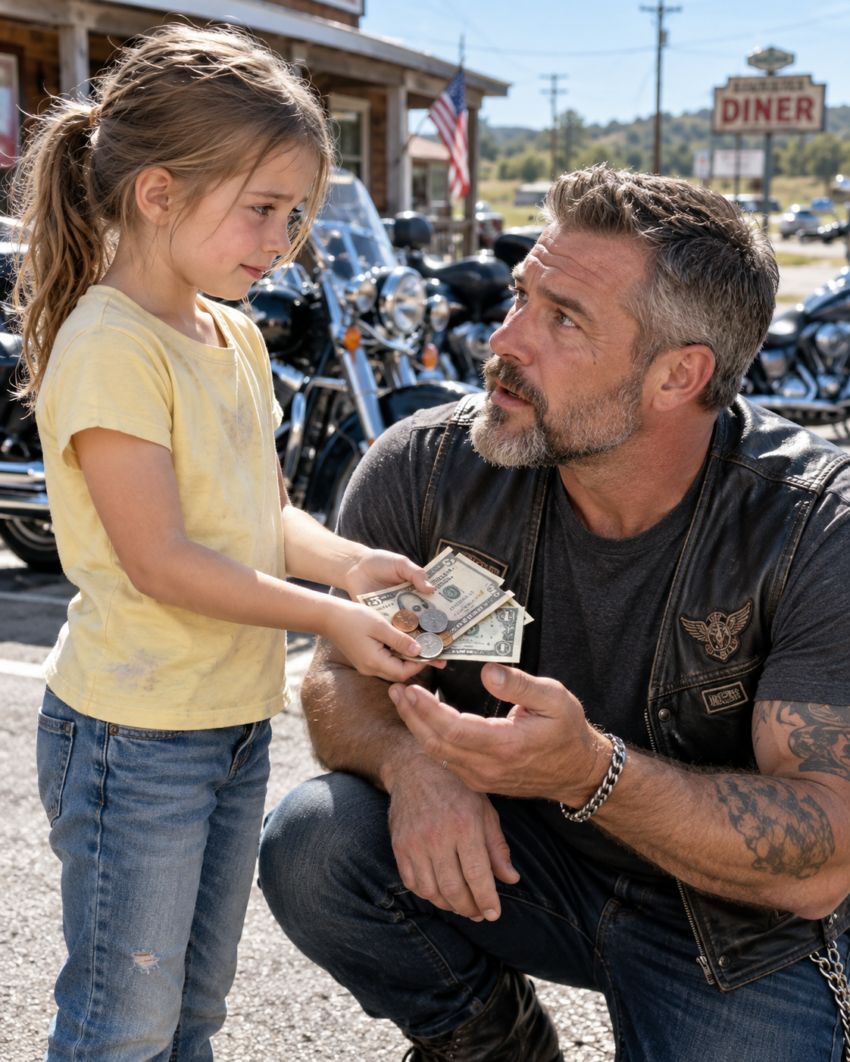
He had barely removed his helmet when a little girl stepped into his path.
She looked about eight years old. Her light-brown hair was tied into a messy ponytail, her sneakers were dusty, and her pale-blue shirt hung loosely over her small shoulders.
She held something tightly in her right hand.
“Excuse me, sir. Can I hire you?”
Garrett looked down, surprised.
“Hire me for what, sweetheart?”
The girl opened her fist.
Inside were a folded five-dollar bill, two one-dollar bills, four dimes, and three pennies.
Seven dollars and forty-three cents.
“I need someone who looks scary enough to make two men leave my mommy alone.”
The six bikers standing behind Garrett became silent.
He crouched so that his eyes were level with hers.
“What’s your name?”
“Maisie.”
“Well, Maisie, I’m Garrett. Why do you think your mom needs help?”
The girl hesitated.
Then she turned her face slightly, revealing a faint purple mark near her cheekbone.
“They came to our house yesterday. They wanted Mommy to sign some papers, but she wouldn’t. This morning, one of them grabbed my backpack when I tried to leave.”
Garrett’s expression changed.
“Did your mother tell you to come here?”
Maisie nodded.
“She said if those men came back, I should run to Mrs. June’s diner. Mrs. June told me your motorcycle club helps people, so I waited for you.”
Garrett glanced toward the diner.
Through the front window, an older woman was watching them anxiously.
“How far did you walk?”
“A little over a mile. I know the way because Mommy and I come here for pancakes.”
Garrett looked at the money again.
Something about the exact amount stirred a memory he had spent years trying to bury.
But he pushed it aside.
“Keep your money, Maisie. Helping your mom doesn’t cost anything.”
The girl shook her head.
“Please take it. I want you to promise you’ll help her.”
Garrett slowly accepted the bills and coins.
“All right. I promise we’ll find out what’s happening. And we’ll do it the right way.”
For the first time, Maisie smiled.
The Envelope Behind the Counter
Inside the diner, June Bennett, a sixty-seven-year-old widow who had owned the place for nearly thirty years, immediately brought Maisie a grilled cheese sandwich and a glass of lemonade.
Garrett sat across from the child while his friend, Russell, called the club’s attorney.
June placed a large brown envelope on the table.
“Her mother gave her this before sending her here,” June explained. “I called the sheriff’s office earlier, but the deputy who came didn’t seem interested.”
Garrett examined the outside of the envelope without opening it.
“Do you know what’s inside?”
“Property records, trust documents, and an old birth certificate. Her mother told her not to let anyone take them.”
Maisie looked up from her sandwich.
“Mommy said Uncle Warren wants to take our house.”
“Is Warren really your uncle?” Garrett asked.
“He’s Mommy’s uncle. He used to visit us, but now Mommy gets upset whenever he calls.”
June lowered her voice.
“Maisie’s father passed away in a construction accident two years ago. Her mother has been raising her alone. Warren started showing up more often after her grandmother died.”
Garrett looked toward the child.
“Where’s your mom now?”
“At home. The men were still there when I left.”
Garrett immediately stood.
“June, please keep Maisie here with you. Russell and I are going to check on her mother.”
Maisie caught his sleeve.
“You won’t hurt anybody, will you?”
Garrett looked into her worried eyes.
“No, sweetheart. We’re going to make sure everyone is safe, and we’re bringing a lawyer.”
She released his sleeve.
“Okay. Then you can keep my money until you finish.”
Garrett placed the seven dollars and forty-three cents carefully inside his wallet.
He did not understand why his hands were trembling.
The Woman Standing on the Porch
Twenty minutes later, the Cedar Ridge Riders arrived outside a modest white farmhouse surrounded by oak trees.
A black SUV stood in the driveway.
Two men were arguing near the front porch.
One was a well-dressed man in his late fifties. The other was younger and considerably larger, wearing a gray sport coat despite the heat.
Garrett parked on the public roadside.
The other bikers followed.
The older man approached them immediately.
“This is private property. What are you doing here?”
“My name is Garrett Whitmore. We came to check on the woman who lives here.”
The man’s face changed.
For a moment, he seemed unable to speak.
“Whitmore?”
“That’s right. And you are?”
“Warren Bellamy.”
The name meant nothing to Garrett.
But Warren continued staring at him with an expression that looked strangely like fear.
The younger man stepped forward.
“I’m Travis Keene, a private security contractor. You’re interfering with a family matter.”
Garrett remained calm.
“Then the homeowner can tell us herself whether she wants us here.”
At that moment, the front door opened.
A woman in her late twenties appeared.
She wore jeans and a simple cream-colored blouse. Her dark-blond hair was pulled behind her head, and there was a tiredness in her face that made her look older than she was.
“What’s going on?” she asked.
Warren turned sharply.
“Claire, go back inside.”
She ignored him.
Her attention had settled on Garrett.
The color slowly drained from her face.
Garrett experienced an equally unsettling feeling.
Her eyes were familiar.
So was the way she pressed her lips together when she was frightened.
He had seen that expression before.
A very long time ago.
“Are you Maisie’s mother?” he asked.
She nodded.
“Is she safe?”
“She’s with June at the diner. She’s eating lunch.”
The woman covered her mouth with one hand.
“Thank goodness.”
Garrett continued.
“She said these men have been pressuring you to sign documents.”
Warren interrupted.
“This doesn’t concern you.”
Claire turned toward him.
“You don’t get to decide that anymore.”
Then she looked back at Garrett.
“Did Maisie give you any money?”
He frowned.
“Seven dollars and forty-three cents.”
Claire staggered backward.
Warren closed his eyes.
And Garrett suddenly felt the world around him grow terribly quiet.
A Name Buried for Nineteen Years
“Where did she get that money?” Claire whispered.
“She said she’d been saving it.”
Claire shook her head.
“No. She found it in an old blue keepsake box in my closet.”
Garrett felt his heartbeat quicken.
A blue box.
Seven dollars and forty-three cents.
He remembered a little girl sitting at their kitchen table, carefully arranging coins into small piles.
She had been eight years old.
Her name was Hannah.
His daughter.
“Daddy, don’t spend it yet. It’s for your birthday.”
Garrett had smiled and promised.
That had been one of the last afternoons they spent together.
Months later, while Garrett was serving a sentence following a serious bar altercation, he received devastating news.
His former wife and daughter had reportedly died in a house fire in New Mexico.
He had been given official-looking documents.
There had even been photographs of a memorial service.
For nineteen years, he had believed his little girl was gone.
Garrett stared at Claire.
“What was your name when you were little?”
Her eyes filled with tears.
Warren stepped toward her.
“Claire, you don’t have to answer him.”
She moved away.
“My name was Hannah Whitmore.”
Garrett’s knees nearly gave way.
“Hannah?”
She nodded slowly.
“My mother changed my name after we moved. She told me my father had died while I was young.”
Garrett struggled to breathe.
“I was told you died in a fire.”
Claire began crying.
“I found out six months ago that you might still be alive.”
For several seconds, neither moved.
Then Garrett whispered:
“I’ve spent nineteen years believing I buried my little girl.”
Claire looked toward Warren.
“And you’ve spent nineteen years knowing that wasn’t true.”
Warren said nothing.
Garrett understood that silence better than any confession.
The woman standing before him was his daughter.
And the frightened little girl who had hired him was his granddaughter.
The Truth About the Fire
Their attorney, Martin Sloane, arrived shortly afterward.
At Claire’s request, everyone returned to June’s diner, where they could speak privately.
Garrett sat across from the daughter he had believed was gone.
He wanted to embrace her.
He wanted to ask about every birthday, every Christmas, and every ordinary afternoon he had missed.
But he remained still.
Claire deserved time to understand what had happened.
Eventually, she began explaining.
Her mother, Patricia, had left Garrett after years of arguments and his growing problems with alcohol.
“She was frightened of the person you had become,” Claire said quietly.
Garrett nodded.
“She had reasons to be.”
He did not attempt to excuse his past.
“I wasn’t the father you deserved. I know that.”
Claire wiped her eyes.
“But she shouldn’t have told us each other was dead.”
“No,” Garrett answered. “She shouldn’t have.”
Claire explained that Patricia’s brother, Warren, had helped them relocate to New Mexico.
After an unrelated fire destroyed an unoccupied family property, Warren used connections to obtain falsified identification and death-related records.
Those documents were presented to Garrett’s family as proof that Patricia and Hannah had died.
Patricia and her daughter moved again, eventually settling in Texas under new names.
The deception had not legally erased Hannah’s original identity. Instead, it had created a false paper trail that nobody close to Garrett had successfully challenged.
“Mom admitted some of it before she passed away,” Claire said. “She said she wanted to protect me, but eventually she became afraid to tell the truth.”
Garrett looked down at his hands.
“I got sober fourteen years ago. I started my repair shop. I tried to become someone you wouldn’t have been afraid of.”
Claire studied him.
“I don’t know how to feel about any of this.”
“You don’t have to decide today.”
That answer seemed to surprise her.
For the first time, she reached across the table and touched his hand.
The Twelve-Million-Dollar Secret
Martin spread the trust documents across the table.
The family’s property dispute was more complicated than Maisie had understood.
Claire’s grandmother had established a trust holding the farmhouse and approximately 220 acres of land north of Brenham.
The trust named Hannah Whitmore as its primary beneficiary.
Following Patricia’s death, Warren had attempted to assume control of the trust’s administration.
Three months earlier, an energy company had approached the family about a potential natural-gas lease.
Depending on drilling approvals, production estimates, and future conditions, the proposed agreement could eventually generate payments totaling as much as twelve million dollars.
Warren wanted control before any agreement was finalized.
“These documents aren’t simply about managing property,” Martin explained. “They would have Claire acknowledge that she has no legal connection to Hannah Whitmore and release any claim she might have under the original trust.”
Claire stared at him.
“But I am Hannah Whitmore.”
“Exactly. That’s why they need your signature.”
Garrett looked toward the papers.
“And if she refuses?”
“We challenge Warren’s authority, preserve the trust assets, and establish Claire’s identity through the proper legal process.”
Martin explained that an initial private DNA test could provide useful investigative information, but a court-admissible test would require verified identification and documented sample handling.
They would also need original birth records, historical school files, and evidence concerning the fraudulent documents.
Claire leaned back.
“So he wasn’t just trying to take the land.”
Martin nodded.
“He was trying to make you sign away your connection to the person who owns it.”
Garrett looked toward Maisie, who was coloring quietly beside June.
The little girl had walked more than a mile because she believed her mother needed protection.
Without knowing it, she had interrupted a scheme that might have cost her family everything.
The Evidence Warren Never Expected
The following morning, Warren filed a petition challenging Claire’s identity.
He claimed she was attempting to impersonate a deceased beneficiary.
His filing included copies of the old fire documents and a photograph supposedly showing Hannah’s memorial.
But Martin had already contacted a Texas Ranger investigator after identifying inconsistencies in the records.
The investigator discovered that several documents had been altered years after their supposed issuance.
The sheriff’s office had also failed to preserve an earlier complaint involving Warren’s attempts to pressure Claire.
Further examination revealed that a senior local official had received unexplained payments from a business associated with Warren.
The Texas Rangers began investigating possible evidence concealment and official misconduct.
Meanwhile, June revealed that she had placed Claire’s original documents in a bank safe-deposit box before anyone could remove them.
“I’ve owned this diner for thirty years,” she told Martin. “I know when somebody is more interested in paperwork than in people.”
The original records proved essential.
A preliminary DNA test strongly supported Garrett and Claire’s biological relationship.
Several weeks later, properly documented testing, together with historical records, provided the evidence needed for court proceedings.
The court issued orders protecting the trust property while Claire’s identity claim was reviewed.
Warren’s attempt to obtain control failed.
As investigators continued examining the fraudulent records, Warren eventually agreed to cooperate.
The evidence established that he had knowingly helped conceal Claire’s original identity and had later used that deception to pursue control of the trust.
The case did not end with one dramatic courtroom speech.
It took months of records, interviews, legal hearings, and careful work.
But eventually, Claire’s identity as Hannah Whitmore was legally established.
She chose to continue using the name Claire, the name she had lived with for most of her life.
Garrett respected that decision.
The Blue Box
One evening, after the legal proceedings had begun, Claire invited Garrett to her home.
Maisie was asleep upstairs.
On the kitchen table sat a small blue wooden box.
Claire opened it carefully.
Inside were childhood photographs, a faded ribbon, and a handwritten birthday card.
At the bottom was a letter from Patricia.
Claire handed it to Garrett.
He recognized his former wife’s handwriting immediately.
The letter explained why she had left, why she had been afraid, and why she had eventually regretted allowing that fear to become a permanent lie.
She acknowledged that Garrett had changed.
She also admitted that she had denied their daughter the opportunity to decide for herself whether she wanted him in her life.
Near the end, Patricia mentioned the money Hannah had saved for his birthday.
Seven dollars and forty-three cents.
She had kept it in the blue box for nineteen years.
Garrett stared at the letter.
“She remembered.”
Claire nodded.
“I never knew why she kept those particular bills and coins.”
Garrett took the money from his wallet.
He laid it beside the box.
“You spent months saving this for me. You were so proud because you counted every penny yourself.”
Claire began crying.
“And Maisie took it because she thought it was enough to hire someone to protect me.”
Garrett smiled through his tears.
“It turned out to be more than enough.”
Claire looked at him for a long moment.
Then she stood and walked around the table.
“I don’t know how to give us those nineteen years back.”
Garrett rose slowly.
“We can’t. But we can decide what to do with the years ahead.”
This time, when Claire embraced him, he held his daughter for the first time in nearly two decades.
The Grandfather Maisie Hired
Six months later, Garrett sat outside June’s diner beneath the shade of an old oak tree.
Several motorcycles were parked nearby.
Claire had retained her family’s property rights, and the trust was being administered under independent professional supervision.
The energy lease remained subject to negotiations and regulatory approvals.
For the first time in years, she no longer feared losing her home.
More importantly, she and Garrett were learning how to be family again.
Some days were easy.
Other days brought difficult questions.
Garrett never pretended his past had been perfect.
Claire never pretended nineteen missing years could be repaired with a few conversations.
But they kept showing up for each other.
That afternoon, Maisie came running out of the diner carrying three ice cream cones.
“Grandpa Garrett!”
He turned.
Even after months, hearing that name made his chest tighten.
“What is it, sweetheart?”
She handed him a cone.
“I bought you ice cream.”
“Well, thank you. How much do I owe you?”
Maisie considered the question with a serious expression.
Then she smiled.
“Seven dollars and forty-three cents.”
Garrett burst out laughing.
Claire, standing nearby, laughed too.
He reached into his wallet and removed the original bills and coins, now protected inside a small transparent sleeve.
Maisie stared at them.
“You still have my money?”
“I do.”
“Why didn’t you spend it?”
Garrett looked toward Claire.
“Because your mom gave it to me a long time before you did.”
Maisie frowned.
“But Mommy said she didn’t know you when she was little.”
Claire crouched beside her.
“I did know him, honey. I just didn’t know he was still here.”
Maisie thought about that.
Then she looked up at Garrett.
“So when I hired you, I was actually hiring my own grandpa?”
He smiled.
“Looks that way.”
She wrapped her arms around his waist.
“That’s good, because I think you’re the best biker in Texas.”
Garrett held her close.
For nineteen years, he had believed the most important part of his life was gone forever.
Now his daughter stood beside him, and his granddaughter was laughing against his chest.
He could not recover the years he had lost.
He could not undo every mistake.
But he could keep the promise he had made to a frightened little girl outside a roadside diner.
He could be there.
And sometimes, being there was the beginning of everything.
Messages to Remember
Sometimes the smallest act of courage comes from someone the world barely notices, and a frightened child with only a few dollars can accomplish what powerful adults have failed to do for years.
A person’s appearance rarely tells the complete story of their character, because the stranger who looks intimidating may be the very person willing to stand beside a family when everyone else has turned away.
The mistakes we made in the past cannot simply be erased, but genuine change becomes meaningful when we accept responsibility and consistently choose to become better people.
Protecting someone we love should never mean taking away their right to know the truth, because love built on deception can leave wounds that last far longer than the fear that created them.
Money can provide security and comfort, but it cannot replace the birthdays, ordinary conversations, family dinners, and quiet moments that disappear when people are separated by secrets.
Forgiveness does not require pretending that nothing happened, and rebuilding trust often means allowing another person to ask difficult questions without demanding that they immediately accept our answers.
Children sometimes understand loyalty more clearly than adults do, because they recognize that helping someone in trouble matters more than wealth, reputation, or the approval of others.
The most valuable gifts are not always expensive, since seven dollars and forty-three cents can carry more love, memory, and meaning than an inheritance worth millions.
A family reunion is not the end of a painful journey but the beginning of a new relationship that must be built through patience, honesty, respect, and the willingness to remain present.
And perhaps the greatest lesson is that while we cannot return to yesterday and change the choices that separated us, we can still choose kindness today and create a tomorrow worth sharing with the people we love.