PART 1 — THE SUMMER MY PARENTS LEFT ME BEHIND
“YOU’RE NOT COMING WITH US, DANIEL. YOUR SISTER DESERVES A NICE VACATION, AND YOU’LL BE JUST FINE AT GRANDPA’S.”
I was seven years old when my mother said those words and handed me a pillowcase stuffed with my clothes.
My five-year-old sister, Sophie, had a brand-new pink suitcase. My parents had packed three large bags for their vacation to Florida. I had six T-shirts, two pairs of jeans, and a pair of sneakers with a hole beginning to form near the toe.
What I didn’t know was that my grandfather would give me something that summer and make me promise never to show it to my mother.
Seventeen years later, when she arrived at his ranch demanding that I sign away my rights to the property, I finally understood why.
The Boy With the Pillowcase
My name is Daniel Bennett. I grew up outside Fort Worth, Texas, in a family that looked perfectly ordinary from the outside.
My father, Richard, managed a car dealership. My mother, Patricia, worked as a bookkeeper for a private company. We lived in a comfortable house, attended church on Sundays, and had family photographs hanging along the staircase.
My sister Sophie was two years younger than I was.
She was cheerful, outgoing, and had a way of making adults smile simply by walking into a room. I loved her. When she was little, I tied her shoes and let her borrow my favorite toys.
But somewhere along the way, my parents began treating us as though we belonged to different families.
Sophie received birthday parties at restaurants, new clothes before every school year, and invitations to accompany our parents everywhere.
I was expected to understand when money was tight.
That first summer, my mother drove me to my grandfather’s cattle ranch about an hour outside Fort Worth.
Grandpa Ernest was her father. He’d spent his entire adult life raising cattle, growing hay, and maintaining several hundred acres that had belonged to our family for generations.
When we pulled into his driveway, I asked where my suitcase was.
“You don’t need a suitcase,” Mom answered. “You’re staying here for a few weeks.”
“Are we going to Florida afterward?”
Dad laughed as he adjusted the luggage in the back of our SUV.
“Not this time, buddy. You get to learn what ranch life is all about.”
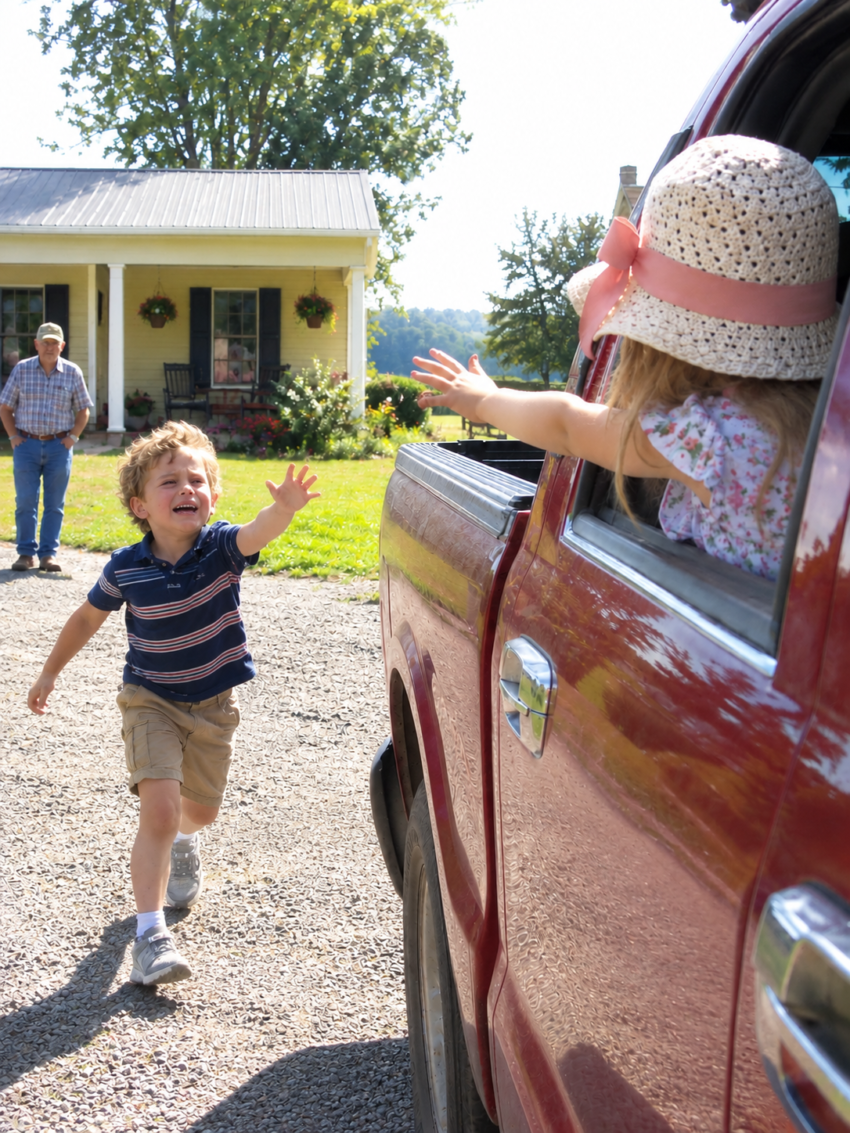
I looked at Sophie. She was wearing a straw hat with a pink ribbon.
“Can I bring Daniel a seashell?” she asked.
Mom smiled at her.
“Of course, sweetheart.”
Then she turned toward Grandpa.
“Make sure he behaves, Dad. And please don’t call us over every little thing.”
Grandpa looked at the pillowcase in my hands.
“How long are you planning to be gone?”
“A couple of weeks. We’ll call.”
She kissed the top of my head without bending down.
A few minutes later, their SUV disappeared down the gravel road.
I stood beside Grandpa, watching the dust settle.
“Did I do something wrong?” I asked.
He looked down at me.
“No, son. You didn’t.”
He took the pillowcase from my hands.
“Come on. Let’s get you settled.”
The Man Who Stayed
Grandpa’s house smelled of coffee, leather, and old wood.
He gave me the bedroom overlooking the pasture. The quilt on the bed was faded, and the dresser had belonged to his father.
That first night, I cried into my pillow.
At six the following morning, Grandpa knocked gently on the door.
“You awake, Daniel?”
I shook my head beneath the blanket.
“Well, the cattle are. Come have some breakfast.”
He didn’t tell me to stop crying.
He made scrambled eggs, toast, and a glass of orange juice. Then he took me outside and showed me how to refill the water troughs and help measure feed.
He never expected me to handle anything dangerous or too heavy. Most days, I followed him around, asking questions while he worked.
When I got tired, we rested in the shade.
When I scraped my knee, he cleaned it and found a bandage.
And when I asked whether my parents were coming back soon, he didn’t invent excuses.
“They said they would,” he answered.
Two weeks passed.
Then three.
By the end of July, I had stopped asking every morning.
Mom called occasionally, usually to ask Grandpa whether I was behaving.
Once, Sophie shouted into the phone that she’d seen dolphins.
I smiled while she talked.
Afterward, I went behind the barn and cried.
Grandpa found me sitting on an overturned bucket.
He didn’t ask me to explain.
He sat beside me, peeled an orange, and handed me half.
We stayed there until I was ready to go inside.
Every Friday, Grandpa took out a small notebook and wrote down the things we’d accomplished together.
He gave me a few dollars for helping.
“What’s this for?” I asked the first time.
“For your candy fund.”
“Are you going to pay me every week?”
He smiled.
“Something like that. But the important part comes in August.”
I assumed he was saving up to buy me a bicycle.
I was wrong.
The Little Brass Washer
Near the end of August, Grandpa took me into town.
We had breakfast at a diner, then visited an attorney named Mr. Caldwell, whose office was above a hardware store.
Grandpa spoke with him for almost an hour while I colored pictures at a small table.
At one point, Mr. Caldwell showed me a document and asked me to write my name on a separate sheet.
“What’s it for?” I asked.
Grandpa smiled.
“Just practicing your signature, son.”
I didn’t understand why the attorney laughed.
Years later, I learned that the real property documents were being handled through a carefully prepared trust. My childhood signature had never been part of the legal transfer.
That evening, Grandpa brought me into his workshop.
He opened a drawer filled with bolts, nuts, and brass washers.
He selected one, placed it on his workbench, and stamped a number into the metal.
Then he handed me an old red coffee tin.
“Keep this safe.”
I looked inside.
There was nothing in it except the washer.
“What’s the number mean?”
“It’s something we worked on together.”
“Can I show Mom?”
His expression changed.
He crouched so we were eye to eye.
“Daniel, I need you to promise me something. Don’t show this tin to your mother.”
I frowned.
“Why?”
He considered his answer.
“Because some people get very interested in things once they think those things are worth money.”
I didn’t understand.
He opened his notebook and wrote the same number beside a rough drawing of the ranch.
“One day, when you’re older, I’ll explain.”
I placed the washer inside the tin and snapped the lid shut.
That night, I tucked it beneath my bed.
I thought it was simply a souvenir.
I had no idea Grandpa was beginning something that would change my life.
Eleven Summers
My parents came for me just before school started.
Sophie had a suntan, a suitcase full of souvenirs, and dozens of photographs.
Mom brought me a T-shirt from a beach shop.
It was two sizes too big.
The following summer, they left me at the ranch again.
And the summer after that.
I learned about Florida, California, Hawaii, and even Paris through photographs on our refrigerator.
At eleven, I discovered that my parents had celebrated Sophie’s birthday at a beachfront hotel with several cousins and one of her friends.
Nobody had told me there was going to be a party.
I asked Mom why I hadn’t been invited.
“Oh, Daniel, don’t start. You know your grandfather counts on you during the summer.”
“But I wanted to go.”
She sighed.
“Your sister doesn’t get the same opportunities you do. You have the ranch.”
I remember staring at her.
I couldn’t understand how being left behind was supposed to be a privilege.
That night, Grandpa found me looking at the vacation photographs.
“Does it hurt?” he asked.
I nodded.
He sat beside me.
“Then I’m not going to tell you it shouldn’t.”
He made hot chocolate, and we talked until the house grew quiet.
As I got older, he taught me to repair irrigation pumps, maintain fencing, recognize problems with livestock, and drive the tractor under his supervision.
Each August, we visited Mr. Caldwell.
Each August, Grandpa added another numbered brass washer to the red tin.
When I was thirteen, I finally asked what they represented.
“They’re reminders of things you’ve helped build,” he answered.
“Are they worth anything?”
Grandpa smiled.
“Not much at the hardware store.”
I laughed.
He didn’t.
When I was fifteen, I asked my parents if I could come on vacation for once.
Mom was making dinner.
“We’ve already booked four seats,” she said.
“But there are four of us.”
She didn’t look up.
“Sophie invited her best friend. She’s been having a difficult year.”
“What about me?”“You have Grandpa. Besides, he needs your help.”
I walked away before she could see me cry.
That summer, Grandpa told me something about my mother I’d never known.
He admitted he’d been a demanding father.
“I worked your mother too hard when she was little,” he said. “I thought feeding her and keeping a roof over her head was enough. I didn’t listen when she told me she wanted a different life.”
“Is that why she hates the ranch?”
He looked across the pasture.
“Maybe. But what I did wrong doesn’t excuse what she’s doing to you.”
It was the first time I understood that Grandpa carried regrets of his own.
The Washer Marked HOME
When I was seventeen, a terrible hailstorm damaged much of our hay crop.
Grandpa and I spent days repairing fences, clearing debris, and arranging help from neighboring ranchers.
At the end of August, he gave me the eleventh washer.
This one was different.
Instead of a number, he’d stamped a single word into the brass.
HOME.
“Why does this one say that?” I asked.
He turned it over in his palm.
“Because everybody ought to have a place where they know they belong.”
We visited Mr. Caldwell again.
Grandpa signed several documents, and the attorney placed them in a thick folder.
“You’ll understand all of this when the time comes,” Grandpa told me.
I wanted to ask more questions.
But I’d learned that when he made a promise, he kept it.
A few months later, I received a partial scholarship to study agricultural engineering at Texas A&M.
My parents barely reacted.
When I asked about the college savings Grandpa had been sending them for years, Mom finally admitted she’d used the money.
“There were family expenses, Daniel.”
Those expenses included vacations, Sophie’s dance lessons, and celebrations I’d never attended.
Grandpa had sent approximately $22,000 toward my education.
He was furious when he learned what had happened.
But he didn’t ask me to fight my parents.
Instead, he paid the remaining cost of my first semesters directly to the university and told me to concentrate on studying.
I graduated, found work with an agricultural equipment company, and continued helping him on weekends.
My parents rarely called.
Until I was twenty-four.
The Day My Mother Came for the Ranch
One morning, our ranch foreman, Julian, called me before sunrise.
Grandpa had fallen and fractured his hip.
I drove straight to the hospital.
When I arrived, Mom was standing outside his room speaking with an attorney.
“Your grandfather can’t manage the ranch anymore,” she announced.
“He’s had an accident, Mom. That doesn’t mean he can’t make decisions.”
She crossed her arms.
“I have power of attorney. Somebody has to take responsibility.”
I asked Grandpa how he was feeling.
He was uncomfortable but alert.
“I’ve had better mornings,” he said. “Don’t let anybody sell my cattle while I’m stuck in here.”
I smiled.
“Nobody’s selling anything.”
I believed that.
Two days later, Julian called again.
A surveying crew had arrived near the northern pasture.
A solar energy company was negotiating to purchase a substantial portion of the ranch.
Mom had already signed preliminary documents.
When I confronted her, she barely looked embarrassed.
“Your grandfather needs care, Daniel. Selling part of the ranch is sensible.”
“Did he agree to this?”
“I’m authorized to handle his affairs.”
Then she mentioned a vacation home she and Dad were planning to buy with part of the proceeds.
I stared at her.
“You want to sell Grandpa’s land to buy yourselves a second house?”
She frowned.
“Don’t be dramatic. This property will eventually be family money anyway.”
I called Mr. Caldwell.
He asked me to bring the red coffee tin.
For the first time in seventeen years, I understood that the washers weren’t just memories.
And when my parents arrived at the ranch that afternoon with their attorney, I learned exactly what Grandpa had been protecting.
PART 2 — THE LAND THEY NEVER KNEW WAS MINE
The Name on the Deed
Mom spread several property records across Grandpa’s kitchen table.
Dad stood beside her, looking impatient.
“Explain this,” she demanded.
I looked at the documents.
The ranch had originally covered approximately 640 acres.
According to the county records, Grandpa still owned about 200 acres.
The remaining 440 acres, including the farmhouse, barns, and main access road, were held in a trust established for my benefit.
Mom pointed to my name.
“How long have you known about this?”
“I haven’t.”
Dad gave a bitter laugh.
“You expect us to believe you didn’t know your grandfather was giving you hundreds of acres?”
“I knew he was teaching me to run the ranch. That’s all.”
Mom leaned forward.
“You took advantage of an old man. We’re going to challenge every one of these transfers.”
My hands were shaking.
I went to my old bedroom, retrieved the red tin, and carried it back to the kitchen.
I poured eleven brass washers onto the table.
Each numbered piece corresponded to a section of the ranch marked on Grandpa’s old map.
The final washer said HOME.
Mom stared at it.
Before she could speak, Sophie entered the room.
She’d driven down after hearing about Grandpa’s accident.
She picked up one of the documents.
“Mom, what is this?”
“Stay out of it, Sophie.”
But Sophie kept reading.
Then she held up another page.
“This says Grandpa revoked your power of attorney six years ago.”
The room fell silent.
Beside the acknowledgment of notice was Mom’s signature.
She had known.
Or at the very least, she’d signed paperwork acknowledging that the authority she was now claiming had been withdrawn.
Mom reached for the page.
“That doesn’t prove anything.”
Sophie stepped back.
“Then why were you trying to sell land that doesn’t belong to you?”
Dad turned toward me.
“This is all your doing.”
For the first time in my life, I didn’t lower my eyes.
“No, Dad. I didn’t sign those documents. And I didn’t bring a buyer onto Grandpa’s property.”
I gathered the washers and put them back in the tin.
“We’re going to let Grandpa’s attorney explain what happened.”
What the Washers Really Meant
Mr. Caldwell arrived the following morning with a thick folder.
We sat at the kitchen table where Grandpa and I had eaten breakfast for seventeen summers.
The attorney explained that Grandpa had begun planning for the ranch’s future when I was seven.
He’d established a trust and gradually transferred specific parcels into it, using properly executed and recorded documents.
As a child, I hadn’t signed away or accepted property on my own. The arrangements had been handled through the trust and its authorized representatives.
Each washer corresponded to a parcel Grandpa intended to preserve for me.
Mr. Caldwell placed the first deed beside the first washer.
“This is the pasture where you learned to feed calves.”
He picked up the second.
“And this covers the water system you helped your grandfather maintain.”
One by one, he matched the washers to the land records.
Finally, he reached the piece marked HOME.
“Your grandfather wanted you to have the house and the surrounding property,” he said. “He wanted you to know you’d always have somewhere to return.”
I couldn’t speak.
For eleven summers, I’d believed those little brass pieces were souvenirs.
Now I understood that Grandpa had been quietly making sure I wouldn’t lose the only place where I’d ever felt completely welcome.
“Why didn’t he tell me?” I asked.
Mr. Caldwell closed the folder.
“He wanted you to grow up without feeling that your relationship depended on what you might inherit. And he was concerned about your mother’s involvement.”
He also showed us the paperwork documenting the revocation of Mom’s power of attorney.
The notice had been sent and acknowledged years earlier.
That didn’t automatically resolve every possible dispute, he explained, but it raised serious questions about the documents she’d recently signed.
Then he produced another folder.
It contained the bank records of the money Grandpa had sent toward my college education.
Mom had admitted she’d spent those funds on family expenses.
Now we had the records to support a formal request for repayment.
“Your grandfather doesn’t want revenge,” Mr. Caldwell said. “He wants his decisions respected.”
I looked at the red tin.
For the first time, I felt the weight of what Grandpa had spent years preparing.
The Conversation at the Hospital
That afternoon, I returned to the hospital.
Grandpa was eating gelatin when I walked in.
I placed the HOME washer on his bedside table.He studied it.
Then he smiled.
“Well, it’s about time you figured that out.”
I sat beside him.
“Why did you give me all that land?”
His smile faded.
“Daniel, I didn’t give you land as payment for loving me.”
“I know.”
“I need you to understand that.”
He looked toward the window.
“When your mother was growing up, I made her work too hard. I thought that was how children learned responsibility. I rarely thanked her, and I didn’t listen when she told me she wanted a different life.”
I’d heard some of this before.
But never with such sadness in his voice.
“I lost my daughter long before she left this ranch,” he continued.
I took his hand.
“You didn’t have to give me anything to make me love you.”
“I know, son.”
He squeezed my fingers.
“That’s why I could.”
For a while, neither of us spoke.
Then he told me that Mom had visited with someone who wanted him to sign additional property documents.
He’d refused without consulting Mr. Caldwell.
The hospital had recorded the visit.
“She cried when I said no,” he told me.
“Did you feel sorry for her?”
He looked tired.
“I felt sad. That’s different.”
I thought about the little boy who’d arrived at the ranch carrying a pillowcase.
Grandpa had never made me feel like an inconvenience.
He’d given me work appropriate for my age, taught me patiently, and listened when I was unhappy.
“When your mother left you here that first summer,” he said, “I recognized something I didn’t like. You were beginning to feel the way she once felt with me.”
He looked directly at me.
“I couldn’t make your parents include you. But I could make sure you always had a home.”
I leaned forward and hugged him carefully.
He patted my shoulder.
“Now quit worrying about me and make sure Julian gets those cattle fed.”
I laughed through my tears.
Even in a hospital bed, he was still Grandpa.
The Hearing
Mom filed a petition seeking authority over Grandpa’s financial affairs, arguing that his age and recent injury made him unable to manage the ranch.
She also threatened to challenge the trust transfers.
Mr. Caldwell arranged for an independent medical evaluation.
Grandpa was recovering from his hip fracture, but the assessment found that he remained capable of understanding and communicating his decisions.
At the hearing, Mom’s attorney pointed to the confusion Grandpa had experienced immediately after his accident.
Mr. Caldwell presented the later evaluation, the recorded trust documents, and the revocation of Mom’s power of attorney.
The judge explained that age and a physical injury alone were not enough to justify removing someone’s decision-making authority.
Grandpa attended in a wheelchair.
He wore his best blue shirt.
When asked whether he’d intended to transfer land into the trust for my benefit, he answered without hesitation.
“Yes, Your Honor.”
“And why did you make those arrangements?”
Grandpa looked toward me.
“My grandson spent eleven summers helping me on that ranch. But I didn’t give him land because of the work. I gave it to him because I wanted him to have a home.”
He paused.
“I made mistakes raising my daughter. I didn’t listen to her enough, and I regret that. But I won’t let anybody tell me I don’t understand what I’ve done with my own property.”
Mom looked down.
The judge declined to appoint someone to take over Grandpa’s affairs on the evidence presented.
Any separate challenge to the trust or property transfers would have to be pursued through the appropriate legal process.
Outside the courthouse, Mom walked past me without speaking.
Dad followed her.
Sophie stayed.
“Daniel,” she said quietly, “I’m sorry.”
I looked at her.
“You didn’t know.”
“Mom always told me you wanted to stay at the ranch. She said you hated traveling.”
I shook my head.
“I asked to go every year.”
Her eyes filled.
“I wish I’d known.”
I put my arm around her.
“We were kids, Sophie.”
She hugged me.
It was the first time in years that I felt as though I had a sister instead of someone I’d been taught to compare myself with.
What My Parents Lost
Once the solar company learned that my parents didn’t control the parcels they were negotiating to sell, the proposed transaction stopped.
The vacation home they’d planned to purchase was no longer possible.
Through their attorneys, my parents eventually agreed to repay the money Grandpa had sent for my education.
The agreement was documented in writing.
The payment arrived without an apology.
I stared at the bank notification for several minutes.
I remembered being seventeen, asking Mom about my college savings.
She’d told me I needed to learn to take care of myself.
Now the money had been returned.
But it couldn’t replace the birthdays I’d missed, the family vacations I’d never taken, or the years I’d spent wondering what was wrong with me.
I set aside part of it for improvements to the ranch’s irrigation system and kept the rest for future professional plans.
I didn’t call my parents.
For the first time, I didn’t feel compelled to explain my choices to them.
A Place for Both of Us
Two weeks later, Grandpa came home from the hospital.
Sophie drove behind us.
As soon as we arrived, Grandpa insisted on checking on a pregnant cow.
“The doctor said you’re supposed to rest,” I reminded him.
“I can rest while looking at my cattle.”
We took him to the pasture in his wheelchair.
He watched the animals for several minutes, looking more content than I’d seen him in weeks.
Then he asked us to bring him into the workshop.
The room still smelled of oil, wood, and metal.
For eleven summers, I’d walked into that room and received a brass washer without understanding its meaning.
Grandpa pointed toward a drawer.
“Open that, Daniel.”
Inside was a new washer.
It hadn’t been stamped.
I picked it up.
“Who’s this for?”
Grandpa looked toward Sophie.
She stood in the doorway wearing spotless sneakers and looking uncertain.
“I hear this young lady is my granddaughter, too,” he said.
Sophie laughed.
“I am, Grandpa. But I don’t know the first thing about ranching.”
“Well, that can be fixed.”
She stepped closer.
“Would you really let me come out here and learn?”
Grandpa nodded.
“This house is open to you, Sophie. But nobody’s going to make you stay.”
She looked at the washer.
Then she looked at me.
“I’d like that.”
For once, I didn’t feel as though my sister was receiving something I’d been denied.
I felt as though we were finally getting the chance to know each other.
Grandpa slipped the washer into his shirt pocket.
“Then breakfast is at six.”
Sophie’s eyes widened.
“Six in the morning?”
Grandpa laughed so hard he had to wipe his eyes.
It was the same hour he’d woken me on my first morning at the ranch.
But this time, nobody had decided for us.
The Red Coffee Tin
That evening, I carried the red tin into my old bedroom.
I placed all eleven washers on the desk.
Each one held a memory: a newborn calf, a broken water pump, a difficult harvest, a long afternoon beside the barn.
I thought about the seven-year-old boy who’d arrived with his clothes in a pillowcase.
He’d believed his family had left him behind because he mattered less than his sister.
I wished I could tell him that the quiet man waiting on the porch wasn’t going to replace everything his parents had withheld.
But he would give him something they hadn’t.
A place where he was wanted.
I put the washers back in the tin and set it beside my bed.
The following morning, someone knocked on my door.
It was Sophie.
She wore old jeans, borrowed boots, and her hair tied back.
“Daniel, are we going to work or what?”
I glanced at the clock.
It was ten minutes before six.
I smiled and reached for my hat.
For the first time in our lives, my sister and I were heading to the same place.
And this time, neither of us was being left behind.