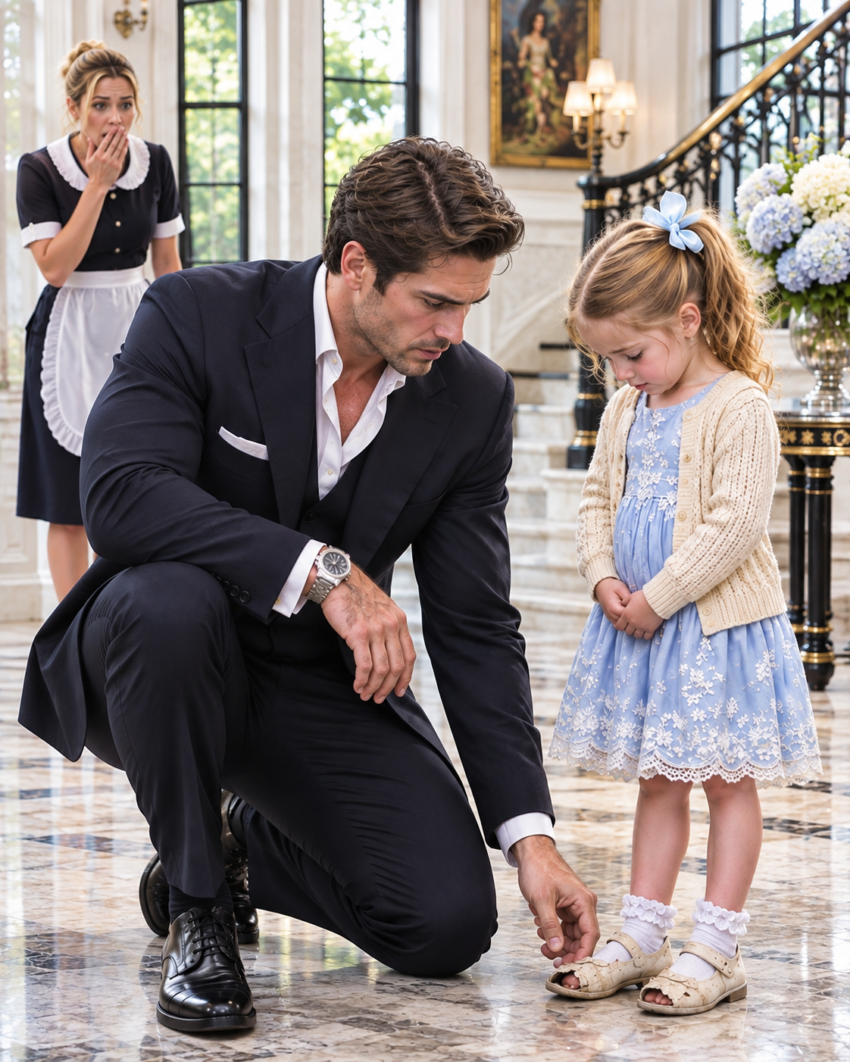
The Little Girl With Broken Shoes Who Changed a Powerful Man’s Heart
My five-year-old daughter was sitting on our bedroom floor, carefully pressing the loose sole of her shoe back into place with school glue.
When she noticed me watching, she smiled proudly.
“Look, Mommy. I fixed it! Now you don’t have to spend money on new shoes.”
I wanted to smile back, but my heart ached.
My little girl was only five, yet she already understood that we couldn’t afford everything we needed.
A few hours later, that same child would be standing inside the mansion of one of the most feared businessmen in Philadelphia.
And when the owner, Conrad Blackwell, discovered her hiding in his kitchen, I was certain I would lose the only job keeping us from becoming homeless.
But then he noticed her broken shoe.
He walked toward her, slowly lowered himself to her eye level, and did something nobody in that mansion expected.
Before I tell you what happened, you need to understand why my daughter was there in the first place.
Chapter 1: The Shoes My Daughter Tried to Save
My name is Natalie Brooks. I was thirty-one years old, a single mother living in a small apartment in South Philadelphia with my daughter, Maisie.
Our apartment had two bedrooms, although the second was barely large enough for a child’s bed and a little dresser.
The kitchen cabinets were old, the heating sometimes stopped working, and our landlord had been asking about the rent for weeks.
But it was our home.
And as long as Maisie had somewhere warm to sleep, I told myself we were doing all right.
That Tuesday morning, I woke to the smell of school glue.
I followed it into our bedroom and found Maisie sitting cross-legged on the carpet.
Her favorite pink sneakers were spread out in front of her.
One was still wearable. The other had a sole that had almost completely separated from the front.
She was trying to glue it together.
“Sweetheart, what are you doing?” I asked.
She looked up with a cheerful expression.
“I’m fixing my shoe, Mommy. See? If I hold it like this, maybe it’ll stay.”
I knelt beside her.
“You don’t have to do that. I’ll figure something out.”
Maisie shook her head.
“But new shoes cost money. And you need money for our house.”
For a moment, I couldn’t speak.
I had never told my daughter exactly how much we owed.
I had never explained why I sometimes skipped dinner or why I checked my bank account before buying groceries.
But children notice more than adults realize.
Maisie had noticed every time I put something back on a store shelf.
She had noticed when I said we would buy new clothes another week.
And apparently, she had noticed how worried I looked whenever another bill arrived.
I pulled her into my arms.
“Listen to me, sweetheart. Taking care of you is my job. You don’t have to worry about money.”
She hugged me tightly.
“I just wanted to help.”
I kissed her forehead.
“I know you did, baby.”
What I couldn’t tell her was that I had only forty-three dollars left until payday.
We were three months behind on rent, and the pharmacy was holding a prescription I couldn’t yet afford to collect.
I had promised myself that Maisie would never feel responsible for those problems.
Yet there she was, trying to repair her own shoes.
Chapter 2: The Job I Couldn’t Afford to Lose
For almost two years, I had worked as a housekeeper at Blackwell Manor, a magnificent estate outside Philadelphia.
The property belonged to Conrad Blackwell, a fifty-three-year-old businessman whose name carried enormous influence throughout the city.
He owned several companies, invested in commercial real estate, and maintained connections with people most ordinary families would never meet.
There were rumors about the way he conducted business.
Some people said he was ruthless.
Others claimed that anyone who challenged him eventually regretted it.
I had no way of knowing which stories were true.
I only knew that everyone inside his mansion treated him with extraordinary caution.
The estate had towering iron gates, polished marble floors, expensive artwork, and rooms so large that my entire apartment could have fit inside one of them.
Every employee followed strict rules.
We were expected to work quietly, avoid unnecessary conversations, and never enter private areas without permission.
Visitors were carefully screened.
And bringing children onto the property was absolutely forbidden.
I had served Mr. Blackwell coffee a handful of times.
He had never asked about my family.
I doubted he even knew my name.
That suited me perfectly.
I didn’t need his attention.
I needed my paycheck.
It paid for groceries, kept our electricity connected, and gave me a chance to catch up on the rent.
Losing that job would have changed everything.
Unfortunately, that Tuesday morning brought a problem I couldn’t solve.
At 5:47 a.m., my phone vibrated.
It was a message from Maisie’s daycare.
A major plumbing problem had forced the building to close immediately.
There was no estimated reopening date.
I read the message twice, hoping I had misunderstood.
Then I called two neighbors.
Neither could watch Maisie.
I considered staying home, but I had already used my available days off when she was sick.
Another unexpected absence might cost me my position.
I sat at the kitchen table, staring at my phone.
“Mommy, are you sad?” Maisie asked.
I forced a smile.
“No, honey. I’m just trying to figure something out.”
She climbed onto the chair beside me.
“Can I help?”
I looked at her little face and made a decision I knew could get me into trouble.
“Actually, sweetheart, you’re going to come to work with me today.”
Her eyes widened.
“To the big house?”
“Yes. But you have to stay very quiet and listen carefully.”
She nodded enthusiastically.
“I promise, Mommy. I’ll be so good.”
I wished she didn’t have to make that promise.
Chapter 3: A Secret in the Mansion Kitchen
We arrived at Blackwell Manor shortly before seven.
Maisie held my hand as we walked through the service entrance.
She wore a pale blue cardigan, a simple cotton dress, and the pink sneakers she had tried to repair.
The glue had already started coming loose.
I tried not to look at it.
Inside the kitchen, the head housekeeper, Mrs. Delaney, stopped what she was doing.
She was a sixty-year-old woman who had worked at the estate for more than a decade.
Her eyes widened when she saw Maisie.
“Natalie, please tell me you didn’t bring a child into this house.”
“I’m sorry, Mrs. Delaney. The daycare closed unexpectedly. I couldn’t find anyone to watch her.”
She glanced toward the hallway.
“You know Mr. Blackwell’s rules.”
“I do. And I wouldn’t ask if I had another choice.”
My voice trembled despite my efforts to stay calm.
“Please. She can sit in the kitchen with her coloring book. She won’t bother anyone. I’ll work through lunch and stay late if necessary.”
Mrs. Delaney looked at Maisie.
My daughter was holding a small notebook against her chest.
“Hello, ma’am,” she said politely.
Mrs. Delaney’s expression softened slightly.
She sighed.
“One day, Natalie. That’s all I can allow.”
Relief washed over me.
“Thank you so much.”
“But she stays in this kitchen. Nobody upstairs is to know she’s here. And whatever happens, don’t let Mr. Blackwell see her.”
I promised.
We found a wooden stool beside the pantry, away from the busy cooking area.
Maisie climbed onto it and opened her coloring book.
“You can draw while Mommy works,” I told her.
“Okay.”
“And please don’t wander around.”
She gave me a serious nod.
“I won’t move, Mommy. I’ll be very quiet.”
I kissed her cheek and hurried to begin my shift.
For the next several hours, I carried dishes, polished furniture, cleaned dining tables, and helped prepare rooms for an afternoon meeting.
Whenever I returned to the kitchen, I checked on Maisie.
She was always exactly where I had left her.
Sometimes she was coloring flowers.
Sometimes she was drawing our apartment.
Once, she showed me a picture of the two of us standing beside a little yellow house.
“That’s our new home someday,” she whispered.
I smiled.
“It’s beautiful, sweetheart.”
“And it has a backyard so we can get a puppy.”
“That sounds wonderful.”
I didn’t tell her how far away that dream seemed.
Chapter 4: The Smallest Person in the Biggest House
By late morning, the kitchen had become busy with preparations for lunch.
Maisie sat quietly, swinging her feet beneath the stool.
That was when I noticed her shoe.
The front sole had separated again.
Each time she moved her foot, it opened a little wider.
She noticed me looking.
Immediately, she stopped swinging her legs.
Then she pressed the broken part against the other shoe, trying to push it back into place.
I pretended not to see.
I knew she was embarrassed.
And I knew she was trying to protect me from another worry.
Mrs. Delaney approached while I was arranging silverware.
“You seem distracted today,” she said.
“I’m sorry. I’ll concentrate.”
She glanced toward Maisie.
For a moment, I thought she might say something about the shoes.
Instead, she simply nodded and returned to work.
I continued cleaning.
Still, I couldn’t stop thinking about my daughter.
She should have been playing with other children.
She should have been laughing, running, and asking questions.
Instead, she was sitting in a corner of a wealthy man’s kitchen, trying to make herself invisible.
I realized with a painful sense of recognition that she had learned that behavior from me.
At work, I kept my head down.
At home, I tried not to complain.
Whenever someone asked how we were doing, I said we were fine.
Maisie had watched me make myself small.
Now she was doing the same thing.
I promised myself that when I received my next paycheck, I would buy her a proper pair of shoes.
Even if I had to delay another payment.
She deserved that much.
I had just returned from the dining room with an empty silver tray when the atmosphere in the kitchen suddenly changed.
A conversation stopped.
Someone put down a utensil.
Mrs. Delaney went completely still.
I turned toward the doorway.
And there stood Conrad Blackwell.
Chapter 5: The Man Nobody Expected to See
I had never seen Mr. Blackwell enter the service kitchen during my shift.
He usually remained in his private office or entertained visitors in the formal rooms upstairs.
But that morning, he stood in the doorway wearing a perfectly tailored charcoal suit.
His dark hair was streaked with silver, and his expression was unreadable.
The room became silent.
I felt my stomach tighten.
Then I remembered Maisie.
She was still sitting beside the pantry, holding a purple crayon.
I looked toward her instinctively.
Mr. Blackwell followed my gaze.
His eyes settled on my daughter.
Then they moved down to her shoes.
He stared at the loose sole for several seconds.
“Whose child is that?” he asked.
His voice was quiet, but everyone heard him.
I tried to answer.
“Mr. Blackwell, I can explain.”
He looked directly at me.
I had spent nearly two years avoiding that moment.
“I asked whose child she is.”
Before I could respond, Maisie climbed down from her stool.
Her broken shoe made a soft tapping sound against the marble.
“I’m Maisie,” she said.
My heart nearly stopped.
She wasn’t trying to be disrespectful.
She was simply answering an adult’s question.
But I knew the rules.
And I knew how easily everything could go wrong.
Mr. Blackwell began walking toward her.
Mrs. Delaney stood motionless.
I gripped the tray against my chest.
Maisie looked down at her shoe.
The sole had opened completely.
She quickly bent over and pressed it together with both hands.
Her small fingers were still marked with dried glue from that morning.
“Sorry,” she whispered.
Mr. Blackwell stopped.
For a long moment, he said nothing.
Then he looked at me.
“Is she your daughter?”
“Yes, sir. Her daycare closed this morning. I had nobody to leave her with, and I couldn’t afford to miss work.”
I swallowed.
“I know children aren’t allowed here. I take full responsibility.”
He didn’t answer immediately.
Instead, he looked back at Maisie.
She was still trying to repair the shoe.
“It came apart again, Mommy,” she said softly.
Those words hurt more than I could explain.
She wasn’t frightened by the enormous mansion or the intimidating man standing in front of her.
She was worried about disappointing me.
I wanted to kneel beside her.
I wanted to tell her that the shoe didn’t matter.
But I was terrified that we were about to lose the income keeping us housed.
Then something unexpected happened.
Conrad Blackwell bent down until his eyes were level with my daughter’s.
Chapter 6: The Question That Changed Everything
Nobody moved.
The most powerful man I had ever met was kneeling on the marble floor in front of a little girl with worn-out sneakers.
He looked at her shoe, then at the glue on her fingers.
“Did you try to fix that yourself?” he asked.
Maisie nodded.
“Yes, sir.”
“Why?”
She glanced at me before answering.
“Because Mommy works really hard, and new shoes cost money.”
The room seemed to grow even quieter.
Mr. Blackwell looked at her for a long moment.
“And you thought fixing them would help your mother?”
“Yes. We have to save money for our house.”
I felt tears gathering in my eyes.
I hadn’t expected her to say that.
I certainly hadn’t expected her to say it to him.
Mr. Blackwell slowly turned toward me.
“Natalie, isn’t it?”
I was stunned that he knew my name.
“Yes, sir.”
“How long have you worked here?”
“Almost two years.”
“And you couldn’t find anyone to watch your daughter today?”
I shook my head.
“No, sir. I’m sorry.”
He studied my face.
Then he looked back at Maisie.
“You know something, young lady? Shoes aren’t supposed to make you work this hard.”
Maisie looked confused.
“They’re not?”
“No. They’re supposed to help you run and play.”
She considered that seriously.
“I like running.”
For the first time, I saw the faintest hint of a smile on his face.
“Then you ought to have shoes that can keep up with you.”
He stood and turned toward Mrs. Delaney.
“Would you bring me a chair, please?”
She hurried to obey.
I didn’t understand what was happening.
He sat near Maisie and asked her what she had been drawing.
Within moments, she was showing him the little yellow house in her coloring book.
“That’s where Mommy and I are going to live someday,” she explained.
He studied the picture.
“Does it have a backyard?”
“Yes. For our puppy.”
“I see.”
Then he looked at me.
“Natalie, when your shift is finished, I’d like a word with you.”
My relief disappeared.
I nodded, convinced that the kindness he had shown Maisie wouldn’t change the consequences of breaking his rules.
Chapter 7: An Unexpected Conversation
The rest of the afternoon passed slowly.
Maisie stayed beside Mrs. Delaney while I finished my duties.
At four o’clock, I was called to Mr. Blackwell’s office.
I walked down the long hallway with my hands trembling.
His office was enormous, with tall windows overlooking the gardens.
He was standing beside his desk when I entered.
“Please sit down, Natalie.”
I sat carefully.
“Mr. Blackwell, I’m truly sorry about this morning. It won’t happen again.”
He raised one hand.
“I’m not asking you here to discuss punishment.”
I looked up.
“You’re not?”
“No. I’m trying to understand something.”
He sat opposite me.
“You have worked here for nearly two years. You’ve been dependable, punctual, and careful. Yet today, you were willing to risk your job because you had nowhere for your daughter to go.”
I lowered my eyes.
“I didn’t know what else to do.”
“Why didn’t you ask for help?”
The question surprised me.
I thought about the rent notices, the pharmacy, and the endless calculations I made before buying groceries.
“Because I didn’t think anyone here would want to hear about my problems.”
He remained silent.
Then he asked about my situation.
I hesitated.
Talking about money had always made me uncomfortable.
But something in his expression encouraged me to be truthful.
I explained that Maisie’s father had left when she was very young.
I told him about our apartment, the overdue rent, and the bills I was struggling to manage.
I didn’t exaggerate anything.
I simply told him what our life looked like.
When I finished, he leaned back in his chair.
“And your daughter knows about all this?”
“Not the details. But she notices things.”
I wiped my eyes.
“I try so hard to keep her from worrying, Mr. Blackwell. But this morning, she was sitting on the floor trying to glue her shoes together because she thought it would save me money.”
For several seconds, he said nothing.
Then his expression changed.
“When I was a boy, my mother worked two jobs,” he said quietly.
I looked at him.
“She used to repair my school clothes at the kitchen table because she couldn’t afford to replace them.”
He glanced toward the window.
“I hadn’t thought about that in years.”
I listened without interrupting.
“Your daughter reminded me of something I should never have forgotten.”
He returned his attention to me.
“People can work very hard and still need help.”
I didn’t know what to say.
Then he reached for the telephone on his desk.
Chapter 8: A Pair of Shoes and a New Beginning
Mr. Blackwell asked his assistant to arrange a few things.
First, he requested that someone take Maisie and me to a children’s shoe store after my shift.
I immediately shook my head.
“Sir, that’s very kind, but you don’t have to do that.”
“I know I don’t.”
He spoke gently.
“I’d still like to.”
Then he explained that the estate would begin offering emergency childcare assistance to employees who faced unexpected family situations.
“No parent should have to choose between keeping a job and making sure their child is safe,” he said.
I stared at him.
For two years, I had believed the mansion’s rules were impossible to change.
Yet a little girl with broken shoes had made him reconsider one of them.
He also asked the household manager to review my wages and available employee assistance.
“You have been a valuable member of this household,” he said. “That should be reflected in how you’re treated.”
I began crying.
Not because everything in my life had suddenly become perfect.
There were still bills to pay and responsibilities waiting for me.
But for the first time in months, I felt as though someone had seen how hard I was trying.
“Thank you,” I whispered.
Mr. Blackwell nodded.
“You don’t need to thank me for listening.”
When I returned to the kitchen, Maisie ran toward me.
“Mommy! Mrs. Delaney said we’re going somewhere!”
I knelt and hugged her.
“We are, sweetheart.”
“Where?”
I smiled through my tears.
“We’re going to get you some new shoes.”
She looked down at her old sneakers.
“But I can try fixing them again.”
I gently shook my head.
“You don’t have to, baby. Not this time.”
That evening, Maisie chose a pair of lavender sneakers with tiny silver stars.
She walked carefully around the store, testing them.
Then she began running in small circles.
Her laughter filled the room.
I watched her and realized how long it had been since I’d heard her laugh without worrying about something.
“Mommy, these don’t come apart!” she announced.
I laughed.
“No, sweetheart. They don’t.”
She ran into my arms.
And for the first time in a long while, I allowed myself to believe that tomorrow might be easier.
Chapter 9: What Really Changed That Day
Over the following weeks, things slowly improved.
The employee assistance program helped me address the most urgent bills, and the adjustment to my wages gave us a little more breathing room.
I began making regular payments toward the rent we owed.
Maisie’s prescription was finally collected from the pharmacy.
And when her daycare had another unexpected closure, I no longer had to panic.
The new childcare arrangements meant I could ask for help without fearing that my job would disappear.
Mr. Blackwell didn’t become a different person overnight.
He was still a serious man.
He still expected employees to do their jobs properly.
And he still rarely smiled.
But something about the household had changed.
Employees were encouraged to speak up when they faced genuine difficulties.
Mrs. Delaney became more patient with unexpected family emergencies.
And I stopped believing that asking for help meant I had failed.
One afternoon, several weeks later, Maisie accompanied me to a small employee family gathering at the estate.
She wore her lavender sneakers.
When she spotted Mr. Blackwell near the garden, she ran toward him.
“Mr. Blackwell! Look! My shoes are still good!”
He glanced down.
“I can see that.”
“I can run really fast in them.”
“Then I suppose you chose the right pair.”
Maisie smiled.
Then she reached into her pocket and handed him a folded piece of paper.
It was a drawing.
A little girl stood beside a tall man in a dark suit.
Both were smiling.
At the bottom, in uneven letters, she had written:
Thank you for my shoes.
Mr. Blackwell looked at the picture for a long time.
Then he carefully folded it and placed it inside his jacket.
“Thank you, Maisie. I’ll keep this.”
I stood a few steps away, watching.
I had once believed that a man like Conrad Blackwell would never notice someone like us.
But that day reminded me that people are often more complicated than the reputations surrounding them.
And sometimes, the smallest acts of kindness reveal the parts of ourselves we have forgotten.
Chapter 10: The Lesson My Daughter Taught Me
Several months later, Maisie and I were sitting together at our kitchen table.
Our apartment was still small.
The furniture was still old.
And we were still learning how to manage our money carefully.
But the rent was current, the refrigerator was full, and I no longer felt frightened every time my phone rang.
Maisie was drawing another house.
This one had a bright red door and a large tree in the backyard.
“Mommy, do you think we’ll live somewhere like this one day?”
I looked at the picture.
“I think we can keep working toward it, sweetheart.”
She smiled.
“And can we have a puppy?”
I laughed.
“We’ll talk about the puppy when we have the backyard.”
She giggled and returned to coloring.
A few minutes later, she looked up again.
“Mommy?”
“Yes, baby?”
“Do you remember when I fixed my shoes?”
I nodded.
“Of course I do.”
“I thought you were going to be sad because they broke again.”
I reached across the table and took her hand.
“Maisie, I was never upset with you about those shoes.”
She looked thoughtful.
“Really?”
“Really. And I want you to remember something.”
She put down her crayon.
“What?”
“You don’t have to solve grown-up problems. You don’t have to worry about bills or rent or whether Mommy has enough money. Your job is to learn, play, laugh, and enjoy being a little girl.”
She listened carefully.
“And your job is to take care of me?”
I smiled.
“That’s right.”
She climbed into my lap and wrapped her arms around my neck.
“I love you, Mommy.”
I held her close.
“I love you more than anything.”
That night, after Maisie fell asleep, I found her old pink sneakers in the back of the closet.
The glue had hardened around the edges, and the left sole was still hanging loose.
I sat on the floor holding them.
Those shoes reminded me of one of the hardest mornings of my life.
But they also reminded me of the moment everything began to change.
I had spent so long believing that being a good mother meant carrying every burden alone.
My daughter had taught me otherwise.
She had shown me that love could be found in the smallest gestures.
In a child’s attempt to save her mother a few dollars.
In a stranger taking the time to listen.
And in a powerful man choosing compassion when he could easily have looked away.
I placed the shoes carefully into a small keepsake box.
Someday, when Maisie was older, I would tell her the whole story.
Not because I wanted her to remember how little we had.
But because I wanted her to understand how much her kindness had meant.
And I hoped she would always remember that she never needed to earn love by sacrificing her own happiness.
She had been worthy of it from the very beginning.
A Message From the Heart
No child should have to worry about whether their parents can afford a new pair of shoes, because childhood should be filled with curiosity, laughter, and the freedom to dream without carrying adult responsibilities.
A mother’s love is often expressed through quiet sacrifices that nobody notices, from skipping personal comforts to working long hours simply to make sure her children have what they need.
Sometimes the people who appear strongest are carrying struggles they rarely discuss, and a little understanding can mean more to them than anyone realizes.
True kindness is not measured by the size of a person’s bank account, but by their willingness to notice someone else’s difficulties and respond with genuine compassion.
A child who tries to help a struggling parent deserves appreciation for that loving heart, but also reassurance that the family’s financial burdens are not theirs to carry.
We should never assume that a person’s job title, clothing, or financial circumstances reveal their worth, because dignity belongs equally to everyone.
Even someone known for being distant or demanding may discover a softer side of themselves when they encounter a moment of unexpected honesty and innocence.
Asking for help does not make a parent weak, and accepting kindness does not diminish the hard work or determination that brought them through difficult times.
The smallest gestures of compassion can create lasting changes, especially when they inspire people to treat others with greater patience, fairness, and respect.
And perhaps the most beautiful lesson of all is that children do not need perfect homes, expensive possessions, or extraordinary lives to feel loved; they need to know that they are safe, cherished, and free to be children.