An 11-Year-Old Burn Survivor Sat Alone at the Hospital Art Table—Then the Biker Everyone Feared Rolled Up His Sleeve and Showed Her the Scar He’d Hidden for 20 Years.
An eleven-year-old girl with burn scars across most of her body sat alone at a children’s hospital art table, trying to paint a sunflower while every other child in the room found a reason to sit somewhere else.
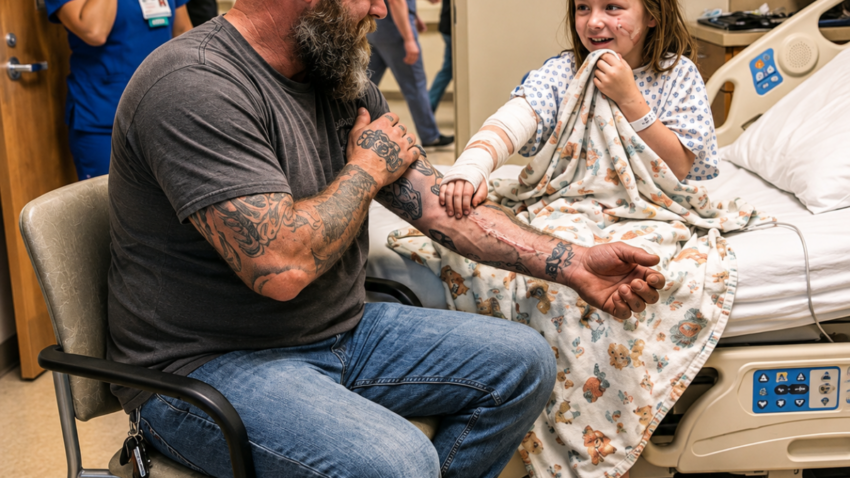
Then Caleb “Iron” Mercer—the six-foot-four, nearly three-hundred-pound biker most parents had been quietly watching since he entered—walked over, rolled his sleeve above his elbow, and exposed a twisted burn scar cutting straight through twenty years of black ink.
Everyone thought he was about to humiliate Lily Harper; none of us knew we were watching the first five minutes of a relationship that would take three years, two sold motorcycles, fifty-two Sundays, one foster-care investigation, and a family-court judge to finish.
My name is Margaret Sloan.
I was a pediatric social worker at Cumberland Children’s Hospital outside Nashville when Lily Harper arrived.
I had worked with injured children for sixteen years.
That sentence sounds more useful than it really is.
Experience can teach you how to explain procedures.
It can teach you how to sit with parents while surgeons are still operating.
It can teach you which silences need filling and which ones should be left alone.
It cannot teach you how to make an eleven-year-old believe her life still belongs to her after fire changes nearly everything she recognizes in the mirror.
Lily’s fire began shortly after midnight in a second-floor apartment.
Investigators eventually traced it to an overloaded electrical outlet connected to an old space heater.
Her mother, Sarah Harper, woke when smoke reached the bedroom.
She wrapped Lily in a wet comforter.
Got her into the hallway.
Then heard a neighbor screaming that his toddler was still inside the apartment across the landing.
Sarah went back.
Firefighters found Lily near the stairwell.
They found the toddler alive beneath Sarah’s body.
Sarah did not survive.
Lily’s father had died in a construction accident when she was four.
Her grandparents were gone.
An aunt in Kentucky became temporary medical guardian, but she was already caring full-time for a husband with advanced Parkinson’s disease.
She called Lily every week.
Loved her.
Wanted to help.
Could not provide the level of daily medical care Lily would need.
That distinction became important later.
People love simplifying stories.
Nobody wanted her.
The biker rescued her.
The scars made families afraid.
Reality was less neat.
Some people loved Lily but lacked the money, physical ability, housing, training, or stability to become her caregiver.
Other people had those things.
And withdrew.
Lily spent six weeks heavily sedated.
When she became alert enough to understand where she was, she asked for her mother.
There is no training that makes that conversation easy.
Recovery did not look inspirational.
Some mornings Lily finished hand therapy while crying silently.
Some mornings she refused to sit up.
PART2:
Some days she screamed during dressing changes before anyone touched her because fear had arrived before pain.
There were grafts.
Compression garments.
Contracture treatment.
Occupational therapy.
Future surgeries.
Skin protection.
Medication.
Pain control.
Nightmares.
Mirrors.
The mirrors became their own battle.
Occupational therapy used them to help Lily understand movement and positioning.
She asked nurses to turn them toward the wall.
After one classmate gasped during a video call, Lily stopped answering calls from school.
When new volunteers entered her room, she pulled the blanket over her face.
Adults kept telling her:
“You’re so brave.”
Lily began throwing things whenever someone called her brave.
A plastic cup once missed my head by three inches.
“Stop saying that!”
PART3:
“I didn’t say it.”
“You were thinking it.”
“I was thinking you have good aim.”
That got half a smile.
Then she hated herself for smiling.
That was where we were when the hospital scheduled a Saturday family-art fundraiser.
Local volunteers came.
Firefighters.
Teachers.
A few motorcycle riders connected to a charity group called the Iron Saints.
Their club had supported hospital families for years.
They donated blood.
Fixed vans.
Paid for motel rooms.
Delivered toys at Christmas.
But the man running most of it avoided pediatric floors whenever possible.
Caleb Mercer.
Iron.
He owned Mercer Custom Cycles along Highway 41.
Fifty-two.
Shaved head.
Gray-and-black beard.
Old road scars.
A criminal record old enough to buy alcohol.
Two disorderly-conduct arrests.
A street-racing conviction.
One bar fight from his twenties.
Nothing recent.
Nothing involving children.
He had the kind of face people assumed had been created by consequences.
That Saturday he wore faded jeans, heavy black boots, a dark thermal shirt, and a plain black leather vest.
No readable club slogans.
No patches facing outward.
That was his own rule.
No club advertising around sick children.
No loud motorcycle engines near patient windows.
No photographs with children unless a parent or guardian signed permission.
No unsupervised contact.
“Kids aren’t publicity,” he once told me.
I liked him for that before I liked much else.
Caleb hated hospitals.
At nineteen, a motorcycle collision shattered his right arm.
At thirty-two, an electrical fire inside his repair shop burned part of his left forearm and shoulder while he dragged a young mechanic away from a workbench.
His injuries were nothing like Lily’s.
Caleb never pretended they were.
That mattered.
His scars simply gave him one honest thing to show her. The original story likewise makes clear that the biker’s scars were not comparable to the child’s injuries; they only gave him something truthful to offer.
Before the fundraiser, I gave volunteers short briefings about children who might participate.
When Caleb’s turn came, I said:
“Lily is angry.”
He looked at me.
“Good.”
I frowned.
“Good?”
“Means something’s still fighting.”
That was Caleb.
He had grown up in foster care.
His mother disappeared during a long period of addiction when he was eight.
His father’s name never appeared on any document that helped.
Six foster homes.
One family returned him after eleven days because their younger son was afraid of him.
Another foster father accused him of stealing food and made him eat separately.
By fourteen, Caleb stopped unpacking.
At seventeen, he aged out with a garbage bag of clothes and the address of a transitional apartment program that had already closed.
Motorcycles made sense to him because machines did not read case files.
A damaged engine did not ask what happened before deciding whether repair was worthwhile.
You fixed what could be fixed.
You learned what could not.
Then you kept going.
That philosophy worked better on motorcycles than people.
Caleb knew it.
The art fundraiser began at one.
Lily arrived in a loose lavender hospital hoodie.
Gray sweatpants.
Soft slippers.
Compression sleeves under the hoodie.
Light brown hair had grown back unevenly along one side of her scalp.
She had clipped a small yellow barrette into the longest patch.
That barrette was defiance.
I knew because the first time a nurse suggested it, Lily threw it away.
Three days later, she asked for it back.
She sat at the far end of the art table.
Paint.
Paper.
Water cup.
One unfinished sunflower.
She was good at drawing.
She hated people watching her draw.
Other children were not cruel.
That deserves saying.
They were curious.
Uncertain.
Children often look because children look at everything they do not understand.
Adults then panic and turn curiosity into shame.
A little boy asked:
“What happened to your face?”
His mother grabbed him so quickly his chair scraped.
“We do not ask things like that.”
She pulled him away.
Lily’s paintbrush stopped.
The boy had not frightened her.
The mother had.
Because once again, Lily had become a thing people could not discuss normally.
She lowered her head.
Pulled both hands into her sleeves.
That was when Caleb crossed the room.
A father near the snack table whispered:
“Why is he going over there?”
One of our nurses started moving toward him.
I lifted a hand.
“Wait.”
Caleb stopped beside Lily’s chair.
Not too close.
He did not sit.
Did not touch the table.
Did not say:
“You’re beautiful.”
Did not say:
“You’re brave.”
Did not say:
“I know exactly what you’re going through.”
He rolled up his left sleeve.
The room went quiet.
A pale, twisted burn scar ran from near his wrist toward his elbow.
It split an old tattoo.
The tattoo had once been a black snake wrapped around a wrench.
The scar cut through the snake so sharply that the design seemed broken in half.
Several adults gasped.
Lily looked up.
Caleb extended his arm.
Not toward her.
Just where she could see it.
“Mine’s ugly too.”
A mother near the doorway snapped:
“Don’t say that to her.”
Caleb ignored her.
Lily kept staring.
Caleb picked up a yellow crayon.
Placed it beside Lily’s paintbrush.
“But ugly doesn’t mean ruined.”
Lily’s lower lip trembled.
She slowly pulled one hand out of her sleeve.
Then the other.
She pointed.
“Did it hurt?”
“Yep.”
“A lot?”
“Yep.”
“Did people stare?”
“Still do.”
“Do you hate them?”
Caleb thought.
“Sometimes.”
Lily looked surprised.
Adults usually fed her polished answers.
You’ll get used to it.
People mean well.
Don’t let it bother you.
You’re still beautiful.
Caleb said:
Sometimes.
Lily asked:
“What do you do when you hate them?”
“Wait before I talk.”
“Does that work?”
“Not always.”
She almost smiled.
Then she traced the air above the jagged line on his forearm.
Did not touch.
“Did people look away from you too?”
That was the question.
Caleb’s face changed.
Not much.
If you had not been watching him carefully, you might have missed it.
His jaw tightened.
The fingers of his right hand curled once.
Then relaxed.
“Yeah.”
“Why?”
“Some were scared.”
“Of your scar?”
“Some.”
“Of you?”
“More.”
“Why?”
Caleb looked toward the floor.
“Gave ’em reasons.”
Lily considered that.
“You bad?”
“Used to be angrier.”
“That’s not what I asked.”
Caleb looked at me.
I shrugged.
You walked over there.
He looked back at Lily.
“I’ve done bad things.”
“Did you stop?”
“Trying.”
“Trying isn’t stopping.”
“No.”
She dipped her brush into yellow paint.
“That’s what my therapist says about scratching.”
Caleb nodded.
“Smart therapist.”
“She’s annoying.”
“Usually same thing.”
Lily painted one petal.
Caleb remained standing.
After a minute she asked:
“You going to keep staring?”
“I was told staring is rude.”
“You already stared.”
“Fair.”
“Sit.”
He sat.
That was the first five minutes.
He stayed exactly five.
Because that was the time we had approved.
At five minutes, he stood.
Lily frowned.
“Where are you going?”
“Time’s up.”
“You could stay.”
“Rules say five.”
“I say ten.”
Caleb looked at me.
I almost gave permission.
Then I saw what he was doing.
He wanted Lily to see him respect the first boundary even when she offered more.
I said:
“Five today.”
Caleb nodded.
“See you.”
Lily looked down.
“Whatever.”
The next morning she asked one of the nurses:
“Is Ugly Arm coming back?”
That was how it began.
The following Sunday at two, Caleb returned.
Deck of cards.
Two bottles of water.
No speech.
He knocked on Lily’s door even though it stood open.
She looked at him.
“You can come in.”
He entered.
A stuffed bear from the fundraiser sat on her chair.
“Yours?”
“Was for about five minutes.”
“You didn’t name him?”
“No.”
“That’s neglect.”
“What should I call him?”
Lily sniffed.
She could smell leather and cold air on Caleb’s jacket.
“Asphalt.”
“Asphalt?”
“You smell like a parking lot.”
“Fair.”
They played cards.
Lily cheated.
Caleb noticed.
He let her get away with it until she accused him of cheating.
Then he made her return every card hidden beneath the blanket.
She called him a hypocrite.
He said:
“That word’s too long for somebody holding four queens.”
The Sunday visits developed rules.
Caleb knocked.
Always.
Lily decided whether he entered.
Always.
He never touched her without asking.
Not shoulder.
Not hand.
Not even fist bump.
He did not discuss her scars unless she started.
He did not ask about the fire.
He never told Sarah Harper’s story as though Lily’s mother had died so strangers could learn something.
That mattered more than I can explain.
He brought motorcycle photographs.
Lily ranked them by color.
Orange:
“Horrible.”
Blue:
“Acceptable.”
Red:
“Trying too hard.”
Caleb’s black Road King:
“Best.”
“Because it’s mine?”
“No.”
“Why?”
“The windshield has sky in it.”
Eventually Lily moved from acute care into a pediatric rehabilitation placement.
Caleb completed the visitor paperwork.
Background screening.
Rules.
Then kept appearing.
Every Sunday.
Two o’clock.
The Road King had a low engine note Lily learned before she learned most staff schedules.
Sometimes she would be in therapy and hear it outside.
“That’s him.”
Sometimes it was a delivery truck.
She looked at the door anyway.
One Sunday.
Then another.
Ten.
Twenty.
Fifty-two.
Caleb never promised forever.
He promised next Sunday.
Then repeated it.
The second year became harder.
A foster couple from Knoxville became interested in Lily.
They had medical experience.
Large home.
Two older children.
Good references.
Lily met them several times.
The visits went reasonably well.
Then, on the fifth, they asked to speak privately with me.
They were worried about future surgeries.
Bullying.
School accommodation.
Medical costs.
The effect of complex care on their other children.
Those questions were legitimate.
Then the prospective foster mother said:
“I don’t know if I can handle people staring everywhere we go.”
She did not say it cruelly.
That did not matter.
The office door was partly open.
Lily heard.
She returned to her room.
Took every motorcycle photograph Caleb had given her off the wall.
Put them facedown.
Sunday came.
Caleb knocked.
“No.”
He stayed in the hallway.
One hour.
Then two.
He did not knock again.
At the end of the second hour, Lily opened the door.
Caleb was still there.
Hands resting on his knees.
He looked up.
“They don’t want me.”
Caleb looked at the photographs on the floor.
“Sounds like they couldn’t do the job.”
“Because of this.”
She pointed at her face.
“No.”
“They said people would stare.”
“That’s people failing.”
“They still stare.”
“Yep.”
“Then it’s my problem.”
Caleb stood.
His voice came out harder than he intended.
“No.”
A nurse looked around the corner.
Caleb lowered his voice.
“It happens to you.”
“That doesn’t make it yours.”
Lily stared at him.
“You leaving too?”
“Not today.”
“What about next Sunday?”
“Planning to be here.”
“You can lie.”
Caleb nodded.
“Yep.”
That made her angry.
“You’re supposed to say you don’t.”
“Everybody can lie.”
He picked up one motorcycle photograph.
Turned it faceup.
“Watch what people repeat.”
The following Sunday, the Road King arrived at two.
Then the next.
Then the next.
Caleb kept a notebook in his garage.
Nobody knew until his closest friend, Preacher, found it beneath a carburetor manual.
Sunday visits.
Therapy goals Lily had chosen to share.
Favorite foods.
Foods she hated.
School plans.
Medical questions he needed professionals to answer.
Things he did wrong.
One entry read:
DON’T CUT FOOD UNLESS ASKED.
Another:
STOP ANSWERING FOR HER.
Another:
SHE HATES ORANGE. THIS APPEARS PERMANENT.
At the end of year two, Lily’s child-welfare team had to consider long-term options.
Another medical foster placement.
Residential care.
Possibly extended institutional support.
Caleb attended a public information session for foster parents.
Sat in the back.
Clean jeans.
Long sleeves covering tattoos.
Notebook open.
Training.
Background checks.
Home inspection.
Financial review.
Trauma-informed parenting.
Respite.
Transportation.
Medical decision-making.
Court oversight.
Preacher found the binder later.
“You applying?”
“Reading.”
“For Lily?”
Caleb did not answer.
Preacher sat opposite him at the shop.
“You want to be her father?”
Silence.
“Or you want to rescue the kid everybody else backed away from?”
Caleb’s eyes hardened.
Preacher did not move.
“Rescue ends.”
“Parenting doesn’t.”
The shop went quiet.
That was the best thing the Iron Saints ever did for Caleb.
They did not applaud him for having a noble impulse.
They challenged it.
Caleb finally said:
“Don’t know.”
Preacher nodded.
“Then figure it out before she does.”
Caleb spent six months figuring it out.
Privately.
He met with me.
Burn specialists.
Foster-care trainers.
A pediatric psychologist.
He completed certification.
Financial review.
Medical clearance.
References.
His old record came up.
Street racing.
Bar fight.
Disorderly conduct.
The licensing board asked uncomfortable questions.
Caleb answered every one.
No excuses.
He did not say:
“That wasn’t me.”
He said:
“That was me.”
“What changed?”
“Consequences.”
“What else?”
“Age.”
“What else?”
He thought.
“People kept coming back.”
Then home inspection.
Caleb lived in a small house behind Mercer Custom Cycles.
One bedroom.
One recliner.
Kitchen built for a man whose idea of dinner was eggs over a sink.
The second room contained motorcycle parts.
Oil-stained flooring.
Metal shelving.
No proper closet.
Inspector looked around.
Caleb said:
“Needs work.”
That evening, Iron Saints motorcycles filled the driveway.
Caleb tried refusing help.
They selectively ignored him.
Boone was a licensed electrician.
Rewired the room.
Preacher built a closet.
Other members installed insulation and new flooring.
Caleb paid for every material he could.
The club provided labor through the same volunteer program they used for accessibility repairs.
The medical team added requirements.
Sun-filtering windows.
Temperature control.
Safe bathroom equipment.
Locked medication storage.
Space for stretching.
Transportation for appointments.
Backup care.
Caleb owned three motorcycles.
His Road King.
A custom chopper built over nine years.
And a restored 1976 Shovelhead he once said would leave only after his funeral.
He sold the chopper first.
Enough money to cover immediate modifications, transportation, equipment, and a reserve for medical expenses not immediately reimbursed.
Boone found the empty garage space.
“You sold it?”
“Yep.”
“We could’ve raised money.”
“No.”
“Why?”
Caleb looked at him.
“Girl ain’t a fundraiser.”
“She’s family.”
“Not yet.”
Two months later, he sold the Shovelhead.
Preacher watched the buyer roll it into a trailer.
Caleb’s hand stayed on the handlebar until the buyer quietly asked:
“You changing your mind?”
Caleb let go.
“No.”
After the truck left, Preacher said:
“You kept the cheapest one.”
Caleb looked at the black Road King.
“Kept the right one.”
“Why?”
Caleb did not answer.
I knew.
Lily knew that bike by sound.
Two years and nine months after the art table, Lily came to Caleb’s house for her first supervised home visit.
She thought it was part of an independent-living assessment.
Gray hoodie.
Gloves despite warm weather.
Caleb showed her the kitchen.
Medication cabinet.
Bathroom.
Backyard.
Then he opened a blue bedroom.
Lily stopped.
Every motorcycle photograph she had once taken off her rehabilitation-room wall sat on a shelf.
Asphalt the bear was on the bed.
A black motorcycle helmet sat on the desk for decoration.
No rides had been medically approved yet.
Lily looked at Caleb.
“Whose room?”
His hands disappeared into his pockets.
“Could be yours.”
Her face closed immediately.
“For how long?”
“Court decides.”
“You’re fostering me?”
“If you want.”
“Until you get tired?”
“No.”
“They always say no.”
“Fair.”
Lily walked to the window.
Sun-filtering film softened the light.
Then she noticed the garage.
Two empty spaces.
“You sold motorcycles.”
“Two.”
“For this?”
“Partly.”
“I didn’t ask you to.”
“No.”
“You can buy them back when you change your mind.”
“No.”
“You don’t know that.”
Caleb exhaled.
“I know what I sold.”
She turned.
“Do you know what you’re getting?”
That question held two years of adults reading medical files before looking at Lily herself.
Caleb answered slowly.
“A kid who cheats at cards.”
“I do not.”
“Hates orange.”
“Correct.”
“Leaves wet towels on chairs.”
“Sometimes.”
“Calls my cooking a safety violation.”
“It is.”
“What about the medical stuff?”
“Learning.”
“The scars?”
“Already saw ’em.”
Lily looked away.
Not because she was ashamed.
Because she was crying.
Caleb saw.
He said nothing.
The placement happened gradually.
Afternoon.
Overnight.
Weekend.
More weekends.
Caleb learned dressing care.
Scar moisturization.
Compression schedules.
Warning signs.
Appointment logistics.
Sun protection.
Medication management.
Most importantly, he learned that helping was not the same as taking control.
Lily corrected him constantly.
At first he listened badly.
Then less badly.
One evening he cut her chicken before placing the plate down.
Lily stared at it.
“What?”
“You cut it.”
“Yeah.”
“Why?”
“Easier.”
“For who?”
Caleb looked at the knife.
Then her hands.
“Right.”
He pushed another piece toward her.
“Want me to leave that one?”
“Yes.”
“Okay.”
That exchange looked trivial.
It wasn’t.
Children who spend months in hospitals lose control over their bodies in a thousand medically necessary ways.
Caleb had to learn not to turn care into another form of control.
Three years after the art-table fundraiser, I submitted the adoption petition.
The hearing lasted less than an hour.
Caleb treated it like a military inspection.
Arrived forty minutes early.
White button-down shirt.
Dark jeans.
Polished boots.
No leather vest.
Long sleeves.
He looked almost ordinary.
That made Lily uneasy.
Preacher attended in a suit too tight across the shoulders.
Boone brought duplicate copies of every document even though our attorney already had them.
Dr. Evelyn Chen from Lily’s burn team testified about continuing care.
Possible future procedures.
Compression needs.
Skin monitoring.
She explained that Caleb attended every training session without pretending expertise.
“He asks difficult questions,” she said.
The judge looked at Caleb.
“Is that a compliment?”
Dr. Chen smiled.
“Usually after the third question.”
Lily laughed.
The judge reviewed Caleb’s old arrests.
“You were angry?”
“Yes.”
“Are you still?”
“Sometimes.”
“What do you do with it?”
Caleb thought.
“Wait.”
“Work.”
“Ask somebody smarter.”
Preacher whispered to Boone:
“That last one’s new.”
The judge looked up.
“So is whispering in court.”
Even Caleb smiled.
Then the judge turned to Lily.
“Do you understand adoption is permanent?”
“Yes.”
“Do you understand Mr. Mercer would become your legal father?”
“Yes.”
“Is that what you want?”
Lily did not answer.
Caleb’s hands rested flat on his knees.
His tattoos and scars disappeared beneath the white sleeves.
Lily studied him.
Then looked at the judge.
“Can he roll those up?”
The judge blinked.
“What?”
Caleb understood.
He unbuttoned both cuffs.
Pushed his sleeves above his elbows.
Old tattoos.
Road scars.
Surgical marks.
And the pale burn line splitting the black snake.
Lily nodded.
“That’s him.”
The judge smiled.
“Is that a yes?”
Lily looked at Caleb.
“You told me people can lie.”
“Yep.”
“But I watched what you repeated.”
Caleb swallowed.
Lily faced the judge.
“Yes.”
The order was signed.
Lily Harper became Lily Harper Mercer.
She kept Harper.
Caleb insisted.
“That name belonged to her before I showed up.”
Outside the courthouse, Iron Saints members stood in two quiet lines.
No motorcycles running.
No banners.
No cameras.
Preacher handed Lily a small box.
Inside was a blue cloth patch matching her bedroom walls.
No club symbol.
Only the stitched outline of a front door.
Lily pinned it inside Caleb’s leather vest.
Boone asked:
“Why inside?”
She looked at him.
“Because it isn’t yours.”
Caleb looked like somebody had hit him in the chest.
He did not cry.
He signed adoption papers in the wrong place twice.
Close enough.
Parenthood did not transform either of them into inspirational characters.
Their first year contained arguments.
Medication reminders.
School.
Privacy.
Clothes.
Counseling.
Caleb standing outside Lily’s bedroom every time she cried.
One night she opened the door.
“You can come in.”
Caleb stayed in the hallway.
“You sure?”
“No.”
He waited.
Lily stepped aside.
That was how their family worked.
Permission sometimes arrived frightened.
Love entered slowly.
School was difficult.
Some students stared.
One asked:
“Is your face going to stay like that?”
Another secretly photographed her.
Caleb wanted to ride directly to school.
I told him:
“Let Lily decide what she wants.”
He hated that advice.
He followed it.
Lily requested a meeting herself.
The photograph was deleted.
The school handled consequences.
Lily spoke with a counselor.
Caleb waited outside on the Road King.
When Lily came out, he asked:
“You want me to do anything?”
“Yes.”
His shoulders squared.
“What?”
“Ice cream.”
“That all?”
“For today.”
He bought ice cream.
The medical needs did not disappear.
There was no miracle.
There were appointments.
Forms.
Exercises.
Counseling.
Compression garments.
Bad nights.
Good mornings.
Procedures.
Insurance.
Adoption assistance.
Medication.
Sun protection.
Homework.
Arguments over dishes.
One adult returning after every difficult day.
The same thing.
Repeated.
At fourteen, Dr. Chen eventually cleared Lily for short motorcycle rides as a properly protected passenger.
Caleb prepared for six weeks.
Backrest.
Equipment inspection.
Protective clothing compatible with Lily’s skin needs.
Emergency information.
Short routes.
Weather limitations.
Lily selected a black full-face helmet.
Their first ride lasted seventeen minutes.
Mercer Custom Cycles.
Quiet stretch of Highway 41.
Roadside diner.
Back home before afternoon heat.
Two Iron Saints followed at a distance.
At first Lily barely held Caleb.
First turn:
Grip tightened.
Caleb tapped her glove once.
She tapped him back.
At the diner, people stared.
Not everyone.
Enough.
One woman looked at Lily’s face.
Looked away.
Then looked again.
Two teenagers whispered.
Caleb moved slightly.
Placed his own body where their eyes landed first.
Short sleeves.
Tattooed arms.
Burn scar visible.
Lily noticed immediately.
“You’re doing that on purpose.”
“What?”
“Short sleeves.”
“Hot.”
“It’s February.”
Caleb drank coffee.
Lily waited.
Finally:
“Let ’em see mine first.”
“Why?”
“Gives ’em practice.”
Lily laughed so loudly that more people looked.
Caleb shook his head.
“That defeated the purpose.”
The Sunday rides continued.
Not every Sunday.
Weather changed plans.
Pain changed plans.
Medical appointments.
Teenage mood.
Caleb never treated cancellation as failure.
“The road stays.”
When they did ride, Lily wore whatever protective clothing she needed.
Caleb wore short sleeves.
At stoplights, if somebody stared too long, he angled his scarred arm toward the window.
Not threatening.
Just offering them an easier target.
Lily began noticing something Caleb had not taught her.
Some people did not stare.
A little boy at a gas station asked about her helmet.
An older woman complimented her boots.
A veteran held a diner door without turning the gesture into sympathy.
The world had not become kind.
It had become less absolute.
One Sunday, Lily asked:
“Why’d you sell the other bikes and keep this one?”
Caleb tapped the Road King’s fuel tank.
“You knew this one.”
“So?”
“Heard it from upstairs every Sunday.”
“You thought I’d miss the sound?”
Caleb started the engine.
“Thought I would.”
Six years after the art table, Lily graduated from high school.
She chose a sleeveless dark-blue dress.
That decision belonged entirely to her.
No one suggested it.
No one called her brave for wearing it.
Caleb sat in the third row beside the Iron Saints.
Clean short-sleeved shirt.
Every scar visible.
When Lily crossed the stage, the gym stood.
Caleb remained seated.
Preacher pulled him up by his collar.
Afterward Lily found him beside the Road King.
“You looked away.”
“When?”
“When I got the diploma.”
“Dust.”
“Inside a gym?”
“Bad building.”
She hugged him.
His arms stayed at his sides half a second.
Then closed around her.
Lily planned to study occupational therapy.
People immediately tried turning it into a perfect ending.
Burn survivor dedicates life to helping injured children.
Full circle.
Triumph.
Meaning.
At a scholarship event, one reporter used exactly that language.
Lily corrected her.
“I’m choosing a job.”
The reporter smiled uncertainly.
Lily continued:
“I’m not turning what happened to me into a lesson for strangers.”
Caleb stood behind the cameras.
Almost smiled.
On the Sunday before Lily left for college, they rode their old route.
Road King.
Highway 41.
Same diner.
Lily wore protective sleeves under her jacket.
Caleb wore his leather vest over a faded sleeveless shirt.
A little girl at the next table stared at Lily.
Her mother noticed.
“I’m sorry.”
She turned the child’s chair.
Lily stopped her.
“It’s okay.”
The little girl looked at Lily.
“Did it hurt?”
“Yes.”
“Does it still?”
“Sometimes.”
The child accepted the answer.
Then pointed at Caleb.
“What happened to him?”
Lily looked at his tattooed arms.
His scar.
Gray beard.
Then said:
“He got old.”
Caleb nearly choked on coffee.
Outside, Lily put on her helmet.
Climbed onto the Road King.
Wrapped both hands around Caleb’s waist before he started the engine.
“Ready?”
“No.”
Caleb did not move.
Six years earlier, that would have surprised me.
Now I understood.
He waited.
Lily looked toward Highway 41.
Afternoon sunlight stretched across repaired pavement.
“Go anyway.”
The V-twin turned over.
At the first intersection, a driver in the next lane stared.
Caleb shifted his scarred arm where the man could see it.
Lily leaned forward.
“You know he can still see me.”
“Yep.”
“You can’t block everybody.”
“Ain’t trying.”
“What are you doing?”
Caleb checked the mirror.
Then said the sentence that finally answered the question Lily had asked at the art table six years before.
Did people look away from you too?
Yes.
What do you do?
Caleb had spent years learning the answer.
“Making sure they see a man who stayed.”
The light changed.
They moved onto Highway 41.
Lily behind him.
Caleb ahead.
No shame between them.
One motorcycle remained in the garage.
It carried both of them home.
And whenever I think about the beginning, I do not remember the adoption hearing first.
I do not remember the motorcycles Caleb sold.
I do not remember the graduation dress.
I remember an art table.
One unfinished sunflower.
A yellow crayon.
A room full of adults who thought a scar-faced biker was about to say the worst possible thing to a burned child.
“Mine’s ugly too.”
He had said it plainly.
Then he placed the yellow crayon beside Lily’s trembling hand.
“But ugly doesn’t mean ruined.”
People thought that sentence was what changed Lily.
It wasn’t.
Words mattered.
But Lily had already heard thousands of words.
What changed her was what came afterward.
Sunday.
Then another Sunday.
Then another.
Fifty-two.
A hallway where Caleb waited two hours without knocking twice.
A foster-care class Lily did not know he attended.
A bedroom built before he knew she would accept it.
Two empty spaces in a motorcycle garage.
A courthouse where he rolled his sleeves up because she needed to see the man she recognized.
A school parking lot where he waited instead of fighting her battle for her.
A motorcycle engine arriving at the same time every week.
Caleb once told Lily:
“Everybody can lie.”
“Watch what they repeat.”
She did.
What Caleb repeated was simple.
He came back.
Again.
And again.
And again.
Until the little girl who once hid her hands beneath lavender sleeves no longer needed anyone to tell her she was not ruined.