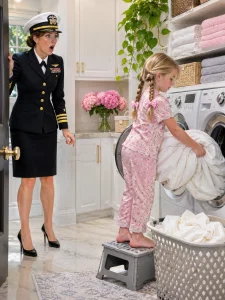
“Mom, please don’t turn off the washing machine! If Daddy finds out I didn’t finish the sheets, he’ll punish me!”
That was the first thing my nine-year-old daughter said to me when I got home after four months of service in the Navy.
It was almost midnight.
Tessie was standing on an overturned bucket, trying to stuff a huge pile of sheets into the washing machine.
Her eyes were swollen, her hands were red, and her pajamas were stained with detergent.
I had pictured our reunion a hundred times, but never anything like this.
My name is Joanna Pruett. I’m 43 years old, and I’ve served more than two decades in the United States Navy.
That night I was returning from a long deployment in the Pacific.
My family lived in Pensacola, Florida, in a house we had bought after years of sacrifice.
I hadn’t told my husband, Dale, I’d be arriving that night.
I wanted to surprise him and, above all, to hug Tessie before she woke up the next morning.
But when I opened the door, everything was far too quiet.
The light in the laundry room was still on.
“Tessie?” I called.
My daughter turned around, startled.
For a moment she looked more frightened than happy.
Then she ran to me and hugged me so tightly she nearly knocked me off balance.
“Mom! I thought you weren’t coming back for a long time!”
I lifted her into my arms.
“I’m here now, sweetheart. Why are you doing laundry this late?”
Tessie lowered her eyes.
“Daddy said I had to finish before bed.”
“And where is your dad?”
She pointed upward.
“In his room.
But don’t go up, Mom.
He’ll get mad.”
A chill ran through me.
I sat her down on the couch, promised her no one would punish her, and went up the stairs.
From our bedroom I heard a woman’s laugh.
I opened the door.
Dale was lying in our bed with his arms around a woman I’d never seen before.
Two glasses and a bottle of wine sat on the nightstand.
My husband opened his eyes.
“Joanna? What are you doing here?
I thought you were coming back next week.”
The woman sat up at once.
“You said your wife was out of the country!” she snapped.
I didn’t even look at her.
“Get out of my house,” I told Dale.
He let out a nervous little laugh.
“Don’t overreact.
We can talk tomorrow.”
“My daughter is washing your sheets at midnight while you’re in here with another woman.”
His expression changed.
“Tessie needs to learn some responsibility.
You’re never around to raise her.”
Those words hurt me more than finding him with a mistress.
The woman gathered her clothes and hurried out.
Dale stayed where he was, annoyed that I had interrupted his night.
“Don’t come home after four months and tell me how to run this house,” he muttered.
I didn’t answer.
I went downstairs to find Tessie.
She was sitting beside the washing machine, clutching a small notebook against her chest.
“What have you got there, honey?”
She tried to hide it.
“Nothing, Mom.”
I knelt in front of her.
“You can trust me.”
Her eyes filled with tears.
“It’s the list Daddy and Miss Shelby made me.
If I don’t finish everything, they say I don’t deserve to rest.”
I opened the notebook.
There were chores for every day: washing clothes, cleaning bathrooms, making breakfast, taking out the trash, and tidying bedrooms.
At the bottom of one page, in an adult’s handwriting, someone had written:
“If Mom asks, tell her you do it because you want to.”
Then Tessie took my hand and whispered something that left me frozen:
“Mom, there’s something else Daddy told me not to tell you… and it has to do with Miss Shelby and our house.”
PART 2: What the Notebook Didn’t Say
“Daddy says this house will belong to Shelby soon,” Tessie whispered. “He says she’s going to be my new mom when you leave again.”
The floor seemed to vanish beneath me.
“Who told you that?”
“Both of them. Shelby says women who work far away from their kids shouldn’t get to have a family.” Her chin trembled. “I told them I wanted you. But Daddy said if I didn’t learn to obey, a judge would decide where I had to live.”
I held her against me.
That night I understood that Dale had done more than cheat on me. While I was gone, he had turned our daughter into a child who was afraid to say what she felt.
The next morning he strolled into the kitchen as if nothing had happened.
“We need to talk about us.”
“First we’re going to talk about Tessie.”
He rolled his eyes. “Here we go again. She needs discipline. You spoil her.”
“She’s nine, Dale. She’s not your employee.”
“Somebody has to keep this house running while you play hero.”
I didn’t argue. After he left for work, I pulled up the security camera footage we’d installed years earlier.
What I found turned my stomach.
In one clip, Tessie dragged two enormous trash bags to the curb in the rain. In another, she scrubbed the patio while Dale and Shelby ate breakfast at the table a few feet away. In a third, she walked into the laundry room a little before eleven at night.
Then I opened our bank accounts. In four months, nearly $44,000 had gone out in transfers to a company called Gulf Horizon Development. I had never authorized a single one.
I called Beth, an old friend from my Navy days.
“I need a lawyer,” I said.
She put me in touch with Renee Lockhart, a family law attorney. When I finished telling her everything, Renee put down her pen.
“Joanna, the affair is the least of it. We need to protect your daughter and document what she’s been through.”
On her advice, I scheduled an evaluation for Tessie with a child psychologist, Dr. Faye Sorenson. After the session, the doctor told me something I’ll never forget.
“Tessie is showing signs of parentification. She’s taking on responsibilities and emotional burdens that belong to adults.”
“Can she recover?”
“Yes. But she needs safety, support, and to understand that she doesn’t have to earn anyone’s love.”
That afternoon I locked the notebook away as evidence and took Tessie to play soccer on the beach.
At first she seemed uneasy. “Don’t I have to clean first?”
“Today your only job is to have fun.”
For the first time since I’d come home, I heard her laugh without fear.
It didn’t last. Three days later, a process server handed me court papers. Dale had filed for full custody of Tessie and exclusive use of our home, arguing that my deployments made me an absentee mother.
When I confronted him, he smirked. “I’ve been the one raising her. You just visit.”
Then I learned he was coaching Tessie to tell the court she wanted to live with him and Shelby. He’d promised her a new bike.
Renee requested temporary protective orders and a neutral interview so Tessie could speak without pressure. Sitting in a room with beanbag chairs and a gentle interviewer, my daughter told the truth: the punishments, the nights at the washing machine, the way her stomach knotted whenever Dale got angry.
When she came out, she buried her face in my coat. “I’m sorry, Mom. Daddy said I had to pick him, but I couldn’t lie.”
“You have nothing to be sorry for, baby.”
Dale went pale when he heard she had talked.
That same evening, Renee called me, her voice urgent. “Joanna, we dug into Gulf Horizon Development. It’s linked to Shelby.”
I couldn’t speak. “My husband gave her our savings?”
“There’s more. We found loan paperwork for buying land. Your house is listed as collateral.”
“That’s impossible. I never signed anything.”
Renee was quiet for a moment. “That’s exactly why I need you to come in. There’s an authorization with your name on it. It’s dated while you were still at sea.”
PART 3: The Signature
In twenty-three years, I had learned to stay calm in dangerous situations. I’d spent nights in heavy seas and made hard decisions under crushing pressure. Nothing had prepared me for finding out that the man I’d built a family with was using my absence to take my child and put our home at risk.
At Renee’s office, documents were spread across her desk.
“Before you read these, understand this,” she said. “Your house isn’t mortgaged yet. What we found is a loan application listing it as collateral. They’d need more steps to finalize it. But someone used an authorization with your signature.”
I picked up the page. Joanna Pruett. The signature looked like mine, with small flourishes I’d never make. The date was a Wednesday in April.
That Wednesday, I’d been hundreds of miles offshore aboard a Navy vessel.
“I didn’t sign this.”
“I know. And we’re going to prove it.”
Renee explained that Dale had been negotiating to buy two parcels of land near Orange Beach, Alabama, through Gulf Horizon Development. A former business partner of his ran the company. Shelby was listed as an agent for certain transactions. The $44,000 had gone to deposits, fees, and expenses for the deal.
“What was the plan?”
“From the emails, it looks like they meant to secure more financing, finish the project, and keep the profits. We still have to confirm how far they got.”
I stared at the pages. For four months I had worked away from my daughter, believing I was building her future. Dale had spent our savings on a new life with another woman, and now he wanted the house where Tessie had learned to walk.
My fists clenched. “I want him to pay for all of it.”
Renee looked at me steadily. “Then we do this correctly. We don’t need revenge. We need to prove what he did and protect Tessie.”
Those words steadied me. That week I submitted official records of my deployment. We filed to preserve the bank documentation and to request an examination of the signature. Renee warned me that the property dispute would run on its own track from the custody case, and that the forgery would have to be investigated separately.
What mattered most was my daughter.
Dale learned what we’d done two days later. He stormed in furious.
“You hired somebody to dig through my accounts?”
Tessie was doing homework in her room. I told him to keep his voice down.
“I’m reviewing what you did with our money.”
“That money is mine too!”
“Then explain why you used a signature that isn’t mine.”
For the first time since I’d come home, Dale had no quick answer. The color left his face.
“You don’t understand how business works.”
“I know exactly when I’ve signed something.”
He stepped closer. “Joanna, we can fix this between us.”
“We can also talk about why our daughter was afraid to go to bed without finishing your chores.”
His face hardened. “The kid again! You’re filling her head with nonsense.”
“No. Tessie is finally telling the truth about what she lived through.”
Dale slapped the table. “I took care of her while you were gone!”
I didn’t back up. “Taking care of a child doesn’t mean turning her into a servant so you can entertain your girlfriend.”
Shelby appeared at the bottom of the stairs, wearing one of my robes.
“Dale, you don’t have to put up with this humiliation.”
“That robe is mine,” I said. “I’d appreciate it if you stopped using my things.”
She smirked. “We’ll be talking soon about who keeps what.”
“The courts will decide that. But understand this: Tessie is not a piece of property you get to include in your plans.”
Dale glared at me. “When the judge sees how much you work, he’ll know she’s better off with me.”
I didn’t answer. He still believed that money, a house, and the number of hours he’d been physically near our daughter were enough to make him a good father. He had no idea how much damage he had done.
Preparing for the hearing was one of the hardest stretches of my life. Renee organized the video footage, the bank records, and the company documents. We also tracked down our neighbor, Mrs. Odell, who was 68. When I told her what had happened, she started to cry.
“I used to see Tessie dragging out the garbage after dark,” she admitted. “One night it was pouring and I told her to get inside. She said her daddy would be angry if the cans weren’t out.”
“Why didn’t you ever call me?”
She lowered her eyes. “I thought they were just chores. I never imagined the child was going through all that.”
Then she told me something that broke my heart a little more. One afternoon, Tessie had been sitting on the curb, too tired to finish sweeping the driveway. Mrs. Odell offered her a cookie, and Tessie refused.
“She told me she wasn’t allowed to eat anything nice until her work was done,” Mrs. Odell said.
That night I sat beside Tessie’s bed. She was hugging a stuffed dinosaur I’d bought before I left.
“Can I ask you something, kiddo?”
She nodded.
“Why didn’t you tell me what was happening when we talked on video calls?”
Her face crumpled. “Because Daddy said you’d worry and might lose your job.”
My throat closed. “Sweetheart, you never have to hide something from me that’s hurting you.”
She squeezed the dinosaur. “I thought if I worked really hard, Daddy would love me more.”
I held her gently. “You don’t have to work for love. Not mine, not anyone’s.”
“Even if I get bad grades?”
“Even if you get bad grades.”
“Even if I don’t know how to wash clothes right?”
“Even if you never touch a washing machine again.”
She smiled faintly. “Even if I burn the pancakes?”
I laughed out loud. “That would be tough, because I burn them worse.”
Tessie giggled. I promised myself that night that I would never again mistake a spotless house for a happy home.
The temporary-orders hearing took place weeks later in a family courtroom in Pensacola. I arrived with Renee. Dale showed up in an expensive suit with his hair neatly combed and a lawyer carrying a huge binder. He looked at me as though he’d already won.
His attorney opened by arguing that Dale had been Tessie’s primary caregiver during my deployments. “Mr. Pruitt has provided daily stability for the child. The mother’s professional obligations keep her away from the family home for long stretches.”
I couldn’t deny I’d been physically absent. But I wasn’t going to let them treat my service as proof that I didn’t love my daughter.
Renee presented the evidence. First, the footage. On the courtroom screen, Tessie hauled a trash can nearly as tall as she was. Then Dale appeared, chatting with Shelby while my daughter scrubbed the patio. The judge asked for dates and times, and Renee explained it wasn’t an isolated incident.
Next, she presented the notebook. Its pages showed a routine that would have exhausted most adults. Laundry. Bathrooms. Meals. Bedrooms. Trash. Each task had a checkmark, and some carried notes in Dale’s handwriting. Done wrong. Redo. No rest until finished.
My eyes burned.
Renee also entered Dr. Sorenson’s report, which documented anxiety, a fear of making mistakes, and a belief that Tessie had to behave like an adult to earn approval. The judge reviewed the neutral interview, too. Tessie had not been forced to repeat her story in front of everyone. Her voice had already been heard.
Mrs. Odell testified about what she’d witnessed from her yard. Dale wouldn’t look at her.
When my turn came, I took a breath.
“I’ve served my country for twenty-three years,” I began. “I know my work means absences, and I know I have to plan around them as a mother. I’m not claiming to be perfect.”
I turned to the judge. “But my daughter was nine years old when I came home and found her washing sheets at midnight. She was afraid of making a mistake. She was afraid to rest. And she had learned to believe she didn’t deserve love unless she finished her chores.”
My voice shook. “I’m not asking the court to punish Dale for cheating on me. I’m asking that Tessie get to feel safe again.”
Dale tried to defend himself. “I was only teaching her discipline. Her mother lets her do whatever she wants.”
The judge asked whether he thought it was appropriate to assign extensive housework to a nine-year-old late into the night. He hesitated. “There was a lot of work to do around the house.”
Renee stood. “And why did your daughter have to do it while you and your girlfriend relaxed?”
Dale said nothing. His lawyer started to object, but the question had already done its work.
The financial documents came next. The judge made clear that this hearing wouldn’t decide whether forgery had occurred or settle the division of property, but that the information bore on the family conflict and on what protections were needed while the cases continued.
After hearing both sides, she announced her temporary ruling. Tessie would remain in my primary care. Dale’s visits would be supervised at first, subject to evaluation and professional follow-up. And Tessie and I could continue living in the family home while everything else was resolved.
When I heard those words, I felt like I’d finally exhaled after holding my breath for weeks.
Dale bowed his head. I didn’t smile. I hadn’t won a trophy. I’d earned my daughter some safety while we began rebuilding.
Dale moved out soon after. Shelby left with him, hauling her belongings out in boxes. There were no screaming goodbyes. The woman who had tried to take my place never even glanced at Tessie.
Tessie stood beside me, watching the car pull away.
“Is Daddy not going to live here anymore?”
“For now he’s going to live somewhere else.”
“Is he mad at me?”
I knelt. “What grown-ups decide is the grown-ups’ responsibility. You didn’t cause any of this.”
She thought about it. “Can I still love him?”
That question nearly undid me. “Of course, baby. He’s your dad. You can love him and still say so when something hurts you.”
She hugged me, and I understood that protecting my daughter didn’t mean teaching her to hate her father. It meant making sure love never again got mixed up with fear.
The following months were hard. The investigation into the documents continued. A forensic examiner found significant differences in the signature, and more evidence was requested about where the authorization had come from. The lender froze the financing once it received notice of the dispute. Dale was also ordered to provide records of the transfers and the land investment made with our savings. The property case moved along separately from the custody case. The money didn’t sort itself out overnight, but Dale no longer had the control he’d believed he’d secured.
His relationship with Shelby ended too. He called one afternoon to arrange a visit with Tessie, and his voice sounded different.
“Shelby left,” he said.
I stayed quiet.
“When the money trouble started, she said she didn’t want to be involved.”
“That has nothing to do with me anymore, Dale.”
He sighed. “Tessie barely talks to me during visits.”
“She needs time.”
“I feel like she’s afraid of me.”
For once I didn’t hear arrogance. “For months you taught her she could lose your love if she didn’t obey,” I said. “Now you have to show her she can trust you even when she doesn’t do everything you ask.”
He took a few seconds to answer. “I didn’t think I was hurting her this much.”
“That was exactly the problem. You never stopped to ask how she felt.”
We hung up without arguing. I didn’t know whether Dale would truly change. But I understood it was no longer my job to rescue him from the consequences of his choices.
Meanwhile, Tessie started getting her childhood back. On Saturdays we made pancakes. I still burned some, and she laughed every time she smelled the first batch. Afterward we walked along the beach or played soccer until we collapsed. We set small chores suited to her age, like putting away her toys and carrying her plate to the sink. The difference was that now she could make mistakes without feeling terror.
She kept going to therapy. Slowly, she stopped asking permission to rest. She started inviting friends over again. Her teacher told me she was speaking up in class and had rediscovered her love of writing stories.
I had my own lessons to learn. I requested a shore assignment that gave me more stability, and I built a support network for the times when duty would still pull me away. I didn’t give up my career. But I never again assumed that loving my child was enough if I wasn’t paying attention to what was happening around her.
A year later came a day I’ll never forget. Tessie burst into the kitchen waving a sheet of paper.
“Mom! I won the school essay contest!”
I hugged her. “Congratulations, kiddo! What did you write about?”
She grinned mysteriously. “It’s a surprise.”
A week later I went to the ceremony. The auditorium was packed with parents, teachers, and students. When they announced the winning essay, I heard the title:
“The Bravest Person I Know.”
Tessie walked onto the stage clutching her paper with both hands. At first she spoke nervously.
“A lot of people think my mom is brave because she’s in the Navy.”
She paused.
“I think she’s brave for that, too. But that’s not the most important thing.”
She found me in the audience.
“My mom taught me that I don’t have to do hard things for someone to love me. I used to think if I didn’t clean right, or if I made a mistake, I was a bad kid.”
Tears ran down my face.
“When she came home, she told me my only job was to be a kid. Now I know I can play, and laugh, and rest without being scared.”
The auditorium was completely silent.
“I think a brave person isn’t someone who’s never afraid. It’s someone who protects somebody, even when it’s hard.”
Then she smiled. “My mom says she’s proud of me. But I’m prouder of her, because she taught me that a house doesn’t have to be perfect to be a home.”
When she finished reading, everyone applauded. I could barely see the stage through my tears. She ran to me, and I held her as tightly as I had the night I came home from that deployment.
But there was an enormous difference. This time my daughter wasn’t shaking with fear.
She was happy.
On our way out, we walked hand in hand toward the car.
“Mom, are we going home?”
“Of course, sweetheart.”
“Can we make pancakes for dinner?”
I laughed. “If you promise not to make fun of me when I burn them.”
“I don’t promise anything.”
Her laughter rang across the parking lot.
Watching her, I thought about that terrible night, the sheets, the overturned bucket, and the notebook that changed our lives.
I had come home expecting to find a family waiting for me. Instead I found a betrayal, and a little girl who had learned to feel guilty for needing love.
I lost my marriage. I faced court battles, painful arguments, and truths I never imagined uncovering.
But I got back something far more important: my daughter’s peace of mind.
Today, when I think about what happened, Dale and Shelby aren’t the first people who come to mind. I think of Tessie, laughing as she tries to flip a pancake. I think of how simple it should be for every child to feel loved.
And I think of one truth I will never forget:
A child can learn to make her bed, pick up her toys, and help around the house. But she should never carry the burdens of adults, or have to earn the right to be loved.
Because a real home isn’t one where everything is spotless and nobody makes mistakes.
It’s one where a child can close her eyes at night without fear that she’ll wake up to find someone has stopped loving her for not being good enough.
THE END.