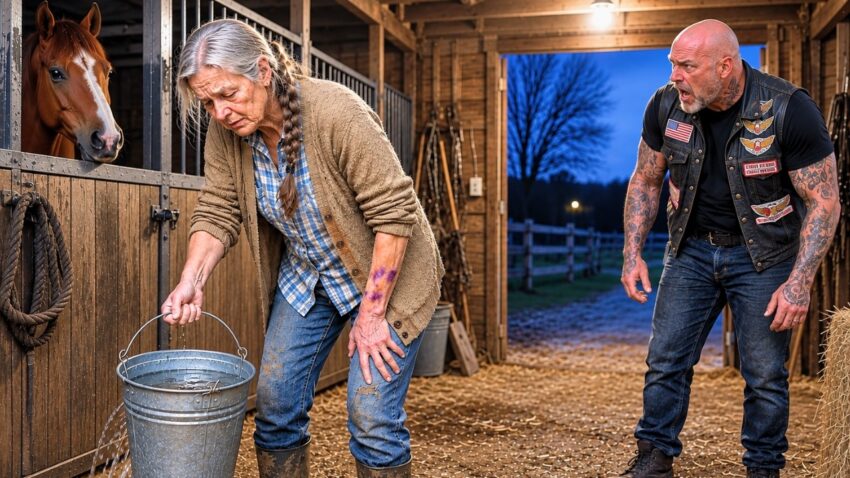
Cole Braddock didn’t sleep that night. He sat out in the barn with his phone and started making calls.
Not to muscle. To the two smartest people he knew.
One was a brother named Teo, who’d done eight years for wire fraud and come out knowing more about paper trails than most lawyers.
The other was his mother’s old attorney’s junior partner, a woman named Grace Okafor, who had never liked how the estate got settled and had said so and been overruled.
“Pull everything,” Cole told them. “The deed transfer, the power of attorney, the notary log, the dates.
Every single day that man touched a piece of paper with my mother’s name on it.
And her medical records from the same dates.”
Because here’s what Cole had figured out sitting in the dark: Dale’s fortress was built on signatures, and a signature is only as good as the hand and the mind behind it.
If his mother had signed the deed on a day when she couldn’t have known what she was signing, the whole thing was built on sand.
By dawn, Teo had the county records. By noon, Grace had the medical file. And together they found the crack.
The deed transferring the farm to Dale Mercer was dated March 3rd. Signed, notarized, filed.
But on March 3rd, Cole’s mother had been in the hospital in Carville. Grace had the admission records right there.
Heavily sedated. Diagnosed in a doctor’s own handwriting as not competent to make legal or financial decisions.
She could not have driven to a notary’s office. She could not have held a pen steady.
She was two counties away in a hospital bed, and yet her signature sat on a deed in the county records, witnessed by a notary who swore she’d appeared before him in person.
That notary, Teo found out with about 20 minutes of digging, had done three other transfers for Dale Mercer in the past two years: all elderly, all alone, one already dead, with no family to ask questions.
Dale wasn’t a bully who’d gotten lucky with one old woman. Dale ran this. This was his business.
He found isolated old people, made himself useful, got the paper signed, and peeled the life right off of them.
A check and a deed at a time. Edith was just the one still breathing in the house.
And that changed everything for Cole. Because this was bigger than his mother’s farm now.
There were other names in that notary’s log.
Other Ediths out there, or dead and buried with their families, none the wiser.
Cole realized that if he just scared Dale off and took his own farm back, Dale would set up shop in the next county and do it all again.
Scaring him wasn’t enough. Cole had to end the whole machine. So he built his own fortress. Quietly.
Over four days, while he fixed the porch railing and chopped wood and let Dale think he’d been cowed into waiting on lawyers.
Teo pulled every transfer. Grace prepared affidavits. And Cole did one more thing.
He took his phone to Edith, sat her down, gentle, and asked her to tell the truth into it.
All of it: the chore list, the bank, the wrist, the nights in the pantry.
She was terrified, but Cole held her hand, the bruised one, soft as he could, and said, “I will not let him near you again.
I give you my word, and I have never broken it, but I need your voice.” And she gave it.
That recording would matter.