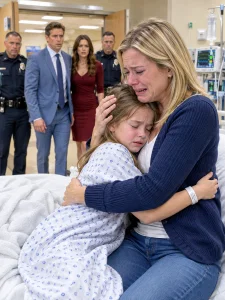
At exactly 11:47 p.m., the monitor went silent.
One cruel, endless tone filled the room.
I had stood beside friends as their worlds fell apart.
I had kept my voice calm during tragedies.
But nothing prepared me for my own daughter’s hand growing still in mine.
Ruby was only five.
Five years of Batman pajamas.
Sticky pancake kisses.
Bedtime stories.
Uneven crayon suns taped to the fridge.
Gone.
Her green stuffed dinosaur rested beside her under the hospital blanket.
Hours earlier, Ruby had looked up at me through her oxygen mask, her lashes damp, her voice barely a whisper.
“Is Daddy coming?”
I kissed her forehead and lied with my whole broken heart.
“Yes, baby.
Daddy’s coming.”
Then I called Russell again.
And again.
And again.
Eighteen times while doctors fought for Ruby.
Eighteen times while I stood beside my child, helpless and terrified.
Eighteen times while my daughter needed her father.
Russell never answered.
When the doctor finally stepped back with defeat written across his face, he said the words that split my life in two.
“Time of passing, 11:47 p.m.”
For two hours, I sat beside Ruby without crying.
The grief had gone too deep for tears.
It hollowed me out until even breathing felt wrong.
At 2:17 a.m., Russell appeared at the end of the hallway.
Silk tie undone.
Polished shoes.
Disheveled hair.
Not from rushing.
From something else.
The moment he saw me, his face changed too quickly, shifting into concern like a mask.
“Meredith,” he said, hurrying toward me.
“What happened?
My phone died.
I was at a client dinner, I swear.
I came as soon as I plugged it in.”
I stared at the man our daughter had called for in her final moments.
“Our daughter is gone.
She passed away asking for you.”
His mouth opened.
Then closed.
Horror crossed his face…
PART 2
Horror crossed his face.
But not fast enough.
“No,” he whispered.
“No, that can’t be true.”
“It happened three hours ago.”
He sank into the chair beside me, slipping off his heavy wool overcoat in a panic, and covered his face.
“I’m sorry.
God, Meredith, I’m so sorry.
I should have been here.”
“Yes,” I said emptily.
“You should have.”
Shivering in the freezing corridor, I reached out and pulled his discarded coat over my shoulders, seeking some twisted comfort.
My hand slipped into the deep side pocket.
My fingers brushed against hard plastic.
I drew it out slowly, almost without thinking.
It was a key card, white with a gold border. Across the top, in elegant script, were the words The Aldridge Grand Hotel, Downtown Columbus. On the sleeve it came in, someone had written a room number in blue ink: 1412.
I turned it over in my fingers. Russell was still sobbing into his hands, and he didn’t see.
A client dinner, he had said. His phone had died, he had said.
But a client dinner doesn’t come with a room key, and nobody keeps a dead phone in his pocket for eight hours without looking for a charger.
I slid the card back where I had found it. I folded his coat over the chair and stood up.
“Where are you going?” he asked, looking up with red eyes.
“To sign some papers,” I said. “They need to know where to send Ruby.”
It was the first honest thing either of us had said all night, and he didn’t understand it.
A nurse named Alvarez, who had held my elbow through the worst of it, found me in the family room around three. She was young, maybe twenty-six, with tired eyes and a lanyard covered in cartoon pins. She sat across from me and said, very softly, “Mrs. Lawson, I need to tell you something, and I hope it helps rather than hurts.”
I waited.
“Around nine-forty, when Ruby’s numbers started dropping, I called the second emergency contact on your chart. Your husband’s cell. I left a voicemail. Then I called again at ten-fifteen, and again at ten-fifty.” She hesitated. “The third time, it didn’t go to voicemail. It was declined. Someone pressed the button.”
I stared at her.
“A dead phone doesn’t decline a call,” she said quietly. “I don’t know what your husband was doing. But I’ve worked in this unit for four years, and I want you to know the hospital keeps a record of every call we make. If you ever need it, you can request it.”
“Thank you,” I whispered.
“I’m so sorry about your little girl,” she said, and her voice cracked. “She asked me to fix the dinosaur’s tail earlier. I want you to know she was brave.”
When she left, I sat alone with my hands in my lap.
I did not cry. Something else was happening inside me, something slow and cold and very clear, like ice forming over a lake.
I thought: He declined the call.
I thought: He knew.
And then I thought, with a steadiness that frightened me, I’m going to find out everything.
We buried Ruby on a Saturday, under a gray October sky, in a small cemetery on the edge of town where the maples had already turned red.
Russell wore a black suit and cried convincingly. He held my arm at the graveside and told the minister that he would never forgive himself. People pressed his hand and murmured that grief affects everyone differently. My mother-in-law, who had always called him “my golden boy,” wept on his shoulder.
I stood perfectly still. I watched my daughter’s small white casket go down into the ground. I held a green stuffed dinosaur against my chest, because I couldn’t bring myself to bury it with her. And all the while, in my coat pocket, my phone held a folder of screenshots I had taken in the dark hours between the death and the funeral.
Because here is what Russell had not thought through, in his panic and his lies.
We shared a family cloud account. Years ago, after a fight about lost photos, he had set it up himself, and he had never changed the password. It held our pictures, our backups, our location history, and a feature I’d long forgotten: shared device activity.
At 7:52 p.m. on the night Ruby died, his phone had been connected to the Wi-Fi network of the Aldridge Grand Hotel.
At 9:41 p.m., the same phone had opened the iMessage I’d sent him from the ICU. Ruby is asking for you. Please come. It’s bad. The read receipt had popped up on my own screen as I stood by her bed, and I had been so desperate for any sign of him that I had actually felt hope. He’s seen it. He’s coming.
He had seen it.
At 10:03 p.m., he had opened another message, the one that said, Please, Russell. She’s scared. She wants her dad.
At 10:15, he opened the third.
And at 10:52, he declined the call from the hospital.
I read the timestamps over and over, the way you press on a bruise. And when I could stand it no longer, I put the phone face-down on the kitchen table and did the next thing, the thing that took me from grief into purpose.
I called Gloria Fenwick.
Gloria had been my college roommate. She was now one of the sharpest family law attorneys in Ohio, a woman who wore red lipstick to depositions and had once made a judge apologize. When I told her the story, she said nothing for almost a full minute.
“Mer,” she finally said. “I’m so sorry. I’m coming over. Don’t say a word to him. Don’t change a thing. Don’t delete anything. Do you understand?”
“I understand.”
“And Mer?” Her voice softened. “You don’t have to do this right now. You can just grieve.”
“I’m grieving,” I said. “This is how.”
Gloria arrived within the hour, with a legal pad and a thermos of coffee that tasted like smoke. We sat at my kitchen table, with Ruby’s crayon drawings still on the fridge behind us, and went through it piece by piece.
She told me what I needed to hear first.
“Revenge isn’t something I can help with,” she said. “Accountability is. And I can make sure that what happens next is clean, documented, and permanent. That’s better than anything you’d do in anger. Do you trust me?”
“With my life.”
“Then here’s what we’re going to do.”
The first step was preserving everything. Gloria sent a formal preservation letter to the hospital, requesting the complete call log and the voicemail recordings from Nurse Alvarez. She sent another to the Aldridge Grand, asking for key card records and billing for room 1412 on the night of October ninth. A forensic specialist she trusted imaged my cloud account that same afternoon, creating a certified copy of every timestamp.
The second step was less comfortable.
“We need to know who she is,” Gloria said. “Not for gossip. Because if she’s a colleague, or a client, or someone with a business relationship to Russell’s firm, that changes the picture.”
I already knew.
I had known, in some part of myself, for months. The late nights. The new gym membership. The way his phone always lay face-down. The woman named Sloane Whitaker, a senior associate at his firm, who had started appearing in his stories about work around spring. Sloane’s brilliant. Sloane stayed late again.
Russell was a partner at Lawson & Briggs, a mid-sized financial advisory firm that managed retirement funds for teachers, nurses, and municipal workers. His reputation was the thing he cared about most. He gave speeches on integrity. He had a framed code of conduct on his office wall.
“Sloane reports directly to him,” I said.
Gloria’s pen stopped. “She reports to him?”
“He supervises her. He signs her reviews.”
Gloria set the pen down. “Meredith, firms like his have very strict policies about relationships between partners and subordinates. Regulators care too. If he used corporate funds for that hotel room, or used his position in any way, this could be much bigger than a marriage.”
“I don’t want to destroy his career,” I said slowly. “Not out of spite. But I won’t hide the truth to protect him, either.”
“Then we won’t hide it,” Gloria said. “We’ll just make sure it gets to the right people, in the right way.”
The hotel records came back in nine days.
The room had been booked on Russell’s corporate card, the one his firm reimbursed. The charge included a bottle of champagne, two entrées from room service, and a spa package. The key card log showed that room 1412 had been opened at 6:48 p.m. and again at 4:12 a.m., when, I imagine, a very tired man finally let himself out and drove to a hospital with a story.
The hospital’s records were even more devastating. Nurse Alvarez had made four calls to Russell’s phone. The carrier’s logs showed that the third call, at 10:52 p.m., had lasted zero seconds. That is the signature of a declined call.
The final piece came from an unexpected place.
Two weeks after the funeral, I received a handwritten letter in the mail. The return address read S. Whitaker, and the envelope trembled in my hand before I even opened it.
Mrs. Lawson, it began.
I’m so sorry. I don’t know if you’ll read this, and I understand if you don’t. I didn’t know. I swear to you, I didn’t know about your daughter until the next afternoon, when a coworker mentioned it. Russell told me his phone was off for a “family dinner” and that you were out of town with the kids. He told me you and he were separated. He said you’d both agreed.
I’ve been sick ever since. I’ve already spoken to HR, and I’ve resigned. I wanted you to hear it from me before you heard it from anyone else. If it helps, I’ve saved every message he ever sent me. I’ll give them to whoever needs them.
I’m sorry for the part I played. I will carry it for the rest of my life.
I sat with that letter for a long time.
I did not forgive her. It wasn’t mine to give, and it wasn’t what I needed. But I understood something, reading it. I understood that Russell had been lying to everyone, to me, to her, to his partners, to his mother, to himself. And that the lie had a particular shape. He had built a life where nobody ever saw the whole of him, so he could be all of it at once: the doting father, the devoted husband, the upright professional, the man who answered every call.
All except the one that mattered.
I handed the letter to Gloria without a word.
She read it, nodded, and said, “This isn’t just a gift. This is evidence.”
We filed for divorce in November, on grounds of adultery and abandonment, with a motion for full discovery.
Russell, to his credit, looked genuinely stunned when the process server arrived. He called me six times that evening. I answered none of them.
You can’t do this, he texted. Meredith, please. We just lost our daughter. We need each other.
I looked at that message for a long while. Then I took a screenshot, put the phone down, and made myself a cup of tea.
He did need someone. He just didn’t have the right to need me.
The next day, his attorney called Gloria and proposed a quiet settlement: split the assets evenly, no fault finding, sealed records. Gloria listened, thanked him, and said, “I’ll take that to my client, but I should tell you what we’re prepared to put in front of a judge.”
She read the list. The hospital’s call logs. The carrier records. The read receipts. The hotel charges. The corporate expense reports. Ms. Whitaker’s willingness to testify. The firm’s code of ethics.
There was a very long silence on the line.
“Let me call you back,” his lawyer said.
He did, forty minutes later, in a different voice.
The terms we ultimately agreed on, after three weeks of negotiation, were not dramatic. There were no thrown glasses, no tearful courtroom speeches. There were documents, and signatures, and a judge in Franklin County who read the file in silence and looked at Russell over her glasses for a very long time.
I received the house, the full proceeds of our joint savings, and a substantial portion of his retirement account, plus a settlement that Gloria had structured with a precision I could only admire. Russell kept his license, but the state regulatory board, notified by the firm after its own internal review, imposed a formal censure for misuse of corporate funds. His partners asked him to step down from the executive committee. His clients, many of whom were teachers and nurses with their own children, began quietly moving their accounts elsewhere.
None of it was cruelty. All of it was consequence.
And then there was the last piece, the one I’d decided on long before the lawyers ever got involved.
In January, on what would have been Ruby’s sixth birthday, I stood in a bright room in the pediatric wing of St. Luke’s Children’s Hospital, in front of a small crowd of nurses, doctors, and parents.
On the wall behind me hung a banner in green and gold, Ruby’s favorite colors. It read: THE RUBY LAWSON FAMILY FUND.
“My daughter was five years old,” I told them, my voice steady. “She loved dinosaurs. She had a laugh that could fill a house. And in her last hours, she asked for her father, and he wasn’t there.”
The room was silent.
“I can’t change that,” I said. “I would give anything to change that. But I can make sure that no other child spends their last hours without someone beside them.”
The fund, which I’d endowed with the settlement I received from Russell, would cover three things. First, it would pay for overnight accommodations so parents of critically ill children never had to choose between sleeping in a car and leaving their child’s side. Second, it would fund a program of trained “bedside companions,” volunteers who would sit with any child whose family could not be there, so no frightened little hand would ever be left to grip empty air. Third, it would provide grief counseling, free of charge, for any family who lost a child in that unit.
Nurse Alvarez, standing near the front, was crying openly. Beside her, Dr. Patel, the doctor who had said time of passing that terrible night, wiped his eyes and nodded at me.
When I finished speaking, a woman I didn’t know came up and took my hands. She had a toddler on her hip and fatigue carved into her face.
“My son is in room 308,” she whispered. “I haven’t slept in four days. Thank you.”
I held her hands and thought: This. This is what a mother can do.
Not hate. Not destruction. A door held open for someone else.
Russell attended the opening, uninvited. He stood at the back of the room in a rumpled gray suit, thinner than I remembered, his face drawn. He didn’t approach me during the ceremony. He waited until the crowd thinned and the balloons began to droop.
“Meredith.”
I turned.
“I just wanted to say…” His voice shook. “I know I don’t deserve anything from you. I know what I did. I’ve been going to counseling. I think about that night every single day.”
“I’m glad you’re getting help,” I said, and I meant it, strangely.
“Do you think,” he said, and the words seemed to hurt him, “do you think she knew I was coming? Ruby? Do you think she thought I was on my way?”
I looked at him for a long moment. This man I had loved, who had held my hand in the delivery room, who had once cried with joy when a nurse placed our daughter in his arms. This man who had stared at a phone screen showing Ruby is asking for you and chosen a hotel bed.
I could have told him the truth. That she had asked for him twice. That I had lied to her with my last breath. That she died believing in him.
Or I could have told him the other truth, the one with a blade in it.
“She believed you were coming,” I said. “Right up to the end. That’s what I told her, and she believed me.”
His face crumpled. He pressed his hand to his mouth.
“That’s the part you’ll live with,” I said gently. “I’m not saying it to hurt you. I’m saying it because it’s true, and because you deserve to know.”
He nodded, once, and walked away without another word.
I never saw him again.
Spring came slowly to Columbus that year.
I kept the house, though I repainted the guest room and let the nursery stay as it was, her little bed, her bookshelf, her crayon suns still taped to the fridge. On Sundays, I volunteered at the hospital, sitting with the children who had no one else. I read dinosaur books in a voice I had practiced for years. I braided doll hair. I held small hands.
The first time a little boy fell asleep clutching my fingers, I sat motionless for two hours so I wouldn’t wake him.
On the anniversary of that October night, I drove to the cemetery with a green plastic dinosaur in my bag, one I’d bought from a gift shop on a whim. I knelt on the grass, brushed the fallen maple leaves from the stone, and set the dinosaur beside the flowers.
“I did it, baby,” I whispered. “I made it so nobody else has to wait alone.”
The wind moved through the branches. Somewhere a child laughed, far off, bright and careless.
I closed my eyes and let myself cry, finally, the way I hadn’t in that cold hospital corridor. It wasn’t the silent grief that had hollowed me out. It was a different kind, wet and warm and alive, the kind that runs down your face and leaves you lighter.
I had asked God, under those cold ICU lights, to let my daughter breathe one more time.
He hadn’t answered.
But in the years that followed, in every child who slept safely, every parent who didn’t have to choose, every small hand that was held until morning, a little of her breath kept moving through the world.
And that, in the end, was the only revenge that mattered.
THE END