The Afternoon She Chose Not to Face It Alone
By the time the lunch crowd began to thin out at Maple Hollow Diner, most people in the room had settled into that quiet, ordinary rhythm that belongs to small-town afternoons. Coffee cups clinked softly against saucers. A waitress moved between tables with the easy speed of someone who had worked the same floor for years. Near the front windows, sunlight stretched across the tile in warm golden squares, making the whole place look gentler than it felt.
Then the motorcycles arrived.
The sound rolled across the parking lot in a low, steady wave, deep enough to make the window glass tremble. A few customers looked up immediately. Others pretended not to notice, though the change in the room was impossible to miss. Conversation softened. A man near the register glanced toward the door and then back down at his sandwich. A young mother pulled her daughter a little closer without even seeming to realize she had done it.
When the door opened, six bikers stepped inside.
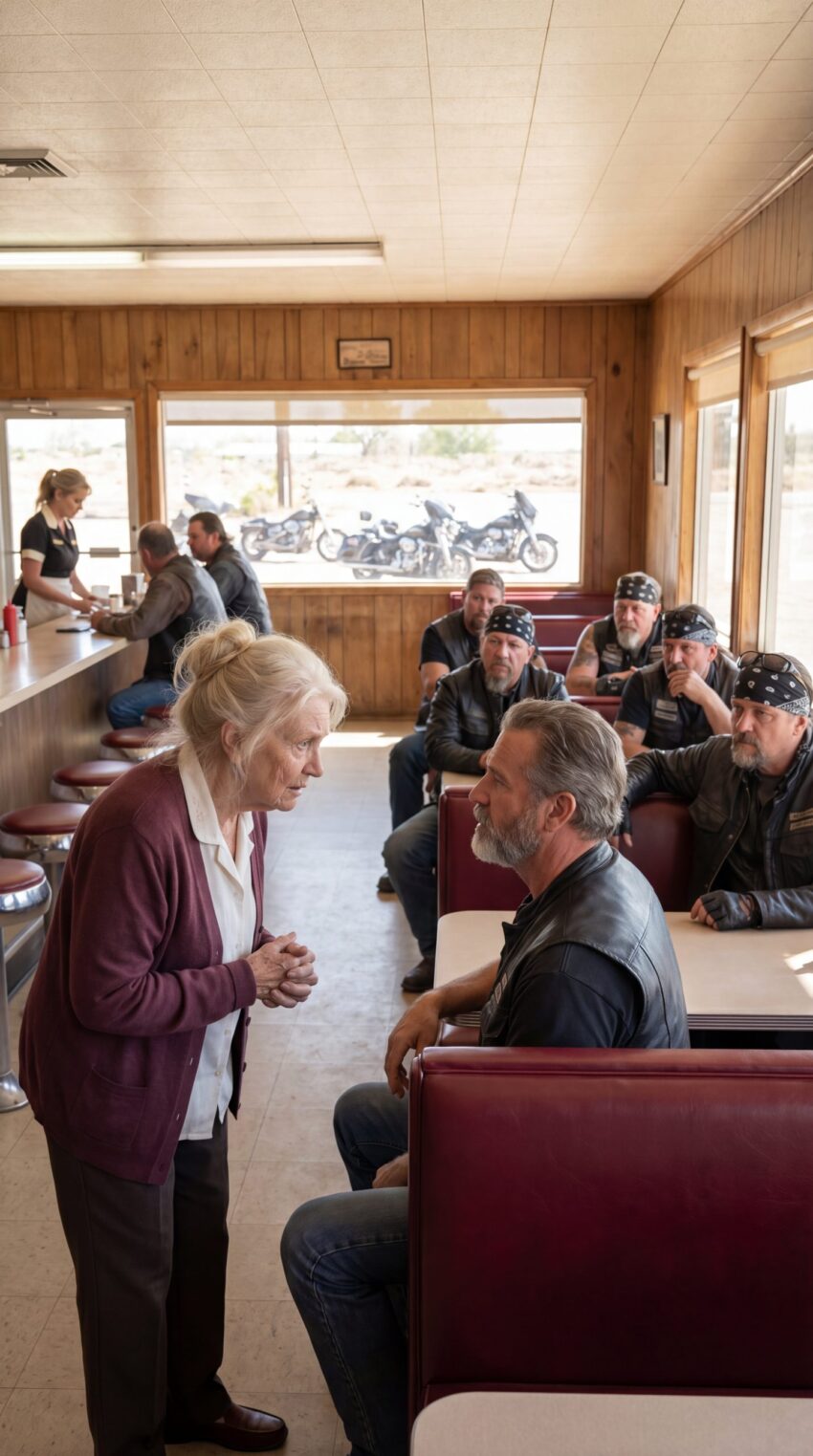
They were broad-shouldered men with weathered faces, worn leather vests, and boots that carried the dust of long roads. They did not rush. They did not speak harshly. They simply crossed the diner and took the largest booth near the back wall, the one most groups usually waited for on busy days.
Still, almost no one looked at them for long.
Except one woman.
At a small two-person table near the far corner sat eighty-seven-year-old Eleanor Whitcomb. Her silver hair was pinned neatly above the collar of her cream blouse. She wore a soft green cardigan and a pearl pin at her shoulder, as though she still believed in dressing carefully even for an ordinary meal. A slice of peach pie rested on the plate in front of her, untouched except for one small bite. Her coffee had gone lukewarm.
Her hands trembled around the mug.
Not because she was old.
Because she was afraid.
A Woman Who Had Carried Too Much Alone
Eleanor Whitcomb had never been the kind of woman people described as fragile. In fact, most of Rosefield, Tennessee knew her as the opposite.
For thirty-one years she had worked at the public library on Main Street, where she could find a misplaced book faster than anyone else and remembered the names of children long after they had become adults. She had raised two daughters and one son while managing a household budget so carefully that every dollar seemed to stretch farther in her hands. When her husband, Thomas, began losing his hearing and later his strength, Eleanor became the quiet engine that kept their life moving forward.
She learned how to fix small things around the house because waiting for help often took too long. She handled doctor visits, tax papers, and broken appliances with the same calm expression. After Thomas passed away, she arranged every detail herself, not because no one offered to help, but because she did not want her children carrying more sorrow than they already had.
She was not easily shaken.
Which was why the fear sitting inside her that afternoon meant something.
For the past month, her nephew had been visiting more often than usual. His name was Darren Pike, and for years he had lived just far enough away, and cared just little enough, to remain a distant relative rather than a meaningful one. Then suddenly he had become attentive.
He brought groceries once.
He offered to drive her to a clinic appointment another time.
He told neighbors he was “keeping an eye on Aunt Eleanor,” as though he were doing something noble.
At first, it almost looked like concern.
But then the questions began.
How much was her house worth now?
Had she thought about who would manage her affairs one day?
Did she realize how complicated property issues could become for someone her age?
Wouldn’t it be easier if she signed a few papers now, while things were still simple?
Eleanor had smiled politely through every visit. But she had read enough forms, contracts, and legal notices in her lifetime to know when language was trying to hide its true purpose. Darren did not want to help her. He wanted control.
And this afternoon, he was coming to the diner with documents.
He had told her it would “only take a signature.”
She had heard the trap in that sentence ever since.
The Table Everyone Avoided
At the back booth, the bikers laughed over something one of them had said. Their voices were rough but warm, more like old friends catching up than men looking for trouble. The largest among them sat on the aisle end. He had a broad chest, a gray-brown beard, and the kind of stillness that made people pay attention without knowing why. His eyes moved around the room with calm awareness, taking in details without staring.
His name was Wade Holloway.
Among the riders, he was known as Stone.
Years on the road had given him a patient way of seeing people. He noticed who was comfortable, who was pretending, and who was barely holding themselves together. So it did not take long for him to realize the elderly woman in the corner kept looking toward their table.
Not with fear.
With thought.
She looked like someone trying to decide whether to do something she had never imagined asking of strangers.
Wade said nothing at first. He simply watched her over the rim of his coffee mug.
A minute passed.
Then another.
Finally, Eleanor set down her cup.
She took one slow breath, pressed a napkin carefully beside her plate as if straightening the world before stepping into something uncertain, and stood.
The room seemed to notice all at once.
Her shoes made light tapping sounds across the tile as she walked toward the bikers’ booth. The waitress behind the counter paused with a stack of clean glasses in her hands. A man halfway through paying his bill stopped counting his cash. Even the laughter at the biker table faded as Eleanor came closer.
She rested one hand on the edge of the booth.
Wade looked up.
For a second, neither of them spoke.
Then Eleanor asked, in a voice soft but steady enough to stop the whole room in place,
“Would one of you be willing to pretend to be my son today?”
A Question That Changed the Air in the Room
The silence after her words felt almost unreal.
One of the younger bikers blinked in surprise. Another shifted in his seat and glanced at Wade as though to confirm he had heard correctly. At the counter, the waitress lowered the glasses onto a towel without making a sound.
Wade studied Eleanor’s face. He saw the careful way she held herself upright. He saw the embarrassment she had pushed aside just to ask. Most of all, he saw that the trembling in her fingers came from something immediate, something real.
He leaned slightly closer.
“Ma’am,” he said, his voice low and respectful, “are you in some kind of trouble?”
Eleanor gave a tiny shake of her head.
“Not yet,” she answered.
She swallowed, then added with a truth so simple it landed harder than anything dramatic ever could.
“But I expect I will be in about fifteen minutes.”
That earned a few exchanged looks around the table.
A sandy-haired rider named Cole sat forward with his forearms on the table.
“What happens in fifteen minutes?” he asked.
Eleanor looked down briefly, as if ashamed to say it aloud. Then she lifted her chin and told them.
She explained about Darren Pike. About the sudden kindness. About the papers he wanted signed. About the words “for your protection” and “just a formality” and “it would make things easier.” She explained that she was not confused and not uninformed. She knew exactly what he was trying to do. The documents would give him power over her home, her money, and nearly every important decision she still had the right to make for herself.
“He thinks I’ll feel too cornered to say no,” she said quietly. “He thinks if we’re in public, I won’t want to make a scene. And he thinks being old means I’ll eventually give in just to keep the peace.”
Nobody at that booth interrupted her.
When she finished, Wade asked the one question that mattered most.
“Do you want to sign anything today?”
Eleanor’s answer came without hesitation.
“Absolutely not.”
Wade nodded once, as though that settled the entire matter.
The Waitress Who Had Already Heard Too Much
Before anyone else could speak, the waitress came out from behind the counter and approached the table. Her name tag read Mara. She was in her early forties, with tired eyes and the brisk, practical energy of someone who had spent years taking care of more than one thing at a time.
She looked first at Eleanor, then at Wade.
“She’s telling the truth,” Mara said.
Eleanor turned in surprise. “You heard him?”
Mara nodded. “Three days ago. You were sitting by the front window when he called. I was wiping down the next table over. He must not have realized I could hear his side of the conversation.”
Her mouth tightened.
“He said once you signed, the house would be under his authority. Those were his words.”
A quiet heaviness settled over the booth.
Mara continued, “I didn’t know whether to say anything then. I kept thinking maybe I misheard it. But I didn’t. And when I saw you come in today looking this worried, I knew it had to be about that.”
Eleanor’s eyes glistened, not with tears exactly, but with the strain of being seen after trying so hard to handle everything alone.
“Thank you,” she whispered.
Mara gave her a small nod, the kind women sometimes give one another when there is no need for a longer explanation.
Wade looked around the booth at the other riders. No one argued. No one hesitated. The decision moved through them like something already understood.
Then Wade slid over, making room beside him.
“Well,” he said, with the gentlest half-smile Eleanor had seen all day, “if I’m your son for the afternoon, you ought to sit down, Mom.”
For the first time since she had entered the diner, Eleanor laughed.
It was only a small laugh, shaky and surprised, but it changed the room.
For One Afternoon, the Table Became a Family
Eleanor settled into the booth between Wade and Cole while the others shifted to make more space. The transformation happened quickly, almost naturally.
Mara brought a fresh cup of coffee without being asked.
One of the bikers, a big man named Russell, pushed the basket of fries toward Eleanor and said, “You need to eat something if we’re doing family lunch properly.”
Another rider with deep smile lines and a soft voice introduced himself as Leo and began telling Eleanor about a stray hound he had adopted from a shelter outside Tulsa. By the time he reached the part where the dog had stolen an entire pack of hamburger buns from his saddlebag, even Eleanor was shaking her head and laughing.
Cole asked Eleanor what kind of pie she had ordered.
“Peach,” she said.
He looked offended in an exaggerated way and replied, “Then your fake sons have failed already. Somebody should’ve made sure you had ice cream with that.”
Mara, catching the exchange from across the room, brought a scoop over a minute later and set it down with a wink.
Little by little, the tension that had wrapped itself around Eleanor’s shoulders began to loosen. She had come in feeling small, cornered, and terribly alone. Now she sat inside the warm noise of easy conversation, surrounded by six men the entire diner had judged from across the room and who, within minutes, had offered her something her own blood relative had not—protection without conditions.
Wade leaned back with one arm resting along the top of the booth.
“When he comes in,” he said quietly so only the table could hear, “you won’t have to argue. You won’t have to explain more than you want to. Just say what you need to say. We’ll do the rest by being exactly where we are.”
Eleanor looked at him.
“Why would you do this for me?”
Wade held her gaze for a moment before answering.
“Because nobody should be pressured into giving away their life,” he said. “And because sometimes people only back off when they realize someone decent is paying attention.”
That answer stayed with her.
The Man With the Folder
Darren Pike arrived twelve minutes later.
The bell above the diner door gave its usual cheerful chime, sounding almost ridiculous compared to the tightness that instantly moved through the room. Eleanor saw him before he saw her. He was in his mid-forties, clean-shaven, neatly dressed, carrying a dark leather folder under one arm. From a distance, he looked polished and respectable. The sort of man who might hold doors open for strangers while arranging private harm with a smile.
He stepped inside confidently.
Then he looked toward Eleanor’s usual table.
Found it empty.
His eyes moved again.
And landed on the back booth.
He slowed.
There sat Eleanor Whitcomb, no longer alone at a corner table, but tucked comfortably among six bikers as though she had known them for years. Fresh coffee sat in front of her. Her pie plate had been moved aside. Wade’s arm rested behind her in a posture so relaxed it carried all the force of a warning Darren could not challenge without exposing himself.
Darren recovered quickly, but not completely. His smile looked assembled rather than genuine when he approached.
“Aunt Eleanor,” he said, stopping beside the booth. “I didn’t realize you were meeting people.”
Eleanor folded her hands neatly on the table.
“Just family,” she replied.
The words were gentle.
Their effect was not.
She turned slightly toward Wade and added, “Darren, this is my son, Wade.”
The title hung in the air with quiet precision.
Wade extended a hand.
“Good to meet you.”
Darren hesitated for the briefest second before taking it.
Wade’s grip was firm, controlled, and impossible to ignore.
“Likewise,” Darren said, though his voice had lost some of its ease.
Around the booth, the other riders watched without staring. No one needed to scowl. No one needed to posture. Their calm was stronger than that.
The Plan That Could Not Survive Witnesses
Darren cleared his throat and laid the leather folder on the edge of the table.
“I only need a few minutes with Aunt Eleanor,” he said. “There are some documents we’ve been meaning to review.”
Wade looked down at the folder, then back at Darren.
“What kind of documents?”
Darren’s smile tightened.
“Private family matters.”
Before Wade could reply, Cole leaned back and said with casual dryness, “Looks like family’s all here.”
A faint ripple of laughter moved around the booth. Not mocking, not loud, just enough to let Darren know he was no longer speaking from a position of control.
Eleanor placed one hand gently over the folder and pushed it back toward him.
Her voice, when she spoke, was calm.
“I won’t be signing anything today, Darren.”
He blinked. “Aunt Eleanor, I think you may not fully understand what these papers are for.”
Eleanor met his eyes directly.
“That is exactly where you are mistaken.”
For the first time, the kindness drained from his expression.
Not completely, but enough for the truth underneath to show.
“I’m trying to help you,” he said.
Mara, standing near enough now to hear every word, folded her arms across her apron.
Eleanor answered before anyone else could.
“Real help does not arrive with pressure, hidden language, and a deadline.”
Darren glanced around the booth, perhaps searching for uncertainty, perhaps hoping one of the men would look away or lose interest. None of them did.
Wade spoke next, still polite.
“She said no.”
That was all.
No threat. No raised voice. No dramatics.
Just a boundary stated by someone who fully intended to see it respected.
Darren put one hand on the folder and slowly closed it. The little snap of the clasp sounded far louder than it should have.
“Perhaps another time,” he said.
Eleanor gave a small, dignified nod.
“No,” she replied. “Not another time either.”
For a moment, Darren stood there with nowhere to place his confidence. Then he picked up the folder, muttered something that did not quite become a sentence, and turned toward the door.
The bell chimed again when he left.
This time, the whole diner exhaled.
The Kind of Victory That Arrives Quietly
Eleanor did not realize how much breath she had been holding until the door shut behind Darren and the pressure inside her chest suddenly released. She leaned back against the booth and closed her eyes for one second.
Then two.
When she opened them again, Wade lifted his coffee mug toward her in a small toast.
“Your sons showed up on time,” he said.
That made her laugh again, and this time the sound came easier.
Mara brought over a fresh slice of pie on the house. “Victory dessert,” she declared.
Russell insisted that any proper family celebration required milkshakes, so two more were ordered. Leo said he was telling this story for the next twenty years whether Eleanor liked it or not. Cole asked whether she needed someone to follow her home and make sure no one came by the house later.
At that, Wade’s expression turned thoughtful.
“Actually,” he said, “that’s not a bad idea.”
Eleanor started to protest out of habit, then stopped. Habit had nearly left her sitting alone under pressure. Maybe accepting care did not make a person weak. Maybe sometimes it simply made them wiser.
“I would appreciate that,” she admitted softly.
Wade nodded as if she had done something every bit as brave as confronting Darren.
And perhaps she had.
Because asking for help after a lifetime of managing alone can be one of the hardest things a person ever does.
The Ride Home and the Lesson She Carried With Her
That afternoon, two of the bikers followed Eleanor’s car back to her little white house on Cedar Lane. Wade drove behind her the entire way, giving her plenty of space but never letting her feel unprotected. The ride itself was quiet, but Eleanor’s thoughts were not.
She kept returning to the image of the diner before she stood up—the room full of people, the fear in her hands, the terrible loneliness of wondering whether anyone would believe her if she said she felt trapped.
Then she thought about what happened after.
Six men nobody trusted on sight had made room for her at their table.
A waitress who could have stayed silent chose to speak.
A room that had first watched from a distance gradually softened into something like support.
By the time Eleanor pulled into her driveway, she felt different. Not because the world had suddenly become safe. Not because trouble could never return.
But because she now knew something she had nearly forgotten.
She did not have to face every hard moment by herself.
Wade parked at the curb and walked her to the porch while the others waited nearby on their bikes.
At the door, Eleanor turned to him.
“I don’t know how to thank you properly,” she said.
Wade shook his head.
“You already did,” he answered.
She looked puzzled.
He smiled a little.
“You trusted us.”
Eleanor stood very still at that.
Then she reached out and squeezed his hand.
“Come back sometime,” she said. “Next time as yourselves.”
Wade’s smile deepened.
“We’d like that, Mom.”
And for the first time in many weeks, Eleanor stepped inside her home feeling that it was truly still hers.
Sometimes the people the world teaches us to fear are the very ones who understand gentleness, loyalty, and human dignity more deeply than anyone expects.
A person’s appearance can never tell the full story of their heart, because true character reveals itself most clearly in the moments when someone vulnerable needs comfort, courage, and protection.
There is a special kind of bravery in asking for help before a situation grows worse, and that courage deserves just as much respect as the strength it takes to endure hardship in silence.
No one should ever be pressured into giving away their voice, their home, or their peace simply because others assume age, loneliness, or kindness can be manipulated.
Sometimes family is not defined by blood, history, or shared last names, but by who chooses to stand beside you when you need witnesses, warmth, and truth.
The quietest acts of support can become life-changing moments, because one chair pulled closer, one honest sentence, or one person refusing to look away can restore someone’s sense of safety.
There is deep wisdom in remembering that dignity matters at every age, and older people do not lose their right to be heard, respected, and trusted simply because others think they can be spoken over.
Communities become stronger when ordinary people decide that kindness is not someone else’s responsibility, and that protecting one another is part of what makes a place truly human.
A firm boundary spoken calmly can carry more power than anger ever could, especially when it comes from someone who knows their worth and refuses to surrender it.
And perhaps the most beautiful truth of all is that even on an ordinary afternoon, in a place as simple as a small-town diner, compassion can arrive unexpectedly and remind a frightened heart that it is not alone anymore.