The Eight Dollars She Spent on a Stranger
At 6:42 on a cold Wednesday evening, Nora Whitaker stood inside a nearly empty gas station outside Cedar Falls, Iowa, counting the last money in her hand.
Eight dollars.
That was all she had until Friday.
She had just finished a long shift at a roadside diner where her feet hurt, her back ached, and her apron still smelled faintly of coffee and fried potatoes. At home, her six-year-old son, Miles, was waiting in their small apartment with homework on the kitchen table and an empty cereal bowl beside the sink.
Nora had planned everything carefully.
A small carton of milk. A cheap box of cereal. Maybe one banana if the price was low enough.
That would get Miles through breakfast.
That was all she could afford.
She moved slowly down the narrow aisle, trying not to think about the rent notice taped to her door or the way Miles had smiled that morning and said, “It’s okay, Mom. I’m not that hungry.”
Children should not have to make adults feel better.
Nora reached for the cheapest milk when she heard a sharp sound outside.
Metal scraping pavement.
Then a heavy thud.
She turned toward the window.
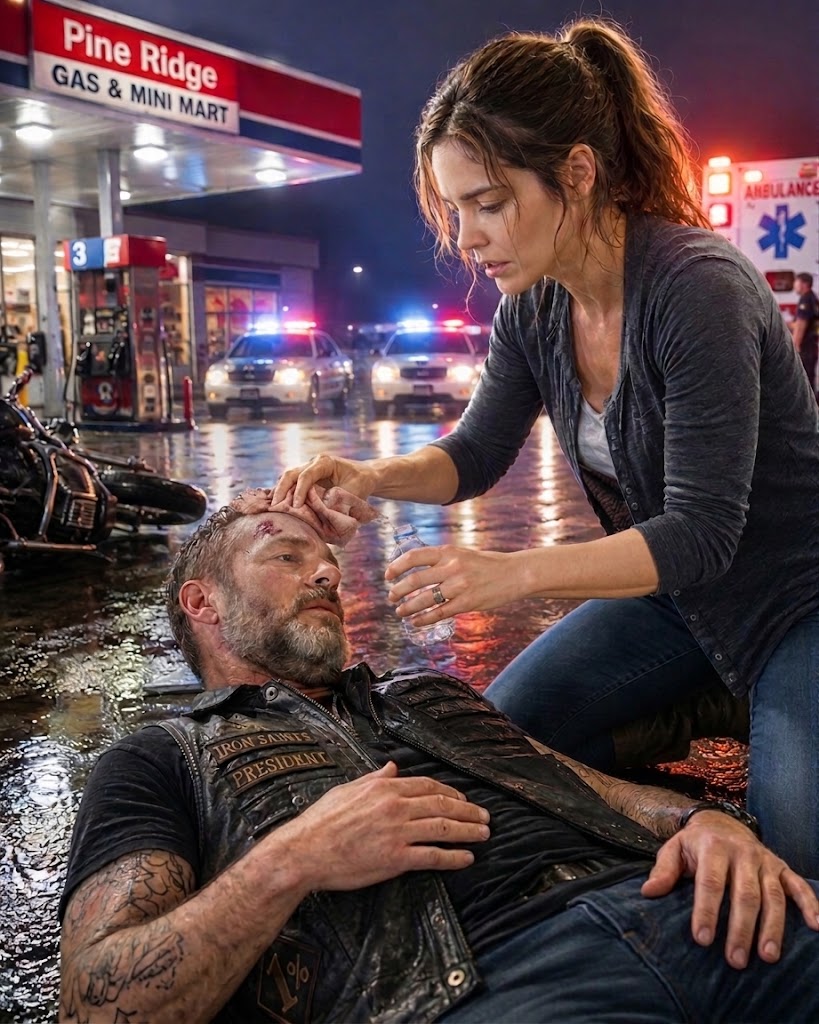
Under the bright gas station lights, a motorcycle lay on its side near pump three. A man in a black leather vest was on the ground beside it, one arm bent beneath him, his gray beard catching the light.
For a second, no one moved.
The young clerk behind the counter looked up from his phone and muttered, “Not again.”
Nora stared at him. “Do you know him?”
The clerk shrugged. “Biker type. I wouldn’t get involved.”
Outside, two cars pulled away from the pumps. One driver slowed, looked at the man, then kept going.
Nora’s fingers tightened around the eight dollars.
She thought of Miles waiting at home.
She thought of the milk.
Then she looked back at the man on the pavement.
He was not moving.
The Choice No One Else Made
Nora walked to the counter and placed the money down.
“Water,” she said. “And whatever pain medicine this will cover.”
The clerk frowned. “You’re spending your last cash on him?”
Nora did not answer right away. She was tired of explaining kindness to people who treated it like foolishness.
Finally, she said, “He’s alone.”
The clerk rang up the water and a small packet of tablets. Nora grabbed them and hurried outside.
The cold air hit her face. She knelt beside the man carefully, keeping her voice steady even though her hands were shaking.
“Sir, can you hear me?”
The man groaned softly.
Relief rushed through her.
“That’s good. Stay with me, okay? I’m calling for help.”
She dialed 911 and gave the location. While she waited, she folded a napkin, poured water onto it, and pressed it gently near the scrape on his temple. His breathing was uneven, but he was breathing.
His eyes opened halfway.
“Bike…” he whispered.
“It’s still here,” Nora said. “Don’t try to move.”
He looked confused, as if he could not understand why she was there.
“You know me?”
“No.”
“Then why help?”
Nora swallowed hard.
There were many answers she could have given. Because no one else stopped. Because someone should have. Because she hoped someone would do the same for her son one day.
But the simplest truth came out first.
“Because you mattered enough not to be left there.”
The man stared at her for one quiet second.
Then his eyes closed again.
An Empty Kitchen the Next Morning
The ambulance arrived soon after. The paramedics took over, asking questions and checking the man carefully. Nora stepped back, holding the half-empty bottle of water against her coat.
As they lifted him onto the stretcher, the man suddenly reached for her wrist.
His grip was weak, but his eyes were clear.
“Name?”
“Nora,” she said softly. “Nora Whitaker.”
He nodded once, as if he was trying to remember it.
Then they took him away.
By the time Nora got home, Miles was asleep on the couch with his schoolbook open on his chest. She stood in the doorway for a moment, looking at him in the dim yellow light.
There was no milk.
No cereal.
No banana.
The next morning, she toasted the last two slices of bread and spread a thin line of peanut butter across them.
Miles took one bite and smiled too brightly.
“Crunchy breakfast is good,” he said.
Nora turned toward the sink so he would not see her eyes fill.
That day at the diner, she worked through lunch and dinner with a headache she did not mention. Customers complained about cold coffee. Her manager reminded her that she could not keep asking for extra hours and then look exhausted during them.
That night, a red notice waited on her apartment door.
FINAL REMINDER.
Nora read it twice, then folded it and put it in the drawer with the other papers she did not know how to fix.
The Sound Outside Her Window
Two mornings later, a low rumble rolled through the apartment building.
Nora froze in the kitchen.
Miles looked up from the couch. “Mom?”
The sound grew louder.
Not one engine.
Many.
Nora walked to the window and pulled the curtain back.
Her breath caught.
The street below was filled with motorcycles.
Dozens of them.
Black bikes, chrome bikes, touring bikes, old road-worn bikes with leather bags and polished mirrors. Men and women stood beside them in jackets and vests, quiet and still beneath the pale morning light.
Miles hurried over and pressed his face to the glass.
“Are they here for us?”
Nora’s heart beat hard.
Before she could answer, someone knocked on the apartment door.
Three firm knocks.
She told Miles to stay behind her, then opened it.
A tall woman in a dark leather jacket stood in the hallway. Her silver hair was pulled back neatly, and her expression was calm, almost gentle. Beside her stood two men and another woman holding a small paper bag.
The silver-haired woman removed her gloves.
“Nora Whitaker?”
“Yes.”
“My name is June Callahan,” the woman said. “I ride with the Harbor Saints Motorcycle Club.”
Nora’s throat tightened.
June continued, “The man you helped at the gas station is our president.”
Nora blinked. “President?”
“His name is Grant Hollis. He’s alive because you stopped.”
The words hit Nora so suddenly she had to hold the doorframe.
“He’s alive?”
June’s face softened.
“Yes. Bruised up, stubborn as ever, and already arguing with doctors. But alive.”
Miles peeked around Nora’s side.
One of the men smiled gently and reached into his pocket, pulling out a small embroidered patch shaped like a wing.
“You must be Miles.”
Miles looked at his mother first.
Nora gave a tiny nod.
The man handed him the patch.
“Your mom did something brave.”
Miles held the patch like it was gold.
A Debt Paid With Respect
Footsteps sounded on the stairs.
Slow.
Careful.
Every rider in the hallway straightened.
Then Nora saw him.
The man from the gas station.
Grant Hollis looked pale, with a small bandage near his temple and a bruise along his cheek, but he was standing on his own. He wore a clean black shirt beneath his leather vest, and his gray beard had been trimmed.
Nora stared at him. “You should still be resting.”
A faint smile crossed his face.
“That is what everyone keeps telling me.”
He stepped closer and held out an envelope.
Nora shook her head immediately. “I can’t take money.”
Grant did not pull the envelope back.
“Good,” he said. “Then don’t think of it as money.”
“What else would it be?”
His eyes met hers.
“Respect.”
Nora looked down at the envelope. Her fingers trembled as she opened it.
Inside was a cashier’s check.
Enough to cover three months of rent, overdue utilities, groceries, and more.
Her face went hot.
“No. I didn’t help you for this.”
Grant nodded.
“I know. That is why I knew you were the kind of person who deserved it.”
Tears blurred her vision. “I don’t want charity.”
Grant’s voice stayed low and steady.
“This is not charity, Nora. Charity looks down. Respect looks straight at you.”
She could not speak.
June gently pointed toward the stairwell.
“There’s more.”
Nora looked past them.
Riders were carrying boxes up the stairs. Groceries. Cleaning supplies. Warm blankets. A small wooden desk. A twin mattress still wrapped in plastic. A lamp. School supplies. A winter coat in Miles’s size.
Miles gasped.
“Mom… is that bed for me?”
That broke her.
Nora covered her mouth, but the tears came anyway.
Grant stepped back, giving her room to feel what she had spent years trying to hide.
“We are not here to embarrass you,” he said. “We are here because you treated a stranger like a human being when everyone else looked away.”
The Apartment That Felt Different
For the next few hours, Nora watched strangers turn her apartment into something warmer.
One rider fixed the loose cabinet door in the kitchen. Another replaced the broken lock. June organized the groceries without making Nora feel small. A younger woman named Tess sat with Miles on the floor and helped him put pencils, notebooks, and crayons into his new backpack.
Nobody made a speech about how hard Nora’s life looked.
Nobody asked rude questions.
Nobody acted like she owed them gratitude on command.
That was what made it harder not to cry.
They helped with quiet dignity.
By noon, Miles had a real bed.
He sat on it with his shoes off, touching the superhero sheets again and again.
“This is really mine?”
Tess laughed softly.
“Every inch of it.”
Nora stood in the doorway beside Grant.
“I don’t know how to thank you.”
Grant looked at Miles, then back at her.
“You already did.”
“I bought water. That’s all.”
Grant shook his head.
“No. You saw me.”
Nora did not understand at first.
He touched the leather vest over his chest.
“Most people see this and decide the whole story before we say a word. Trouble. Noise. Bad news. Someone to avoid.”
Nora remembered the clerk’s warning.
Biker type.
Grant’s voice became quieter.
“That night, I was lying under those lights watching people look at me and drive away. Then you came out with eight dollars’ worth of mercy.”
Nora wiped her cheek.
“I was scared.”
“I know.”
“I almost didn’t stop.”
“But you did.”
The Family She Did Not Expect
Later that afternoon, after the bikes had quieted and the hallway was calm, June sat at Nora’s small kitchen table with two mugs of tea.
Miles had fallen asleep on his new bed.
Nora looked around the apartment, almost afraid that if she blinked, everything would disappear.
June seemed to understand.
“You’re waiting for the catch.”
Nora gave a tired laugh. “A little.”
“There isn’t one.”
“People don’t usually help like this.”
June looked down at her cup.
“Some don’t. Some do. You just hadn’t met us yet.”
Nora breathed in slowly.
For years, she had felt like she was standing in a storm with one arm around her child and the other holding up a roof that kept getting heavier. She had learned not to expect rescue. She had learned to smile while choosing which bill could wait. She had learned that being proud and being tired could live inside the same heart.
But that day, something shifted.
Not because everything was fixed.
Life was still life. Work would still be hard. Bills would still come. The world would not suddenly become easy.
But she was not invisible anymore.
Grant returned before leaving and placed one more small card on the counter.
It had a phone number written on it.
“If the landlord gives you trouble, call June. If your car won’t start, call Reggie. If Miles needs a ride to school and you’re stuck at work, call Tess.”
Nora stared at the card.
“I can’t keep asking you people for things.”
Grant smiled gently.
“Then don’t call it asking.”
“What should I call it?”
He glanced toward Miles’s room.
“Family checks on family.”
The Boy Who Finally Slept
That night, the apartment was quiet in a way Nora had never known.
Not empty quiet.
Safe quiet.
Miles slept in his new bed, one hand curled around the biker patch on his pillow. His backpack sat beside the desk. The refrigerator hummed, but this time it was full.
Nora stood in the kitchen and looked at the milk on the shelf.
A simple carton of milk.
Two days earlier, it had felt impossible.
Now it sat there beside eggs, apples, bread, and a covered dish June had labeled in neat handwriting: Chicken soup. Heat gently.
Nora pressed one hand against the refrigerator door and cried.
Not loudly.
Not the kind of crying that comes from defeat.
This was different.
This was the sound of someone finally being allowed to put down a weight for a moment.
The next morning, Miles woke up early and ran into the kitchen.
“Mom, do we still have cereal?”
Nora smiled.
“We do.”
He climbed into his chair, then looked at her carefully.
“Are the motorcycle people coming back?”
Nora poured milk into his bowl.
“I think so.”
Miles grinned.
“Good. They’re nice.”
Nora looked toward the window, where the morning sun was beginning to brighten the street.
“Yes,” she said softly. “They are.”
The Kindness That Came Back
A week later, Nora returned to the same gas station.
She did not need anything.
She only stood by pump three for a moment, remembering the cold pavement, the harsh lights, and the choice that had changed everything.
The clerk recognized her and looked embarrassed.
“Heard those bikers helped you out.”
Nora nodded.
“They did.”
He shifted awkwardly. “Guess you were right to stop.”
Nora looked at the spot where Grant had fallen.
Then she looked back at the clerk.
“I wasn’t thinking about being right.”
“What were you thinking?”
She smiled faintly.
“That no one should be left alone like that.”
The clerk had no answer.
On the drive home, Nora passed a line of motorcycles parked outside a small community center. The Harbor Saints were helping repair the building’s front steps. June waved from the sidewalk. Grant lifted one hand from where he stood beside a toolbox.
Miles waved wildly from the back seat.
Nora laughed for the first time in what felt like months.
And for once, the sound did not feel borrowed.
It felt like hers.
The Door That Stayed Open
Months later, Nora’s life was not perfect.
But it was steadier.
She found a better job at a local bakery with morning hours that let her pick Miles up from school. The landlord stopped leaving red notices. Miles joined a Saturday reading group at the community center, where half the volunteers wore leather vests and pretended not to tear up whenever children read out loud.
Grant healed.
June checked in every Sunday.
Tess became Miles’s favorite person after his mother.
And every time Nora tried to thank them again, they gave her the same answer.
“You started it.”
One evening, as spring rain tapped softly against the windows, Miles sat at the kitchen table drawing a picture.
Nora glanced over and saw a small woman, a little boy, and a long row of motorcycles under a bright yellow sun.
Above the picture, in uneven first-grade handwriting, Miles had written:
MY BIG FAMILY.
Nora touched the paper gently.
Her eyes filled again, but this time she smiled through it.
She had spent eight dollars because a stranger was lying alone under gas station lights.
She had thought it was a small act.
A bottle of water.
A packet of medicine.
A few gentle words.
But kindness does not always stay small.
Sometimes it travels farther than we ever expect. Sometimes it knocks on the door with groceries, rent money, a child’s bed, and a dozen quiet people who know how to show respect without making you feel weak.
And sometimes, when life has made you believe you are standing alone, one small act of mercy brings an entire family to your doorstep.
Kindness does not need to be loud to change a life; sometimes it begins with one tired person choosing to stop when everyone else keeps walking.
A person’s clothing, vehicle, job, neighborhood, or appearance can never tell the whole truth about their heart, and the people we are taught to fear may sometimes be the very ones who understand loyalty best.
Helping someone does not always mean having enough; sometimes it means giving from the little you have because your heart refuses to let another person be forgotten.
There is a kind of dignity in quiet struggle, but no one should have to carry every burden alone just to prove they are strong.
True gratitude does not embarrass people, shame them, or make them feel smaller; it lifts them up while still looking them straight in the eye.
A child remembers more than adults think, especially the moments when strangers become safe, when a home becomes warmer, and when hope finally feels real again.
The smallest choice can become the beginning of a new chapter, not because it fixes everything at once, but because it reminds someone they still matter.
Real family is not always built by blood or shared last names; sometimes it is built by loyalty, kindness, protection, and the people who show up when life is hardest.
When the world teaches us to look away, the bravest thing we can do is look closer and remember that every person on the ground is still someone’s whole world.
And sometimes, the mercy we give away with trembling hands returns to us in a form we never expected — not as charity, but as love, respect, and a door that finally stays open.