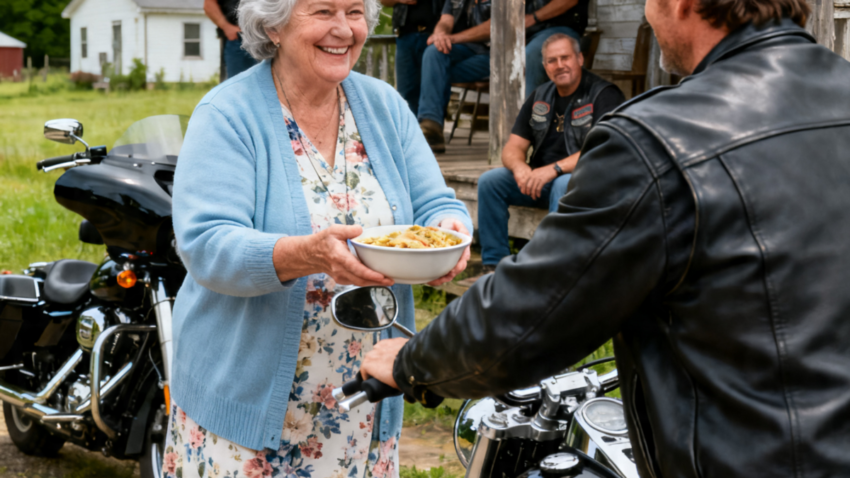
By sunrise, Margaret Pearson thought the whole town had already decided she was a fool.
By the next sunrise, the same town would stand frozen in the street, watching 800 motorcycles roll toward her crumbling house like a storm made of chrome, leather, and thunder.
The first time the bikers came, they arrived desperate, soaked by an Arizona monsoon and stranded on a lonely stretch of old Route 66.
The second time they came, they arrived with lumber, shingles, tools, electricians, plumbers, carpenters, permits, food trucks, generators, and a promise that no one in Williams would ever forget.
Margaret had not asked for any of it.
She had not opened her door hoping for money.
She had not fed them because she thought powerful men in leather would owe her something.
She had done it because thirty human beings were standing in front of her house with rain behind them, lightning above them, and nowhere else to go.
That was all.
To Margaret, it had been simple.
To the town, it had been madness.
To the Hells Angels, it had been something sacred.
The afternoon before everything changed, Margaret stood on her front porch with one hand pressed against the crooked screen door and the other shading her eyes from the hot Arizona glare.
The screen door had been hanging unevenly for years.
It dragged against the frame every time she opened it, whining like something wounded.
The porch beneath her feet had three bad boards, though she knew exactly where to step so they would not give way.
The third step had split straight through the middle, and Margaret had learned to lean on the railing, place her foot on the edge, and pretend that did not frighten her.
At seventy-three, she had become an expert at pretending.
She pretended the roof would last one more season.
She pretended the plywood over the upstairs windows did not make the house look abandoned.
She pretended the water stain on the bedroom ceiling was not spreading.
She pretended the letters from the bank, tucked in a kitchen drawer beneath an old biscuit tin, did not exist when she was making tea in the morning.
Most of all, she pretended she did not feel alone.
Her house sat near the eastern edge of Williams, Arizona, where Route 66 curved away from the cleaner, faster traffic of the interstate and became something older, rougher, and quieter.
The land opened out around it in dusty stretches of juniper, pine, and stubborn grass.
In the distance, the San Francisco Peaks rose under the sky, blue and solemn, like they had been watching human trouble for centuries and had grown too wise to interrupt.
The house had once been white.
Now the paint had peeled away in large gray patches, exposing wood that the sun had baked and the rain had softened.
Harold used to paint it every few years.
He would stand on a ladder in his work boots, humming to himself, a streak of white paint across his cheek, promising Margaret he would finish before supper and never once keeping that promise.
Back then, the house smelled of sawdust, lemon polish, Sunday roast, and fresh sheets.
Back then, Rebecca brought the grandchildren for weekends, and the rooms filled with the shrieks and footsteps of small children chasing each other upstairs.
Back then, Harold ran a contractor business out of the old shed behind the house, and men came by for estimates, invoices, tools, and coffee.
Back then, the porch was solid.
The windows shone.
The roof did not sag in the middle like a tired back.
But Harold had died fifteen years earlier from a heart attack so sudden that Margaret still remembered the sound of the coffee cup hitting the kitchen floor.
After that came the hospital bills, the funeral costs, the mortgage Harold had taken against the house when money grew tight, the taxes that never stopped arriving, and Rebecca’s slow retreat into her own life in California.
The calls came less often.
Then only on birthdays.
Then not even that.
Margaret told people Rebecca was busy.
She told herself the same thing until the lie grew soft enough to sleep beside.
Now she lived on social security, small savings, and whatever she could coax from the vegetable garden behind the house.
That summer, the tomatoes had done well.
The beans had come in stronger than expected.
The basil smelled rich and green whenever she brushed against it.
Small mercies mattered when the larger ones had run out.
On that afternoon, though, Margaret was not thinking about Rebecca, the mortgage, or the bank letters.
She was watching the sky.
A wall of dark clouds was gathering over the peaks, swollen and black at the edges.
The wind had shifted.
It carried the metallic scent of rain, the dry bite of dust, and the pressure that settled in old bones before a bad storm.
Margaret had lived in Arizona long enough to read a summer monsoon before the first drop fell.
This one would not be gentle.
She stepped farther onto the porch, felt the weak board dip beneath her shoe, and frowned toward the road.
At first, she thought the sound was thunder.
Then it grew deeper.
Closer.
More mechanical.
Engines.
A long line of motorcycles appeared in the distance, dark shapes rising out of the heat shimmer.
They rode in formation, steady and disciplined, their headlights cutting through the dust.
The sound rolled over the land and vibrated through the porch boards under Margaret’s feet.
Thirty bikes, maybe more.
The lead motorcycle slowed as it neared her drive.
Margaret saw black leather vests, patches, thick boots, beards, sunglasses, bandanas, and the kind of posture men develop when the world has been expecting trouble from them for a very long time.
She saw the insignia before she could read the words.
Hells Angels.
Three houses down, Patricia Walsh would have been on the phone before the first tire touched the gravel.
Patricia had a gift for fear.
She collected it the way other women collected plates or church bulletins.
She feared loose dogs, teenagers in hoodies, men with tattoos, storms, strangers, delivery vans, untrimmed hedges, and anything that looked like it had not asked her permission to exist.
Margaret could almost hear her voice already.
Lock your doors.
Call Sheriff Murphy.
Do not speak to them.
Margaret did none of those things.
She stood on the porch while the lead rider pulled into the dirt driveway.
He was a large man in his fifties, with iron-gray hair tied back at the nape of his neck and a scar through his left eyebrow.
His face was weathered, but not cruel.
His eyes, when he removed his sunglasses, were tired and unexpectedly kind.
The patch on his vest gave his name as Vincent Blackwell, though the smaller name stitched beneath it read Hawk.
Behind him, the other riders slowed and began lining their motorcycles along the road and beside the driveway.
Some looked toward the storm.
Some looked toward the house.
Some looked toward Margaret with the wary uncertainty of men who were used to doors closing before they could knock.
Vincent shut off his engine.
The sudden quiet seemed too thin after the thunder of motorcycles.
He stepped off the bike, removed his gloves, and looked up at the sky.
Lightning flickered inside the cloud wall.
It was still far enough away to look beautiful, but close enough to be dangerous.
“Ma’am,” Vincent said.
His voice was deep and careful.
“Sorry to bother you.”
Margaret waited.
“That storm is coming in fast,” he said.
“We misjudged it.”
He glanced toward the riders behind him.
“We were wondering if there is a garage, a barn, a diner, anything nearby where we could wait it out.”
Margaret looked past him.
The rain was already visible in the distance, a gray curtain dragging across the desert floor.
There was no real shelter for miles.
No open gas station.
No barn.
No motel.
No place thirty men on motorcycles could reach before the lightning started striking the open road.
“There’s no shelter close enough,” Margaret said.
A few of the bikers exchanged looks.
Vincent’s jaw tightened as if he had expected that answer but dreaded it anyway.
“But you can bring those bikes around back,” Margaret continued.
“And you can come inside.”
Vincent stared at her.
For one second, his entire face went blank.
Then he blinked.
“Ma’am,” he said slowly.
“There are thirty of us.”
“I can count,” Margaret replied.
“We can’t impose like that.”
“You can and you will.”
The first drops of rain hit the dust between them, darkening it in fat circles.
Margaret pointed toward the side of the house.
“There is an old carport out back.”
“It leaks in two places, but it is better than nothing.”
“Get those motorcycles under it before the rain ruins whatever rain can ruin on those things.”
A younger rider pulled beside Vincent and lifted his sunglasses.
He had a square jaw, oil-dark fingernails, and the solid look of a man who knew how to repair what other people threw away.
The name on his vest read Russell Carver, though the riders called him Forge.
“Hawk,” Russell said quietly.
“We should not make this lady responsible for all of us.”
“I heard the lady,” Vincent said.
He looked at Margaret, and she saw something flicker across his face.
Suspicion, maybe.
Or gratitude he did not yet trust.
“Are you sure about this?”
Margaret folded her thin arms.
“I am sure.”
“Now hurry.”
The sky answered with a crack of thunder so sharp it seemed to split the air in two.
The bikers moved instantly.
There was no disorder, no shouting, no rough chaos.
They guided their motorcycles around the side of the house with careful precision, parking them beneath the sagging carport and along the back fence.
Rain began falling harder, tapping against the roof, the porch, the dry leaves, the cracked road.
Margaret turned and went inside, her mind already racing through the pantry.
Thirty men.
Thirty hungry, wet, stranded men.
She had two pounds of ground beef in the freezer, three boxes of pasta, canned tomatoes, green beans from the garden, half a sack of onions, two loaves of bread she had baked the day before, and a wedge of hard cheese wrapped in wax paper.
It was not enough.
It would have to become enough.
She pulled the ground beef from the freezer, set it under running water, and took down her largest pot.
Outside, the rain changed from steady to violent in the space of a breath.
The monsoon slammed into the house as if it had been waiting to punish the old place for standing too long.
Water sheeted down the windows.
The roof groaned.
The wind shoved against the walls.
Thunder crashed directly overhead, and Margaret heard boots rushing across the back steps.
She opened the kitchen door before anyone knocked.
One by one, the bikers came inside.
They were soaked to the skin.
Water streamed from their vests, hair, jeans, boots, and gloves.
But they did not stamp through her kitchen like men claiming space.
They stopped at the threshold.
They wiped their feet.
They removed wet jackets and set them where she pointed.
They pulled off muddy boots without being told.
One of the biggest men in the group looked down at the faded linoleum and asked if she had old newspapers so they would not ruin the floor.
Margaret nearly laughed.
“That floor survived three grandchildren and one collie with stomach trouble,” she said.
“It will survive you.”
Still, they were careful.
Painfully careful.
As if the house were not falling apart around them.
As if the worn table, faded curtains, chipped mugs, water-stained ceiling, and weak staircase deserved respect.
That was the first thing that unsettled Margaret.
Not their size.
Not their patches.
Not their voices.
Their care.
They moved through her house like men who understood what it meant for a poor person to own very little and still love every inch of it.
“I am Margaret Pearson,” she said, standing near the stove.
“There are towels in the bathroom.”
“Do not all rush it at once, or the plumbing will surrender.”
A few of them smiled.
“I am going to make spaghetti and meat sauce.”
“It is what I have that can feed this many.”
“So if anyone has fancy requirements, I am afraid tonight you are eating like a widow on a budget.”
Vincent stepped forward, water dripping from the end of his ponytail.
“Margaret, you do not have to feed us.”
“You already gave us shelter.”
“Nonsense.”
“You are guests in my home.”
“Guests get fed.”
“That is how I was raised.”
The words seemed to ripple through the room.
Some of the younger riders looked down.
One rubbed the back of his neck.
Another stared at the floor as though no one had called him a guest in a very long time.
Russell came to the counter.
“Can I help?”
Margaret glanced at him.
“You cook?”
“Enough not to poison anybody.”
“Good.”
She placed a cutting board and knife in front of him.
“Dice those tomatoes.”
“And wash your hands first.”
He smiled and obeyed.
Within minutes, the kitchen had changed.
Three bikers chopped vegetables.
One stirred sauce.
One opened cans.
Another found plates in the cupboard after asking permission twice.
Two men disappeared down the hallway to inspect the bathroom faucet Margaret had mentioned when she noticed the constant drip had become a steady tick in the stormy silence.
Another knelt by the living-room outlet that had died the previous winter.
He pulled a small tool roll from his bag and muttered something about old wiring.
Margaret told him not to electrocute himself in her living room.
He told her he would try not to embarrass the club.
Rain hammered the roof so loudly that conversation had to rise above it.
Thunder shook the windows.
Water dripped in one corner of the living room, and a biker quietly moved a bowl beneath it without making a comment.
That kindness almost hurt her more than the leak.
The sauce stretched.
The pasta boiled.
The bread was sliced thinner than Margaret would have liked.
She added beans, onions, canned tomatoes, and every bit of seasoning she could spare.
The kitchen filled with steam, garlic, meat, tomatoes, wet leather, coffee, and the strange warmth of too many living bodies in a house that had been silent for years.
At one point, a young rider stood near the front door staring at the porch through the rain.
“Ma’am,” he said.
“Those steps are bad.”
“I know,” Margaret said.
“One is broken clean through.”
“I know that too.”
“You could fall.”
“I have been not falling for years.”
Russell paused in his chopping.
“We could fix that when the rain stops.”
“No,” Margaret said.
“In this storm, you will do no such thing.”
“But thank you.”
The young rider looked troubled, as if the idea of leaving a dangerous step unfixed felt physically uncomfortable.
Margaret noticed Vincent watching her from the edge of the kitchen.
He had not eaten yet.
He had not relaxed.
He stood with one shoulder against the doorframe, his eyes moving over the sagging cabinets, the water stain, the cracked plaster, the old photographs on the wall, and the widow who moved through it all like a woman trying not to admit how tired she was.
Finally, he asked the question.
“Why?”
Margaret turned from the stove.
“Why what?”
“Why are you doing this?”
The kitchen quieted slightly.
Even the men pretending not to listen were listening.
Vincent did not soften the question.
“You do not know us.”
“Most people in this town would have locked the door and called the sheriff before we reached the driveway.”
Margaret stirred the sauce.
The wooden spoon moved slowly through the pot.
Outside, lightning flashed white against the windows.
“My husband Harold used to say character is not revealed by how you treat people who can do something for you.”
She looked at Vincent.
“It is revealed by how you treat people who cannot.”
No one spoke.
“You boys needed help.”
“I had a roof.”
“That seemed simple enough.”
Vincent looked down.
“Most people do not see it that simple.”
“Most people are fools,” Margaret said.
A surprised laugh came from somewhere near the pantry.
Margaret pointed the spoon at the room.
“I have lived seventy-three years.”
“I have learned that a man’s heart matters a whole lot more than the patches on his vest or the machine he rides.”
“Now, is someone going to help me carry these plates, or are you all going to stand around turning supper into a sermon?”
That broke the tension.
Men moved.
Plates filled.
Bowls passed from hand to hand.
Spaghetti and thin meat sauce spread through the house, eaten on mismatched china, old soup bowls, saucers, and two chipped mugs pressed into service because thirty men required creativity.
Margaret kept a small portion for herself.
Too small.
Vincent saw it.
His eyes flicked to her plate, then to the nearly empty pot.
He did not say anything.
Instead, when one rider asked for seconds, Vincent placed a hand on his shoulder and gave one small shake of his head.
The rider understood immediately.
Margaret pretended not to notice.
Later, they washed every dish.
They cleaned the counters.
They wiped the stove.
One of them swept the floor.
Another fixed the bathroom faucet.
The dripping stopped for the first time in three months, and the quiet after it felt almost luxurious.
The living-room outlet came back to life with a spark, a curse, and then a triumphant grunt.
Margaret scolded the man for cursing in her house.
He apologized so sincerely that she had to look away to hide her smile.
The storm did not pass.
Evening lowered over the house, and rain kept pounding the roof.
The road outside had turned into a shallow river.
The low crossing east of town was surely flooded.
No one was going anywhere.
Margaret brought out the quilts.
Some had been made by her grandmother.
Some by her.
One had squares cut from Harold’s old work shirts, blue flannel and faded plaid stitched into soft order.
She handed them to men who took them as carefully as church offerings.
The bikers settled in chairs, against walls, on the floor, and in corners.
They spoke quietly.
Some slept sitting up.
A few looked at old photographs on the mantel and asked about Harold.
Margaret told them he had been a contractor, a stubborn man, a good husband, and a terrible singer.
Russell smiled at the word contractor.
“That explains the old shed,” he said.
“You noticed that?”
“I notice tools.”
“Harold kept everything out there.”
“Most of it is rusted now.”
Russell looked as if he wanted to ask more, but did not.
Near nine, Margaret made coffee.
It was weak because she stretched the grounds too far, but no one complained.
Vincent and Russell sat with her at the kitchen table.
Rain whispered under the larger thunder now, steady and relentless.
“You live here alone?” Russell asked.
“For fifteen years.”
“My husband passed.”
“My daughter moved away.”
She wrapped her hands around the warm mug.
“It is just me and this old house now.”
Vincent glanced around.
“It is more than that.”
Margaret looked at him.
“It is refuge,” he said.
“You gave us that tonight.”
The word sat between them.
Refuge.
Not shelter.
Not convenience.
Not pity.
Refuge.
Margaret felt something tighten in her throat.
“Any decent person would have done the same.”
“No, ma’am,” Vincent said.
He said it with such certainty that she could not dismiss it.
“They would not.”
He leaned back.
“We have been riding for decades.”
“I can count on one hand the number of strangers who treated us like human beings before they decided what we were.”
“You opened the door before we even asked properly.”
“You fed us.”
“You trusted us in your home.”
“That is not ordinary.”
“It should be,” Margaret said.
“It should,” Vincent replied.
“But it is not.”
At ten-thirty, Margaret stood.
“Enough talk.”
“I am going to bed.”
“You boys sleep where you can.”
“If the house makes a noise, ignore it unless something actually falls.”
A few men laughed.
She climbed the stairs carefully, stepping over the weak board near the top, the one that dipped underfoot and made her grip the railing every night.
In her bedroom, the air smelled faintly of damp plaster.
Rain tapped against the old window.
She sat on the edge of the bed and listened to the low murmur of male voices below.
For the first time in years, her house did not feel empty.
That comfort frightened her.
Loneliness, when it stays long enough, begins to feel like a private room.
When someone opens the door, the light can hurt.
Margaret lay down under a thin quilt and told herself she had only done what needed doing.
Nothing more.
By morning, the storm had cleared.
The air outside was bright, washed clean, and sharp with the smell of wet earth.
Margaret woke to motorcycle engines starting one by one.
She dressed quickly in her faded house dress and cardigan and descended the stairs, placing her feet where she knew the boards would hold.
When she opened the front door, sunlight poured over the porch.
The bikers were gathered in the yard.
Their motorcycles gleamed with rainwater.
Their vests were dark from damp leather.
Vincent and Russell stood near the lead bike.
Both approached when they saw her.
“Morning, Margaret,” Vincent said.
“We wanted to thank you before we left.”
“Stop fussing,” she said.
“You slept on my floor and ate cheap spaghetti.”
“We were safe,” he said.
“That is not cheap.”
He pulled a folded paper from his vest.
“This is my number.”
“If you ever need anything, call me.”
“Day or night.”
Margaret took the paper.
She knew she would not call.
Women like Margaret did not ask for help easily, especially not from people they had known for one storm.
“That is kind of you,” she said.
“But I will be fine.”
Russell was not looking at her.
He was looking at the house.
His eyes moved with professional seriousness from the porch rail to the roofline, the warped siding, the plywood windows, the cracked foundation blocks, the gutters hanging loose, and the water damage under the eaves.
The softness left his face.
“Margaret,” he said carefully.
“How long has the house been like this?”
The question made her defensive before she could stop herself.
“A few years.”
“Things wear out.”
“This is not wear and tear.”
His tone was blunt, but not cruel.
“This is structural damage.”
Margaret felt heat rise in her cheeks.
“The roof is failing.”
“Those upstairs windows are not safe.”
“That porch could put you in the hospital.”
“And the floor near the stairs is soft.”
Margaret stared at him.
“You noticed that?”
“I stepped on it last night.”
He frowned.
“Ma’am, you cannot keep living like this.”
“Well,” Margaret said, voice sharper than she intended.
“I am living like this because I do not have much choice in the matter.”
The words landed harder than she meant them to.
Several bikers looked away.
Vincent and Russell exchanged a glance.
It was quick, but Margaret saw it.
Something passed between them that felt like a decision not yet spoken aloud.
“You boys should get on the road,” she said.
“The sun will be hot soon.”
Vincent held out his hand.
“Take care of yourself, Margaret Pearson.”
She placed her hand in his.
His grip was strong but gentle.
“And remember what I said.”
“If you need anything, call.”
She nodded.
“Safe travels.”
The riders mounted up.
Engines roared to life.
One by one, they pulled into formation, rolling out from behind her house and back onto Route 66.
Some lifted a hand as they passed.
Russell looked back once, his expression dark with concern.
Then they were gone.
The thunder faded down the road until the quiet returned.
Margaret stood on the porch, holding Vincent’s phone number in her palm.
For a moment, the house seemed even more broken than before.
She went inside.
There were dishes stacked clean on the counter.
The faucet no longer dripped.
The outlet worked.
One of the men had tightened the loose kitchen chair.
Another had left a small note by the coffee tin.
Thank you for seeing us.
Margaret folded it and placed it beside Harold’s photograph.
That afternoon, Patricia Walsh came.
Margaret saw her through the window before the knock.
Patricia marched up the street with the stiff-backed purpose of a woman carrying judgment like a casserole.
She stopped at the broken porch steps, looked down as if they offended her personally, and rapped on the screen door.
Margaret opened it.
“Margaret,” Patricia said.
“I saw them.”
“Good afternoon to you too.”
“I saw those bikers here all night.”
“A whole gang.”
“They were stranded in the storm.”
“Those were Hells Angels.”
Patricia whispered the name as if saying it normally might summon them back.
“I know who they were.”
“Are you out of your mind?”
Margaret looked at her for a long second.
The question did not hurt because Patricia asked it.
It hurt because Margaret knew half the town would be asking the same thing by dinner.
“What did you expect me to do?” Margaret asked.
“Let them stand in lightning?”
“I expected you to lock your doors and call Sheriff Murphy.”
“They could have robbed you.”
“They could have hurt you.”
“They were perfect gentlemen.”
Patricia’s mouth tightened.
“You do not know that.”
“I was there.”
“They fixed my faucet.”
“That is not the point.”
“It is one of the points.”
Patricia leaned closer.
“At your age, alone in this house, you cannot take risks like that.”
Margaret’s spine straightened.
“At my age, I have earned the right to decide who comes through my door.”
Patricia flushed.
“I am only concerned.”
“No,” Margaret said.
“You are frightened.”
“There is a difference.”
Patricia stared at her, offended into silence.
Margaret softened only slightly.
“They needed help.”
“I helped.”
“If that makes me foolish in this town, then maybe this town has been wise in all the wrong ways.”
She closed the door before Patricia could answer.
Through the window, she watched Patricia storm back toward her house.
By evening, Margaret knew the story had spread.
She saw curtains move across the street.
She saw a truck slow in front of her house.
She saw Sheriff Murphy’s cruiser pass once, then again, though he did not stop.
Let them talk, she told herself.
She had survived debt, widowhood, neglect, illness, leaks, taxes, silence, and winters with bad heating.
She would survive gossip.
But Russell’s words stayed with her.
This is structural damage.
You cannot keep living like this.
That night, Margaret opened the kitchen drawer and took out the letters.
Not all of them.
Just the most recent.
The bank notice.
The tax reminder.
The hardware-store bill she had not paid because medicine had come first.
She laid them on the table beside Harold’s old pencil, the one he used to mark boards and measurements.
For years, she had told herself she was managing.
But managing had become another word for sinking slowly.
The roof needed replacing.
The windows needed replacing.
The porch needed rebuilding.
The electrical system was old enough to make the insurance man nervous, if she still had the kind of policy that would bring one out to inspect.
The plumbing worked because men in leather had been kind enough to fix one faucet, but the pipes groaned whenever the water ran.
Her bedroom floor sagged.
Her back steps leaned.
The shed roof had caved in over Harold’s old tools the previous winter, and she had not had the heart to look inside since.
Margaret placed Vincent’s number beside the letters.
For one reckless moment, she imagined calling him.
Then shame rose in her like a wall.
What would she say?
Hello, Vincent, I fed you spaghetti, so now please save my life from lumber, interest, rot, and old age.
No.
She folded the paper and put it in her cardigan pocket.
She would make do.
That was what she did.
She climbed the stairs slowly, avoiding the weak board.
In bed, under Harold’s quilt, Margaret listened to the house creak around her.
She did not know that at that very hour, Vincent Blackwell was not sleeping.
She did not know that he had spent the day on the phone.
She did not know that Russell had photographed every dangerous angle of her house before leaving.
The roofline.
The porch.
The cracked foundation.
The plywood windows.
The rotted steps.
The water damage.
The sagging shed.
The old contractor’s emblem still faintly visible on a rusted sign behind the house.
Pearson & Son Construction.
There had never been a son, but Harold had liked the sound of it.
Russell sent the photos to three people.
Those three sent them to others.
By midnight, the story had moved beyond the Flagstaff chapter.
By two in the morning, it was moving across Arizona, Nevada, and California.
By dawn, men and women who had never met Margaret Pearson knew her name.
They knew she had opened her door when others would have slammed theirs shut.
They knew she had fed thirty riders with food she could not spare.
They knew she lived alone in a house that might kill her before winter.
And in their world, kindness like that was not ignored.
It was remembered.
It was answered.
The next morning, Margaret woke before sunrise to a sound she could not place.
At first, she thought it was another storm.
But there were no clouds.
No rain.
No wind.
The rumble came from the ground.
Low.
Continuous.
Growing.
She sat up in bed, heart pounding.
The window was cracked open, and the sound pushed through the screen like distant thunder rolling over the highway.
Then it multiplied.
Engines.
Not one.
Not thirty.
Hundreds.
Margaret rose too quickly and had to grip the bedpost until the dizziness passed.
She pulled on her robe and crossed to the window.
When she looked out, her breath caught.
Motorcycles filled Route 66.
They stretched down the road in both directions as far as she could see.
Headlights glowed in the early light.
Chrome flashed.
Black leather moved like a dark river.
Bike after bike turned toward her house, pulling into the yard, lining the road, filling the empty lot across from her driveway, spreading with eerie order across the dusty ground.
It was not chaos.
It was an army arriving with discipline.
Margaret pressed one hand to her chest.
For one terrible second, she wondered if she had somehow insulted them.
Then she saw Vincent standing near the porch.
Russell was beside him.
Both were looking up at her window.
Neither looked angry.
Margaret dressed with trembling hands.
Her fingers fumbled with the buttons of her dress.
She nearly forgot her cardigan.
When she reached the stairs, she stopped at the weak board and whispered, “Not today.”
Then she went down carefully and opened the front door.
The sight stole every word from her mouth.
The yard was full of bikers.
The road was full of bikers.
The air smelled of gasoline, dust, leather, coffee, and morning sun.
Engines idled, then shut off in waves until the rumble faded and the human silence grew enormous.
Vincent stood at the bottom of her porch steps.
“Morning, Margaret,” he said.
“Hope we did not wake you.”
She stared at him.
“Vincent.”
Her voice broke.
“What is this?”
Russell smiled faintly.
“About eight hundred people.”
“Give or take a few dozen.”
Margaret looked past them again, unable to process the scale of it.
“Why?”
Vincent stepped closer.
The broken porch step creaked under his boot.
He looked down at it, then back at her.
“Because you gave us shelter when nobody else would have.”
“You fed us when you barely had enough.”
“You treated us with dignity.”
“You made thirty men feel human in a world that mostly sees patches before faces.”
His voice softened.
“That means something to us.”
Margaret shook her head.
“I only made supper.”
“No,” Vincent said.
“You opened a door.”
Russell lifted a clipboard.
“We are going to fix the house.”
Margaret blinked.
“What?”
“All of it.”
“Roof.”
“Porch.”
“Windows.”
“Electrical.”
“Plumbing.”
“Foundation repairs.”
“Floors.”
“Kitchen.”
“Bathroom.”
“Back steps.”
“Shed if we can save it.”
“We have contractors, carpenters, electricians, roofers, plumbers, painters, framers, and enough stubborn people to make the impossible irritatingly possible.”
Margaret could not speak.
Vincent continued.
“Materials are coming from Flagstaff.”
“Some from Phoenix.”
“Some already paid for by people who heard what you did and wanted in.”
“Permits are handled.”
“Sheriff Murphy got cooperative fast once he understood this was happening with or without his personal feelings.”
Margaret gripped the doorframe.
“You cannot do this.”
“We can.”
“It is too much.”
“It is not enough.”
Tears blurred the porch, the yard, the faces, the motorcycles.
Margaret shook her head again.
“I cannot pay you.”
Russell’s expression changed.
He looked almost offended.
“Nobody asked you to.”
“This is not charity,” Vincent said.
“This is a debt of honor.”
Behind him, the bikers began moving.
Trucks pulled in carrying lumber, shingles, windows, cabinets, rolls of wire, copper pipe, bags of cement, paint, tools, tarps, sawhorses, and ladders.
A generator came next, large enough to power half the block.
Someone began setting up a water station.
Someone else unfolded tables.
A woman with silver hair and tattoos down both arms started handing out assignments with the authority of a general.
The yard became a construction site in less than fifteen minutes.
Margaret stood frozen in the doorway while people she had never met treated her ruined house as if it were the most important building in America.
A voice called from the street.
“Margaret.”
Grace Thornton pushed through the crowd.
Grace owned the diner near Route 66, a practical woman in her forties with kind eyes and no patience for nonsense.
Her apron was still on, and her hair was pinned badly, as if she had left in a hurry.
“Pack a bag,” Grace said.
“You are staying with me.”
Margaret stared.
“Grace, I cannot.”
“You can.”
“I have a guest room.”
“These people cannot rebuild around you while you are making tea in the kitchen and telling everyone not to fuss.”
Margaret tried to protest.
Grace took her hand.
“Listen to me.”
“We all saw your house getting worse.”
“We all knew you needed help.”
“We said it was none of our business because that is easier than admitting we failed you.”
She looked toward the bikers.
“They did not fail you.”
“So the least I can do is give you a bed for three nights.”
That undid Margaret more than the motorcycles had.
“Three nights?”
Russell answered.
“That is the plan.”
Margaret gave a wet, startled laugh.
“This house has needed three years of work.”
“Good thing we brought eight hundred people,” Russell said.
Sheriff Calvin Murphy arrived an hour later.
Everyone saw the cruiser before he stepped out.
The town had been waiting for that moment.
Curtains moved.
Porches filled.
Phones lifted.
Sheriff Murphy walked toward Vincent with the careful posture of a man who knew the wrong tone could turn an already impossible morning into a headline.
“Blackwell,” he said.
“Sheriff,” Vincent replied.
Murphy looked around at the bikes, trucks, materials, and organized crews.
“This is a lot of people.”
“It is.”
“All here legally?”
“Yes.”
“Permits?”
Russell held up the clipboard.
“Filed and approved.”
Murphy glanced at him.
“That fast?”
Vincent’s mouth curved.
“Motivated county employees are a blessing.”
Murphy looked toward Margaret.
She stood beside Grace’s truck with one suitcase, her cardigan wrapped tight around her thin shoulders.
The sheriff’s face changed.
For years, he had driven past this house.
Everyone had.
They had all seen the porch sinking, the roof dipping, the windows boarded up.
They had all told themselves Margaret was proud, private, stubborn, fine.
Now eight hundred strangers had arrived to do what her own town had not.
Murphy took off his hat.
“No problem from me,” he said.
Vincent studied him.
“No?”
“No.”
The sheriff’s voice lowered.
“That woman fed your people in a storm.”
“Meanwhile, she has been living in a death trap while the rest of us looked away.”
He glanced at the road.
“I can help with traffic.”
Vincent nodded once.
“Appreciated.”
Murphy looked at the crews.
“Just do the work right.”
Russell’s eyes hardened.
“We do not do it wrong.”
The work began in full force.
Margaret sat in Grace’s truck, clutching her suitcase, watching men climb onto her roof.
The first shingles came off in black, ruined sheets.
Rotted boards were exposed beneath.
A crew on the porch began pulling up damaged planks.
Another team removed the plywood from the upstairs windows.
Electricians entered through the kitchen.
Plumbers went beneath the house.
Someone carried out old cabinets.
Someone else carefully removed Harold’s framed photograph from the wall and wrapped it in a towel as if it were museum glass.
Margaret saw that and began crying again.
Grace drove her away before she could climb out and tell everyone to stop.
At the diner, Grace placed coffee in front of her and did not ask questions for several minutes.
That kindness helped.
The diner windows faced the road, and all morning, residents came in pretending to order pie while craning their necks toward Margaret’s house.
Some whispered.
Some looked ashamed.
Some looked excited.
Patricia Walsh arrived near noon, pale and stiff.
She sat two booths away and kept looking at Margaret.
Finally, she came over.
“Margaret,” Patricia said.
Margaret waited.
“I suppose you are pleased.”
Grace, behind the counter, turned slowly.
The diner quieted.
Patricia seemed to realize she had chosen the wrong opening.
“I mean,” she added quickly.
“This is certainly something.”
“It is,” Margaret said.
Patricia folded her hands.
“I was worried about you.”
“I know.”
“I still think letting them in was dangerous.”
Margaret looked out the window toward the distant movement around her house.
“Maybe.”
“But letting fear make every decision is dangerous too.”
Patricia had no answer for that.
She left without ordering.
By late afternoon, Margaret could not stay away.
Grace drove her back.
The house she returned to was not the house she had left.
It had been opened like a wound.
The porch was gone.
The roof was stripped.
The kitchen cabinets were out.
The upstairs windows were empty holes filled with light.
The old shed had been cleared, and Harold’s tools lay on tarps, sorted and cleaned by men who understood their value.
Russell met her near the road, dust in his hair and a pencil behind his ear.
“You should not be walking around here without a hard hat.”
“I am seventy-three years old.”
“I have survived childbirth, hospital billing departments, and Patricia Walsh.”
“I will survive a hard hat.”
He handed her one anyway.
She put it on.
Vincent appeared from the side of the house.
His vest was off.
His shirt was dusty.
His hands were scraped.
“You okay?” he asked.
Margaret looked at the exposed beams of her roof.
“I feel like I am watching surgery.”
“That is not far off.”
“Was it bad?”
Vincent and Russell exchanged a glance.
Margaret’s stomach tightened.
“Tell me.”
Russell sighed.
“The roof was worse than I thought.”
“The porch was one hard rain from collapsing.”
“The wiring was dangerous.”
“The upstairs floor needed reinforcement.”
“The foundation has a crack, but we can stabilize it.”
He hesitated.
“Margaret, another winter in this place could have been bad.”
She looked away.
Shame came first.
Then fear.
Then anger, quiet and old, not at them but at every year she had been forced to measure survival in small delays.
Maybe next month.
Maybe after taxes.
Maybe if Rebecca calls.
Maybe if the roof holds.
Vincent seemed to understand.
He did not fill the silence.
Margaret walked to the tarps where Harold’s tools had been laid out.
His hammer.
His square.
His old level.
The red-handled screwdriver he never let anyone borrow.
The leather tool belt cracked with age.
She touched the hammer.
A man with a shaved head and tattooed hands stepped back respectfully.
“Cleaned what we could, ma’am.”
“Some of it is still good.”
Margaret swallowed hard.
“Harold would have liked that.”
“Contractor?”
“The best in three counties, if you asked him.”
The man smiled.
“Then we better not embarrass him.”
For the next three days, Margaret lived between disbelief and gratitude so large it exhausted her.
She stayed in Grace’s guest room, but she returned to the work site again and again.
Every visit revealed another transformation.
The roofers worked from dawn until the stars came out, wearing headlamps after sunset.
Carpenters rebuilt the porch with solid joists and wide steps.
Electricians replaced old wiring hidden in walls that smelled of dust and time.
Plumbers crawled under the house and emerged filthy but triumphant.
Painters sanded and primed.
Window crews installed glass that caught the morning light.
A kitchen crew measured twice, argued once, then installed cabinets Margaret could not imagine owning.
The bathroom was gutted and rebuilt with a safe shower, grab bars, new tile, and a sink that did not wobble.
The floor near the staircase was reinforced.
The railing was rebuilt.
The back steps were replaced.
The garden fence was repaired and expanded.
Someone built raised beds so Margaret would not have to bend so much.
Someone else installed a small bench under the juniper where Harold used to sit after mowing.
No one asked for praise.
No one posed for it.
They worked as if they had come not to perform goodness, but to repay something private.
By the second day, the media arrived.
First came Benjamin Hayes from the Flagstaff paper.
He was lean, observant, and polite, with a notebook in one hand and a camera slung around his neck.
He found Margaret standing near the new porch frame, watching Russell explain a measurement to three younger riders.
“Mrs. Pearson?” he asked.
“I would like to write about this.”
Margaret stiffened.
“I do not need attention.”
“No, ma’am.”
He glanced at the house.
“But maybe the story does.”
Grace, standing beside Margaret, touched her arm.
“Let him tell it.”
Margaret shook her head.
“I only fed people.”
“That is exactly why he should tell it,” Grace said.
So Margaret talked.
At first, her answers were short.
Then the memory opened.
She told Benjamin about the storm.
About the motorcycles appearing under the black sky.
About Vincent asking for shelter and looking surprised when she offered it.
About stretching two pounds of ground beef into supper for thirty men.
About the way they removed their boots, washed dishes, fixed the faucet, and slept under quilts like exhausted sons.
She told him about Harold.
About the house.
About Rebecca.
About the years of making do until making do became another name for disappearing.
Benjamin asked one question that stayed with her.
“Why do you think they came back?”
Margaret watched a biker kneeling in the garden, hammering fresh fence posts into the soil.
“Because they understand what some respectable people forget.”
“What is that?”
“That kindness is not small just because it is simple.”
Benjamin wrote that down.
She continued.
“I gave them shelter from a storm.”
“They are giving me shelter from years of trying to survive alone.”
A photograph ran with the story the next morning.
Margaret in a hard hat, standing beside Vincent and Russell in front of the half-rebuilt porch.
The headline spread first through Arizona.
Then farther.
By noon, Grace’s diner phone would not stop ringing.
News trucks appeared.
Reporters asked questions.
Cameras rolled.
People online argued, cried, praised, doubted, shared, judged, apologized, and shared again.
The story became larger than Margaret’s house.
It became a mirror.
The town of Williams did not enjoy what it saw in that mirror at first.
Businesses that would once have closed their doors at the sight of the motorcycles now carried trays of sandwiches, jugs of water, coffee, fruit, and bags of ice to the work site.
Residents who had whispered from behind curtains walked over and asked if they could help.
Some brought paintbrushes.
Some brought cash.
Some brought tools.
Some brought nothing but shame, which they turned into sweeping, lifting, carrying, and staying out of the way until someone needed them.
Patricia Walsh came on the third morning with a grocery bag full of supplies and an apology folded so tightly it almost tore on the way out.
“I was wrong,” she said to Margaret.
It sounded painful.
Margaret gave her mercy without making it cheap.
“Yes,” she said.
“You were.”
Patricia nodded, eyes wet.
“I am sorry.”
Margaret looked toward the house, where bikers and townspeople were working side by side.
“Then help Grace with the water table.”
Patricia did.
By the third evening, the house was whole.
Not patched.
Not disguised.
Whole.
Margaret arrived just as the sun was lowering behind the peaks, turning the sky gold and rose.
For a moment, she did not recognize the place.
The porch stood solid and level, painted clean white.
The steps were wide and safe.
The screen door hung straight.
The roofline was strong.
New windows reflected the sunset.
The siding had been repaired and painted.
The garden fence stood neat around expanded beds.
The old shed had a repaired roof, a new lock, and Harold’s tools arranged inside on a restored workbench.
A small brass plate had been fixed above it.
Harold Pearson’s Workshop.
Margaret touched the plate and nearly broke.
Vincent found her there.
“Ready to see inside?”
She could not answer.
She nodded.
He offered his arm.
She took it.
The front door opened without dragging.
That alone felt like a miracle.
Inside, the house smelled of fresh paint, wood, clean air, and new beginnings.
The walls were soft cream.
The floors gleamed.
The water stains were gone.
The living room had been repaired, painted, and warmed with light.
Her furniture had been cleaned and arranged with care.
Harold’s photograph was back on the wall, the glass polished, the frame repaired.
The quilt made from his old shirts was folded over the back of the couch.
Margaret pressed her hand to her mouth.
In the kitchen, she stopped completely.
New cabinets.
New counters.
A stove that did not require prayer.
A refrigerator that hummed quietly.
Shelves stocked with staples she had not bought in years because there was never enough left over.
Flour.
Coffee.
Rice.
Beans.
Pasta.
Tea.
Canned tomatoes.
A small pot of basil on the windowsill.
The bathroom had been remade with safety and dignity.
Upstairs, her bedroom floor no longer dipped beneath her feet.
The window unit was new.
The patched ceiling was smooth.
Her grandmother’s quilt lay across the bed.
Someone had placed fresh flowers in a small vase by the window.
Margaret sat on the bed because her knees would not hold her.
Russell leaned in the doorway.
“We replaced what was broken.”
“Updated what was unsafe.”
“Saved what mattered.”
He glanced toward Harold’s quilt.
“At least, we tried.”
Margaret looked at him through tears.
“You did.”
Vincent crouched in front of her.
“We also set up an account at the hardware store.”
Margaret frowned.
“What?”
“Paid up for ten years.”
“Anything breaks, leaks, cracks, squeaks, sparks, or worries you, you call them.”
“No arguments.”
Margaret shook her head.
“No.”
“Yes.”
“I cannot accept this.”
“You already did.”
“I cannot repay it.”
Vincent’s face softened.
“Margaret, you keep saying that like repayment is the point.”
“It is not.”
He held her gaze.
“You gave us something we rarely get.”
“Respect.”
“Dignity.”
“You looked at us and saw human beings.”
“Do you understand how rare that is?”
“It should not be rare,” she whispered.
“No.”
“It should not.”
“But it is.”
He stood and looked around the room.
“This is not charity.”
“This is honor.”
“And we are proud to pay it.”
The next morning, the motorcycles gathered one final time.
Eight hundred riders stood in Margaret’s yard, along the road, and across the lot.
The house behind her looked strong enough to face another fifty monsoons.
The town gathered too.
Grace stood near the porch.
Sheriff Murphy stood by the road, directing traffic with a face that looked less stern than usual.
Patricia stood with both hands clasped, crying openly and not caring who saw.
Benjamin Hayes stood with his notebook closed.
For once, he did not write.
Margaret stepped onto the new porch.
The boards did not groan.
The railing did not wobble.
The stairs did not threaten her.
That simple safety felt so overwhelming that she had to grip the post before speaking.
“I do not know how to thank you,” she said.
Her voice was not loud, but the crowd quieted until every word carried.
“I opened my door because you needed shelter.”
“You rebuilt my home because you believed kindness deserved to be answered.”
She looked at the bikers, then at the townspeople.
“You have shown this town what community looks like.”
“And you have shown me that family can arrive in forms we never expected.”
Her voice trembled.
“I will never forget this.”
Vincent touched two fingers to his heart.
Around him, hundreds did the same.
Then the engines started.
The sound rose slowly, then all at once, thunder returning to Route 66.
One by one, the bikes pulled out.
As each rider passed Margaret’s house, they touched a hand to their heart in salute.
Margaret stood on the porch until the last motorcycle vanished around the bend.
When silence returned, it did not feel empty.
It felt full.
The months that followed changed Williams.
Not all at once.
Towns do not shed prejudice as easily as snakes shed skin.
But something had cracked.
When motorcycle convoys passed through, businesses stayed open.
Grace’s diner became an unofficial stop for riders.
Sheriff Murphy stopped following bikers to the county line and started waving them toward good coffee.
People who once crossed the street began nodding.
Some even talked.
Not everyone changed.
But enough did.
Margaret changed too.
For fifteen years, she had survived.
Now she began to live.
She invited Grace to dinner.
She returned to church.
She joined a book club.
She planted flowers beside the porch and believed she might be around to watch them bloom.
Vincent and Russell visited every month.
Sometimes one came.
Sometimes the other.
Sometimes a rider Margaret had never met before appeared with groceries, a repaired hinge, a bag of mulch, or a story from the road.
They always had an excuse.
Passing through.
Checking the roof.
Heard the weather was rough.
Had extra tomatoes.
Margaret pretended to believe them.
Rebecca called after seeing the news.
The first conversation was awkward.
The second was easier.
By Christmas, Rebecca came.
She stood in the living room, looking at Harold’s photograph and the house strangers had saved, and cried so hard Margaret held her like she had when Rebecca was a child.
Forgiveness did not happen in one afternoon.
But a door opened.
Margaret knew something about the power of open doors.
Six months after the reconstruction, Vincent arrived near sunset.
The air had turned cool.
The peaks were painted in gold.
Margaret was sitting on the porch with a blanket over her knees when she heard his motorcycle.
“Evening,” he said, removing his helmet.
“You are early this month.”
“Had business.”
“Naturally.”
He smiled and sat beside her on the steps.
For a while, they watched the sky.
Then he pulled an envelope from his vest.
“Got something for you.”
Margaret narrowed her eyes.
“Vincent.”
“Open it.”
Inside was a deed.
Her deed.
Stamped.
Cleared.
Paid.
The mortgage Harold had taken out years earlier, the debt that had followed Margaret through widowhood like a shadow, was gone.
She stared at the paper, unable to make the words settle into meaning.
“No,” she whispered.
“Already done.”
“You cannot.”
“The club voted.”
“Unanimous.”
Margaret’s hands shook.
“This is too much.”
Vincent looked at the house.
“No more mortgage.”
“No more worrying the bank will take Harold’s walls away from you.”
“You have your home.”
“Free and clear.”
The tears came before she could stop them.
Vincent sat quietly beside her.
“You know what you taught me?” he asked.
Margaret laughed through tears.
“I doubt I taught you anything.”
“You taught me that the smallest kindness can expose the whole world.”
He leaned forward, elbows on his knees.
“Some people saw thirty bikers and thought danger.”
“You saw thirty wet, tired men.”
“That is all.”
“That is everything.”
Margaret held the deed against her chest.
“It should be easy.”
“It should.”
“But people make fear easier.”
The sun disappeared behind the peaks.
The porch light came on, warm and steady.
Margaret thought about the storm.
The first knock that never came because she opened the door before it could.
The spaghetti stretched thin.
The quilts.
The men sleeping on her floor.
Patricia’s warnings.
Russell’s troubled eyes on the roof.
Vincent’s number in her pocket.
Eight hundred motorcycles at sunrise.
A house reborn.
A town ashamed into goodness.
A daughter calling home.
A debt erased.
All from one open door.
Margaret lived in that restored house for eleven more years.
The roof held.
The porch stayed strong.
The flowers came back every spring.
The garden fed her, Grace, and half the bikers who claimed they were just passing through.
When arthritis made the stairs harder, riders installed handrails.
When rare snow hit Williams, someone shoveled her walk before she woke.
When she could no longer drive comfortably, groceries appeared.
When loneliness returned on quiet nights, a motorcycle sometimes turned into the drive, and Margaret would put on coffee.
She became family to them.
Not because she was helpless.
Not because she was a symbol.
Because she had seen them first.
When Margaret Pearson passed peacefully in her sleep at eighty-four, the town of Williams woke again to thunder.
Eight hundred Hells Angels returned.
They did not come with tools this time.
They came in silence.
They stood in formation while the church bell rang.
Vincent and Russell carried her casket with four others.
Grace wept openly.
Patricia brought flowers.
Rebecca stood by the grave beside Harold’s name and held Vincent’s hand when her knees nearly gave way.
The town that had once feared the bikers watched them mourn a woman who had changed them by refusing to fear them first.
After the service, someone placed a small metal plaque beside Margaret’s gravestone.
No one signed it.
No one needed to.
It read:
She saw human beings where others saw monsters.
She gave shelter where others gave fear.
One open door changed everything.
And in Williams, Arizona, people still tell the story when storm clouds gather over the peaks.
They tell of the widow who had almost nothing but gave what she had.
They tell of thirty stranded bikers who found refuge in a crumbling house.
They tell of eight hundred riders who returned at dawn to rebuild it.
They tell it because the lesson is simple, and because simple lessons are often the ones people spend a lifetime avoiding.
Treat people with dignity.
Show kindness when there is no promise of reward.
Do not mistake appearance for character.
Do not let fear make you cruel.
And never assume angels arrive looking the way you expected.
Sometimes they come soaked from a monsoon.
Sometimes they wear leather.
Sometimes they ride motorcycles.
Sometimes they arrive by the hundreds at sunrise, ready to rebuild what the world ignored.
And sometimes the most powerful thing a person can do is open a door, put on a pot of coffee, stretch one poor meal into thirty plates, and remind strangers that they are still human.