The first time I heard a grown man break down in public, I thought it was funny. I wish I could take that sound back—the small, careless snicker that slipped out of me before I understood I was standing near the edge of someone else’s miracle.
It was a Tuesday afternoon, the kind that made the whole county courthouse feel dull and airless by the time my shift ended. The fluorescent lights had left a faint ache behind my eyes, and the last case of the day had run long enough to drain every bit of patience from me. I remember stepping through the side entrance with my purse tucked under one arm, thinking only about getting to my car, going home, and not speaking to anyone until morning.
The hospital sat across from the courthouse, connected by a wide parking lot that most of us used as a shortcut. Technically, we weren’t supposed to cut through there, but everyone did. Attorneys, clerks, bailiffs, nurses on smoke breaks, families too tired to search for proper crosswalks—all of us moved through that patch of asphalt like it belonged to us.
Sarah was walking beside me, balancing a stack of case files against her hip. She had worked at the courthouse longer than I had, and she had a way of noticing things that other people stepped over. I used to think that made her sentimental. That afternoon, I learned it made her human.
The sun was low enough to shine across the rows of parked cars, turning windshields into white flashes. An ambulance rolled slowly past the emergency entrance with no siren, only its lights blinking silently against the glass doors. Somewhere nearby, a woman was arguing into her phone. Somewhere else, a child was coughing hard enough for the sound to echo.
Then I saw him.
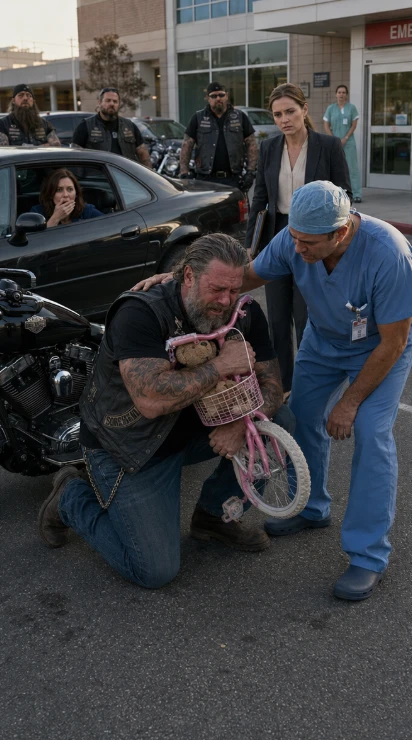
He was kneeling on the pavement beside a Harley-Davidson, both hands pressed over his face. He was enormous, easily over six feet tall, built like someone who could lift a refrigerator without asking for help. His leather vest was covered in patches, some faded, some sharp and bright, and his arms were wrapped in tattoos from wrist to shoulder. A gray beard hung against his chest, and his shoulders were shaking so hard that the whole vest seemed to move with every breath.
At first, my mind refused to match the picture with the sound. A man like that was supposed to be loud, intimidating, maybe angry. He was supposed to lean against motorcycles with a cigarette in his mouth and a warning in his eyes. He was not supposed to be on his knees in a hospital parking lot, crying like something inside him had finally split open.
I slowed without meaning to. Sarah slowed too, but she didn’t stare the way I did. Her face changed immediately, softening with a kind of recognition I didn’t understand. I saw only the surface—the leather, the patches, the tattoos, the massive frame bowed low over the blacktop.
A short, ugly laugh escaped me.
It was not loud. It was not even deliberate. It was a tiny snicker, the kind of sound people make when they think they are safe inside their own cruelty because no one important can hear it. But Sarah heard it. She turned her head toward me so fast that the files against her chest shifted.
“What?” I said, already defensive.
She didn’t answer right away. Her eyes had gone cold in a way I had never seen before, and the look landed harder than any scolding could have. She looked from me to the man on the ground, then back again, as if trying to decide whether I had really become the person she had just heard.
“I didn’t mean anything,” I muttered.
Sarah kept walking, but her steps were slower now. “You don’t know what people are carrying.”
The words irritated me because they sounded like a lesson, and I did not want a lesson. I had spent the entire day handling paperwork for people who yelled, lied, begged, threatened, and cried when things did not go their way. By that hour, I had no sympathy left. I told myself that was why I laughed. I told myself I was tired, that the image was strange, that it was nothing.
But the truth was uglier. I laughed because I thought tears had rules. I thought certain people earned compassion while others looked ridiculous receiving it.
Sarah veered off toward the staff entrance where she had parked, leaving me to cross the last row alone. I reached my car, unlocked it, and tossed my purse onto the passenger seat. For a moment, I sat behind the wheel with the door open, listening to the heat tick off the hood of the car beside me. The image of the biker on his knees stayed in my mind, and I tried to shake it away with annoyance.
I started the engine and pulled slowly out of my space.
The exit road curved past the hospital’s west wing, close enough to the motorcycle that I had to pass within a few yards of him. I told myself not to look again. I told myself I had already seen enough. But as my car rolled forward, something bright and small caught my eye behind the Harley.
A child’s bicycle was leaning against the back of the motorcycle.
It was pink.
Not dusty, not old, not abandoned. Pink and polished, with white streamers hanging from the handlebars and a little basket on the front. Inside the basket sat a stuffed teddy bear with one floppy ear, strapped in with what looked like a purple ribbon. The sight of it was so unexpected beside the black motorcycle and the crying man that my foot eased off the gas.
I stared at the bicycle, and my first thought was that it looked heartbreakingly tiny.
There was a sticker on the frame, a peeling glitter heart near the back wheel. A pink helmet hung from one handlebar. One of the streamers moved in the breeze, brushing against the man’s leather vest as if it were trying to get his attention. The contrast hit me in a strange place—this huge man folded on the ground, and beside him, a little girl’s bicycle waiting like a promise.
A doctor stood next to him.
I had not noticed him before because the biker had taken up all the space in my judgment. The doctor wore blue scrubs, his surgical cap pushed back from his forehead, and he had one hand resting on the biker’s shoulder. His posture was careful. Not casual, not rushed. He looked like a man who had carried news through hospital corridors often enough to know that words could either destroy or save a person in an instant.
My window was cracked because the air-conditioning in my car had been acting up, and as I slowed near them, the doctor’s voice came through clearly.
“She’s out of surgery, Jax,” he said. “She’s going to be okay. The heart transplant was a success.”
Everything inside my car went still.
The steering wheel felt strange under my hands. The brake pressed down beneath my foot before I even realized I had stopped. The doctor’s words seemed to hang in the hot afternoon air, too huge for that little patch of parking lot, too sacred for someone like me to have overheard by accident.
The biker lifted his head.
His face was wet, completely unguarded, stripped of every hard thing I had assigned to him. His beard was damp with tears. His eyes were red and swollen, and his mouth opened like he was trying to breathe around something too big for his body. For one suspended second, he looked at the doctor as if he did not trust the sentence to be real.
Then a sound came out of him.
It was not a sob. It was not the broken whimper I had expected after seeing his shoulders shake. It was a roar, deep and raw and full of so much relief that it seemed to tear through the whole parking lot. A few people turned. A nurse near the entrance froze with her hand on the door. The doctor squeezed his shoulder harder, and the big man bent forward until his forehead nearly touched the pavement.
That was the moment my laugh came back to me, not as a sound, but as a stain.
Jax reached for the little pink bicycle with both hands. He pulled it toward him carefully, almost reverently, as if the handlebars were fragile bones. The teddy bear in the basket wobbled, and he caught it against his chest with the same instinct someone would use to protect a living child.
He held that tiny bicycle against his leather vest and began crying harder.
“She’s alive,” he whispered, his voice shaking so badly I barely recognized it as words. “My little girl is alive.”
The doctor crouched beside him now, speaking quietly. I couldn’t catch every sentence, only fragments. Stable. Recovery. ICU. Strong heart. Long road. But each phrase seemed to land on Jax’s face like another wave he had to survive. He nodded at the doctor, then shook his head, then pressed one hand over his mouth as if he were afraid his relief might spill out too loudly and scare the miracle away.
I sat there with both hands gripping the wheel, unable to drive.
Cars were backing up behind me, but no one honked. Maybe they saw what I saw. Maybe there are moments when even strangers understand that traffic can wait. The air outside shimmered with heat, and the hospital doors kept opening and closing, swallowing and releasing people whose lives had been changed behind those walls.
I thought of the pink bike again. I pictured a little girl riding it on a sidewalk, streamers fluttering, teddy bear bouncing in the basket. I pictured her small hands gripping the handlebars, her feet pushing hard on the pedals, her laughter chasing her father down a driveway. Then I pictured that same bicycle waiting for forty-eight hours beside a motorcycle while its owner lay under bright surgical lights, her chest opened, her life held in gloved hands.
My stomach twisted.
Sarah appeared at my window.
I hadn’t seen her walk over. One moment I was alone in my shame, and the next she was standing beside the car, her face drawn and quiet. She had set her files down somewhere, or maybe she had left them in her car. Her arms hung at her sides, and she looked past me toward Jax before she spoke.
“You know who that is?” she asked.
I shook my head. My throat felt too tight to answer with words.
“That’s Jax Keller,” she said. “He’s the president of Iron Grace Riders.”
The name meant nothing to me, and she must have seen that. Her mouth tightened, not in anger exactly, but in disappointment. That was worse. Anger might have let me defend myself. Disappointment only left me exposed.
“They’re a local motorcycle club,” Sarah continued. “But not the kind people whisper about. They raise money for kids who need heart surgery. They organize rides, auctions, blood drives, motel stays for parents, gas cards for families who live three counties away. He’s been doing it for years.”
I looked at Jax again. He was still on the ground, still clutching the bicycle, while the doctor spoke with one hand on his back. The leather patches I had mocked with my eyes now looked different. I noticed a small heart embroidered near the front of his vest. Under it were tiny initials, maybe children’s names. There were too many to count from where I sat.
Sarah leaned closer to my open window, her voice low enough that only I could hear.
“He’s spent the last three years saving other people’s children,” she said. “And for the last forty-eight hours, he’s been sitting right there on that pavement, praying someone else’s child’s heart would give his daughter a second chance.”
My hands slid off the wheel and fell into my lap.
Forty-eight hours.
The number opened a door in my mind. I saw him there at midnight, under the hospital lights, refusing to go home. I saw him at dawn, stiff from the pavement, accepting bad coffee from nurses who knew his name. I saw him watching every doctor who walked through those doors, studying their faces for either mercy or disaster. I saw him beside that tiny bicycle, using it as an anchor because he could not hold his daughter’s hand in the operating room.
“He wasn’t crying because he’s weak,” Sarah said. “He was crying because he’s been carrying the weight of his daughter’s life on his shoulders, and today he finally got to put it down.”
The words struck me with such force that I had to look away.
Beyond the windshield, the parking lot blurred. I was not crying—not yet. Shame has a different shape at first. It does not flow. It hardens. It sits behind your ribs and makes it difficult to breathe. I thought about all the quick judgments I had made in my life, all the little dismissals I had handed out without consequence because the people receiving them never knew. I thought about how proud I had been of being sharp, practical, hard to fool.
And then I thought about a father on his knees.
I had mistaken the sound of a man surviving a nightmare for weakness.
Sarah did not soften her voice when she added, “You laughed.”
I closed my eyes.
“I know,” I whispered.
“No,” she said quietly. “I don’t think you do.”
She stepped back from the window, not to punish me, but because there was nothing else she needed to say. She had placed the truth in my lap, and now I had to sit with it. For several seconds, I remained in the car while the world continued around me. A woman pushed an empty wheelchair toward the entrance. A man in a suit walked past carrying balloons. Somewhere in the distance, an ambulance siren rose and faded.
I could have driven away.
That would have been easier. No one had heard me except Sarah. Jax did not know I had laughed. The doctor did not know I had reduced a father’s agony to a private joke. I could have gone home, made dinner, watched television, and carried the shame quietly until it became just another memory I tried not to examine too closely.
But the pink bicycle was still there.
The teddy bear’s floppy ear hung over the basket. The white streamers flickered in the wind. And Jax, this terrifying, tattooed, gentle giant of a man, had one hand wrapped around the frame as if it were a lifeline.
I turned off the car.
My legs felt weak when I stepped out. For a moment, I stood beside my open door, unsure of what I thought I was doing. Apologies are easy when they cost nothing, but this one cost the version of myself I had been protecting. I had to walk across the same pavement where I had looked down on him and admit, if only to myself, that I had been cruel.
Sarah watched from a distance. She said nothing.
As I approached, the doctor glanced up first. His expression shifted into professional caution, the kind people wear when they are protecting a family from strangers. I stopped a few feet away, suddenly aware of my courthouse badge, my blouse, my polished shoes, my entire ordinary life standing upright before a man who had been waiting on his knees.
Jax looked up at me.
His eyes were exhausted. Not just tired, but emptied out by hours of fear and filled again too quickly by hope. His face was rough, his beard streaked with gray, his skin weathered by sun and road. But there was nothing hard in his expression then. He looked at me like a man who had no room left for suspicion because every part of him was still listening for the echo of good news.
I opened my mouth, but the apology caught behind my teeth.
What could I say? I laughed at you because I was small. I judged you because you looked different from the kind of grief I respect. I thought your tears were absurd until I learned they belonged to your daughter.
None of it felt enough.
So I reached into my purse with shaking hands and pulled out my wallet. I had cash from the weekend, more than I usually carried, folded behind old receipts and a courthouse parking pass. I took all of it. Every bill. My fingers fumbled so badly that one slipped and fell near my shoe, and I bent to pick it up with heat burning across my face.
The doctor started to say something, but I held the money out to Jax.
“For her recovery,” I said.
My voice was barely more than a whisper, and for a second I thought he had not heard me. Then his eyes moved from the cash to my face. He did not reach for it right away. That hesitation made me feel even worse, because I knew what I must have looked like—a stranger intruding on the holiest moment of his life with a handful of guilt.
“I’m so sorry,” I added.
The doctor’s eyes flicked toward me, sharp with a question. Jax’s did not. He just looked at me for a long moment, and I wondered if somehow he knew. Maybe grief makes people sensitive to every cruelty around them. Maybe he had heard the laugh after all. Maybe Sarah was right, and people carry more than we ever imagine, including the small wounds strangers leave behind.
Jax took the money, but then he did something I did not expect.
He reached out and wrapped his massive hand around mine.
His palm was rough and calloused, warm from the sun and trembling from everything he had just endured. He squeezed my hand once, firmly, not like someone accepting charity, but like someone receiving another human being’s awkward attempt at kindness and choosing to honor it instead of question it.
“Thank you,” he said. “God bless you.”
I almost broke then.
Not because he forgave me. He had not been told what needed forgiving. Not because the money mattered. It was nothing compared to what his daughter would need. I nearly broke because he had every reason, known and unknown, to be closed off to the world, and he still met a stranger’s clumsy offering with grace.
The doctor nodded once, his face softening. “They’ll let you see her soon, Jax. Just a few more minutes.”
Jax turned sharply toward him, and in that movement I saw the father rise through the biker, through the patches, through every label I had placed on him. His whole body changed at the words see her. He set the bicycle gently against the Harley, checked the teddy bear in the basket as if it needed to be ready too, and wiped both hands down his vest.
“Can I bring Daisy?” he asked.
The doctor blinked. “Daisy?”
Jax touched the bicycle seat. His voice dropped into a tenderness that seemed almost too fragile for him. “Her bike. She made me promise I’d bring Daisy when she got her new heart. Said if Daisy waited outside, she’d know she had to come back and ride again.”
The doctor swallowed. I saw it. He swallowed like someone trying to keep his own composure intact.
“I’ll ask the nurse,” he said gently. “Maybe not into the ICU room, but close enough for her to see it when she wakes up.”
Jax nodded hard, pressing his lips together.
That tiny pink bicycle was not a prop in his grief. It was the promise his daughter had made to stay alive.
I stepped back because the space no longer belonged to me. It never had. Jax brushed one hand over the streamers, then straightened the teddy bear in the basket. He was still crying, but the crying had changed. Before, it had looked like collapse. Now it looked like a man learning how to stand after being crushed for too long.
A few more bikers had gathered near the far end of the row. I had not noticed them before. They were quieter than I expected, standing in a loose line near their motorcycles, all wearing the same kind of leather vests. One older woman with silver hair had both hands clasped at her mouth. A younger man with a shaved head turned away, wiping his eyes with the heel of his hand. Another rider held a cardboard tray of coffee cups that no one seemed able to drink.
The patches on their vests caught the sunlight as they moved closer. I could read some of them now. Ride for Riley. Miles for Mason. Hope Has a Pulse. One patch showed angel wings around a small red heart. Another had a date stitched beneath a child’s name.
These were not decorations. They were memorials. They were battles. They were proof that the man I had mocked belonged to a brotherhood built around children whose hearts had failed them and parents whose lives had stopped in hospital waiting rooms.
Sarah came to stand beside me, not touching me, not looking at me. We watched as the riders moved toward Jax one by one. None of them said much. One placed a hand on the back of his neck. Another gripped his shoulder. The woman with silver hair kissed the top of his head as if he were her own son. Jax let them, still holding the little helmet in one hand.
“Her name is Lily,” Sarah said quietly.
I looked at her.
“His daughter,” she added. “She’s seven.”
Seven.
The number cut through me. Seven was missing front teeth and drawings on refrigerators. Seven was untied shoelaces and bedtime bargaining. Seven was still young enough to believe a bike could wait outside a hospital and help call her back from the edge.
“How do you know all this?” I asked.
Sarah kept her eyes on Jax. “My nephew was one of the kids they helped.”
I turned toward her fully.
She took a breath, and for the first time that afternoon, I noticed that her hands were shaking. “My sister couldn’t afford to stay near the hospital during his surgery. Insurance covered some things, not everything. Jax and his club paid for her motel, gas, food, everything. They sat with us during the waiting. He brought my nephew a toy motorcycle and told him he had to get better because the club needed a new recruit.”
Her mouth trembled, but she held herself steady.
“He died anyway,” she said.
The sentence settled between us with terrible quiet.
I did not know what to say. The parking lot noise seemed to soften around her grief, as if even the cars understood not to intrude. Sarah looked smaller suddenly, not weaker, just more real. All those years beside her at work, and I had known the office version of her: efficient, dry, impossible to rattle. I had not known this.
“Jax came to the funeral,” she continued. “Every rider did. They lined the road with their motorcycles and stood there in the rain while my sister carried that tiny urn. He cried then too.”
Her eyes finally moved to mine.
“So when you laughed today,” she said, “I heard it for more than him.”
The shame I had felt before was only the beginning. This was deeper. This had roots. I had not merely misjudged a stranger; I had reopened something in a friend I claimed to respect. My careless laugh had traveled farther than I meant it to. Cruelty often does.
“I’m sorry,” I said.
Sarah looked away, and for a second I thought she would refuse it. She had every right to. Instead, she folded her arms tightly, as if holding herself together.
“I know,” she said. “Just don’t waste it.”
Before I could answer, the hospital doors opened again.
A nurse stepped out wearing pale green scrubs, her hair tucked beneath a cap printed with tiny cartoon hearts. She looked across the parking lot until she found Jax. Something passed through the whole group of riders before she even spoke. Every body went still. Every face turned toward her. Even I held my breath.
“Jax?” the nurse called.
He stood so quickly that he almost stumbled. Two riders reached to steady him, but he waved them off, gripping the pink helmet against his chest.
The nurse smiled.
“She’s waking up.”
The words moved through the group like electricity. The silver-haired woman covered her face and sobbed. The young man with the shaved head bent forward with both hands on his knees. Jax took one step toward the hospital, then stopped and turned back for the bicycle.
The doctor met him halfway.
“We can bring the bear,” he said. “The bike will need to stay outside the unit for now, but I’ll make sure she knows it’s here.”
Jax looked down at the bicycle, and the conflict on his face was so pure it hurt to watch. He wanted to obey every rule that would keep his daughter safe. He also wanted to keep the promise exactly as she had given it to him. For a moment, his huge fingers hovered over the streamers.
Then he carefully lifted the teddy bear from the basket.
“Daisy waits here,” he whispered, more to the bike than to anyone else. “I’ll tell her you came.”
He tucked the bear under one arm and walked toward the hospital doors.
No one cheered. No one clapped. The riders simply parted for him like a quiet guard of honor. Some bowed their heads. Some reached out and touched his vest as he passed. I stood near my car, feeling like an outsider at a ceremony I had not earned the right to witness.
Just before he entered the hospital, Jax stopped.
He turned back toward the motorcycle, the bicycle, the riders, the doctor, the nurse, Sarah, and me. His eyes swept over all of us, and his voice, though cracked, carried across the parking lot.
“She made it,” he said.
The silver-haired woman answered first. “Yes, she did.”
Jax pressed the teddy bear against his chest. His face folded again, but this time he did not hide it. He let the tears fall openly in front of everyone. No one looked away. No one laughed. No one treated his grief or his relief as something that needed to be contained.
In that parking lot, a man I had mistaken for frightening taught me what tenderness looks like when it has survived terror.
Then he disappeared through the sliding doors.
The riders remained outside for a while. Some leaned against their bikes. Some sat on the curb. One man took off his vest and draped it carefully over the pink bicycle’s seat to shade it from the sun. Another brought a bottled water and placed it in the basket, then laughed softly at himself and moved it to the ground instead.
Sarah and I stood in silence.
I wanted to say something profound, something that would prove I had changed in the span of a few minutes. But change, real change, does not announce itself in polished sentences. It begins as discomfort. It begins as a memory you can no longer arrange in your favor. It begins when you see yourself clearly and do not like what you see.
“I thought I was a decent person,” I said at last.
Sarah looked at me, and this time there was no coldness in her face. Only tired honesty.
“Most people do,” she said.
That might have been the most merciful answer she could have given me. Not absolution. Not condemnation. Just the truth.
I drove home later with the radio off.
The road from the hospital to my apartment seemed different though nothing had changed. Same traffic lights. Same gas station on the corner. Same grocery store with the cracked sign. But I kept seeing faces in every car I passed, wondering what each person had left behind that morning, what news they were waiting for, what private fear sat in the passenger seat beside them.
At a red light, a man in a delivery van rubbed his eyes with both hands. I wondered whether he was exhausted from work or from something worse. At the next corner, a woman in scrubs sat on a bench outside a clinic, staring at nothing. I wondered whether she had just lost a patient or saved one. A teenager crossed the street with headphones on and his shoulders hunched, and I wondered whether anyone had mistaken his silence for attitude when it was actually pain.
The world had not become kinder. I had simply become less certain that I knew what I was seeing.
When I got home, I sat in the driveway long after turning off the engine. My apartment windows glowed faintly in the evening light, and somewhere inside, my phone buzzed with messages I did not want to read. I thought of Jax walking into the ICU with the teddy bear. I imagined Lily opening her eyes, pale and small beneath hospital blankets, tubes and wires around her, her father trying to smile without falling apart.
I imagined him leaning close to her bed.
“Daisy’s outside,” he might have whispered. “She waited for you.”
Maybe Lily would be too weak to answer. Maybe she would only move her fingers. Maybe she would hear him through the fog of medicine and understand that her bicycle had kept its promise, that her father had kept his, that she had come back.
I pressed my forehead against the steering wheel and cried.
Not loudly. Not dramatically. Just enough to finally let the shame move through me instead of sitting like stone. I cried for the little girl whose heart had needed replacing before she was old enough to understand the unfairness of it. I cried for the parents who waited in hospital parking lots because the walls inside were too tight for their fear. I cried for Sarah’s nephew, a child I had never met, and for the rain at his funeral, and for the bikers who stood there anyway.
And yes, I cried for myself too, though not in a way that felt clean. I cried because I had seen how quickly arrogance can make a person cruel. I cried because my first instinct had been to mock what I should have honored. I cried because a man I had laughed at had held my hand and blessed me.
The next morning, I went to work early.
Sarah was already at her desk, sorting files into color-coded stacks. She looked up when I approached, guarded but not hostile. I placed a coffee beside her, the kind she liked from the shop across the street, with the cinnamon she always pretended not to care about.
“I looked up Iron Grace Riders last night,” I said.
She waited.
“They have a fundraiser next month,” I continued. “A ride and auction for pediatric cardiac families. I signed up to volunteer.”
Her expression did not change immediately, but something in her shoulders loosened.
“That’s good,” she said.
“I’m not telling you because I want credit.”
“I know.”
“I just needed you to know I heard you.”
Sarah picked up the coffee and looked at the label, then back at me. “Then keep hearing it.”
I nodded.
In the weeks that followed, I learned more about Jax than I had any right to know from that first glance. His real name was Jackson Keller, but nobody called him that unless they worked at the DMV or wanted to irritate him. He had raised Lily mostly on his own after her mother died when Lily was three. The heart condition had been discovered not long after, and from that point forward, his life had become a map of hospital corridors, medication schedules, insurance calls, and waiting rooms.
Iron Grace Riders had started after Jax met another father in a cardiac unit. That man had slept in his truck for nine nights because he could not afford a hotel near the hospital. Jax found out, passed a helmet around at a bike meet, and collected enough cash in one evening to cover the man’s stay. One act became another. One family became ten. Then thirty. Then so many that the club had to create a foundation just to keep up.
I saw pictures on their website. Jax kneeling beside children in hospital gowns. Jax wearing a ridiculous paper crown at a fundraiser tea party. Jax handing a tiny leather vest to a boy with oxygen tubes in his nose. Jax standing at memorial rides, head bowed, one hand over his heart.
The more I learned, the more embarrassed I became by the smallness of my first impression. But embarrassment, I discovered, can become useful if you refuse to turn away from it. It can become a tool. A warning. A hand on your shoulder before you make the same mistake twice.
The fundraiser took place on a Saturday morning under a sky so blue it looked almost staged. Dozens of motorcycles lined the fairground lot, their chrome flashing in the sun. Families moved between booths with paper plates of pancakes and cups of lemonade. There were children everywhere—some running, some in wheelchairs, some with scars visible above their collars, some with the careful fragility of kids who had spent too much of their lives being told not to overdo it.
I arrived early and was assigned to the registration table. Sarah came too, carrying a box of wristbands and pretending she had not chosen the table closest to mine on purpose. For the first hour, we checked names, handed out raffle tickets, and directed people toward the silent auction. I kept waiting to see Jax, and when I finally did, I recognized him first by the pink bicycle rolling beside him.
He was not riding it, of course. He was pushing it with one hand while holding his daughter’s hand with the other.
Lily was smaller than I expected.
She wore a yellow cardigan over a dress with tiny flowers on it, and her hair had been gathered into two loose braids. She moved slowly, with the cautious steps of a child whose body was still remembering how to be hers. A small bandage peeked above the neckline of her dress, and one hand clutched the teddy bear from the bicycle basket.
Jax walked at her pace.
Not one step ahead. Not half-dragging her along. He bent his entire world around her speed. Every few feet, he looked down to check her face, and every time she looked up at him, he smiled like the sun had personally risen just for him.
When they reached the registration table, Sarah’s eyes filled instantly. Lily recognized her first.
“Aunt Sarah!” the little girl said, her voice thin but bright.
Sarah came around the table and crouched, arms open but careful. Lily leaned into her, and Sarah hugged her as gently as if she were made of glass. Jax watched them with a smile that trembled at the edges.
Then his eyes moved to me.
For one awful second, I wondered if he remembered me only as the strange woman from the parking lot with the money and the apology. Maybe that was all I deserved to be. But he smiled anyway.
“Courthouse lady,” he said warmly.
I gave a nervous laugh, nothing like the one from that day. “My name is Emily.”
“Emily,” he repeated, as if making sure he would remember. “You came.”
“I said I would help.”
He nodded toward the table. “Then you’re already family.”
The word family caught me off guard. I looked at Sarah, but she was busy helping Lily choose a wristband color. Jax leaned one elbow on the table, and for the first time, I saw how tired he still was. Relief had not erased the road ahead. Lily’s recovery would be long. There would be rejection risks, medications, appointments, bills, fear returning in new forms. Miracles do not end struggle; sometimes they simply make struggle worth continuing.
“How is she?” I asked.
Jax glanced down at his daughter. Lily was making the teddy bear dance on the edge of the table while Sarah pretended to be impressed.
“She woke up asking if Daisy was mad at her for taking so long,” he said.
I smiled, but my throat tightened.
“What did you tell her?”
“I told her Daisy understood traffic.”
We both laughed softly. Then his expression changed, becoming quieter.
“She’s got a long way to go,” he said. “But she’s here.”
Sometimes “she’s here” is the whole prayer, the whole victory, the whole reason a grown man falls apart on pavement.
I wanted to tell him then. I wanted to confess the laugh properly, to lay it at his feet and let him decide what to do with it. The words rose in me again, sharper this time. But before I could speak, Lily turned toward me.
“Are you helping Daddy’s ride?” she asked.
Her eyes were enormous, serious in the way sick children sometimes become serious after hearing too many adult conversations. I looked at her teddy bear, then at the pink bicycle, then at Jax’s hand resting lightly on her shoulder.
“I am,” I said. “I’m very lucky they let me.”
Lily considered that, then nodded as if I had passed some private test.
“Daddy says helpers are angels without wings.”
Jax looked embarrassed. “I say a lot of things.”
Lily tilted her head back to look at him. “You do.”
Sarah laughed, and even I smiled. For a few seconds, everything felt almost ordinary. A child teasing her father. A father pretending not to melt. A sunny fairground full of noise and motion. But beneath it all ran something deeper, something I could feel now because I had learned to look below the surface.
Later that day, during the opening speech, Jax stood on a small wooden platform near the front of the crowd. Lily sat in a folding chair beside the stage, Daisy parked next to her with the teddy bear returned to the basket. The riders gathered behind him, their vests heavy with patches and names.
Jax held the microphone with both hands.
“I’m not good at speeches,” he began.
Several people laughed, and someone shouted, “Liar!”
He grinned, but the smile faded quickly. His eyes moved over the crowd, lingering on the families, the children, the nurses, the parents who already knew the particular fear that had shaped him.
“I used to think strength meant standing up straight no matter what,” he said. “I used to think it meant nobody seeing you crack. Then my little girl got sick, and I learned real quick that strength is a lot messier than that.”
The crowd grew quiet.
“Strength is sleeping in a chair for three weeks because your kid wakes up scared if you’re not there. Strength is answering the phone when the hospital calls, even though your hands are shaking too bad to hold it. Strength is letting doctors wheel your child away and not chasing them down the hall because you know the only way to save her is to let go.”
His voice broke. He looked at Lily, and she lifted her teddy bear toward him as if offering courage.
Jax wiped his eyes with the back of one hand.
“And strength is crying when you need to,” he said. “Because tears don’t mean the load is light. They mean you’ve been carrying it long enough.”
I stood near the registration table, unable to move.
Sarah found my hand and squeezed it once. I squeezed back.
Jax continued, telling the crowd about families who needed help, about children waiting for surgeries, about parents choosing between gas money and groceries while trying to keep a child alive. He did not make it sentimental. He made it real. He spoke of receipts, motel rooms, medication costs, missed work, and the loneliness of hospital nights. Then he looked down at Lily again.
“My daughter got her second chance because another family, in the middle of their worst day, said yes to donation,” he said. “I don’t know their names. I may never know them. But every time Lily laughs, that family’s love is still moving through the world.”
The entire fairground seemed to hold its breath.
A miracle, I realized, is never one person’s story. It is grief and love passing through many hands until life reaches someone who is still waiting.
After the speech, people lined up to donate. Cash filled the boxes. Checks were written. Volunteers rushed to bring more envelopes. A local business owner offered to cover lodging for three families. A nurse signed up her church group for meal deliveries. By late afternoon, the number on the donation board had climbed far beyond the original goal.
I worked until my feet hurt and my voice went hoarse.
At one point, I saw Lily sitting on her bicycle while Jax held the handlebars steady. She did not ride, not really. She only sat there, feet barely touching the pedals, while her father crouched in front of her with both hands ready in case she wobbled. The streamers hung still in the warm air.
“Not yet,” he told her gently. “Doctor said we wait.”
“I know,” Lily said. “I’m just reminding Daisy I came back.”
Jax lowered his head, and I knew he was crying again. This time, when I saw his shoulders shake, there was no trace of laughter anywhere inside me. There was only awe.
Months passed.
Life returned to its routines, but I did not return to the person I had been. At the courthouse, I found myself listening differently. When a defendant’s mother cried outside the courtroom, I did not roll my eyes. When a man snapped at me over a filing mistake, I wondered what panic sat underneath his anger. When a young woman came in with sunglasses hiding bruised-looking exhaustion under her eyes, I did not assume drama. I asked if she needed a chair.
I was not suddenly perfect. Judgment is a stubborn habit. It rises quickly, wearing the voice of common sense. But now, more often than before, I caught it by the wrist before it could point.
Sometimes Sarah noticed.
Once, after I spent twenty minutes helping an elderly man fill out a form he should have been able to complete himself, she walked by my desk and murmured, “Keep hearing it.”
I did.
On the anniversary of Lily’s transplant, Iron Grace Riders held a smaller gathering at the hospital. Not a fundraiser exactly. More like a thank-you ride. The motorcycles rolled in slowly, engines low, not roaring out of respect for the patients inside. Nurses came to the windows. Children waved from upper floors. Families gathered near the entrance with signs and balloons.
I went after work, still wearing my courthouse clothes.
The same parking lot looked different in the evening light. I found myself standing near the spot where Jax had knelt a year earlier. The pavement had no marker. No plaque. Nothing to show that a father had nearly been crushed there by fear and then lifted by the words “she’s going to be okay.” To anyone else, it was just another space near the west wing.
To me, it felt like sacred ground.
Jax arrived with Lily in a small red wagon decorated with ribbons. She was stronger now, her cheeks fuller, her laugh louder. Daisy, the pink bicycle, was attached to the back of the wagon with a little sign that read, STILL WAITING FOR FULL SPEED. Lily had insisted, Jax told everyone, that Daisy deserved to attend.
When Lily saw me, she waved both arms.
“Emily! I rode six whole houses yesterday!”
Jax winced. “Driveways. Six driveways. Very slowly.”
“Six whole houses,” Lily repeated with authority.
I laughed and clapped for her. “That’s huge.”
“It is,” she said. “Daddy cried.”
Jax sighed. “Daddy had allergies.”
“No, you didn’t.”
The riders around him chuckled, and Jax gave up pretending. He rested one hand on Lily’s hair, his expression open and unashamed.
“Fine,” he said. “Daddy cried.”
Lily looked at me seriously. “Happy crying is allowed.”
I glanced at Jax, and he winked.
“It is,” I said. “Very allowed.”
As the sun began to set, the group gathered near the hospital entrance. A chaplain said a few words. A transplant nurse read a letter from a family who had received help from the club. Then Jax stepped forward, holding Lily’s hand. He did not give a long speech this time. He only looked at the hospital, then at the riders, then at the families standing together in the soft orange light.
“A year ago,” he said, “I thought this parking lot was where I was going to lose everything.”
His voice thickened, but he kept going.
“Instead, it became the place where I learned that sometimes the whole world is holding you up, even when you think you’re alone.”
I felt Sarah shift beside me. We were both looking at the same patch of pavement now.
Jax continued, “So tonight, we ride for the kids still inside. We ride for the parents waiting for news. We ride for the families who said goodbye so someone else could say hello. And we ride for every person carrying something heavy enough to bring them to their knees.”
He paused, then smiled down at Lily.
“And if you see them crying,” he said, “don’t look away. Don’t laugh. Don’t assume you know the story.”
My breath caught.
I knew he had not said it for me. He probably still did not know what I had done. But the words found me anyway, as if they had been waiting a year to arrive.
The motorcycles started one by one, low thunder rolling through the lot. Jax lifted Lily carefully onto the seat in front of him, not to ride far, only for the ceremonial loop around the hospital driveway. She wore her pink helmet, the same one that had once hung from Daisy’s handlebars. Her teddy bear was strapped safely to the front of the bike for the ride.
Sarah stood beside me, arms folded, smiling through tears.
“Happy crying?” I asked.
She wiped her cheek. “Allowed.”
The bikes moved slowly, headlights glowing in the dusk. Families clapped. Nurses waved. Lily lifted one small hand, and the entire parking lot seemed to answer. Jax rode with one arm secure around her, his face lifted toward the hospital windows, tears shining openly in his beard.
This time, no one misunderstood them.
I watched until the last motorcycle curved out of sight, and I thought about the woman I had been in that same lot one year earlier. Tired, smug, impatient, certain that she could read a man’s worth from his clothes and his tears. I could not erase her. I could only refuse to keep being her.
There are lessons that arrive gently, and there are lessons that knock the breath out of you. Mine came in the shape of a leather vest, a pink bicycle, a doctor in blue scrubs, and a father’s roar when his daughter was given back to him.
I have forgotten many things from my years at the courthouse. Case numbers, names, arguments, the exact wording of judgments that seemed important at the time. But I will never forget that parking lot. I will never forget the teddy bear in the basket, the streamers moving in the wind, or the way Jax held that little bicycle as if it were his child’s heartbeat made visible.
Most of all, I will never forget the shame of my own laugh, because it became the doorway to something better.
That day taught me that the toughest people are not the ones who never cry. They are the ones who love so deeply that fear can break them open and still, somehow, they stand back up. They are the ones who carry unbearable weight in silence until mercy finally lets them set it down.
And before you laugh at someone’s tears, you had better be certain you are strong enough to carry the burden that caused them.