PART 2
The first time I saw Maddie Collins, I thought she was waiting for someone.
My name is Elaine Brooks, and I was a fifty-three-year-old Black American cashier at Watson’s Fuel & Market outside Cookeville, Tennessee, where Highway 70 curves past cattle fields and old houses that look like they have been standing against the weather out of pure stubbornness. I had been behind that register almost fourteen years. You learn to recognize travelers, locals, runaways, tired mothers, and children who are supposed to be somewhere else.
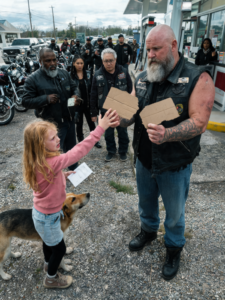
Maddie belonged to that last category.
She appeared before eight that morning carrying a folding chair that looked too heavy for her and leading Buddy on a frayed leash. She set herself up beside the edge of the lot, far enough from the road to be safe but close enough that drivers could see the sign. When I asked where her parent was, she said, “Mom knows I’m outside.”
Later, I learned that was not exactly true.
Her mother knew Maddie had gone to ask the pharmacist whether they could delay payment.
She did not know Maddie had come back with an idea of her own.
At nine, I offered her a breakfast biscuit.
She refused.
At ten, I put one beside her anyway.
She broke it in half and gave Buddy the larger piece.
That should tell you everything you need to know about that child.
People noticed the sign all morning. Some slowed. One man laughed and told his passenger nine dollars was suspiciously cheap for a dog. A woman driving a minivan stopped long enough to ask whether Buddy was house-trained, and Maddie said yes. Then the woman asked whether the dog shed. Maddie looked horrified, hugged Buddy tighter, and said, “A little.”
The woman drove away.
Maddie cried after that.
Not because she failed to sell him.
Because for thirty seconds she thought she might.
Around noon, the twelve bikers came.
They belonged to an old riding club called the Iron Shepherds, though their current vests did not carry readable public markings. Most were men in their fifties and sixties. They were riding back from a funeral fundraiser for a local mechanic when Bear saw Maddie’s sign.
At first, even I thought he handled it wrong.
He tore the cardboard.
Maddie looked humiliated.
Customers stared.
A young white American man near the soda machine began filming through the window. In the ten-second clip he later uploaded, Bear looked exactly like what strangers assumed he was: a huge tattooed biker destroying a poor child’s sign while eleven riders gathered behind him.
The clip did not show the pharmacy paper.
It did not show Maddie’s answer.
It did not show Bear emptying his wallet.
What happened next happened quickly.
Bear put down eighty-four dollars.
Marcus “Anchor” Hall, a sixty-one-year-old Black American biker with deep brown skin, close-shaved head, salt-and-pepper beard, broad shoulders, and a plain leather vest, added a hundred.
Rosa Delgado, a fifty-four-year-old Latina American female rider with tan skin, dark braided hair, tattooed hands, jeans and boots, added seventy-five.
Kenji Mori, a sixty-five-year-old Asian American biker with light tan skin, silver hair tied short, glasses, denim shirt, and calloused mechanic’s hands, put down sixty.
Then everyone contributed.
Cash.
A few twenties.
A handful of fives.
Money tucked in saddlebags for gas.
Emergency bills folded behind licenses.
By the time they counted it, the pile came to $873.
Bear looked at the amount.
“Anybody got twenty-seven?”
I came out from behind the counter with my purse.
“I do.”
Bear looked at me.
“You don’t have to.”
“I watched her all morning.”
That was my answer.
We reached exactly $900.
Bear stacked the money carefully and placed it in Maddie’s hands.
She stared at it.
“You paid too much.”
Bear shook his head.
“No. We paid what Buddy’s worth.”
Maddie started crying.
Buddy licked her wrist.
Then came the part that confused her.
Bear knelt, unclipped Buddy’s leash from Maddie’s hand, took it for exactly one second, then clipped it right back.
“There,” he said. “Sale complete.”
Maddie blinked.
“What?”
“Buddy belongs to us.”
Her face collapsed.
Then Bear pointed at her.
“And we’re giving him to you.”
For the first time all day, the child made a sound that was not brave.
She sobbed.
Hard.
The bikers looked away in the awkward, respectful way grown men sometimes do when a child’s relief is too intimate to watch.
But Bear was not finished.
“Now,” he said, “where’s your mother?”
Maddie wiped her face.
“Home.”
“Can we take the medicine money to her?”
Her expression tightened.
She looked at twelve motorcycles.
“I can’t ride on those.”
Bear almost smiled.
“Smart kid.”
Rosa stepped forward.
“We’re not putting an eight-year-old on a motorcycle without her mother’s permission.”
Marcus pointed toward a pickup towing the small maintenance trailer they used on group rides.
“We’ve got the support truck.”
Maddie hesitated.
Then she looked at the nine-dollar prescription slip.
“Mom needs the pills today.”
That was when Bear made the second decision.
“We go together.”
PART 3
The ride to Maddie’s house took fourteen minutes.
It felt longer.
Rosa drove the support truck with Maddie in the passenger seat and Buddy belted into the back with an improvised harness. Elaine rode with them because everyone agreed another adult woman should accompany the child. The twelve motorcycles followed at a respectful distance, engines low through the rural roads.
Maddie gave directions.
Left past the church.
Right after the abandoned feed store.
Down a narrow road where pavement became patched asphalt and then gravel.
“House with the green mailbox,” she said.
The mailbox was leaning.
The house looked worse.
It was a small white rental with peeling siding, a porch that sagged slightly on the left, and curtains made from mismatched sheets. Grass had grown high around an old plastic tricycle. There was no car in the driveway. No air-conditioner humming. No porch light despite the gray afternoon.
Rosa parked.
Maddie suddenly became nervous.
“My mom’s going to be mad.”
“Why?” I asked.
“Because I sold Buddy.”
Bear had taken off his helmet behind us. He heard that.
“You didn’t sell Buddy.”
“I tried.”
“That might matter to your mom.”
Maddie looked down.
“She doesn’t like people helping.”
Bear’s face changed slightly at that.
People who have been poor often recognize pride in one another.
The front door opened before we knocked.
Sarah Collins appeared holding the frame for balance.
She was thirty-seven years old, white American, with pale skin, hollow green eyes, shoulder-length brown hair pulled loosely back, a faded navy T-shirt under an old cardigan, gray sweatpants, and the unmistakable exhaustion of someone who had been sick while trying to pretend she was not. She looked from Maddie to the truck, then past the truck to twelve motorcycles lining the road.
Fear hit her instantly.
“Maddie?”
The girl ran to her.
“I’m sorry.”
Sarah hugged her first.
Only after confirming her daughter was safe did she look at the bikers.
“What happened?”
Bear stayed at the bottom of the porch.
That was deliberate.
A man his size does not walk toward a frightened sick woman’s doorway unless invited.
“Ma’am,” he said, “your daughter tried to sell her dog.”
Sarah closed her eyes.
“Oh, God.”
“For nine dollars.”
Sarah looked at the pharmacy paper in Maddie’s hand.
Then the cash.
Her face changed.
“No.”
Maddie said quickly, “They bought Buddy for nine hundred dollars but gave him back.”
Sarah stared at her.
Then at Bear.
“You did what?”
Bear reached into his vest, then stopped when Sarah tensed. He slowly took his hand back out empty.
“I was going to show you my ID,” he said. “I can keep my hands where you can see them.”
Sarah looked embarrassed.
“You don’t have to.”
“I do if it makes you comfortable.”
That was when I began to understand Bear.
The group’s roughness was not an excuse for forcing trust.
They knew what they looked like.
They compensated.
Sarah let us inside after Elaine explained everything.
And that was when the next clues appeared.
The living room was almost empty.
One thrift-store couch.
A television that did not work.
Two folding chairs.
A coffee table made from stacked plastic crates and a plywood board.
An orange extension cord ran uselessly toward a wall socket.
Rosa flipped the light switch by habit.
Nothing happened.
Sarah’s face filled with shame.
“Power got shut off yesterday.”
Bear looked around.
His jaw tightened, but he did not make the mistake of pitying her aloud.
The refrigerator was silent.
A cooler sat on the kitchen floor with melting ice around a small plastic bag containing medicine.
Sarah noticed us looking.
“I’m handling it.”
Bear nodded.
“I believe you.”
She seemed surprised.
Then Kenji, standing near the doorway, looked at the wall.
There were only three photographs hanging there.
One showed Maddie as a baby.
One showed Sarah and Maddie at a school event.
The third was older.
A man in a leather vest stood in the middle of a group of bikers beside a highway guardrail. He was white American, early forties, lean, dark-haired, broad-smiled, with one hand resting on another rider’s shoulder.
Kenji stopped breathing.
“Bear.”
Bear turned.
Saw the picture.
And froze.
Maddie followed his eyes.
“That’s my dad.”
Bear did not answer.
Sarah’s expression changed from embarrassment to confusion.
“You knew Dale?”
Bear crossed the living room slowly.
He did not touch the photograph.
He simply stood under it.
“Dale Collins?”
Sarah nodded.
Behind Bear, eleven bikers went silent.
Then Marcus whispered, “No way.”
Maddie looked from face to face.
“My dad was a biker too.”
Bear’s voice came out rough.
“Your dad wasn’t just a biker.”
Sarah looked at him.
“What do you mean?”
Bear finally turned from the photograph.
There were tears in his eyes.
“He saved my life.”
PART 4
Nobody sat down after that.
For a minute, every adult in the room seemed to forget how furniture worked.
Sarah leaned against the wall, pale and confused. Maddie stayed beside her, Buddy pressed against the girl’s legs. Bear stood beneath the photograph of Dale Collins, staring at a man he had spent three years mourning and searching around.
Sarah spoke first.
“You’re Raymond.”
Bear looked at her.
She knew.
Not everything.
Enough.
“Dale called you Bear,” she said.
His throat moved.
“Yes.”
Sarah lowered herself onto the couch.
“My God.”
Rosa knelt beside Maddie.
“Sweetheart, would you like some water?”
Maddie shook her head.
She was watching Bear.
“Dad saved you?”
Bear looked at Sarah before answering, silently asking permission to tell the story.
Sarah nodded.
“Go ahead.”
Three years earlier, the Iron Shepherds had been returning from a charity ride near Knoxville when a distracted driver crossed lanes during heavy rain. Bear swerved, lost control, and went down beside an SUV that had been struck and started burning near the shoulder. Bear’s leg became trapped between the motorcycle and a bent section of guardrail.
Other riders could not reach him safely at first.
Fuel was spreading.
Smoke thickened.
Dale Collins went back.
“He should’ve waited for firefighters,” Bear said. “I told him to wait.”
Maddie stared.
“What did he do?”
Bear gave the smallest, saddest smile.
“Your father was terrible at listening.”
Sarah laughed once through tears.
That sounded like Dale.
Bear continued. Dale crawled beneath the smoke, pulled debris away, and freed Bear’s leg enough to drag him backward. He kept Bear awake until first responders arrived. Bear suffered a fractured pelvis, burns to one arm, and injuries serious enough to keep him in the hospital for weeks.
Dale walked away with smoke exposure and burned gloves.
Bear believed they would laugh about it forever.
They got eight months.
Then Dale died from an unrelated heart condition no one had known was severe.
That was the part Sarah had never fully told Maddie.
It had happened at home while Maddie was five. Fast. Quiet. Cruel.
The club attended the funeral.
Then, according to Bear, Sarah disappeared.
“We went to the apartment,” he said. “Empty. Number disconnected. Mail forwarding protected. We asked around. Your sister said you needed space.”
Sarah’s face hardened.
“My sister told you that?”
“Yes.”
She looked away.
“That’s not exactly what I told her.”
This was another twist.
Sarah had not wanted the bikers gone because she disliked them. She had been drowning in shame.
After Dale died, the bills arrived almost immediately. Funeral expenses. Rent. Old medical debt. A truck loan. She lost childcare help. Then she lost her receptionist job because she missed too many shifts when Maddie struggled after her father’s death. Sarah moved two counties away to cheaper housing. She changed her number because creditors would not stop calling.
The club tried finding her.
She found out.
She avoided them.
“Why?” Bear asked, unable to hide the hurt.
Sarah looked at the floor.
“Because Dale spent his life helping everybody. I wasn’t going to turn his friends into my welfare system.”
Marcus shook his head.
“That’s not what family is.”
Sarah’s eyes flashed.
“You say that now because you’re standing in a house without electricity. Three years ago I had people bringing casseroles, envelopes, promises, everyone saying call if you need anything. Then normal life came back for them.”
No one argued.
Because she had a right to the anger.
Sarah continued.
“I didn’t want Maddie growing up knowing people looked at us and saw Dale’s poor widow.”
Bear looked devastated.
“We didn’t.”
“You didn’t get the chance.”
That landed.
Maddie squeezed Buddy.
Then she said the most painful thing anyone had said yet.
“Mom didn’t tell me Dad had twelve friends.”
Bear looked at her.
“No, kid.”
His voice cracked.
“He had eleven.”
Maddie frowned.
Bear pointed to himself.
“I was his brother.”
The room broke quietly.
Not with dramatic screams.
With men looking down at their boots.
With Rosa wiping her cheek.
With Kenji facing the window.
With Sarah closing her eyes because she had spent three years trying to protect her daughter from becoming a burden and had accidentally protected her from a family that had been looking for them.
Bear took one step toward Sarah, then stopped.
“I am not mad at you.”
She looked up.
“I’m mad at me.”
“For what?”
His eyes moved toward the nine-dollar pharmacy slip still lying on the table.
“For being alive because of Dale while his daughter sat beside a highway selling her dog for nine dollars.”
PART 5
Bear Dalton had always believed debts should be paid.
That belief came from a childhood where too many debts never were.
He grew up outside Knoxville in a white American working-class family, the oldest of four boys, with a father who disappeared after payday often enough that eventually everyone stopped pretending he was coming back. Bear’s mother cleaned offices at night. At thirteen, Bear delivered newspapers before school. At sixteen, he rebuilt a motorcycle from scrap because the engine made more sense than adults.
He became rough early.
Not cruel.
Rough.
He fought too easily, drank too hard in his twenties, and learned loyalty from other men who were also pretending scars were personalities. The Iron Shepherds grew slowly from that world. What began as riders meeting at garages became something more useful over the years: funeral escorts, hospital visits, toy drives, emergency repairs, rides for veterans, quiet collections when somebody’s roof leaked.
Dale joined fifteen years before his death.
He was not physically intimidating compared with Bear. He was forty-one when he died, white American, five-foot-ten, lean, dark brown hair, hazel eyes, mechanic’s hands, and a habit of laughing at the wrong moment when tension got too heavy.
He did not join because he wanted brotherhood.
He joined because his truck broke down outside Bear’s garage.
Bear fixed it.
Dale refused charity.
He returned the next Saturday to sweep floors as repayment.
Then the next Saturday.
Then the next.
Eventually someone handed him a spare helmet and told him sweeping required road testing.
Dale became the club’s unofficial conscience.
He was the person who asked whether an old man stranded beside the interstate needed help when everyone was tired. He kept granola bars in his saddlebag for diabetic riders. He remembered birthdays. He drove home anyone who drank. He refused to let young riders mistake recklessness for courage.
Most importantly, he challenged Bear.
When Bear wanted to solve conflict with intimidation, Dale asked what happened after intimidation left. When Bear called pity useless, Dale said dignity was not pity. When Bear once paid a struggling member’s electric bill without telling him, Dale made Bear accept repayment at ten dollars a month because, in Dale’s words, “Helping somebody doesn’t mean taking away their right to stand.”
Bear never forgot that.
Which was why Sarah’s resistance to help mattered.
He could not simply throw money at her and call it gratitude.
He needed to remember the man who saved him.
That evening, before anything else, Rosa drove Sarah to urgent care because her prescription was for an infection that had worsened and she had been rationing medication. Elaine stayed with Maddie. The club paid the clinic and pharmacy costs only after Sarah agreed they could call it repayment from Dale’s old emergency fund.
There had been no such fund.
Bear invented the name.
Sarah suspected.
She allowed the fiction because sometimes dignity needs a bridge.
The electricity was restored before midnight. Marcus handled the utility company by phone after Sarah approved the payment. Kenji fixed the refrigerator once power came back. Two bikers bought groceries, but they did not arrive with a humiliating mountain of food. They asked Sarah what she actually used.
That was Dale’s influence.
Help specific enough to respect someone.
Not generous enough to become performance.
Then Bear found something in his saddlebag.
A photograph.
He carried it on every anniversary of the crash.
It showed Dale standing beside Bear’s hospital bed three years earlier. Bear looked terrible, pale beneath bruises, arm wrapped, beard partly shaved by medical staff. Dale stood beside him holding a paper cup and smiling like saving a man from fire had been an annoying interruption to his week.
On the back Dale had written:
You owe me one bad decision. Make yours helping somebody.
Bear gave the photograph to Maddie.
She read the sentence twice.
“Dad wrote that?”
“Yes.”
“Was he funny?”
Bear smiled.
“He thought he was.”
Sarah laughed from the couch.
Maddie looked at the photo, then toward the nine-dollar prescription slip.
Something changed in her expression.
She had spent three years with memories borrowed from her mother.
Now she had eleven new witnesses.
Twelve if you counted Bear.
The emotional twist was not simply that Dale had saved Bear’s life.
It was that the bikers had not come to replace Dale.
They were the parts of him Maddie had never known existed.
PART 6
The video from the gas station had already spread by the time the club learned what happened.
It showed Bear tearing Maddie’s sign.
Twelve bikers surrounding a child.
Buddy growling.
Maddie clutching the dog.
Then the clip stopped.
Its caption said:
Biker gang destroys little girl’s dog-sale sign.
By evening it had thousands of shares.
Some people called the riders bullies.
Others speculated they were intimidating the girl because animals could not legally be sold there.
One commenter claimed the bikers had taken the dog.
That lie spread fastest.
Elaine saw it while sitting in Sarah’s living room waiting for the clinic call.
“You boys are famous,” she said.
Bear looked at the phone, then at Maddie.
“Delete it.”
“I can’t delete somebody else’s post.”
“I mean don’t show her.”
That told Elaine everything she needed.
Bear did not care about his reputation.
He cared about making sure Maddie did not read strangers debating whether she deserved to keep Buddy.
The reversal began when Watson’s Fuel & Market released its security footage with Sarah’s permission. Elaine insisted Maddie’s face be blurred. The full video showed the child sitting there for hours. It showed customers passing. It showed Bear reading the sign, tearing it, then kneeling to ask questions. It showed the prescription slip. It showed each biker contributing cash. It showed Bear counting exactly nine hundred dollars and the bizarre little ceremony where he accepted Buddy’s leash before returning it.
The store posted only a short statement:
The child and dog shown in an edited video are safe. The riders did not take the dog or threaten the child. They purchased the dog with family permission subsequently obtained and immediately returned him. Please do not share identifiable images of the minor.
Then Elaine added a comment:
Sometimes the part outside the frame is the whole story.
The tone changed.
Fast.
People who had insulted Bear deleted comments.
Some apologized.
Some claimed they had always suspected there was more context.
The biker who had filmed the final collection posted nothing because the Iron Shepherds had an old club rule: if help needed cameras to count, it was probably becoming something else.
The more important evidence came from Sarah.
She found an old storage box after the electricity came back. Inside were Dale’s club photographs, cards, receipts, and a small metal tin containing eleven handwritten notes to other riders. Apparently Dale wrote them after Bear’s crash because the incident scared him more than he admitted.
One was addressed to Bear.
Sarah handed it over.
It said:
Brother, if anything happens to me before you, don’t turn Sarah and Maddie into a charity project. They’ll hate that. Show up. Fix what breaks. Sit when sitting is needed. Leave when asked. Come back next week anyway.
Bear read it twice.
Then a third time.
Marcus laughed through tears.
“That son of a gun knew everybody.”
Sarah covered her mouth.
Bear folded the note carefully.
“You want us gone tonight?”
Sarah looked around the room.
Twelve bikers.
One cashier.
Buddy asleep under Maddie’s chair.
A refrigerator humming again.
Lights glowing overhead for the first time in two days.
“No,” she said.
Bear nodded.
“Then we stay until you’re tired of us.”
“You already exhaust me.”
“Good. Dale said come back next week.”
That was exactly what they did.
Not every day.
Not in a swarm.
Every Saturday.
Usually three or four at a time.
But the motorcycles became predictable.
Kenji repaired the sagging porch.
Marcus replaced rotten steps after getting the landlord’s written approval.
Rosa helped Sarah apply for a legitimate assistance program rather than slipping cash under doors.
Bear took Maddie and Sarah to school events only when invited.
Elaine became part of the circle too.
When Sarah recovered enough to work again, the bikers did not protest.
They helped fix her old car.
When she got a job at a medical billing office, Bear sent flowers with no name attached.
Sarah knew anyway.
She called and told him the flowers were ugly.
He said Dale would have picked worse.
That was how healing looked.
Not grand.
Consistent.
PART 7
Seven years later, Maddie Collins turned fifteen.
She was taller now, still white American and freckled, strawberry-blond hair falling past her shoulders, blue-gray eyes brighter than they had been beside the highway, jeans, boots, and a confidence that had grown slowly rather than magically. Buddy had gone gray around the muzzle and moved more slowly, but he still followed her from room to room like selling him had permanently convinced him never to let her out of sight.
Every Saturday, motorcycles still appeared outside the house.
Not always twelve.
Bodies aged.
Knees failed.
One rider moved to Arizona.
Another stopped riding after surgery.
But somehow, on important days, there were twelve.
Sometimes motorcycles.
Sometimes pickup trucks.
Sometimes one old biker arriving in a sedan and complaining that the others would never let him forget it.
Maddie called all twelve of them Uncle.
Uncle Bear.
Uncle Marcus.
Aunt Rosa, despite Maddie insisting the biker club counted her among the uncles because the category had become philosophical rather than grammatical.
Uncle Kenji.
Uncle Roy.
Uncle Stitch.
Uncle Benny.
Names layered into a childhood that had once been dangerously close to becoming only absence.
Sarah never became dependent on them.
That was important.
She went back to work full-time. Paid her own bills. Rebuilt savings. Eventually moved out of the rental and into a small two-bedroom house with a maple tree out front. The club helped move furniture only after she threatened to hire strangers if they did not stop arguing over who got to carry the couch.
The original nine hundred dollars was never spent on rent.
Sarah kept most of it.
Not from sentimentality at first.
From fear.
Then, years later, she turned it into something else.
On Maddie’s fifteenth birthday, Sarah invited all twelve riders to the house. Bear arrived last because age had finally taught him lateness, though he claimed traffic.
Maddie brought out a small wooden box.
“Dad’s?” Bear asked.
“No.”
“Then why am I scared?”
“Because you’re dramatic.”
Marcus nearly fell out of his chair laughing.
Maddie opened the box.
Inside was the original torn cardboard sign.
Sarah had kept it.
Both halves.
DOG FOR SALE — $9.
Bear stared.
“I thought I threw that away.”
Elaine, now retired, smiled from the porch.
“I picked it up.”
Maddie had mounted the pieces carefully on a backing board. Around them were twelve small photographs, one for each rider. Each showed a moment from the last seven years: porch repairs, birthdays, school plays, a fishing trip, Buddy wearing a ridiculous birthday hat, Sarah holding keys to the new house, Bear asleep on the couch with a children’s movie still playing, Rosa teaching Maddie to change a tire, Kenji helping build a science fair project.
In the center was the original pharmacy slip.
$9.
Bear sat down.
He could not speak.
Maddie handed him an envelope.
Inside was a cashier’s check for nine hundred dollars.
His expression hardened immediately.
“No.”
Maddie smiled.
“Yes.”
“I’m not taking that.”
“It isn’t for you.”
He looked at her.
Sarah stepped closer.
“The money you all gave that day stayed in savings after the pharmacy and clinic were handled. I added to it. Maddie added babysitting money. We want to start a small emergency fund at Watson’s.”
Elaine’s eyes filled.
“For what?”
Maddie answered.
“For kids whose parents need medicine. Or food. Or dog food. Whatever keeps them from thinking they have to sell the thing they love most.”
Nobody moved.
That was the final twist.
Nine dollars had become nine hundred.
Nine hundred had become a repaired house, restored electricity, medical care, Saturdays, birthdays, uncles, and now a fund designed to make sure the next child did not sit by a highway believing love was the only asset left to sell.
They named it Buddy’s Nine-Dollar Fund.
Bear hated the name.
Everyone ignored him.
The fund stayed small and local by design. Watson’s Fuel & Market kept applications private. A church clinic and pharmacy helped verify emergencies. People could contribute without publicity. Families received prepaid cards or direct pharmacy payments, not bags presented in front of cameras.
Sarah insisted on that.
Dale would have too.
Later that evening, after cake and arguments and too much food, Maddie asked Bear to walk with her to the garage.
She had one more thing.
On the wall hung the photograph that first made the twelve bikers fall silent seven years earlier: Dale Collins standing in his leather vest among the Iron Shepherds after pulling Bear from the burning wreck.
Maddie had enlarged it.
Below it was a second picture.
Bear in the gas station gravel, crouched in front of an eight-year-old Maddie holding Buddy.
The torn nine-dollar sign sat between them.
“You know what Mom told me?” Maddie asked.
Bear shook his head.
“She said Dad would’ve been furious at me for sitting beside the highway alone.”
Bear laughed.
“He would’ve lost his mind.”
“She also said he would’ve bought Buddy.”
“He would’ve paid too much.”
Maddie looked at him.
“Like you?”
Bear went quiet.
She stepped closer.
“For years you keep saying you failed us because you didn’t find us sooner.”
Bear looked at the old photograph.
“I did.”
“No.”
“Maddie—”
“No.”
There was Dale’s stubbornness in her now.
“You didn’t know where we were. Mom hid because she was scared. Dad was gone. Everybody was hurting. Nobody planned it.”
Bear’s eyes filled.
Maddie continued.
“You found me when I needed nine dollars.”
He looked away.
That was worse.
Bear had spent seven years repeating a sentence whenever the story came up:
“Her father saved my life three years before that, and I lost track of his family. His little girl was sitting by the road selling her dog for nine dollars while I was still alive because of him. I’ll never forgive myself for that.”
Maddie had heard him say it too many times.
She reached into the wooden box and removed one final object.
Dale’s old motorcycle key.
Sarah had found it after his death. Bear recognized the scratched brass immediately.
Maddie placed it in his palm.
“Mom says Dad gave you your life back.”
Bear stared at the key.
“And?”
“I think he’d be mad if you spent it punishing yourself.”
That destroyed him.
The six-foot-four biker who had frightened strangers for most of his adult life sat down on an overturned bucket and cried with his dead friend’s motorcycle key in one hand.
Maddie sat beside him.
Buddy lowered himself between their boots.
No speeches.
No crowd.
No phones.
Just a girl, a dog she once nearly sold, and a man finally understanding that gratitude could become another prison if he refused to let it turn into love.
Bear eventually clipped Dale’s key inside his vest.
Not as a debt.
As permission.
The Saturdays continued.
When Maddie learned to drive, twelve adults argued about who would teach her. Sarah ended the fight by hiring an instructor.
When Maddie attended her first formal dance, Bear arrived with eleven others and nearly frightened her date into leaving. Rosa told them all to wait in the driveway.
When Buddy died at seventeen, every rider came.
They buried him beneath the maple tree.
Maddie placed a tiny copy of the old cardboard sign beside his collar before the dirt went in.
Not because Buddy had ever really been for sale.
Because that sign was where her second family found her.
Years later, the original sign remained framed at Watson’s Fuel & Market beside a simple note explaining the emergency fund. No photographs of Maddie. No personal medical details. No glorifying the club. Only nine dollars written in a child’s crooked hand and a reminder beneath it:
Ask why before you drive past.
Bear still looked terrifying.
Silver beard.
Tattooed hands.
Heavy boots.
Scarred face.
But to Maddie, he was Uncle Bear—the man who tore up a sign because he refused to accept the price she had placed on the thing she loved most.
And to the twelve bikers who kept returning every Saturday, Maddie was never the poor girl they rescued.
She was Dale’s daughter.
Then, eventually, she was simply theirs too.
Follow this page for more unforgettable biker stories about misunderstood heroes, quiet kindness, and the rough-looking people who notice what everyone else misses.