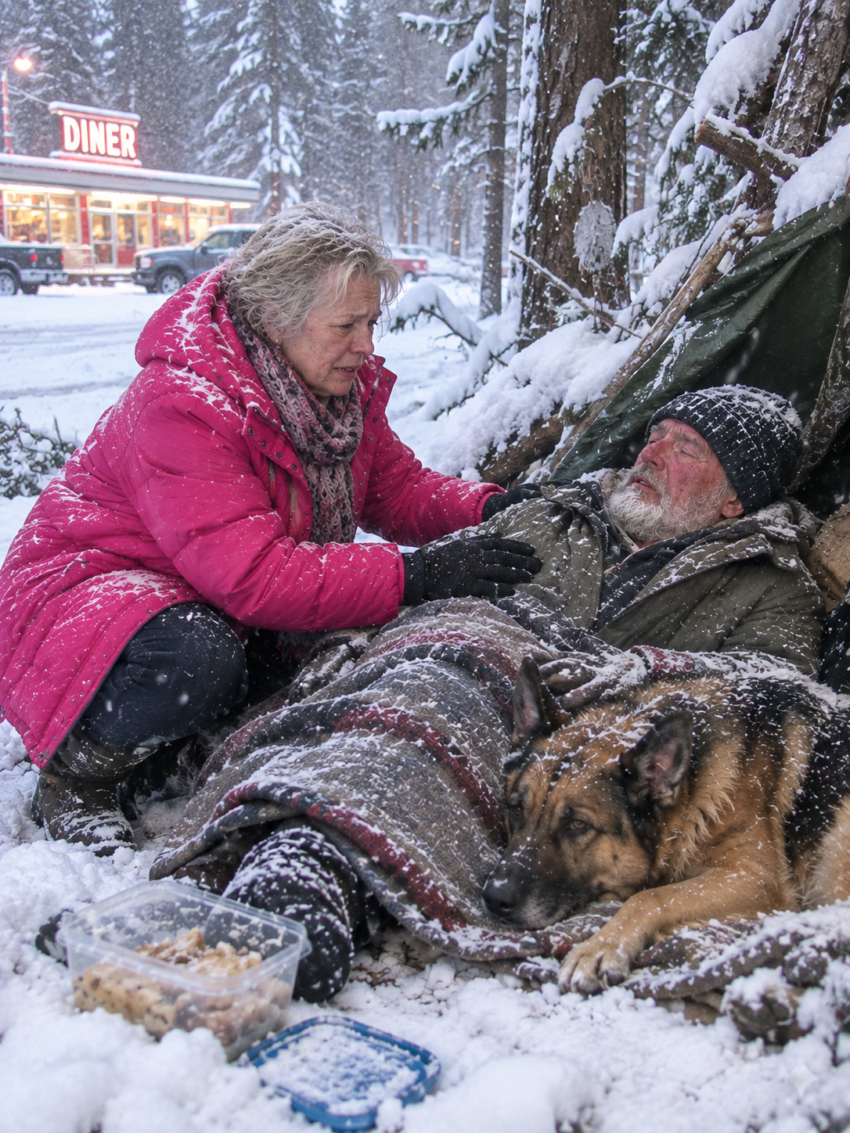
PART 1 — THE DOG WHO NEVER ATE HER BISCUIT
“DON’T YOU DARE FOLLOW THAT FILTHY MUTT! YOU’LL GET YOURSELF HURT, AND NOBODY’S COMING TO SAVE YOU!” Glen Hobart shouted across my diner as a limping German shepherd caught the hem of my apron between her teeth and pulled toward the door.
For eleven mornings, that dog had arrived at exactly 6:40, accepted one biscuit, and disappeared into the snowy Minnesota woods without eating a bite. On the twelfth morning, she refused the biscuit entirely. And when I noticed a fresh red stain beneath her worn collar, I knew something was terribly wrong.
I took off my apron, grabbed my winter coat, and followed her.
My name is Dorothy Kincaid, though everybody in Ely, Minnesota, calls me Dot. I’m seventy-one years old, and I’ve owned Dot’s Diner for thirty-two years. My husband, Ed, built the wooden counter himself, back when we were young enough to believe that hard work could fix just about anything.
Ed’s been gone six years now. I still catch myself reaching for a second coffee mug when I open the diner in the morning, especially when the place is quiet.
These days, quiet is something I have plenty of.
My landlord raised the rent by eight hundred dollars in September. Between groceries, utilities, and the cost of keeping two employees on the payroll, I was barely covering expenses. Rudy, my cook of eighteen years, knew how bad things were because he’d watched me spend three evenings going over the same bills.
“We’ll make it through Christmas, Dot,” he’d told me.
“I hope you’re right, honey. I’m running out of places to find another eight hundred dollars.”
The building’s owner had recently mentioned that Glen Hobart was interested in buying the property. Glen owned several commercial buildings around town and had been pestering me for years to sell the business and retire.
He came in every morning, ordered black coffee, and found something to complain about. I’d known men like Glen all my life. They weren’t satisfied with having more than enough for themselves. They wanted everyone else to know it.
The first time the German shepherd appeared, snow was blowing hard enough to cover the diner windows.
She pushed against the front door just as a customer was leaving and stepped inside. She was a big dog, though terribly thin, with a thick black-and-tan coat and one back leg she clearly didn’t want to put much weight on.
There was dried blood along the edge of her collar.
She stood beside the register, watching me.
“Well, hello there, sweetheart,” I said, coming around the counter. “Where’d you come from?”
She didn’t bark or wag her tail. She simply waited, her ears forward and her eyes fixed on my hands.
I took a plain biscuit from the tray Rudy had just brought out.
“You hungry?”
She accepted it so gently that I barely felt her teeth. Then she turned around and hurried through the door before it closed.
Rudy watched her disappear across the highway.
“Probably somebody’s farm dog. She looks like she’s been through a rough patch.”
“That collar bothers me,” I said. “Looks like she’s hurt herself.”
The next morning, she came back at 6:40.
And the morning after that.
By the fourth day, I’d started leaving a biscuit beside the register before sunrise. She always took exactly one, never begged for another, and disappeared across the highway toward the pine woods.
Then I noticed something peculiar.
She never ate it.
One morning, I watched from the front window as she carried the biscuit between her teeth, moving carefully despite her injured leg. She crossed the road, climbed the snowy shoulder, and vanished among the trees.
“Rudy, have you ever seen a hungry dog refuse food?” I asked.
He glanced up from the grill.
“Not unless she’s taking it to somebody else.”
His words stayed with me.
I started asking customers whether anyone recognized her. Nobody did. There was no identification tag, and I couldn’t get close enough to examine the collar without making her nervous.
On the sixth morning, I called the local animal shelter and described her. The woman who answered said they hadn’t received a matching missing-dog report but suggested I contact them again if I could safely contain her.
I tried following her that afternoon after closing, but she’d already disappeared. With the early darkness and deep snow, I didn’t get far beyond the highway.
By the eighth morning, Glen had noticed our little visitor.
“Are you seriously letting stray animals into a restaurant now?” he demanded, loud enough for everyone to hear.
The dog stood beside the register, waiting patiently.
“She’s here for less than a minute, Glen. I’ll take care of it.”
“You’d better. People don’t want to eat in some rundown place full of dirty animals.”
Rudy turned from the grill.
“Nobody’s asked for your opinion on the food, Glen.”
“I’m a paying customer, aren’t I?” Glen snapped. “And I know the health department would love to hear about this.”
I handed the dog her biscuit and opened the door.
“Go on, sweetheart. Be careful out there.”
Glen watched her leave.
“You’re going to lose this place, Dorothy. Maybe it’s time you accepted that.”
I didn’t answer because he wasn’t entirely wrong about the diner being in trouble. But I wasn’t going to let him frighten me into treating a hungry animal badly.
The following day, Glen announced that he’d filed a complaint with the county.
“Inspector’s coming Friday,” he said with a satisfied smile. “Maybe that’ll finally convince you to close up and go home.”
I set his coffee on the counter.
“Your eggs will be out in a minute.”
He seemed disappointed that I hadn’t argued.
That evening, while checking my receipts, I found myself thinking about the quiet elderly man who used to sit in the corner booth every Tuesday.
He’d been coming for almost two years. Black coffee, two eggs over easy, toast lightly buttered. He wore an old Army jacket and usually left a twenty-dollar bill, even though his breakfast cost much less.
I knew his name was Harold because I’d heard him introduce himself to Rudy once.
He hadn’t been in for two Tuesdays.
At first, I’d assumed he’d gone to visit family or wasn’t feeling well. But now, remembering Rudy’s comment about the dog taking food to somebody else, I began to wonder.
I checked the local missing-person notices online. Nothing about Harold. I didn’t know his last name, and the only other thing I remembered was that he lived somewhere beyond the old logging road.
I went home uneasy.
For eleven mornings, the dog had come for her biscuit. Eleven mornings, she’d carried it away.
And on the twelfth morning, she finally showed me why.
THE TRAIL THROUGH THE PINES
The German shepherd arrived at 6:40, just as she always had. But instead of waiting by the register, she came straight toward me, whining softly.
I reached for her biscuit.
“Here you go, sweetheart.”
She ignored it.
Instead, she caught my apron in her teeth and pulled. When I stepped forward, she released it and hurried toward the door, looking back to see whether I was following.
I tried offering the biscuit again.
She wouldn’t take it.
Then I noticed the fresh stain beneath her collar. She’d been rubbing or scratching at the irritated skin, and the old wound looked worse.
“Rudy,” I said, “I think she’s trying to show me something.”
Glen, sitting three stools away, gave a disgusted snort.
“Oh, give me a break. You’re taking orders from a dog now?”
The shepherd pulled my apron again.
“Dot, don’t be ridiculous,” Glen continued. “It’s ten degrees outside. You fall out there, who’s going to come looking for you?”
I untied my apron and handed it to Rudy.
“Call somebody if I’m not back soon. I’m going to see where she goes.”
Rudy looked concerned.
“Take your phone. And don’t try climbing anything steep.”
I put on my heaviest coat, pulled my boots tight, and followed the dog across the highway.
She moved faster than I expected, considering her injured leg. Every few minutes, she stopped and looked back, waiting until I caught up before continuing.
The old logging trail climbed gradually into the woods. Snow covered most of the path, but I could see where an animal had traveled repeatedly between the trees.
My knees began aching after the first half mile.
At seventy-one, I can still work a twelve-hour shift, but walking through deep snow is another matter. I stopped twice to catch my breath, leaning against tree trunks while the dog circled back and whined.
“I’m coming, girl. Just give me a minute.”
She waited.
We’d traveled perhaps a mile and a half when I heard running water beneath the ice near a narrow creek.
The dog suddenly hurried off the trail.
I followed her around a cluster of pines and saw a blue tarp stretched over fallen branches. Beneath it was a makeshift shelter, barely large enough for a person to lie down.
And there, wrapped in an old Army field jacket, was an elderly man.
His face was pale, his beard covered with frost, and one leg lay at an unnatural angle. Around him, scattered across the snow and tucked into the folds of his jacket, were pieces of biscuit.
The shepherd crawled beside him and pressed her body against his chest.
I recognized him immediately.
“Harold? Honey, can you hear me?”
I knelt beside him and touched his cheek. His skin was terribly cold, but he was breathing.
His eyelids moved.
Then he looked directly at me and whispered a single word.“Birdie?”
For a moment, I forgot the cold.
Nobody had called me Birdie in fifty-eight years.
It was the name my father had given me when I was a little girl. He used to say I talked as much as a sparrow and never stayed still long enough for him to finish a sentence.
My father was an Army sergeant who served in Vietnam.
He never came home.
I was thirteen when two uniformed officers knocked on our front door in Duluth. My mother collapsed into a chair, and I stood in the hallway holding a letter I’d written to him the night before.
After that day, I wouldn’t let anybody call me Birdie.
Not my mother. Not my grandparents. Not even Ed.
Yet here was a man I’d served breakfast to for nearly two years, lying in the snow and speaking the one name I hadn’t heard since childhood.
I took out my phone with trembling fingers and called 911.
“I’ve found an elderly man injured near the old fire tower trail,” I told the dispatcher. “He’s breathing, but he’s terribly cold. Please send help.”
I gave her the best description of our location I could manage, including the creek and the logging trail. She kept me on the line while I covered Harold with my coat and tried to shield him from the wind.
The shepherd pressed herself against him.
“Stay with us, sweetheart,” I whispered, stroking her neck. “You’ve done your part. Let me do mine.”
Harold’s eyes opened once more.
He looked at me and murmured, “Your daddy… I promised…”
Then he closed them again.
I held his hand until the rescue team reached us.
And all that time, I kept wondering how a stranger could know my father’s private name for me.
PART 2 — THE MAN WHO KNEW MY FATHER
It took the rescue team nearly ninety minutes to reach us. By then, my feet were numb, and I could barely feel the fingers I’d wrapped around Harold’s hand. Two paramedics examined him while the others prepared a rescue sled to carry him back along the trail.
The German shepherd refused to move.
“Easy, girl,” one of the rescuers said, reaching toward her collar. “We’re trying to help him.”
She gave a low whine and pressed closer to Harold. I crouched beside her, careful not to touch the irritated skin around her neck.
“Come here, sweetheart. They’re going to take care of him. You can stay with me.”
She looked at Harold, then reluctantly came to my side. I kept one hand on her shoulder while the rescuers secured him to the sled. Before they carried him away, he opened his eyes and tried to speak.
“The jacket,” he whispered. “Don’t lose my jacket.”
I promised I wouldn’t.
They transported him to a hospital in Duluth. The doctor later told me he had a broken hip, severe dehydration, and hypothermia. He’d apparently been outside for nearly two weeks, sheltered beneath that flimsy tarp while the temperature dropped well below freezing.
“He’s fortunate you found him when you did,” the doctor explained. “Another couple of nights could have been disastrous. That dog probably helped keep him alive.”
I thought about the eleven biscuits scattered around his shelter.
“She brought him food every morning,” I said.
The doctor shook his head in amazement.
“Animals can be remarkably devoted.”
Harold was eighty-four years old. His full name was Harold Tate, and according to the hospital staff, he’d been living alone in a small cabin near the old fire tower. He had no close family nearby, and the emergency contact listed in his records was several years out of date.
I took the shepherd home after a local veterinarian examined her. The vet cleaned the irritated wound beneath her collar, checked her injured leg, and prescribed treatment. Fortunately, her leg injury didn’t require surgery.
Her name, I eventually learned, was Duchess.
For the first two nights, she barely slept. She paced between my bedroom and the front door, occasionally resting her head on the rug as though listening for someone outside.
I understood that kind of waiting.
Three days after the rescue, the hospital called to say Harold was awake and had asked to see me.
I drove to Duluth the following afternoon.
He was sitting upright in bed, looking considerably better than he had beneath the tarp. His face was still pale, and his voice was weak, but his eyes were clear.
When I entered, he studied me for a long moment.
“Dorothy Kincaid,” he said softly. “You look so much like your father.”
I pulled a chair beside his bed.
“How did you know my father?”
He swallowed.
“We served together. Same unit in Vietnam. Your daddy was my closest friend.”
For several seconds, I couldn’t speak.
My father had been gone for nearly sixty years. I’d spent most of my adult life believing there was nothing left to learn about his final months.
Harold looked toward the closet beside his bed.
“Would you get my jacket? There’s something in the inside pocket.”
I retrieved the old Army jacket the rescuers had brought from the woods. Harold pointed to a small interior pocket, where I found a plastic sandwich bag wrapped tightly around a photograph and a yellowed envelope.
The photograph showed two young soldiers sitting on a wall of sandbags, squinting into the sunlight.
One of them was my father.
I recognized him immediately.
He had the same crooked smile I remembered from childhood, the one that appeared whenever he was about to tease me.
The other soldier was Harold, nearly sixty years younger.
“Your daddy talked about you constantly,” Harold said. “Birdie this, Birdie that. He told everybody you could catch more fish than any boy in Minnesota.”
I laughed unexpectedly.
“He used to take me fishing before sunrise. I complained the whole way there.”
“He told me that, too.”
Harold smiled, but it didn’t last.
He pointed toward the envelope.
“He wrote that two days before he was lost. He gave it to me and asked me to bring it to you if anything happened.”
I stared at the faded handwriting.
My name was written across the front.
To my Birdie.
I looked up.
“Harold, why am I only getting this now?”
His eyes filled.
“Because I failed him.”
THE LETTER THAT WAITED FIFTY-EIGHT YEARS
Harold took a long breath before continuing. He told me he’d returned from Vietnam carrying injuries nobody could see and memories he couldn’t bear to discuss. He’d struggled with drinking for twenty years before finally getting sober.
“Your father was a good man, Dorothy. Better than I ever managed to be. I should’ve brought that letter to your mother the moment I came home.”
“Then why didn’t you?”
He looked down at his hands.
“I couldn’t face you. I kept thinking about what I was supposed to say. Your father didn’t make it home, and I did. Every year I waited, it got harder. Eventually I convinced myself you’d be better off without some broken-down soldier showing up on your doorstep.”
I felt anger rising beneath the grief.
“You had almost sixty years, Harold. My mother went to her grave without seeing that letter.”
He nodded, tears gathering along his lower eyelids.
“I know. And there’s no excuse that’ll make that right.”
For a while, neither of us spoke.
Then he told me that two years earlier, after moving back to northern Minnesota, he’d started looking for me. An old acquaintance had mentioned that Dorothy Kincaid owned a diner in Ely.
He found the place on a Tuesday morning.
“I walked in, and there you were behind the counter. Same chin as your daddy. Same way of looking at somebody when you think they’re talking nonsense.”
I remembered him now. The quiet old man who sat in the corner booth, ordered two eggs and black coffee, and always left a twenty-dollar bill.
“Why didn’t you tell me?”
“I tried. More times than you know. But you’d come over with the coffeepot and ask how my breakfast was, and I’d lose my nerve.”
He gave a tired smile.
“You were kind to me. I suppose I was afraid that would change once you knew.”
His memory had also begun slipping. He sometimes forgot appointments and struggled to find his way home. On the day of his accident, he’d taken Duchess for a walk, wandered farther than intended, and fallen near the creek.
He couldn’t stand afterward.
“I had the tarp in my pack. Thought I could stay warm until somebody came along. But nobody uses that trail much in winter.”
“And Duchess?”
“She kept leaving and coming back. First time she brought me a biscuit, I thought I was imagining things.”
He looked toward the window.
“That dog wouldn’t give up on me.”I looked down at the envelope in my lap.
“May I open it?”
Harold nodded.
The paper was fragile, and I unfolded it slowly. My father’s handwriting filled most of the page, slanting slightly toward the right.
He called me Birdie. He wrote about the fishing trips we would take when he came home and reminded me not to let anybody talk me out of becoming a teacher.
He told me to look after my mother, to be kind to animals that had nowhere else to go, and to remember that being frightened didn’t mean I couldn’t be brave.
Near the bottom, he’d written:
If Harold brings you this, sweetheart, it means I couldn’t come home myself. I hope you have a wonderful life. Don’t spend it waiting for me. I love you more than all the stars over Minnesota.
I covered my mouth.
For fifty-eight years, I’d carried the memory of two officers standing on our porch. I’d remembered my mother’s sobbing and the letter I’d never mailed.
Now I was holding a letter my father had written to me.
Harold reached for a tissue and handed it across the bed.
“He loved you something fierce, Dorothy.”
I nodded, unable to answer.
I hadn’t cried like that since Ed’s funeral. I sat beside Harold’s bed with the letter in my hands, letting years of grief and anger find their way out.
Eventually, I looked at him.
“I wish you’d brought this sooner.”
“So do I.”
“But I’m glad you finally did.”
He closed his eyes, and I held his hand until the nurse came to check on him.
THE FRIDAY GLEN HAD BEEN WAITING FOR
While Harold recovered, word of the rescue spread through Ely.
Rudy had told a few customers where I’d gone that morning, and one of the rescuers mentioned the story to a local reporter. By Thursday evening, people were calling the diner to ask about Duchess and the elderly veteran she’d helped save.
Friday was also the day the county health inspector was supposed to arrive.
Glen came in early, looking unusually pleased with himself.
“Well, Dorothy, I hear you’ve been running around the woods after that dog,” he said, settling onto his usual stool. “Hope you enjoyed your little adventure. It won’t change what the inspector finds.”
I poured his coffee.
“Good morning to you, too, Glen.”
He glanced toward the front window.
“You ought to think seriously about selling while you’ve still got a business worth buying.”
I’d heard that suggestion for years. Usually, I let it pass because arguing with Glen was like arguing with a parking meter.
That morning, I set down the coffeepot and looked directly at him.
“Glen, if I ever decide to sell my diner, I’ll make that decision myself. Until then, I’d appreciate it if you’d stop trying to frighten me into it.”
He stared.
“I’m offering you practical advice.”
“I’ve heard it. I don’t need to hear it every morning.”
Rudy turned toward the grill to hide a smile.
Glen finished his coffee without another word.
The inspector arrived shortly afterward. I explained what had happened with Duchess, showed him where she’d entered, and described the steps we’d taken to keep the food preparation area clean.
He inspected the diner, discussed animal access and sanitation requirements with me, and pointed out a few procedures I needed to tighten.
I listened carefully and agreed to make the changes.
He didn’t order us closed.
By lunchtime, the diner was busier than it had been in months.
Members of the local VFW post came in after hearing about Harold. So did several teachers, a group of high school hockey players, and families who remembered eating at Dot’s when they were children.
A local reporter asked whether she could photograph the old wooden counter Ed had built.
I told her she could, provided she didn’t interrupt Rudy while he was cooking.
The story appeared in the local paper that weekend. It wasn’t about a heroic old woman who’d done something extraordinary. It was about a dog who refused to abandon her owner and a small-town diner where she’d found someone willing to pay attention.
A few days later, the commander of the local VFW post came to see me.
He brought two other veterans and an envelope containing a letter from the post.
“Dot, we heard you’re having trouble with the rent,” he said. “Our members voted to help cover the increase for the next two years.”
I stared at him.
“I can’t ask you gentlemen to do that.”
“You didn’t ask,” he replied. “We voted. Harold’s one of ours, and you brought him home.”
I looked at the letter, then at the three men standing in front of me.
For weeks, I’d been worrying about whether I’d have to close the diner before Christmas. Now these men were offering me enough help to keep the doors open while I worked out a longer-term plan.
“I don’t know what to say.”
The commander smiled.
“How about three coffees? We’ll pay for those ourselves.”
I laughed and reached for the mugs.
Glen stopped coming in shortly afterward.
I never asked why.
THE BISCUIT SHE FINALLY ATE
Harold spent several weeks recovering before moving into an assisted living community two blocks from the diner. His doctors wanted him somewhere he could receive help with his medications, mobility, and memory.
He wasn’t happy about giving up his cabin.
“I’ve lived alone most of my life,” he complained when I visited. “I don’t need somebody reminding me what day it is.”
“Harold, you got lost on a trail you’ve walked for years. There’s no shame in having somebody nearby.”
He looked away.
“What about Duchess?”
I smiled.
“She’s already made herself comfortable at my house. You can see her whenever you like.”
He studied me for a moment.
“You’d really keep her?”
“Harold, that dog has been sleeping on Ed’s side of my bed for three weeks. I think she’s made the decision for both of us.”
He laughed, and I saw a little of the young soldier from the photograph.
We arranged for Rudy to drive Harold to the diner every Tuesday, provided he was feeling well enough. He still ordered black coffee and two eggs over easy, and he still tried to leave a twenty-dollar bill.
I started giving him his change directly instead of leaving it on the table.
“You’ve tipped me enough over the last two years, Harold.”
“Your coffee’s worth it.”
“Then come back next Tuesday and buy another cup.”
He always did.
As for Duchess, her injured leg gradually improved, and the irritated skin around her collar healed. She gained weight, became considerably more interested in her meals, and developed the habit of following me from room to room.
Every morning, she rode with me to the diner before sunrise.
I kept her in the little office behind the kitchen, away from the food service area, where she had a comfortable bed and a water bowl. Rudy usually stopped to scratch her ears before putting on his apron.
One Tuesday, Harold arrived earlier than usual. He settled into his familiar corner booth while Rudy prepared his breakfast, and I brought Duchess out to see him before opening for the morning rush.
She hurried to his chair and rested her head against his knee.
Harold stroked her ears.
“There’s my good girl. You still taking care of everybody?”
I stood beside them, holding a plain biscuit.
For eleven mornings, I’d watched this dog carry her food away without tasting it. I’d wondered where she went, why she was so determined, and what could possibly matter more to a hungry animal than eating.
Now I knew.
I held out the biscuit.
“Here you go, Duchess. This one’s yours.”
She took it gently, just as she had on that first snowy morning.
But this time, she didn’t turn toward the door.
She settled beside Harold’s chair, laid the biscuit between her paws, and ate it while he scratched behind her ears.
I glanced at the clock above Ed’s old wooden counter.
It was 6:40.
And for the first time in twelve mornings, Duchess wasn’t waiting for someone to follow her.