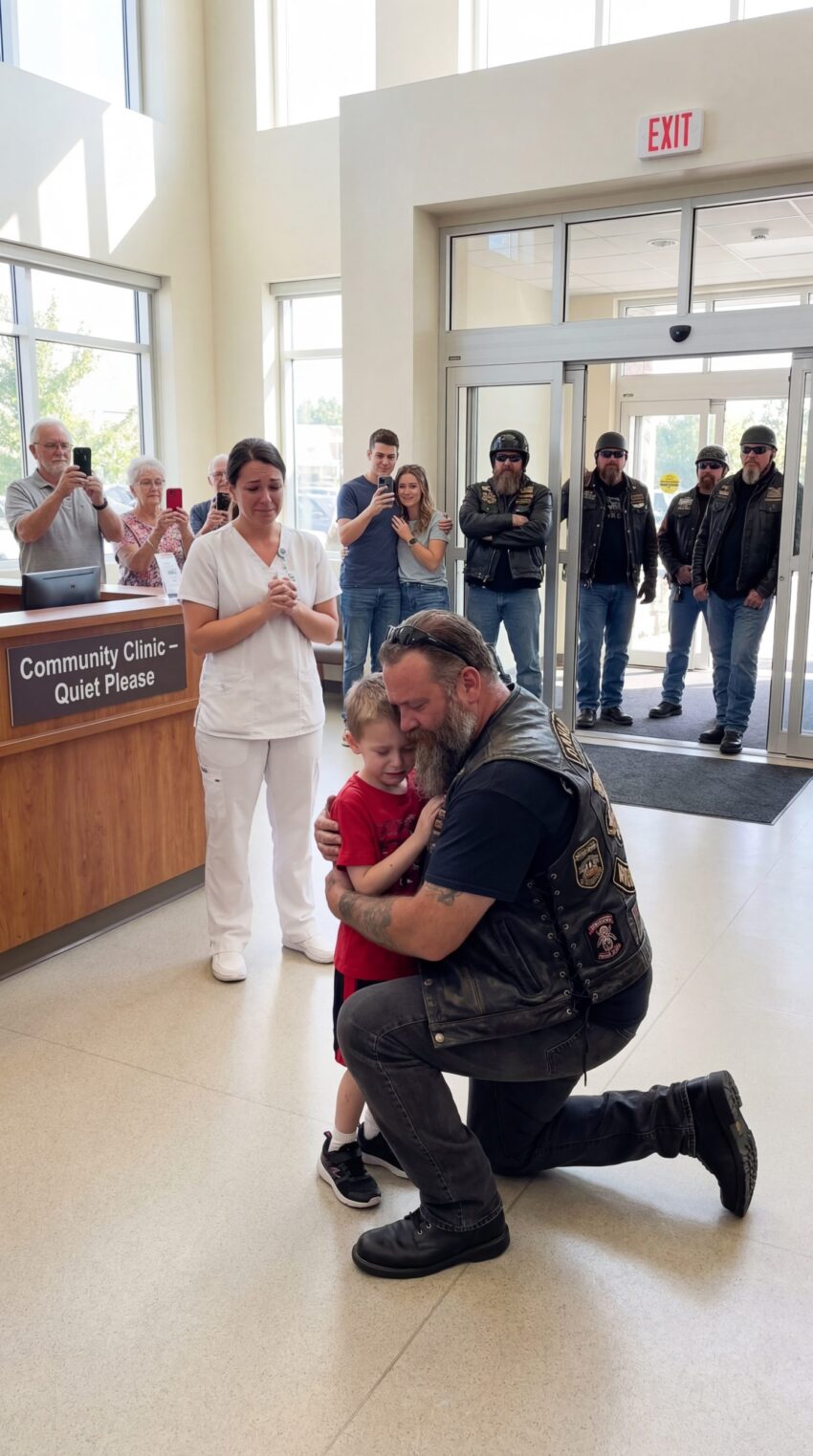
The Afternoon Everything Went Quiet
The town of Millbrook Crossing, Tennessee, was the kind of place people usually passed without noticing. It sat a few miles off Highway 64, surrounded by stretches of farmland and quiet roads lined with aging oak trees. Travelers sped past the green exit sign without wondering what life looked like beyond it.
If someone had turned down that road and driven a little farther, they would have found a small diner with a blinking coffee sign, a barber shop with one chair, and a modest health clinic that served most of the families in the area.
That clinic was where I worked.
My name is Hannah Whitaker. I had been a nurse at Millbrook Community Health Center for nearly eighteen years. At forty-six, I had spent almost half of my life walking the same pale hallway floors, checking charts, comforting patients, and listening to the steady rhythm of everyday emergencies that came through our doors.
But if someone asked what truly defined my life, I would never say nursing.
I would say my son.
The Boy Who Heard Too Much
My son’s name is Owen.
He was nine years old, with sandy hair that refused to stay flat and pale gray eyes that seemed to study the world in ways most people never noticed. When Owen was three, doctors explained that he lived on the autism spectrum.
The word sounded clinical when the doctor said it.
But to me, it simply described the way Owen experienced the world.
He spoke less than most children his age. Sometimes entire days passed with only a few short phrases. Yet silence never meant he was unaware of what was happening around him.
In many ways, he noticed far more than anyone else.
The faint buzz of fluorescent lights.
The whistle of wind slipping through a cracked window.
The overlapping voices in a crowded room.
To most people, those sounds blended together into background noise.
For Owen, they arrived all at once.
Loud, bright, and impossible to ignore.
Sometimes I imagined that living inside his mind must feel like standing in the middle of a busy orchestra where every instrument played at the same time.
A Day That Did Not Go According to Plan
That Wednesday afternoon in late October began like any other busy shift.
The waiting room filled before the clinic doors had even been open for twenty minutes. Flu season had started early, and half the town seemed to be coughing.
Two nurses had called out sick.
The front desk phone rang constantly.
My coworker, Carla Jennings, was juggling insurance forms while trying to calm a frustrated patient who insisted the clinic had misplaced paperwork he had brought in years earlier.
It was the kind of chaos that had become normal for us.
But that day, Owen was with me.
Usually my sister watched him after school until my shift ended. That afternoon her car broke down outside a grocery store in the next town over.
There had been no time to arrange another plan.
So I did what many working parents do when life becomes complicated.
I improvised.
I packed Owen’s tablet, his noise-canceling headphones, his weighted vest, and the small plastic dinosaur he carried everywhere.Then I brought him to the clinic.
The Quiet Supply Room
Behind the clinic hallway sat a narrow supply room where extra boxes of gloves and paper towels were stored. In one corner was a faded beanbag chair.
It was not a perfect space.
But it was quiet.
For the first hour, everything went smoothly.
Between patients I peeked inside the room. Owen sat cross-legged on the beanbag chair watching one of his favorite videos.
Old steam trains rolling slowly across open countryside.
He loved the steady rhythm of the wheels.
The predictability of the motion.
Every time the train whistle sounded, he tapped the dinosaur against his knee twice.
Tap.
Tap.
That was his quiet signal that he was okay.
“You’re doing great, buddy,” I whispered once as I brushed his hair away from his eyes.
He did not answer, but he glanced at me briefly.
For Owen, that small look meant everything.
The Moment Everything Changed

Trouble rarely arrives with a clear warning.
Often it slips quietly into ordinary moments.
In our case, it began with the lights.
The building wiring was old, the kind installed decades earlier when the town was growing quickly and construction had been rushed.
When strong wind rolled through the valley, the electricity sometimes flickered.
That afternoon a sudden gust rattled the clinic windows.
The fluorescent lights blinked.
Once.
Then again.
And then they returned to normal.
Most people in the waiting room barely noticed.
A few glanced upward.
Someone chuckled.
But I knew something was wrong before I even heard him.
Owen screamed.
The Collapse in the Waiting Room
It was not the kind of cry a child makes when they are upset.
It was raw panic.
I ran down the hallway just in time to see Owen burst from the supply room, his hands clamped tightly over his ears.
“Owen!” I called.
But he did not hear me.
Or perhaps he heard everything at once.
He ran straight into the waiting room.
Twenty people turned to look.
Before I could reach him, he fell onto the tile floor.
His body curled inward as if he were trying to protect himself from invisible waves crashing around him.
His breathing came in short bursts.
The overhead lights buzzed loudly.
Or maybe my own fear made the sound seem louder.
I knelt beside him.
“Hey, sweetheart. It’s Mom. You’re safe.”
He shook his head violently, pressing his hands harder against his ears.
I reached for the headphones in my pocket.
He knocked them away.
They slid across the floor.
The Eyes of the Room
Whispers started behind me.
Soft at first.
Then sharper.
“Maybe she should take him outside.”
“That looks like a tantrum.”
“Why bring a child to work if he’s going to disturb everyone?”
I kept my focus on Owen.
“Breathe, honey. Just breathe.”
But my voice trembled.
Across the room, a toddler began crying.
Someone’s phone chimed.
Every sound seemed to make Owen’s body jolt again.
Then I noticed something that made my chest tighten.
A teenager standing near the wall raised his phone.
The camera pointed directly at us.
“Please,” I said quietly. “Don’t record this.”
He shrugged.
“I’m just filming what’s happening.”
As if my son’s panic were entertainment.
The Door Opens
The clinic door creaked open.
Heavy footsteps crossed the tile floor.
Slow.
Measured.
At first I did not look up.
Then the entire room went strangely quiet.
When I glanced toward the entrance, I saw a tall older man standing just inside the doorway.
His silver hair was tied back loosely at the base of his neck.
A worn leather motorcycle jacket rested on his shoulders, decorated with faded patches from years of travel.
One patch carried a small American flag.
Another showed a winged emblem that looked like something from an old military unit.
A wooden cane rested in his right hand.
Later I would learn his name.
Walter “Walt” Branson.
Former Army sergeant.
Vietnam veteran.
Grandfather.
But at that moment he was simply a stranger watching a child struggling on the clinic floor.
The Man Who Said Very Little
The receptionist hurried toward him.
“Sir, I’m sorry about the noise,” she began.
He raised his hand gently.
Then he looked at Owen.
“That boy is autistic,” he said quietly.
It was not a question.
I nodded.
“Yes. I’m sorry for the disruption.”
His eyes moved to mine.
They were steady and kind.
“You never need to apologize for your child.”
A man near the window muttered something impatiently.
But the older biker ignored him completely.
Instead, he stepped closer to Owen.
Slowly.
Carefully.
Like someone approaching a frightened animal.
Then he looked at me with a silent question.
I hesitated for a second.
But something about his calm expression made me nod.
The Unexpected Thing He Did
Without another word, the man lowered himself to the floor.
He lay flat on his back beside Owen.
Several people gasped.
A woman whispered, “What is he doing?”
I blinked in surprise.
“Sir, you really don’t have to—”
“Just watch,” he said gently.
He folded his hands over his chest and took a slow, deep breath.
Then another.
His breathing was exaggerated and steady.
After a moment he began humming.
Low.
Soft.
Almost like the vibration of a distant engine.
Borrowing Calm
For a few seconds nothing changed.
Then Owen’s rocking slowed slightly.
The humming continued.
Steady.
Even.
Grounding.
Someone muttered that it looked strange.
Without opening his eyes, the man spoke quietly.
“Sometimes the best way to help someone is to meet them where they are.”
Owen’s breathing gradually slowed.
His eyes drifted toward the leather sleeve lying inches from his face.
A patch on the jacket caught his attention.
He reached out and touched it.
The man opened one eye and smiled gently.
“That patch?” he said softly. “Got it a long time ago.”
I looked at him.
“You’ve done this before?”
He nodded.
“My granddaughter, Emma. Loud alarms send her into the same storm.”
He hummed again.
“Her therapist taught me this. Kids can borrow calm from us when they can’t find their own.”
The Long Five Minutes
Time seemed to stretch.
The waiting room remained completely silent.
The teenager slowly lowered his phone.
Owen’s fists unclenched.
His breathing softened.
After a few more minutes the storm inside him began to fade.
One final shaky sob escaped him.
Then he lay still on the tile floor.
His cheek rested against the cool surface as he stared quietly at the patch on the leather jacket.
I brushed his hair gently.
“You did great, sweetheart.”
A Quiet Kindness
The older man slowly pushed himself upright, wincing slightly as his knees protested.
The room finally breathed again.
People shifted in their chairs.
A few avoided looking at us.
He picked up his cane.
“You did good, kid,” he told Owen.
Then he turned to me.
“Don’t be too hard on yourself. These moments happen.”
I swallowed hard.
“Thank you. I don’t know how to repay you.”
He shook his head.
“No repayment needed. Just passing along something someone once taught me.”
The Beginning of Something New
Before leaving, he paused near the door.
“The Veterans Hall on Maple Street,” he said. “We host quiet afternoons there for kids who need a calmer place. No one complains about noise or movement.”
I blinked.
“That sounds wonderful.”
He nodded.
“Bring your boy sometime.”
And we did.
The following Saturday.
The hall smelled faintly of coffee and old wood.
Veterans played cards near the window while children rolled toy cars across the floor.
Owen met a girl named Emma.
They did not speak.
But they played together.
Sometimes friendship does not require words.
The Storm Months Later
Several months later a thunderstorm rolled through Millbrook Crossing.
Lightning flashed across the sky.
Thunder cracked loudly overhead.
Owen froze.
His hands moved to his ears.
Fear flickered in his eyes.
For a moment my heart raced.
Then I remembered the clinic floor.
The leather jacket.
The quiet humming.
So I lay down on the living room rug beside him.
Flat on my back.
Just like the biker had done.
I took a slow breath.
Then another.
And I hummed softly.
Owen looked at me.
Then he rolled toward me until our foreheads touched.
His breathing slowly matched mine.
The thunder continued outside.
But he stayed calm.
After a moment he whispered something so soft I almost missed it.
“Mom.”
He had not said that word in weeks.
The Quiet Strength That Changes Lives
True compassion rarely arrives with applause or attention, yet its influence travels farther than we often realize, quietly shaping the lives of those who witness it and those who receive it.
A single moment of patience can calm a storm inside another person’s heart in ways that years of misunderstanding never could.
Children who experience the world differently are not problems waiting to be fixed but individuals who simply need a little more space, understanding, and kindness.
When we slow down long enough to see another person’s struggle, we discover that empathy is far more powerful than judgment.
Communities are strengthened not by grand speeches or public recognition but by small acts of care repeated day after day.
The courage to kneel beside someone in distress often matters far more than standing above them with opinions or criticism.
Kindness is not weakness; it is a quiet strength that allows people to feel safe when the world becomes overwhelming.
When one person chooses patience instead of irritation, that choice can ripple outward and change the atmosphere of an entire room.
Moments of understanding between strangers remind us that humanity is built on connection rather than separation.
And sometimes the most powerful help we can offer another person is simply the calm presence that allows them to borrow our strength until they can stand steady again on their own.