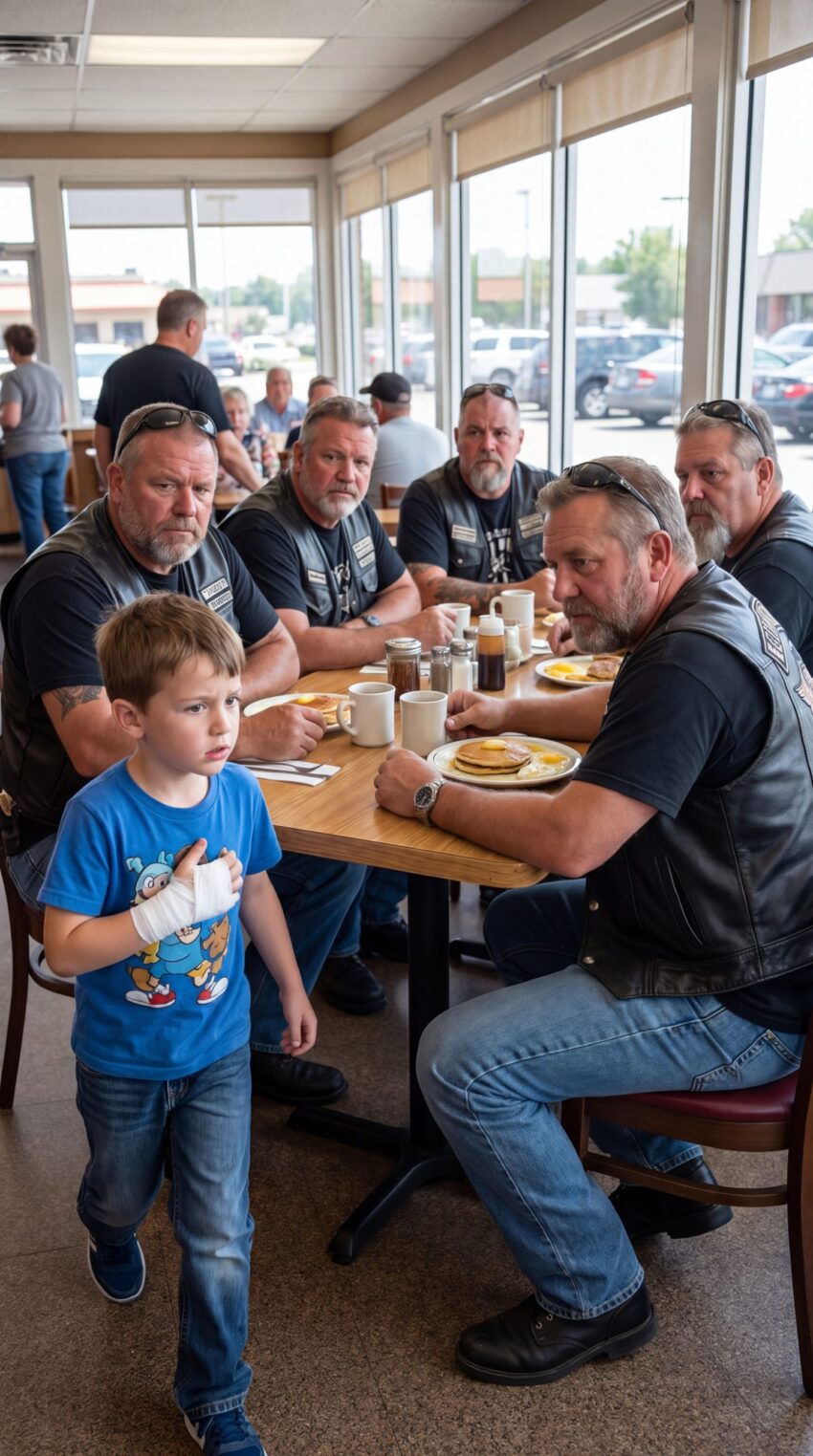
The Boy Who Walked Up to Our Table
The lunch crowd at Iron Skillet Diner in Ashford, Kentucky had been loud enough to cover almost anything. Plates were clinking, stools were scraping, and somebody near the windows was arguing about college basketball like it was a matter of national security. My brothers and I had taken over our usual corner after a veterans’ fundraiser across town, fifteen men in worn leather vests and faded jeans, looking rougher than we felt and older than we liked to admit.
Most people gave our table space. That was normal. We were used to the double takes, the lowered voices, the curious glances that came and went in a hurry.
What was not normal was an eight-year-old boy in a green dinosaur T-shirt walking straight toward us like he had made up his mind a long time ago.
He stopped beside our table, swallowed hard, and looked directly at me.
“Can one of you make my stepdad stop hurting my mom?”
The whole diner seemed to lose its sound at once.
It was as if every fork, every voice, every coffee cup had frozen in midair. Even the waitress carrying a tray near the register stopped moving. Fifteen bikers stared at a little boy with untied sneakers and a face too serious for his age, and nobody said a word for two full seconds.
Then he reached into his pocket, pulled out a crumpled fistful of bills, and set them beside my coffee.
“I only have seven dollars,” he said softly. “But you look like men who know how to protect people.”
I have lived long enough to know there are moments that divide life into before and after. That was one of them.
I pushed back my chair and knelt so I was eye level with him. Up close, I could see his lips trembling, though he was trying hard not to let them. His hair had been cut unevenly, like someone had tried to do it at home with dull scissors. There was dirt on one knee of his jeans. His eyes were wide, but they were not confused. They were desperate.
“What’s your name, son?” I asked.
“Owen,” he whispered.
“Owen, where’s your mama?”
He glanced toward the hallway leading to the restrooms.
“She’s in the bathroom. She doesn’t know I came over here.”
His fingers twisted together. He leaned closer as if he was sharing a secret too heavy for a child to carry.
“Please answer fast. She’ll be scared if she sees me here.”
What We Saw Without Him Saying It
I asked him the question as gently as I could.
“Why do you think you need help from us?”
For a second, he didn’t answer. Then he lifted the collar of his shirt just enough for me to see the marks at the side of his neck.
They were faint, but they were there.
Not old enough to be forgotten. Not new enough to be explained away.
Around me, the men at the table went still in the kind of silence I had only heard before a storm or before bad news was spoken out loud.
Owen lowered his shirt and stared at the floor.
“He said if I tell anybody, things will get worse for Mom,” he murmured. “But I thought maybe if I found someone stronger than him, he’d stop.”
My friend Reed, who had served two tours overseas and still carried himself like he was guarding a door no one else could see, leaned forward slowly.
“What’s your stepdad’s name?”
“Wade.”
“And your real dad?”
The boy’s face changed at once. Pride and sadness moved across it together.
“My dad was a Marine,” he said. “He died when I was little.”
Nobody at that table looked away after that.
Once you’ve buried friends in dress uniforms and folded flags, something inside you changes forever. A child saying his father was a Marine hit every man there in a place he did not show to the world.
That was when I began noticing everything else.
The stiffness in Owen’s left arm.
The way he stood more on one foot than the other.
A pale yellow shadow near his jaw that looked like someone had tried to hide it and had run out of time.
And then I saw the restroom door open.
The Mother Who Tried to Leave Quietly
She moved quickly at first, then slowed halfway to the table, as though pain had reminded her to be careful.
She looked about thirty-four, maybe thirty-five. Slim. Tired. Pretty in a worn-down sort of way, the kind of beauty that had not disappeared but had gone quiet under too much worry. Her hair was pulled back in a loose knot that looked like it had been fixed more than once that morning. She took one look at Owen standing beside fifteen bikers and all the color left her face.
“Owen,” she said, hurrying over, “I’m so sorry. I hope he isn’t bothering you.”
Her voice was polite, but fear was underneath it, plain as daylight.
“Not bothering us at all, ma’am,” I told her, rising slowly so I wouldn’t startle her. “Your son’s got courage most grown men don’t have.”
She reached for his hand at once.
As she did, the makeup near her wrist smudged. Under it, there was a darkened patch she had tried hard to hide.
She noticed me noticing and quickly tugged her sleeve down.
“Come on, sweetheart,” she whispered to Owen. “We need to go.”
I could feel every man at my table watching, waiting to see how I would handle it.
So I softened my voice.
“How about you both sit with us for a minute? We were thinking about ordering pie, and it would be a shame to do that without company.”
Her eyes widened.
“We really can’t.”
“Please,” I said. “No pressure. Just a few minutes. Your boy was telling us about dinosaurs, and half the men here suddenly became experts.”
That got the smallest flicker of confusion out of her. Confusion was good. Confusion was better than panic.
Owen looked up at her with a kind of pleading hope that broke my heart.
Finally, she sat down at the end of the booth with him close against her side, as though she believed she might have to pull him up and run at any second.
“What’s your name?” I asked her.
She hesitated.
“Naomi.”
“Naomi,” I said, “I’m Grant. These men are friends of mine. Nobody here wants to make your day harder.”
She nodded, but her shoulders stayed tight.
I turned to Owen again.
“You were brave enough to walk over here. Can you be brave for one more minute?”
He nodded once.
“Is somebody making home feel unsafe for you and your mom?”
Naomi let out a sharp breath and covered her mouth.
For a second, I thought she might stand up and leave anyway. Instead, tears filled her eyes so quickly it was like a dam had cracked somewhere inside her.
“You don’t understand,” she whispered. “He always finds out.”
The Truth at the Table
There are different kinds of fear. I have seen fear in war, fear in hospitals, fear at gravesides, fear in fathers who do not know whether their daughters are coming home. Naomi’s fear was the kind that had lived with her for so long it had learned her routines.
“Help me understand,” I said.
She looked around the diner, then leaned closer.
“My husband works in law enforcement,” she said quietly. “He knows how to talk his way out of things. He knows who to call. He knows how to make me sound unstable.”
A few of the men at the table exchanged looks. Not because we were surprised, but because suddenly every piece fit where it belonged.
Reed asked the next question.
“How long has this been going on?”
Naomi stared at her folded hands.
“Since before the wedding,” she admitted. “But after we got married, it got worse. After a while, I stopped knowing what counted as normal anymore.”
Owen pressed closer to her side.
She placed a hand on his hair without looking at him, like it was the only thing keeping her steady.
“I tried leaving once,” she said. “I thought if I could get out while he was on shift, we’d make it. But he found us before sunset.”
Her voice broke there.
Nobody rushed her.
The waitress came over, set down fresh coffee without being asked, and walked away again with tears in her own eyes.
“After that,” Naomi said, “I stopped trying where he could see it. I told myself I just needed time. I told myself I was waiting for the right moment.”
Owen looked up and said in a tiny voice, “Mom says we just need one safe place.”
That sentence hit the table like a prayer.
A man two seats down from me, a former medic named Ellis, rubbed his jaw hard and looked toward the window so nobody would see his eyes.
I asked the question that mattered next.
“Where is Wade right now?”
“At work until midnight,” she said. Then she checked her phone and went pale. “Unless he leaves early.”
“What kind of car do you drive?”
“A silver Accord.”
I pointed to three of our younger guys.
“Go look it over. Inside, outside, under the frame. Check everything.”
Naomi stared at me.
“Why would you do that?”
“Because men who need control don’t like losing sight of the people they think belong to them.”
She closed her eyes for a second. That was not surprise on her face. It was recognition.
Why It Became Personal
While the others went outside, the rest of us stayed around Naomi and Owen like a quiet wall. Not loud. Not threatening. Just present.
My youngest grandson is about Owen’s age. He likes plastic reptiles, hates broccoli, and still thinks adults can solve anything if they care enough. Sitting across from that boy, I had the strangest, saddest thought that Owen had probably outgrown that belief too soon.
Then Reese, our road captain, asked gently, “Your first husband served?”
Naomi nodded.
“Caleb Rowan,” she said. “United States Marine Corps.”
Every man there straightened a little.
It was not ceremonial. It was instinct.
“He was killed overseas?” Reese asked quietly.
“Training accident after returning home,” she said. “Owen was three.”
Owen lifted his chin.
“Dad was brave,” he said. “He used to tell Mom there are still good people everywhere.”
For a moment nobody spoke.
That was the thing about grief. It does not stay in the past where you leave it. Sometimes it comes back wearing the face of a little boy trying to buy safety with seven dollars.
I took out my phone.
“Naomi, I know attorneys. I know a retired judge in Lexington who does not bend for uniforms or titles. And one of our guys volunteers with a family advocacy group. We are not guessing our way through this.”
She looked at me like she wanted to believe me but had run out of the ability.
“He says no one will ever believe me over him.”
“Maybe he has said that enough times that it feels true,” I said. “That doesn’t make it true.”
Ellis leaned forward.
“And for the record, ma’am, people who live with fear start doubting themselves. That doesn’t make them weak. It means they’ve been carrying too much alone.”
Naomi pressed trembling fingers to her lips.
“I don’t want Owen growing up thinking this is what a home feels like.”
Owen answered before anyone else could.
“I already know it’s not.”
I do not think anyone at that table forgot those words.
The Call From the Parking Lot
My phone rang before I could say anything else.
It was one of the men outside.
I answered and listened.
Then I stood very still
“You were right,” I said to Naomi after I hung up. “They found two trackers on your car.”
Her face lost the last bit of color it had.
“What?”
“And one inside a magnetic case near the rear bumper. There may be more, but that’s enough.”
She looked at her phone like it had turned into something alive.
I held out my hand.
“May I?”
She gave it to me without speaking.
A quick glance was enough.
“He’s tracking this too.”
Owen’s hand tightened around hers.
“Mom?”
She looked at him, then at me, then back toward the diner windows where the sky had started to soften into late afternoon.
“He knows where we are,” she whispered.
I nodded once.
“Then we stop running scared and start moving smart.”
She shook her head quickly.
“You don’t know him. He smiles in public. He shakes hands with pastors. He knows how to act patient when other people are watching. He can make me look like I’m overreacting even when I’m standing there shaking.”
“Naomi,” I said, “men like that count on isolation. They count on silence. They count on everyone else staying out of it because it feels easier. That part is over now.”
Reed stood and took off his vest, folding it over the back of the booth so Owen would not have to stare at all the patches and old military pins.
“You and your son are not walking back into this alone,” he said.
The men who had checked the car came back in through the diner door. Their expressions told the story before they opened their mouths.
One of them set two small tracking devices on the table wrapped in a napkin.
Naomi stared at them and covered her eyes.
The waitress at the counter quietly turned the sign on the front door from OPEN to BACK IN 10 MINUTES without asking her manager. Some things matter more than business hours.
The Moment She Chose to Trust Us
There is no dramatic music when a person decides to trust someone. No spotlight. No thunder. It happens in tiny shifts.
A breath that finally leaves the body.
A hand that stops shaking long enough to set down a cup.
A look that says, I still don’t know if this is safe, but I know staying where I was is not.
Naomi looked at Owen. He was watching her with absolute faith, the kind only children can have after they have already seen too much.
Then she looked at me.
“If I say yes,” she asked, “what happens next?”
I answered carefully because she deserved the truth.
“Next, you do not go home tonight. Next, one of our friends drives your car somewhere else after the trackers are removed. Next, another friend takes you and Owen to a safe address Wade does not know. Next, photographs are taken. Calls are made. Notes are written while everything is still fresh. And next, people with clean records and steady hands stand beside you while you tell the truth.”
She cried then, but more quietly than before.
Not hopeless tears.
Exhausted tears.
The kind that come when somebody finally opens a locked door.
Owen climbed halfway into her lap and wrapped his arms around her.
“It’s okay, Mom,” he whispered. “They believed us.”
I had to look down at the table for a second after that.
When I lifted my head again, every man there was ready.
Not loud.
Not reckless.
Ready.
Naomi nodded once, then twice.
“Okay,” she said. “I’m done being scared all by myself.”
And in that old diner in Ashford, with pie going cold in the display case and afternoon light sliding across the floor, fifteen bikers quietly formed a circle around a mother and her son and decided that whatever came next, those two would not face it alone again.
Wade might have thought fear would keep control in his hands forever.
He was wrong.
Because sometimes help does not arrive wearing a suit or carrying a title.
Sometimes it comes in worn leather, tired eyes, steady voices, and men who still remember what it means to stand between danger and the people who cannot fight it by themselves.
And sometimes the bravest person in the room is a little boy with seven dollars in his pocket who decides that silence has lasted long enough.
Grace does not always enter your life gently, and rescue does not always look polished, but both can still arrive exactly when they are needed most.
A child should never have to become the alarm system for the adults around him, and when he does, every decent person within reach has a duty to listen.
The world changes when even one frightened voice is believed quickly, protected carefully, and answered with real courage instead of empty sympathy.
The strongest people are often not the loudest ones, but the ones who stay calm enough to build safety while everybody else is still reacting to the shock of the moment.
No wound becomes smaller just because it is hidden well, and no family becomes safer just because pain has learned how to dress itself in silence.
Real protection is not about power over someone else, but about using whatever strength you have to make sure another person gets to breathe easier.
Children remember who noticed, who listened, and who stepped closer when everyone else found it easier to look away.
A home should be the first place where fear disappears, and if it becomes the place where fear grows, then help must be allowed to enter without shame.
Trust can be hard to offer after disappointment, but one honest hand extended at the right moment can become the first step toward an entirely different life.
Even after long seasons of worry, a new beginning can start in one ordinary room, with one truthful conversation, and with the decision that today will not look like yesterday.
There is still goodness in this world, and sometimes it reveals itself most clearly when wounded people finally meet those who are willing to stand beside them and mean it.