The Boy Who Asked for a Picture
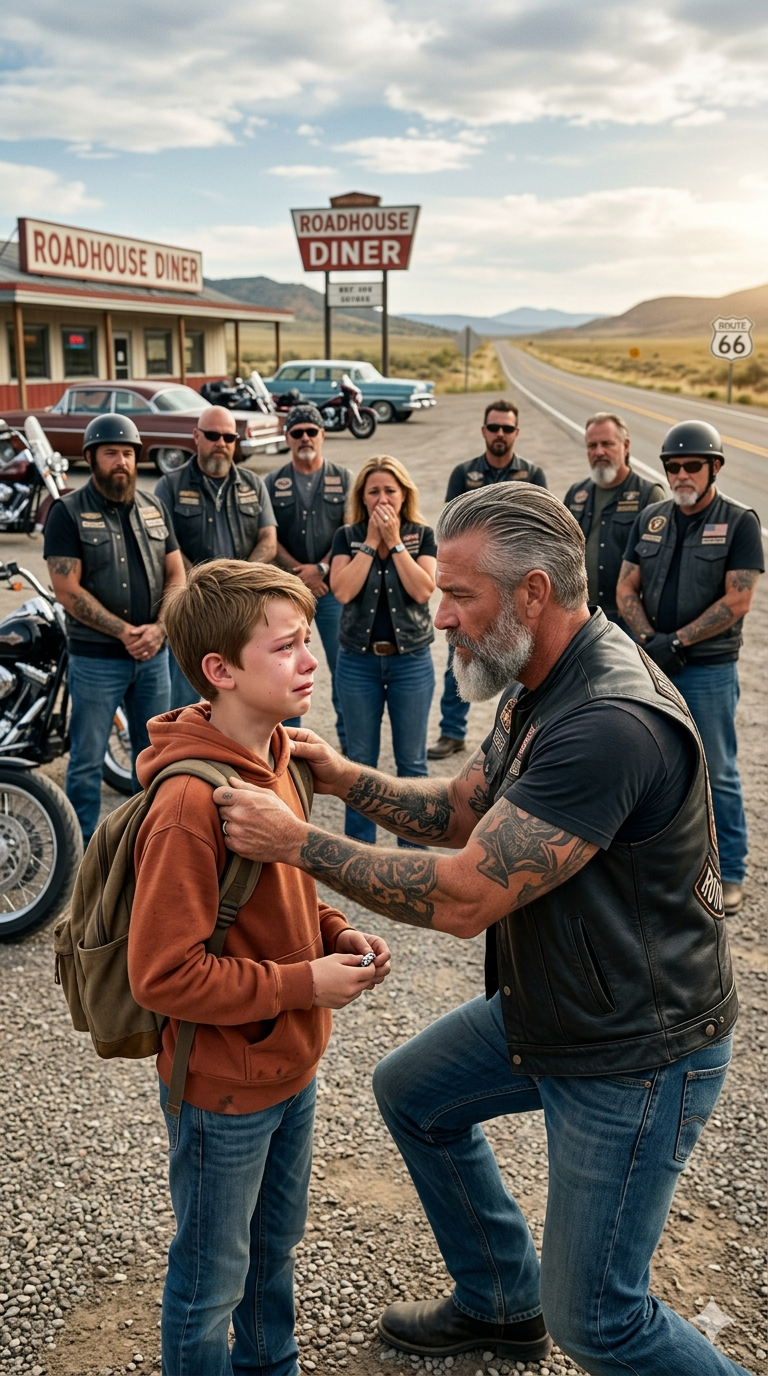
The afternoon sun hung high above the parking lot outside Miller’s Roadhouse in Flagstaff, Arizona, casting a bright silver glow across rows of motorcycles lined up like polished steel horses. The place was alive with sound. Engines rumbled low and steady, boots scraped against the pavement, and conversations drifted through the warm air in pieces—laughter, teasing, old stories, and the kind of rough affection that only existed between people who had spent years on the road together.
To anyone passing by, it looked like a scene built for confidence. The riders wore faded denim, leather vests, and patches earned over time. Their bikes gleamed under the light. Their presence filled the lot so completely that it seemed impossible for anyone timid or uncertain to step into that world without feeling small.
That was exactly how twelve-year-old Nolan Mercer felt as he stood near the edge of the crowd.
He was thin for his age, wearing worn sneakers, a dark green hoodie that looked a little too big for him, and a backpack clutched tightly against his chest. He did not belong in that picture, at least not on the surface. He looked like the kind of boy most people would overlook in a grocery store line, at a bus stop, or in the back of a classroom. But there was something in the way he stared at those motorcycles that made it clear he had not stopped there by accident.
He had come for a reason.
Nolan took one careful breath after another, trying to steady himself. He looked at the riders, then at the bikes, then back down at the faded concrete beneath his shoes. He almost turned away twice. The crowd was too loud. The scene was too intimidating. Every part of him seemed to say that this had been a mistake.
Still, after a long moment, he forced his feet forward.
A Question That Drew Laughter
The biker nearest to him was a broad-shouldered man in his late fifties with a weathered face, a silver beard, and a calm, heavy stillness that made people instinctively give him space. He stood beside a deep blue touring bike, one hand resting on the handlebar as if it were the most natural thing in the world.
Nolan stopped a few feet away and swallowed hard.
“Excuse me, sir?” he said, his voice so soft it almost disappeared beneath the noise.
The older man turned and looked down at him. His expression did not change much, but his eyes were gentle enough to let the boy continue.
“Yeah, son?”
Nolan tightened his grip on the backpack strap. “I was just wondering… if maybe I could sit on one of the bikes for a picture. Just one picture. I wouldn’t touch anything without permission. I just… I just wanted to know what it feels like.”
For a brief second, the sound around them seemed to pause.
Then several voices broke into laughter.
It started from the back and rolled forward quickly, not because the request was cruel or wrong, but because people often laughed before they understood. A few shook their heads. One man let out a low chuckle and said something about kids watching too many movies. Another muttered that the parking lot was not a playground. Someone else asked where the boy’s parents were.
None of the words were shouted, but Nolan heard them all.
His ears turned hot. His shoulders folded inward. He stepped back so fast it looked like he wished he could disappear entirely.
“Sorry,” he said. “I didn’t mean to bother anybody.”
He lowered his eyes and turned halfway around, ready to leave before the embarrassment could get any worse.
The Voice That Changed the Moment
“Hold on.”
The older biker did not say it loudly, but his tone cut through the noise with enough force to stop the laughter almost at once.
A few men looked away. Others cleared their throats and shifted where they stood. The teasing faded as quickly as it had begun.
The biker stepped closer to Nolan, not in a threatening way, but slowly, with the kind of care people use when they sense a child is one breath away from breaking down.
“What’s your name?” he asked.
Nolan hesitated, then answered. “Nolan Mercer.”
The man nodded once. “I’m Wade Buckley. Now tell me something, Nolan. Why does one picture matter this much?”
The boy looked at the bikes again, then at the ground. There was a tightness in his face that did not belong on someone that young. He seemed to be deciding whether the truth would make things better or worse.
Finally, he spoke.
“My dad used to ride,” he said quietly. “I don’t remember much, but my grandma said he loved his motorcycle more than almost anything. Not more than me,” he added quickly, as if he needed to protect someone who was not there to defend himself. “Just… it was part of who he was. I wanted one picture because I thought maybe if I sat on one, I could feel close to him for a minute.”
The parking lot grew still.
The earlier laughter now hung in the air like something everyone wished they could take back.
One man in the crowd exhaled heavily and looked down at his boots. Another rubbed the back of his neck. A woman standing near the diner window lowered her phone and stopped recording.
Wade studied the boy’s face. “What was your father’s name?”
Nolan did not answer immediately. Instead, he slowly opened the front pocket of his backpack.
The Ring in the Backpack
Everything about the movement was careful, almost ceremonial. It was the kind of care people use when they are handling the last thing they have left of someone they loved.
When Nolan pulled his hand back out, there was a silver ring resting in his palm.
It was old, slightly scratched, worn smooth around the edges from years of use. Nothing about it looked flashy. It was not the kind of jewelry that demanded attention. But it carried weight. The kind that came from time, memory, and meaning.
“This belonged to him,” Nolan said. “My grandma gave it to me last winter. She said if I ever felt like I was forgetting him, I should hold on to this and remember that some people leave love behind in things they touched every day.”
Wade reached for the ring slowly. “Can I?”
Nolan nodded.
The biker turned it over in his hand, looking first with mild curiosity, then with sudden focus. His eyes narrowed. His thumb froze against the inside of the band where a worn engraving had almost disappeared under years of use.
Another biker stepped closer.
Then another.
Their expressions changed one by one.
The easy conversation in the parking lot was gone now. Nobody was smiling. Nobody was joking. Even the diner staff had started watching through the windows.
Wade’s voice came out lower this time.
“What was your father’s name, Nolan?”
The boy drew in a breath. “Travis Mercer. But everybody used to call him Raven.”
The effect was immediate.
A man near the gas pump took off his sunglasses. Another rider whispered the nickname under his breath like he was testing whether he had heard it right. A third man shut his eyes for a moment and pressed his lips together.
Wade looked as though the ground had shifted beneath him.
“Raven?” he repeated.
Nolan nodded. “You knew him?”
The Name They Had Never Forgotten
Wade crouched down until he was eye level with the boy.
His face had changed completely. The authority was still there, but now it was carrying something much deeper—recognition, disbelief, and the ache of memory arriving all at once.
“Your father rode with us,” Wade said. “Not once or twice. Not casually. He was one of ours.”
Nolan stared at him, unblinking.
Before the boy could answer, another rider stepped forward. He was younger than Wade, with dark hair tied back and a voice thick with emotion.
“Your dad helped me outside Kingman fifteen years ago,” he said. “I was stranded in the heat, had no money, and no one stopped. He pulled over, sat with me, fixed what he could, and made sure I got home. Never asked for a thing.”
A third biker, older and quiet until then, added softly, “He bought my first real helmet when I was too proud to admit I couldn’t afford one. He told the shop owner not to tell me it was him.”
Another man gave a small laugh through wet eyes. “That sounds like Raven. He was always helping people and acting like it was nothing.”
Nolan’s lips parted, but no sound came out.
For years, his father had felt like a story told in fragments. A photograph in a drawer. A few memories from his grandmother. A name spoken in quiet rooms. He had never imagined there were people out in the world who still carried his father in full color.
Wade gently placed the ring back into Nolan’s hand.
“This ring means something,” he said. “Around here, it stands for loyalty. For being the kind of man who showed up when it mattered.”
Nolan looked down at it as if seeing it for the first time.
“My grandma said he always tried to help people,” he whispered.
Wade nodded. “Your grandma told you the truth.”
The Gift of Belonging
The parking lot remained silent as Wade rose to his feet.
Then he turned toward the riders and called out, “Cut the engines.”
One by one, the motorcycles fell quiet.
The rumbling sound that had defined the afternoon disappeared, replaced by a stillness so complete that Nolan could hear the breeze brushing against the flags near the road and the faint clink of dishes from inside the diner.
Wade removed his leather vest.
The motion was slow, deliberate, and full of meaning Nolan did not yet understand. On the back of the vest, stitched into worn black fabric, was an older patch with a faded emblem and a road name stitched beneath it.
Several riders did the same.
The patches were different in age, but connected in spirit. Every one of them told the same story: years of miles, loyalty, and brotherhood built out on open roads.
Wade stepped close enough to place his vest gently across Nolan’s shoulders.
The leather was too large and too heavy. It nearly swallowed the boy whole.
Still, Nolan did not move.
His eyes filled instantly.
“This club rode with your father,” Wade said. “That means you were never as alone as you thought.”
Nolan blinked hard. “I didn’t know.”
“You do now.”
A man standing nearby smiled through tears and said, “Kid, your dad talked about having a son before some of us ever met you. He was proud of you before he even knew the color of your eyes.”
That was the sentence that finally undid Nolan.
His chin trembled. His face crumpled. He tried to hold himself together, but the effort lasted only a second. Tears spilled down his cheeks, fast and unguarded.
He made no attempt to hide them.
No one looked away.
The Bike Reserved for Memory
Wade turned and motioned toward a black-and-chrome motorcycle parked a little apart from the others. It was older than the rest, but perfectly maintained. Not flashy. Not forgotten. Protected.
“That was Raven’s bike,” Wade said quietly.
Nolan stared at it in shock. “You still have it?”
Wade gave a small nod. “We kept it running. We could never let it sit and fade.”
For a long moment, the boy simply looked at the machine.
It was no longer just metal and rubber and chrome. It was something almost sacred now. A living piece of the father he had been trying to imagine all these years.
Wade held out a helmet.
“You asked for a picture,” he said.
Nolan took the helmet with shaking hands.
“Are you serious?”
“Completely.”
A few bikers moved in at once, but gently. One adjusted the bike to make it easier for the boy to climb on. Another steadied the handlebars. Someone made sure the footrest was in the right place. Their rough hands were careful, respectful, almost protective.
When Nolan finally sat on the bike, the entire parking lot seemed to hold its breath.
He looked small there, but not out of place.
Not anymore.
Wade rested one hand lightly on the back of the seat. “How does it feel?”
Nolan swallowed. A fresh wave of tears gathered in his eyes, but this time a smile came with them.
“Like I’m meeting him somehow,” he said.
Wade looked away for half a second, blinking against his own emotion.
Several phones came up again, but now with permission, with tenderness, with understanding.
The picture was taken.
And in that single moment, Nolan’s face transformed. The uncertainty was gone. The shame was gone. The loneliness that had followed him into that parking lot had lifted just enough to make room for something else.
Belonging.
A Promise on the Open Road
When Nolan climbed back down, Wade took the helmet from him and placed a steady hand on his shoulder.
“Listen to me,” he said. “Your father was the kind of man who left goodness behind wherever he went. That doesn’t disappear just because time moves on.”
Nolan nodded slowly, still wiping at his face.
One of the younger riders stepped forward and said, “We’re doing a memorial ride this afternoon. We were already heading north. Now we know whose name we’re carrying with us.”
Another biker added, “From this day on, if you ever need people who remember where you came from, you know where to find us.”
Nolan looked around at them, still struggling to believe any of this was real.
“You mean that?”
Wade’s answer came without hesitation.
“Every word.”
Then he turned to the others.
“Today, we ride for Raven Mercer.”
The riders nodded.
Some bowed their heads. Some placed a fist over their hearts. Some simply stood in silence, because there are moments too full for words.
Then the engines came back to life.
But the sound felt different now.
It no longer seemed loud or overwhelming. It felt warm. Powerful. Protective. Like a promise wrapped in thunder.
The line of motorcycles rolled slowly toward the road, sunlight bouncing off chrome as they moved. Nolan stood there in the oversized vest, holding his father’s ring in one hand and watching the men who had just given him back a piece of himself he did not know he had lost.
He was not watching strangers anymore.
He was watching living proof that his father had mattered.
That he had been respected.
That he had been loved.
And that love had not vanished with time.
What the Crowd Finally Understood
Long after the riders pulled onto the highway, the people who had witnessed the scene remained quiet.
No one laughed now.
The same crowd that had looked at Nolan and seen only a nervous child now understood they had been standing in front of a legacy. They had mistaken grief for weakness and longing for foolishness. They had missed the courage it took for a boy to walk alone into a place that terrified him, carrying the only thing he had left of the man he missed.
Inside the diner, waitresses dabbed at their eyes.
Outside, a man who had laughed earlier knelt down near the curb and stared at the pavement, ashamed of how quickly he had judged what he did not understand.
Nolan did not notice any of that.
His attention was fixed on the road stretching into the distance.
For the first time in a long time, he no longer felt as though his father existed only in absence.
Now his father existed in stories. In voices. In memories other people still protected. In a patched vest resting around his shoulders. In a well-kept motorcycle that had waited for years to carry meaning again.
And deep inside Nolan, something fragile had become steady.
His father had not disappeared.
He had simply been living on in places Nolan had not known how to find.
Sometimes the world laughs first because it does not yet understand the quiet courage standing in front of it, but that does not mean the quiet heart is small; it often means it is carrying something too deep for the crowd to recognize right away.
A child may walk into a place feeling alone, unwanted, and uncertain, yet one honest moment can uncover a whole history of love waiting behind the silence, proving that the people we lose can still leave doors open for us years later.
The strongest kind of legacy is not built through money, fame, or applause, but through simple acts of kindness that stay alive inside the people who were lifted, helped, protected, and remembered.
We should be careful with laughter, quick opinions, and careless words, because the person standing in front of us may be carrying grief, hope, and memory all at the same time, and our response might either wound them or help heal something they thought would always hurt.
There is something deeply powerful about being remembered with honor, because even after a life ends, the goodness a person leaves behind can continue guiding others like a light on a road that might otherwise feel dark and endless.
Children do not always ask for much; sometimes they are only looking for one small sign that the people they miss were real, valued, and loved, and when the world gives them that sign, it can restore more than anyone expects.
True brotherhood is not only about riding together in easy times, but about showing up when memory, pain, and love call people back into one another’s lives with honesty, respect, and open arms.
The most beautiful moments often begin with vulnerability, because when someone dares to speak from the heart instead of hiding behind pride, they make space for truth to rise and for others to answer with compassion.
No good life is ever truly lost when it leaves behind stories worth telling, people worth gathering, and love strong enough to reach a child who thought he had been forgotten by the world.
Sometimes healing does not arrive in a quiet room or through a perfect speech; sometimes it comes in the middle of a noisy parking lot, through unexpected kindness, shared memory, and the sudden realization that love has been waiting there all along.