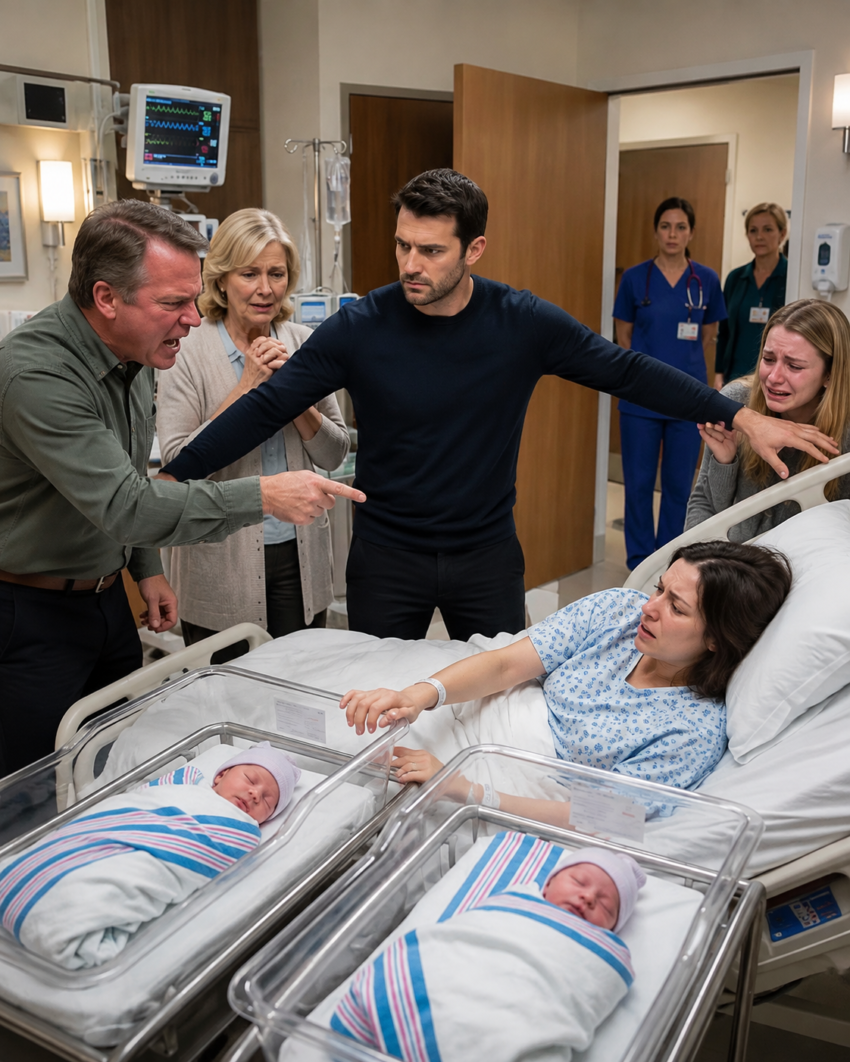
My father pointed at the bassinet beside my hospital bed and said, “Sarah, you have two. Olivia has none. Give your sister one.”
For a few seconds, I thought the anesthesia was making me hear things.
My twin boys were less than twelve hours old.
I had delivered them by emergency C-section after Baby B’s heart rate dropped. I still had an IV taped to my hand, a compression sleeve around each calf, and a white hospital pillow pressed against my abdomen whenever I coughed.
Daniel was standing near the window holding a paper cup of coffee he hadn’t touched.
My mother stood beside my father.
And my younger sister, Olivia, was staring at my sons.
Neither baby was crying.
One had his tiny fist tucked beside his cheek. The other was wrapped so tightly in his striped hospital blanket that only his face showed.
I pulled both bassinets closer to my bed.
“What did you just say?”
Dad didn’t look embarrassed.
He looked irritated that I was making him repeat himself.
“You heard me.”
“You Don’t Need Two”
My parents had arrived twenty minutes earlier.
They weren’t supposed to come until that afternoon, but Mom had texted Daniel saying they were already downstairs.
I remember being annoyed because I hadn’t showered. That seems ridiculous now, but at the time it mattered.
I was exhausted.
My hair was stuck to my neck. I was wearing a hospital gown. Every movement felt like somebody was pulling a tight wire through my abdomen.
Olivia came in carrying a pale blue gift bag.
Mom kissed my forehead.
Dad said congratulations.
For maybe five minutes, everything seemed normal.
Then Olivia walked over to the bassinets.
She had been trying to have a baby for years.
I knew more about her fertility treatments than I knew about some parts of my own life. There had been medications, appointments, two procedures that failed, and one pregnancy that ended very early.
I had sat beside her on her bathroom floor after that loss.
I had driven her to appointments when her husband couldn’t get off work.
So when she looked down at my boys with tears in her eyes, I reached for her hand.
“You can hold one when the nurse comes back,” I told her.
Olivia nodded.
Then Dad said, “Maybe she should do more than hold one.”
Daniel turned from the window.
“What does that mean?”
Dad nodded toward the bassinets.
“Sarah has two boys. Olivia may never have one. There’s an obvious solution here.”
Mom touched his arm.
For one hopeful second, I thought she was going to stop him.
Instead she said, “Maybe not right now, Robert.”
Not don’t say that.
Not that’s insane.
Just not right now.
I looked at her.
“Mom?”
She sighed.
“Your father is saying it badly.”
“Then say it better.”
She glanced at Olivia before looking back at me.
“You know what your sister has been through.”
I put my hand on the nearest bassinet.
“I know exactly what she’s been through.”
“Then you understand why this is difficult for her.”
Daniel set his coffee down.
“Marianne, these are our children.”
Dad gave him a look.
“Nobody is talking to you.”
Daniel moved closer to my bed.
“Then you should start.”
Dad ignored him.
He looked directly at me.
“Sarah, be practical. You weren’t even planning on twins.”
I stared at him.
“What?”
“You expected one baby. Now you have two. Olivia has been trying for almost six years.”
“They’re not extra babies.”
Mom lowered her voice.
“Nobody said they were.”
“Dad just did.”
Olivia still hadn’t spoken.
That bothered me almost as much as what my parents were saying.
She stood beside the second bassinet with both hands wrapped around the handles of the gift bag.
I looked at her.
“Olivia.”
Her eyes met mine.
“I didn’t know they were going to bring this up today.”
That wasn’t the same thing as saying no.
I reached across the bed rail and dragged the second bassinet toward me.
The wheels squeaked against the floor.
“These are my sons.”
Dad rubbed a hand over his jaw.
“No one is denying that.”
“You’re asking me to give one away.”
“To your sister.”
He said it as though that distinction fixed everything.
Daniel stepped between Dad and the bassinets.
“This conversation is over.”
Dad laughed once.
“You don’t decide when a conversation in my family is over.”
Daniel didn’t move.
“In this room, about my wife and my sons? I do.”
The Things I Had Always Handed Over
My father had always believed fairness meant Olivia getting whatever would make her stop hurting.
When we were children, I didn’t have words for it.
I just knew the routine.
At eleven, I gave Olivia the new bicycle our grandparents bought me because hers had been stolen.
At seventeen, I canceled a weekend trip with friends because Olivia had broken up with her boyfriend and Mom said she shouldn’t be alone.
Years later, when Daniel and I announced our engagement, Mom asked me not to talk about wedding planning around Olivia because her relationship was struggling.
None of those things seemed enormous by themselves.
That was how it worked.
Each request was small enough that refusing it made me look selfish.
“She needs you.”
“Be the bigger person.”
“You know how sensitive Olivia is.”
And the sentence Dad used more than any other:
“Family makes sacrifices.”
He said it again in my hospital room.
“Family makes sacrifices, Sarah.”
I looked down at the two striped blankets beside my bed.
One of my sons moved his mouth in his sleep.
“Not this sacrifice.”
Dad’s face changed.
Only slightly.
His mouth tightened.
“You don’t need two babies.”
Daniel said, “Back away from the bed.”
Mom immediately turned on him.
“Daniel, don’t make this ugly.”
“I’m not the one making it ugly.”
Dad took another step.
Daniel blocked him.
I pressed the call button beside my bed.
Dad noticed.
“Seriously?”
“Yes.”
“You’re calling a nurse because your father is talking to you?”
“I’m calling a nurse because I want you to leave.”
Mom stared at me.
“Sarah.”
I kept my finger on the button.
“All three of you. Please leave.”
Olivia finally moved.
“Maybe we should go.”
Dad turned toward her.
“No. This family has avoided this conversation long enough.”
I didn’t even know there had been a conversation to avoid.
That was the part that frightened me.
“How long have you been discussing my children?”
Nobody answered.
“Dad?”
He looked away.
“We discussed possibilities.”Daniel’s head snapped toward him.
“Before they were born?”
Mom said, “Nothing was decided.”
I almost laughed.
“Nothing was yours to decide.”
Dad put both hands on the edge of my bed.
Then he slammed them down.
It wasn’t on me.
He didn’t hit me.
But the mattress jolted.
Pain tore across my lower abdomen so sharply that I folded forward before I could stop myself.
I heard Daniel shout my name.
Then the monitor beside me started beeping.
The Nurse Who Stopped Asking Politely
The door opened almost immediately.
A nurse named Angela hurried in, followed by another nurse.
“Sarah, look at me. Where does it hurt?”
I pressed both hands against the pillow over my incision.
“My stomach. The incision.”
Daniel pointed toward my father.
“He slammed the bed.”
Dad threw up his hands.
“I did not touch her.”
Angela didn’t argue.
She checked the monitor, then my abdomen.
“Everyone except the patient’s husband needs to step outside.”
Mom moved toward me.
“We’re her parents.”
“You need to leave.”
Dad said, “This is a private family matter.”
Angela straightened.
Her voice stayed calm.
“It became a hospital matter when your behavior affected a postoperative patient.”
Nobody spoke.
A second nurse moved toward the door.
Dad looked at me.
“You’re really going to let them throw us out?”
I was still holding the pillow against my abdomen.
“Yes.”
It was one of the shortest answers I had ever given my father.
And probably the most important.
He stared at me for another second.
Then security arrived.
Olivia walked out first.
Mom followed her.
Dad was last.
At the door, he turned around.
“We’ll talk when you’ve calmed down.”
Angela closed the door behind him.
Daniel pulled the two bassinets against my bed again.
The babies had slept through almost everything.
The Question I Was Finally Asked
My incision hadn’t opened.
The muscles around it had been strained, and my pain medication had to be adjusted, but there was no internal bleeding and no damage to the surgical site.
That afternoon, a hospital social worker named Rachel came into my room.
She pulled a chair beside the bed.
She didn’t begin by asking what my father had done.
She asked something simpler.
“Do you feel safe with your family?”
I looked at Daniel.
Then at my sons.
“Physically?”
Rachel waited.
That silence did something to me.
I told her about the bicycle.
The canceled trip.
The engagement.
The years of being told that Olivia’s disappointment was somehow mine to repair.
Rachel didn’t diagnose my family.
She didn’t tell me what to do.
She just asked, “What happens when you say no?”
I looked toward the hospital door.
My father had answered that question for her a few hours earlier.
“They keep pushing until I give in.”
“And today?”
I reached into the nearest bassinet and touched my son’s hand.
His fingers closed around mine.
“Today I didn’t.”
That evening, Daniel and I made a decision.
My parents would not visit again.
Not at the hospital.
Not at home.
Not until we decided otherwise.
It wasn’t permanent.
At least, I didn’t think it was then.
But it was the first boundary I had ever set with my parents without immediately explaining, apologizing, or bargaining it down.
And for the first time in my life, they couldn’t simply keep arguing until I surrendered.
My Parents Wanted an Apology From Me
The messages started before we even left the hospital.
Mom texted first.
Your father is devastated.
Then:
The nurses completely misunderstood what happened.
Then:
Olivia is humiliated.
There was nothing about my incision.
Nothing about frightening me hours after surgery.
Nothing about asking me to hand over my newborn child.
Dad’s message came that night.
I lost my temper because you refused to have a reasonable discussion. That does not justify treating your parents like criminals.
Daniel read it over my shoulder.
“Don’t answer.”
I put the phone facedown.
“I’m not going to.”
Three days later, we brought the boys home.
Our living room filled with burp cloths, bottles, diapers, and two bassinets that barely fit beside the couch.
I slept in stretches so short I stopped checking the clock.
Then Olivia called.
I almost didn’t answer.
Daniel was feeding one baby in the kitchen while I held the other against my chest.
I picked up.
“Hi.”
Olivia was quiet.
“Can we talk?”
“You’re talking.”
“I didn’t ask them to do that.”
I looked down at my son.
“Okay.”
“Sarah, I mean it. I never told Mom and Dad to ask you for one of the twins.”
“Did you know they were thinking about it?”
Silence.
That was enough.
“Olivia?”
“Mom mentioned something a few weeks ago.”
I closed my eyes.
“A few weeks ago.”
“I thought she was just talking.”
“What did you say?”
Another silence.
“I didn’t really say anything.”
I shifted the baby higher against my shoulder.
“That’s the problem.”
Her voice cracked.
“What was I supposed to say?”
“No.”
She didn’t answer.
“You were supposed to say no.”
“I Wanted to Believe Them”
Olivia came to our house two weeks later.
Without our parents.
Daniel stayed in the living room while she sat across from me at the kitchen table.
She looked exhausted.
There were dark circles under her eyes, and she kept turning her wedding ring around her finger.
“I’m sorry.”
It was the first apology I had heard from anyone in my family.
I waited.
She swallowed.
“When Mom first mentioned it, I told her it was crazy.”
“But?”
“But she kept talking.”
Olivia looked toward the living room, where one of the twins was sleeping.
“She said you hadn’t planned on having twins. She said maybe there was some kind of arrangement. She kept saying nobody would be losing anything.”
I stared at her.
“I would be losing my child.”
“I know.”
“Do you?”
Olivia nodded, but her eyes filled.
“I do now.”
I hated that answer.
But I believed it.
She rubbed her palms against her jeans.
“I wanted a baby so badly that when Mom kept saying there might be some way this could happen, I let myself listen.”
I didn’t rescue her from the discomfort.
That was new for both of us.
“You stood beside my babies and said nothing.”
“I know.”
“Dad told me I didn’t need both of them.”
“I know.”
“You could have stopped it.”
Olivia looked down.
“I should have.”
That was all.
No excuse.
No argument.
No request that I understand how hard infertility had been for her.
For once, she let the responsibility sit where it belonged.
The Letter I Sent Instead of Another Argument
My parents were different.
They called.
They texted.
Mom left a voicemail saying, “Babies should grow up knowing their grandparents.”
Dad emailed Daniel accusing him of turning me against my family.
Then Mom sent the sentence I had heard my entire life.
Families forgive each other.
I read it while sitting on the couch between the two bassinets.
For years, family had been the word they used whenever they wanted something from me.
I opened my laptop.
I didn’t write an angry letter.
I didn’t list every childhood grievance.
I wrote one page.
I told them I loved them.
I told them I wanted my sons to know their grandparents.
Then I told them what would have to happen first.
They needed to acknowledge that asking me to surrender one of my newborn children was unacceptable.
Dad needed to acknowledge what happened at the hospital without blaming me, Daniel, the nurses, or stress.
And both of them needed to accept that decisions about our children belonged to Daniel and me.
Until then, there would be no visits.
No photographs sent through relatives.
No surprise appearances.
No negotiations.
I read the letter once.
Daniel read it once.
Then I mailed it.
Mom called three days later.
“So now there are conditions for loving your own parents?”
I looked at one of my sons asleep beside me.
“There are conditions for being around my children.”
She went quiet.
“Your father will never agree to being spoken to like this.”
“Then he won’t agree.”
“Sarah, you’re tearing this family apart.”
I almost started explaining myself.
I could feel the old reflex coming.
Then the baby stirred.
I reached into the bassinet and rested my hand against his chest.
“I have to go, Mom.”
And I hung up.
Olivia Came Back Alone
For several months, Olivia and I barely spoke.
Then she sent me a message.
I started therapy.
I didn’t know what she wanted me to say, so I wrote:
I hope it helps.
She didn’t ask to see the boys.
That mattered.
A month later, she asked whether she could meet Daniel and me for coffee.
We chose a small place near our house.
Olivia arrived early.
She already had a cup in front of her when we walked in.
“I need to tell you something,” she said.
Daniel pulled out a chair.
“Okay.”
Olivia looked at me.
“Mom and Dad taught me that whenever I was hurting, somebody else was supposed to fix it.”
I said nothing.
“Usually you.”
Her hands tightened around the paper cup.
“I think I believed your life was supposed to make up for whatever mine was missing.”
I had never heard her say anything like that.
“And when they started talking about the twins, I knew it was wrong.”
She paused.
“But there was a part of me that wanted to believe them.”
That was harder to hear than an excuse.
It was also more honest.
“I’m sorry I stood there,” she said. “I should have protected you from them too.”
I shook my head.
“You didn’t have to protect me.”
She looked confused.
“You just had to say no.”
She nodded.
“Then I should have said no.”
We didn’t hug across the table.
I didn’t tell her everything was forgiven.
But a week later, I sent her a picture of the twins.
Two weeks after that, she came over for dinner.
She asked before picking either baby up.
That mattered too.
Two Bassinets
My parents never gave me the apology I asked for.
Mom still sent birthday cards.
Dad sent a Christmas email that said he hoped I would eventually “put family above resentment.”
I didn’t answer.
Olivia stopped carrying messages between us.
That was one of the boundaries she learned in therapy.
My relationship with her came back slowly.
Not to what it had been.
Something different.
Something where no meant no.
Something where disappointment could exist without somebody being required to fix it.
One evening, months after the hospital, Olivia was sitting on our living room rug with both boys.
One was chewing on a stuffed giraffe.
The other kept trying to grab his brother’s sock.
Olivia laughed.
“They’re completely different.”
“I know.”
She picked up the fallen sock and handed it to me.
“It’s strange that anyone ever talked about them like they were interchangeable.”
I looked at her.
She didn’t look away.
“I know,” she said quietly.
After she left, Daniel carried one baby upstairs.
I carried the other.
The bassinets that had once stood side by side in my hospital room were already packed away in the garage because the boys had outgrown them.
I stopped beside them for a second.
I remembered pulling those little plastic beds toward me with shaking hands while my father told me I had more than I needed.
Then I closed the garage door and went upstairs, where both of my sons were waiting for me.