The Rain That Brought Riders to Maribel’s Porch
The storm came in quietly at first.
Out beyond the wide roads near Abilene, Texas, the late-summer sky turned from pale blue to a heavy shade of gray. The air smelled like dry grass, warm dust, and rain that had not yet touched the ground.
Maribel Lawson stood on the front porch of her old farmhouse with one hand resting on the wooden rail.
At seventy-four, she had learned to read the weather better than most people read the morning paper. She knew when the wind shifted. She knew when the birds disappeared. She knew when the clouds were no longer just clouds.
A storm was coming.
Her house stood alone beside a quiet country road, surrounded by open fields and an aging fence that leaned in several places. The white paint on the siding had faded years ago. The porch steps creaked under every footstep. One upstairs window had been patched with cardboard after a branch cracked the glass the previous winter.
Advertisements
Still, it was home.
Her late husband, Walter Lawson, had built most of it with his own hands. He had not been a rich man, but he had known how to make things last. He used to say a home did not need to be perfect to be full of love.
Walter had been gone for eleven years.
Since then, the rooms had grown too quiet.
Their only daughter lived in Colorado with a busy job, two teenagers, and a life that always seemed too full for long visits. Calls came on holidays, sometimes birthdays, and sometimes not at all.
So Maribel lived simply.
She grew tomatoes behind the house. She baked bread when her hands felt strong enough. She fixed what she could and learned to ignore what she could not afford to repair.
That evening, as the wind pressed against her cardigan, she heard a sound moving across the road.
Not thunder.
Engines.
Thirty Strangers on the Road
Maribel narrowed her eyes and looked toward the long stretch of highway beyond her property.
At first, she saw only dust rising.
Then the motorcycles appeared.
One after another, they came around the bend, chrome flashing under the darkening sky. There were dozens of them, riding in a steady line, leather jackets snapping in the wind.
Most people would have stepped inside and locked the door.
Maribel did not move.
She had lived long enough to know that fear often dressed itself as judgment.
The first rider slowed near her mailbox. He was a tall man, maybe in his late fifties, with a gray beard, tired eyes, and a respectful way of moving. He parked at the edge of her gravel drive, removed his helmet, and walked toward the porch without stepping too close.
“Ma’am, I’m sorry to trouble you,” he said. “That storm is coming faster than we expected. Is there any place nearby where a group could wait until it passes?”
Maribel looked past him.
More riders had stopped along the road. They stayed beside their motorcycles, quiet and patient, as if they did not want to frighten her.
The sky flashed in the distance.
Rain would be there within minutes.
Maribel turned back to the man.
“How many are with you?”
He hesitated.
“Thirty-two.”
She studied him for one second longer, then nodded toward the side yard.
“Bring the bikes around back. There’s room near the shed. Then come inside before the rain catches you.”
The man blinked as if he had heard her wrong.
“Ma’am, there are thirty-two of us.”
Maribel gave him a small, firm smile.
“Then we’ll make room for thirty-two.”
A Small House Full of Warmth
The rain arrived before the last motorcycle was parked.
It fell hard and fast, turning the dusty yard dark within seconds. Thunder rolled across the fields, and wind pushed sheets of water against the windows.
Inside, Maribel moved through her kitchen with purpose.
She opened the pantry and took inventory.
A bag of rice.
Two cans of beans.
A few jars of sauce.
Onions, peppers, and tomatoes from her garden.
Half a loaf of bread.
It was not much, but Maribel had spent a lifetime making little things stretch.
The riders entered one by one, removing wet jackets, wiping their boots, and thanking her in low voices. They were large men and women, rough around the edges, with road-worn faces and heavy boots. But they treated her home with care.
The man who had spoken first stood near the kitchen doorway.
“My name is Nolan Briggs,” he said. “People call me Brick. We appreciate this more than you know.”
Maribel pointed toward the sink.
“Appreciation is nice, Mr. Briggs, but useful hands are better. Can any of you cook?”
A younger woman with dark hair tied under a bandana stepped forward.
“I can chop vegetables.”
“Good,” Maribel said, handing her a knife. “Start with the onions.”
Within minutes, the little farmhouse changed.
One rider stirred the pot.
Another set the table.
Someone found extra chairs in the back room.
A man with a toolbox offered to tighten the loose hinge on the pantry door. Another noticed the dripping faucet and repaired it before Maribel could protest.
The house that had been silent for years suddenly carried voices, footsteps, laughter, and the smell of food.
Maribel stood at the stove, listening to the storm outside and the life inside.
For the first time in a long while, she did not feel alone.
Supper While the Storm Raged
The meal was simple, but no one complained.
Maribel served rice, beans, vegetables, bread, and hot coffee in every mug she owned. Some riders sat at the table. Others balanced plates on their knees in the living room. A few stood near the hallway because there was nowhere else to sit.
Nolan watched as Maribel filled everyone’s plate before touching her own.
“You should eat too,” he said gently.
She waved him off.
“Guests first.”
“You fed thirty-two strangers with what you had in the pantry.”
“Food tastes better when it’s shared,” she replied.
The room grew quiet for a moment.
Then one of the riders, a broad-shouldered man with kind eyes, lowered his head and said, “My mother used to say that.”
Maribel smiled.
“Then your mother was a smart woman.”
Outside, thunder shook the windows.
Inside, the riders ate slowly, gratefully, like people who understood the value of a warm meal on a hard road.
After supper, they refused to let Maribel clean.
The kitchen filled again with movement. Plates were washed. Counters were wiped. The floor was swept. Someone carried firewood from the porch. Someone else covered the drafty window with plastic sheeting to keep the rain from blowing through the crack.
Maribel tried to stop them more than once.
No one listened.
The Question at the Kitchen Table
The storm did not pass quickly.
Advertisements
By nightfall, the road outside had turned muddy, and lightning still flashed over the fields. Maribel brought out old quilts, folded blankets, and pillows she had not used in years.
The riders found places to rest.
Some slept in chairs.
Some leaned against walls.
Some stayed awake, speaking softly so they would not disturb her.
Nolan remained at the kitchen table after most of the house had settled.
Maribel poured him one last cup of coffee and sat across from him.
He looked up at the ceiling.
A brown water stain spread near the corner.
“That roof has been leaking a while,” he said.
Maribel followed his gaze.
“Long enough that I’ve stopped arguing with it.”
He looked toward the hallway, where the floor dipped slightly near the stairs.
“And the steps?”
“Old.”
“The porch?”
“Older.”
Nolan was quiet for a moment.
“Why haven’t you had the place fixed?”
Maribel wrapped both hands around her mug.
“Because fixing things costs money. And sometimes money has already been spent on medicine, taxes, groceries, and staying warm.”
Nolan’s face softened.
“Do you have family nearby?”
She shook her head.
“Not nearby. Not really.”
He looked around the small kitchen, at the worn cabinets, the patched wall, the careful way she kept everything clean even when she could not keep everything new.
Then he asked the question that had been sitting behind his eyes all evening.
“Why did you let us in?”
Maribel did not answer right away.
Rain tapped hard against the window.
Finally, she said, “Because you needed a dry place.”
“Most people see riders like us and think trouble.”
Maribel looked him straight in the eyes.
“Most people are wrong about someone at least once a day.”
Nolan gave a faint smile.
She continued, softer now.
“My husband used to tell me that a person’s worth is not measured by how polished they look. It is measured by what they do when nobody owes them anything.”
Nolan lowered his eyes to the coffee cup.
He did not speak for a long time.
But he remembered every word.
A Quiet Goodbye
Morning came bright and clean.
The storm had moved east, leaving wet grass, shining puddles, and a sky washed clear by rain.
Maribel woke to the smell of fresh coffee.
For one confused moment, she thought Walter was in the kitchen.
Then she remembered the riders.
When she stepped outside, most of them were already preparing to leave. Their jackets were dry. Their motorcycles were lined neatly beside the shed. The yard looked better than it had the day before.
Someone had fixed the loose porch rail.
Someone had stacked the fallen wood behind the barn.
Someone had repaired the gate that had not closed properly in three years.
Nolan walked up the steps and handed her a small card.
“My number is on there,” he said. “If you ever need anything, call.”
Maribel accepted it politely, though she had no intention of asking strangers for help.
“You’ve all done enough.”
Nolan looked back at the old house.
His eyes moved over the roof, the window, the worn boards, the sagging steps.
“No,” he said quietly. “We haven’t.”
Before Maribel could ask what he meant, he put on his helmet.
One by one, the motorcycles started.
The sound filled the morning, deep and steady, then faded down the road until the farmhouse was quiet again.
Maribel stood on the porch with the card in her hand.
She thought the story had ended.
She was wrong.
The Day the Road Filled With Engines
The next morning, Maribel was watering her tomatoes when the ground began to tremble.
At first, she thought another storm was coming.
Then she heard engines.
Not thirty.
Not even fifty.
Hundreds.
She walked slowly to the front yard and stopped beside the fence.
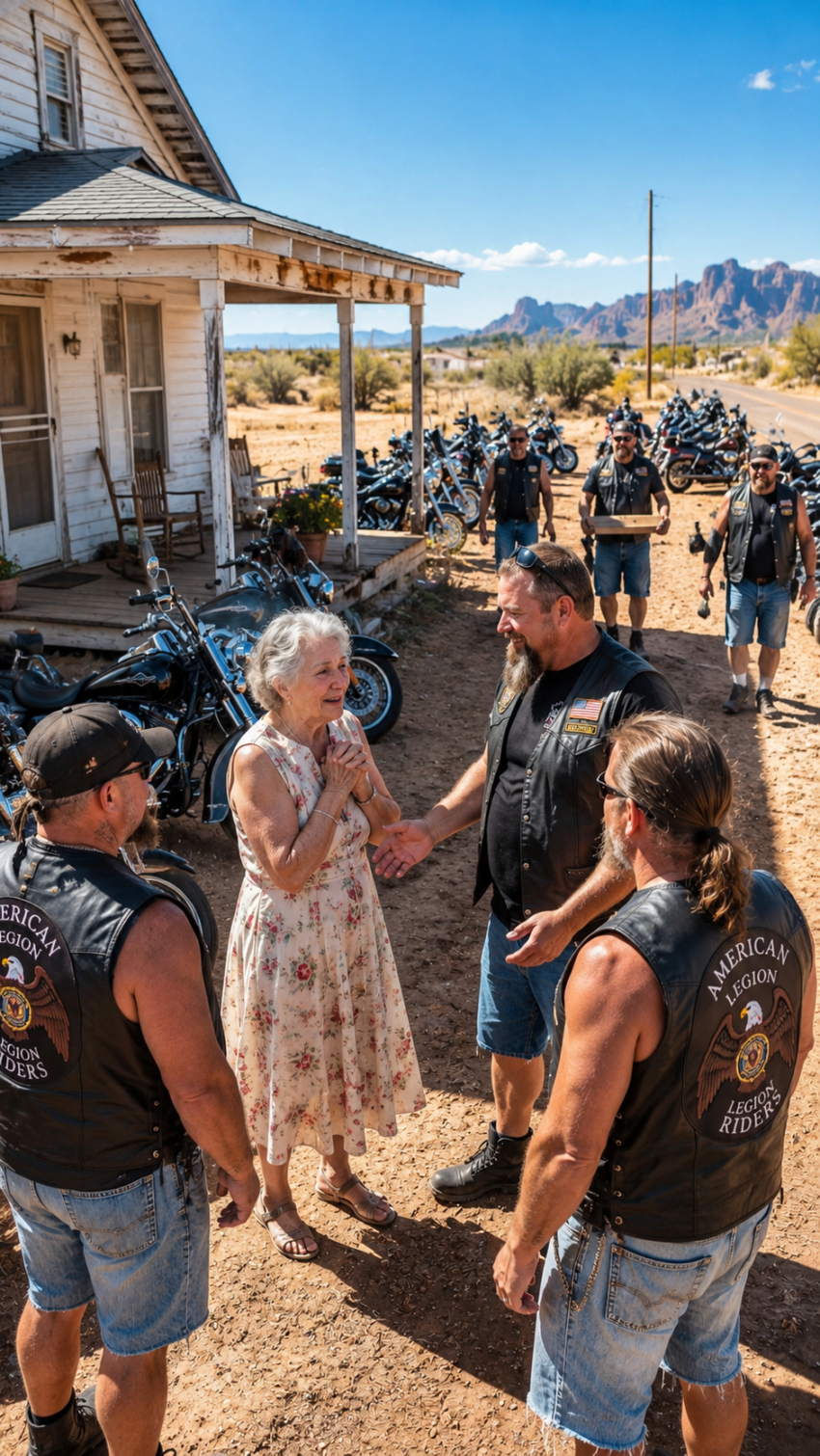
Motorcycles stretched down the road farther than she could see. They came in a long, shining line beneath the Texas sun. Riders filled the highway, turning carefully into her property and the open field beyond it.
Maribel covered her mouth with one hand.
Nolan Briggs stood at the front of the crowd.
Behind him were riders, trucks, trailers, and work vans loaded with lumber, shingles, tools, paint, windows, and boxes.
Maribel stared at him.
“Mr. Briggs… what have you done?”
Nolan smiled.
“You opened your door to thirty-two people when the world would have told you not to.”
She looked past him at the crowd.
Advertisements
“There must be hundreds of you.”
“Seven hundred and sixty-eight,” he said. “Give or take a few who are still parking.”
Maribel shook her head, unable to understand.
“Why?”
Nolan stepped closer, his voice gentle.
“Because kindness should not leave a good woman living under a leaking roof.”
Three Days of Work and Gratitude
What happened next felt impossible.
Teams formed without confusion.
Carpenters climbed onto the roof.
Electricians checked the old wiring.
Plumbers worked under the kitchen sink and beneath the house.
Painters scraped faded boards and opened cans of fresh paint.
Several women organized food tables in the yard so everyone could eat while they worked. A retired contractor inspected the foundation. A nurse checked on Maribel every few hours and made sure she rested in the shade.
Maribel tried to protest.
No one let her.
“Sit down, ma’am,” one rider said kindly. “You gave us shelter. Now let us give some back.”
For three days, the farmhouse became the center of something Maribel could hardly describe.
Neighbors came by to watch.
Some looked embarrassed because they had passed her house for years and never asked what she needed.
By the second day, several of them joined in.
A local store donated groceries.
A hardware shop sent extra supplies.
A church group brought casseroles.
Children carried bottles of water to the workers.
By the third evening, the old farmhouse no longer looked forgotten.
The roof was strong.
The porch stood level.
The windows shone.
The stairs were safe.
The kitchen had working lights, repaired cabinets, and a sink that no longer leaked.
The outside walls were painted a soft warm white, just like they had been when Walter first built the place.
When Maribel walked through the front door, she stopped in the entryway and began to cry.
Nolan removed his cap and stood quietly beside her.
“I don’t know how to thank you,” she whispered.
He shook his head.
“You already did.”
“No, I only gave you supper.”
“No,” Nolan said. “You gave us dignity before you knew our names.”
The Porch That Was Never Empty Again
After that, Maribel’s life changed.
Not in a loud way.
In a steady way.
The riders did not disappear after the repairs were done. They came back often. Sometimes two of them stopped by to check the gutters. Sometimes a whole group came for coffee on the porch. Sometimes they brought groceries, firewood, garden soil, or just stories from the road.
Maribel learned their names.
She learned who had grandchildren.
Who had lost someone.
Who loved old country music.
Who could bake pie better than they admitted.
And they learned her stories too.
They learned about Walter.
About the daughter she missed.
About the years when the house had been full of birthday candles, Christmas music, and muddy boots by the door.
One Sunday afternoon, Nolan brought a wooden sign and placed it near the front porch.
It read: Lawson House.
Beneath it, in smaller letters, were the words:
Where strangers became family.
Maribel touched the sign with trembling fingers.
“Walter would have loved this,” she said.
Nolan smiled.
“Then we did it right.”
That evening, Maribel sat on her restored porch as the sun lowered over the fields. The air was warm. The house behind her was strong again. Down the road, she could hear motorcycles approaching, not as a warning, but as a welcome sound.
She had opened her door during a storm.
And somehow, the storm had brought her a family.
Kindness does not always arrive with perfect timing, but it always leaves a mark deeper than we expect.
Never judge a person by their clothes, their vehicle, their silence, or the stories other people have told about them.
A warm meal, a dry chair, and a little trust can become the beginning of something life-changing.
Sometimes the people who look the toughest on the outside are carrying the softest hearts inside.
A lonely home can become full again when one brave act of compassion opens the door.
The smallest help given at the right moment can return as a blessing too large to measure.
Respect is one of the greatest gifts we can offer, especially to people who are used to being misunderstood.
True family is not always the one connected by blood; sometimes it is the one that shows up with tools, time, and love.
A house can be repaired with wood and nails, but a heart is restored by being remembered.
And sometimes, the miracle you have been waiting for begins with nothing more than saying, “Come inside before the rain starts.”