Part 2
After that, I never looked at Bear’s outfits the same way again.
Before I knew the truth, the crown had seemed funny. The pink boots seemed sweet. The glitter wings seemed like something a confident father did because his little girl asked and because love, when it is healthy, does not always worry about looking ridiculous. But once Bear told me about the diagnosis, every costume became a clock.
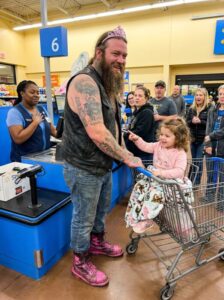
I learned Lily had a rare degenerative neurological condition, the kind doctors explain carefully while parents hear only the parts that break the room apart. Her walking would weaken first. Then balance. Then swallowing, speech, muscle control, maybe breathing later, depending on how fast the disease moved. There were treatments to slow things. Therapies to help. Specialists in Dallas. Hope, but not the kind that promised what parents beg for.
Bear and Lily’s mother, Marissa, had separated before the diagnosis, but not in the ugly way people sometimes assume. Marissa was a white American woman in her early thirties, a soft-spoken preschool aide who loved Lily fiercely and cried in parking lots where her daughter could not see. She and Bear had failed as a couple, but they refused to fail as parents. They split appointments. They split bills. They split fear as evenly as two exhausted people could.
On weekends, Bear had Lily.
And every weekend, he brought her to Walmart.
Not because Walmart was magical.
Because Walmart was ordinary.
That mattered.
Sickness had already taken too much of Lily’s normal life. Doctor offices smelled sharp and cold. Therapy rooms had mats and charts and gentle adults asking her to try again when her little legs shook. Hospitals had bracelets, scales, waiting rooms, and doors her father opened too slowly because he was trying not to look afraid.
But Walmart had bananas.
Stickers.
Cereal.
Socks with animals on them.
A fish tank near the pet aisle she called “the ocean.”
And a cashier at register six who learned to greet her like visiting royalty.
Bear turned those trips into a ceremony. On Friday nights, Lily chose his outfit from a plastic storage bin in his garage. The bin was labeled, in black marker, ROYAL GEAR. Inside were tiaras, fairy wings, sunglasses, feather boas, plastic necklaces, hats with ears, clip-on bows, and later, the pink boots he had painted after Lily said black boots were “too grumpy.”
He could have said no.
Many fathers would have.
Not cruelly, maybe, but from embarrassment, habit, pride, or the strange fear grown men sometimes have of looking silly in front of strangers. Bear had plenty of reasons to protect his image. He was a biker. A mechanic. A man whose hands were scarred from wrenches, road rash, and years of being judged before people knew him.
But he had sat in a doctor’s office and heard the future narrow around his daughter.
After that, embarrassment was too small to obey.
At home, he practiced voices for the grocery trip. A royal announcer voice. A dragon guard voice. A cowboy princess voice that made no sense but made Lily laugh until she hiccupped. He learned which aisles made her happiest and which days the store was too crowded. He learned to push the cart smoothly so her body did not jolt. He learned to hold his smile until she looked away.
Then he would breathe.
Just once.
Like the smile had cost him something.
The store changed too. Employees started saving stickers. The greeter wore a plastic crown once, and Lily declared him “Assistant King.” A stocker in the cereal aisle bowed when she passed. The bakery woman made a tiny cupcake with pink frosting and wrote LILY on the box, though Bear insisted on paying for it every time.
He never accepted pity.
He accepted kindness.
There is a difference.
Part 3
The false climax came on visit number thirty-nine.
I remember because Bear corrected me later when I said it was forty. He had numbers written on the back of every photo in Lily’s album. Visit 1: Crown and boots. Visit 7: Purple wings. Visit 12: Dad wore butterfly clips. Visit 24: Lily laughed at banana mustache. Visit 39: Bad day but came anyway.
That morning, Lily arrived quieter than usual.
Bear wore a pink cowboy hat, a feather boa around his neck, and the painted boots, but he was carrying Lily against his chest instead of letting her ride in the cart seat. Her head rested on his shoulder. Her eyes were open, but she looked tired in a way three-year-olds should never look tired. Marissa walked beside them that day, which told me something was different before anyone spoke.
Bear placed Lily carefully in the cart with a pillow behind her back.
She did not laugh at his hat.
He tried the royal banana line.
Nothing.
He tried putting a pair of sunglasses upside down on his beard.
A tiny smile came, then disappeared.
People in the store seemed to feel it. The usual smiles became softer. The jokes stayed away. Even the carts sounded quieter that morning, though I know that is not possible. Grief changes memory until ordinary sounds kneel down around it.
At checkout, Bear put the items on the belt slowly. Applesauce pouches. Strawberry yogurt. Children’s toothpaste. A pink blanket. Medicine. A small pack of star stickers Lily had chosen by blinking twice when Marissa held them up.
I scanned everything.
Then Lily lifted one hand.
Barely.
Bear saw it immediately and leaned close.
“What is it, Bug?”
Her fingers moved toward his hat.
He lowered his head until the pink cowboy brim touched the edge of the cart.
Lily tapped it once.
“Too small,” she whispered.
Bear’s eyes closed for half a second.
Then he took the hat off, placed it on the conveyor belt, and looked at me with the seriousness of a man making an emergency request.
“Denise, you got any bigger hats back there?”
I looked under my register as if Walmart cashiers kept royal emergency supplies beneath the bags. The woman behind them in line, a retired school librarian named Mrs. Hannigan, pulled a wide-brimmed straw sunhat from her own cart and said, “Try this.”
Bear put it on.
It was ridiculous.
The feather boa caught under his beard. The straw hat sat too high on his head. A pink ribbon dangled against his ear. Lily looked at him for three long seconds.
Then she laughed.
Not loudly.
Not like before.
But it was there.
Bear’s face broke open with relief so raw I had to look down at the scanner to keep from crying. Marissa turned away and pressed her fist against her mouth. Mrs. Hannigan pretended to read the candy prices.
That day, Bear bought the hat.
Full price.
Mrs. Hannigan tried to refuse, but he said, “Ma’am, you saved the royal visit.”
After that, customers started bringing things. Not gifts for Lily exactly, because Bear did not want the trips to become a spectacle, but silly hats, safe stickers, little costume pieces they would quietly hand to me before he arrived. I kept them in a box under register six labeled RETURNS, because if management had known half of what was in there, someone would have made it complicated.
Lily got weaker.
The box got fuller.
Bear kept showing up.
Part 4
By visit number sixty-one, Lily could no longer sit in the cart without special support.
Bear adapted.
That was what he did.
He brought a small padded insert from her therapy chair and strapped it carefully into the shopping cart, checking every buckle twice. He wrapped her in soft blankets if the store was cold. He carried a suction machine once in a backpack decorated with unicorn stickers because Lily had decided medical equipment looked less scary if it was “fancy.”
His outfits got more elaborate because her laughter got harder to reach.
That sounds backwards until you understand love under pressure.
When easy joy disappears, parents become scientists of small happiness. They test sounds, faces, songs, lights, textures, routines, anything that might bring one more smile into a day that has become measured in symptoms. Bear learned that Lily liked exaggerated surprise, but not loud noises. She liked him pretending the bananas were telephones. She liked when he asked the cereal boxes for legal advice. She liked when he bowed to automatic doors because she said Walmart doors were “magic gates.”
So he bowed.
Every time.
One Saturday, he wore fairy wings, a plastic crown, pink boots, and a cape made from an old bedsheet Lily had decorated with marker dots. He walked through the sliding doors, bowed deeply, and announced, “Princess Lily enters the kingdom.”
The greeter, now fully committed to the tradition, bowed too.
“Welcome, Your Majesty.”
Lily’s mouth moved into a smile, but no sound came out.
Bear saw it.
He smiled back like it was enough.
Because he had promised.
When she could not laugh out loud, he would make her laugh with her eyes.
The cashier team learned to read those eyes too. Bright meant happy. Slow blink meant yes. Two blinks meant more. Side glance toward Bear usually meant she wanted him to do something foolish again. On hard days, when even her eyes seemed tired, Bear still dressed up because the promise was not dependent on success. It was not, “I will make you laugh if your body lets me.” It was, “I will keep trying so you know joy did not abandon you.”
Parents in line began bringing their children to register six just to see Bear and Lily, but I warned them gently not to crowd. This was not a show. It was a father and daughter buying groceries inside the last stretch of normal they could still reach.
At visit seventy-eight, Bear wore the original crown and pink boots.
No wings.
No boa.
No cowboy hat.
Just the first outfit.
Lily was four and a half by then, though illness had made her look younger in some ways and older in others. Marissa walked beside them with a hospital bag over one shoulder. Bear pushed the cart slower than ever. Lily’s head rested against a soft pillow, and her eyes tracked the ceiling lights as if even looking sideways took effort.
When they reached my register, Bear placed only three things on the belt.
Applesauce.
Pink nail polish.
A tiny princess crown from the party aisle.
“For replacement?” I asked, trying to sound normal.
Bear looked at Lily.
She blinked twice.
He smiled.
“For backup royalty.”
I scanned the crown, and Lily’s eyes moved toward his boots.
Bear looked down.
“Still pink, Bug.”
Her eyes brightened.
That was the last time she came to Walmart.
Part 5
Month nineteen changed everything.
Lily’s doctors recommended keeping her home more often, then always. Her body tired too quickly. Crowds became risky. The bright lights that once looked magical became too much. Her breathing equipment grew more complicated. The family living room turned into the kind of room parents create when love has to make peace with medical supplies: blankets, stuffed animals, medicine charts, oxygen tubing, hand sanitizer, storybooks, and one space near the couch where Bear could sit on the floor in full costume.
Because he did not stop.
Every weekend, he called me from the parking lot or sent a picture through Marissa’s phone. Not for attention. For the album. He still dressed in whatever Lily chose, though choosing became slower. Sometimes Marissa held up two options, and Lily blinked. Crown or hat. Wings or cape. Pink boots or bunny slippers. Bear obeyed the vote like it came from a queen.
Then he stood beside her bed.
He wore the crown.
The boots.
The wings.
The ridiculous hats.
The sticker beard.
The cape with marker dots.
He walked into her room like it was Walmart’s sliding doors, bowed deeply, and said, “Princess Lily enters the kingdom.”
Sometimes her eyes laughed.
Sometimes only one corner of her mouth moved.
Sometimes nothing moved at all, and Bear still performed the whole grocery trip in place. He pretended the IV pole was a shopping cart. He scanned applesauce pouches with a hairbrush. He asked a stuffed bear whether the royal bananas were ripe. He made receipt noises. He complained that the imaginary checkout line was too long.
Marissa filmed some of it.
Not all.
Some moments belong only to the people surviving them.
Lily died in early spring, just after sunrise, with Marissa holding one hand and Bear holding the other. The original plastic crown was on the pillow beside her. Not on her head. Bear had asked the night before, and Lily’s eyes had moved toward it. He placed it where she could feel it near her cheek.
At the funeral, Bear wore a black suit that looked uncomfortable on him and the pink boots Lily had painted over with stickers during one of her better months. Some people noticed. Some did not. Those who knew understood immediately.
They buried Lily with a crown.
Not the original one.
Bear kept that.
He placed the backup crown with her, the one from visit seventy-eight, wrapped in a small blanket with stars on it. During the service, he did not speak long. Men like Bear often discover that grief makes words either impossible or too large to trust.
He only said, “She made me brave enough to be silly.”
Then he sat down.
Afterward, in the Walmart break room, employees cried over a photo album Bear had brought for us to see. Seventy-eight visits. Seventy-eight outfits. Seventy-eight attempts to turn a fluorescent grocery store into a kingdom because a little girl deserved more laughter than time had given her.
On the last page, he had written one sentence.
I kept my promise as long as her eyes could hear me.
Part 6
The first time Bear came back to Walmart alone, nobody knew what to do.
It had been nearly four months since Lily died. I was at register six, scanning dog food for a man in a work shirt, when the automatic doors opened and Bear walked in wearing his leather vest, dark jeans, and the pink boots.
No crown.
No wings.
No cart seat blanket.
Just the boots.
They looked more worn than before, scuffed along the toes and faded where the paint had cracked around the seams. Against his size and leather, they should have looked ridiculous. Instead, they looked like a wound he had chosen to keep visible.
He took a cart.
For a second, I thought he might leave.
Then he walked the same route he used to take with Lily. Produce first. Royal bananas. Cereal aisle. Stickers. Bakery. Pet fish. Party supplies. He moved slowly, one hand on the cart handle, the other tucked near the inside pocket of his vest. Later, he showed me what he carried there: a small photo of Lily laughing at him in the original crown and boots.
At checkout, he placed three items on the belt.
Bananas.
Pink nail polish.
A pack of princess stickers.
I scanned them without trusting my voice.
Bear looked at the empty child seat in the cart.
Then he said, “She would’ve picked the glitter ones.”
I reached under the register and pulled out the old RETURNS box. Inside were the leftover hats, stickers, ribbons, and tiny costume pieces people had brought over those months. I had kept them because throwing them away felt like betraying something.
Bear stared at the box.
“I didn’t know you still had that.”
“I didn’t know where else to put it.”
He touched the edge of a folded pink cape.
For the first time in all the months I had known him, Bear cried where people could see.
Not loudly.
Not dramatically.
Just one hand over his eyes, shoulders shaking once, then again, while customers in line looked away with the kindest manners they had. The man buying dog food waited. A teenager removed his cap. Another cashier shut off her light and came to stand beside me.
Bear finally lowered his hand.
“Can I buy it?”
I shook my head.
“No.”
His face tightened.
Then I pushed the box toward him.
“It’s already hers.”
He took it home and turned the costume pieces into something none of us expected. With Marissa’s permission, he started a small fund in Lily’s name for families with seriously ill children, not for hospital bills, because bigger charities already fought that battle, but for joy. Costumes. Wagons. Soft blankets. Movie nights. Birthday decorations. Aquarium tickets. Gas cards for one ordinary afternoon when a family needed to remember they were still allowed to laugh.
He called it the Pink Boots Fund.
No logo with his face.
No dramatic speeches.
Just help.
Every year on Lily’s birthday, Bear rode to Walmart in the pink boots and bought bananas, stickers, and one ridiculous accessory from the party aisle. Then he donated a cart full of comfort items to the children’s hospital in Amarillo.
People asked him why he still wore the boots.
His answer never changed.
“So she knows I’m still shopping with her.”
Part 7
Years have passed, and I still work at that Walmart, though register six has a newer scanner now and the old tile near the checkout lanes has been replaced.
Bear is older. His beard has more gray. His shoulders are still broad, but grief and time have lowered them a little. The Road King still comes through the parking lot some Saturdays, its engine deep and familiar, and if the weather is clear, he still wears the pink boots.
Not every week.
Only sometimes.
But always on Lily’s birthday.
Customers who do not know the story stare the way people stared on that first Saturday. They see a giant biker in a leather vest and pink boots and think they are seeing something funny. Maybe they are, in a way. Lily would have liked that. She believed pink boots were supposed to make people laugh.
But those of us who remember understand the rest.
We remember the little girl in the cart, laughing beneath Walmart lights like the whole building had become hers. We remember Bear asking cereal boxes for legal advice. We remember Marissa smiling through tears near the checkout lane. We remember the day Lily’s laugh became only her eyes, and the day Bear kept performing anyway because promises do not retire when they become hard.
A few months ago, a young father came through my line with a little boy in a wheelchair. The boy wore a superhero cape, and the father looked embarrassed because people were staring. Bear happened to be in the next lane, buying bananas and princess stickers in the pink boots.
He saw the father tugging at the cape like maybe he should take it off.
Bear stepped closer and said, “Cape looks strong.”
The little boy smiled.
The father’s face changed.
Bear tapped one pink boot against the floor.
“Trust me,” he said. “The outfit matters.”
Then he walked out toward the parking lot, leather vest moving in the Texas light, pink boots scuffed and bright beneath him.
Somewhere beyond the automatic doors, his Harley waited.
And maybe, if love reaches as far as parents need it to, a little girl knew her daddy was still taking her shopping.
Follow the page for more stories about the people we almost judge too quickly.