The Afternoon Everyone Remembered
By three o’clock on a warm Wednesday afternoon, the parking lot outside Desert Willow Café in Kingman, Arizona, looked more like the starting point of a cross-country rally than a quiet roadside restaurant.
Motorcycles filled nearly every available space.
There were touring bikes, old cruisers polished until their chrome reflected the desert sky, and newer machines covered with travel bags and road dust. Almost one hundred and eighty riders had stopped there during an annual charity ride through northern Arizona.
Inside, customers kept glancing toward the windows.
I understood why.
A large group of bikers can look intimidating when you do not know them.
My name is Russell Merrick. I was fifty-two years old and had spent eighteen years organizing routes for the Canyon Ridge Riders, a motorcycle association that raised money for veterans, struggling families, and children’s programs throughout the Southwest.
My closest friend, Daryl Boone, sat across from me.
He studied the menu for several minutes before ordering exactly what he always ordered.
I laughed.
“You know there are other things on that menu, right?”
Daryl folded it and handed it to the waitress.
“Why ruin eighteen years of good decisions?”
I was about to answer when the bell above the café door rang.
A man entered with a little girl.
Something about them immediately caught my attention.
The man looked around thirty-eight or forty. His shirt was wrinkled, his face was tense, and he kept checking the parking lot as though he expected someone to appear.
The girl was perhaps six.
Her light brown hair had been unevenly cut around her shoulders. She wore an oversized green T-shirt, faded shorts, and two sneakers that did not match.
But none of those details bothered me as much as her eyes.
She wasn’t curious about the motorcycles.
She wasn’t asking questions.
She wasn’t even looking at the dessert case that almost every child noticed when entering the café.
She simply followed.
Quietly.
Too quietly.
Daryl saw me watching.
“You noticed it too?”
I nodded.
“Something feels off.”
We did nothing.
Not yet.
Years on the road had taught both of us an important lesson: concern should make you observant, not reckless.
So we watched.
The Girl Who Never Looked Up
The man chose a booth close to the front window.
He ordered fries for the girl, coffee for himself, and two glasses of water.
While they waited, he repeatedly checked his phone.
The girl stared at the tabletop.
When the fries arrived, she ate only one.
Then she placed her hands in her lap.
At one point, the waitress smiled at her.
The child immediately lowered her eyes.
Daryl leaned closer.
“Russ, that kid looks scared.”
“I know.”
The man finished his coffee quickly.
Several minutes later, he walked to the register.
The little girl watched him go.
Then something changed.
She looked around the café for the first time.
Her eyes moved across dozens of strangers until they stopped on me.
I still don’t know why she chose my table.
Maybe it was because I was older than most of the riders.
Maybe I reminded her of someone.
Or maybe children sometimes recognize safety in ways adults cannot explain.
She slipped out of the booth.
Then she started walking.
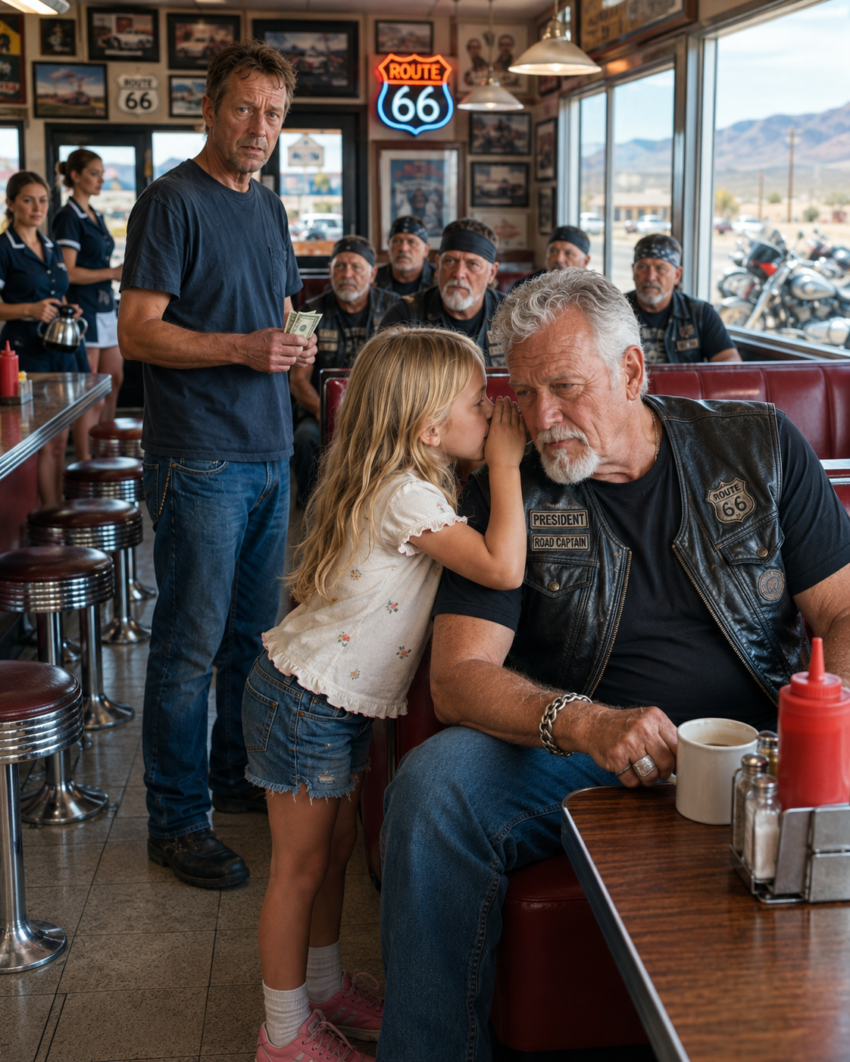
She passed several tables filled with large men wearing leather vests.
Nobody stopped her.
When she reached me, she gently pulled the edge of my sleeve.
I turned.
“Hey there,” I said. “Do you need something?”
She glanced over her shoulder.
The man was still at the register.
Then she leaned close enough that I could barely hear her.
“That man isn’t my dad.”
For half a second, I forgot how to breathe.
I kept my voice calm.
“Okay. What’s your name?”
“Lucy.”
“Lucy, do you know that man?”
Her eyes filled with fear.
“He came to our house.”
I didn’t interrupt.
She swallowed.
“My dad tried to stop him in the garage. Then my dad fell down and wouldn’t answer me.”
Daryl stopped moving.
Several riders at nearby tables had heard enough to understand that something serious was happening.
Still, no one stood.
No one raised a voice.
I asked the question as gently as I could.
“Did the man tell you where he was taking you?”
Lucy shook her head.
Then she whispered:
“He said I wasn’t allowed to tell anybody.”
I slowly stood and moved between Lucy and the front counter.
That was when the man turned around.
He saw the empty booth first.
Then he saw Lucy beside me.
His expression changed instantly.
Every Phone Made the Same Sound
Before the man could say anything, phones began sounding throughout the café.
One after another.
Mine vibrated against the table.
Daryl looked at his screen.
The easygoing expression he had worn all afternoon disappeared.
“Russ.”
He turned the phone toward me.
An emergency child alert had just been issued across the region.
The photograph showed a smiling six-year-old girl.
Lucy Mercer.
Last seen at her family’s home earlier that afternoon.
Authorities were searching for a dark blue SUV and an adult male believed to be traveling with her.
I looked through the café window.
A dark blue SUV was parked near the entrance.
The man’s keys were still in his hand.
For several seconds, nobody spoke.
Then he stepped toward us.
“Lucy, come here.”
She moved behind me.
I held up one hand.
“She’s staying right here until the authorities arrive.”
His face tightened.
“You don’t understand what’s happening.”
“Then you can explain it when they get here.”
He looked toward the entrance.
Then toward the side hallway.
Then at the nearly two hundred riders surrounding him.
Daryl stood beside me.
He didn’t threaten the man.
He didn’t need to.
“Don’t make this harder than it already is,” Daryl said quietly.
The man suddenly tried to push past another table toward the exit.
Several riders blocked the path without striking him or escalating the situation.
Within moments, he realized there was nowhere to go.
One of our members had already called emergency services.
The café remained strangely quiet until sirens finally became audible in the distance.
Lucy grabbed the back of my vest.
I turned and knelt so we were eye level.
“They’re coming to help you.”
Her voice trembled.
“Is my dad coming too?”
That question stayed with me.
I couldn’t promise something I didn’t know.
So I gave her the only promise I could keep.
“You’re not going to face this alone.”
A Small Hand That Wouldn’t Let Go
At the local sheriff’s office, Lucy sat beside me beneath harsh fluorescent lights.
She had been given a small blanket, apple juice, and crackers.
She barely touched any of them.
Whenever someone unfamiliar approached, her fingers tightened around my sleeve.
A deputy crouched several feet away.
“Lucy, we’re going to make sure you’re safe.”
She leaned against me.
“Can Russell stay?”
The deputy looked at me.
I nodded.
“As long as I’m allowed.”
Later, a family-services worker named Monica Pierce arrived and explained that they had located Lucy’s nearest relative.
Her grandmother lived about ninety minutes away.
There would be paperwork, interviews, and several official steps before Lucy could leave.
None of that mattered to her.
She had only one question.
“Will you leave before Grandma gets here?”
Something inside me tightened.
I hadn’t talked about my daughter in years.
Her name was Sophie.
She had been sixteen when I lost her after a roadway accident.
The hardest part was knowing I had missed her school concert earlier that week because I was helping organize a motorcycle fundraiser several states away.
She had called me afterward.
I told her I was sorry.
She laughed.
“It’s okay, Dad. You’ll come to the next one.”
There was never a next one.
After that, promises became sacred to me.
So when Lucy looked up and asked whether I would stay, I already knew my answer.
“I’m staying.”
She studied my face.
“Promise?”
I hesitated only because that word still hurt.
Then I held out my hand.
“Promise.”
For the first time since she had walked into the café, Lucy smiled.
The House With Wind Chimes
Lucy’s grandmother, Marjorie Mercer, lived outside Lake Havasu City in a small stucco house with blue shutters.
Several members of our association went there the following morning.
Marjorie opened the door before we could knock.
She was sixty-seven, with silver hair tied loosely behind her head and the exhausted expression of someone who had spent an entire night waiting for news.
“Is Lucy all right?”
That was the first thing she asked.
Not what happened.
Not who was responsible.
Not what the police had learned.
Only Lucy.
“She’s safe,” I told her.
Marjorie covered her mouth and began crying.
Inside her home were photographs everywhere.
Lucy on her first day of kindergarten.
Lucy holding a birthday cake.
Lucy sitting on her father’s shoulders at a county fair.
Her father appeared in almost every photograph.
Marjorie told us she had always been close to both of them.
Then she admitted what frightened her most.
“What if they decide I’m too old to care for her?”
I looked around the house.
The refrigerator was covered with Lucy’s drawings.
A bedroom down the hall still contained books and toys from her previous visits.
There was nothing temporary about the love inside that home.
“Then we’ll help you show them exactly what kind of home you can give her,” I said.
One of our riders, Calvin Reed, worked in family law.
He offered to guide Marjorie through the necessary paperwork.
Others volunteered to repair the loose backyard fence and install better exterior lighting.
Someone started a collection for household expenses.
By lunchtime, enough money had been gathered to cover far more than Marjorie expected.
She stared at the envelope.
“I can’t accept this.”
Daryl smiled.
“Good thing nobody asked.”
She laughed through her tears.
The Reunion Nobody Wanted to Interrupt
Lucy arrived later that afternoon with a caseworker.
Marjorie was standing on the porch.
The moment Lucy stepped out of the vehicle, she froze.
Her grandmother whispered her name.
“Lucy.”
The little girl dropped the small backpack she was carrying.
Then she ran.
Marjorie met her halfway across the yard.
They held each other so tightly that even the toughest men standing around me suddenly became very interested in looking at the sky, their boots, or anything else that might hide their emotions.
I stepped backward.
That moment belonged to them.
But Lucy hadn’t forgotten me.
Before going inside, she turned.
“Russell!”
I looked up.
She ran back and hugged me around the waist.
“You really stayed.”
“I told you I would.”
She reached into her pocket and removed a tiny plastic star from a bracelet the caseworker had given her.
“This is for you.”
I accepted it.
“What’s it for?”
“So you remember me.”
I looked down at that tiny star.
“Lucy, I don’t think forgetting you is going to be possible.”
She smiled.
I handed it back.
“You keep it.”
Her eyebrows lifted.
“Why?”
“Because someday, when you’re having a difficult day, I want you to look at it and remember something.”
“What?”
“There are more good people in this world than you think.”
She closed her hand around the star.
Three Months Later
Autumn arrived quietly in northern Arizona.
Three months after that afternoon, the Canyon Ridge Riders returned to Desert Willow Café.
This time, we weren’t gathering for a charity route.
We were celebrating.
Marjorie had received approval to become Lucy’s permanent guardian.
When their car pulled into the parking lot, riders began applauding.
Lucy climbed out wearing jeans, pink sneakers that actually matched, and a little denim vest someone from our group had made for her.
On the back were the words:
HONORARY ROAD CAPTAIN.
She marched through the café entrance as though she owned the building.
Then she spotted me.
“Uncle Russell!”
She ran across the room.
I barely had time to stand before she hugged me.
“I have news.”
“Good news or expensive news?”
She laughed.
“Good news.”
She pulled a folded paper from her backpack.
It was a school certificate.
“Best reader in my class.”
I looked at Marjorie.
She was glowing.
“That’s incredible.”
Lucy sat beside me.
“Grandma says reading makes you smarter.”
Daryl leaned across the table.
“Then Russell better start immediately.”
Lucy laughed so hard she nearly dropped her certificate.
For the next hour, she colored pictures while the adults talked.
Eventually, she drew a desert highway surrounded by mountains.
Across the bottom were dozens of motorcycles.
Near the front was a tiny girl standing beside a tall man wearing a leather vest.
I stared at the picture longer than I expected.
For years, I believed the greatest responsibility of a road captain was bringing people safely home.
Lucy taught me something different.
Sometimes the most important journey isn’t about bringing yourself home.
Sometimes it’s about noticing someone who has lost their way and helping them find theirs.
And sometimes, without realizing it, they help you find your way too.
Sometimes the person who needs our help most will not shout or make a scene, which is why genuine compassion begins when we slow down enough to notice the quiet signals that everyone else overlooks.
Courage does not always mean confronting danger with force, because some of the bravest moments begin with remaining calm, listening carefully, and choosing to protect another person without making a frightening situation worse.
A promise may sound like only a few words when it is spoken, but to someone who has lost their sense of safety, keeping that promise can become proof that trustworthy people still exist.
Families are built in many different ways, and sometimes the strongest bonds are created by ordinary people who simply decide that another person’s future matters enough for them to stay.
Children remember far more than adults realize, especially the faces, voices, and small acts of kindness that helped them feel protected during moments when their world seemed uncertain.
We should never underestimate what a simple act of attention can accomplish, because noticing one frightened expression, one unusual detail, or one quiet request for help can completely change the direction of someone’s life.
Helping another person does not always require money, influence, or special authority; sometimes what matters most is being present, believing them, and refusing to walk away when staying would make a difference.
Pain can convince us that an important part of our life is permanently gone, yet sometimes healing arrives unexpectedly through another person who reminds us that our hearts are still capable of caring deeply.
The strongest communities are not created by people who look alike or live identical lives, but by people who understand that protecting the vulnerable and supporting one another is everyone’s responsibility.
When life gives you an opportunity to become the safe person someone desperately needs, remember that what feels like one ordinary decision to you may become the moment they remember for the rest of their life.