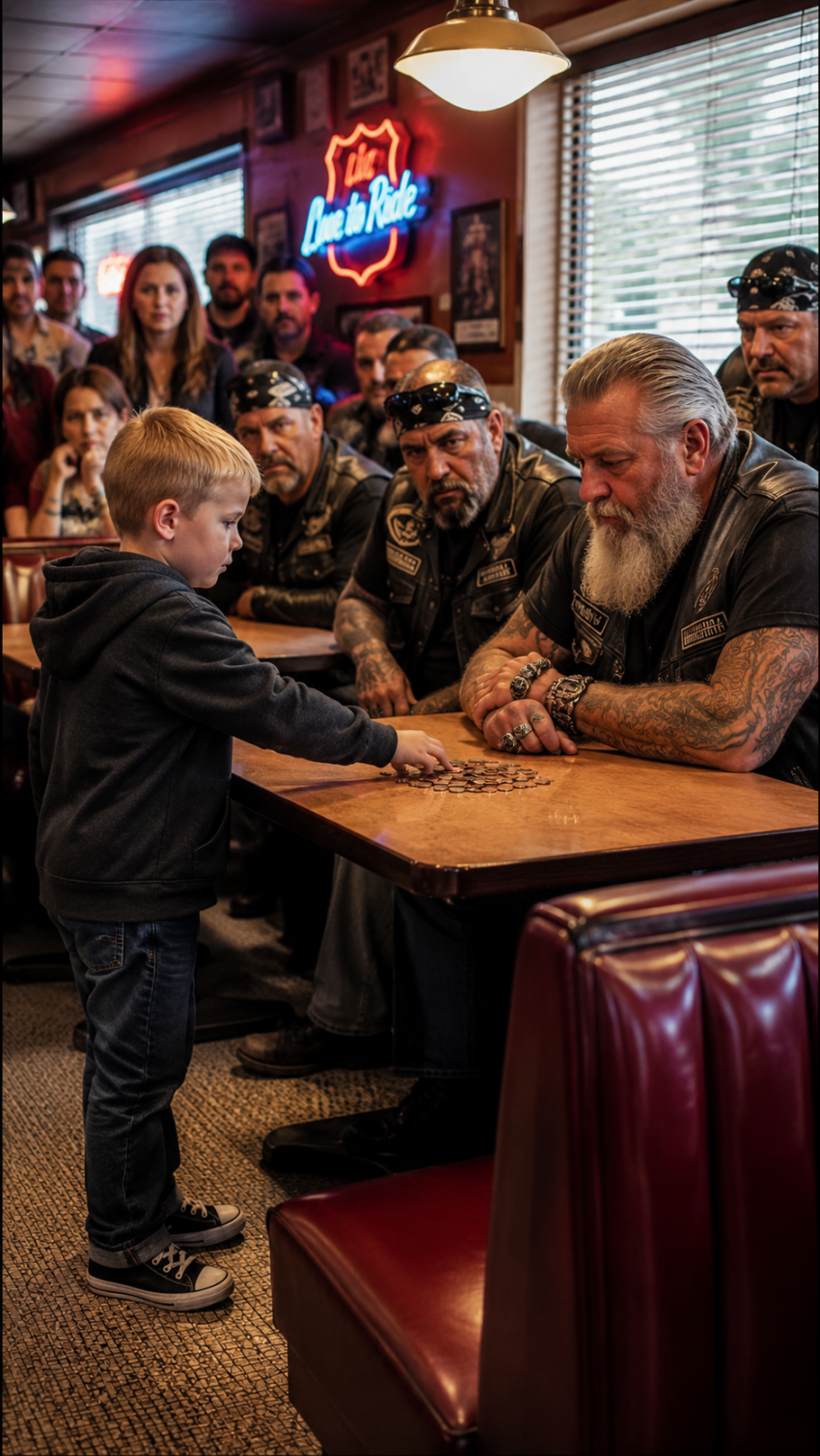
The Boy Who Chose The Biker Table
The storm had been sitting over western Kentucky all afternoon, heavy and gray, as if the sky itself was holding its breath.
Outside a small roadside diner near Bowling Green, motorcycles filled the gravel lot in a long shining row. Inside, families ate fried chicken, truckers warmed their hands around coffee mugs, and waitresses moved quickly between crowded booths.
In the back corner sat fourteen members of the Iron Valley Riders.
Most people noticed them immediately.
They were large men in leather vests, with gray beards, scarred hands, and quiet eyes that made strangers lower their voices. They were not loud. They were not looking for trouble. But they looked like men who had seen enough of it to recognize it from across a room.
At the center of the table sat Raymond Keene.
Advertisements
Raymond was sixty-five, a retired firefighter with broad shoulders, white hair, and a face lined by years of smoke, loss, and long nights spent helping people he would never meet again.
He had just lifted his coffee when a little boy walked toward their table.
The child looked about eight years old. His blond hair was messy. His jeans were too short. His sneakers had holes near the toes. In his small fist, he carried a few folded dollar bills and a handful of coins.
The whole diner seemed to grow quieter as he stopped beside Raymond.
Then the boy placed the money on the table.
Raymond looked at the coins, then at the child.
“Can you please help my mom?”
No one at the biker table moved.
Raymond slowly set down his cup.
“What’s your name, buddy?”
The boy swallowed.
“Noah.”
“Noah, what kind of help does your mom need?”
The boy looked toward the hallway where the restrooms were.
“She keeps saying we’re okay.”
His voice trembled.
“But we’re not okay.”
A waitress stopped near the counter. A father at another booth lowered his fork. Even the rain against the windows seemed quieter.
Raymond leaned forward, keeping his voice soft.
“Does your mom know you came over here?”
Noah shook his head.
“She’s washing her face.”
That answer told Raymond more than the child realized.
A moment later, a woman hurried from the hallway. She was thin, pale, and trying very hard to look calm. The instant she saw her son standing beside the bikers, fear flashed across her face.
“Noah,” she said quickly. “Come here, sweetheart. I’m so sorry. He didn’t mean to bother you.”
Raymond stood, but not too fast.
“Ma’am, he isn’t bothering us.”
The woman reached for Noah’s hand.
“We should go.”
Raymond glanced at the coins on the table.
“Looks to me like your son came to make a very serious request.”
Her eyes filled before she could stop them.
“Please,” she whispered. “We don’t want trouble.”
Raymond’s expression softened.
“Neither do we.”
He pulled out the empty chair beside him.
“Why don’t you sit down for a minute? Let us buy you both lunch.”
She hesitated. Her pride fought with her exhaustion. Then Noah slipped his hand into hers and whispered something Raymond could not hear.
Finally, she sat.
Her name was Allison Parker.
She ordered nothing for herself, only soup for Noah, but one of the waitresses quietly brought sandwiches, fries, and two chocolate milkshakes anyway.
Noah ate like a child who had learned not to ask for seconds.
Raymond noticed everything.
He noticed the way Allison kept checking the front window.
He noticed the way she flinched when someone laughed too loudly.
He noticed Noah leaning against her as if he was both her child and her guard.
After a long silence, Raymond asked the question gently.
“Are you safe at home, Allison?”
She tried to answer.
Instead, tears slipped down her face.
Noah stared at his soup.
Finally, Allison whispered, “Not the way we should be.”
Around the table, every biker became still.
Allison told them pieces of the truth. She had married a man named Russell three years earlier. At first, he had been charming. He brought flowers. He promised stability. He told her he would take care of her and Noah.
Then slowly, everything changed.
He decided where she could go. He watched her phone. He kept control of the money. He made her feel small in her own home. Some days he apologized. Other days he blamed her for everything.
“I wanted to leave,” Allison said. “I tried. But I had nowhere to go. No savings. No family close enough to help.”
Noah looked up at Raymond.
“Can you take us somewhere he can’t find us?”
Raymond felt something tighten in his chest.
No child should have to ask that question.
He looked around the table. Fourteen men looked back at him, and every one of them understood.
Raymond nodded once.
Then he turned to Noah.
“Yes, son. We can help.”
For the first time since he had entered the diner, Noah smiled.
It was small.
But it was real.
The Ride Home That Wasn’t A Return
Thirty minutes later, the Iron Valley Riders left the diner together.
Allison drove her old blue sedan, and the motorcycles formed around her like a wall. Raymond rode in front. Two riders stayed behind. The rest surrounded the car on both sides, not to frighten anyone, but to make sure one frightened mother and one brave little boy no longer felt alone.
The rain began as they crossed the county road.
Allison’s hands trembled on the steering wheel.
Noah sat beside her, holding the dinosaur backpack he had brought from the diner.
When they turned onto her street, Allison whispered, “Maybe we shouldn’t do this.”
Raymond parked his motorcycle and walked to her window.“Allison, leaving fear behind is not a mistake.”
She covered her mouth as tears returned.
The house was small, with faded siding, an overgrown yard, and curtains drawn tight across every window. It did not look dangerous from the outside. That was the thing about some homes. From the road, they looked ordinary. Inside, people could be quietly falling apart.
Raymond did not storm the house. He did not raise his voice. He did not let anyone act foolishly.
Instead, he called the proper people. He waited. He stood beside Allison while she made the reports she had been too afraid to make before. He watched her hand over messages, photos of damaged belongings, and records she had hidden for months.
For the first time, Allison spoke without being interrupted.
Advertisements
For the first time, someone believed her before asking why she had waited.
When it was safe, the riders helped her gather what mattered.
Noah’s school papers.
Birth certificates.
A box of old photographs.
Three bags of clothing.
A small stuffed fox Noah had slept with since kindergarten.
At one point, Noah stood in his room staring at a shelf full of books.
“We probably can’t take all of them,” he said quietly.
Raymond stepped beside him.
“Who told you that?”
Noah shrugged.
“There’s not much room.”
Raymond picked up the first stack.
“Then we make room.”
Noah looked at him as if those four words had opened a door in the wall.
By evening, Allison and Noah were taken to a safe place arranged through people who knew what they were doing. Raymond and the riders did not pretend to be heroes. They simply stayed until the mother and son were no longer standing in the dark by themselves.
Before Raymond left, Noah ran to him.
“Will I see you again?”
Raymond knelt carefully in the wet grass.
“You’ll see me Saturday if your mama says it’s all right.”
Noah hugged him hard.
Raymond closed his eyes.
Some calls came through fire alarms.
Some came through a little boy with crumpled dollar bills.
Both mattered.
The Family That Chose Them
The next years were not easy, but they were no longer empty.
Allison found work at a pharmacy, then enrolled in a medical assistant program at night. She studied after long shifts, sometimes falling asleep over textbooks while Noah did homework at the kitchen table.
Money was tight. There were weeks when every bill felt like a mountain.
But every Saturday, Raymond called.
Sometimes he brought groceries and claimed he had “accidentally bought too much.” Sometimes another rider fixed Allison’s car. Sometimes the club showed up at Noah’s school events looking wildly out of place and completely proud.
When Noah played soccer, fourteen bikers stood along the sideline cheering like he was in the World Cup.
When he won a reading award, Raymond arrived with flowers for Allison and a handshake for Noah.
When Allison finished her program, the loudest applause in the auditorium came from men in leather vests who wiped their eyes and pretended they were not crying.
People stared at them everywhere.
At first, Allison felt embarrassed.
Then she stopped caring.
Because those men had become family.
On Noah’s eleventh birthday, Raymond gave him a small wooden box. Inside was an old silver firefighter badge, polished but worn at the edges.
Noah lifted it carefully.
“Is this yours?”
Raymond nodded.
“I carried that for a long time.”
“Why are you giving it to me?”
Raymond smiled.
“Because courage doesn’t belong in a drawer. It belongs with someone who knows what it costs.”
Noah pinned it inside his jacket that night.
From then on, he kept it close.
Not because he wanted to look brave.
Because it reminded him that he had once asked for help, and someone had answered.
The Promise Noah Kept
Years passed.
Noah grew taller than his mother. His shoulders broadened. His voice deepened. But he never became hard.
That was what Raymond admired most.
Noah remembered what fear felt like, so he was gentle with people who were afraid. He remembered what hunger felt like, so he volunteered at food drives. He remembered what it meant to have no one, so he became the first person to stand beside someone else.
During his senior year, Noah asked Raymond to meet him at the same diner where they had first met.
The building had been painted since then. The sign was newer. But the back corner table was still there.
Noah sat across from Raymond, nervous in a way Raymond had not seen in years.
“I made a decision,” Noah said.
“Sounds serious.”
Noah nodded.
“I’m joining the fire academy.”
Raymond went quiet.
Outside, the evening sun turned the parking lot gold.
“Why?” Raymond asked.
Noah looked down at the old badge in his palm.
“Because when I was scared, someone came for me.”
His voice grew thicker.
“I want to be the kind of man who comes when people need help.”
Raymond looked away toward the window.
“Your mama know?”
“She cried for twenty minutes.”
Raymond laughed softly.
“That sounds about right.”
Then Noah said, “She said you’d understand.”
Raymond reached across the table and squeezed his shoulder.
“I do.”And he did.
Noah left for training that fall. Allison missed him terribly, but she never held him back. Every photograph he sent home showed the same thing tucked near his heart: the old silver badge Raymond had given him.
Years later, Noah became the kind of firefighter people remembered.
Calm under pressure.
Patient with children.
Kind to older people.
Advertisements
Brave without needing attention.
Every life he helped was connected, in some quiet way, to the day he had walked across a diner with coins in his hand.
Fifteen Years Later
The sky looked almost the same that afternoon.
Gray clouds rolled over Kentucky. Rain tapped against the windows of the diner. Motorcycles lined the lot outside.
Raymond was eighty now.
His beard had gone fully white. His knees hurt when it rained. His hands were slower, but his eyes were still sharp.
He sat at the same back table with the Iron Valley Riders, though there were fewer of them now. Time had taken some. Age had slowed others. But every Saturday, whoever could come still came.
Traditions mattered.
The lunch rush was loud until a red pickup pulled into the lot.
Raymond glanced out the window.
A tall man stepped out wearing a firefighter dress uniform. Beside him stood a young woman holding the hand of a little boy with blond hair and serious eyes.
Then Allison stepped out of the passenger side.
Raymond froze.
She looked older, of course. But healthy. Strong. Peaceful.
Nothing like the frightened woman who had once apologized for needing help.
The diner door opened.
The man in uniform walked straight to Raymond’s table.
For a moment, neither of them spoke.
Then the man smiled through tears.
“You probably don’t recognize me.”
Raymond stared at him.
The eyes were the same.
So was the quiet courage.
The man swallowed.
“I’m Noah.”
Raymond stood slowly.
The whole diner seemed to disappear.
Noah stepped forward, and the old biker pulled him into his arms.
They held each other like family, because that was what they were.
When they finally stepped apart, Noah motioned to the little boy.
“This is my son, Caleb.”
The child hid behind his mother’s leg for a second, then looked up at Raymond.
Noah knelt beside him.
“Caleb, this is Mr. Raymond. He helped Grandma and me a long time ago.”
Caleb held out a small box with both hands.
Raymond took it carefully.
Inside was a new silver pin shaped like a firefighter shield. On the back, engraved in tiny letters, were seven words:
THANK YOU FOR HELPING ME GROW UP
Raymond’s hands trembled.
Noah’s voice broke.
“You didn’t just help us get through one bad day.”
He looked at Allison, then at his wife and son.
“You gave us all the days after it.”
Allison stepped closer.
“I used to think asking for help made me weak.”
She smiled through tears.
“Then my little boy became braver than I was, and you showed me that kindness can be stronger than fear.”
The diner had gone silent again, just like it had fifteen years earlier.
Only this time, no one was afraid.
Raymond looked at Caleb, then back at Noah.
“Your boy has your eyes.”
Noah laughed softly.
“And my stubbornness, according to his mother.”
Raymond wiped his face with the back of his hand.
“Best handful of coins I ever accepted.”
The whole diner laughed.
Then someone began clapping.
Soon, everyone joined in.
Waitresses. Truckers. Families. Riders.
Outside, thunder rolled across the Kentucky hills, but inside that diner, there was only warmth.
An old biker held a small silver pin in his hand and understood something he had spent his life learning.
Kindness does not always announce itself.
Sometimes it walks in wearing muddy sneakers, carrying crumpled bills, asking for help with a shaking voice.
And sometimes, when someone answers, that answer keeps echoing for generations.
Sometimes the bravest person in the room is not the strongest adult, but the child who is scared and still finds the courage to ask someone for help.
A single act of kindness may look small in the moment, but years later it can become the reason a family survives, heals, and begins again.
We should never judge people by their clothes, their silence, or the pain they try to hide, because the ones who say they are fine often need compassion the most.
Real strength is not about controlling others or making people fear you; real strength is standing calmly beside someone until they remember they are not alone.
The right people do not always arrive wearing perfect suits or carrying perfect words; sometimes they arrive on motorcycles, with rough hands and gentle hearts.
A child should never have to carry adult fear, but when a child speaks the truth, the world should be quiet enough to listen.
Leaving a painful life behind is not weakness, failure, or shame; sometimes it is the first brave step toward peace.
Family is not only the people who share your name, but also the people who show up, stay steady, and help you rebuild when life falls apart.
The kindness we give today may become the courage someone else carries tomorrow, and that courage may one day protect people we will never meet.
Never underestimate what one gentle answer can do, because one person saying “yes, I will help” can change not just one life, but an entire future.