My Mother Told Me to Take Off My Navy Uniform at My Father’s Memorial
“Take it off.”
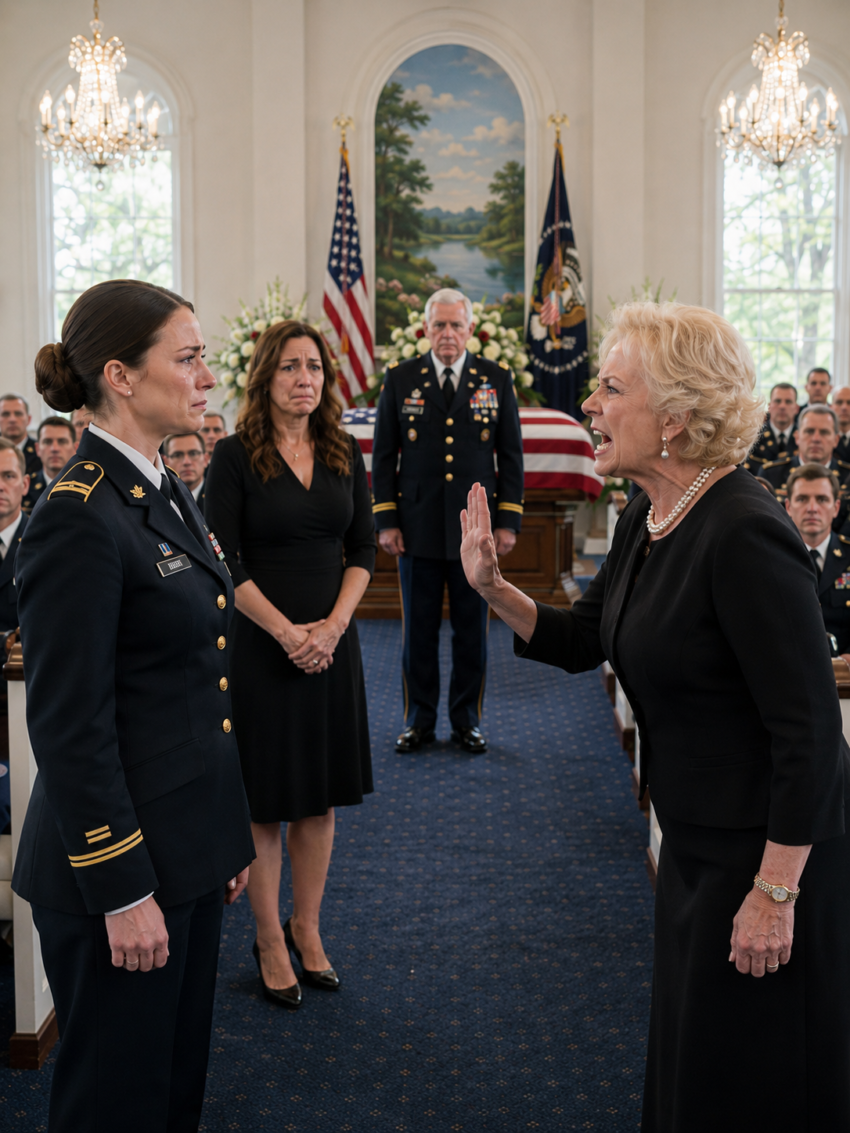
My mother said it quietly enough that the people in the first few pews leaned forward to hear her.
I stood beside my father’s flag-draped memorial table in First Methodist Church, still wearing my Navy dress blues.
Mom pointed at my uniform.
“You don’t get to wear that in front of your father.”
The church went silent.
There were probably a hundred people inside. Men who had served with Dad. Women who had brought casseroles to our house when I was a kid. Former teachers. Neighbors who had known me since I wore braces.
Most of them were looking at me the same way.
Not shocked at my mother.
Disappointed in me.
I looked at the framed photograph on the table between us.
Colonel Thomas Carter, U.S. Army, retired.
Dad was smiling in the picture.
The photograph had been taken at my commissioning ceremony twelve years earlier.
I remembered because I had chosen it myself.
Mom apparently didn’t.
“Elaine,” someone murmured.
She ignored them.
“Your father waited for you,” she said. “For years. Birthdays. Christmases. His retirement dinner. And when he was about to pass away, you still couldn’t come home.”
I kept my hands at my sides.
There were things I could have said.
I could have told everyone where I had been when my father died.
I could have told them about Landstuhl Regional Medical Center in Germany.
About the surgery.
About waking up with a drainage tube beneath my ribs and asking a Navy nurse whether anyone had called Tennessee.
But explaining myself in front of my father’s photograph felt wrong.
So I looked at my mother and asked one question.
“Did Dad tell you he didn’t want me wearing this?”
Her mouth tightened.
“I’m telling you.”
“That’s not what I asked.”
For the first time, she looked away.
That was when I knew I wasn’t taking the uniform off.
The Story Everyone Had Heard
Willow Creek was the kind of Tennessee town where people remembered who your grandparents were.
Dad had spent twenty-eight years in the Army. Even after retirement, people still called him Colonel Carter.
When I was seventeen, I told him I wanted to join the Navy.
Mom stopped cutting vegetables.
Dad looked across the kitchen table at me.
“The Navy?”
“Yes, sir.”
He smiled.
“At least somebody in this family finally developed good judgment.”
Mom didn’t laugh.
For her, leaving Willow Creek had always been something other people did.
College was acceptable if you came home afterward. A job was fine if it was within driving distance. Marriage was supposed to mean Thanksgiving at the same dining room table.
The military was different.
The military could send me anywhere.
And it did.
San Diego. Norfolk. Bahrain. Japan. Germany.
At first I called home every Sunday.
Then deployments made Sunday calls impossible, so I called whenever I could.
Sometimes Dad answered.
Sometimes Mom did.
“He’s outside.”
“He’s sleeping.”
“He’s at the store.”
“I’ll tell him you called.”
I believed her.
Why wouldn’t I?
Dad wasn’t much of a phone person anyway. He wrote short emails and mailed birthday cards with five-dollar bills inside even after I turned thirty.
But over the years, something changed.
His emails became less frequent.
Then shorter.
When I asked Mom about him, she always gave the same answer.
“He’s disappointed, Rebecca.”
The first time she said it, I was twenty-seven.
I had missed their anniversary dinner because my leave request had been denied.
“Disappointed about what?”
There was a pause.
“You know what.”
I didn’t.
But I carried that sentence for years.
I started sending Dad letters.
Real ones.
He had always liked handwritten mail.
I wrote from ships, hotel rooms, temporary quarters, airports.
I told him about promotions and people I’d met. I complained about terrible coffee. I sent photographs.
He rarely mentioned them.
Once, I finally asked.
“Did you get the letter I sent from Bahrain?”
Dad hesitated.
“Which one?”
Mom’s voice came through somewhere behind him.
“Thomas, dinner.”
He lowered his voice.
“I’ll call you later, Bec.”
He didn’t.
I told myself he was getting older.
I told myself families changed.
Mostly, I told myself not to make everything about me.
The Call I Couldn’t Answer the Way She Wanted
Dad’s health declined quickly during his final year.
He never gave me many details.
Mom gave me even fewer.
Whenever I called, she made it sound manageable.
“He’s tired.”
“The doctor changed his medication.”
“There’s nothing you can do from there.”
Then one Tuesday morning, while I was overseas, I received an email from an old family friend.
Major William Hayes.
He had served with Dad years earlier.
His message was six words.
Rebecca, call me when you can.
I called immediately.
William answered on the second ring.
“Your dad’s in the hospital.”
I stood up from my desk.
“What?”
“Elaine didn’t tell you?”
I don’t remember what I said next.
I remember walking into the hallway.
I remember putting one hand against the wall.
Dad had been hospitalized three days earlier.
His condition was worse than Mom had admitted.
I submitted an emergency leave request that afternoon.
It was denied because of operational requirements.
I submitted another request through my chain of command.
That one went higher.
While I waited, I called home repeatedly.
Mom answered once.
“Now you’re worried?”
“Put Dad on.”
“He’s resting.”
“Wake him up.”
Silence.
“Mom. Please.”
She exhaled.
“Rebecca, you can’t disappear for years and then expect everyone to rearrange things when you suddenly decide to be a daughter.”
I gripped the phone.
“I am trying to come home.”
“You’re always trying.”
Then she hung up.
My second leave request was still being reviewed when my unit’s situation changed.
Three days later, I was injured during an overseas operation.
I remember the helicopter.
I remember a medic cutting through my uniform.
After that, my memories came in pieces.
White ceiling.
German voices.
A Navy corpsman standing beside my bed.
Pain every time I breathed.
When I was awake long enough to understand where I was, I asked for my phone.
A nurse told me it had been secured with my belongings.
“I need to call my father.”
She looked at my chart.
“You just came out of surgery.”
“Please.”
She brought me a hospital phone.
Nobody answered at home.
I tried again later.
Then again.
Dad died the following morning.
Mom called the hospital.
She didn’t ask how badly I was hurt.
She said only:
“He’s gone.”
I closed my eyes.
“I know.”
“The funeral is Friday.”
I looked down at the IV taped to my hand.
“I can’t fly.”
Her voice became flat.
“Of course you can’t.”
The call ended less than a minute later.
I missed my father’s funeral.
By the time I was medically cleared to travel, he had already been buried.
What I didn’t know was what Mom had told everyone back home.
Rebecca chose not to come.
What Dad Asked For
The memorial was held almost four months later.
It had been planned by several of Dad’s old Army friends as a larger celebration of his life for people who hadn’t been able to attend the funeral.
William Hayes contacted me personally.
His email was simple.
Your father left instructions. He wanted you there in uniform.
I read it three times.
Then I called him.
“Are you sure?”
“I’m looking at his handwriting.”
That settled it.
I flew into Nashville the day before the service and rented a car.
Mom didn’t offer me a room at the house.
I didn’t ask.
I stayed at a hotel twenty minutes outside Willow Creek.
That morning, I put on my dress blues slowly.
My injuries had healed enough that nobody could see them beneath the uniform, although one scar still pulled when I lifted my right arm.
Dad’s commissioning photograph sat on my phone screen while I fixed my ribbons.
He had been standing beside me that day.
Proud enough to embarrass me.
I remembered him shaking hands with every officer he could find.
“That’s my daughter.”
Back then, I thought I’d have years to hear him say it again.
At the church, Mom barely greeted me.
She looked at the uniform first.
Then my face.
“You actually wore it.”
“Dad asked me to.”
“According to William.”
I stopped.
“What does that mean?”
She adjusted a flower arrangement.
“It means William likes drama.”
People were beginning to enter the sanctuary.
I watched her straighten one white rose that didn’t need straightening.
“Did Dad ask for me to wear the uniform?”
She didn’t answer.
Ten minutes later, she told me to take it off in front of everyone.
The Man in the Third Pew
I stayed where I was.
“I’m not taking it off.”
Mom’s face changed.
Not much.
Just enough.
“Don’t make this uglier than it already is.”
“Then stop.”
A few people shifted in their seats.
Mom looked around the sanctuary as if she couldn’t believe I would embarrass her in front of them.
“Your father spent his last years wondering why his only daughter couldn’t make time for him.”
I stared at her.
That wasn’t the father I remembered.
Dad could be stubborn.
He could be quiet for days when he was angry.
But he had never once told me to leave the Navy.
Never once asked me to give up my career.
Before I could answer, a wooden pew creaked behind us.
William Hayes stood.
He was seventy-three then, tall but slightly stooped, with silver hair and an Army service pin on his jacket.
He carried a small wooden box under one arm.
“Elaine.”
Mom turned.
“Not now, William.”
“Actually, now is exactly when Thomas wanted this done.”
Nobody moved.
William walked down the center aisle.
Mom stepped toward him.
“This is a family matter.”
“Thomas made it my matter.”
He placed the wooden box on the memorial table.
I recognized it immediately.
Dad had kept it in his home office for as long as I could remember.
Dark walnut.
Brass latch.
A small scratch across the lid from one of our moves when I was a child.
“Where did you get that?” I asked.
William looked at me.
“Your father gave it to me six weeks before he died.”
Mom’s face drained.
That was the first thing all morning that frightened her.
She reached toward the box.
William put his hand over the lid.
“No, Elaine.”
Her hand stopped.
He opened his jacket and removed a folded envelope.
My name was written across the front.
REBECCA.
Dad’s handwriting.
My knees almost gave way.
“Thomas asked me to read this if there was ever a question about why his daughter wasn’t beside him at the end.”
Mom shook her head.
“He was sick. He was confused.”
William looked at her.
“He was neither when he wrote this.”
Then he unfolded the letter.
Nobody in the church made a sound.
William began reading.
Dad wrote that he knew I had tried to come home.
He knew about my denied leave requests.
He knew I had been injured overseas.
And he knew I had tried to call him.
William stopped for a moment.
I looked at Mom.
She wasn’t looking at me anymore.
She was staring at the wooden box.
William continued.
Dad had written one sentence twice.
My daughter did not abandon me.
The second time William read it, someone behind me began crying quietly.
I couldn’t turn around.
I was watching my mother.
“How did he know?” I asked.
William lowered the letter.
“Because I told him.”
Mom closed her eyes.
William reached into the wooden box.
He removed a bundle tied with an old blue ribbon.
At first I thought they were Dad’s letters.
Then I saw the handwriting on the top envelope.
Mine.
The return address was from Norfolk.
I had mailed it nine years earlier.
Underneath it was another from Bahrain.
Then Japan.
Then San Diego.
There were dozens.
All unopened.
I picked up the first envelope.
My thumb ran over my own handwriting.
“Where were these?”
William didn’t answer immediately.
He looked at Mom.
So did I.
Her arms were folded tightly across her chest.
“Mom.”
She said nothing.
“Where did Dad get these?”
William answered for her.
“He found them in your mother’s locked desk.”
The church disappeared around me.
I looked down at the letters again.
For twelve years, I had wondered why Dad stopped answering.
Why he never mentioned photographs I sent.
Why every conversation seemed shorter than the one before it.
I had blamed deployments.
Distance.
Time.
Myself.
Mom finally spoke.
“You don’t understand what it was like.”
I placed the letter back on the table.
“Then explain it.”
She looked around at all the people watching her.
For once, nobody was looking at me.
William reached into the box again.
This time he took out a small digital voice recorder.
Mom moved toward him.
Fast.
“William, don’t.”
He stepped back.
That was all I needed to see.
I picked up Dad’s unopened letters and held them against the front of the uniform my mother had ordered me to remove.
Then I looked at William.
“Is that Dad’s?”
He nodded.
“He recorded it himself.”
Mom whispered my name.
I didn’t answer her.
William placed the recorder on the memorial table beside Dad’s photograph.
His finger rested over the play button.
And for the first time since I had walked into that church, my mother looked afraid of what my father still had left to say.
My Father’s Voice Filled the Church
William pressed play.
For two seconds, there was only static. Then my father’s voice came through the little recorder, weaker than I remembered but unmistakably his.
“Rebecca, if you’re hearing this, then I didn’t get the chance to tell you myself.”
My mother lowered herself into the nearest pew.
Dad paused on the recording, breathing heavily.
“You did not abandon me. I need you to know that before anything else.”
I stared at his photograph.
He said William had shown him copies of my leave requests after learning I had been trying to come home. He knew about Germany. He knew I had called from the hospital.
Then his voice changed.
“There’s something else I should have understood sooner.”
Mom whispered, “Turn it off.”
William did not move.
Dad explained that months before his death, he had found several of my letters hidden in Mom’s desk while looking for insurance papers. At first, he thought she had misplaced them.
Then he found more.
Some were years old.
“I confronted your mother,” Dad said. “She told me she was tired of watching me wait for a daughter who had chosen another life.”
My mother stood.
“He was angry when he recorded that.”
I looked at her.
“Did you hide them?”
She pressed her lips together.
The recorder continued.
Dad said he had begun checking old phone records and asking questions. Calls I had been told he could not take had never been mentioned to him. Messages had disappeared. Letters he wrote to me had sometimes been left unmailed.
“Your mother believed distance would prove her right,” he said. “Instead, it hurt both of us.”
Mom walked toward the aisle.
I stepped in front of her.
“Please stay.”
She stared at me.
I had spent years imagining what I would say if Dad ever admitted he was disappointed in me.
Now his recorded voice said the opposite.
“Rebecca built a life I did not choose for her. That is what children are supposed to do. I was proud of her when she left, and I was proud of her when I died.”
Nobody spoke after the recording ended.
William switched it off.
The silence felt cleaner than everything that had come before it.
What My Mother Finally Said
Mom was the first to move.
She picked up her purse.
“I’m not doing this here.”
“You already did.”
She stopped.
I did not raise my voice.
“You told everyone here I abandoned Dad. You asked me to remove my uniform in front of them. So answer one question here.”
Her fingers tightened around the purse strap.
“Did you hide my letters?”
She looked toward the doors.
“Your father and I had problems you knew nothing about.”
“That isn’t an answer.”
“You left.”
There it was.
Not denial.
Just two words she had apparently been carrying for twelve years.
“I joined the Navy.”
“You left this family.”
“Those are not the same thing.”
She shook her head.
“Every promotion meant another place. Every deployment meant another excuse. Your father defended you every time.”
I picked up the bundle of letters.
“So you decided what he was allowed to read?”
Her eyes moved to them.
“I thought eventually you would come home.”
“By making him think I stopped writing?”
She said nothing.
That silence was the closest thing to an admission I was going to get that morning.
William cleared his throat.
He told me Dad had left one other instruction.
The Carter Service Foundation was a small scholarship fund Dad had established after retirement. It helped young people from our county enter nursing, teaching, emergency services, and military careers.
I knew about it, but I had assumed Mom would manage it.
William handed me another envelope.
“Your father named you chair.”
Mom turned sharply.
“What?”
“Effective upon his death.”
I opened the document.
My name was there.
Rebecca Carter.
For years, Mom had told people my career proved I did not care about home.
Dad had left me responsibility for helping other young people leave home to serve.
I folded the paper carefully.
Mom walked out before the service began.
I did not follow her.
The Desk in My Father’s Office
Two days later, I went to my parents’ house.
Mom had agreed to stay with my aunt for the afternoon while I collected Dad’s personal things.
His office looked almost untouched.
His reading glasses sat beside the lamp. A yellow legal pad lay beneath a coffee mug. His Army retirement photograph hung crooked over the bookshelf.
I straightened it automatically.
Then I opened his desk.
Inside were three notebooks.
Dad had kept journals irregularly for years. Most entries were ordinary: doctor appointments, grocery lists, names of people he meant to call.
Near the end, my name appeared repeatedly.
“Asked Elaine whether Rebecca called.”
“No message again.”
“William says Rebecca emailed him last week.”
Then:
“Found letters.”
I sat in Dad’s chair.
The next pages were brief.
He had documented the confrontation with Mom, the phone records William helped him obtain, and several pieces of mail he discovered in a cabinet.
There was no grand conspiracy.
Just small choices repeated for years.
A message not passed along.
An envelope placed in a drawer.
A phone call described as unimportant.
A daughter called selfish often enough that eventually other people repeated it.
I closed the notebook.
Mom arrived before I finished packing.
She stood in the doorway.
“Did you find what you wanted?”
“More than I wanted.”
Her eyes dropped to the journals.
“Your father wrote things when he was upset.”
“The phone records weren’t upset.”
She flinched.
I put the notebooks into my bag.
“I’m not here to punish you.”
“It certainly feels like it.”
“I’m here because I spent twelve years believing Dad thought I had abandoned him.”
She looked past me toward his empty chair.
“I was scared.”
It was the first explanation she gave that sounded like the truth.
“Of what?”
“That you’d leave and never need us again.”
I waited.
She did not apologize.
Not then.
So I told her what would happen next.
“I won’t lie for you. If someone asks, I’ll tell them what happened. And you don’t get to speak for Dad anymore.”
She folded her arms.
“And what about me?”
“When you’re ready to talk without changing what happened, call me.”
Then I carried Dad’s journals out to my car.
The Boundary Between Us
For nearly six months, Mom and I barely spoke.
I returned to duty, though not to the same operational role. My injuries had changed what I could physically do, and I had begun thinking differently about what I wanted from the Navy.
I also started working with Dad’s foundation.
Our first scholarship under my leadership went to a seventeen-year-old girl named Hannah whose mother wanted her to stay in Willow Creek and work at the family pharmacy.
At the interview, Hannah kept twisting a bracelet around her wrist.
“I love my family,” she said. “I just want something different.”
I knew that sentence.
“Those things can both be true,” I told her.
We awarded her the scholarship.
A little more than a year after Dad’s memorial, Mom called.
I almost let it go to voicemail.
“Rebecca?”
“I’m here.”
She was quiet for several seconds.
“I lied.”
I sat down.
She said it plainly this time.
She had hidden letters.
She had intercepted messages.
She had told Dad I called less often than I did.
And she had told other people I chose not to come when he was sick, even after learning I was hospitalized in Germany.
“Why?”
Her answer was smaller than I expected.
“Because every time you succeeded somewhere else, I thought there would be less reason for you to come back.”
“So you made coming back painful.”
“Yes.”
That was the first time she did not defend herself.
I did not forgive her on that call.
I told her I needed time.
She said she understood.
For once, she did not tell me what I should feel.
Before hanging up, Mom asked whether I still had the blue ribbon from Dad’s box. I told her I did. Neither of us said what those letters had cost us both.
We rebuilt slowly.
Coffee once when I was in town.
A birthday call.
Dinner.
No pretending.
No rewriting.
Years later, after leaving operational service, I began helping military families with communication during deployments and medical emergencies. Much of the work was simple: making sure messages reached the right person before silence became a story somebody else could control.
I kept one of Dad’s letters framed in my office.
Beside it was the photograph from my commissioning.
The same photograph that had sat on his memorial table.
For years, I thought that uniform represented the distance between my father and me.
Now, whenever I looked at the picture, I saw his hand resting proudly on my shoulder.
He had never asked me to take it off.