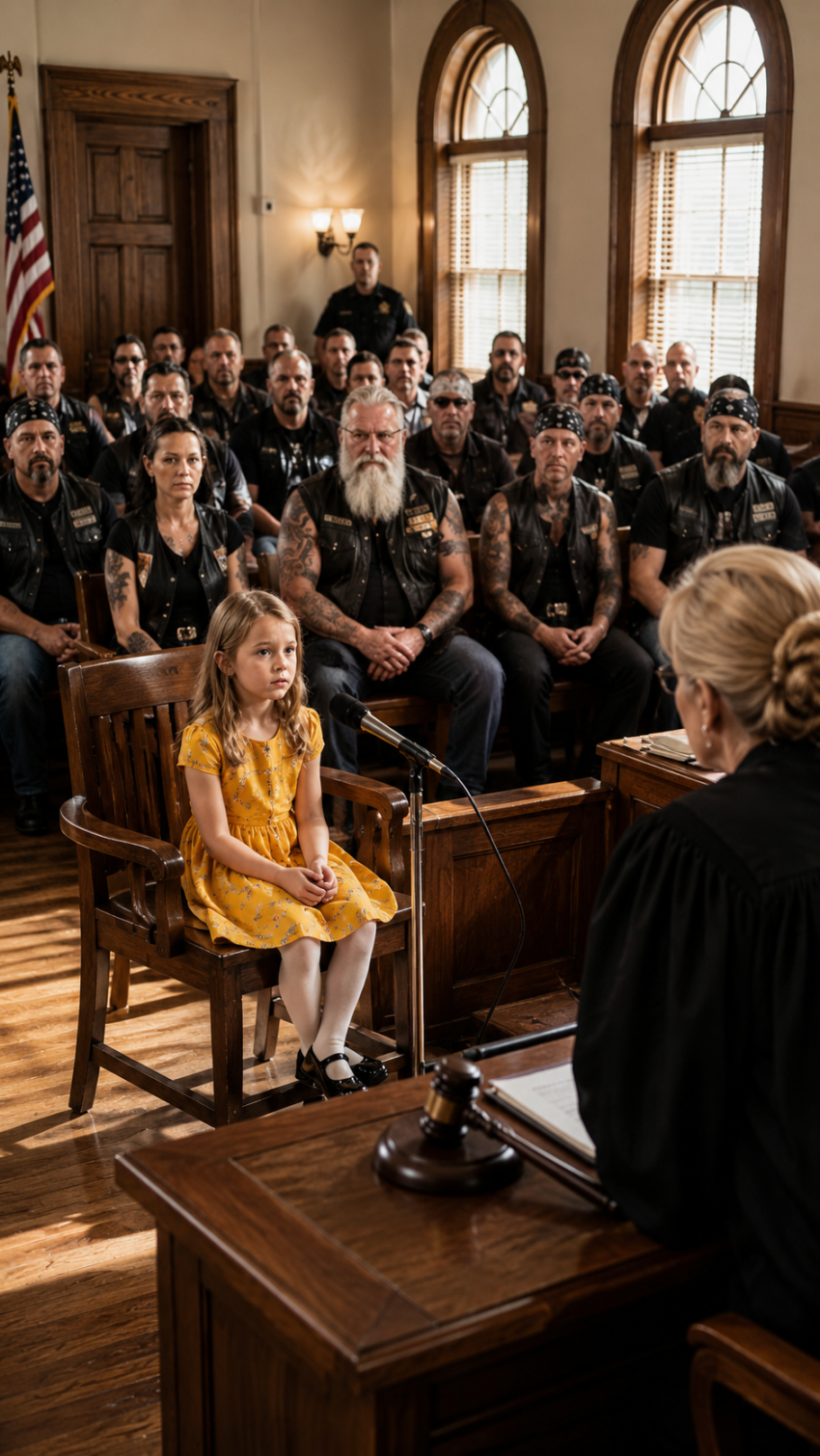
Thirty Riders Came For One Little Girl
The nine-year-old girl was hiding under her foster mother’s kitchen table when she whispered, “I can tell the truth… but only if thirty big people sit where I can see them.”
Three mornings later, thirty bikers walked into the county courthouse in Wichita, Kansas.
My name is Nora Pickett, and I was the child advocate assigned to help a little girl named Piper Sloan prepare for the hardest morning of her young life.
Piper was small for nine, with soft brown hair, serious gray eyes, and sleeves she always pulled over her hands when adults spoke too loudly. She noticed exits before she noticed windows. She counted footsteps in hallways. She could smile at a cartoon on television, then freeze if a man’s voice came from another room.
The court needed her to speak.
Piper needed to feel that the room would not swallow her whole.
Advertisements
The Table She Would Not Leave
Her foster mother, Denise Alder, had made warm pancakes that morning, but Piper had not eaten a bite. She slipped from her chair, crawled beneath the kitchen table, and curled her knees against her chest.
Denise sat on the floor nearby, careful not to reach for her.
I lowered myself beside them and spoke softly.
“Piper, what would make the courtroom feel smaller?”
She stared through the chair legs.
“People.”
“What kind of people?”
Her answer came so quietly I almost missed it.
“My road people.”
That was what she called the bikers.
For four months, members of a local child-support riding group had been visiting Piper. They never asked her to tell the story before she was ready. They waited outside counseling appointments. They sat in school meetings. They answered the phone when nighttime made her feel alone.
The largest rider was a sixty-year-old white American man everyone called Redwood. He had a silver beard, tattooed arms, and a black leather vest that made strangers step aside in grocery stores.
Piper was not afraid of him.
Redwood always stopped several feet away and said the same thing.
“You choose the distance, kiddo.”
Beside him was Magnolia, a fifty-five-year-old Black American woman with calm eyes, short silver curls, and tiny flower tattoos near her wrist. She spoke softly, but when she entered a room, every child seemed to know she was safe.
They had given Piper a little denim vest with the road name she chose herself.
SPARK.
“Because sparks are small,” Piper said, “but they still make light.”
The Number She Asked For
When Redwood heard Piper’s request, he did not make a careless promise.
Thirty bikers could not simply walk into a courtroom and surround a child. That could look wrong. It could seem unfair. It had to be approved by the prosecutor, courthouse security, and the judge.
So Redwood made phone calls for two days.
The riders agreed to every rule.
No signs.
No staring at the defendant.
No gestures.
No comments.
No show of anger.
Anything the courthouse did not allow would stay outside.
“We are not going there to scare anyone,” Redwood told the group. “We are going because one child asked not to feel alone.”
Thirty riders volunteered before sunset.
One changed a work shift. Two rode in from another county. A grandmother called Miss Clover came even though rain had soaked the highways all morning.
When someone asked why thirty were needed, Magnolia answered simply.
“Because thirty is the number Piper asked for.”
The Morning At The Courthouse
Piper arrived at the courthouse in a navy dress, white tights, and shiny black shoes. Her feet barely touched the floor when she sat on the hallway bench.
She made it through security.
Then she saw Raymond Pike through the narrow window in the courtroom door.
Raymond was the man she feared. The story did not need to make him look like a monster. That was part of what made it harder. He looked ordinary. He wore a gray suit. He sat quietly beside his attorney like any other adult.
Piper’s breathing changed.
“He is looking for me,” she whispered.
I knelt in front of her.
“He cannot come near you.”
Her eyes filled with tears.
“That does not stop his eyes.”
Then the elevator doors opened.
Thirty leather-clad riders stepped into the hallway in complete silence.
Redwood removed his sunglasses.
“Morning, Spark.”
Piper lowered one hand from her face.
“You came.”
“All thirty,” he said.
She looked past him, counting the men and women standing behind him.
“I am still scared.”
Redwood nodded.
“We did not come to take scared away.”
“Then why are you here?”
Magnolia answered this time.
“So scared is not the only thing in the room.”
The Wall That Made Room For A Voice
Judge Elaine Porter allowed the riders to sit in two gallery rows, directly where Piper could see them from the witness chair. They could not block the court. They could not speak. They could not react.
But they could be present.
When Piper entered, Raymond turned his head.
Redwood shifted slightly.
Magnolia moved too.
Then all thirty riders adjusted their shoulders until their dark vests formed one steady line between Piper’s eyes and the table she feared.
Piper climbed into the witness chair.
The prosecutor asked her name.
For a moment, nothing came out.
Redwood placed one large hand over his heart.
Magnolia nodded once.
Piper took a breath.
“My name is Piper Sloan,” she whispered.
The prosecutor began gently.
“How old are you, Piper?”
“Nine.”
“Do you know why you are here today?”
Piper looked down at her hands.
“To tell what is true.”
“And do you know the difference between something true and something made up?”
She nodded.
“True is what really happened, even if saying it makes your stomach hurt.”
Advertisements
The courtroom became very still.
When Her Voice Shook
The questions stayed careful. No one asked Piper to describe more than the court needed. The prosecutor asked whether Raymond had made her afraid, whether he told her not to speak, and whether she believed adults would listen.
Piper held the yellow break card in both hands.
“He said nobody would believe me,” she said.
“Did you believe that?”
“At first.”
“What changed?”
Piper looked at the riders.
“They came.”
The prosecutor followed her gaze.
“Who came?”
“My road people.”
Several riders lowered their heads.
Piper continued.
“They said I did not have to stop being scared before I told the truth. They said I could tell the truth while I was scared.”
The defense attorney later asked whether Piper remembered every date, every hour, every word.
She did not.
And she said so.
“I do not remember that part.”
“I am not sure.”
“Nobody told me to say that.”
Those answers mattered. Courage was not pretending to know everything. Courage was refusing to change the truth just to please grown-ups.
Then the attorney asked, “Piper, did you already dislike Mr. Pike before this case began?”
Piper looked toward the biker wall.
Her voice grew small, but clear.
“I did not want him to be bad.”
The room held its breath.
Then she added, “I only wanted him to stop making me afraid.”
No one moved.
Not the judge.
Not the jury.
Not even Raymond’s attorney.
Why Thirty Riders Stayed Silent
When Piper finished, Judge Porter thanked her for telling the truth.
Piper climbed down from the chair and walked toward the gallery. She did not look at Raymond. She looked at the thirty riders.
Redwood stayed seated until she reached him.
Then Piper lifted both arms.
He glanced at Magnolia, silently asking if it was okay.
Piper stepped closer.
Redwood opened his arms carefully, and the little girl disappeared against his leather vest.
No one clapped.
No one cheered.
This was not a performance.
It was a child making it through a moment no child should have to face alone.
Before the court recessed, Judge Porter looked toward Redwood.
“Sir, would you explain why your group came here today?”
Redwood stood slowly.
His voice was deep, but it shook.
“Your Honor, we cannot erase what frightened her.”
He swallowed hard.
“But we can make sure she never has to stand alone while telling the truth.”
That was the reason.
Not anger.
Not revenge.
Not a show of power.
Thirty adults came because one child needed the room to hold more support than fear.
After The Verdict
Two days later, the jury believed Piper.
Denise received the call while Piper was coloring at the same kitchen table where she had once hidden beneath the chairs.
Denise did not explain every legal detail. She only knelt beside her and said, “They believed you.”
Piper kept coloring for a few seconds.
Then she asked, “All of them?”
“The jury did.”
“What about Redwood and Magnolia?”
Denise smiled through tears.
“They believed you before you ever walked in.”
Piper nodded as if that mattered most.
The court’s decision did not magically fix everything. Some nights were still hard. Some doors still felt too heavy. Some sounds still made Piper freeze.
But the bikers did not vanish when the courtroom story ended.
Redwood attended her school concert and sat in the back row because he was too tall for the middle seats. Magnolia helped Denise find a gentle swimming teacher. Miss Clover brought flower seeds for the backyard. Another rider named Finch repaired Piper’s bicycle chain and added tiny reflective stickers shaped like sparks.
Their love was not loud every day.
Most of the time, it was simple.
They showed up.The Room Became Smaller
Six months later, Judge Porter invited Piper to visit the empty courtroom on a Saturday.
There was no jury.
No defendant.
No lawyers.
Only a quiet room with sunlight across the floor.
Piper hesitated at the door.
Advertisements
Redwood and Magnolia stood behind her.
Judge Porter smiled from the bench.
“They may come in only if you want them to.”
Piper thought for a moment.
“Two can come.”
Redwood and Magnolia entered.
Piper walked slowly around the courtroom. She touched the wooden witness chair. She looked at the jury box. She stood near the bench and stared at the place where the thirty riders had sat.
“It felt bigger before,” she said.
Judge Porter nodded.
“Fear can change the size of a room.”
Piper climbed into the witness chair again.
Her feet still did not reach the floor.
She leaned toward the silent microphone and said, “My name is Spark. I told the truth here.”
Redwood covered his mouth.
Magnolia wiped one tear from her cheek.
This time, the courtroom did not ask Piper to prove anything.
It simply held her words.
Four Years Later
Four years passed.
Piper grew taller. Her hair reached her shoulders. She no longer pulled her sleeves over her hands every time an adult spoke.
She still had hard days, because healing is not a straight road. Honest stories should never pretend otherwise.
But she rode a blue bicycle covered in spark stickers. She acted in school plays. She argued about homework. She told Redwood his favorite music sounded like “old trucks falling down stairs,” and he laughed harder than anyone.
Every year, the riders held Spark Day.
They collected backpacks, night-lights, comfort blankets, and small toys for children entering foster homes or preparing for difficult court days.
Piper chose the project herself.
One year, she picked night-lights.
“Dark rooms feel smaller when there is one thing you can see,” she explained.
Thirty bikers packed hundreds of tiny lamps into boxes.
One spring afternoon, another frightened child came to the advocacy center. Piper did not ask about his case. She only sat nearby while Redwood explained that support could look different for every kid.
The boy asked, “Do bikers fight bad people?”
Redwood shook his head.
“No, son.”
“Then how do you protect anybody?”
Piper answered before he could.
“They stay where you can see them.”
The boy looked at her.
“Does that work?”
Piper touched the SPARK patch on the little denim vest she had outgrown but still kept.
“It helped me talk while I was scared.”
Later, outside the center, Redwood asked, “Do you still remember the wall?”
Piper nodded.
“I thought you were keeping me from seeing him.”
“We were trying to.”
She looked at the motorcycles parked along the curb.
“But you were doing something else too.”
“What was that?”
“You made him see I had people.”
Redwood lowered his head.
“That matters too.”
Piper hugged him quickly, then put on her bicycle helmet.
Before riding away, she turned back.
“I was not brave because I stopped being scared.”
Magnolia smiled.
“We know, sweetheart.”
Piper lifted her chin.
“I was brave because I spoke anyway.”
Then she pedaled down the sidewalk.
No wall around her.
No adult holding the bike.
Just a girl carrying her own light forward.
Thirty bikers could not erase the past.
They could not speak for Piper.
They could not take every fear away.
But they did something small enough to be possible and powerful enough to change her life.
They stayed where she could see them until the truth became louder than the fear that once kept her silent.
Sometimes a child does not need someone to speak louder for them; they need someone steady enough to stand beside them until their own voice feels safe to use.
Real protection is not always about anger, force, or dramatic promises; sometimes it is about quiet adults following the rules, staying calm, and showing up exactly when a child asks them to.
A frightened child should never be told to stop being scared before they are allowed to be brave, because the deepest kind of courage often begins while fear is still sitting in the room.
The people who look rough on the outside can still carry the gentlest hearts, and the people who look ordinary can sometimes be the ones a child needs protection from.
Healing does not happen the moment a courtroom believes someone; healing begins in the ordinary days afterward, when safe people continue to arrive without demanding praise.
When a child says what they need, adults should listen carefully, because the answer may sound unusual, but it may also be the exact bridge between silence and truth.
No one can erase a painful chapter from another person’s life, but love, patience, and steady presence can help them write the next chapter with stronger hands.
A voice does not have to be loud to be powerful; sometimes the sentence that changes a room is whispered by a child whose feet do not even touch the floor.
The best protectors do not steal the story, steal the attention, or make the moment about themselves; they stand close enough to help and quiet enough to let the truth be heard.
If one small spark is surrounded by enough kindness, it can survive the darkest room and grow into a light strong enough to guide someone else home.