The Last Bill Outside the Café
The late November wind moved through Hartwell, Pennsylvania, like it knew exactly where people were weakest.
It pushed under coat sleeves, slipped through old window frames, and made the brick storefronts along Birch Avenue look even lonelier than they were. Outside a small café called Harper’s Corner, an eighty-one-year-old man named Arthur Winslow sat on a metal bench with both hands tucked into the pockets of his worn brown coat.
Inside one pocket was a folded twenty-dollar bill.
It was all he had left until his next pension payment came.
Arthur had learned how to stretch little things. Half a loaf of bread. One can of soup split into two meals. A cup of coffee reheated until it tasted more like memory than comfort. He had lived through lean years before. He had lost his wife, Ruth, after fifty-three years of marriage. He had buried friends. He had watched neighbors move away and businesses close.
But old age had a special kind of silence.
Advertisements
It did not arrive all at once. It came in small ways. Fewer phone calls. Fewer visitors. Fewer people asking if you needed anything and meaning it.
Arthur pressed his hand over the bill in his pocket.
He was deciding whether to buy groceries or pay for his heart medicine first when he noticed the man standing near the café window.
The stranger was broad-shouldered, with a gray beard, heavy boots, and a black leather vest over a faded flannel shirt. A motorcycle helmet hung from one hand. Most people walking by gave him a careful look and kept moving.
Arthur did not.
He saw the way the man stared at the plates of food inside the café.
He saw the way the man swallowed hard, then looked away like pride had ordered him not to want anything.
Arthur knew that look.
He had worn it himself.
Slowly, he pushed himself up from the bench. His knees complained. His cane tapped against the sidewalk as he crossed toward the man.
The biker turned at once.
“Can I help you, sir?” he asked, his voice low but respectful.
Arthur pulled the folded bill from his pocket.
“Maybe,” Arthur said. “You look like you could use a warm meal.”
The man stared at the money, then shook his head.
“No, sir. I can’t take that from you.”
Arthur held it out farther.
“You can.”
“Please keep it.”
Arthur gave him a tired smile.
“Son, I may be old, but I still know hunger when I see it.”
Something shifted in the biker’s eyes. Not anger. Not embarrassment exactly. Something deeper.
Arthur took his hand, placed the twenty-dollar bill into his palm, and gently closed the man’s fingers around it.
“Go inside,” Arthur said. “Eat something hot.”
The biker looked like he wanted to argue, but no words came.
Arthur nodded once and returned to the bench.
Only after he sat down did the truth settle over him.
His last twenty was gone.
The next few days would be harder now.
But somehow, beneath the worry, his chest felt lighter.
Because even when life had taken almost everything, it had not taken the part of him that could still see another person.
A Meal He Could Not Eat Alone
The biker’s name was Travis Rourke.
Most of the men in his riding club called him Ridge, because he looked like a mountain and spoke about as often as one. At fifty-four, Travis was used to being misunderstood. People saw the leather, the beard, the old motorcycle, and they built a story before he ever opened his mouth.
But Arthur Winslow had seen past all of that.
And it bothered him.
Travis walked into Harper’s Corner and sat at the counter. The waitress gave him a polite smile.
“What can I get you?”
He looked at the menu, though he already knew he would order the cheapest full plate.
“Meatloaf special,” he said. “And coffee.”
When the food arrived, steam rose from the mashed potatoes and gravy. His stomach tightened with need. He had spent his last cash fixing his bike that morning and had eaten nothing but crackers since sunrise.
He picked up the fork.
Then he looked through the window.
Arthur was still outside on the bench.
Alone.
Small against the cold.
Travis set the fork down.
The waitress noticed.
“Something wrong with the food?”
Travis shook his head and pushed the plate back.
“No. It’s fine. Could you box it up?”
“You’re not eating?”
He looked out at Arthur again.
“Not by myself.”
A few minutes later, Travis stepped outside with the boxed meal and a fresh coffee.
But the bench was empty.
For reasons he could not explain, panic rose in him. Not loud panic. The quiet kind that comes when you feel a chance slipping away.
He asked a shop owner. Then a newspaper vendor. Then an older woman carrying groceries.
At last, someone pointed him toward a tired apartment building two blocks behind Birch Avenue.
Travis did not stop with the meal.
He called a friend from the club and borrowed money until Friday. Then he bought bread, eggs, canned soup, fruit, coffee, a warm blanket, and a small space heater from the hardware store.
It still did not feel like enough.
But it felt like a beginning.
Apartment 3B
Arthur opened the door of Apartment 3B with one hand on his cane and suspicion in his eyes.
Then he saw Travis.
Then he saw the bags.
“You found me,” Arthur said.
Travis lifted the groceries slightly.
“You gave a stranger your last twenty. I couldn’t let that be the whole story.”
Arthur looked down at the bags.
“You followed an old man home over one meal?”
“Not over the meal,” Travis said. “Over what it cost you.”
For a long moment, Arthur said nothing.
Then he stepped aside.
“Come in before the hallway freezes both of us.”
The apartment was clean, but painfully bare. One faded armchair sat near the window. A small table stood beside a kitchen with almost nothing on the shelves. The heater rattled like it was trying to quit. A photograph of Arthur and Ruth stood on a wooden side table, the only thing in the room that looked cared for instead of simply kept.
Travis began placing groceries on the counter.
Bread. Eggs. Soup. Apples. Coffee. A roasted chicken. Oatmeal. Crackers.
Arthur watched quietly.
“You shouldn’t have done all this.”
Travis looked at him.
“Maybe not. But I needed to.”
Arthur’s eyes moved to the boxed meal.“Is that the dinner my twenty bought?”
“Yes, sir.”
A faint smile touched Arthur’s face.
“Then we’ll split it. My Ruth always said food tastes better when somebody sits across from you.”
They ate from two mismatched plates.
For a while, neither man spoke much. They did not need to. The quiet between them was not empty. It was the quiet of two people who both understood what it meant to lose too much and still try to stand straight.
Advertisements
Then Travis noticed the curtain moving.
“That window always let in air like that?”
Arthur sighed.
“Only when it’s cold, raining, windy, or inconvenient.”
Travis almost smiled. Then he pulled out his phone.
Arthur narrowed his eyes.
“I don’t like that look.”
Travis dialed.
“Mack,” he said when someone answered. “Bring tools. And if anyone’s near a grocery store, tell them to pick up what they can. Birch Avenue apartments. Unit 3B.”
Arthur pointed his fork at him.
“Absolutely not.”
Travis looked calm.
“Too late.”
When the Motorcycles Arrived
Less than an hour later, the street outside filled with the low sound of engines.
Arthur stood by the window, stunned.
One motorcycle arrived. Then another. Then several more.
Neighbors peeked through curtains. A child on the sidewalk stopped with his backpack hanging from one shoulder. A woman across the hall opened her door just wide enough to stare.
Arthur whispered, “Good Lord.”
Travis shrugged.
“They’re louder than they are dangerous.”
The first person through the door was a woman in a leather jacket carrying two grocery bags and a toolbox. Her name was Denise Mallory, and she had the sharp, capable eyes of someone who fixed problems before people finished explaining them.
“You must be Mr. Winslow,” she said warmly. “I’m Denise.”
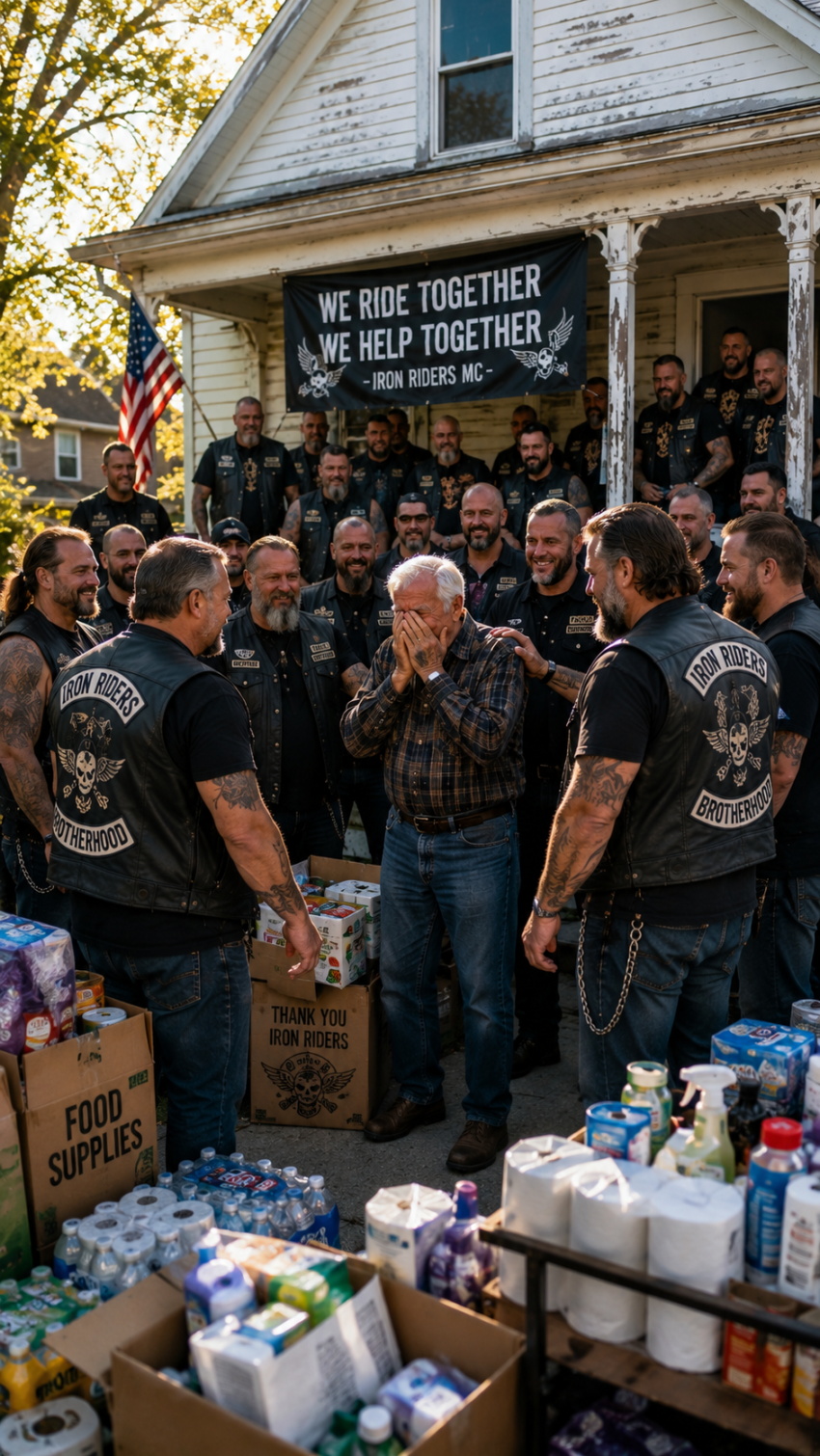
Behind her came Mack, a large man with a shaved head and gentle hands, carrying a new heater. Two more riders followed with lightbulbs, weather stripping, canned goods, and a bag of fresh oranges.
Nobody treated Arthur like a burden.
Nobody spoke to him like he was helpless.
They simply got to work.
Denise filled the pantry. Mack replaced the heater. Travis sealed the draft around the window. Another rider checked the kitchen sink. Someone else changed the dim bulb above Arthur’s table.
Arthur sat in his chair and watched strangers restore dignity to his home without making a show of it.
After a while, he asked the question sitting heavy in his chest.
“Why are all of you doing this?”
The room grew quieter.
Travis looked over from the window.
“Because you gave me your last twenty dollars.”
Arthur looked down.
“It was only twenty.”
Travis shook his head.
“No. It was kindness when you had every reason to keep it for yourself.”
No one spoke after that.
By the time they left, Apartment 3B was warmer. The pantry had food. The lamp beside Arthur’s bed worked again. The window no longer breathed cold air into the room.
Travis stayed near the door, helmet in hand.
“You need anything else tonight?”
Arthur looked around slowly.
His eyes were wet, but his voice stayed steady.
“No,” he said. “Tonight I just need to sit here and believe this really happened.”
The Truth Behind the Empty Cupboards
Travis came back two days later with stew.
Then again with laundry quarters.
Then again with a new rubber tip for Arthur’s cane because he noticed the old one slipping on the stairs.
Before long, the visits became a routine neither man had officially agreed to.
Little by little, Arthur began to talk.
He had worked at a hardware warehouse for thirty-two years. He had married Ruth when they were both young and broke and hopeful. They had one son, Martin, who used to be kind before bitterness and money changed him.
After Ruth passed, Martin and his wife offered to “help” Arthur with banking and bills.
At first, Arthur had been grateful.
Then his pension seemed to disappear faster each month. Bills went unpaid. Letters arrived that he did not understand. Martin always had an explanation.
“You’re getting older, Dad.”
“You forget things.”
“We’re only trying to protect you.”
Arthur wanted to believe him.
Because no parent wants to think their own child sees them as something to use.
One afternoon, Denise was helping Arthur sort mail when she found bank papers that did not make sense. Small transfers. Repeated charges. A separate account Arthur had never opened.
Travis read the papers in silence.
His jaw tightened.
“Arthur,” he said carefully, “this is why your money never lasts.”
Arthur stared at the numbers.
For a moment, he did not look angry.
He looked heartbroken.
“He used to run to me during storms,” Arthur said softly. “Ruth would make cocoa, and he’d sit between us until the thunder passed.”
Travis had no quick answer.
Some pain was too old and too personal for easy comfort.
But he knew one thing.
Arthur was not going to face it alone anymore.
The Son Who Came to Take Control
The truth moved slowly at first, then all at once.
Denise contacted a local senior advocate. Mack knew a retired accountant. Travis found a lawyer who agreed to review the papers.
They discovered more than missing money.
Martin had been signing forms without Arthur fully understanding them. He had contacted the apartment manager about moving Arthur into a cheaper facility. He had even discussed selling some of Ruth’s belongings from storage.
When Martin arrived at Apartment 3B, he came dressed in a pressed navy coat and irritation.
“Dad, what is going on?” he demanded.
Arthur sat at the table.
Travis stood near the window.
Denise leaned against the counter with her arms crossed.
Martin looked around at the repaired heater, the full pantry, and the bikers in the room.
“You brought these people into our family business?”
Travis answered before Arthur had to.
Martin turned sharply.
“You stay out of this.”
Arthur placed the copied bank records on the table.
His hand trembled, but his voice did not.
“No, Martin. I think it is time everyone stopped staying out of it.”
Martin barely looked at the papers.
Advertisements
That alone told the room enough.
“Dad, you’re confused,” he said. “We were managing things for you.”
Arthur’s eyes lifted.
“You were not managing things for me. You were managing me.”
Martin’s face hardened.
“These strangers have turned you against your own son.”
Arthur took a slow breath.
“No. They showed up when my own son stopped showing up with love.”
The words changed the room.
Martin looked stunned, then angry, then almost frightened.
He grabbed the papers and pushed them back.
“You’ll regret embarrassing me.”
Arthur did not look away.
“I regret trusting you with silence. I do not regret telling the truth.”
Martin left without saying goodbye.
After the door closed, Denise stepped closer.
“Are you okay?”
Arthur sat still for a long moment.
Then he nodded.
“I think I just remembered that being old does not mean I belong to someone else.”
A Town That Finally Looked Closer
The legal process took time, but the facts became harder to ignore.
The suspicious transfers were stopped. The apartment issue was reviewed. Martin and his wife were forced to answer questions they had avoided for too long.
Then other people in the building started speaking.
An older widow downstairs admitted her nephew had been pressuring her to sign over control of her checks. A retired teacher on the second floor said the property manager had been pushing elderly tenants to leave. A mail carrier remembered seeing Martin take envelopes from Arthur’s mailbox.
What had looked like one old man’s private trouble became something larger.
Hartwell began to wake up.
Harper’s Corner started offering pay-it-forward meals for seniors. The owner placed a small jar beside the register with a handwritten note:
For anyone who needs a warm plate and a little dignity.
The jar filled every day.
Travis and the riders began delivering groceries on weekends. Denise organized paperwork help at the community center. Mack repaired broken steps, loose railings, and drafty windows for anyone who asked.
Arthur wanted no attention.
But attention came anyway.
Not the cruel kind.
The kind that says, We see you now. We should have seen you sooner.
By spring, an empty storage space behind the café had become a small community pantry. Volunteers stocked shelves. Local farmers donated produce. Teenagers helped carry boxes.
They named it Ruth’s Table.
Arthur argued against it for two full days.
Then he saw the sign.
Ruth’s Table: Warm Meals, Open Hands, No One Turned Away.
He had to sit down.
Travis stood beside him, pretending not to notice the tears in his eyes.
“She would have liked this,” Arthur whispered.
Travis nodded.
“Then we did it right.”
The Bench Where It Started
Months later, Arthur sat once again on the bench outside Harper’s Corner.
The air was still cool, but not cruel this time.
Travis came out with two coffees and handed one to him.
They sat quietly, watching volunteers load food boxes into cars. Denise was laughing with Mack near the pantry door. A little boy waved at the motorcycles parked along the curb.
Arthur smiled.
“You know,” he said, “people used to cross the street when you all rode in.”
Travis took a sip of coffee.
“Some still do.”
“Not as many.”
Travis looked at him.
“You changed that.”
Arthur shook his head.
“No. A hungry man and an old fool with twenty dollars changed that.”
Travis laughed softly.
“You’re not a fool.”
Arthur reached into his coat pocket.
Travis saw the folded bill and groaned.
“No. Don’t even start.”
Arthur tucked the twenty beneath the sugar holder beside the café window.
“For the next person who needs breakfast.”
“Arthur, you are supposed to be more careful now.”
Arthur smiled.
“Careful is not the same as closed-hearted.”
Travis looked across the street at the riders, the volunteers, the pantry, and the town that had become a little softer because one man had refused to look away.
For the first time in years, he felt peace instead of regret.
And Arthur, sitting beside him with coffee warming his hands, felt something he had not felt since Ruth passed.
He felt remembered.
He felt protected.
He felt home.
Sometimes the smallest kindness carries the greatest weight, because it is not measured by how much a person gives, but by how much love and courage it takes to give when they have very little left.
No one should become invisible simply because they have grown older, because every lined face carries a history, every trembling hand once built a life, and every quiet person still deserves respect.
Real family is not proven by a shared last name; it is proven by who shows up when your room is cold, your cupboard is empty, and your voice has almost disappeared.
The world often judges people by appearance, but compassion has a way of revealing the truth, and sometimes the person others fear is the first one willing to protect the vulnerable.
It is painful when betrayal comes from someone you once held close, but even that pain can become the beginning of freedom when the truth is finally spoken aloud.
Receiving help is not weakness; sometimes it is the brave first step toward remembering that your life still has value and that you were never meant to carry every burden alone.
A community becomes stronger not through perfect words, but through ordinary people deciding that loneliness, hunger, and quiet suffering will no longer be ignored.
Pride can keep a person standing, but kindness can help them breathe again, and there are moments when a warm meal offered with dignity can feel like hope returning.
Every act of goodness travels farther than we think, touching people we may never meet and opening doors we never knew were closed.
In the end, life is changed by simple human choices: to notice, to care, to stand beside someone, and to never walk past a hurting person as if their pain does not matter.
“Funny. Your family business seems to involve taking money that isn’t yours.”