The Girl Who Ran Toward a Biker at the Gas Station
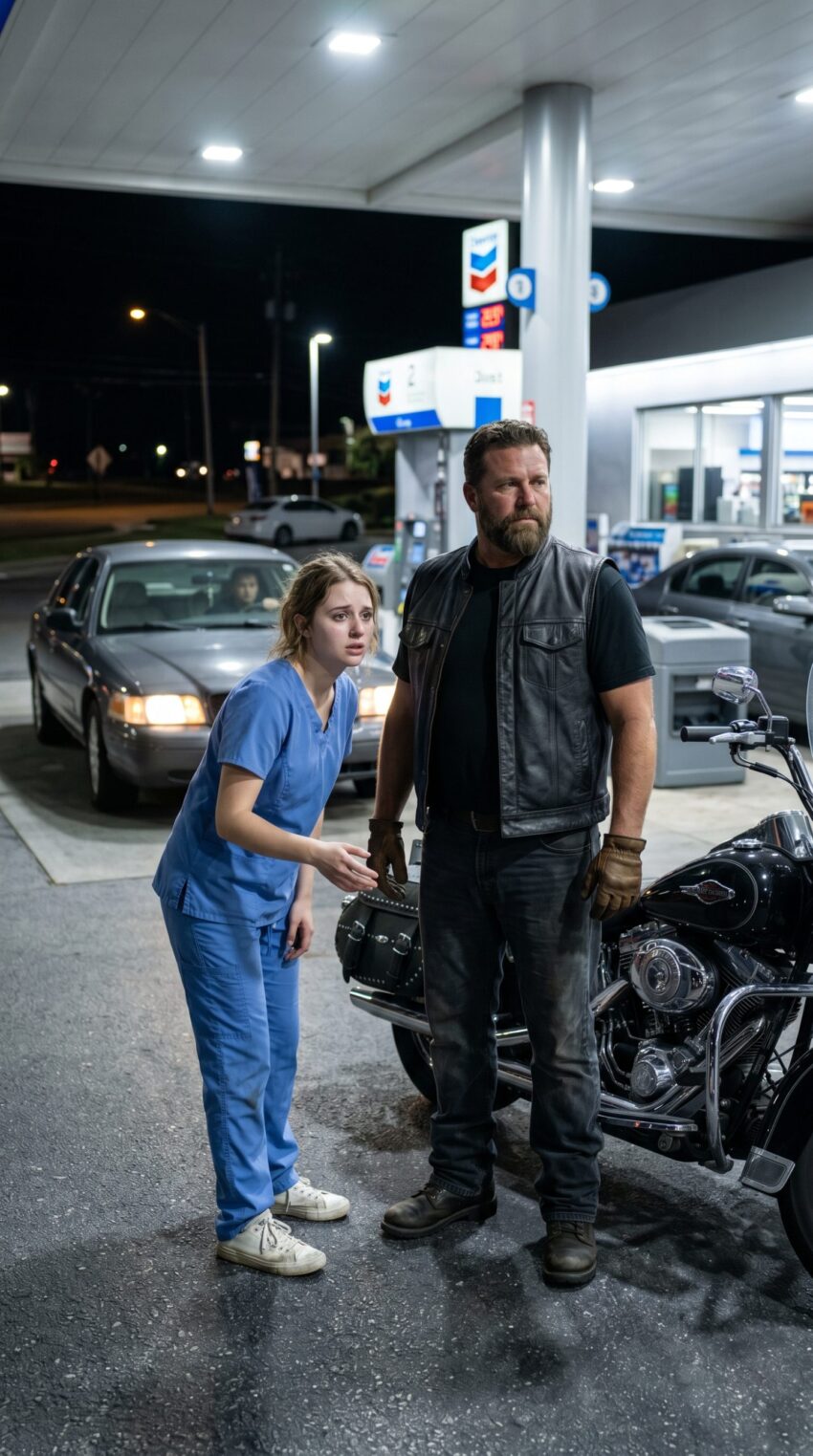
Nineteen-year-old Harper Quinn had just finished another exhausting shift at Mercy Ridge Medical Center in Dayton, Ohio.Her blue scrubs were wrinkled, her shoes ached from twelve straight hours on the hospital floor, and her mind was heavy with the same fear she had carried for days.
A gray sedan had been following her again.
At first, Harper tried to convince herself it was nothing. Maybe the car simply took the same road. Maybe the driver lived nearby. Maybe she was tired and imagining things.
But that night, when she turned twice and the sedan turned with her, her chest tightened.
By the time she reached a gas station on the edge of town, her hands were shaking so badly she could barely hold her keys.
Then she saw him.
A large biker stood beside a black cruiser motorcycle near pump four. He was broad-shouldered, bearded, and dressed in a black leather vest, heavy boots, and riding gloves. He looked like the kind of man most strangers would avoid.
But Harper did not avoid him.
She ran straight toward him.
“Please help me,” she whispered, her voice breaking. “That car has been following me since I left work.”
The Stranger Who Believed Her
The biker’s name was Wyatt Boone.
He had stopped for gas after visiting an old riding friend across town. He was checking his phone when he heard fast footsteps behind him.
When he looked up, he saw Harper standing there with tears in her eyes.
Wyatt did not laugh. He did not tell her she was overreacting. He did not ask why she had waited so long to speak up.
He only looked past her toward the road.
The gray sedan was parked near the air pump, its lights dimmed, its windows too dark to see through.
Wyatt’s face changed.
“Stay behind my bike,” he said calmly.
Harper obeyed at once.
Wyatt stepped forward, placing himself between her and the sedan. He did not rush. He did not shout. He simply walked toward the car with steady, quiet purpose.
The sedan’s engine suddenly growled.
For one tense second, Harper thought the driver might speed toward him.
Instead, the car reversed sharply, tires scraping against the pavement, then pulled out of the gas station and disappeared down the road.
Wyatt watched until the taillights faded.
Then he turned back to Harper.
“He’s gone for now,” he said. “But this wasn’t the first time, was it?”
Harper shook her head as tears slipped down her face.
“I tried telling people,” she said. “No one believed me.”
The Long Road Away From Fear
Wyatt listened as Harper explained everything.
The car had appeared outside the hospital several nights in a row. She had seen it near her apartment building. She had even reported it once, but the answer she received made her feel smaller than before.
They told her nothing could be done unless something clearer happened.
Wyatt’s jaw tightened.
His own daughter was only a few years older than Harper. The thought of her being ignored while afraid on a dark road made his stomach turn.
“You’re not driving home tonight,” he said.
Harper looked at him with panic in her eyes.
“I don’t have anywhere else to go.”
Wyatt nodded once, as if the decision had already been made.
“Then you’re coming with me. My club has a place nearby. You’ll be safe there.”
Harper glanced at his leather vest. She had heard stories about biker clubs. Some were true. Some were not. But the man standing in front of her had done more in two minutes than anyone else had done in two weeks.
So she nodded.
“Okay,” she whispered. “Please don’t let him find me again.”
Wyatt’s voice softened.
“Not tonight.”
The Clubhouse With Open Doors
Wyatt drove carefully, taking side roads through the industrial district. Harper held tightly to his waist as the cold wind cut across her face.
Several blocks later, Wyatt noticed the gray sedan again.
It stayed far behind them, moving like a shadow.
Wyatt took a sharp turn through a service road near an old construction site. His motorcycle slipped through a narrow gap between concrete barriers, a place no car could follow.
When they reached the clubhouse, the gate opened to an old brick warehouse with lights over the entrance and motorcycles parked in a long row.A man with a shaved head and a thick gray beard looked at Harper, then at Wyatt.
“What happened?” he asked.
Wyatt helped Harper off the motorcycle.
“She’s being followed,” Wyatt said. “Gray sedan. Driver knows her work route and maybe where she lives.”
The mood changed immediately.
Nobody questioned Harper. Nobody asked if she was sure. Nobody made her explain herself twice before deciding whether she deserved help.
A woman named Tess brought her inside, wrapped a blanket around her shoulders, and placed a hot cup of coffee in her hands.
“You’re safe in here, honey,” Tess said. “Take a breath.”
For the first time that night, Harper did.
The Truth Behind the Gray Sedan
Inside the clubhouse, Wyatt and the others checked nearby security cameras.
The gray sedan had not simply followed Harper by chance. It had passed her workplace several times that week. It had waited near her apartment building. It had circled the hospital parking lot.
Harper stared at the screen, her fingers tight around the coffee mug.
“I thought I was losing my mind,” she said quietly.
Wyatt looked at her.
“You weren’t,” he said. “You were paying attention.”
One of the bikers, a former mechanic named Ellis, zoomed in on the back of the sedan. There was a small white sticker near the bumper, partly covered in dirt.
Wyatt frowned.
“I’ve seen that mark before,” Ellis said. “Those people run a private security group out near North Hills. They act like they own half the county.”
Harper’s stomach turned.
She had never met them. She had no idea why anyone like that would want to follow her.
Then she remembered something.
Her father was a reporter in Columbus. Years earlier, he had written a series of stories that exposed a powerful local figure who later lost his position.
Harper whispered the name.
The room went still.
Wyatt looked at the others.
“That explains why they picked her.”
When the Night Became Louder
The clubhouse lights flickered.
Then several camera feeds went black.
The bikers moved quickly, but no one panicked. Gates were checked. Doors were locked. Tess guided Harper toward a secure back room beneath the old office floor.
Harper grabbed Wyatt’s sleeve before he could leave.
“What if they come inside?”
Wyatt looked down at her, steady and calm.
“Then they picked the wrong building.”
A heavy crash shook the front gate.
Harper flinched as Tess pulled her into the back room. Above them, boots moved across the floor. Voices rose. Engines growled outside.
The gray sedan was not alone anymore.
Two dark trucks had pulled up behind it.
The people inside had not come to talk.
Wyatt stood near the broken entrance with the others, his hands low, his expression hard. He had spent years on the road, seen plenty of trouble, and learned that some people only understood strength when kindness was standing behind it.
But this was not about pride.
This was about a frightened young woman who had asked for help and deserved to receive it.
The Stand at the Clubhouse
The men outside expected the bikers to back down.
They were wrong.
When the first group pushed through the entrance, Wyatt and his brothers blocked them from going farther. The bikers did not fight to prove anything. They held their ground to protect Harper.
The confrontation was fast, loud, and frightening, but Wyatt never lost focus.
Every move he made had one purpose.
Do not let them reach the back room.
The man from the gray sedan stood in the courtyard, dry under a hooded jacket, watching with a cold smile. He looked less like a stranger now and more like someone who had planned every detail.
Wyatt stepped outside into the rain.
The man smiled.“You don’t understand what you’ve stepped into,” he said.
Wyatt’s voice was low.
“I understand enough. She asked for help. That made it my business.”
The man’s smile faded.
Behind him, headlights appeared at both ends of the street.
Not police headlights at first.
Motorcycles.
Dozens of them.
Wyatt’s club had sent an emergency call when the cameras went down, and riders from nearby chapters had answered.
The street filled with the deep thunder of engines.
The men in the trucks suddenly realized they were surrounded.
The Help That Finally Came
Within minutes, state police arrived.
This time, the right people were listening.
The men outside the clubhouse were detained. The gray sedan was searched. Inside, investigators found photos of Harper’s workplace, notes about her schedule, and a copied key to her apartment building.
The man behind it all was identified as Russell Vance, a former public official whose reputation had been damaged years earlier by Harper’s father’s reporting.
He had not targeted Harper because of anything she had done.
He had targeted her because he wanted revenge on someone connected to her.
The discovery shook the city.
Questions were asked about why Harper’s earlier reports had been brushed aside. Officials who ignored her were placed under review. The private group connected to Vance was investigated.
Harper stood in the clubhouse courtyard as dawn slowly brightened the sky.
Her scrubs were still wrinkled. Her eyes were tired. But she was no longer standing alone.
Wyatt walked toward her, wiping rain from his beard.
“You did good,” he said.
Harper gave a weak laugh.
“I ran to a stranger at a gas station.”
Wyatt shook his head.
“No. You trusted your own fear when everyone else told you not to.”
The Pin on Her Hospital Badge
A week later, Harper returned to the hospital.
Some people looked at her differently. Some apologized. Some avoided her eyes because they knew they had dismissed her when she needed help.
Harper did not argue with them.
She simply walked through the halls with her head a little higher.
Before she left the clubhouse, Wyatt had given her a small silver pin shaped like a winged wrench, the symbol his club used for people they considered family.
“Keep it,” he told her. “If you ever see one of us on the road, show them that. You won’t have to explain everything from the beginning.”
Harper wore the pin behind her hospital badge.
Years later, when she became a trauma nurse, she still kept it there.
And on some Friday nights, after finishing a long shift, she stopped at the same gas station where everything changed.
Sometimes Wyatt was there, leaning beside his black motorcycle with a cup of coffee in his hand.
Harper would buy two coffees, leave one near him, and smile.
Because the world had once made her feel invisible.
But one biker had looked up, listened, and refused to turn away.
Ten Long Messages and Reflections
Sometimes the person who saves you is not the person with the perfect title, the cleanest reputation, or the most polished words, but the stranger who sees fear in your eyes and chooses to stand beside you before asking what it will cost.
When someone says they are afraid, the kindest thing you can do is not dismiss them, not mock them, and not tell them to calm down, but listen carefully enough to understand that fear often arrives before proof does.
Harper’s story reminds us that courage is not always loud; sometimes courage is a young woman running across a gas station parking lot and asking for help even after the world has taught her that no one will believe her.
Wyatt did not need to know Harper’s entire life story before protecting her, because real decency does not wait for a perfect explanation before doing what is clearly right.
A leather vest can frighten people who only judge by appearances, but character is not stitched onto clothing; it is shown in the moment someone vulnerable stands in front of you and needs shelter.
The people who ignored Harper may have had rules, excuses, and procedures, but Wyatt had something far simpler and stronger: the belief that no one should have to walk through fear alone.
This story is not only about danger on a dark road; it is about what happens when one person finally says, “I believe you,” and those three words become the first safe place someone has felt in weeks.
The strongest brotherhoods are not built only on motorcycles, patches, or long roads, but on the promise that when someone is left unheard, they will become a voice loud enough to call others into action.
Harper did not become strong because the fear disappeared; she became strong because someone helped her survive the moment when fear was trying to make her silent.
And maybe the lesson is simple: every city needs more people like Wyatt, people who do not look away when a stranger trembles, people who understand that protection begins with listening, and people who prove that kindness can be as powerful as thunder on an empty road.
Based on the uploaded source story.