The Woman Who Only Asked for One Witness
The town of Ashbury Ridge, Kentucky, had seen plenty of unusual things over the years—summer storms that knocked out power for days, parades that filled Main Street with tractors and marching bands, and church suppers where everyone somehow knew everyone else’s business before dessert was served.
But nothing in that quiet town had prepared people for what they would see on a cool Thursday morning outside Faith Chapel.
Long rows of motorcycles stood along the narrow road like a wall of chrome and black leather, stretching farther than anyone could count at a glance. Men and women in riding boots and weathered vests stood in complete silence, helmets tucked under their arms, eyes lowered with a kind of respect that made even the wind seem quieter.
Most of them had never met the man whose funeral they had come to attend.
And yet, they had come anyway.
What the town did not know was that the whole thing had begun the afternoon before, with a trembling ninety-one-year-old widow, a roadside diner, and one request spoken so softly it could have been missed by anyone who was not really listening.
A Small Table by the Window
The afternoon sun leaned warm and low across the windows of Miller’s Turnpike Diner, painting the booths in soft gold. The place smelled like coffee, toasted bread, and the kind of pie crust that always made people stay longer than they meant to. A few truckers sat near the counter. A young waitress moved between tables with a coffee pot in one hand and a pencil tucked behind her ear.
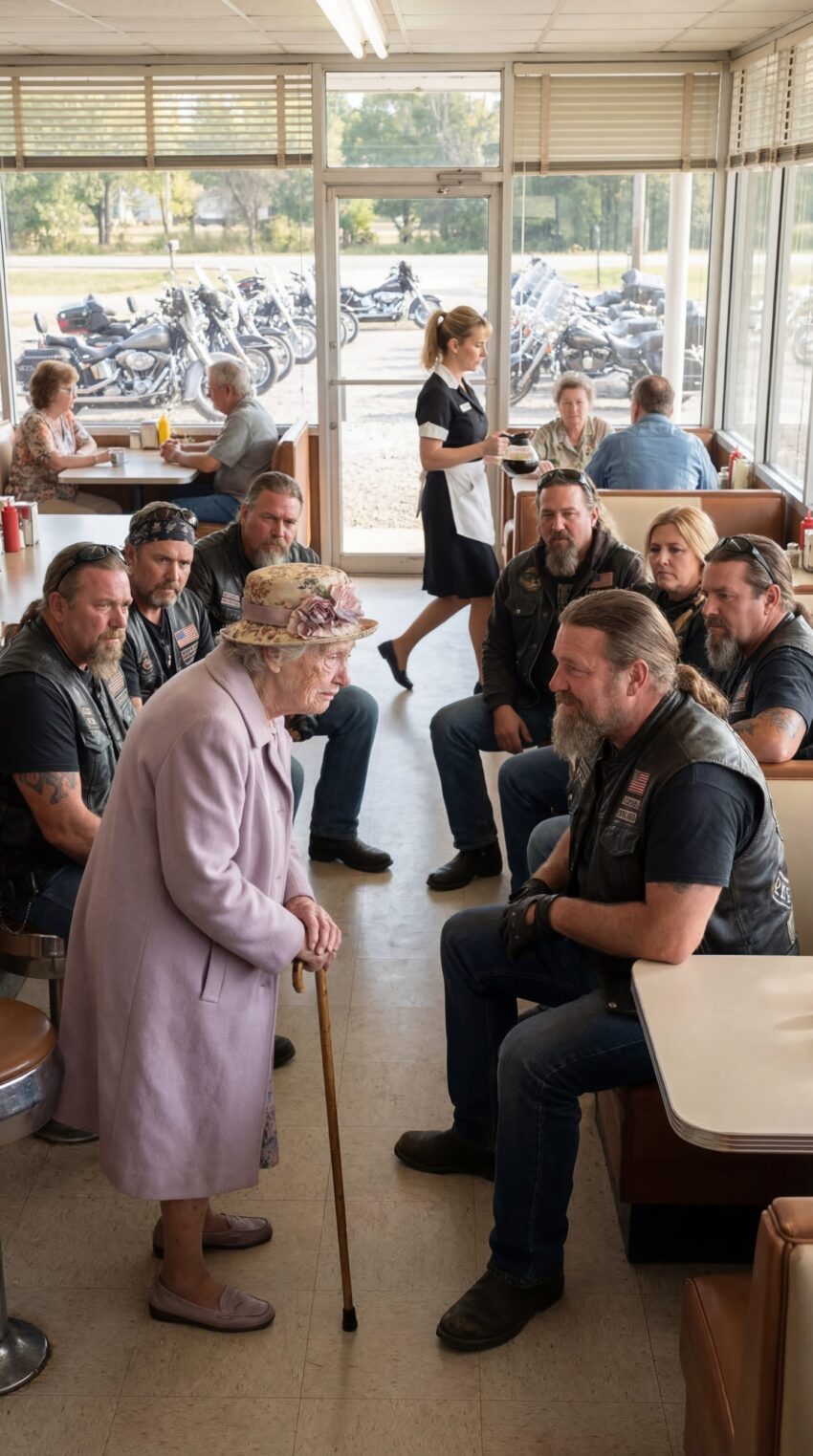
At a booth by the window sat four bikers who looked like they had been on the road for hours. Their jackets were folded beside them, their boots dusty, their shoulders broad and tired in the way that came from long miles and strong wind. They belonged to a riding club called the Black River Legion, a group known in several states not for causing trouble, but for never turning their backs on one another.
The oldest among them was a heavily built man named Wade Callahan. His beard was streaked with silver, his knuckles scarred from years of hard work, and his voice, when he did speak, carried a quiet steadiness that made younger riders listen. He was stirring sugar into his coffee while the others talked about road construction, weather maps, and how far they could get before nightfall.
That was when the front door opened.
The bell above it gave a tired little jingle, and in stepped a woman so slight that the first thought anyone had was that the wind might have carried her in if she had not been leaning on a wooden cane.
Her name was Evelyn Mercer.
She wore a pale lavender coat buttoned carefully at the front and a small hat that had probably belonged to better years, years when she and her husband still drove into town every Sunday after church and sat at the same corner table sharing pie with two forks. Her hands trembled slightly as she paused near the entrance, letting her eyes adjust.
Six days earlier, her husband, Harold Mercer, had passed away in the living room of the little house they had shared since 1971.
She had not yet learned how to walk through a day without feeling as if some important part of the world had gone missing.
A Fear Too Heavy to Carry Alone
Evelyn had almost turned around before ordering anything.
She had told herself all morning that she would not trouble strangers. She had repeated it while putting on her coat, while finding Harold’s old handkerchief in the kitchen drawer, while locking the front door behind her. But grief had a way of pressing on the same thought until it became impossible to ignore.
Harold’s funeral was scheduled for ten o’clock the next morning at Faith Chapel, the small white-brick church at the edge of town where they had worshiped for decades. The pastor had been gentle when he spoke to her, but gentle words could not hide the truth: very few people had said they would be there.
Their only daughter had passed away years ago after a sudden illness. Harold’s brothers were gone. Most of their old neighbors had either moved away, grown too frail to travel, or left this life themselves. Time had quietly thinned their circle until Evelyn hardly noticed how small it had become—until now.
The thought of Harold lying in a near-empty church had kept her awake for three nights.
She would lie in bed staring at the ceiling, remembering the way he used to whistle while fixing old clocks in the garage, the way he always warmed up the car for her in winter, the way he still called her sweetheart even when his voice had grown thin with age.
She sat alone in a booth with a menu open in front of her, though she did not read a single word on it. Every few moments, she glanced toward the bikers by the window. They looked strong, loud in appearance, impossible to misunderstand from a distance. And yet there was something oddly respectful in the way the older man listened more than he spoke.
For nearly ten minutes, she tried to gather the nerve to approach them.
Then at last, with the kind of courage that only appears when a person feels they have nothing left to protect except love, Evelyn rose from her seat and walked slowly across the diner floor.
The Question That Changed Everything
The younger riders noticed her first and fell quiet. Their conversation stopped as she reached the edge of the table, one hand wrapped tightly around her cane. Wade looked up, and whatever he saw in her face made his expression soften immediately.
“Afternoon, ma’am,” he said.
His voice surprised her. It was deep, yes, but gentle too.
Evelyn swallowed and nodded once. “I’m sorry to interrupt you,” she said. “I know you’re likely just passing through, and I hate to bother anyone, but… I wondered if I might ask something.”
The youngest rider moved as if to stand, perhaps to offer her his seat, but Wade lifted a hand slightly and gave a quiet nod toward the empty chair beside the booth.
“You’re not bothering anybody,” he told her. “Take your time.”
She remained standing. She seemed afraid that if she sat down, the little strength holding her together might leave all at once.
“My husband passed last week,” she said, and the words came out thinner than she had intended. “We were married sixty-eight years.”
That changed the table instantly.
One rider removed his cap. Another lowered his eyes. The shift was so natural, so immediate, that Evelyn almost lost her breath.
“I’m sorry for your loss,” Wade said quietly.
She nodded and looked down at the diner floor, where late sunlight stretched across the tiles.
“His service is tomorrow morning,” she continued. “At ten. And there’s hardly anyone left to come. Most of our people are gone now. The few who are still here can’t travel.”
Her fingers tightened around the cane.
“I suppose I’m ashamed to even say it out loud,” she said with a fragile smile that broke before it fully formed. “But I’m afraid my Harold will be sent off with almost no one there.”
For a moment the diner seemed to hold its breath.
The hum of the refrigerator behind the counter sounded louder. A spoon clinked against a mug somewhere far away. No one at the surrounding tables pretended not to listen anymore.
Wade leaned forward, resting his forearms on the table.
“What is it you’re asking from us, ma’am?”
Evelyn looked at him, and in her face there was no pride left, only truth.
“I just need someone at the funeral,” she whispered. “Just someone, so he won’t be alone.”
A Promise Made Over Coffee
Wade did not answer right away.
He studied her face carefully, the deep lines shaped by many years, the grief she was trying so hard to hold with dignity, the exhaustion of a woman who had already spent too many nights bracing herself against loneliness.
Then he pushed back from the booth and stood.
He was a tall man, broad enough to block part of the window behind him, but there was nothing hard in the way he looked at her.
“What time did you say the service starts?” he asked.
“Ten in the morning,” Evelyn replied.
He nodded once.
“Then I think we can make sure your husband has company.”
Her eyes filled almost at once.
“You mean… you and your friends?” she asked.
A small smile touched the corner of his mouth.
“Let’s just say he won’t be by himself.”
Evelyn thanked him more than once. She was already overwhelmed by the idea that four strangers would show up for a man they had never known. To her, that already felt like an undeserved kindness, the sort of mercy people only read about in church bulletins and community newsletters.
She had no way of knowing that the promise standing before her was about to travel far beyond that diner, across county roads and highways, through garages, motel parking lots, gas stations, and late-night group messages.
When she finally left, moving slowly toward the door with her cane, Wade watched until she disappeared into the afternoon light.
Then he reached for his phone.
The Message That Rolled Across State Lines
The Black River Legion was more than a club built around motorcycles. To the people inside it, loyalty was not decoration. It was a rule. If one rider called, others answered. If someone vulnerable needed help, word moved fast.
Wade opened a private group thread used by riders scattered across Tennessee, Indiana, Missouri, and beyond. Some were on the road. Some were off work and at home. Some were halfway through fixing bikes in cluttered garages with country radio playing in the background.
He typed only one short message:
Widow in Ashbury Ridge. Ninety-one years old. Husband’s funeral tomorrow at Faith Chapel, 10 a.m. She’s afraid nobody will show. Let’s change that.
Replies came almost instantly.
On my way if I can make it.
Send the address.
Two hours out by midnight.
I’ll wake the others.
Count me in.
The phone buzzed again and again in his hand.
Across miles of darkening highway, riders adjusted plans without hesitation. A woman in southern Indiana packed an overnight bag and checked the air in her tires. A retired mechanic in Missouri called his son and said he would be gone until the next day. Two brothers outside Nashville changed their route entirely and fueled up under a gas station canopy as twilight settled over the pumps.
Most of them had never heard the name Harold Mercer before that afternoon.
But they knew what it meant for a person to be left with too little company at the end of a long life.
And for people who had built their own lives around brotherhood, that idea sat wrong in the heart.
The Long Night Before Morning
By nine that night, the message thread had become a stream of names, locations, estimated arrival times, and short promises written in the plain language of people who did not need many words to mean what they said.
Wade and his three companions had taken rooms at a roadside motel just outside town. The neon vacancy sign outside the office flickered on and off while crickets sang in the grass. Inside his room, Wade sat on the edge of the bed with his phone in one hand and his boots still on.
A younger rider named Jesse Pike leaned against the doorframe, arms crossed, watching the list grow.
“This is getting bigger than I thought,” Jesse said.
Wade let out a slow breath that might have been a laugh.
“Good,” he answered. “That old lady asked for one witness. I think her husband deserves a room full of them.”
By midnight, the count had climbed past fifty.
By one in the morning, it had gone well beyond that.
Headlights cut through farmland and sleeping towns. Engines rolled over long stretches of blacktop where only truckers and night workers were awake to hear them. Riders leaned into the wind, jackets pulled tight, eyes on the road, all heading toward a church most had never seen for the sake of a woman whose voice still trembled in Wade’s memory.
Meanwhile, on Willow Creek Lane, Evelyn Mercer sat alone at her kitchen table folding the black dress she would wear in the morning. The house was painfully quiet. Harold’s reading glasses still rested beside his chair. His favorite mug still stood in the dish rack. The silence was so complete that she could hear the tick of the wall clock in the hallway.
She believed four bikers might come.
Maybe five.
That thought alone was enough to make her whisper a soft thank-you into the empty room before going to bed.
The Town Wakes to a Surprise
The first motorcycles arrived shortly after sunrise.
Ashbury Ridge was just beginning to stir. The owner of the hardware store was unlocking his front door. A woman at the bakery was turning on lights in the display case. A school bus passed through one intersection with only a few children aboard.
Then the bikes came.
One pair at first.
Then four more.
Then six.
Then a line of engines rolling in low and steady from the eastern highway, followed by another cluster from the south road half an hour later.
They parked neatly along both sides of the road leading to Faith Chapel. No revving for attention. No shouting. No disorder. Just arrival after arrival, each rider stepping off the bike, removing a helmet, and asking one simple question:
“Is this for Harold Mercer?”
By eight o’clock, people in town had started whispering.
By eight-thirty, the church caretaker had stepped outside twice just to make sure he was seeing correctly.
By nine, there were so many motorcycles along the road that passing cars slowed almost to a stop.
Yet the mood remained calm, almost reverent. Riders spoke quietly. Some helped direct newcomers into place. Others stood with their hands folded in front of them, boots planted in the morning gravel, faces solemn.
The townspeople expected noise.
What they found instead was respect.
The Widow at the Church Gate
At a quarter to ten, Evelyn’s taxi turned onto the narrow road leading to Faith Chapel.
She was looking down at the folded funeral program in her lap, tracing Harold’s printed name with one finger as if she still could not believe the page belonged to real life. The driver slowed suddenly.
“Ma’am,” he said, leaning forward over the steering wheel, “I think there’s some kind of event here.”
Evelyn looked up.
At first, her mind could not make sense of what her eyes were seeing.
Motorcycles lined both sides of the road, stretching far beyond the church yard. Men and women in dark riding vests stood in still rows beneath the pale morning sky. Chrome flashed softly in the sunlight. Not a rally. Not a parade. Not chaos. Something quieter, weightier.
Then she saw Wade.
He stepped away from the crowd and walked toward the taxi, helmet in hand.
The driver opened her door. Evelyn stepped out slowly, leaning on her cane, her eyes moving from face to face and then back to Wade as tears began to gather before a single word could form.
“Mr. Callahan,” she said softly.
He smiled with warmth that seemed to belong to an old friend rather than a stranger she had met only the day before.
“Morning, Mrs. Mercer.”
She turned in a small circle, overwhelmed.
“What is all this?” she asked, her voice trembling.
Wade glanced toward the gathered riders.
“You said you didn’t want your husband to be alone,” he replied. “So nobody let him be.”
At those words, the crowd began to move.
Not loudly. Not suddenly.
Just quietly, with the natural order of people who understood what was being asked of them. Riders formed two long lines from the church gate to the front doors, creating a path of honor. Helmets came off. Heads bowed. The last engines shut down, and the road fell into a silence so complete that Evelyn could hear herself crying.
She covered her mouth with one hand.
“They came for Harold?” she whispered.
Wade gently offered her his arm.
“They came for both of you,” he said.
A Farewell Filled With Witnesses
As Evelyn walked between the lines of riders, each person lowered their head respectfully as she passed. Some placed a hand over their heart. Some gave the smallest nod. None of them rushed her. None of them made a spectacle of their kindness. They simply stood there and gave her what she had begged for in the diner: presence.
Inside the church, every pew was filled.
Leather vests and work boots mixed strangely but beautifully with hymnals, stained glass, and polished wood. The pastor, Reverend Nolan Pierce, stood at the front with visible emotion in his face when he saw how many people had come. For a moment he had to clear his throat before he could begin.
The service was simple.
Evelyn spoke about Harold’s steady life—how he repaired old radios for neighbors who could not afford new ones, how he planted tomatoes every spring even when his knees hurt, how he whistled old country songs while sweeping the porch, how he never once forgot their anniversary in sixty-eight years of marriage.
People listened as if they had known him.
That was the part that nearly broke her all over again.
They listened to stories about a quiet man from a small town as though his life mattered deeply.
And perhaps that was the whole point. It did.
When the service ended and it was time for the final goodbye, the line of riders approaching the casket stretched through the aisle, out the doors, and into the churchyard. One by one they stepped forward. One rested a gloved hand lightly against the polished wood. Another removed his cap and bowed his head. A woman with silver hair braided down her back whispered, “Ride easy, sir,” before moving on.
No one tried to make the moment about themselves.
They were there to bear witness.
And they did.
The Card in the Envelope
After the burial, as the late-morning sun rose a little higher and people began returning to their bikes, Wade walked over to Evelyn with a plain white envelope in his hand.
“This is for you,” he said.
She opened it carefully.
Inside was a large card signed edge to edge with names—first names, road names, initials, small notes written in black and blue ink from riders who had come from miles away. Some signatures were neat. Some looked as if they had been hurried at the last minute while leaning on a motorcycle seat.
At the bottom, written in larger letters than the rest, was a single sentence:
No one leaves this world without company.
Evelyn pressed the card to her chest.
By then, she was crying too hard to speak, but Wade seemed to understand. He only nodded, tipped his head respectfully, and stepped back.
Soon the engines began again, not harsh now, but almost musical in the open country air. One by one, then in groups, the riders pulled away from Faith Chapel and rolled down the road past fields and fences and mailboxes, their long line slowly thinning as they disappeared beyond the bend.
The thunder of motorcycles faded.
But the kindness they had left behind stayed.
In the days that followed, people in Ashbury Ridge would retell the story in barber shops, grocery aisles, church circles, and front porches. They would remember the sight of hundreds of bikers standing in silence for a man most of them had never met. They would remember the widow in the lavender coat. They would remember how compassion had arrived not as something soft and small, but as something powerful enough to fill an empty church.
And Evelyn Mercer, sitting alone in her house that evening with Harold’s card in her lap, would understand that while grief could still be heavy, loneliness had loosened its grip.
Because one whispered request had crossed the path of people willing to hear it.
And they answered with everything they had.
Sometimes the greatest kindness in life is not found in grand speeches or perfect plans, but in the simple decision to show up for someone when their heart is too tired to ask twice and their grief has already taken more from them than words can explain.
A person does not need to have known someone for years in order to honor their life with sincerity, because respect is not measured by history alone, but also by the willingness to stand still in another person’s sorrow and say, without needing many words, that their loss matters.
The world often teaches people to judge one another by appearance, by reputation, or by the stories they have heard from a distance, yet some of the gentlest acts of mercy come from the very people others never expected to carry such tenderness in their hearts.
No one should have to say goodbye to a loved one while feeling abandoned by time, circumstance, or silence, and whenever human beings choose to close that lonely gap for one another, they create the kind of dignity that stays in memory far longer than flowers or formal ceremonies ever could.
There is something deeply healing about being witnessed in pain, because sorrow becomes a little less crushing when even one person chooses to remain present, and what feels unbearable in isolation can become survivable when shared in the company of compassionate strangers.
The most meaningful legacies are not always built through fame, wealth, or public recognition, but through ordinary years of faithfulness, kindness, routine, sacrifice, and love—the kind of life that deserves to be honored fully even if only a small town had once noticed it.
True strength is not only found in endurance, loud courage, or physical presence, but also in the quiet discipline of treating fragile moments with care, protecting another person’s dignity, and understanding when silence can be more respectful than any speech ever spoken.
When people come together for no reward other than doing what is right, they remind the world that goodness is still alive in places where cynicism said it could not survive, and that compassion can travel astonishing distances when guided by sincerity instead of obligation.
Every human life deserves a farewell touched by respect, and every grieving heart deserves the comfort of knowing that love does not vanish simply because a room feels empty at first, because sometimes help is already on the road before we even realize anyone has heard us.
If there is one lesson worth holding onto from moments like this, it is that we should never underestimate the power of one honest request, one open heart, and one promise kept, because those three things together can transform an ordinary day of sorrow into a memory of grace that lasts forever.