In the small town of Red Hollow, Missouri, there was a house that didn’t stand out because of its size or design, but because of the life that had unfolded inside it.
For over sixty years, Harold Whitaker had called that place home.
He had raised his children within those walls. He had watched them take their first steps across the same worn wooden floors. He had stood in the kitchen late at night with his wife, sharing quiet conversations after long days. And when she passed, it was in that very home that he learned how to live with silence.
Every corner of the house carried something no one else could see—memories that could not be packed into boxes.
But one morning, everything changed.
A letter arrived.
It was formal, brief, and difficult to fully understand at first glance. It explained that the city had approved a development plan. The land Harold’s home stood on had been included. He would need to leave.
Seven days.
That was all the time he was given.
The amount offered in return felt small compared to what the house meant, but Harold didn’t argue. He read the letter more than once, his hands trembling slightly, trying to make sense of what he was being asked to accept.
“I just need a little more time,” he quietly told the officials who later came to speak with him.
“I’ve been here a long time… I don’t know how to leave it all behind so quickly.”
They listened, but their responses stayed formal.
The process, they explained, had already been set in motion.
The Day Everything Became Visible
On the morning Harold was asked to step outside, the air felt unusually still.
A few officials stood near the porch, speaking in low, careful tones. They helped him down the steps, moving slowly as he steadied himself with his walker. His oxygen tank rested gently at his side, swaying slightly with each step.
There was no shouting. No sudden movement.
But something about the moment felt heavier than words.
A neighbor, standing across the street, quietly recorded what was happening—not out of curiosity, but because it didn’t feel right to look away.
By evening, that video had reached far beyond Red Hollow.
People who had never met Harold began watching the clip. They saw an elderly man leaving a home filled with a lifetime of memories, and something about it stayed with them.
Questions began to appear.
Not accusations. Not anger.
Just questions.
A Quiet Movement Begins
As the sun went down, something unexpected started to happen.
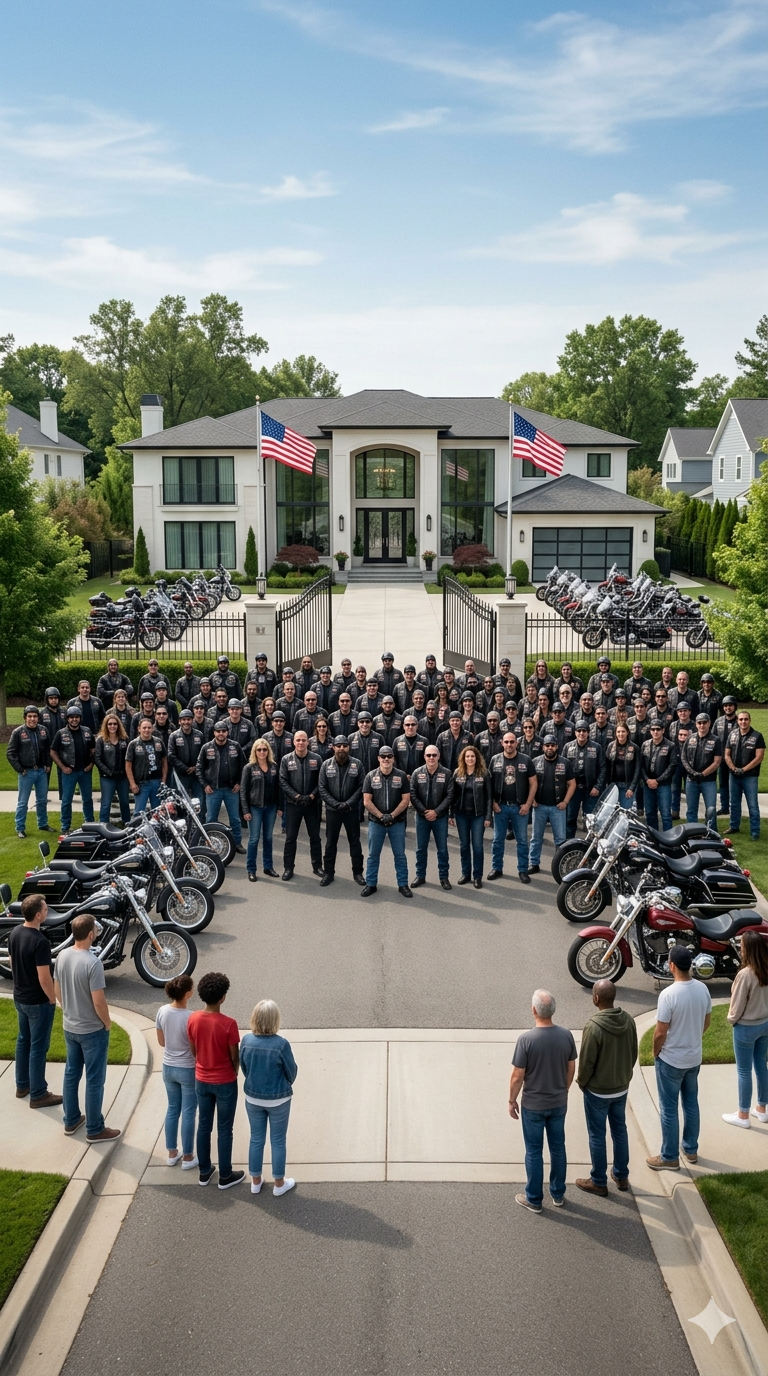
Motorcycles began arriving—not loudly, not all at once, but steadily.
One. Then another.
Then more.
They came from different directions, different roads, different parts of the state. Some riders knew each other. Many did not. But that night, they didn’t need introductions.
They parked carefully, forming long rows along the street.
No one blocked the road. No one caused disruption.
They simply stood there.
Watching. Waiting.
Standing together.
When Differences No Longer Mattered
By late evening, it was clear that this was not just a small gathering.
Groups that rarely crossed paths found themselves side by side. Clubs with different histories, different colors, different stories—all present for the same reason.
It wasn’t about territory.
It wasn’t about identity.
It was about one man.
And the feeling that something about his story deserved to be understood more clearly.
A Conversation Instead of a Confrontation
Not long after, City Manager Daniel Rhodes stepped outside his residence, clearly surprised by what he saw.
He looked across the street, taking in the rows of motorcycles, the calm but unmistakable presence of the crowd.
“What is all this?” he asked, his voice steady but uncertain.
A man stepped forward from the group—not aggressively, not hurried.
Just calmly.
“We’re here because people have questions,” he said.
“And sometimes, when something doesn’t feel right, the best thing to do is stop and take a closer look.”
There was no shouting.
No threats.
Only a quiet request for clarity.
The Moment People Started Paying Attention
More residents began stepping outside their homes
Then came local reporters.
Then cameras.
As the night unfolded, what had started as a quiet gathering slowly became something larger—a moment where people simply wanted to understand how things had reached this point.
Harold’s granddaughter, Emily Whitaker, arrived as well.
She had been the one who shared the video.
Standing among the crowd, holding her phone as thousands watched online, she spoke with a voice that trembled but did not break.
“My grandfather gave everything he had to this country and this town,” she said.
“He worked, he paid his dues, and he never asked for much… just to stay in the place he built his life.”
She paused, taking a breath.
“We’re not here to fight… we’re here to ask why this happened.”
When the Story Took a Different Turn
As more information came to light, officials acknowledged that the situation deserved further review.
Decisions had been made.
But now, those decisions were being looked at more closely.
What had once been a quiet administrative process had become a public conversation.
And in that conversation, something important was happening—people were being heard.
A Return That Meant More Than a House
The following morning, the street looked different.
Not because of the motorcycles.
But because of what had changed.
City representatives announced that the situation would be reassessed.
Harold was invited back.
Not permanently at first—but long enough for everything to be reviewed properly.
When he arrived, supported gently as he stepped back onto his porch, he paused.
His eyes moved slowly across the familiar space.
The door.
The windows.
The small details no one else would notice.
“I thought I had already said goodbye,” he whispered.
Behind him, riders stood quietly.
No engines running now.
No noise.
Just presence.
More Than Just One Home
Over the next few days, people came together—not as strangers, but as neighbors.
Small repairs were made.
The yard was cleaned.
Flowers were planted again near the front steps.
Nothing extravagant.
Just care.
Just respect.
The Day He Finally Felt at Peace
Months later, Harold passed away peacefully in his own home.
Not surrounded by headlines.
Not in the middle of a crowd.
But in the quiet place he had loved for decades.
The same place where his life had unfolded.
What People Remembered
In time, the story faded from the news.
But not from the people who had been there.
Each year, some of those riders returned—not for attention, not for recognition, but simply to remember.
Because for one night, something had shifted.
Not through force.
Not through anger.
But through people choosing to stand together, calmly, and ask for something better.
“Sometimes, it’s not about making noise,” one rider said softly.
“It’s about showing up… and not walking away.”
Sometimes, the smallest act of standing beside someone can carry more meaning than the loudest words ever spoken.
In moments when something feels unfair, it is often quiet courage—not anger—that brings real change.
A community is not defined by how loud it reacts, but by how deeply it cares when one of its own needs support.
There are times when asking questions with respect can open doors that force never could.
True strength is not always seen in confrontation, but in the ability to remain calm while standing firm for what matters.
Even in difficult situations, kindness has a way of reshaping how stories end.
When people choose to come together without division, they create something far more powerful than conflict.
Not every story needs a hero—sometimes it just needs people who refuse to look away.
A place becomes a home not because of its walls, but because of the life lived inside it.
And in the end, what matters most is not who had power, but who chose to use their presence to protect something meaningful.