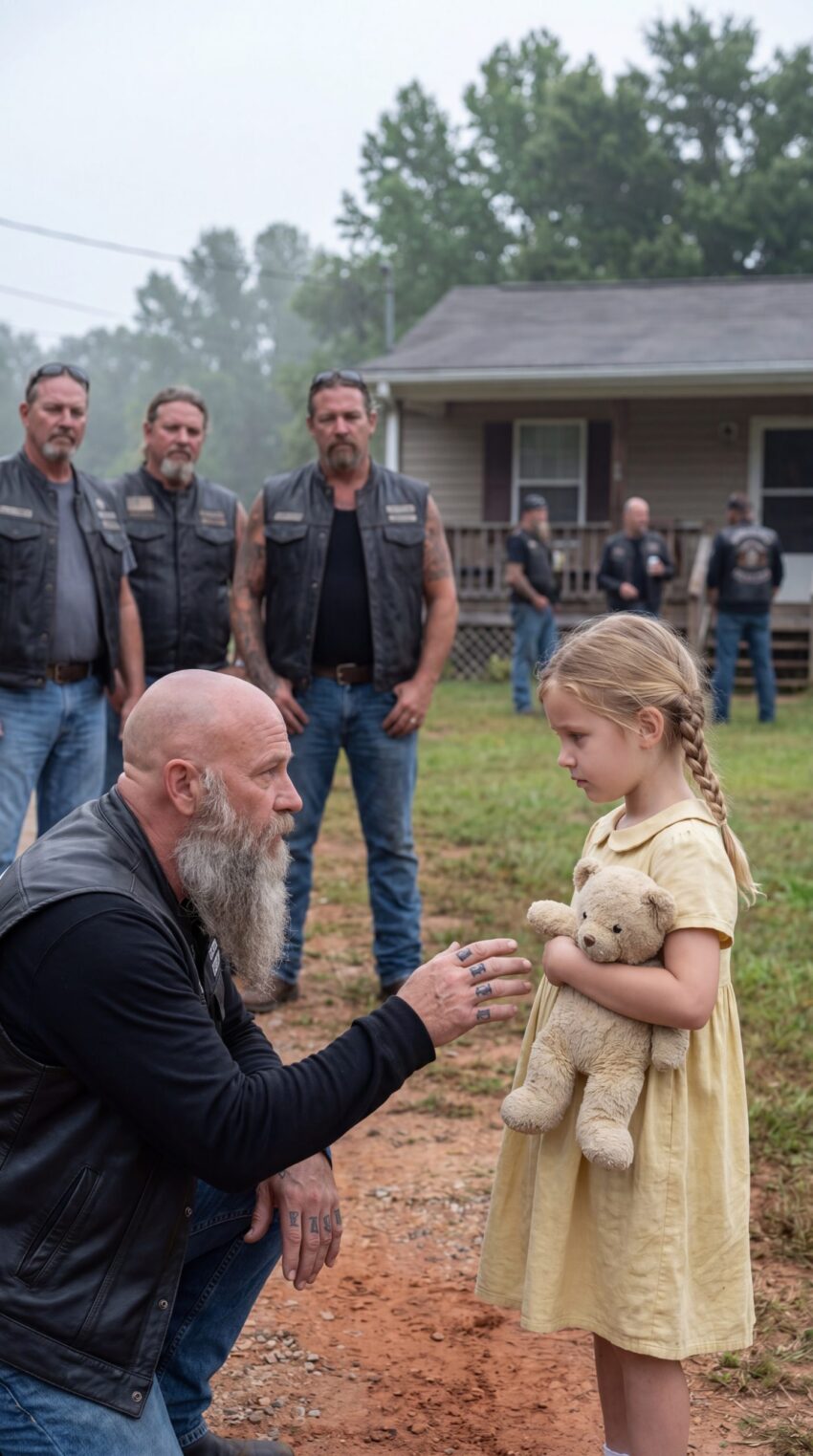
The Letter That Reached Our Clubhouse
The letter arrived on a humid Thursday evening, folded twice and sealed in a plain white envelope with no return address. It sat on the scarred wooden table in the middle of our clubhouse while eight men finished coffee that had gone cold an hour earlier. Outside, the last light of the day rested over the pines, and somewhere beyond the gravel lot, a train dragged itself through the dark like it was carrying the weight of the whole South behind it.
We were used to calls. We were used to urgent voices. We were used to hearing that a child was frightened, that a mother needed help, that a family had reached the point where silence could no longer protect them. But letters were different. Letters meant someone had taken the time to sit down, steady their hands, and choose every word carefully because the matter was too serious to leave to a rushed conversation.
I opened it and began to read.
It had been written by an elementary school teacher in a small town outside Rome, Georgia. She did not write her own name more than once, and even then, she did it with hesitation, as if she feared that writing it too clearly might somehow place her student in greater danger. She explained that a little girl in her class had been living in fear for a long time. The child had become quiet in ways children should never become quiet. She startled when doors shut too hard. She flinched when adults raised their voices. She had begun staring at the floor whenever anyone asked if she was all right.
The girl was supposed to appear in court the next morning.
The case depended on her words. Without her voice, the man who had brought fear into her home might walk away untouched. But the child had told her teacher she was too afraid to speak if she had to sit in the same room and see his face. She had whispered that she felt small every time she imagined it. She had whispered that she did not know how to be brave when her body still remembered being scared.
The last line of the letter said this:
Please send someone who looks strong enough to make her believe the world can still protect her.
When I looked up from the page, nobody in the room spoke.
Then one chair scraped backward.
Mason Rourke stood up.
And in the same quiet voice he used for everything important, he said one word.
“When.”
The Man Most People Misread
If you had seen Mason Rourke for the first time at a gas station after dark, you would have remembered him for all the wrong reasons.
He stood six foot four and carried the kind of size that made doorways look smaller. His shoulders were broad, his hands heavy, his jaw marked by an old scar that ran from just below his ear to the corner of his mouth. Across the knuckles of one hand were the letters F A D E. Across the other were the letters G O N E. The ink was old, the kind that had settled into a man’s skin so completely it looked less like a choice and more like a confession.
Children sometimes hid behind shopping carts when he walked in. Cashiers often became extra polite in that nervous, careful way people do when they are judging danger by appearance alone. Police cars had followed him down county highways more than once for no reason other than the way he looked riding alone at night.
But I had known Mason for nearly ten years, and I knew what most people did not.
I knew he always stopped for stray dogs.
I knew he kept granola bars in his saddlebag because he said hungry kids never plan ahead.
I knew he sent part of every paycheck to our chapter fund without telling anyone and got irritated if somebody thanked him for it.
I knew he had once ridden two hours in the rain because a ten-year-old boy was too anxious to sleep after his first court hearing and wanted one of our members to sit outside the house until morning.
And I knew he never talked much about his past.
Not because he had nothing to say.
Because the things that mattered most to him had been buried so deep that speaking them aloud seemed to cost him something.
A Vote Made in Silence
Our chapter was not large, but we were steady. Men of different ages, different stories, different mistakes, and different kinds of grace. Some were veterans. Some were welders. Some worked construction, some drove trucks, some ran small repair shops that smelled like oil and metal and heat. We were not polished men, and none of us pretended to be. But when a child needed somebody to stand beside them, we showed up.
That night, nobody argued. Nobody asked whether we had enough time or whether the distance was inconvenient or whether the morning would be too early.
We only worked out the details.
We would meet before dawn. We would ride in formation. We would park where the girl could see us before fear had a chance to swallow the morning. We would remain calm. No noise unless the family needed strength from the sound of our engines. No crowding. No pressure. No making the child feel that she owed us bravery simply because we had arrived.
We were there to lend courage, not demand it.
Before we left, I folded the letter again and slipped it into my vest pocket. Mason stayed behind for a minute after everyone else had gone outside. He stood by the table and kept looking at the empty space where the envelope had been.
I asked him, “You all right?”
He nodded once.
Then after a pause, he said, “Kids know when they’re alone. Faster than grown folks do.”
He walked out before I could answer.
The Road Before Sunrise
We rolled out at 4:41 in the morning.
The sky was still dark enough to hold the stars, though a thin ribbon of pale color had begun to gather low on the horizon. Twenty-one bikes moved through the quiet roads of Floyd County in a long chain of white headlights, the engines low and steady. The world looked untouched at that hour. Farmhouses were still dark. Mailboxes stood like small watchmen at the edges of driveways. Mist settled over the fields in long silver bands.
There is something sacred about a road before sunrise when every man riding beside you understands why he is there.
Nobody joked much that morning. Nobody played music through a speaker. We just rode.
Mason stayed near the front, not because he needed attention but because men naturally made room around him. He wore a black denim vest over a faded work shirt. His gloves were on. His back was straight. He looked like he had known for years that one particular morning would eventually arrive and ask something of him.
The girl’s home sat outside a small town called Armuchee, down a dirt driveway lined with thin fence posts and scrub grass. It was a modest rented place with a patched porch, a rusted swing frame in the side yard, and a child’s bicycle leaning against the steps with one tire half flat.
We pulled in just before six and parked in a straight line along the roadside.
Then we waited.
The sky changed by slow degrees—deep blue to lavender, lavender to pink, pink to pale gold. Birds started up in the trees. Somewhere a dog barked twice and then fell quiet again.
No one moved.
No one needed to.
Sometimes presence is the only language fear understands.
The Girl in the Blue Cardigan
At 7:08, the front door opened.
The little girl stepped out holding her mother’s hand.
She was seven years old, though fear had given her the careful movements of someone older. She wore a pale blue cardigan over a cream dress, white socks folded at the ankle, and black shoes that had been polished for court. Her hair had been parted neatly and braided down both sides, and clipped to one braid was a small yellow ribbon that looked like somebody had chosen it because it was bright enough to remind her of happier things.
Her name, for the sake of this story, was Annie Belle.
She saw us and stopped.
Not crying. Not speaking.
Just frozen.
Her mother crouched beside her and said something softly. Annie Belle shook her head. Her fingers tightened around the handle of a worn stuffed rabbit she had tucked under one arm. Her mother spoke again, this time brushing a hand over the child’s shoulder. Annie Belle shook her head harder.
That was when Mason stepped forward.
He did not approach too fast. He did not raise his voice. He did not smile in the forced way adults sometimes do when they want children to trust them before they have earned it.
He walked until he was several feet from the porch.
Then he went down onto one knee in the red dirt.
Then, after a breath, onto both knees.
He removed his gloves slowly and tucked them into his back pocket. He held one scarred hand out, palm up, like he was offering her something fragile instead of asking for anything at all.
His tattooed knuckles faced the morning sky.
When he spoke, his voice was so gentle I almost did not recognize it.
“You don’t have to be scared by yourself today
Annie Belle stared at him.
Mason went on.
“You see all these bikes behind me?”
She gave the smallest nod.
“They came for you.”
Her mouth trembled.
“Not to make you do anything,” he said. “Only to make sure you know you won’t walk in there alone.”
Still, she did not move.
So he said the words that changed the whole morning.
“You are safe. I promise.”
She kept looking at his face as if she were searching it for signs adults usually carry when they are saying what sounds right instead of what is true.
Then she looked down at his hand.
Then, with a hesitation so small it almost broke my heart to see it, she stepped off the porch.
One step.
Then another.
Then she crossed the dirt driveway and placed her tiny hand in his.
Mason closed his fingers around hers with a kind of care that made his size seem almost impossible.
“That’s it,” he said softly. “We’ll take it one step at a time.”
The Ride to the Courthouse
Annie Belle rode to the courthouse in the front seat of her mother’s old SUV. We formed around them in a loose escort—bikes ahead, bikes behind, bikes to either side when the roads widened enough to allow it safely. Morning traffic slowed to watch us pass. A school bus driver lifted two fingers from the steering wheel in quiet respect. A man outside a feed store removed his cap and held it to his chest.
Word travels fast in small places, especially when pain has lived too close to home for too long.
By the time we entered downtown Rome, people were already standing on sidewalks, not cheering, not turning it into a spectacle, just watching in that still way communities do when they understand something serious is happening.
At the courthouse, we parked and let the family take the lead.
Mason walked beside Annie Belle all the way to the entrance, not touching her unless she reached for him first. At the top of the steps, she stopped and looked at the doors like they were much larger than ordinary doors had any right to be.
He bent slightly so he could meet her eyes.
“You don’t have to be bigger than your fear,” he told her. “You just have to tell the truth while it’s trying to scare you.”
Her lower lip shook.
“Will you still be here?”
Mason answered without hesitation.
“Every minute.”
She drew one careful breath.
Then she walked inside.
The Courage of a Small Voice
Courtrooms do not look frightening from the outside. That is part of what makes them hard for children. The wood is polished. The flags stand neatly in place. The adults wear pressed clothes and speak in controlled voices. Everything looks orderly, and yet a child can feel terror sitting in the room like a second presence no one else is willing to name.
We took the back rows.
All of us.
Not to intimidate. Not to create a scene. Just to make sure that when Annie Belle looked up, she could find familiar faces where she needed them.
When the moment came, she climbed into the witness chair holding her stuffed rabbit in one hand. The judge allowed it. The prosecutor kept his voice calm and measured. Annie Belle’s first answers were barely above a whisper.
Then she looked toward the back.
Toward Mason.
He did not nod dramatically. He did not mouth instructions. He just sat there, steady as stone, giving her the kind of stillness frightened children can lean on.
And little by little, her voice became strong enough to be heard.
She told the truth.
She did not tell it with easy confidence. She told it with shaking hands, watery eyes, and the kind of courage that only appears when a child decides that fear does not get the last word.
When it was over, the room seemed to exhale.
The ruling did not erase what had happened. No courtroom can do that. But it did close one dangerous door. It did give her mother room to build a different life. It did prove to Annie Belle that the truth, once spoken, could protect instead of only expose.
Outside the courthouse, she clung to Mason for a brief moment before stepping back.
He reached into his vest pocket and handed her a small patch from our chapter.
“This means you’ve got people now,” he said.
She looked at it like it was something precious.
“Even later?” she asked.
“Especially later,” he replied.
The Story Beneath the Silence
Three weeks passed before I understood why that day had shaken Mason in a way none of us had seen before.
It was a Friday night. We had finished a chapter dinner, and most of the men were inside stacking chairs and putting away folding tables. Mason sat on the clubhouse steps alone, one boot on the lower step, one elbow resting on his knee. The summer air was thick. Crickets filled the dark edges of the lot.
I stepped outside and sat beside him.
For a while, we listened to the low hum of voices inside and the distant sound of traffic on the county road.
Then Mason spoke without looking at me.
“You know why I joined this work?”
I said, “I figured because you care.”
A sad smile touched one corner of his mouth.
“That ain’t the first reason.”
He waited so long that I thought maybe he had changed his mind.
Then he said, “When I was seven, nobody came for me.”
The words landed between us heavier than anything else I had ever heard from him.
He spoke slowly, plain and direct, like a man setting down stones one by one.
There had been fear in his childhood home for years. The adults around him had noticed enough to suspect pain, but not enough—or not bravely enough—to stop it. Some looked away. Some offered soft words that changed nothing. Some trusted time to fix what should have been interrupted immediately.
No one interrupted it.
He told me he used to lie awake at night imagining one impossible thing: a grown man with broad shoulders and no fear stepping through the bedroom door and saying it was over.
Just one person.
Just once.
But no one came.
So he grew up believing the only way to survive was to become harder than anything that had ever frightened him. He got bigger. Rougher. Meaner in appearance. He learned to make people step aside before they could decide to harm him. He wore anger like armor because he did not know what else a wounded boy was supposed to become when tenderness had never protected him.
Then he rubbed a hand over his face and laughed once without humor.
“Problem is,” he said, “looking dangerous can keep the world back, but it doesn’t heal the scared kid under it.”
I did not answer.
There was nothing smart enough to say.
He looked out into the dark lot.
“When that teacher wrote about Annie Belle,” he continued, “I knew what that little girl was feeling before I ever saw her face. I knew what it was to dread a room. I knew what it was to feel small before the day even started. I knew what it was to wish somebody stronger would stand between you and the thing you feared.”
Then he finally looked at me.
His voice dropped.
“I think I’ve been riding toward that driveway my whole life.”
What the Tattoos Really Meant
Most people who looked at Mason saw the first message his hands offered.
They saw the roughness. The scar. The hard expression. The old ink.
They saw F A D E on one fist and assumed it meant bitterness. They saw G O N E on the other and assumed it meant threat. They read his body like a warning because that was the loudest version of him.
But after that night on the clubhouse steps, I realized something I should have understood years earlier.
Those tattoos were never a threat.
They were a map.
Fade.
Gone.
Not rage. Loss.
Not cruelty. Grief.
They were the language of a boy who had been abandoned long before he was strong enough to defend himself, and who had spent the rest of his life trying not to disappear inside that memory.
Everything important had been written on him the whole time.
Most of us just did not know how to read him properly.
The Morning He Returns
Every year now, on the anniversary of Annie Belle’s court date, Mason takes the day off work.
He gets on his motorcycle before sunrise and rides the same route we took that morning. He stops at the stretch of road where the dirt driveway once opened toward that little house. The family moved away later to somewhere quieter and safer, but Mason still remembers the exact place the porch stood, the exact patch of ground where the first sunlight touched Annie Belle’s shoes, the exact spot where he knelt and held out his hand.
He sits there for a while and watches the sun come up.
He does not make a ceremony of it. He does not tell the chapter in advance. He does not post about it anywhere. It is not performance. It is remembrance.
One year I asked him what he thinks about during those early rides.
He was quiet for a long moment.
Then he said, “I think about the boy I was.”
I waited.
He added, “And I tell him somebody finally came.”
I have never forgotten that.
I do not think I ever will.
Because sometimes the strongest thing a person can do is become the protection they once prayed for and never received. Sometimes healing does not look dramatic. Sometimes it looks like waking up before dawn, starting an engine, and choosing—again and again—to stand beside someone smaller than you while they learn they are not alone.
And sometimes the men the world fears most are the very ones who understand best how badly a child needs gentleness.
That is the part people miss.
That is the part worth remembering.
A Quiet Ending That Still Matters
Annie Belle’s mother sends Mason a card every year. The front usually has a child’s drawing—flowers, a sun in the corner, a house with too-large windows, a motorcycle with impossible proportions. Inside is always a short note written in a grateful hand.
Some years it says, Thank you for staying.
Some years it says, She is doing better.
Some years it says only, She sleeps peacefully now.
Mason keeps every card in a small wooden box in his kitchen.
He never brings it up.
But he never throws one away.
And I think that tells you everything you need to know.
Because the truth is, some people spend their whole lives trying to outrun the darkest parts of their childhood. Others turn around, face them honestly, and build a road back toward every frightened child still standing where they once stood.
Mason did that.
For Annie Belle.
For the boy he used to be.
And maybe, in some quiet way, for all the children still waiting to hear the words that can make a world feel safe again.
“You are safe. I promise.”
There are children all around us carrying fear far heavier than their small shoulders should ever have to bear, and sometimes the most life-changing thing an adult can do is notice the silence, believe the hesitation, and step in with calm, steady protection before that silence becomes the language the child uses for the rest of their life.
Strength is not proven by how loud a person can be, how intimidating they look, or how many people move out of their way; real strength is revealed in the moment someone chooses to kneel down, lower their voice, and make a frightened child feel safe without asking that child to earn comfort first.
Many people who appear rough on the outside are carrying stories of loss, loneliness, and pain that the world never took the time to understand, and sometimes the kindest hearts are hidden behind faces that others misjudge because they only know how to read appearances, not survival.
A child does not need perfect words, grand speeches, or dramatic promises to find courage; often all they need is one dependable person, one steady presence, and one truthful reassurance strong enough to remind them that fear does not get to decide how the story ends.
Healing does not always arrive in the form of forgetting what happened, because some things are too deep to be erased completely; sometimes healing begins when a person realizes that what once happened to them will not be allowed to happen to someone else while they are still able to stand, speak, and protect.
Communities become stronger when they stop assuming that pain belongs only inside private walls and start understanding that protecting children is not someone else’s responsibility, not a distant issue, and not a matter to ignore until it becomes impossible to deny.
Courage in a child should never be measured by the absence of trembling, tears, or fear, because the bravest children are often the ones whose voices shake while they still choose to tell the truth, step forward, and trust that there are finally good people standing close enough to catch them if they falter.
The adults who were not protected in their own early years often carry a unique tenderness for those who are still vulnerable, and when they choose compassion over bitterness, they become living proof that painful beginnings do not have to decide the entire shape of a person’s life.
Sometimes the most meaningful promise we can make is not that life will always be easy or that fear will never return, but that no child should have to face frightening moments alone when there are grown hands, grown hearts, and grown voices willing to stand beside them.
Every act of protection, no matter how quiet it may seem in the moment, can echo for years in the life of a child who needed someone to show up, and that is why showing up matters so much—because long after the courtroom empties, the road grows still, and the day moves on, the memory of safety can remain and help rebuild a life from the inside out.