PART2:
She grew enough hair to complain that brushing it hurt.
I would have paid anything to hear that complaint forever.
Then in March, she became tired.
Not normal eight-year-old tired.
Emma could fall asleep in the car after school and stay asleep when I carried her inside.
Bruises appeared on her legs.
Her gums bled.
I knew before the pediatrician said anything.
Mothers learn too much.
The leukemia was back.
This time treatment did not move with the confidence it had before.
Doctors used words like refractory.
Second-line therapy.
Clinical trial.
Palliative.
They spoke softly.
And slowly, the grammar changed.
“If she responds.”
“If her counts recover.”
“If we can control the pain.”
“If she remains stable.”
When disappeared.
If took its place.
By May, I had sold our house.
People assume that was some noble sacrifice.
It did not feel noble.
It felt like signing papers with shaking hands while a realtor avoided looking at me.
The house had been small.
Two bedrooms.
A cracked driveway.
A kitchen drawer that never closed properly.
Emma’s bedroom had stars painted on the ceiling because when she was four, she decided she wanted to sleep “in space.”
I painted every one.
Badly.
The new owners asked if I wanted to repaint before closing.
I said no.
Couldn’t.
The sale covered debt from the first treatment and gave me enough to survive the next stretch.
After that, Emma and I moved into my sister Melissa’s spare room.
Melissa loved us.
I need that understood.
She had three children of her own.
A husband working construction whenever work existed.
A mortgage.
One bathroom shared by seven people.
She never once complained.
But love does not create square footage.
The spare room had originally been storage.
One narrow bed.
A folding cot for me.
A window that leaked cold air.
A space heater that glowed orange and produced approximately the warmth of an angry toaster.
By October, nighttime temperatures were dropping.
Emma’s second relapse had brought pain.
Bone pain.
Deep aches.
Episodes so intense she would curl into herself and whisper:
“Mommy, please.”
Her medication schedule was complicated enough inside a hospital.
At home—or what passed for home—I was terrified I would get something wrong.
Tuesday afternoon was when the case manager came in.
Emma was asleep with a stuffed rabbit under one arm.
The rabbit’s name was Captain.
No reason.
Children do not owe us coherent naming systems.
I was sitting beside the bed paying a bill I could not afford when there was a knock.
A woman stepped inside.
Mid-forties.
Professional.
Clipboard.
Hospital badge.
Her name was Patricia Pratt.
Everyone called her Ms. Pratt.
“Ms. Dalton?”
“That’s me.”
“Can we talk?”
That sentence never brings anything good in a hospital.
I put the bill aside.
Ms. Pratt glanced at Emma.
“Your daughter’s insurance has completed its current inpatient review.”
I had become fluent in sentences designed to hide consequences.
“What does that mean?”
“They’re no longer authorizing continued acute inpatient coverage beyond Friday.”
I stared at her.
“Friday?”
“Yes.”
“What happens Friday?”
“Discharge.”
The word landed without making sense.
“Discharge where?”
She hesitated.
“Home.”
I laughed.
Not because it was funny.
“Which home?”
She looked at the clipboard.
“I have the address on Willow Street.”
“My sister’s house.”
“Yes.”
“That’s not our home.”
“I understand.”
“No, I don’t think you do.”
I stood.
Emma shifted.
I lowered my voice.
“We don’t have a home.”
Ms. Pratt looked uncomfortable.
“I’m aware there have been housing difficulties.”
“Difficulties?”
I almost admired the word.
“I sold our house to pay for treatment.”
“I’m sorry.”
“She’s on pain medication every four hours.”
“I know.”
“The room at my sister’s barely has heat.”
“We can arrange home health—”
“How often?”
“That depends on eligibility.”
“So not every four hours.”
“No.”
“What happens at three in the morning when she’s screaming?”
Ms. Pratt’s fingers tightened around the clipboard.
“We can give you instructions.”
“Instructions?”
My voice rose.
Emma stirred again.
I stopped.
Took a breath.
“Please.”
That word humiliated me more than yelling would have.
“Please don’t send her there.”
Ms. Pratt looked at me then.
Really looked.
And for a second, I saw a woman behind the job.
She was not cruel.
She was tired.
Maybe afraid.
Maybe angry herself.
But she still said:
“I don’t make the coverage rules.”
“Then who does?”
“The payer determines medical necessity for continued inpatient care.”
“Her doctor?”
“The insurance review team.”
“Has the insurance review team met my daughter?”
Silence.
“Have they seen her at three in the morning?”
Silence.
“Have they watched her bleed from her nose for forty minutes?”
Silence.
“Have they slept in the room with her?”
“No.”
“Then why do they get to decide?”
Ms. Pratt’s voice became quieter.
“I’m sorry.”
There are apologies that comfort.
And apologies that mean nothing can be changed.
Hers was the second kind.
“It’s policy.”
I walked out because I could not cry in front of Emma.
I made it as far as the hallway.
Then leaned against the wall and broke.
Not elegant tears.
Not quiet movie tears.
The kind that fold your body.
I pressed both hands over my mouth because pediatric floors have sick children behind every door and grief travels too easily.
I cried because Emma might die.
Cried because I had sold our house and it had not been enough.
Cried because I had spent years doing everything adults tell you to do.
Work.
Insurance.
Savings.
Forms.
Phone calls.
Appeals.
And still an invisible person somewhere had decided a freezing room was “safe enough.”
I cried long enough that I did not notice the man sitting beside the elevators.
Emma saw him before I really did.
But that came later.
What I remember first was movement.
Heavy boots.
Then a shadow crossing the hallway.
I wiped my face.
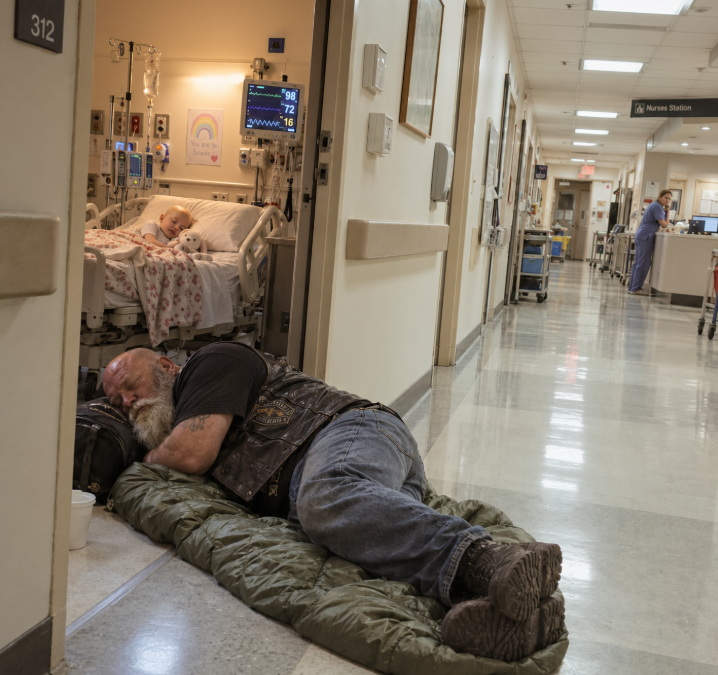
A huge man stood maybe fifteen feet away.
Gray beard.
Leather vest.
Faded jeans.
Hands like baseball mitts.
He looked around sixty.
Maybe older.
Deep lines around his eyes.
Scar through one eyebrow.
The vest had patches.
American flag.
A unit patch.
One large patch that said DESERT STORM.
He did not ask what was wrong.
Did not tell me everything happened for a reason.
Did not offer prayer as a substitute for help.
He simply looked toward Emma’s room.
Then at me.
Then walked to the elevator.
I thought he was leaving.
Ten minutes later, he returned carrying a rolled sleeping bag.
He unrolled it across the wall outside Emma’s doorway.
Not blocking medical staff.
Close enough that anyone passing could not miss him.
He sat.
Pulled off one boot.
Then the other.
The nurse at the station stared.
“Sir?”
He looked up.
“You can’t sleep there.”
“Reckon I can.”
“This is a hospital hallway.”
“Yes, ma’am.”
“You’re going to have to move.”
He pointed toward Emma’s room.
“You tell whoever runs this place that little girl ain’t leaving till somebody grows enough sense to make a safe plan.”
The nurse blinked.
“I’m sorry?”
He stretched the sleeping bag flat.
“This is my bed till they do.”
I walked toward him.
“What are you doing?”
He looked at me.
“Ma’am, go be with your girl.”
“You don’t even know us.”
“Don’t need to.”
“That doesn’t make sense.”
“Plenty don’t.”
Then he lay down.
That was it.
I stood there staring at a stranger sleeping outside my daughter’s hospital room because I had cried in the wrong hallway at the right time.
Emma was awake when I returned.
She pointed toward the door.
“Mama.”
“What?”
“There’s a giant.”
I almost laughed.
“What giant?”
“On our floor.”
She tried to lift her head.
I adjusted her pillow.
“That’s just a man.”
“He’s huge.”
“He’s sleeping.”
“Why?”
“I’m not sure.”
Emma studied him through the doorway.
“He looks like Hagrid.”
“Please don’t call him that.”
“Mr. Hallway.”
“What?”
“That’s his name.”
“No, it isn’t.”
She smiled weakly.
“It is now.”
That first night, hospital security arrived around two in the morning.
The officer’s name was Lewis.
He was older.
Gray at the temples.
Straight-backed.
He walked like someone whose body still remembered marching.
I saw him approach and immediately stood in Emma’s doorway.
“Please.”
Lewis held up one hand.
“Ma’am.”
“He isn’t hurting anybody.”
“I know.”
“Please don’t make him leave.”
He looked at me strangely.
Then crouched beside the sleeping bag.
The biker opened his eyes immediately.
No startled movement.
Just awake.
“Ray.”
That caught my attention.
Lewis knew him.
The biker sat up.
“Lew.”
They spoke too quietly for me to hear.
Maybe five minutes.
Lewis shook his head once.
The biker said something.
Lewis put one hand on his shoulder.
Then stood.
Walked away.
The sleeping bag stayed.
The next morning Emma asked me to take the stranger coffee.
“I’m not bringing a random biker coffee.”
“He’s protecting us.”
“He’s sleeping.”
“Same thing.”
I looked at her.
She had lost more weight that month.
Her face seemed too small for her eyes.
“You’re bossy.”
“I have cancer.”
She used that whenever convenient.
It was difficult to argue.
So I got coffee.
Around midnight the second night, I handed it to him.
He sat against the wall.
“Thank you.”
“You’re welcome.”
Up close he looked exhausted.
“You don’t have to do this.”
“I know.”
“I don’t know your name.”
He blew across the cup.
“Folks call me Deacon.”
“Is that your real name?”
“Nope.”
“What’s your real name?”
“Raymond.”
“Raymond what?”
He gave me a look.
“Interrogation cost extra.”
Despite myself, I smiled.
“I’m Jenna.”
“I know.”
“Emma.”
“I know that too.”
I sat on the floor across from him.
“Why are you doing this, Deacon?”
He looked through the doorway.
Emma was awake.
She waved her whole arm.
Deacon lifted two fingers from his coffee.
Waved back.
Then he said:
“Go sit with your girl, Jenna.”
“Why?”
“I got the hall.”
That was all he would give me.
The second night, security came again.
Different guard.
Lewis arrived halfway through.
Whispered to him.
Both left.
Third night.
Nothing.
On the third afternoon, I found Lewis by the vending machines.
“Can I ask you something?”
He fed a dollar into the machine.
“You’re going to.”
“Why do you let him stay?”
He pressed the button for a candy bar.
The machine dropped it.
Lewis took his time.
“I’ve worked this hospital twenty-two years.”
“Okay.”
“Every October, motorcycles fill that front lot.”
“I’ve heard them.”
“Forty sometimes. Fifty other years.”
“What does that have to do with Deacon?”
Lewis opened the wrapper.
“He rides in front.”
“Why?”
Lewis looked toward the elevators.
“That’s his story.”
I waited.
“That all you’re telling me?”
“That’s all that belongs to me.”
Friday was supposed to be discharge day.
Thursday morning, Dr. Priya Anand came into Emma’s room.
She had treated Emma since age six.
Small woman.
Fast walker.
Faster talker.
Never sat unless something was serious.
That morning she pulled over a chair.
My stomach tightened.
“I heard about Friday.”
I nodded.
“I’ve also heard about your… hallway situation.”
Emma said:
“Mr. Hallway.”
Dr. Anand looked toward Deacon.
“Of course.”
Then back to me.
“I can’t force the insurer to authorize an acute inpatient stay indefinitely.”
My heart sank.
“But I can document that discharging Emma to housing without reliable heat, with her current pain-control needs, is not medically safe.”
“Will that stop them?”
“Temporarily.”
“How long?”
“A few days.”
“A few days.”
Dr. Anand took my hand.
“Sometimes a few days is everything.”
Friday morning came.
No wheelchair.
No discharge packet.
No transport.
Emma noticed.
“Are we staying?”
“For now.”
“Because of Mr. Hallway?”
I looked toward the door.
“Partly.”
Emma smiled.
“I knew he was useful.”
By then, she and Deacon had developed a relationship entirely across eight feet of hallway.
He never entered her room.
Not once.
Even when Emma invited him.
He would say:
“That’s your mama’s space, darlin’. I don’t go where I ain’t invited.”
“You are invited.”
“Your mama ain’t said.”
I finally told him:
“You’re invited.”
He shook his head.
“Not yet.”
I did not understand.
Emma started drawing pictures.
Purple motorcycle.
Dog with wings.
A bearded stick man sleeping under stars.
Nurse Tasha carried each one to him.
Deacon accepted them like legal documents.
Folded each carefully.
Placed them inside his vest.
Right over his chest.
In return, he told stories.
About his 2004 Road King.
“Name’s Bertha.”
Emma laughed.
“That’s an old-lady name.”
“She’s an old lady.”
“Is she fast?”
“Fast enough.”
“Can I ride her?”
Deacon’s smile disappeared for half a second.
“We’ll see.”
“You said that like grown-ups say things when they mean no.”
He looked at her.
“Smart kid.”
“I have cancer.”
Again.
Weaponized diagnosis.
Deacon laughed.
Then he told her about Monument Valley at sunrise.
About getting caught in hail outside Amarillo.
About a terrier named Biscuit who rode in a saddlebag for nine years.
Emma listened like these were legends.
On Saturday, two bikers stepped out of the elevator.
One enormous.
One thin and bald.
The big one carried lasagna.
“My wife made this.”
“For who?”
“You.”
“Why?”
He looked offended by the question.
“Deacon says you ain’t eating.”
The skinny one handed me a phone charger and grocery bag.
Socks.
Toothpaste.
Dry shampoo.
Granola bars.
A clean sweatshirt.
He said:
“No offense, ma’am, but Deacon says you’ve been wearing that hoodie since Tuesday.”
I laughed.
Then cried.
The big biker stood holding the lasagna while I sat on a chair trying to stop.
Neither man acted uncomfortable.
That may have been the kindness.
They did not rush me.
Did not say “don’t cry.”
They just waited.
Later that night, I went looking for ice.
Near the stairwell, I heard Deacon’s voice.
The door was cracked.
He was on the phone.
“Carol.”
Pause.
“I know.”
His voice sounded completely different.
Smaller.
“I know it’s been eleven years.”
Long pause.
“I wouldn’t call if it wasn’t…”
He stopped.
I heard breathing.
“Please.”
Another pause.
“It’s in the blue box.”
Silence.
“The one with her bracelet.”
His voice broke.
“I need it.”
I backed away.
Not because I understood.
Because I recognized begging.
I had done enough of it to know when it deserved privacy.
Monday morning Ms. Pratt returned.
She looked worse than before.
“Good news.”
Her tone told me it was not.
“We found placement.”
“What does that mean?”
“A family shelter on the east side.”
I stared at her.
“A shelter?”
“They have space.”
“For Emma?”
“For both of you.”
I stood.
“She has a pain pump.”
“I know.”
“Her nose bleeds for an hour some nights.”
“I know.”
“She wakes up screaming.”
Ms. Pratt looked away.
“The facility meets the discharge criteria.”
“What criteria?”
“It has heat.”
“Is there medical staff?”
“No.”
“Private bathroom?”
“I don’t believe so.”
“Sterile space?”
“No.”
“Twenty-four-hour nursing?”
“No.”
“Then what exactly makes it safe?”
She swallowed.
“It meets the criteria.”
I laughed.
“You keep saying that.”
“I know.”
“Do you hear yourself?”
Her eyes filled.
“Yes.”
That stopped me.
“I have forty-two patients,” she said quietly. “Every day I get lists. Covered. Not covered. Authorized. Denied. Placement. No placement. I am trying.”
“Then help me.”
“I am.”
“A family shelter is not help.”
Her clipboard trembled.
“I’m sorry.”
After she left, I saw Deacon standing outside.
He had heard everything.
He walked to the elevator.
“Where are you going?”
“Downstairs.”
“Why?”
“To talk.”
An hour later he came back furious.
Not loud.
That would have been easier.
His face was red.
Hands clenched.
“They won’t see me.”
“Who?”
“Administration.”
“What happened?”
“Front desk says make an appointment.”
“When?”
“Two weeks.”
He laughed once.
“Two weeks.”
Then he sat on the sleeping bag.
No words.
That night I noticed something.
People stepped over him.
Doctors.
Residents.
Administrators.
Nurses.
Visitors.
Every person entering that hallway had to see him.
Could not pretend the problem did not exist.
Maybe that was the point.
Tuesday afternoon a printed notice appeared at the nurses’ station.
COMPLAINT: NON-VISITOR INTIMIDATING STAFF / OBSTRUCTING PEDIATRIC CORRIDOR.
Tasha read it.
Then tore her copy in half.
“Intimidating.”
She looked toward Deacon.
“That man has thrown away every empty coffee cup I’ve left near this desk for a week.”
The formal complaint triggered security again.
This time three officers came.
Lewis with them.
A supervisor said:
“Mr. Kessler, we need you to relocate to the family lounge.”
First time I heard the surname.
Kessler.
Deacon said:
“No.”
“You cannot sleep in the corridor.”
“I’m not blocking egress.”
“This is not designated visitor space.”
“Neither’s the lounge safe housing for that child.”
“That isn’t your decision.”
“No.”
Deacon looked toward Emma’s door.
“It ought to be somebody’s.”
The supervisor turned toward Lewis.
Lewis said nothing.
Long silence.
Then the supervisor:
“Tonight.”
Deacon shook his head.
“Till she has somewhere safe.”
Nobody touched him.
They left.
Tuesday night was the worst.
At 3:07 a.m., Emma’s pain broke through.
One minute she was sleeping.
Next she screamed.
Not loud at first.
Sharp.
High.
“Mama.”
I was awake instantly.
“What?”
“My legs.”
Her body curled.
“Mama.”
I hit the call button.
Tasha came running.
Resident behind her.
Pain pump.
Dose review.
Vitals.
Questions.
Emma cried.
“Make it stop.”
I held her.
“I know.”
“Make it stop.”
“I’m trying.”
“Mama please.”
There is no helplessness like being commanded by your child to fix something you cannot touch.
For forty minutes, they worked.
Medication.
Warm packs.
Position changes.
Dr. Anand called.
Finally a rescue dose began working.
Emma’s body loosened.
Her breathing slowed.
She slept.
I walked into the hallway because I thought I might throw up.
Deacon was sitting against the wall.
Head down.
Huge shoulders shaking.
I had never seen a man that big look so small.
I slid down beside him.
We sat.
Five minutes.
Maybe ten.
Then he said:
“I had a little girl once.”
Once.
I closed my eyes.
“She cried like that.”
I did not ask.
He continued anyway.
“Seven.”
My chest tightened.
“What was her name?”
“Katie.”
His voice was barely audible.
“Katie Marie Kessler.”
I waited.
He said nothing else.
Wednesday afternoon, a FedEx envelope arrived at the nurses’ station.
Large.
Cardboard.
Deacon’s name written across it.
He opened it there.
Inside was an old blue folder.
A hospital wristband.
A child’s plastic bracelet with faded beads.
And a folded document.
He read the paper.
Closed his eyes.
Pressed it against his chest.
I knew without asking.
Carol.
Blue box.
Katie.
He went downstairs carrying it.
Twenty minutes later he returned.
“They still won’t see me.”
“What?”
“Administration.”
“You have an appointment?”
“Now I got proof.”
“Proof of what?”
He looked at me.
“Something they forgot.”
“What?”
He shook his head.
“Tomorrow.”
But tomorrow came early.
At ten that night, the elevator doors opened.
A man in a gray suit stepped out.
Mid-fifties.
Hospital badge.
Two police officers behind him.
Lewis came from the opposite hallway.
I stood.
Tasha stopped typing.
Deacon slowly rose from the sleeping bag.
The man in the suit introduced himself.
“Michael Mercer. Hospital director.”
Deacon nodded.
“I know.”
“Mr. Kessler, we’ve received repeated reports regarding your presence.”
“You received those.”
“This has become a safety and operational concern.”
“Has it?”
“You’ve refused repeated requests to leave the corridor.”
“Yes.”
“The police are here because we need to resolve this peacefully.”
Deacon looked at the officers.
One looked uncomfortable.
The other kept his expression neutral.
I stepped forward.
“Please.”
Mercer turned.
“Ms. Dalton, this isn’t—”
“He’s not dangerous.”
“I’m not saying he is.”
“He’s helping us.”
“I understand you’re under enormous stress.”
That sentence made me angry.
People use stress to turn your opinion into a symptom.
“I know what I’m saying.”
Mercer returned to Deacon.
“Mr. Kessler, I’m asking you voluntarily to remove your belongings.”
Deacon nodded once.
“Sure.”
My stomach dropped.
Then he reached inside his vest.
Both police officers tensed.
Not dramatically.
Just hands shifting.
Deacon moved slowly.
Pulled out a folded paper.
Held it between two fingers.
Passed it to Mercer.
“Read that first.”
Mercer frowned.
Unfolded it.
His eyes moved down the page.
Once.
Then again.
His face changed.
Not movie-white.
But enough.
The confidence disappeared.
He looked at the signature.
Then at Deacon.
“Sir…”
Deacon said nothing.
Mercer read again.
Then whispered:
“Nobody told me you were Katie Kessler’s father.”
The hallway went absolutely still.
I looked at Deacon.
His jaw tightened.
One police officer stepped back.
Lewis lowered his eyes.
I did not know who Katie Kessler was.
Not completely.
Not yet.
Deacon said:
“Read the rest.”
Mercer swallowed.
“Sir—”
“Out loud.”
Mercer looked toward Emma’s room.
Then at me.
Deacon said:
“Her mama needs to hear.”
The director read.
Ten years earlier, Saint Gabriel Children’s Hospital and the Katie Kessler Memorial Ride had entered into a charitable restricted-use agreement.
Annual donations raised by a motorcycle group would establish a fund for pediatric families facing end-of-life or medically fragile discharge situations.
The purpose was specific.
No child receiving end-of-life or high-risk palliative care would be discharged solely because of inability to pay into housing judged medically unsafe.
When insurer coverage ended and no safe discharge location existed, the fund would pay for continued inpatient or affiliated hospice-level support until an appropriate plan was available.
I stopped breathing.
Mercer continued.
The agreement contained two signatures.
Hospital director Thomas Avery.
And:
Raymond “Deacon” Kessler.
Mercer lowered the paper.
“We merged with Valley Health two years ago.”
Deacon said nothing.
“The foundations were consolidated.”
Still nothing.
“I believe this account was transferred into general pediatric support.”
“Believe?”
Mercer looked embarrassed.
“I need to verify.”
Deacon’s voice remained level.
“You people cash the checks?”
Mercer hesitated.
“I’m not directly responsible for—”
“Do you?”
“Yes.”
“Last one was three weeks ago.”
Lewis looked up.
Deacon continued.
“Sixty-one thousand dollars.”
Mercer closed his eyes briefly.
“Mr. Kessler—”
“Forty-three riders.”
His voice never rose.
“That’s what rolled into your lot.”
Mercer looked toward the wall.
“Some of them got artificial knees.”
One officer almost smiled.
“One has cancer himself.”
No smile now.
“Couple widows rode their husbands’ bikes because those men died between one October and the next.”
He pointed at the paper.
“We kept our part.”
Silence.
“You took the money.”
Mercer’s face tightened.
“We did.”
“And stopped keeping yours.”
Mercer did not argue.
That mattered.
An arrogant man would have.
Instead he looked toward Emma’s room.
She was asleep.
Captain under her chin.
IV pump glowing.
Then he looked at me.
Wrinkled sweatshirt.
Hair tied with a rubber band.
I had not showered in two days.
There are moments when institutions turn back into people.
I watched it happen to him.
He lowered the paper.
“Officers.”
Both looked at him.
“I apologize for wasting your time.”
They nodded.
Left.
He turned toward Deacon.
“You stay tonight.”
Deacon said:
“She stays.”
Mercer looked at me.
“Ms. Dalton.”
I braced.
“Your daughter’s discharge is canceled.”
My knees weakened.
He continued:
“Effective immediately.”
I covered my mouth.
“I will have a written authorization by morning covering continued care while we review the fund and her discharge needs.”
“Insurance?”
“The fund.”
I started crying.
Again.
Mercer looked ashamed.
“And this does not stop with Emma.”
He looked down the hall.
“We are going to find out how this disappeared.”
Deacon said:
“You better.”
Mercer nodded.
“Yes, sir.”
After he left, Deacon sat on the sleeping bag.
Not gracefully.
Like his legs stopped working.
I sat beside him.
For a long time, neither spoke.
Then I said:
“Katie.”
He nodded.
“Tell me.”
He stared at the ceiling.
Fourteen years earlier, Katie Kessler was seven.
Same cancer.
Acute lymphoblastic leukemia.
Deacon had been a welder.
Good job.
Plant two towns away.
Union.
Insurance.
Mortgage.
Normal life.
Then the plant closed.
Six hundred people gone.
Insurance ended.
Katie was already sick.
COBRA cost more than the mortgage.
They paid for a while.
Then could not.
Bills stacked.
Treatment continued in pieces.
One Tuesday, a case manager walked into Katie’s room.
Clipboard.
Deacon laughed bitterly.
“Always a clipboard.”
They were told Katie no longer met inpatient criteria.
Her pain could be managed at home.
Home was a single-wide trailer.
Furnace broken.
February.
Hospice referral delayed.
Four days before a nurse could come.
Deacon told them.
Begged.
Exactly as I had.
“They said the same thing.”
“What?”
“Policy.”
He rubbed his face.
“They sent her home Tuesday.”
His voice cracked.
“Katie died Monday.”
Six days.
Six days in a cold trailer.
Medications Deacon did not understand well enough.
Instructions printed in twelve-point font.
A frightened child.
“She got scared at night.”
He looked toward Emma’s doorway.
“Wouldn’t let me turn off the hall light.”
I said nothing.
“So I slept outside her bedroom.”
My stomach dropped.
“On the floor.”
He nodded.
“Every night.”
He swallowed.
“Figured if anything was coming to get her, it had to go through me first.”
He laughed once.
Broken.
“Stupid.”
“No.”
“Didn’t stop anything.”
“No.”
“She went anyway.”
He wiped his face.
“And I sat there thinking if I’d had money, she could’ve been somewhere warm.”
“Deacon…”
“Warm bed.”
His voice broke.
“Doctors close.”
I touched his arm.
He did not move.
“Carol left the next year.”
“Your wife?”
He nodded.
“I don’t blame her.”
“What happened?”
“We turned grief into a weapon.”
That sentence stayed with me.
“She looked at me and saw Katie.”
He stared ahead.
“I looked at her and saw everything I couldn’t save.”
He drank.
Two years.
Almost died more than once.
Then members of his motorcycle club began showing up.
At first one.
Then three.
Then twelve.
Would not leave.
Made him eat.
Dragged him to meetings.
Took alcohol out of his house.
One man slept on his couch for three weeks.
Deacon laughed.
“He snored worse than Bertha.”
“What happened after that?”
“Katie Run.”
First year:
Three thousand dollars.
Second:
Eight.
Third:
Nearly twenty.
“Then I came here.”
“To the hospital?”
“With forty bikers.”
He smiled.
“They thought we were gonna start trouble.”
“What did you do?”
“Told the director I wanted a meeting.”
“What did he say?”
“Eventually?”
He held up the paper.
“He listened.”
The original director, Thomas Avery, had remembered Katie.
Not personally at first.
Then her chart.
The discharge.
The delay.
He apologized.
Deacon told him apology was not enough.
“I said make sure it don’t happen again.”
That was how the fund began.
Every October.
Money.
Restricted.
Specifically intended to stop unsafe end-of-life discharges based on coverage.
For twelve years, the riders delivered checks.
Then Saint Gabriel merged into Valley Health.
New systems.
New accounting.
New leadership.
The checks kept arriving.
But somewhere in the transition, the fund lost its purpose.
Money moved into general pediatric support.
Nobody told Deacon.
Nobody told case managers.
Nobody told doctors.
The policy disappeared.
The donations did not.
“Why were you sitting by the elevator that first day?”
I asked.
He looked at the floor.
“Anniversary.”
“What anniversary?”
“The day they sent Katie home.”
My chest hurt.
“Every year?”
“Every year I come here.”
“Why?”
He shrugged.
“Sit one hour.”
“Why?”
“I don’t know.”
Then:
“Maybe I do.”
He looked toward Emma.
“I think I come to see if that hallway still feels the same.”
I understood.
“And then you heard me.”
“Crying.”
“And Ms. Pratt.”
“Policy.”
His jaw tightened.
“I thought…”
He stopped.
“What?”
“Not again.”
He looked at the sleeping bag.
“Not while I’m breathing.”
I swallowed.
“Why didn’t you call a lawyer?”
“Lawyer takes time.”
“You could’ve filed an injunction.”
He smiled.
“You sound like Carol.”
“Your girl needed days.”
He tapped the sleeping bag.
“This took ten minutes.”
I laughed through tears.
“And honestly?”
“What?”
He looked embarrassed.
“Sleeping outside a little girl’s door is the only thing I ever knew how to do.”
Silence.
“Didn’t work for Katie.”
His eyes filled.
“I needed it to work once.”
Emma lived twenty-six more days.
That number sounds small.
It was not.
Twenty-six days is a universe when someone you love is dying.
The morning after the director found the agreement, everything changed.
Not magically.
Hospitals do not change magically.
Meetings began.
Legal.
Foundation office.
Finance.
Ethics.
Palliative care.
Case management.
A woman from compliance came to our room.
Then apologized and asked if we wanted representation present.
I almost laughed.
Deacon sat in the hallway.
Still.
The fund was frozen temporarily while they audited transactions.
The hospital placed Emma’s stay under an emergency charitable authorization.
By noon, Mercer returned.
Handed me a letter.
Written.
Signed.
No discharge unless Dr. Anand and palliative care agreed a safe plan existed.
I read it three times.
Then gave it to Deacon.
He did not read.
“Got your name?”
“Yes.”
“Emma?”
“Yes.”
“Says she stays?”
“Yes.”
He nodded.
“Good.”
Then rolled onto his sleeping bag.
Like this had all been about getting one sentence on paper.
Ms. Pratt came by with donuts.
She stood at the door.
“I owe you an apology.”
I shook my head.
“No.”
“I should have pushed harder.”
“You told me the truth.”
“I told you policy.”
“That was the truth you had.”
She cried.
Not dramatically.
Just tears filling.
“I’ve been here nine years.”
She said she had never once seen the Katie Kessler Fund in her system.
Never.
She had forty-two active cases.
Metrics.
Deadlines.
Insurer denials.
Placement lists.
Escalation rules.
She showed me the discharge workflow.
There was no field for:
There is a charitable fund specifically created for this child’s situation.
I hugged her.
I do not know why.
Maybe because anger gets tired too.
Maybe because she had been a face I could blame until the real problem became visible.
A system can hurt people without every person inside it being cruel.
That does not make the harm smaller.
It makes fixing it harder.
On the fifth day after the agreement resurfaced, Emma looked toward the doorway.
“Mr. Hallway.”
Deacon lifted his head.
“Ma’am.”
“You can come in.”
He looked at me.
I nodded.
“Official invitation.”
He stood.
Then did something that broke me.
He took off his boots.
Set them neatly beside the sleeping bag.
As though Emma’s hospital room were someone’s home and he did not want to track dirt inside.
He entered.
Emma smiled.
“Wow.”
“What?”
“You’re bigger in here.”
Deacon laughed.
“So are you.”
“That makes no sense.”
“I ain’t known for sense.”
He sat in the chair.
Emma studied his patches.
“What’s Desert Storm?”
“Long story.”
“Tell me.”
He told her an edited version.
Sand.
Heat.
Noise.
Missing home.
He did not tell an eight-year-old about death.
Emma asked:
“Were you scared?”
Deacon paused.
“Yes.”
She seemed surprised.
“You’re huge.”
“Fear don’t care.”
“Did you cry?”
“Yep.”
“Really?”
“More than once.”
Emma considered this.
Then:
“Good.”
“Good?”
“Mom says brave doesn’t mean not scared.”
Deacon looked at me.
“Your mama’s right.”
Emma climbed halfway out of bed.
Her IV line caught.
Tasha adjusted it.
She leaned into Deacon.
He froze.
I watched his hands.
Huge hands.
Hands that could hold a motorcycle engine part.
Hands scarred from welding.
He did not know where to put them.
Then slowly he rested one arm around her shoulders.
Emma put her head against the Desert Storm patch.
Within minutes she was asleep.
Deacon stared at the far wall.
Tears ran into his beard.
Nobody said anything.
We did not make him explain.
Over the next two weeks, Emma adopted the entire biker club.
Or maybe they adopted her.
They came in shifts.
Never more than two or three.
Hospital rules.
One brought model motorcycles.
Another brought a stuffed bulldog.
A woman rider named Maria painted Emma’s nails purple.
A man called Tiny turned out to be the enormous lasagna carrier.
He cried every time Emma complimented his tattoos.
Lewis stopped pretending he was uninvolved.
He brought coffee.
Sat with Deacon.
Sometimes they talked about Army things.
Sometimes baseball.
Emma started calling Lewis “Officer Grandpa.”
He pretended to hate it.
On a warm afternoon in early November, Dr. Anand came into the room.
“I have something irresponsible to suggest.”
I stared.
“You?”
“Don’t get used to it.”
Emma perked up.
“What?”
“There are about forty motorcycles downstairs.”
I looked at Deacon.
He suddenly became interested in his boots.
“Raymond.”
He winced.
“That means you’re mad.”
“What did you do?”
“Nothing yet.”
Dr. Anand said:
“Emma has been asking to see his motorcycle.”
“Yes.”
“She is stable enough to go to the ambulance bay with monitoring.”
My chest tightened.
“Outside?”
“For fifteen minutes.”
Emma sat upright.
“BERTHA?”
Deacon looked offended.
“She heard you.”
“Can I ride her?”
“No road.”
“You promised maybe.”
“I promised maybe.”
“Maybe means yes if you ask enough.”
Deacon looked at me.
“Your child negotiates like organized labor.”
“She learned from cancer.”
They bundled Emma.
Blanket.
Pain pump.
Warm hat.
Two nurses.
I had not seen her outdoors in almost three weeks.
When the ambulance-bay doors opened, sunlight hit her face.
She closed her eyes.
Just sunlight.
I started crying.
Again.
By then, crying had become a bodily function.
And there she was.
Bertha.
Black 2004 Road King.
Washed.
Polished.
Chrome shining.
Along the street stood forty-three motorcycles.
Men.
Women.
Leather.
Helmets.
A line stretching almost to the corner.
Emma whispered:
“Whoa.”
Deacon crouched.
“Still wanna?”
She nodded violently.
He lifted her.
She weighed almost nothing.
That hurt more than I expected.
He placed her on the seat in front of him.
Someone produced a child-sized helmet.
Pink.
Orange flames.
Emma screamed.
“It has FIRE!”
“Safety fire.”
“That’s not a thing.”
“It is now.”
He fastened it.
Climbed behind her.
One arm around her waist.
Did not move the bike.
Could not.
Would not.
He turned the key.
Bertha came alive.
The sound rolled through the ambulance bay.
Emma’s eyes widened.
She put both hands on the handlebars.
“AGAIN!”
“It’s already on!”
“Make it louder!”
Deacon looked at me.
I covered my ears.
“Fine.”
He revved once.
Emma shrieked with laughter.
Then Tiny raised one hand.
Every rider started their engine.
One by one.
Then all together.
The windows rattled.
Nurses came to the first-floor glass.
Doctors.
Housekeepers.
Transport workers.
Lewis stood near the doors.
Straight.
Hands behind his back.
Emma laughed so hard she coughed.
Tasha checked her.
Emma waved her away.
“I’m FINE.”
Cancer had taken so many sounds from my daughter.
Running footsteps.
Playground yelling.
Singing in the car.
That afternoon it gave one back.
Laughter.
Huge.
Uncontrolled.
Alive.
For the rest of her life, she talked about “the ride.”
Technically the bike never moved six inches.
Did not matter.
To Emma, she had ridden.
“What did it feel like?”
I asked that night.
She smiled.
“Like thunder.”
After that, her body declined quickly.
The good days became shorter.
Her pain increased.
She slept more.
Stopped asking for food.
Then stopped pretending to be hungry for my sake.
Dr. Anand sat with me.
No charts.
No euphemisms.
“She’s dying.”
I nodded.
“Days?”
“Likely.”
My throat closed.
“Will she hurt?”
“We’ll control everything we can.”
“Will she know?”
“Some children do.”
“What do I say?”
Dr. Anand looked at me.
“The truth she can carry.”
That night, Emma asked:
“Am I going home?”
I froze.
“What do you mean?”
She looked at me.
Kids know when adults stall.
“Home-home.”
I lay beside her.
“I don’t think we’re going back to Aunt Melissa’s.”
“No.”
She picked at Captain’s ear.
“Am I dying?”
Every instinct in me screamed lie.
No.
Of course not.
You’re eight.
You cannot.
Instead I said:
“Yes.”
Her face changed.
Not shock.
Relief.
Because the room finally matched what she already knew.
“Soon?”
“I think so.”
“Will it hurt?”
“We won’t let you hurt.”
“Promise?”
“I promise we’ll do everything.”
She nodded.
“Will you be there?”
“Yes.”
“Dr. Anand?”
“If you want.”
“Tasha?”
“Yes.”
Then:
“Mr. Hallway?”
I looked toward the door.
Deacon sat outside.
“Yeah.”
She smiled.
“Okay.”
That was all.
Emma died Sunday morning at 6:14.
Warm bed.
Clean sheets.
No freezing room.
No shelter.
No rushed discharge.
I lay beside her.
Tasha held my hand.
Dr. Anand came in on her day off.
Deacon sat in the chair with the first purple motorcycle picture in his hands.
Sometime after three, Emma woke.
Barely.
Her eyes opened.
“Mom?”
“I’m here.”
“Is Mr. Hallway still here?”
Deacon leaned forward.
“I’m here, darlin’.”
Her mouth moved into the smallest smile.
“You sleep too much.”
He laughed and cried at the same time.
“Yes, ma’am.”
“Don’t leave.”
“I ain’t going nowhere.”
Emma closed her eyes.
Those were her last words.
She stopped breathing three hours later.
No alarm.
No drama.
Her breathing slowed.
Paused.
Returned.
Paused longer.
Then did not come back.
I knew before the monitor told me.
I put my forehead against hers.
There are no words for touching your child after the moment she stops being alive.
People try.
They say empty.
Broken.
Destroyed.
None is large enough.
Deacon stood.
Walked toward the door.
I said:
“Stay.”
He stopped.
“Please.”
He turned.
I held one hand toward him.
He came back.
Stood beside the bed.
Put his huge hand on Emma’s blanket.
And cried for Katie and Emma at the same time.
Three weeks after the funeral, Valley Health held an emergency board session.
I was invited.
I almost did not go.
Deacon said:
“You should.”
“I can’t sit in that hospital.”
“You can.”
“I don’t want to.”
“That’s different.”
He was right.
The investigation had found what happened.
The Katie Kessler Fund had not been stolen.
Not exactly.
During the merger, restricted foundation accounts had been consolidated under a broader pediatric charitable pool.
The money still supported children.
Transportation.
Meal vouchers.
Medical equipment.
Family lodging.
Good things.
But the specific discharge protection had vanished from operational policy.
Its purpose had been diluted into accounting language.
The board called it a governance failure.
Deacon called it forgetting a promise.
I preferred his version.
The hospital restored the fund.
Not just as money.
As policy.
Every case manager received the criteria.
Every palliative team.
Every utilization-review committee.
Any medically fragile pediatric patient facing discharge to unsafe housing could trigger an automatic review.
No child would be sent somewhere unsafe solely because insurer coverage ended without the charitable pathway being considered.
The rule appeared in bold.
Deacon asked for one change.
The board chair said:
“What?”
“The name.”
Everyone looked at him.
“It ain’t just Katie anymore.”
He looked at me.
I started crying before he said it.
“The Katie and Emma Fund.”
I shook my head.
“Deacon—”
He said:
“Katie got it started.”
His voice cracked.
“Emma reminded them why it mattered.”
The board voted unanimously.
Months later, Ms. Pratt showed me the new case-management screen.
A red flag appeared automatically for certain pediatric palliative cases.
SAFE DISCHARGE CHARITABLE REVIEW REQUIRED.
She touched the monitor.
“This would have appeared for Emma.”
I nodded.
She cried.
So did I.
Lewis retired the following spring.
At his party, the bikers gave him a leather vest with a patch that said:
OFFICER GRANDPA.
He pretended to be furious.
He wore it all night.
Carol came back into Deacon’s life.
Not romantically.
That was over.
Some endings do not reverse themselves.
But they spoke.
First about Katie.
Then about ordinary things.
She came to one ride.
Stood beside me.
I asked:
“Did you really send him the document?”
She nodded.
“Blue box.”
“He said you wrote ‘Go get ’em, Ray.’”
Carol laughed.
“I did.”
Then she looked toward Deacon.
“I was angry at him for a long time.”
“Why?”
“For surviving differently than I did.”
She looked at me.
“Grief makes everyone think their way of drowning is the correct one.”
I remembered Deacon saying they had weaponized grief.
“What changed?”
“Nothing.”
She smiled sadly.
“Then enough time passed that nothing changed and I got tired of carrying it.”
That stayed with me too.
Last October, almost a year after Emma died, I rode in the Katie and Emma Run.
I nearly backed out.
I had never ridden on a motorcycle.
Deacon parked Bertha in front of my sister’s house.
Held out a helmet.
Purple.
Of course.
I stared.
“No flames?”
“Couldn’t find any.”
“Emma would complain.”
“Emma complained professionally.”
I laughed.
Then cried.
Then put on the helmet.
Melissa hugged me.
My nieces and nephews waved.
I climbed behind Deacon.
“Where do I hold?”
“My vest.”
“That feels unsafe.”
“You wanna drive?”
“No.”
“Then trust the professional.”
“You’re a welder.”
“Retired.”
“Not helping.”
Forty-three motorcycles met us outside town.
Same riders.
Some new.
Tiny.
Maria.
The bald guy whose real name was Stephen.
People I now knew.
We rode toward Saint Gabriel.
At first I was terrified.
Every turn.
Every vibration.
Then the fear shifted.
Wind.
Engine.
Road.
I thought about Emma.
“Like thunder.”
She had been right.
When we turned into the hospital parking lot, Lewis stood at the entrance.
Retired.
Suit jacket.
Leather vest underneath.
He raised his hand.
Saluted.
Deacon slowed.
Every motorcycle behind us quieted.
The riders parked.
Families came outside.
Nurses.
Doctors.
Case managers.
Some children in wheelchairs.
Some with IV poles.
Some bald.
Some masked.
Some laughing.
The fundraiser that year exceeded eighty thousand dollars.
I stood at a microphone.
Had no speech prepared.
I looked up at the fourth-floor windows.
One of those rooms had held my entire universe.
I said:
“My daughter did not get the future I wanted for her.”
My voice shook.
“Nobody can fix that.”
People were silent.
“But she got twenty-six days that did not belong to an insurance spreadsheet.”
I looked at Deacon.
“She got warmth.”
At Dr. Anand.
“Pain control.”
At Tasha.
“People who loved her.”
Then back at the windows.
“And she never had to wonder where she would sleep.”
I took a breath.
“There are parents inside this building right now being told terrible things.”
My throat closed.
“They should not also have to beg for a safe place for their child to die.”
I stepped away.
That was enough.
Deacon still keeps the sleeping bag rolled behind Bertha.
Old now.
Faded.
One buckle repaired with duct tape.
I asked him once:
“Why do you still carry that thing?”
We were standing in the hospital lot after the ride.
He looked at the fourth floor.
For a long time.
Then:
“You never know.”
“Know what?”
“When some little girl’s gonna need somebody in the hallway.”
I smiled.
But he did not.
So I asked:
“Did sleeping there fix what happened to Katie?”
His eyes stayed on the windows.
“No.”
“Did helping Emma?”
He shook his head.
“No.”
I waited.
Then:
“But it gave what happened somewhere to go.”
That may be the truest thing anyone has ever told me about grief.
Pain does not disappear because you do something good with it.
Katie was still dead.
Emma was still dead.
Deacon still had nights when he woke hearing his daughter cry.
I still sometimes reached across the bed before remembering nobody was there.
Justice did not resurrect anyone.
The restored fund did not turn twenty-six days into sixty years.
But loss can become more than absence.
Sometimes it becomes a warning.
A promise.
A policy.
A stranger sleeping on a hospital floor because another parent should not have to learn the lesson he learned.
For years, Deacon thought the worst night of his life proved he had failed his daughter.
He could not save Katie.
Could not keep death outside her bedroom no matter how long he slept in the hallway.
He thought the sleeping bag represented helplessness.
Then fourteen years later, he unrolled one outside Emma’s door.
This time, death was still coming.
Nobody could stop that either.
But cold could be stopped.
Unsafe discharge could be stopped.
Fear could be softened.
Pain could be managed.
A little girl could stay where nurses knew her name.
A mother could sleep beside her without calculating whether the space heater might fail.
A child could sit on a motorcycle and laugh so loudly forty bikers cried behind their sunglasses.
Maybe that is the difference between saving someone and showing up.
Saving is not always possible.
Showing up usually is.
Deacon could not save Katie.
He could not save Emma.
But he stood between Emma and one unnecessary cruelty.
And sometimes that is what dignity looks like.
Not defeating death.
Refusing to let bureaucracy make dying harder than it already is.
I keep one of Emma’s drawings now.
Not the purple motorcycle.
Deacon has that.
Mine is a picture she made on her last week.
Three stick figures.
One small.
One woman.
One enormous man with a beard.
Above them, a rectangle.
I asked what it was.
“A door.”
“Why are we standing by a door?”
She looked at me like I was stupid.
“Because Mr. Hallway guards it.”
At the bottom, in crooked purple letters, she wrote:
NO BAD STUFF ALLOWED.
Children simplify what adults complicate.
No bad stuff allowed.
Obviously impossible.
Bad things come.
Cancer.
Debt.
Insurance denials.
Closed factories.
Broken furnaces.
Death.
They come through doors we cannot lock.
But maybe the work is deciding which bad things are unavoidable and which ones are simply tolerated because everyone keeps saying:
That’s policy.
Emma’s cancer was unavoidable.
Sending her into unsafe housing was not.
Katie’s disease was unavoidable.
Her final days in a freezing trailer should not have been.
Grief was unavoidable.
Forgetting the promise was not.
That paper Deacon handed the director did not contain magic.
It contained accountability.
Two signatures.
A purpose.
A promise somebody had failed to carry forward.
And when the director read it, what frightened him was not Raymond Kessler.
Not the leather vest.
Not the bikers.
Not the police standing behind him.
It was the realization that the institution had accepted years of money attached to a promise it no longer remembered making.
Deacon never screamed.
Never threatened.
Never touched anyone.
He slept.
That was his protest.
Night after night.
The nurses stepped around him.
Doctors stepped around him.
Administrators stepped around him.
Security spoke to him.
Families asked about him.
Children waved.
Every person passing Emma’s room was forced to confront one question:
Why is that man still here?
Eventually the right person asked.
That changed everything.
Sometimes I think about the afternoon I first saw him.
I was crying against a hospital wall.
I thought I was alone.
He was fifteen feet away.
He did not tell me to be strong.
Did not say everything happens for a reason.
Did not promise Emma would recover.
He knew better than most what false hope costs.
He simply went to his motorcycle.
Got a sleeping bag.
Returned.
And made himself impossible to ignore.
That was Deacon’s gift.
Presence.
Nine nights of it.
Nine nights because once, fourteen years earlier, he had slept outside another little girl’s room and believed it had meant nothing.
He was wrong.
That first hallway did not save Katie.
But Katie shaped every night that came after.
Every mile of every October ride.
Every donation check.
Every child helped by that fund.
Every case manager who now sees the warning in bold.
And Emma became part of that promise too.
I wish she had lived.
I will always wish that.
There is no lesson powerful enough to make me grateful my daughter died.
I would trade the fund.
The ride.
The friendships.
Every beautiful thing that followed.
For one ordinary Tuesday with Emma complaining about homework.
But grief does not offer trades.
It gives you what remains.
So I take what remains.
I ride once a year.
I speak when they ask.
I sit with mothers when I can.
I know where the family shower is.
Which vending machine steals dollar bills.
Which waiting-room chair reclines farther than the others.
I know that sometimes a parent does not need advice.
She needs someone to sit nearby while she cries.
And every October, when the engines roll into the hospital parking lot, I look at the man at the front.
Gray beard whiter now.
Back stiffer.
Hands still enormous.
Sleeping bag strapped behind him.
People call him Deacon.
Emma called him Mr. Hallway.
I think that name fits better.
Because long before anyone read the paper, before the board restored the fund, before Emma’s name was added beside Katie’s, he had already decided what mattered.
There was a sick child behind a door.
Her mother was afraid.
People with clipboards were saying policy.
And Raymond Kessler had heard those words once before.
He knew where they could lead.
So he put his body in the hallway and stayed.
Not because he believed he could stop death.
Because he knew there are some things death should never be allowed to take first.
Warmth.
Safety.
Dignity.
A mother’s right to hold her child without wondering where they will be sleeping tomorrow.
And for twenty-six final days, Emma had all of them.
Because one grieving father who had failed to save his own little girl fourteen years earlier looked at mine and decided:
Not again.
Not this child.
Not this hallway.