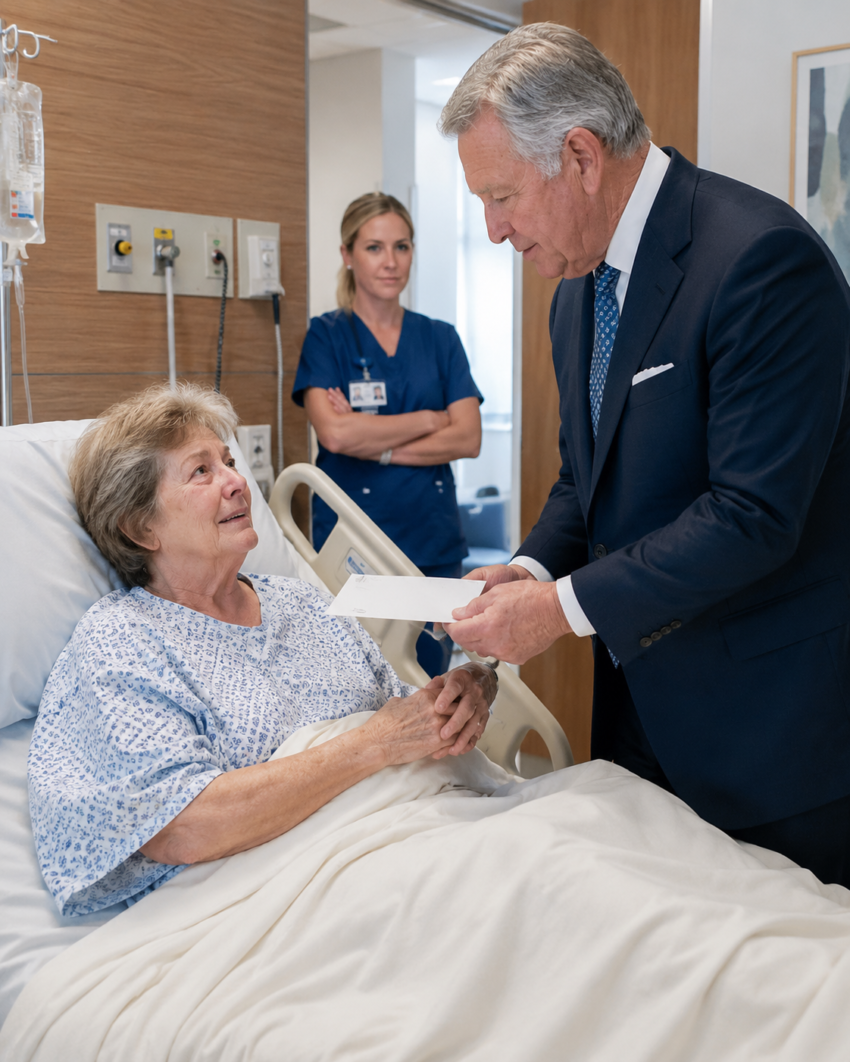
The first thing I saw when I woke up after heart surgery was three empty chairs.
My son had left his coffee cup on the windowsill. My daughter’s sweater was gone. The third chair, where my youngest had been sitting before they wheeled me into surgery, had been pushed neatly against the wall.
I tried to lift my head.
A nurse named Rebecca noticed.
“Easy, Mrs. Bennett.”
My throat felt scraped raw.
“Where are my children?”
Rebecca stopped adjusting my IV.
That pause told me more than her answer did.
“They stepped out.”
“All three?”
She looked toward the door.
“They said the parking charges were getting pretty high. They told the desk they’d come back later.”
I stared at the empty chairs.
I was sixty-four years old. I had raised three children by myself after their father left when Michael was still in elementary school.
And after a four-hour heart procedure, apparently I wasn’t worth another hour of parking.
I closed my eyes.
“What time did they leave?”
Rebecca checked the chart.
“A little before noon.”
It was 2:17.
I didn’t cry.
I asked her to move my water closer.
That was when someone knocked.
Not one of my children.
A man in his late fifties stood in the doorway wearing a dark gray suit. He had silver at his temples and carried a worn plastic card inside a clear protective sleeve.
“Mrs. Bennett?”
“Yes?”
He smiled.
“You probably don’t remember me.”
I looked at him for several seconds.
I didn’t.
He walked closer and placed the plastic sleeve on my bedside table.
Inside was an old school lunch card.
Across the faded top were the words:
CEDAR GROVE ELEMENTARY.
And beneath them, written in blue ink, was a name I hadn’t seen in more than forty years.
Thomas Lee.
My hand stopped halfway to my water.
“Tommy?”
The man’s smile disappeared.
He nodded.
“Hello, Miss Bennett.”
The Lunch Card He Had Kept for Forty-Seven Years
In 1979, I was sixteen and worked afternoons as a classroom aide through a high-school program.
I wasn’t a teacher. I wasn’t even old enough to drive by myself after dark.
But I remembered Tommy.
He was small for his age and wore the same brown jacket almost every day.
Most children ran toward the cafeteria.
Tommy didn’t.
He would sit near the drinking fountain until lunch ended.
One afternoon I asked him why.
“I’m not hungry.”
The next day, I watched him drink two cups of water instead.
I understood.
I was earning a few dollars an hour then. I started putting money on his lunch account without telling him.
It wasn’t much.
A hamburger. Milk. Sometimes fruit.
I had forgotten most of it.
Thomas hadn’t.
He picked up the card.
“I kept this through college, medical school, three moves and one divorce.”
I laughed, then immediately regretted it because of the incision in my chest.
“You became a doctor?”
“Eventually.”
That turned out to be an understatement.
Thomas had been adopted the following year by a couple in Virginia. He finished school, went into medicine, and years later started buying struggling community hospitals with two partners.
He now ran a regional health network.
Including the hospital where I was lying.
I stared at him.
“You own this hospital?”
“Part of the organization that owns it.”
“And you came here because of a lunch card?”
“I came because I’ve been trying to find you for years.”
He explained that his company funded school meal programs in several counties. Whenever reporters asked why, he told them about a sixteen-year-old classroom aide who noticed a hungry boy sitting beside a drinking fountain.
I looked down at the card.
“Thomas, I bought you lunch.”
“Every school day for almost a year.”
“It probably cost me three dollars.”
“It mattered to me.”
There wasn’t much to say after that.
Rebecca came in to check my blood pressure.
Thomas moved aside.
While she worked, he glanced at the three empty chairs.
“Your family went home?”
I didn’t want to explain.
“Parking was expensive.”
Rebecca’s eyes dropped to my blood-pressure cuff.
Thomas said nothing.
But he didn’t leave.
Twenty minutes later, he pulled the visitor chair closer.
“There’s another reason I wanted to see you.”
Something in his voice had changed.
“What reason?”
He folded his hands.
“When my office finally located you, we did some basic due diligence because I wanted to approach you about a charitable project.”
I waited.
“Your name appeared in something I wasn’t expecting.”
“What?”
“Questions your children have been asking.”
My fingers tightened around the blanket.
“What kind of questions?”
Thomas hesitated.
“About your ability to manage your own affairs.”
My Children Had Been Planning for a Future I Was Still Alive to Live
At first, I thought Thomas had the wrong family.
David was forty-one.
Sarah was thirty-eight.
Michael was thirty-four.
They had problems, certainly.
David’s contracting business had been slow for almost a year. Sarah was going through her second divorce. Michael changed jobs so often that I sometimes forgot which company he worked for.
But they were my children.
I had paid David’s mortgage twice when work dried up.
I had given Sarah $8,000 when her divorce attorney required a retainer.
Michael still had a credit card connected to an account I maintained for emergencies.
I didn’t consider those sacrifices.
They were simply things I had done.
Thomas reached for his phone but didn’t unlock it.
“David met with an attorney about what would be required to establish that an older parent couldn’t reliably manage finances.”
I stared at him.
“Older parent.”
Thomas didn’t respond.
“I’m sixty-four.”
“I know.”
He continued carefully.
Sarah had requested information from two assisted-living communities.
Michael had asked questions about guardianship.
None of that, Thomas explained, meant they could simply take control of my life. Asking questions wasn’t the same as filing a case.
Still, the timing bothered him.
So did the reason.
“Your charitable giving came up repeatedly.”
That made even less sense.
I donated to a church food pantry. A women’s shelter. A scholarship fund at the community college.
Nothing extravagant.
“They think I’m giving away too much?”
“They appear to think you’re giving away money that should remain in the family.”
I turned toward the window.
My reflection looked pale against the glass.
For years, David had teased me about my donations.
“Mom, you’re not Warren Buffett.”
Sarah once told me I needed to stop “adopting every sad story in the county.”
Michael had asked me last Christmas how much I planned to leave them.
I had laughed.
Now I remembered that he hadn’t.
“Why are you telling me this?”
Thomas asked a question instead.
“Do any of them have access to your bank accounts?”
“Michael has an emergency card.”
“Anyone else?”
“David knows where my financial paperwork is kept.”
“Do they have power of attorney?”
“No.”
He nodded.
“Good.”
I reached for my phone.
My hands were weak enough that I nearly dropped it.
Thomas moved as though he might help, then stopped himself.
I called my bank.
It took eleven minutes.
I revoked Michael’s card.
Then I changed the verbal security code on my account and requested that no information be released to anyone except me.
Thomas didn’t say congratulations.
He simply sat there while I did it.
When I finished, I placed the phone on my blanket.
That small action exhausted me more than I expected.
“What else?” I asked.
Thomas looked at me.
“Recover first.”
“What else did you find?”
He was quiet for a moment.
Then he unlocked his phone.
“There’s something you should hear.”
The Conversation in the Parking Garage
The recording wasn’t long.
Less than three minutes.
Thomas explained that a hospital security review had captured audio near an administrative entrance after one of his staff members recognized David’s name during the search for me.
He didn’t tell me what was on it.
He just pressed play.
David spoke first.
“We were here. That’s what matters.”
Sarah said something I couldn’t make out.
Then Michael:
“If anybody asks, we stayed through surgery.”
David again.
“Exactly. It establishes that we’re involved.”
There was the sound of a car unlocking.
Sarah said:
“She’s going to fight the house thing.”
“Then don’t call it the house thing,” David replied. “Call it planning.”
Michael laughed once.
Then Sarah mentioned my donations.
“She gave another fifteen hundred away last month.”
David answered immediately.
“That’s our inheritance she’s handing out.”
I reached toward the phone.
Thomas stopped the recording.
The room was silent except for the air vent above my bed.
“Play the rest.”
“You don’t have to hear it today.”
“Play it.”
He did.
David’s voice returned.
“The lawyer said generosity alone isn’t enough. We need a pattern of questionable decisions.”
Sarah asked:
“And the surgery?”
“It helps establish vulnerability. Especially afterward.”
Then Michael said:
“We’re late.”
David answered:
“The attorney can wait ten minutes.”
The recording ended.
I looked at the clock.
They hadn’t left because parking was expensive.
They had left my recovery room to meet another attorney.
I asked Thomas to replay one part.
Not the lawyer.
Not the house.
The inheritance.
He played it.
“That’s our inheritance she’s handing out.”
I looked at the old lunch card beside my water.
Forty-seven years earlier, I had spent a few dollars feeding a hungry child.
My own children were now discussing whether that same habit of giving could be used as evidence that I shouldn’t control my money.
I picked up my phone again.
“Who are you calling?” Thomas asked.
“My attorney.”
That time, my hand didn’t shake.
Three Bouquets and One Question
David, Sarah and Michael returned at 5:40.
All three were carrying flowers.
David came in first.
“Mom! You’re awake.”
He kissed my forehead.
Sarah put a bouquet beside Thomas’s lunch card.
Michael stood near the foot of the bed.
“You look great.”
I had tubes attached to my arm, oxygen under my nose and a fresh incision running down my chest.
“Thank you.”
David pulled the chair close.
“We wanted to talk while everybody’s together.”
I looked at the flowers.
“About what?”
Sarah smiled.
“Your recovery.”
David took over.
He said my surgery had made them think seriously about the future.
The house had stairs.
The yard required maintenance.
I lived alone.
“Nobody’s saying you can’t handle things,” he said.
Michael nodded.
“We’re saying you shouldn’t have to.”
Then Sarah mentioned a community called Willow Creek.
She had brochures.
Of course she did.
She removed them from her purse and spread them across my blanket.
One-bedroom units.
Medication assistance.
Transportation.
Meals included.
I touched the corner of one brochure.
“How long have you been looking at these?”
Sarah glanced at David.
“Not long.”
“Before my surgery?”
Nobody answered.
David leaned forward.
“Mom, don’t turn this into something it isn’t.”
“Have you spoken to an attorney about me?”
His face changed.
Only slightly.
But I saw it.
“Who told you that?”
I didn’t answer.
“Mom.”
“Have you?”
Sarah picked up one of the brochures and straightened it.
Michael looked toward the window.
David’s voice became firmer.
“We’ve asked some questions. That’s what responsible families do.”
“About taking control of my finances?”
“About protecting you.”
The door opened.
Thomas stepped inside.
David stood immediately.
“Dr. Lee.”
Apparently he’d looked him up.
His whole manner changed.
He smiled and extended his hand.
“David Bennett. Adrienne’s oldest son. I’ve heard a lot about you.”
Thomas shook it.
David began explaining.
My surgery.
My age.
The house.
My generosity.
Willow Creek.
Then he said something I still remember exactly.
“Maybe you can help Mom understand that accepting some oversight isn’t losing independence.”
Thomas looked at him.
Then he looked at me.
“What does your mother want?”
Nobody spoke.
Thomas pulled the remaining chair beside my bed.
“Mrs. Bennett?”
I looked at my three children.
“I want to go home when my doctor says I’m ready.”
David exhaled.
“Mom—”
“And I want to keep managing my own money.”Sarah crossed her arms.
“We’re trying to help.”
“I know.”
That seemed to relax them.
So I continued.
“And I agree with you about one thing.”
David looked almost relieved.
“Good.”
“Some things need to change.”
The three of them exchanged glances.
None of them asked what I meant.
That was useful.
Because by then, Thomas had already offered me another possibility.
And for once, I wasn’t going to explain my plans before I had made them.
The Change They Hadn’t Expected
Thomas returned the following morning with a folder.
He placed it beside the old lunch card.
Inside was an offer from the Adrienne Bennett Foundation.
I stared at the name.
“You named a foundation after me?”
“Last year.”
“Without asking?”
He smiled.
“You were surprisingly difficult to locate.”
The foundation funded school meal programs and community assistance for older adults who had spent years supporting other people.
He wanted me to serve as executive director.
The salary was $125,000 a year.
I actually laughed.
“Thomas, I worked in a county records office for twenty-three years.”
“You also spent four decades doing exactly the kind of work this foundation exists to support.”
“I’m not a charity executive.”
“Then don’t answer today.”
There was one more document.
A small paid-off house in a quiet development called Sunset Gardens had been purchased for use by the foundation’s director.
I looked at him.
“What’s the catch?”
“There isn’t one.”
“And if I say no?”
“Then you say no.”
“If I want to stay in my own house?”
“Stay there.”
“If I don’t want the job?”
“Don’t take it.”
I kept waiting for him to tell me what I should do.
He never did.
That was the difference.
My children kept calling their plans help while explaining what I needed to surrender.
Thomas offered help and kept reminding me I could refuse it.
Three weeks later, after my cardiologist cleared me to continue recovering outside the hospital, I made my decision.
I sold nothing.
I signed nothing over.
I gave nobody control of my accounts.
And when David arrived at my house with a real-estate agent’s business card in his pocket, he found me packing boxes.
He smiled.
“So you decided Willow Creek might be best?”
I taped one box shut.
“No.”
His smile faded.
“Then where are you going?”
“Sunset Gardens.”
“I’ve never heard of it.”
“That’s okay.”
He stared at the boxes.
“Who’s paying for that?”
I picked up another roll of tape.
“I have a job.”
David actually laughed.
Then he saw that I wasn’t joking.
“What job?”
“Executive director.”
“Of what?”
I told him.
He stood in my living room for several seconds without speaking.
Then came the question I expected.
“How much are they paying you?”
I looked at him.
“Enough.”
My Children Wanted a Different Kind of Change
Sarah called that night.
She wanted to know whether Thomas was taking advantage of me.
Michael wanted copies of the employment agreement.
David wanted to speak with the foundation’s attorney.
I gave them none of those things.
I didn’t cut them off.
I didn’t block their numbers.
I simply stopped answering questions they had no right to ask.
Sunset Gardens wasn’t an assisted-living facility.
It was a neighborhood.
My house had two bedrooms, a little patio and no stairs.
The foundation office was twelve minutes away.
My first week, I reviewed applications from six school districts asking for meal assistance.
One application came from a rural elementary school where twenty-eight children had outstanding cafeteria balances.
I sat at my desk longer than necessary looking at that number.
Twenty-eight.
Thomas knocked on the open door.
“You all right?”
“Yes.”
I signed the recommendation.
“Fund this one first.”
He glanced at the school name.
Then he nodded.
“Okay.”
No speech.
No lesson.
Just okay.
David continued trying to prove that something about my new life wasn’t legitimate.
He asked my cardiologist whether surgery could impair judgment.
He called the foundation office twice.
Eventually my attorney sent him a short letter confirming that I remained fully competent and that inquiries regarding my finances should be directed to me.
After that, the calls slowed.
Not stopped.
Slowed.
A month later, I wrote three letters.
One to each child.
They were almost identical.
I told them my health was improving.
I told them I was financially secure.
I told them I had chosen where I wanted to live.
Then I wrote:
I love you. But loving me does not give you ownership of my money, my home, or my decisions. I do not need anyone to manage my life for me.
I didn’t mention the recording.
I didn’t mention inheritance.
I didn’t demand apologies.
At the bottom, I enclosed information about the foundation’s Saturday meal-packing program.
If any of you ever want to spend a morning helping children who don’t have enough to eat, we can always use another pair of hands.
David never responded.
Sarah sent a two-line text saying she needed time.
Michael called.
We spoke for nine minutes.
Neither of us said very much.
Before hanging up, he asked:
“Mom, are you happy there?”
I looked through the kitchen window at the small patio behind my new house.
“Yes.”
There was a pause.
“Okay.”
It wasn’t an apology.
But it was the first question one of them had asked in months that was actually about me.
The Card on My Wall
Thomas gave me the old lunch card six months after my surgery.
I refused it at first.
“You’ve kept that thing your whole life.”
“Exactly.”
“So keep it.”
He shook his head.
“I don’t need it anymore.”
I had it framed.
It hangs now beside my kitchen table.
The plastic is scratched. The ink has faded. One corner is bent from being carried around for decades.
Every morning before work, I pass it on my way to the coffee maker.
Sometimes I think about the sixteen-year-old girl who put a few dollars on a little boy’s lunch account because she couldn’t stand watching him drink water while everyone else ate.
She had no plan.
She wasn’t building a foundation.
She certainly wasn’t saving her own future.
She was just buying lunch.
Forty-seven years later, that worn card came back to me in a hospital room with three empty chairs.
And this time, it reminded me that what I gave away had never belonged to anyone waiting to inherit it.