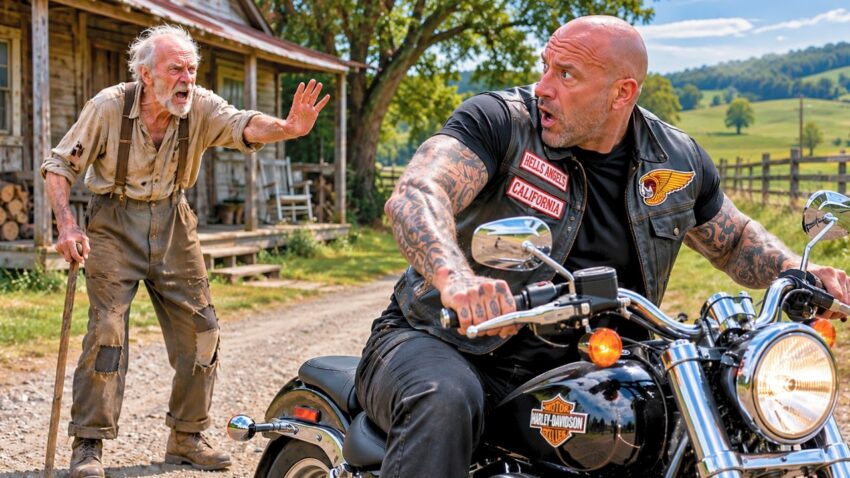
Deacon stood up. He didn’t rush. That’s the thing people always remember. He didn’t shout.
He crossed that floor slow and easy and he put one hand on Dale’s wrist, the one holding the boy’s shirt, and he just squeezed.
Dale’s hand opened. He couldn’t help it. The boy dropped free and ran to his father.
“Let go of me,” Dale said. “You don’t know who I am.” “No,” Deacon said quietly.
“You don’t know who I am.” One of Dale’s men came around the counter fast and took a swing.
Deacon didn’t even look surprised.
He caught the arm, turned, and the man went face first over a table and hit the floor and stayed there.
The second one stopped where he was and decided he liked his teeth. It was over.
In about four seconds, Dale was backed against the register and Deacon was standing there, not even breathing hard.
Because here’s the thing. Dale wasn’t scared, yet. Not really.
He straightened his collar and he smiled—that ugly smile—and he played the only card men like him ever have.
“You just assaulted me in front of witnesses,” he said. “And my cousin wears a badge.
You just made everything 10 times worse for this boy. They’re going to take him for sure now.”
He looked at Marcus. “And you’re going to watch it happen.” And for a second it worked.
Marcus looked like the floor had dropped out from under him, because Dale was right about one thing: he had the badge on his side.
He had the paperwork.
And a big biker throwing men around a diner doesn’t beat a county that’s already made up its mind.
That was the real danger, not Dale’s fists, Dale’s phone call. You can fight a fist.
You can’t fight a man who never shows up himself, who sends a form and a badge and a social worker to do his breaking for him.
Deacon looked at Marcus.
Then he looked down at Caleb, who was pressed against his father’s leg, staring up at him.
Deacon took out his own phone. “You want to call your cousin?” he said to Dale. “Go ahead. Call him.
But while you’re at it,” He dialed a number he knew by heart and put it to his ear.
“I’m going to call mine.” Dale laughed. “Your cousin? What’s he going to do? Ride a motorcycle at me?”
Deacon didn’t answer him. He just talked low into the phone. “It’s Deacon. I’m down in Needles off the 40.
Got a situation. Bring the family.” And he hung up.
Then he pulled out a chair, turned it around and sat down facing Dale. Calm as a Sunday.
“You got a couple hours,” he told him. “You can use them to think.”
Now I need to tell you who Deacon really was, because up to this point you only know what Dale knew: a big man with a dog and an attitude.
Travis Mallory had ridden with the Hells Angels for 31 years. He was a road captain.
That means when the club moved, he moved first and everybody followed his line.
He’d buried brothers and he’d done some hard things in a hard life.
And somewhere along the way he’d become the man who got everybody home safe.
And when a road captain says, “bring the family,” the family comes. They started arriving a little after noon.
First it was a sound way off down the interstate, a low rumble you felt in your chest before you heard it in your ears.
Dale’s head came up. Marcus walked to the window. Caleb pressed his face to the glass.
And they came off the 40 in a line that didn’t seem to end. 30 bikes, then 40, then more.
Chrome and leather and engines you could feel in the fillings of your teeth rolling into that dusty gas station and filling the lot and spilling out onto the shoulder of the road.
Big men and a few hard-eyed women, cuts on their backs, boots on the gravel. They didn’t yell.
They didn’t tear anything up. That’s what nobody expects.
They just got off their bikes and stood there quiet, filling the whole world around that little diner, waiting on the word of the man sitting inside at the counter.
Dale’s face had gone the color of old paper.