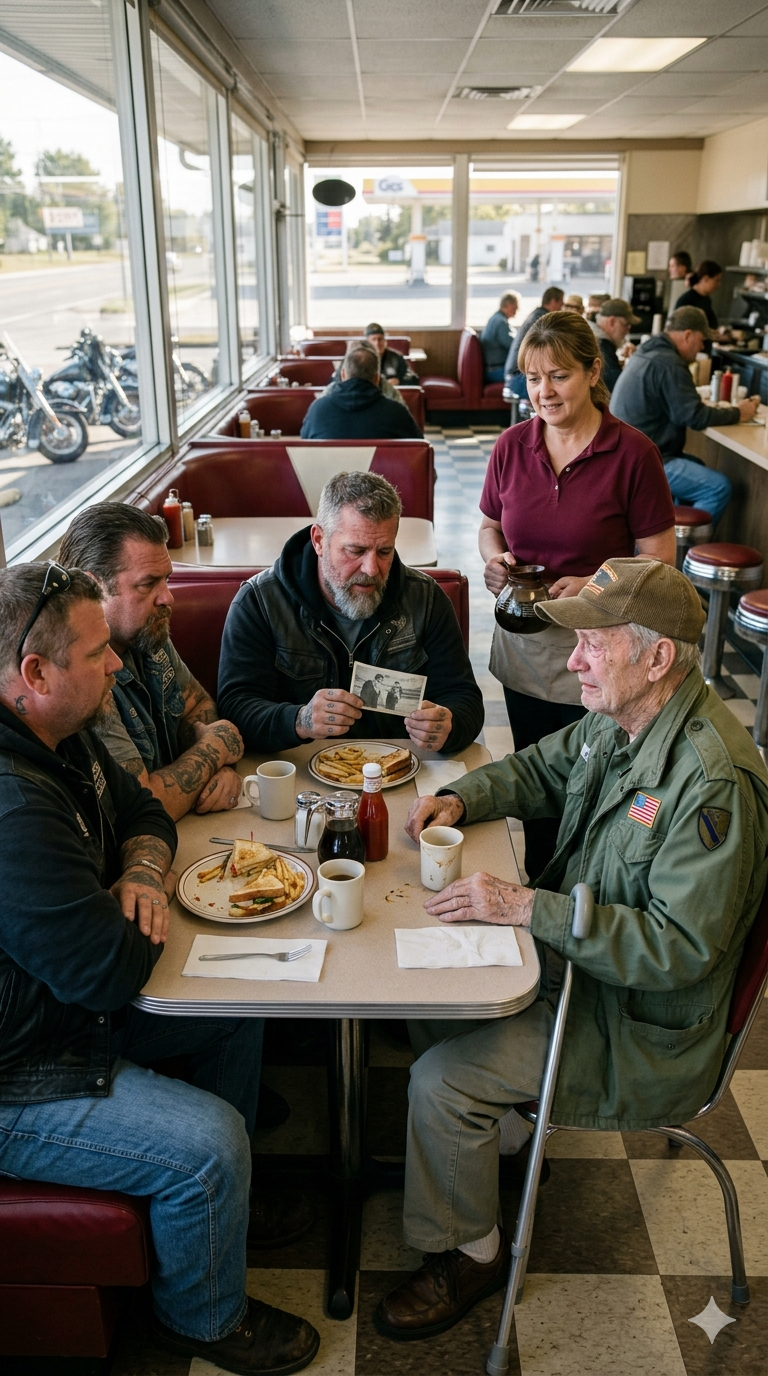
The Quiet Hour at Laurel Pine Diner
The slow hour between lunch and dinner had always been Wade Harlan’s favorite time of day.
By then, the clatter had faded. The families were gone, the office crowd had already rushed back to their jobs, and the booths at Laurel Pine Diner sat in a kind of tired stillness that suited him better than noise ever could. It was late autumn in western North Carolina, and the pale sun stretched across the highway in long golden bands that made everything outside look warmer than it really was. The air still held that mountain chill that slipped through denim, leather, and old scars alike.
Wade stepped through the diner door with five men behind him, broad-shouldered and road-worn, each carrying the quiet presence of someone who had seen enough of life to stop trying to impress anybody. Their boots thudded against the old tile floor. A few people glanced up and then quickly looked away.
That part never surprised Wade.
He had lived long enough to know what people saw when they looked at men like him. The gray in his beard, the heavy leather vest, the old club patch, the expression that never tried too hard to seem friendly—those things told a story before he ever opened his mouth. Most folks decided what kind of man he was from across the room.
He didn’t argue with strangers anymore.
He led his brothers to the biggest booth along the back wall, the one that gave him a clear view of the front door. He always sat facing the entrance. Old habits had a way of becoming permanent after enough years. As he slid into the cracked vinyl seat, June, the diner’s longtime waitress, was already walking toward them with a coffee pot in hand.
She knew them well enough not to put on a fake smile.
“The usual?” she asked.
Wade gave a small nod. So did the others.
June filled their mugs without asking how their ride had been or where they’d come from. She didn’t make conversation unless it came naturally, and Wade respected that. In a world full of people who talked too much, she had learned the value of leaving things alone.
Across from Wade, Boone Mercer stretched his back and groaned. “I swear,” he muttered, rubbing both hands over his face, “if my little boy climbs into my bed one more night and kicks me in the ribs, I’m filing a formal complaint against parenthood.”
That drew a low laugh from the table.
Leon Shaw, who always looked half amused and half annoyed by life in general, took a sip of coffee and said, “He’s five. You’re supposed to be tougher than that.”
Boone frowned. “You try reasoning with a five-year-old at two in the morning.”
“I’m not saying I’d win,” Leon said. “I’m saying I’d at least make it a fight.”
Even Wade smiled at that.
For a few minutes, the booth filled with easy talk and familiar teasing. It was the kind of conversation that came from years of shared miles, shared losses, shared silence. None of them needed to perform for the others. That was rare. And valuable.
Then the bell above the front door rang.
Wade looked up automatically.
The man who stepped inside wasn’t a threat. He was thin, elderly, and moving with the careful effort of someone who had learned not to trust his own balance. He leaned on a cane that had been used so long the handle had gone smooth with wear. His jacket was faded army green, and pinned to it was a small American flag that caught the light when he turned.
He paused just inside the doorway and looked around the diner, but not the way hungry people usually did. There was no casual searching in his eyes. No simple decision about where to sit. It looked more like he was trying to decide whether he was welcome in the room at all.
Something in Wade’s chest tightened.
A teenage hostess led the man to a little table by the front window. It was one of the least comfortable spots in the place, close to the glass, close to the draft, close to the parking lot where strangers could look in and see you sitting there alone. The old man eased himself down carefully, set his cane against the table, folded his hands, and stared out toward the road.
He didn’t open the menu.
A Request No One Expected
Their food arrived, and the men at Wade’s table started eating. The noise of forks, plates, and soft country music filled the room. Boone drowned his fries in hot sauce while Leon complained about the smell. Two of the others argued quietly about carburetors.
But Wade kept glancing toward the window.
The old man still hadn’t ordered.
June had gone by his table once. Wade noticed the short exchange, the polite shake of the old man’s head, and the way June had walked away slower than usual, as if she didn’t quite know what to do with what she’d seen.
There was a loneliness around that man that seemed bigger than the diner itself.
Not the ordinary kind. Not the kind that came from a quiet afternoon or a missed phone call. This was deeper than that. It settled around him like weather that had been building for years.
A few minutes later, the man pushed himself slowly to his feet.
Wade expected him to head for the restroom or maybe the counter. Instead, he turned and began walking toward their booth.
Conversation at the table stopped.
The brothers watched him approach with the alert stillness of men who had spent too many years reading intentions before words were spoken. But when the old man reached the edge of their booth, there was nothing threatening about him. Just nerves. And something close to shame.
He looked at Wade first.
His voice came out dry and unsteady.
“Would one of you mind having lunch with me?”
The question was so simple that for a second nobody answered at all.
Wade had faced anger, disrespect, panic, grief, and pride in all kinds of places. But pure vulnerability like that—an old man standing in front of six intimidating bikers and asking, as gently as he could, not to be alone—had a way of reaching past defense and landing somewhere deeper.
Wade set down his sandwich.
He pushed out the chair at the end of the booth with one heavy boot and said, “You don’t have to ask twice. Sit with us.”
The old man’s face changed in a way Wade would never forget. Relief moved through it so quickly it was almost painful to witness, as if he had prepared himself for rejection and still could not believe kindness had arrived instead.
He sat carefully, both hands resting on top of the cane.
Boone signaled June before the man could protest.
“Bring him whatever he wants,” Boone said. “And a fresh pot of coffee.”
The old man started to shake his head. “I don’t have enough on me for—”
Leon cut in gently. “Then it’s a good thing you’re not paying.”
For the first time, the old man gave a faint, uncertain smile.
The Man by the Window
When the food came, he looked at it for a long moment before touching the fork. Wade had seen hungry people before. This was not that. This was a man who had forgotten what it felt like to be cared for in plain sight.
“My name is Everett Calloway,” he said at last. His voice was soft, but steadier now. “I hope I’m not imposing. I just… I sat over there for a while, and the silence got too loud.”
Wade leaned his forearms on the table. “You’re not imposing, Everett. Everybody needs company sometimes.”
Everett nodded once, eyes lowered.
He was in his eighties, maybe older. His face was lined in the kind of way that didn’t come from age alone. It came from years of carrying memories heavier than your body was meant to hold. His hands trembled a little when he lifted the coffee cup.
Wade noticed the old service pin on his jacket.
“You serve?” he asked.
Everett looked down at the pin as if he had forgotten it was there. Then he nodded.
“Army,” he said. “Long time ago.”
The men around the table grew quieter.
Something in their posture changed. Respect did not need to be announced among men like these. It was simply felt.
Everett took another small bite before speaking again.
“Today makes fifty-five years since the day I lost most of the boys in my unit,” he said. “And my wife passed three months ago. Her name was Helen. Every year, she used to sit with me on this date. She didn’t talk much. She just sat beside me so I wouldn’t have to carry it alone.”
No one interrupted him.
“This is the first year I’ve had to do it by myself,” he went on. “I thought I could manage. Turns out I was wrong.”
Wade felt those words settle hard inside him.
Because pride could keep a man standing for years.
But it could not always keep him warm.
Stories That Refused to Leave
After that, the diner around them seemed to disappear.
Everett began speaking slowly, choosing his words with care, as if each memory had to be lifted out of some locked room inside him. He talked about rain-soaked nights, letters never answered, the faces of young men who had laughed one week and were gone the next. He spoke not with drama, but with the plain honesty of someone too tired to decorate sorrow.
He had been a field medic.
Not a hero in his own telling. Just a man doing whatever he could while the world around him came apart faster than hands could fix it.
Wade listened without moving.
The details stirred something old and buried in him. He had grown up hearing fragments of war stories from a father who never told them straight through. His father had spoken in pieces—late at night, half to himself, over a drink he should not have been holding. There had always been one story he returned to. A medic. Mud. A rescue. A debt he said could never be repaid.
Across the table, Everett swallowed hard and continued.
“There was one young fellow I never forgot,” he said. “Big farm kid. Strong as an ox. Stubborn as sunrise. I thought I was going to lose him too, but I kept talking to him the whole time. Told him he wasn’t allowed to quit on me.”
Boone smiled faintly. “Sounds like the kind of man who wouldn’t listen anyway.”
A small smile touched Everett’s face.
“No,” he said softly. “He didn’t.”
Then he reached into the inside pocket of his jacket and pulled out a worn wallet. From it, he removed an old photograph protected by cloudy plastic. He slid it carefully across the table toward Wade.
“I kept this all these years,” Everett said. “Just to remind myself that at least one of them made it home.”
The Name That Changed Everything
Wade picked up the photograph.
The moment he saw the young soldier’s face, the air seemed to leave the room.
The picture showed a man barely out of his teens, sitting up in a hospital bed, tired but alive. Even through the grain and age of the image, the resemblance was unmistakable. The eyes. The nose. The jaw. Wade knew that face.
He had seen it in his bathroom mirror for most of his life.
His hand tightened around the edge of the plastic sleeve.
The others at the booth noticed his expression shift, but nobody spoke.
Wade looked up at Everett, his voice low and rough.
“What was his name?”
Everett blinked. “His name was Russell Harlan.”
Wade closed his eyes for a moment.
When he opened them again, they were bright with something he had not let many men see in years.
“That was my father,” he said.
The old man stared at him.
For a heartbeat, he looked like he had misheard. Then his eyes widened, and his mouth parted in stunned silence.
Wade reached into his vest and pulled out his own wallet. From it, he removed a small old photo he had carried for years without quite knowing why. It showed him at eight years old beside a stern-faced man with a limp and tired eyes.
He set it next to Everett’s photograph.
“He talked about you,” Wade said, his voice thickening. “Not often. My dad didn’t talk easy. But when he did, he always came back to the medic who dragged him out and refused to let him go. He said he lived because one man decided he was not leaving him behind.”
Everett’s hand rose slowly to his mouth.
The tears came before he could stop them.
“Russell made it home?” he whispered.
Wade nodded. “He did. He was never fully the same. But he made it home. He had a family. He had me.”
Everett began to cry openly then, not with embarrassment, but with the release of someone who had carried one unanswered question for more than half a century.
Wade stood from the booth and leaned forward, wrapping both arms around the old man.
Everett clung to him with surprising strength.
For a long moment, nobody in the diner said a word.
A Debt Passed Through Generations
When they finally sat down again, even June was wiping at her eyes near the counter.
Boone looked away, pretending to study the salt shaker. Leon cleared his throat twice before speaking.
“Well,” he said quietly, “I guess this was supposed to happen.”
Wade let out a shaky breath that almost sounded like a laugh.
Maybe it was.
Maybe some meetings in life were too precise to be called accidents.
Everett kept looking at Wade as though he still could not believe what was in front of him.
“All these years,” he said, “I wondered whether he built any kind of life after that. I wondered whether saving him had changed anything at all.”
Wade rested one hand over the old man’s trembling fingers.
“It changed everything,” he said. “You gave him years he wouldn’t have had. You gave him the chance to be my father, even with all his rough edges. You gave me my life, Everett.”
The old man bowed his head and cried again, quieter this time.
No one rushed him.
Some things deserved space.
After a while, Wade asked the question that felt natural now.
“Where were you headed after this?”
Everett dabbed at his eyes with a folded napkin. “I usually go to the state veterans cemetery. My wife used to drive me. These days I take a car service if I can afford it.”
He gave a faint, apologetic smile.
“This year, I couldn’t.”
Wade looked at his brothers.
He didn’t have to say much. He barely had to say anything at all.
Boone was already nodding. Leon was reaching for his keys. The others were pushing back from the booth.
Wade turned back to Everett.
“You’re not going alone,” he said. “Not today.”
The Ride North
Twenty minutes later, the motorcycles rolled out of the diner parking lot in a low, steady rumble that turned heads all along the road.
Everett sat safely in the sidecar attached to Wade’s bike, wrapped in an extra riding jacket Boone had handed him. It hung loose over his narrow shoulders, but he wore it like a man being welcomed into something he had not realized he missed.
The afternoon sky had turned a cooler shade of gold by the time they reached the cemetery.
Rows of white markers stretched quietly over the hillside. The wind moved through the flags and bare trees with a soft whispering sound. Wade helped Everett out of the sidecar and stayed close, though the old man stood a little straighter now than he had in the diner.
They walked together between the graves.
At one point, Everett stopped and looked at the men beside him—these rough-looking strangers who no longer felt like strangers at all.
“Helen would have loved this,” he said. “She always believed the world still had surprises left in it.”
Wade smiled. “Sounds like she was right.”
They spent the rest of the afternoon there.
No speeches. No performance. Just presence.
Everett spoke the names of the men he had come to remember. Wade and his brothers stood beside him through every one of them. The cold deepened. Shadows lengthened. Still, no one hurried him.
By the time the sun began to disappear behind the hills, Everett looked less like a man left behind by life and more like someone who had been found again.
And maybe that was exactly what had happened.
What the Empty Chair Taught Them
When Wade finally rode Everett home that evening, he walked him all the way to the porch.
The old man paused at the door and turned back slowly.
“I asked for lunch,” he said, his eyes shining. “I didn’t expect to get a family.”
Wade felt his throat tighten.
“You didn’t get one today,” he replied. “You found one that was already waiting for you.”
Everett nodded, pressing one hand over his heart before stepping inside.
Wade stood on that porch a moment longer, listening to the quiet settle around the house. Then he turned and walked back toward the bike, where his brothers were waiting in the fading light.
None of them spoke right away.
They didn’t need to.
Some days did not change the world.
They just changed a man.
And sometimes that was more than enough.
In the years that followed, Wade never let that date pass without showing up at Everett Calloway’s door. Sometimes they went to the diner first. Sometimes they drove straight to the cemetery. Sometimes they barely spoke at all. But Everett was never alone again, and Wade carried a peace in his chest that had not been there before.
All because one lonely old man had found the courage to ask a table full of strangers a simple question.
And one man had the sense to pull out a chair.
The world does not always announce its holiest moments with bright signs or loud music; sometimes they arrive dressed as ordinary afternoons, tired voices, and strangers who are only asking not to be left alone. The people we are quickest to overlook are often carrying stories powerful enough to change the shape of our own lives forever if we are humble enough to stop and listen. Real strength is not in how hard a person looks from across a room, but in whether he can make room at the table for someone whose heart is quietly breaking. We are not here only to protect our own peace; we are also here to notice the souls who are trying not to disappear in front of us. A single act of human warmth can travel across generations, healing wounds that began long before we were born and answering prayers nobody else even knew were still being whispered. Too many people are not hungry for food first; they are hungry for presence, for dignity, for one gentle reminder that they still matter in a rushing world. Brotherhood is not limited to blood, age, history, or background, because sometimes the deepest bonds are formed in the instant one person decides another will not carry the day alone. If life has made you strong, let that strength become shelter and not distance, because the strongest people are often the ones who know how to be tender without shame. We never really know when an unexpected conversation will become the missing piece in someone else’s story or our own, which is why kindness should never be delayed until it feels convenient. There is no small mercy when it reaches the right person at the right moment, and even an empty chair pulled out with sincerity can become the doorway to healing. In the end, the moments people remember most are rarely the grand displays of success, but the quiet times when someone looked at their loneliness and answered it with love.