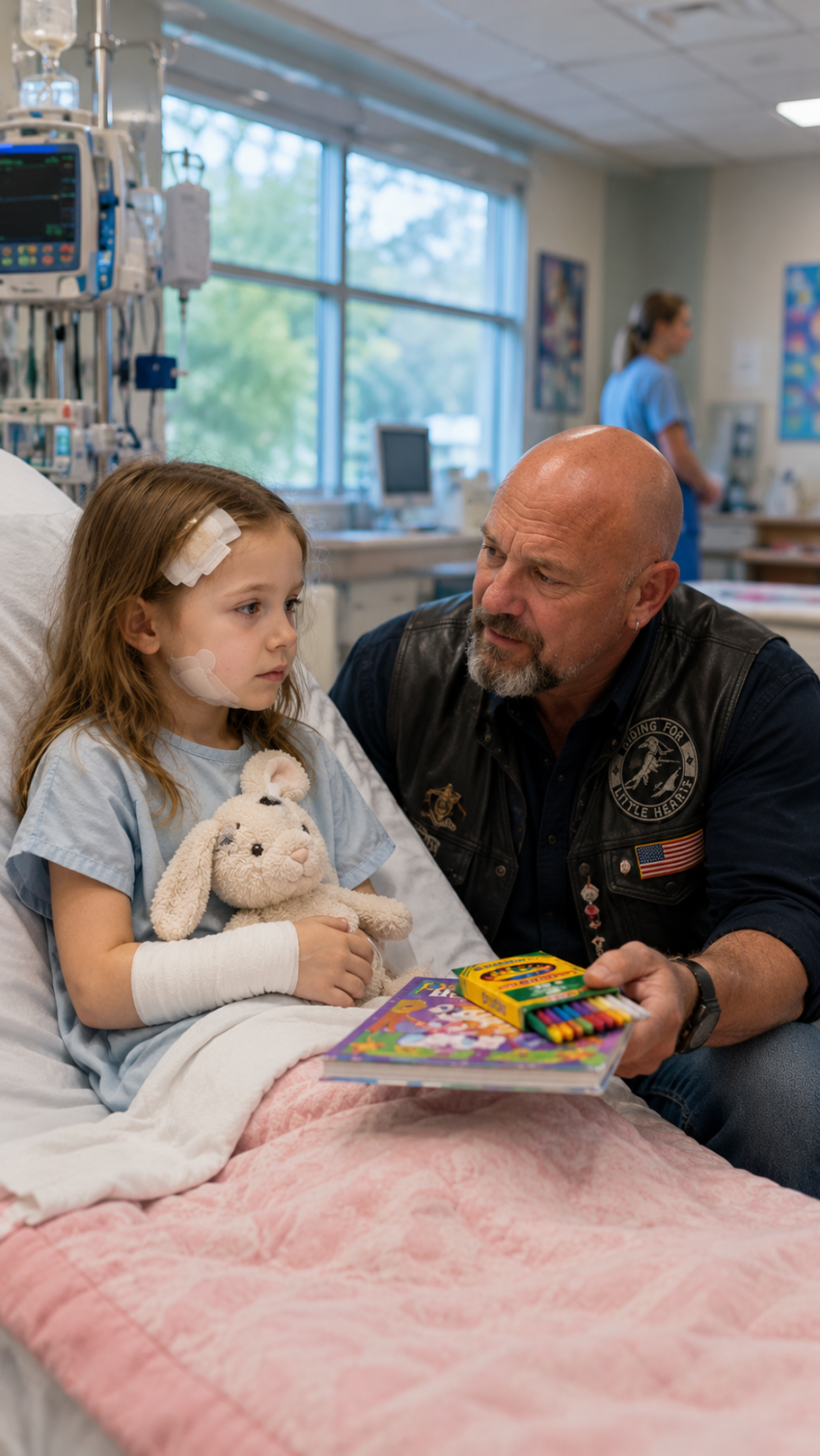
The Man Everyone Feared in the Hospital Hallway
He looked like the kind of man people moved away from in parking lots.
That was the first thing strangers noticed about him.
The gray beard. The wide shoulders. The heavy boots. The faded tattoos running down both arms like old road maps. The black leather vest with patches from towns most people only passed through on long drives. He looked too rough for a children’s hospital, too weathered for soft voices and bright murals painted on the walls.
But he was the only person who did not look away from my daughter’s face.
That is what I remember most.
Not the sound of his motorcycle echoing through the parking garage every Thursday morning. Not the way nurses paused when his boots came down the hallway. Not the cautious looks from parents who pulled their children a little closer when he passed.
I remember the way he looked at Grace.
He looked at her like she was still fully there.
My name is Elaine Porter. At the time, I was forty-nine years old, a widow, and the owner of a small roadside café outside Tulsa, Oklahoma. Grace was not my daughter by blood, but after everything that happened, blood became the least important part of family.
Grace was eleven when she came into my care.
A house fire outside Stillwater had changed her life in one night. Her mother did not survive. Her uncle signed a few early papers, then disappeared before the first major procedure. Her grandmother was living in a care home and could not take responsibility for a child with serious medical needs.
So the state called me.
I had fostered before. I knew how to sign forms, sit beside hospital beds, and stay calm when doctors used careful words to explain difficult things. I knew how to make soup nobody ate and answer questions children were too tired to ask twice.
But nothing prepared me for Grace.
Her face, neck, and arms carried the signs of what she had survived. Doctors spoke gently. Nurses were kind. Volunteers came in with stuffed animals and hopeful voices.
Then they saw her.
Most of them tried not to react, but Grace saw everything.
She saw the pause.
She saw the eyes shifting toward the wall behind her bed.
She saw people talk to me instead of talking to her.
Little by little, she stopped asking for mirrors. She stopped letting anyone touch her hair. She stopped speaking unless a nurse needed a number for her pain.
Room 312 became quiet whenever strangers entered.
Then one Thursday morning, Cole Barrett walked in.
The Biker With the One-Eared Rabbit
Everyone in his riding club called him Shepherd, though I never understood why at first.
Cole did not look gentle.
He was fifty-seven, broad through the chest, with sun-browned skin, a scar crossing one eyebrow, and hands so large they made a paper cup look fragile. His beard was more silver than brown. His leather vest smelled faintly of motor oil, rain, coffee, and wintergreen gum.
He came with a volunteer group from a veterans’ riding club near Edmond. The hospital called them “Highway Helpers,” though the riders seemed embarrassed by the name. They delivered blankets, books, small toys, and quiet company to children who had spent too much time under white lights.
Cole carried a plastic grocery bag.
Not flowers.
Not balloons.
Inside were colored pencils, strawberry licorice, and a stuffed rabbit with one ear missing.
Grace looked at the rabbit first.
Then she looked at him.
Most adults looked away when her eyes met theirs.
Cole did not.
He lowered himself into the visitor chair as if his knees had been arguing with him for years. Then he sat there quietly, all that leather and road dust taking up space in the room, and said nothing for nearly a full minute.
Finally, Grace whispered, “You can look away.”
Cole shook his head.
“No, ma’am,” he said. “I came here to see you.”
Grace turned her cheek toward the window.
Cole did not rush to comfort her. He did not tell her she was brave. He did not use the soft, polished words adults often use when they are afraid of silence.
Instead, he slowly rolled up his sleeve.
His arm was covered with scars.
Some were from welding. Some were old road marks. Some were faded lines from work, weather, and years that had not been kind. His skin told stories he did not explain.
Grace stared.
For the first time in weeks, she looked at someone longer than a few seconds.
Cole rested his arm on the chair.
“People stare at me too,” he said. “So I figured I’d give them something else to look at.”
Grace did not smile.
But her fingers tightened around the one-eared rabbit.
That was the beginning.
The Silence He Never Tried to Fill
Cole came every Thursday after that.
He did not bring big speeches. He did not bring pity. He brought small things: puzzle books, a soft blanket from a roadside gift shop, a keychain shaped like Oklahoma, a box of crayons because Grace hated markers.
Sometimes he read to her.
Not fairy tales.
Maps.
He would spread a road map across her hospital blanket and trace highways with one thick finger.
“This here is Tulsa,” he told her once. “And this road runs west until the sky gets so wide you think it forgot where to stop.”
Grace stared at the map.
“What’s past that?” she asked.
Cole looked pleased, though he tried to hide it.
“More road.”
“What’s after more road?”
“Depends who you ride with.”
That became their game.
He told her about diners where coffee tasted burned but pie was perfect. He told her about gas stations with friendly dogs, empty highways after rain, and sunrises that made chrome shine like water.
He never told her she had to be happy.
That was why she trusted him.
Children can recognize when adults are trying too hard. Grace had become an expert at it. She knew the difference between kindness and discomfort. She knew when people were speaking to the idea of her instead of the child in front of them.
Cole never treated her like a sad story.
He treated her like a person.
One afternoon, she pointed at his leather vest.
“Why do they call you Shepherd?”
Cole looked down at the patch on his chest and shrugged.
“Old joke.”
“You don’t look like a shepherd.”
“Most people don’t look like what they are.”
Grace thought about that for a long time.
Then she asked, “What are you?”
Cole’s face changed slightly.
Not enough for anyone else to notice.
But I noticed.
“Still finding out,” he said.
The Patch Hidden Inside His Vest
There was something sewn inside Cole’s vest.
I saw it once by accident when he reached for his wallet in the cafeteria.
It was a small yellow patch shaped like a sun. Beneath it, in crooked letters, was one name.
SADIE.
When he saw me looking, he closed the vest.
“Old road,” he said.
That was all.
I did not ask again.
But Grace noticed too. Children who have been hurt often learn to read what adults try to hide. She watched his hands. She watched the way he avoided cameras when hospital staff wanted photos of the volunteers. She watched how he stepped behind bigger men, even though he was usually the biggest man in any room.
Cole hated attention.
He washed his hands slowly before entering Grace’s room, as if it were a promise.
He kept his voice low.
He never touched her without asking.
When she said no, he accepted it.
When she said nothing, he stayed.
That mattered more than anything.
One rainy Monday evening, everything changed.
Cole was not supposed to come that day. Thursdays were volunteer days. Monday belonged to doctors, therapy, medication schedules, and the long gray hours after difficult procedures.
Grace had been through a hard morning.
By evening, she would not eat. She would not drink. She pulled the sheet over her face and whispered, “I don’t want this skin anymore.”
The room went still.
A nurse tried to comfort her. I tried. The doctor spoke gently from the doorway.
Nothing reached her.
Then we heard boots in the hall.
Slow.
Heavy.
Certain.
Cole appeared in the doorway with rain on his beard and shoulders. His leather vest was dark with water. He looked like he had ridden through half of Oklahoma to get there.
The nurse glanced at me.
I nodded.
Cole stepped inside.
He did not pull the sheet away.
He did not tell Grace to look at him.
He simply sat down.
For a while, there was only rain tapping the window and the steady sound of hospital machines.
Then Cole spoke.
“You know what people see when they look at me?”
The sheet did not move.
“They see scars. Ink. Bad choices. Long roads. They think they know me before I say a word.”
Grace’s fingers appeared at the edge of the sheet.
Cole rolled his sleeve higher.
“My skin ain’t perfect either, sweetheart.”
Slowly, Grace lowered the sheet enough to see him.
Cole leaned forward, his elbows on his knees, his hands open.
“Your skin got hurt. That is true. But it is not the part of you that loves strawberry licorice. It is not the part of you that hates math worksheets. It is not the part of you that remembers songs. It is not the part of you that made it through a night most grown men would be afraid to face.”
Grace’s eyes filled.
“You don’t know,” she whispered. “You get to go home looking like you.”
Cole’s jaw tightened.
For the first time since I had met him, he looked unsteady.
“No,” he said quietly. “I don’t.”
Then he reached inside his vest.
He took out a folded photograph and placed it on Grace’s blanket.
It showed a little girl around seven years old sitting on a motorcycle, wearing a helmet much too big for her head. She had missing front teeth and a smile bright enough to own the whole road.
Cole touched the edge of the picture.
“This was Sadie.”
Was.
One small word changed the room.
The Promise He Could Never Forget
Everyone assumed Sadie had been Cole’s daughter.
She was not.
She was his niece.
His younger sister worked double shifts at a nursing home, and Cole helped raise Sadie when he could. Back then, he was not the steady man Grace knew. He worked hard, rode hard, and spent too many evenings trying to outrun his own thoughts.
Sadie loved his motorcycle.
She called it the thunder horse.
Cole never rode with her on the road, but he let her sit on the bike in the driveway while they made engine noises and pretended they were crossing the country.
One Friday night, Cole promised to pick Sadie up from a school event.
He stopped somewhere first.
He stayed too long.
By the time he reached the school, Sadie had accepted a ride home with someone else. There was an accident on a county road before she made it back.
Cole did not cause what happened.
But he had broken his promise.
That was the truth he carried.
Months later, after his life had fallen apart, he found an envelope Sadie had decorated before that night. Inside was a drawing of him on his motorcycle under a yellow sun.
That was the patch inside his vest.
Not a symbol of danger.
Not a secret club mark.
A child’s sun.
When Cole told Grace about Sadie, he did not make himself the hero. He did not ask for forgiveness from a child who owed him nothing. He simply let her see that a person could carry pain and still show up for someone else.
Grace looked at the photograph for a long time.
Then she whispered, “Did she like rabbits?”
Cole looked down at the one-eared rabbit in her arms.
His voice grew rough.
“She fixed that one herself.”
Grace held it closer.
That night, she drank water.
The next morning, she asked for pancakes.
A week later, she asked for a mirror.
The Family That Chose Her
Healing did not happen quickly.
Real life does not turn soft because one good man walks into a room.
Grace still had bad mornings. She still turned away from reflections. She still grew tired of appointments, questions, bandages, and people who stared too long in public places.
But she changed.
She began speaking again.
She let Cole read maps to her. She asked about towns beyond Tulsa, roads beyond Oklahoma, and whether the sky looked different in New Mexico.
Cole answered every question like it mattered.
Because to him, it did.
I remained Grace’s foster mother, but the future was uncertain. Social workers called families. Medical foster homes reviewed her file. Good people asked careful questions about surgeries, therapy, school, costs, transportation, and long-term care.
Then they said no.
Always politely.
Always with sadness in their voices.
Always calling her “that poor little girl.”
One afternoon, Cole overheard me on the phone in the hospital waiting area. I hung up and turned to find him standing near the vending machines.
His face was unreadable.
“They said no?” he asked.
I nodded.
“How many?”
I could not answer.
He looked toward Grace’s room.
Then he walked away without another word.
I did not know then what he had decided.
Over the next two years, Cole became part of our lives without asking permission from anyone’s paperwork. He learned Grace’s care routine. He came to school meetings. He fixed the broken railing outside my café because Grace sometimes got weak after appointments. He sat through therapy sessions and never once acted embarrassed when she cried.
He never said, “I love you,” in the easy way some people do.
He changed dressings at midnight.
He drove three hours through bad weather to bring her the rabbit she had forgotten at home.
He stood between her and rude stares at gas stations.
That was his language.
That was love.
The Day the Brotherhood Was Tested
When Grace was fourteen, Cole called a meeting at the riding club’s old clubhouse outside Oklahoma City.
The building sat behind a tire shop, made of cinderblock and stubbornness. Inside were folding chairs, old coffee, framed photos from charity rides, and men who looked rough until you saw how gently they held babies at fundraisers.
I was there because Denise Cooper told me to come.
Denise was the club president. Everyone called her Mama D. She was in her early sixties, with silver braids and a calm voice that could quiet a whole room without rising.
Cole stood at the front with a folder in his hands.
“I’m filing to adopt Grace,” he said.
No one spoke.
A refrigerator hummed in the corner.
One older rider cleared his throat.
“Brother, you sure the state will allow it?”
Cole looked at the lawyer sitting beside the coffee table.
“We’re working on it.”
Another man spoke more softly.
“The medical costs could bury you.”
Cole’s expression did not change.
“She has already been left alone enough.”
That ended the room for a moment.
Then the arguments began.
Not because they did not care about Grace, but because care becomes real when it costs something. Some wanted to use emergency club funds. Others worried about rules. Voices rose. Chairs scraped.
Cole did not raise his voice.
He placed three motorcycle keys on the table.
“I’m selling two bikes,” he said. “Keeping the Road King.”
Mama D stared at him.
“Shepherd.”
Cole shrugged.
“A girl needs a father more than I need chrome in a garage.”
The room changed.
One rider stood.
Then another.
By morning, the club had organized a benefit ride. My café donated pies. A church that had never welcomed bikers before offered its parking lot. A mechanic gave free labor. A retired teacher offered tutoring.
Cole still sold two motorcycles.
I was with him when the buyer came for the second bike. He signed the title and did not touch the handlebars goodbye.
After the truck pulled away, Grace stepped into the garage.
“Are you sad because of me?” she asked.
Cole turned fast.
“No, ma’am.”
“Then why?”
He looked at the empty place on the concrete.
“Because I used to think keeping things made me safe.”
Grace waited.
Cole folded the rag in his hands.
“Turns out letting go can do that better.”
The Courtroom Where She Said Dad
The adoption hearing took place on a bright March morning in Oklahoma County.
Cole wore a white button-down shirt with the sleeves cut at the forearms because Grace had insisted.
“No hiding,” she told him.
Grace wore long sleeves because she chose to.
That difference mattered.
I sat behind them with Mama D and half the riding club. No one spoke much. Even the loudest men seemed to understand that some moments should not be crowded with noise.
The judge asked Grace if she understood what adoption meant.
Grace was fourteen by then. Sharp-eyed, funny, guarded, and stronger than she should have needed to be.
She looked at Cole.
Then she looked at the judge.
“It means he can’t leave when things get hard.”
The courtroom went completely still.
Cole lowered his head.
The judge asked Cole if he understood the responsibility he was taking on.
Cole’s hands trembled as he signed.
“Yes, sir,” he said.
Just two words.
But I saw his whole life inside them.
Afterward, we went to a diner off Route 66. Grace ordered pancakes for dinner. Cole ordered black coffee and meatloaf. The bikers filled three booths and pretended their eyes were dry.
No speeches.
No balloons.
Just forks against plates, leather creaking, and the quiet sound of a family becoming official.
Then Grace reached across the table and touched Cole’s scarred forearm.
“Dad,” she said, as if testing the word.
Cole closed his eyes.
For one clean second, the whole diner seemed to stop breathing.
Outside, someone started a motorcycle.
Grace smiled.
The Sunday Rides
The Sunday rides began a few months later.
Not long rides at first. Grace’s skin needed care, and Cole treated doctor instructions like sacred law. They rode early, before the Oklahoma sun turned sharp. Sometimes they only went ten miles and came back.
But it was enough.
Cole kept the old Harley Road King.
Black paint. Weathered chrome. A small yellow sun sticker inside the windshield where only the rider could see it.
He added a padded backrest for Grace. Then he added more padding because he did not trust the first job. He kept sunscreen in one saddlebag and medical supplies in the other. Between them sat the one-eared rabbit wrapped in a clean bandanna.
Grace wore long sleeves on those rides.
Not because Cole made her.
Because some days she wanted privacy from the world.
Cole wore short sleeves.
Always.
At first, I thought it was pride. Then I understood.
At gas stations, people sometimes looked too long at Grace. Before she could shrink into herself, their eyes would move to Cole’s arms. The scars. The old ink. The weathered skin. The proof that he had been through his own storms and kept going.
He never threatened anyone.
He never made a scene.
He simply stood where the first stare could land on him instead of her.
Every Sunday, Cole took the first look.
And Grace learned she did not have to carry every stranger’s reaction alone.
Sometimes they rode to my café. Sometimes they rode to the cemetery where Sadie was buried beneath a stone with a small carved sun. Grace would sit beside the grave and tell Sadie about school, pancakes, therapy, and how Cole snored during old western movies.
Cole always stood back by the bike.
He never told Grace what to say.
Some bonds are formed by blood.
Others are formed by showing up again and again until the heart finally believes it is safe.
The Girl Who Learned the Road Was Still Hers
I am writing this years later because last Sunday, I watched Grace ride past my café on the back of that old Harley.
She is eighteen now.
Tall. Sharp. Funny in a way that can warm a room or silence it, depending on who deserves which. She still wears long sleeves most days. Sometimes she does not.
Both are victories.
Both belong to her.
Cole is older now. His beard has turned almost white, and his knees complain louder than he does. His hands are still too big for paper cups. His nails are still clean when he visits hospitals.
Yes, he still goes.
There is another child in Room 312 now.
Another family learning how people look away.
Cole walks in with the same leather vest, the same heavy boots, the same quiet presence, and sometimes the same one-eared rabbit tucked under one arm when a child needs it more than he does.
He never starts with advice.
He sits first.
He lets the silence decide whether it trusts him.
Last Sunday, Grace sat behind him at a red light, her helmet covered in small white stars, her arms around the man everyone once feared in a hospital hallway. Cole wore short sleeves. Grace wore long ones. The motorcycle rumbled low beneath them, not loud enough to show off, just enough to be known.
A little boy on the sidewalk stared at Cole’s arms.
Then he looked at Grace.
Cole turned his head slightly.
Before he could do anything, Grace leaned around him, lifted two fingers, and waved.
The boy waved back.
The light changed.
The Harley rolled west past the café, past the old gas station, past the bend where the sun hits chrome for one bright second before the road opens wide.
Cole used to say the same thing before every ride.
“Hold on. We’re going.”
That morning, Grace said it first.
“Hold on, Dad. We’re going.”
Sometimes the person who looks the most intimidating from a distance is the one carrying the softest kind of patience, because life has already taught him what pain looks like when everyone else pretends not to see it.
A child does not always need perfect words, bright smiles, or forced encouragement; sometimes she only needs one steady person who can sit beside her without fear, without pity, and without trying to turn her pain into a lesson too soon.
Real family is not always the first group of people listed on a form; sometimes real family is the person who keeps coming back after the hospital room gets quiet, after the bills arrive, after the easy sympathy has disappeared.
Scars may change how the world looks at someone, but they do not decide the worth of a child, the future of a young woman, or the depth of love she is still able to receive.
Cole did not save Grace by pretending her pain was small; he helped her heal by admitting that some wounds are heavy, then proving she did not have to carry them by herself.
Brotherhood is not proven by loud engines, leather patches, or brave stories told around a table; it is proven when people choose to stand beside someone vulnerable even when compassion becomes expensive and inconvenient.
Grace’s healing was not a perfect straight road; it was made of hard mornings, quiet victories, difficult appointments, small choices, and one man who understood that love often sounds less like a speech and more like “I’m still here.”
The one-eared rabbit mattered because it showed Grace something no mirror could show her: that something repaired, imperfect, and visibly changed could still be held close, loved deeply, and carried into the future.
When Cole stood in front of strangers so their first stare would land on him instead of Grace, he taught her that protection does not always need anger; sometimes protection is simply choosing where to stand.
In the end, the road did not erase what happened to Grace or what Cole had lost, but it gave them both a place to keep moving, and sometimes moving forward with someone who loves you is the beginning of becoming whole again.