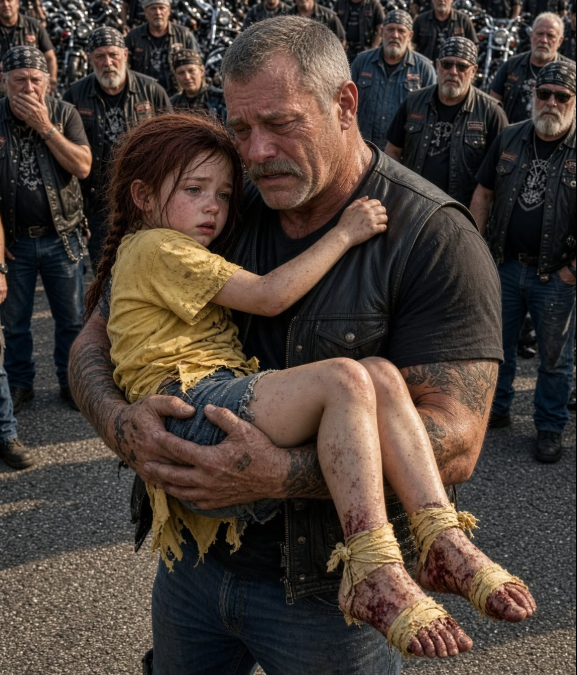
A6-Year-Old Girl Sat Beside 400 Bikers for 40 Minutes, Unable to Stand—When Their Leader Lifted Her, He Saw the Bloody Strips Wrapped Around Her Feet and Heard One Sentence That Silenced the Entire Ride.
Harper Caldwell sat alone on a curb in Knoxville while four hundred motorcycles waited to ride for sick children, but the little girl could not stand no matter how gently anyone asked.
When Wyatt Brennan lifted her into his arms, the riders saw her bloody feet wrapped in strips torn from her own shirt and realized she had walked across the city in pain for a reason no child should ever carry.
Her mother was lying unconscious in an apartment with no phone, no food, and no one answering the door, and the only thing Harper trusted was a promise that the motorcycle people would help.
The first Saturday of September arrived in Knoxville with the kind of heat that made the morning feel personal.
By eight o’clock, the asphalt at Chilhowee Park was already steaming. The east parking lot shimmered beneath rows of motorcycles, four hundred bikes parked with the clean discipline of men who understood machines, danger, and pride.
Harleys.
Indians.
A few custom builds.
Black paint.
Chrome pipes.
Flags tied to handlebars.
Leather saddlebags.
Polished tanks reflecting the white Tennessee sun.
At the far end of the lot, canopy tents had been set up for the eighteenth annual Ride for Children’s Hospital. Black and silver banners moved lazily in the wet air. Volunteers checked registration lists. Coffee steamed on folding tables no one wanted to stand near. Men in leather vests wiped sweat from their faces and pretended the heat did not bother them.
Wyatt Brennan stood beside his 2004 Road King and watched everything.
At fifty-four, Wyatt had the natural authority of an old tree. He was six-foot-two, broad through the shoulders, gray-haired, and weathered by decades of road, work, grief, and leadership. He was president of the Iron Ridge chapter, a motorcycle club Knoxville had learned to respect in the same uneasy way people respect a thunderstorm that waters the crops instead of tearing off roofs.
For eighteen years, the ride had raised money for East Tennessee Children’s Hospital.
Last year, they had brought in sixty-eight thousand dollars.
Therapy rooms.
Playroom renovations.
Equipment.
Bills for families who were already carrying too much.
The city never fully knew what to do with the sight of hundreds of bikers raising money for children, which was fine with Wyatt. He had stopped needing people to understand good before accepting it.
“Registration is at three hundred twelve,” Travis Holden said, appearing with two coffees.
Travis was Wyatt’s vice president, lean, red-bearded, and dry enough to make sarcasm sound like a weather pattern. He handed one cup to Wyatt.
“Donna says we’ll clear four hundred by nine. Record year.”
“Good,” Wyatt said. “Route marshals set?”
“All fourteen. Marcus is running sweep.”
Wyatt looked toward the far row, where his son Marcus was checking tire pressure on his bike.
Twenty-four.
Newly patched.
Quiet in the serious way young men get when they want to prove they were not given anything for free.
Marcus had volunteered to ride last in the convoy, picking up breakdowns and stragglers. Wyatt had not asked him to. That made him proud in a way he kept to himself.
“Good,” Wyatt said again.
Donna Rawlings appeared from nowhere, as usual.
Donna was the club treasurer, a paramedic, and the only person in Knoxville who could make four hundred bikers move faster by using fewer words. She was short, square, gray-haired, and carried a first-aid kit the way some people carried a purse.
“Wyatt,” she said. “We’ve got a situation at the east curb.”
Wyatt turned.
“What kind of situation?”
PART2:
“Little girl. Alone. Been sitting there a while. Won’t stand up. Won’t say where her parents are.”
Wyatt handed his coffee back to Travis.
“Show me.”
The east curb sat along the quieter side of the lot near Magnolia Avenue, where a narrow strip of grass separated the asphalt from a row of tired Bradford pear trees. No food vendors. No registration tables. Just shade, concrete, and the edge of the morning’s noise.
The girl sat on the curb with her legs pulled to her chest, arms wrapped around her shins, chin resting on her knees.
Six years old, maybe.
Small, but not only in size.
She looked compressed, as if her body had learned to occupy as little space as possible.
Her dark auburn braids had mostly come undone. Loose strands clung damply to her forehead. She wore a faded yellow T-shirt with a cracked butterfly on the front, denim shorts, and no shoes.
Her feet were tucked beneath her.
Hidden.
A pink water bottle sat empty beside her.
“Danny noticed her around seven-fifteen,” Donna said quietly. “Gave her water. She drank the whole thing. I tried talking to her. She says she’s waiting.”
“For who?”
“She said she doesn’t know.”
Wyatt studied the child from fifteen feet away.
Her eyes were open, green and watchful, tracking the movement of riders in the lot.
She was not crying.
That bothered him more than tears would have.
Children cried when fear still had somewhere to go. This girl looked like she had already used all her fear and kept moving anyway.
Wyatt approached slowly, then lowered himself to one knee in the grass several feet away.
“Hey there,” he said. “Hot morning for sitting on concrete.”
The green eyes found him and measured him.
“I’m Wyatt,” he said. “I’m in charge of this whole noisy mess. What’s your name?”
PART3:
She waited long enough that Wyatt thought she might not answer.
Then she said, “Harper.”
“Harper,” he repeated. “That’s a strong name. Are you here with somebody?”
She shook her head.
“Are you waiting for somebody?”
“I’m waiting for help.”
Her voice was small, but clear.
Not timid.
Not confused.
She sounded like a child stating a fact after doing the math.
Wyatt felt the lot around him fade slightly.
“Well,” he said gently, “you came to the right place. Can you stand up for me? Let’s get you somewhere cooler.”
Her face tightened.
Not fear.
Pain.
“I can’t,” she said. “It hurts too much.”
Wyatt did not ask what hurt.
He was close enough now to see the tremble in her arms, the tightness around her mouth, the old dried tear tracks dust had settled into.
“Okay,” he said. “That’s okay. Can I pick you up?”
Harper looked at him for a long moment.
She was not deciding whether she trusted him.
Trust was too expensive for a child who had walked into a parking lot alone.
She was deciding whether she had any choice left.
“Please,” she said.
Wyatt slid one arm behind her back and the other under her knees. He lifted her the way he had once lifted Marcus at that age, carefully, with the concentrated gentleness of a large man holding something weightless and priceless.
Then he saw her feet.
Donna drew in a sharp breath.
Every rider within fifty feet went silent.
Harper’s feet were destroyed.
The soles were blistered raw. Some blisters had burst and flattened into torn circles of wet skin. Her right heel had a gash crusted with dried blood. The ball of her left foot was swollen and open, ringed by smaller blisters. Between her toes, the skin was scraped red. Around both feet were strips of yellow cotton fabric, torn unevenly and tied in clumsy knots.
The same yellow fabric as her T-shirt.
She had torn her own shirt to wrap her feet.
Wyatt’s voice lowered.
“Harper, how far did you walk?”
“From my house.”
“Where’s your house?”
“Vestal. Catalpa Avenue.”
Donna’s hand went to her mouth.
Wyatt knew Knoxville.
Catalpa Avenue was across the river, through downtown, past the bridge, south toward Chapman Highway.
Six miles.
Maybe more, depending on how a child walked when she did not know the best route.
“You walked from Vestal?”
“My shoes broke on the bridge,” Harper said. “The bottom came off one. Then the other one hurt, so I took them both off.”
“And kept walking?”
“I had to.”
Wyatt carried her toward the registration tent.
The lot changed as he moved through it.
Laughter stopped.
Men turned.
Conversations died in ripples.
Travis met them halfway, his face sharpening from confusion to focus.
“Chair,” Wyatt said. “First-aid kit. Clean water. Now.”
Donna was already moving.
They set Harper on a folding chair beneath the tent.
Donna knelt in front of her and opened the kit.
“Sweetheart, I’m Donna. I’m going to clean your feet. It might sting.”
Harper nodded.
She did not flinch when Donna unwound the fabric, even when some of it pulled at the wounds.
That made Wyatt angrier than crying would have.
A six-year-old should not know how to hold still through that kind of pain.
Riders gathered in a loose semicircle.
Ten.
Twenty.
Fifty.
Then more.
Nobody crowded her.
Nobody spoke above a murmur.
They just watched Donna wash dirt and blood from tiny feet while the morning ride waited.
Wyatt crouched in front of Harper.
“Why did you need help?”
Harper looked at him with dry green eyes.
“My mama fell down.”
Wyatt went still.
“Last night she was making dinner, and she fell down in the kitchen. I shook her and called her name, but she wouldn’t wake up. She was breathing, but she wouldn’t open her eyes.”
“Did you call 911?”
“We don’t have a phone. Mama’s phone broke.”
Wyatt looked toward Travis.
Travis was already reaching for his cell.
“Did you go to a neighbor?” Wyatt asked.
“I knocked on four doors. Nobody answered. The lady downstairs didn’t open. Mr. Pruitt’s truck was gone.”
Harper looked at her bandaged feet.
“It was dark.”
The semicircle around them grew quieter.
“So what did you do?”
“I put a pillow under Mama’s head. I covered her with the couch blanket. I waited until morning.”
Her voice stayed steady.
Somehow that was worse.
“Then I remembered what Mama said.”
“What did she say?”
Harper looked past Wyatt at the rows of bikes.
“She said if something bad ever happened and she couldn’t help, I should walk to the big parking lot where the motorcycles go. The one with all the flags.”
The words moved through the crowd like weather.
“She said the motorcycle people are loud, but they’re good. She said find the biggest one and tell him I need help.”
Nobody breathed normally for several seconds.
A child had spent the night alone beside her unconscious mother.
At dawn, she had walked six miles through Knoxville on feet that came apart under her. Her shoes broke. She tore her shirt, wrapped the wounds, and kept going because her mother had told her the bikers would help.
Wyatt stood.
When he turned toward the riders, his voice carried across the lot.
“We have a woman down at 1847 Catalpa Avenue, apartment 2B. Unconscious since last night. No phone in the home. Her six-year-old daughter walked six miles barefoot to find us because her mother told her we help people.”
He let that land.
“Her mother was right.”
No one moved.
“Travis, call 911. Donna, you’re with me. Marcus, hold registration. The ride leaves as planned if I’m not back. Everyone else stays calm and useful.”
Travis already had his phone out.
Wyatt lifted Harper again, careful of the bandages, and carried her to his truck.
“Is Mama going to be okay?” she asked.
Wyatt hated promises adults made to children when they were scared.
He hated soft lies.
He hated the easy comfort of saying what he could not know.
“We’re going to do everything we can,” he said. “And the people behind us are pretty good at everything.”
Harper looked through the rear window.
Without being asked, twenty-three bikes had peeled away from the lot behind Wyatt’s truck. Travis rode point. Donna sat in the back seat with Harper, holding a granola bar and a bottle of water. The motorcycles followed in a tight line through Knoxville, engines low, disciplined, not racing, not showing off.
Just moving.
“They’re coming too,” Harper said.
“Yes.”
“Because of Mama?”
Wyatt looked at her in the mirror.
“Because of you both.”
Catalpa Avenue sat in a part of Vestal the city had learned to drive past.
Aging apartment buildings.
Chain-link fences.
Yards made of dirt, weeds, and stubbornness.
Number 1847 was a three-story walk-up with faded brown siding, cracked stairs, and a railing that shifted under Wyatt’s hand.
Apartment 2B was unlocked.
Wyatt stepped inside and saw a home that had almost nothing and cared fiercely for what it had.
The sink was empty.
Handmade curtains hung straight in the window.
A small table held two plates, one with half a piece of toast dried at the edge.
There were children’s drawings taped to the refrigerator with old magnets.
The apartment was not dirty.
It was poor.
And those were not the same thing.
Beth Caldwell lay on the kitchen floor with a pillow under her head and a couch blanket pulled to her chin.
Exactly as Harper had left her.
Donna was beside her in seconds.
“Pulse weak but steady. Breathing shallow. Responsive to pain.”
Beth’s face was pale and gray with exhaustion. Her lips were dry. When Donna pressed a knuckle to her sternum, Beth groaned.
“Not a coma,” Donna said. “Metabolic, maybe diabetic. Dehydration. We need EMS.”
“Already called,” Travis said from the doorway. “Six minutes.”
Harper stood frozen at the threshold.
“Mama?”
Beth’s eyes opened.
Barely.
They moved across the ceiling, the room, then found Harper with the accuracy of love.
“Harper,” she rasped.
The child crossed the room and dropped beside her mother’s head. She put both small hands on Beth’s cheeks and pressed their foreheads together like this was something they had done many times before.
“I found them,” Harper whispered. “I found the motorcycle people.”
Beth tried to lift her hand.
It shook too badly.
“You did good, baby,” she breathed.
The ambulance arrived with sirens off but lights flashing.
Paramedics moved fast. They started fluids, checked blood sugar, asked questions Beth could barely answer.
Harper answered the rest.
Because Harper knew where the medicine bottle was.
Where the last grocery receipt was.
How long the phone had been broken.
How many times her mother said she was not hungry at dinner.
Every answer carved into Wyatt.
When they carried Beth down the stairs, Harper insisted on going with her. Wyatt carried Harper because her bandaged feet could not manage the steps.
At the bottom, twenty-three bikers stood beside their machines in absolute silence.
They had heard the story in the parking lot.
Now they saw it.
They saw the apartment.
They saw the mother on the stretcher.
They saw the little girl with white gauze where her feet should have met childhood cleanly.
They saw the way Harper held Beth’s hand like she could keep her alive by grip alone.
The ambulance pulled away.
Through the rear window, Harper raised one hand.
Not quite a wave.
An acknowledgment.
Travis looked at Wyatt.
“What do we do, Prez?”
Wyatt looked up at the second-floor window where handmade curtains hung straight in a home that had nearly lost everything.
“We do what she did,” he said. “Whatever it takes.”
The hospital confirmed what Donna suspected.
Beth Caldwell had untreated Type 2 diabetes, made dangerous by dehydration, exhaustion, and skipped meals. She worked double shifts cleaning offices and stocking shelves. She fed Harper first. Then stretched leftovers. Then skipped dinner. Then breakfast. Then told her daughter she had eaten at work.
Her body had carried that lie until it could not.
“She’s going to recover,” the ER doctor told Wyatt and Harper near noon. “But she needs medication, regular meals, follow-up care, and rest.”
“She doesn’t eat,” Harper said quietly. “She gives me her food.”
The doctor’s face flickered.
Wyatt looked at the floor because if he looked at the child too long, he might forget how to remain calm.
“We’re fixing that,” he said.
Beth woke fully around two.
Harper climbed carefully onto the hospital bed and curled against her side. Wyatt stood in the doorway, too large for the frame, hands clasped in front of him.
“You’re the one from the parking lot,” Beth said.
“Wyatt Brennan. Iron Ridge.”
“You brought my daughter back.”
“Your daughter brought herself,” he said. “I just had a truck.”
Beth looked down at Harper’s bandaged feet.
Her face folded with guilt.
“She walked?”
“Six miles. Maybe more. Her shoes came apart on the bridge. She tore her shirt and wrapped her feet.”
Beth covered her mouth.
“I told her about you,” she whispered. “I used to drive past Chilhowee Park and see all the motorcycles for the hospital ride. I told her if anything bad ever happened and she couldn’t get help, go there. I told her the motorcycle people were good.”
Her voice broke.
“I didn’t think she’d ever have to do it.”
“She did it right,” Wyatt said.
Beth looked at him.
“You raised a child who kept her head through a night most adults would have panicked in. She gave you a pillow, covered you with a blanket, tried the neighbors, remembered the plan, and walked until she found help. That’s not luck. That’s parenting.”
Beth stared at him as if the word had entered the room in a language she had forgotten.
Parenting.
Not failing.
Not struggling.
Not barely surviving.
Parenting.
“The club is at your apartment,” Wyatt continued. “Bills are being handled. Groceries. Repairs. A phone. When you go home, it will be ready.”
“I can’t pay for that.”
“Nobody asked.”
“I don’t take charity.”
“This isn’t charity,” Wyatt said. “Charity is distant. This is responsibility. Your daughter walked six miles on bloody feet because she believed what you told her about us. If we don’t live up to that, then four hundred men on motorcycles are worth less than one brave little girl with no shoes.”
Beth tried to answer.
The words did not come.
Harper had fallen asleep against her, one hand curled in the hospital blanket.
Beth touched her daughter’s hair.
“Okay,” she whispered. “Okay.”
Back at Catalpa Avenue, the twenty-three riders worked like a crew sent by a storm with tools.
Travis called the utility company and paid the overdue electric bill, then added six months of credit.
Donna organized a grocery run that filled a refrigerator and pantry that had held half a box of rice, one can of green beans, and peanut butter scraped nearly clean.
Garrett Webb, a twenty-one-year-old prospect and plumber’s apprentice, fixed the kitchen faucet and replaced the shower head.
Dale Sutter, who owned a hardware store, installed a smoke detector, a new deadbolt, and repaired the loose railing on the stairs.
Marcus arrived after the ride left and took charge of anything nobody had thought to do.
He cleaned quietly.
Rehung the handmade curtains after Donna washed them.
Found a pink welcome mat at a dollar store and placed it outside 2B because, as he later said, “Coming home should look like something.”
At Chilhowee Park, the ride went on.
Three hundred seventy-seven motorcycles rolled out at 9:15 without Wyatt, following the route through the Smoky Mountain foothills.
Marcus was supposed to run sweep, but with Wyatt gone, the older marshals moved him to lead.
He did it without drama.
Steady.
Focused.
His father would hear about it later and feel a pride he would hide poorly.
When the riders returned that evening, barbecue smoke hung over the park, auction tables were full, and the hospital donation had already broken the previous year’s record.
Wyatt climbed onto the small stage at five o’clock.
The lot quieted.
He told them everything.
Not for pity.
Not for drama.
For truth.
He told them about Harper on the curb, the feet wrapped in strips of her own shirt, the six-mile walk from Vestal, the unconscious mother, the empty pantry, the broken phone, the neighbors who did not answer, and the mother who had starved herself slowly so her daughter could eat.
Four hundred men listened.
Many of them had raised money for children for years. That kind of charity was organized. Clean. Distant enough to be safe.
A hospital room.
A check.
A photo with administrators.
Something good, but contained.
This was different.
Need had walked into their parking lot on bloody feet and looked them in the face.
Wyatt’s voice roughened.
“That little girl did not ask us to be heroes. She asked us to be what her mother told her we were. Good. Helpful. Worth finding.”
No one moved.
“Every day after this, I want us to remember what it cost her to get here.”
For a moment, the silence held.
Then Vincent Marsh, a sixty-one-year-old rider from Maryville, walked to the registration table and laid down three hundred dollars.
“For Harper and Beth,” he said.
The line formed without instruction.
Men came forward with twenties, fifties, hundreds.
Emergency cash from saddlebags.
Auction money.
Lunch money.
One old rider removed a gold ring he no longer wore and set it on the table.
“Sell it if it helps.”
Travis counted late that evening.
Fourteen thousand six hundred dollars.
On top of the hospital donation.
Wyatt looked at the pile and felt the weight of it.
Money mattered.
Of course it mattered.
But money alone was too easy.
“Medical bills first,” he said. “Then phone, food, transport, medication. Donna sets up the clinic. Travis, your wife said something about child care?”
“She runs a group three mornings a week.”
“Harper gets a spot.”
“Work?” Travis asked.
“Beth had two jobs that nearly killed her. We find her one that lets her live.”
Beth came home Monday afternoon.
Wyatt drove.
Travis followed on his bike.
Marcus rode behind them, last in the small formation, because someone should always make sure nobody falls behind.
Beth climbed the stairs slowly, one hand on the repaired railing, the other holding Harper’s. At the door, she stopped at the new welcome mat, then looked at Wyatt.
“Who did this?”
“A lot of people.”
Inside, the apartment was the same and entirely changed.
Same handmade curtains.
Same small table.
Same drawings on the fridge.
But the refrigerator was full. The pantry shelves held rice, beans, pasta, vegetables, cereal, fruit cups, peanut butter, and granola bars.
A slow cooker sat on the counter with a note from Donna taped to the lid.
Step one: put food in.
Step two: wait.
Step three: eat.
There is no step where you skip eating, Beth.
Beside it sat a prepaid phone with three numbers already programmed.
Wyatt Brennan.
Donna Rawlings.
Travis Holden.
In Harper’s room, a small bed had fresh sheets.
On the pillow sat a pair of pink and white sneakers, the right size, laced and ready.
A card beside them read:
For the bravest feet in Tennessee.
Harper picked up the sneakers with both hands.
She pressed them to her chest and stood very still.
Beth sat on the edge of the bed and pulled her close.
“I promise,” Beth whispered. “I promise I will eat. I promise I will take the medicine. I promise you will not have to do that again.”
Harper leaned back.
“Pinky promise?”
Beth held out her smallest finger.
“Pinky promise.”
They hooked pinkies, and Wyatt turned toward the doorway because there were some moments a man had no right to watch too closely.
The Iron Ridge chapter kept its word.
Donna came by weekly to check Beth’s blood sugar, refill a pill organizer, and make sure the woman who had nearly died from feeding her child first did not quietly slip back into the habit.
Travis’s wife, Karen, picked Harper up for child care three mornings a week.
Paul Sutherland, a club member who owned a veterinary clinic on Kingston Pike, hired Beth for the front desk.
One job.
Livable pay.
Health insurance.
Regular hours.
Beth gained color.
Then weight.
Then laughter.
Harper watched her mother eat every meal with the stern attention of a tiny judge.
“You eat, I eat,” Harper told her one evening. “That’s the rule.”
Beth obeyed.
Wyatt came on Saturdays with books.
Harper read them with ferocity, burning through stories as if every page was proof the world was larger than Catalpa Avenue.
He taught her checkers.
She beat him on the third Saturday.
He taught her chess.
Two months later, she trapped his king with a knight and bishop combination that made him stare at the board.
“Where did you learn that?”
“The book you brought.”
“I brought that last week.”
“I read it twice.”
Marcus became her favorite because he let her sit on his parked motorcycle and explained every control with patient seriousness.
Donna became Miss Bossy, a name she accepted with pride.
Travis became the man who always had peppermint candy.
The club became not a crowd, but faces.
Names.
People who knocked.
People who came back.
And that was what changed Wyatt most.
Not the rescue.
Not the money.
Not the applause when people heard the story.
It was the coming back.
Anyone could respond to an emergency.
Emergencies were loud.
Emergencies told you what to do.
But after the ambulance left, after the donation box closed, after the cameras stopped caring, after the swelling in Harper’s feet went down and Beth’s bruised pride began the harder work of healing, life still asked for help in quieter ways.
A ride to the clinic.
A reminder to eat.
A working phone.
A safe babysitter.
A grocery bag left without making the person receiving it feel small.
That was the kind of help that cost more than cash.
Because it required attention.
And attention is the one thing busy people guard hardest.
Wyatt began noticing other things after Harper.
The old man on Magnolia whose porch light had been burned out for months.
The woman at the gas station counting change for baby formula.
The teenager sleeping too often behind the laundromat.
The waitress who smiled too fast and looked dead on her feet.
Need had always been around him.
But Harper had changed its shape.
She had made it impossible to pretend that suffering stayed politely inside its own neighborhood.
One night, Travis found Wyatt outside the clubhouse after a meeting, staring at the row of parked bikes.
“You’re doing that thing,” Travis said.
“What thing?”
“Looking like you’re either thinking deep thoughts or trying not to punch a mailbox.”
“Both, maybe.”
Travis leaned against a post.
“You still thinking about the kid?”
Wyatt looked at him.
“I don’t think I’ll ever stop.”
Travis nodded.
“Good.”
“Good?”
“Yeah. Some stories should haunt you. Keeps the soul from getting lazy.”
Wyatt almost smiled.
“That your philosophy now?”
“No. Donna said it. I stole it.”
“Figures.”
They stood in silence for a while.
Then Wyatt said, “Four hundred motorcycles in that lot, raising money for children we’d never meet.”
“Still a good thing.”
“It is.”
“But?”
Wyatt rubbed one hand over his jaw.
“But one child walked six miles because the help she needed was closer than we knew and farther than she could afford.”
Travis said nothing.
Wyatt looked at the bikes again.
“All that noise. All that leather. All that pride. And it took a little girl with bloody feet to tell us what our reputation was supposed to mean.”
Travis nodded slowly.
“She believed her mama.”
“Yeah,” Wyatt said. “That’s the part.”
Because Beth had told Harper the motorcycle people were good.
Not perfect.
Not safe-looking.
Not polished.
Good.
And Harper had believed her mother enough to walk until pain became background.
Wyatt had spent his life being feared, misread, judged, respected, avoided, admired, cursed, and thanked.
But being trusted by a hungry six-year-old who had no other plan was different.
Trust like that was a debt.
Not the kind you paid once.
The kind you lived under.
The winter after Harper’s walk was hard.
Cold snaps.
A flu wave.
Two job layoffs that hit families connected to the hospital.
A fire in an apartment building off Western Avenue.
Iron Ridge became busier than it had ever been.
Not officially.
There was no new charity name.
No foundation paperwork.
No smiling group photo with a giant check.
Donna kept a list in a spiral notebook she carried in her vest pocket.
Groceries.
Medication.
School shoes.
Rides.
House repairs.
Emergency contacts.
Wyatt asked once why she did not put it on a computer.
Donna looked at him.
“Because if I die, I want somebody useful to find it, not a password.”
That ended the discussion.
Harper recovered, but not quickly.
The physical wounds healed first.
Children’s bodies can do miracles adults forget to believe in.
The feet closed.
The blisters dried.
The new skin turned pink, then pale.
But for months, Harper would stop at bridges.
Not always.
Not every time.
Enough.
If they crossed a bridge in Wyatt’s truck, her hand would sometimes move toward her shoes.
Checking.
Remembering.
Marcus noticed first.
He was driving her and Beth home from a clinic follow-up when the truck crossed the Henley Street Bridge. Harper went quiet.
At the next red light, Marcus asked, “You okay back there?”
Harper looked embarrassed.
“My shoes are fine.”
Marcus did not turn around.
He just nodded.
“Good. Still, I keep tools in the truck if they ever give you trouble.”
“What kind of tools?”
“Enough to fix a shoe badly.”
That made her laugh.
From then on, Marcus kept a small roll of duct tape, two extra pairs of children’s socks, and a cheap pair of flip-flops in the back of his truck.
Wyatt found them one day and looked at him.
Marcus shrugged.
“Preparedness.”
Wyatt said nothing.
His throat had gone tight.
Fatherhood was strange that way.
You spend years trying to teach a boy how to become a man, then one day he does something small and you realize he understood more than your speeches ever said.
Beth struggled too.
Not with gratitude.
She had plenty of that.
Too much, sometimes.
Gratitude can become another burden when people already feel like they owe the world an apology for needing help.
She kept trying to pay them back.
Five dollars here.
Ten dollars there.
A casserole once she got stronger.
A handwritten list of what had been spent.
Wyatt finally sat across from her at the little table in 2B and said, “Beth, stop keeping score.”
She stiffened.
“I don’t want to owe anybody forever.”
“You don’t.”
“I do.”
“No,” Wyatt said. “You don’t owe us money. You owe us the same thing we owe everybody who helped us get through our worst days.”
She looked at him.
“What’s that?”
“When you can, you come back for somebody else.”
Beth stared at the table.
Then she nodded.
Months later, she proved she had listened.
A young mother came into the veterinary clinic where Beth worked, crying because her dog needed medication she could not afford. Paul Sutherland was out that morning, and the receptionist was new and overwhelmed.
Beth quietly paid for the medication herself.
When Wyatt heard, he asked why she had not called him.
She said, “Because I could handle that one.”
He smiled for half the drive home.
One year later, the nineteenth annual Ride for Children’s Hospital broke records again.
Four hundred thirty motorcycles filled Chilhowee Park.
The morning was hot.
The asphalt shimmered.
The banners snapped lightly in a faint breeze.
But the energy in the lot was different now.
Deeper.
More awake.
At nine o’clock, Wyatt stepped in front of the riders and raised one hand.
The lot fell silent.
“Last year,” he said, “a little girl sat on that curb and couldn’t stand up. She had walked six miles from Vestal on bare feet because her shoes broke on the bridge. She wrapped her own wounds in strips of her shirt and kept walking because her mother told her the motorcycle people were good.”
No one looked away.
“She did not ask us to be heroes. She asked us to be worth the walk.”
Wyatt turned toward the registration tent.
Harper Caldwell stepped out.
Seven now.
Auburn braids neat.
Blue T-shirt.
Pink and white sneakers double-knotted.
In her hands, she carried a small black helmet Marcus had painted for her. Across the back, in silver letters, was one word.
Barefoot.
A few men had to turn away.
Travis coughed into his fist.
Donna pretended to check the first-aid kit.
Marcus stood very still near the front row, jaw tight, eyes bright.
Beth stood behind Harper, healthier now, her hands folded over her mouth, as if she was trying to hold in both joy and memory.
Wyatt lowered himself in front of Harper.
“You sure about this?”
Harper nodded.
“You know you’re riding in front of four hundred thirty motorcycles.”
“I know.”
“That’s a lot of noise.”
She looked past him at the riders.
“They’re loud,” she said. “But they’re good.”
Wyatt had to look down for a second.
“Yeah,” he said. “We try.”
He lifted her onto the front of his Road King, the same way he had lifted her from the curb one year earlier.
Except now she was heavier by eight pounds and lighter by a lifetime of fear.
“You ready?” he asked.
Harper looked out at four hundred thirty motorcycles and the men who had become proof that help could be real.
She nodded.
Wyatt started the engine.
The Road King rumbled beneath them.
Then four hundred twenty-nine engines fired behind her, one after another, until the sound rolled over Chilhowee Park and across Knoxville like thunder with a purpose.
Harper put both hands on the bars.
Her pink and white sneakers touched the foot pegs.
She sat tall, face lifted toward the road ahead.
The girl who could not stand had walked farther than most adults would have dared.
Now she rode at the front.
As the convoy pulled out, people lined the road.
Some waved.
Some filmed.
Some wiped their eyes.
Harper did not see all of them.
She was watching the road.
Wyatt kept the bike steady beneath her, one arm loosely around her for safety, the other on the handlebar.
They passed the east curb where she had waited.
The concrete looked ordinary again.
That bothered Wyatt.
Important places should look different after they change a life.
But most of them do not.
A curb stays a curb.
A bridge stays a bridge.
A kitchen floor stays a kitchen floor.
A parking lot stays asphalt and faded lines.
The meaning has to be carried by the people who remember.
Wyatt remembered.
So did the riders behind him.
They remembered every time their engines rolled past the curb.
They remembered every time Harper’s sneakers flashed pink and white in the morning sun.
They remembered every time they saw Beth standing by the registration tent, healthy and crying and alive.
They remembered what need looked like when it arrived without appointment, without paperwork, without pride.
And they remembered that a reputation is not what people say about you when everything is easy.
It is what a child believes about you when everything has gone wrong.
The ride wound through Knoxville and out toward the foothills.
Harper leaned slightly into the turns, trusting Wyatt completely.
At the first stop, Marcus brought her water.
Donna checked her sunscreen.
Travis handed her peppermint candy.
Beth hugged her too long.
“Mama,” Harper said, muffled against her shoulder. “I’m okay.”
“I know,” Beth whispered.
But she held on one second more.
That was allowed.
Some fear leaves slowly.
When the convoy returned to Chilhowee Park hours later, the hospital donation had broken another record.
But Wyatt did not announce that first.
He waited until the riders gathered.
Then he brought Harper onto the stage.
She stood beside him in her pink and white sneakers, helmet tucked under one arm, cheeks flushed from sun and wind.
Wyatt looked out at the crowd.
“This ride started eighteen years ago because we wanted to help sick children,” he said. “That hasn’t changed.”
He placed one hand gently on Harper’s shoulder.
“But last year, this child reminded us something. Helping people cannot only happen when it is scheduled. It cannot only happen when there is a banner and a route map and a donation table.”
No one spoke.
“Sometimes help comes when you are tired. When it is inconvenient. When it is messy. When the person needing it cannot explain everything properly because she is six years old and her feet are bleeding.”
Harper looked down at her shoes.
Wyatt’s voice roughened.
“Sometimes being good means being interrupted.”
Travis nodded once.
Donna wiped her cheek and pretended sweat had gotten in her eye.
Wyatt continued.
“So from now on, a portion of every Ride for Children’s Hospital will go into a standing emergency fund for families connected to this city who need food, medicine, transportation, phones, shoes, whatever keeps a bad night from becoming the last night.”
The applause started low.
Then grew.
Then rolled across the lot until the banners shook.
Wyatt looked down at Harper.
“You want to say anything?”
Harper’s eyes widened.
Beth looked alarmed.
Wyatt leaned down.
“You don’t have to.”
Harper held the helmet with both hands.
Then she stepped toward the microphone.
The entire lot went silent with a speed no adult speaker could ever have commanded.
Harper looked at the bikes.
At the leather vests.
At Donna.
At Travis.
At Marcus.
At her mother.
Then she said, “Thank you for coming back.”
That was all.
Five words.
Thank you for coming back.
Four hundred thirty bikers broke.
Not loudly.
Not theatrically.
But in the way grown men break when something small and true gets past every defense they own.
Wyatt closed his eyes.
Because that was the real story.
Not that they had gone.
Anyone could go once.
They had come back.
Again and again and again.
That was what Harper remembered.
That was what Beth needed.
That was what turned charity into responsibility.
And that was what made the ride different forever.
Years later, people in Knoxville would tell the story wrong.
They would say a little girl showed up at a biker rally with bloody feet.
They would say a motorcycle club saved her mother.
They would say Wyatt Brennan carried her.
They would say the whole thing went viral, though Wyatt hated that word and refused to care about numbers that did not feed anybody.
They would say four hundred bikers changed one family’s life.
All of that was true.
But incomplete.
Because Harper changed them too.
She changed how they looked at the city.
She changed how they defined help.
She changed how they understood the cost of being trusted.
She taught men who already knew how to ride in formation how to show up in formation for a life after the emergency had passed.
That mattered more than any headline.
Late that evening, after the nineteenth ride ended and the tents came down, Wyatt walked to the east curb alone.
The heat had eased.
The asphalt still held the day’s warmth.
He stood where Harper had sat with her knees pulled to her chest and her feet hidden under her.
He could still see her there.
Small.
Dusty.
Silent.
Waiting for help.
Waiting to find out if her mother had told the truth.
Travis came up behind him.
“You good?”
Wyatt looked across the empty lot.
“No.”
Travis nodded.
“Yeah.”
A few seconds passed.
Wyatt said, “I keep thinking about what she said.”
“Today?”
“Last year.”
“About us being loud but good?”
Wyatt nodded.
Travis smiled faintly.
“Could do worse.”
“Could do better.”
“Always.”
Wyatt looked down at the curb.
“We have to make sure she never regrets believing it.”
Travis’s expression sobered.
“We will.”
Behind them, Marcus was helping Beth load folding chairs into a truck while Harper sat on the tailgate eating watermelon from a paper plate. Donna was scolding someone for lifting a cooler wrong. Riders were laughing, tired, sunburned, alive.
Ordinary things.
Holy things.
Wyatt watched Harper swing her feet.
Pink and white sneakers.
Double-knotted.
Clean.
Safe.
Then she looked up and caught him watching.
She waved.
This time, a real wave.
Wyatt lifted his hand.
And for the first time all day, he let himself breathe.
The girl who had walked to them in pain was no longer sitting alone on a curb.
She was surrounded.
Not smothered.
Not pitied.
Surrounded.
There was a difference.
Pity looks down.
Responsibility stands beside.
That was the lesson.
One brave child had walked six miles to ask whether the loud men on motorcycles were as good as her mother said.
A year later, four hundred thirty engines answered.
Yes.