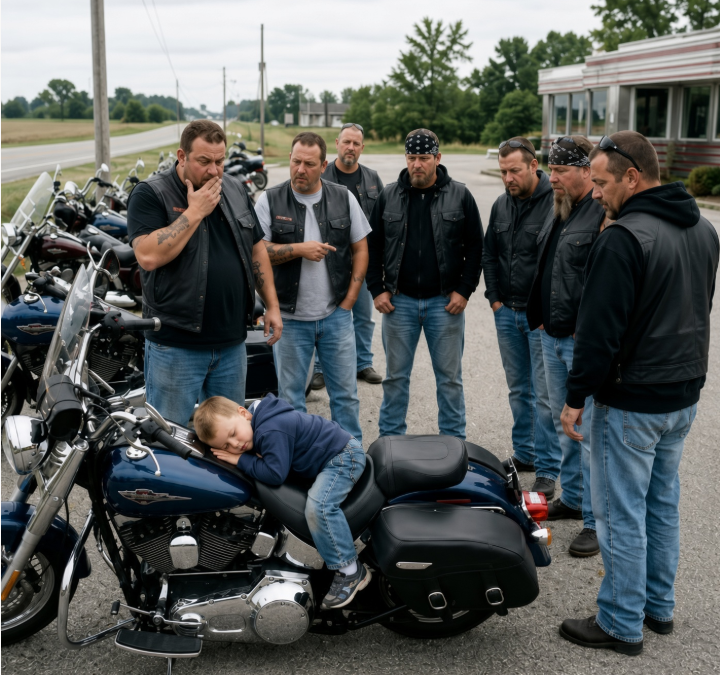
A6-Year-Old Boy Fell Asleep Against a Biker’s Motorcycle, Barefoot and Clutching a Crumpled Photo—Then 300 Riders Learned Why He Had Chosen That Bike.
I found the boy curled against my rear tire, barefoot on hot gravel, clutching a photograph of the parents he had already lost.
He was six years old, starving, and so tired that three hundred motorcycles had not woken him.
But when he opened his eyes and whispered three words in his sleep, I knew the Iron Angels were not leaving Broken Bow without him.
My name is Marcus Caldwell.
For twelve years, I rode at the front of the Iron Angels Motorcycle Club.
Not because I was the oldest.
Not because I was the biggest.
And not because I was the loudest.
A lot of men mistake volume for leadership. I had seen enough loud men break under pressure to know better. Leadership is not thunder. It is direction. It is seeing the pothole before the rider behind you hits it. It is knowing who needs fuel, who needs a break, who is riding angry, who is riding tired, and who is pretending he is fine because pride is cheaper than honesty.
I was forty-six years old that July, with scarred hands from decades of engine work, a salt-and-pepper beard cut close to my jaw, and a face most people described as calm when they meant hard.
I had not always been hard.
That was grief’s work.
Eight years before I found Ethan Whitfield beside my motorcycle, my son died.
Caleb was nine.
Leukemia.
Even now, that word feels less like a diagnosis and more like a door slamming shut.
Caleb loved motorcycles before he loved baseball, before he loved dinosaurs, before he learned to ride a bicycle without training wheels. He used to sit in my garage on an upside-down bucket, swinging his legs while I worked on engines.
“Why do motorcycles rumble?”
“Why does chrome shine?”
“Why do bikers wear leather?”
“Could angels ride motorcycles?”
“If heaven has roads, are they paved or dirt?”
I always had answers for him.
Not because I knew everything.
Because fathers are supposed to make the world sound less frightening than it is.
“If heaven is worth anything,” I told him once, “it has open roads.”
He believed me.
Then came hospitals.
Needles.
Masks.
The smell of antiseptic.
The shaved head he tried to joke about because he hated seeing his mother cry.
Doctors who began with fighting words and ended with comfort words.
A little casket.
A motorcycle procession so loud the whole county heard our grief pass through.
After Caleb died, I kept riding because stopping meant thinking.
And thinking meant remembering.
PART2:
My wife Harper and I did not separate, but something between us became fragile. Not broken. Broken would have been cleaner. Fragile meant we still loved each other, still slept in the same house, still knew how the other took coffee, still said good morning and good night.
But there were rooms inside both of us neither one entered anymore.
Charity rides became the one thing I could still do.
Every July, the Iron Angels crossed Oklahoma and Arkansas raising money for children’s hospitals, burn units, pediatric cancer funds, and small-town families drowning in bills. Mechanics, truck drivers, welders, nurses, teachers, veterans, single fathers, widowers, women who rode harder than half the men and took foolishness from no one.
We came from chapters across six states because we believed a V-twin sounded better when it was headed somewhere that mattered.
I believed that too.
Or I was trying to.
That summer, the ride brought us into Broken Bow, Oklahoma, under a hard July sun.
The ground trembled before the town saw us.
At first, it was only a faint vibration on the edge of Route 259, low and distant beneath the heat rising off the pavement. Then the sound deepened. Windows along Main Street rattled. Coffee cups inside Savannah’s Griddle shivered on their saucers. A woman walking out of the pharmacy stopped with one hand on the door. Two old men outside the feed store turned toward the hill south of town.
Then my motorcycle crested the rise.
Behind me came another.
Then another.
Then a line of chrome, leather, headlights, and thunder stretching so far back it seemed the town held its breath.
Three hundred motorcycles rolled into Broken Bow.
Three hundred riders in black leather vests bearing the same patch: silver wings spread wide around the letters IAM.
Iron Angels Motorcycle Club.
Savannah’s Griddle stood on the edge of Main Street, a squat brick diner with a tin roof, a neon sign that had buzzed pink since 1987, and a parking lot big enough for trucks, but not quite big enough for us.
We spilled across the gravel, along the shoulder, and beneath a stand of red oaks near the tree line. Engines died one by one, leaving behind the ticking heat of metal cooling in the sun.
I pulled off my gloves.
“Thirty minutes,” I called. “Eat fast. We’ve got ninety miles to Tulsa before dark.”
Travis Jennings rolled up beside me and killed his engine.
PART3:
Travis was the club’s vice president, lean, tattooed, quick-grinning, and forty-three years old with the restless energy of a man who had survived hard years by never sitting still too long.
“My back is about to file a formal complaint,” he said, swinging off his bike. “You picked every pothole in Oklahoma on purpose.”
“Builds character.”
“I have enough character. I’m practically unbearable with character.”
I patted my vest pockets and frowned.
“Left my phone in the saddlebag. Go grab us a table.”
Travis looked toward the diner, where riders were already filing in.
“You want pie?”
“I want coffee.”
“You always want coffee.”
“That’s why I’m consistent.”
He disappeared inside with the first wave of hungry riders.
I walked back toward my Road King, parked near the far end of the row closest to the tree line. A cluster of red oaks threw patchy shade across the gravel, their leaves barely moving in the heavy heat.
I unlatched the left saddlebag.
My phone was wedged beside a bottle of water. I grabbed it and checked the screen.
Two missed calls from Harper.
I stared at her name for a moment.
Not because I did not want to call back.
Because things between us had become so delicate that even ordinary calls could feel like handling glass.
I slipped the phone into my vest and started to close the saddlebag when something caught my eye.
A shape that did not belong.
On the right side of my motorcycle, tucked close against the rear fender, curled against the back tire, was a child.
I froze.
The boy was small.
Five, maybe six.
He lay in a tight ball on the ground, knees pulled to his chest, head resting on one arm, asleep so deeply that the rumble of three hundred motorcycles had not kept him awake.
His sandy blond hair was unwashed and matted on one side. His faded blue T-shirt hung from his shoulders like a pillowcase, three sizes too big.
He wore no shoes.
No shoes.
His bare feet were dirty, soles darkened with dust and road grit. A scratch on his left ankle had scabbed over without being cleaned. His ribs showed faintly through the stretched collar of his shirt.
In his right hand, pressed tight against his chest, he clutched a crumpled photograph.
For a second, I was not in Broken Bow.
I was in a hospital room in Tulsa, watching Caleb sleep with one hand curled around a toy motorcycle, eyelashes too dark against skin too pale.
I heard monitors.
Smelled antiseptic.
Felt Harper’s fingers digging into my arm while a doctor said, “We’re doing everything we can.”
Then gravel crunched under my boot.
I was back.
I knelt slowly.
Carefully.
The way a man approaches something wounded enough to run or shatter.
“Hey,” I said softly. “Hey, buddy.”
The boy stirred.
His eyes opened.
Pale blue.
Startled.
For one heartbeat, he looked at me the way a cornered animal looks at a hand it cannot read.
I stayed very still.
“It’s okay,” I said. “Nobody’s going to hurt you.”
The boy sat up slowly, pressing his back against the motorcycle tire. His eyes moved from me to the line of bikes, then toward the diner where men in leather were laughing, stretching, heading inside. His lower lip trembled, but he did not cry.
That made it worse.
Children who cry still believe someone might answer.
“What’s your name?” I asked.
The boy clutched the photograph tighter.
“Ethan,” he whispered.
“Ethan. That’s a good name.”
I shifted down onto one knee so my face was lower than his.
“I’m Marcus. Can you tell me where your mom or dad is?”
Something changed in Ethan’s face.
His eyes filled, but still he held the tears back with a discipline no child should need.
He looked down at the photograph.
Then, with grave care, he held it out.
I took it.
The photograph was worn soft at the edges from being handled too often. It showed a young couple sitting on a picnic blanket. The man had sandy hair like Ethan’s and a smile caught mid-laugh. The woman had kind eyes and windblown dark hair. Between them was a baby, chubby-cheeked, laughing at something outside the frame.
“They went to heaven,” Ethan said quietly. “A long time ago.”
I looked at the photograph.
Then at the boy.
Then I closed my eyes because if I did not, the locked chamber in my chest was going to split open right there beside my motorcycle.
“How long ago?” I asked.
Ethan shrugged.
“I was little.”
I swallowed.
“Who takes care of you now?”
“Uncle Hank.”
“Is Uncle Hank here?”
Ethan shook his head.
“When did you last eat?”
The boy thought seriously, as if the question required arithmetic.
“I don’t remember.”
My hands began to shake.
Not visibly enough for most people to notice.
But I noticed.
I handed the photograph back to Ethan.
Then I stood, took off my leather vest, and wrapped it gently around the boy’s shoulders. It swallowed him whole, heavy and black, smelling faintly of road dust, engine oil, and sun.
Ethan looked up at me.
“Can I sleep here?” he asked.
The question broke something in me so cleanly I almost made a sound.
“Not on the gravel,” I said, voice rough. “Not anymore.”
I lifted Ethan carefully.
The boy weighed almost nothing.
Forty pounds, maybe less.
A featherweight bundle of bones and oversized cotton.
He did not resist. He simply went still in my arms, the way children go still when they are not used to being held and do not know whether safety has rules.
I carried him into Savannah’s Griddle.
The diner fell silent.
Three hundred men and women in leather vests, crowded into booths, standing near the counter, waiting by the pie case, turned at once. Forks paused halfway to mouths. Conversations dropped dead. Coffee stopped pouring.
Every eye in the place followed me as I walked to an empty booth near the window and set Ethan down on the cracked vinyl seat as gently as if the boy were made of glass.
“Savannah,” I called.
The woman behind the counter turned.
Savannah Mercer had owned the diner for twenty-two years and had fed truckers, church groups, hunters, sheriff’s deputies, crying teenagers, broke families, and more than a few strangers who could not pay. She was sixty-four, silver-haired, sturdy, with reading glasses pushed on top of her head and flour on her apron.
She took one look at Ethan’s bare feet, hollow cheeks, oversized shirt, and the photograph clutched in his fist.
Her face changed.
Not pity.
Recognition.
“I need whatever you’ve got that a kid can eat,” I said. “And a glass of milk.”
Savannah disappeared into the kitchen without a word.
Travis slid into the booth across from me, all humor gone.
“Who’s the kid?”
“His name is Ethan,” I said. “Found him asleep against my back tire. Says his parents are gone.”
Travis looked at Ethan.
The boy stared at the tabletop, tracing the wood grain with one fingertip, trying to make himself invisible beneath my vest.
Cody Barrett moved through the crowd and knelt beside the booth.
Cody was thirty-four, from the Durant chapter, with a trimmed beard, patient eyes, and a background few people guessed by looking at him. Before joining the Iron Angels full-time, before his divorce and the road and the patch, Cody had taught second grade for seven years.
He knew children.
More importantly, he knew hurt children.
He saw the hollow eyes.
The mechanical stillness.
The way Ethan’s shoulders tightened whenever someone moved too fast.
“Hey, Ethan,” Cody said easily. “I’m Cody.”
Ethan looked at him, then down.
“You like pancakes?”
A tiny nod.
“You like eggs?”
Another nod.
“You like broccoli?”
Ethan looked horrified.
Cody leaned back.
“Good. Just checking if you were secretly a grown-up in disguise.”
A flicker moved across Ethan’s mouth.
Not a smile.
Almost.
Savannah returned with a plate so full it seemed to stun the whole booth. Scrambled eggs. Two biscuits with gravy. Bacon. Sliced peaches. A glass of milk so cold it sweated down the sides.
She set it in front of Ethan.
Then she rested one hand briefly on his head the way grandmothers do when they are blessing without saying so.
“Eat, baby,” she said.
Ethan looked at me, waiting.
“It’s all yours,” I said.
The boy ate.
Not like a child enjoying breakfast.
Like hunger eating through him.
Fast.
Desperate.
Barely chewing.
Both hands working at once, scooping eggs onto biscuit, pushing food into his mouth with a focus that left no room for manners or embarrassment. He drank the milk in four swallows. He used one finger to get the last gravy from the plate, then froze as if remembering he was being watched.
Nobody in the diner spoke.
Three hundred riders watched a six-year-old eat like he did not know whether food would ever come again.
The silence weighed more than thunder.
Doug Prentice, two hundred forty pounds of beard, denim, and old road scars, took off his sunglasses and wiped his eyes with the back of his hand.
“Dust,” he muttered.
Inside a diner.
Nobody corrected him.
Savannah brought a second plate without being asked.
Ethan looked scared when she placed it down.
“Do I have to pay?”
Savannah’s eyes filled.
“No, baby.”
“I don’t have money.”
“I know.”
“Uncle Hank says people don’t give things for free.”
I leaned closer.
“Your uncle is wrong.”
Ethan studied me with a seriousness that made me feel judged by the whole universe.
Then he picked up his fork.
After he slowed down, Cody began asking gentle questions.
Not like police.
Not like an interrogation.
Like a teacher trying to guide a child across a shaky bridge.
“Where do you live, Ethan?”
The boy pointed vaguely east, past the tree line.
“With Uncle Hank.”
“Where’s Uncle Hank now?”
Ethan gripped the empty glass.
“I don’t know.”
“When did he leave?”
“He said stay inside.”
“When?”
Ethan counted silently.
“Two days. Maybe three.”
The silence shifted.
It was no longer shock.
It was rage arriving in three hundred bodies at once.
My hand curled into a fist under the table.
Cody kept his voice steady.
“You were alone for two or three days?”
Ethan nodded.
“He does that sometimes.”
“Was there food?”
“Some chips. But I ate them.”
“What did you do when the food was gone?”
Ethan shrugged.
“Water.”
Travis turned toward the window, jaw working.
I leaned forward.
“How did you get out?”
“The bathroom window opens if you push hard.” Ethan looked down at his plate. “I got scared when the power went out. It was dark, and the house made noises. I walked until I found people.”
“You came here?”
“I heard the motorcycles.”
For the first time, something like light appeared in Ethan’s pale blue eyes.
“My mom used to say when you hear something big and loud coming toward you, it might be angels.”
He hesitated.
Then whispered, “I thought maybe you were angels coming to get me.”
Someone near the counter swore softly, not in anger at the child but because language had failed him.
I reached across the table and placed my hand over Ethan’s small fist.
“We’re going to figure this out,” I said. “You’re not going to be alone.”
Ethan’s eyelids drooped.
The food, the heat, the safety, the exhaustion finally pulled at him all at once. He leaned sideways, still clutching the photograph.
“Can I sit on your motorcycle again?” he murmured.
I frowned.
“Again?”
Ethan’s voice thinned with sleep.
“I climbed up first. It was warm. I pretended Daddy was driving.”
His eyes closed.
Then, barely audible, he whispered three words.
“Don’t leave me.”
No one moved.
Not Travis.
Not Cody.
Not Savannah behind the counter with both hands pressed to her mouth.
Not the three hundred riders who had come to Broken Bow to eat fast and ride ninety miles before dark.
I stared at the sleeping boy.
Don’t leave me.
Those had been Caleb’s words near the end too.
Not exactly, but close enough to destroy me.
Daddy, stay.
I had stayed then.
Stayed until there was no boy left to hold.
Now another child slept in front of me, abandoned by the living, haunted by the dead, and somehow brave enough to climb onto a stranger’s motorcycle because his mother had told him loud things might be angels.
I stood.
“Travis. Cody. Outside.”
My voice was calm.
That frightened the men who knew me.
We stepped into the brutal afternoon heat behind Savannah’s Griddle. Gravel flashed white. Engines ticked. Cicadas screamed from the trees.
“I want to see where he lives,” I said.
Travis nodded.
“Take my truck.”
“I’m taking mine.”
“Marcus—”
“I’m not asking.”
Cody spoke quietly.
“We need to be careful. If this is neglect, there’s a process.”
I turned toward him.
“You think I don’t know that?”
“I think you know it and hate it.”
I looked toward the diner window, where Ethan slept in the booth with my vest around him.
“Yes,” I said. “I do.”
We took my dented Ford F-250 and followed Ethan’s directions as best we could after gently waking him. The boy sat in the back between Cody and Travis, pointing at landmarks no adult would have used.
A mailbox shaped like a fish.
A tree that looked like a hand.
A rusted tractor beside a collapsed barn.
A blue barrel.
A road with mean rocks.
The house sat at the end of a dirt lane that had given up pretending to be a road a quarter mile back.
Single-story clapboard.
White paint peeled to gray wood.
One window covered with a black trash bag.
Front yard littered with beer cans, engine parts, and fast-food trash.
A dog chain staked near the porch, but no dog.
I parked.
Ethan shrank in the back seat.
“Do I have to go in?”
“No,” I said immediately. “You stay with Cody.”
The front door was locked.
I looked through the window beside it.
The kitchen was a disaster. Dishes crusted with old food. Garbage overflowing onto the floor. Counter covered in empty bottles. The living room held a stained couch, a cracked television, fast-food bags, and piles of laundry that looked damp even from outside.
“Where do you sleep?” Cody asked softly.
Ethan pointed toward a dark hallway.
“Small room. There’s a mattress.”
Travis stepped off the porch and walked in a slow circle around the house.
When he came back, his face was pale with fury.
“Bathroom window’s open. Screen torn. That’s how he got out.”
I looked at the broken screen.
Then at the little boy sitting in the truck, clutching the photograph.
“Call Harper,” I said.
Travis blinked.
“Your wife?”
“Yeah.”
“Why?”
I pulled out my phone.
“Because she’s a pediatric nurse, because she knows DHS people from the hospital, and because if I don’t call somebody smarter than me, I’m going to do something stupid.”
Harper answered on the second ring.
“Marcus? I called twice.”
“I know.”
“Are you okay?”
I looked at the house.
“No.”
The pause on her end changed.
“What happened?”
I told her.
Not all of it.
Enough.
The child.
The parking lot.
The photograph.
The food.
The house.
By the time I finished, Harper’s voice had gone clinical and sharp, the voice she used in hospital corridors when panic needed to be managed by facts.
“Get him medical attention. Call county DHS. Do not take him across state lines. Do not confront the guardian alone. Document everything. Photos if you can do it legally. Witness names. Keep him fed, but not too much too fast if he’s severely malnourished. Is he responsive?”
“Yes.”
“Fever?”
“No.”
“Visible injuries?”
“Scratches. Dirty feet. Too thin.”
Harper exhaled.
“I’m leaving Tulsa now.”
“You don’t have to—”
“Do not finish that sentence.”
I closed my eyes.
For the first time that day, I almost smiled.
“Yes, ma’am.”
The social worker arrived forty minutes later at Savannah’s Griddle, which was fast by McCurtain County standards.
Brooke Ashford pulled up in a silver sedan with a county seal on the door and a back seat overflowing with files. She was thirty-seven, dark-rimmed glasses, brown hair in a practical ponytail, and the kind of tired efficiency that came from doing impossible work with too few people and too much heartbreak.
She shook my hand.
“Mr. Caldwell?”
“Marcus.”
“You reported a child unsupervised for multiple days, possible neglect, unsafe living conditions?”
“His name is Ethan Whitfield. Six years old. Parents dead. Legal guardian is his uncle, Hank Whitfield. I found him asleep against my motorcycle tire. He hadn’t eaten in days.”
Brooke’s expression tightened.
“Where is he?”
I led her inside.
Ethan sat in the booth with Cody, drawing on a napkin with a borrowed pen. Savannah had given him socks from a lost-and-found box and a clean towel to wipe his feet. He wore them like gifts too expensive to trust.
Brooke sat with him for twenty minutes.
Her voice was gentle. Her questions careful. Ethan answered in flat little truths that made her pen move faster.
Yes, Uncle Hank left.
Yes, the lights went out.
No, he did not know where the food was.
Yes, he knew how to open the bathroom window.
No, he had not been to school since Mommy and Daddy went to heaven.
Yes, Uncle Hank got mad when he cried.
Yes, he had slept in the hallway sometimes because his room got scary.
When Brooke stepped outside with me, her professional composure had cracks in it.
“I’m filing an emergency report,” she said. “There are clear grounds for neglect investigation.”
“How fast can you remove him?”
Brooke looked away.
I knew I was not going to like the answer.
“Emergency removal requires a judge’s order unless law enforcement determines immediate danger that meets statutory threshold on scene. Judge Patterson is not sitting until Thursday.”
“That’s four days.”
“I know.”
“You want me to let that boy go back to that house for four days?”
“I don’t want that.” Brooke’s voice sharpened, then softened. “But I have to follow the law. If we remove him without authority and the guardian challenges it, the whole case can collapse. Hank Whitfield is his legal guardian.”
I stared at her.
Inside me, the old helplessness rose.
Hospital helplessness.
The kind that put fathers in rooms with dying sons and told them consent forms mattered more than prayers.
Before I could answer, a pickup truck roared down Main Street and skidded into the diner lot in a cloud of dust.
Hank Whitfield got out already shouting.
He was big, thick through the middle, heavy in the shoulders, red-faced from drink and sun and anger. His sleeveless flannel shirt hung open over a stained undershirt. His boots hit the gravel like he wanted the ground to apologize.
“Where’s the boy?”
Riders spilled out of the diner behind me.
Travis first.
Then Cody.
Then Doug.
Then dozens more, forming a wall of leather between Hank and the door.
Hank looked at them, recalculated, and shouted louder because men like him often mistook volume for courage.
“Somebody called and said bikers got my nephew. Where is he?”
I stepped forward.
“Your nephew was alone for days. No food. No power. No supervision. He climbed out a bathroom window because he got scared.”
“That ain’t your business.”
“He made it my business when he fell asleep against my bike because he had nowhere safe to go.”
Hank jabbed a finger toward my chest but stopped just short when Travis shifted.
“He’s my kid.”
“Then act like it,” I said.
My voice was quiet.
That made it worse.
Brooke stepped between us.
“Mr. Whitfield, I’m Brooke Ashford with McCurtain County DHS. There will be a formal investigation into Ethan’s living situation.”
“Investigation?” Hank barked. “For what? Kid’s fine. He’s got a roof.”
“He has not eaten in days,” Brooke said. “He was found barefoot and unsupervised in a public parking lot. Your home conditions have been observed and are deeply concerning.”
Hank looked from Brooke to me to the army of bikers behind us.
“I want my nephew. Now.”
Brooke hesitated.
I saw it.
The law stood between us like a locked gate.
Hank saw it too.
A smile twitched at his mouth.
“Until a judge says otherwise, he comes with me.”
Brooke’s voice dropped.
“Legally, I can’t stop him. Not yet.”
I turned away because if I looked at Hank another second, I might forget Harper’s instructions.
I walked inside.
Ethan was still drawing.
When he saw my face, the pen stopped.
“Your uncle is here,” I said.
Every word tasted like rust.
“He’s going to take you home for now.”
The light that had begun to return to Ethan’s eyes went out.
Not dimmed.
Out.
He did not argue.
Did not cry.
Did not beg.
He put down the pen, slid from the booth, and walked toward the door with the resigned obedience of a child who had learned hope was dangerous.
At the threshold, he stopped.
He looked back at me.
“Are you still going to figure it out?”
I knelt in front of him.
I took both of his small hands.
“I promise you,” I said. “I am going to figure this out.”
Ethan studied my face.
Then he nodded once and walked to Hank’s truck without looking back.
The pickup drove away.
Dust rose.
Settled.
The sun kept beating down.
Three hundred riders stood in the lot, and not one of them spoke.
I pulled out my phone and called Harper.
She answered immediately.
“Did you find out about the boy?”
“I found out,” I said. “It’s worse than I thought.”
My voice cracked on the last word.
Harper heard it.
“Marcus.”
“I had to let him go back.”
Silence.
Then Harper’s voice came firm and clear.
“Don’t you dare come home without making sure that child is safe.”
“I’m not coming home at all,” I said. “Not yet.”
I hung up and turned to Travis.
“Get every chapter officer on the phone. Every member who can stay. Every member who can dig records, call contacts, pull files, document property, talk to schools, talk to hospitals, talk to courts.”
Travis was already dialing.
I looked toward the road where Hank’s truck had disappeared.
“We’re not leaving Broken Bow.”
The emergency meeting took place at nine that night in the parking lot of the Broken Bow Community Center because no building in town could hold three hundred riders and the weight of what we had decided to carry.
Motorcycle headlights lit the gravel like spotlights. The July heat softened into a thick Oklahoma night full of cricket song and pine sap. I stood on the tailgate of my F-250, Ethan’s crumpled family photograph in my vest pocket.
Three hundred faces looked up at me.
They had ridden together, raised money together, buried brothers together. They had seen me angry. They had seen me grieve.
They had never seen me look like that.
“Most of you saw the boy today,” I began.
My voice was hoarse but steady.
“His name is Ethan Whitfield. He’s six. His parents died about a year ago. He’s been living with his uncle, Hank Whitfield. A man who leaves him alone for days. A man who lets him go hungry. A man who took him in not because he loved him, but because…”
I stopped.
Not for drama.
Because the next words had teeth.
“We’ll get to that part.”
A murmur moved.
I lifted a hand.
“We ride every year for children’s hospitals. We raise money. We take pictures with giant checks. We tell ourselves we stand for kids. That matters. I’m not mocking it.”
I looked across the lot.
“But tonight, standing for a child is not a charity ride. It is not an easy headline. It is not engines outside a hospital window. Tonight, standing for a child means we do paperwork. We gather evidence. We talk to social workers. We follow the law even when every bone in our bodies wants to kick down a door.”
The lot went utterly still.
“I need your help,” I said. “Not as your president. As a man who lost his son and just watched another little boy walk back into hell because the law had not caught up to mercy.”
Travis stepped forward first.
“What do you need?”
I looked at him.
“Everything.”
By midnight, the Iron Angels had turned grief into logistics.
Cody Barrett called the McCurtain County School District. What he found confirmed his worst suspicion. Ethan Whitfield had not been enrolled in school since his parents died. No kindergarten continuation. No first-grade registration. No homeschool paperwork.
Educational neglect.
Doug Prentice, a Tulsa chapter member and paralegal, pulled public records from his laptop while sitting on the tailgate of a pickup. Birth records. Death notices. Guardianship filings. Insurance documents where available.
At 12:43 a.m., Doug walked to me with his face drained of color.
“Marcus.”
“What?”
“Ethan’s parents had life insurance.”
I went still.
“How much?”
“Two hundred forty thousand dollars. Payable to the surviving guardian for the benefit of any minor child.”
Travis swore.
“Hank got it?”
“Every cent,” Doug said. “Fourteen months ago.”
I held out my hand.
Doug gave me the printout.
I read it twice.
Two hundred forty thousand dollars.
And Ethan had bare feet.
Two hundred forty thousand dollars.
And Ethan had not eaten in days.
Two hundred forty thousand dollars.
And a little boy slept beside a motorcycle tire clutching a photograph of the people who used to love him.
I folded the paper carefully and placed it in my vest beside the photograph.
“Get this to Brooke tonight.”
Doug nodded.
“And find where the money went.”
Doug’s mouth tightened.
“Already started.”
The next morning, Brooke had enough to file an emergency motion that even an overburdened system could not ignore.
Educational neglect.
Environmental endangerment.
Child abandonment.
Possible misuse of guardianship funds.
Photographs of the home.
Witness statements from me, Cody, Savannah, Travis, and half the diner if needed.
Ethan’s recorded statement.
Financial documentation showing the insurance disbursement.
Judge Robert Patterson reviewed the filing over morning coffee and called the clerk personally.
The hearing was moved to Wednesday.
Two days.
Not four.
Two.
I spent Tuesday in a state beyond exhaustion.
Harper arrived from Tulsa before noon. She stepped out of her car at Savannah’s Griddle wearing jeans, a white blouse, and the face she used with families in pediatric units when something terrible had to be explained clearly.
I had expected her to ask if I was okay.
She did not waste time.
“Show me the house.”
We drove out with Brooke, Cody, and a sheriff’s deputy willing to document exterior conditions. Harper stood in Hank’s yard and stared at the trash, the broken window, the bathroom screen Ethan had climbed through, the beer cans, the dog chain with no dog, and the dark house where a child had been told nobody wanted him.
Her face went white.
I reached for her hand.
She let me take it.
That alone almost undid me.
“I keep thinking about Caleb,” I said.
“I know.”
“I don’t know if that’s wrong.”
Harper looked at me.
“Loving one child because you lost another isn’t wrong,” she said. “As long as you see Ethan for who he is, not as a ghost you can save.”
I nodded.
I needed that said.
Hard truth had always been Harper’s mercy.
That night, I drove alone to Hank’s property.
I parked at the end of the dirt road and walked quietly past the engine parts and beer cans. The house was dim. A television flickered through the living room window. Somewhere inside, Hank shouted at a game show contestant.
Ethan sat on the back step, looking up at the stars.
My throat tightened.
“Hey, buddy.”
Ethan did not seem surprised.
He had the stillness of a child who had stopped being surprised by anything.
“Uncle Hank says nobody wants me,” Ethan said.
No tears.
No pleading.
Just a fact offered to the night.
I sat beside him. The wood creaked under my weight.
Above us, the Oklahoma sky was thick with stars, the Milky Way smeared across the dark like chalk dust.
“Your uncle is wrong,” I said.
Ethan looked at me.
“People say that.”
“Three hundred people want you,” I said. “Tomorrow we’re going to prove it.”
“What happens tomorrow?”
“There’s a hearing. A judge is going to listen to people who know what happened. His job is to help make sure kids are safe.”
“Will Uncle Hank be mad?”
“Probably.”
Ethan looked down.
“He gets mad a lot.”
I fought to keep my voice even.
“I know.”
“Will you be there?”
“Yes.”
“How many motorcycle angels will be there?”
I looked toward the road, toward the town, toward every rider who had chosen to stay.
“All of them.”
Wednesday morning broke hot and bright over Broken Bow.
The McCurtain County Courthouse stood on Central Avenue, red brick, white columns, an American flag hanging limp in the windless heat. By 8:30, every parking space within three blocks was taken by a motorcycle.
They came from every direction.
Not roaring recklessly.
Not threatening.
In formation.
Three hundred engines announced their arrival with purpose. The riders parked, removed their helmets, and walked toward the courthouse in a single column. Boots clicked against the sidewalk. Silver-winged patches caught the morning sun.
People watched from storefronts, courthouse windows, idling cars.
Inside the courtroom, Judge Patterson looked up from the bench as the gallery filled.
And filled.
And kept filling.
Bikers took every seat. They lined the walls. They stood shoulder to shoulder in the hallway and down the steps outside, quiet and controlled.
Not a mob.
Witnesses.
Hank Whitfield sat at the respondent’s table beside a court-appointed attorney. He looked at the gallery and lost color.
Ethan sat in the front row between Brooke and a court-appointed child advocate. His feet did not touch the floor. He held the crumpled photograph in both hands.
I sat behind him with Harper.
When Ethan turned and saw us, his shoulders lowered half an inch.
Brooke presented the case with methodical precision.
Photographs of Hank’s house.
Records showing Ethan had not been enrolled in school.
Statements about being left alone.
Medical concerns.
The insurance payout.
Two hundred forty thousand dollars.
The judge looked at Hank.
“Mr. Whitfield, can you account for funds intended for the child’s benefit?”
Hank shifted.
“Living costs.”
The judge glanced at the photographs.
“Living costs.”
“He had a roof.”
A sound moved through the gallery.
Judge Patterson lifted his eyes.
The room went silent again.
I was called to testify.
I stood, raised my right hand, swore to tell the truth, and sat in the witness chair feeling every eye in the courtroom.
Brooke asked me what happened.
I told the judge about finding Ethan asleep against the rear tire of my motorcycle.
About the bare feet.
The photograph.
The way the boy ate.
The whisper in his sleep.
Don’t leave me.
The house.
The truck.
The moment the law forced Ethan back into Hank’s custody.
I did not embellish.
I did not have to.
The truth was enough.
Hank’s attorney stood for cross-examination.
“Mr. Caldwell, you are president of a motorcycle club?”
“Yes.”
“A club with hundreds of members currently surrounding this courthouse?”
I looked at the judge.
“They are here peacefully.”
“That was not my question.”
“Yes,” I said. “They are here.”
“Would you say your presence could be perceived as intimidating?”
I leaned slightly toward the microphone.
“To men who hurt children? I hope so.”
A few riders shifted.
Judge Patterson gave me a warning look, but something like approval flickered behind it.
The attorney tightened his mouth.
“What is your interest in this child?”
The question settled over the courtroom.
I turned toward Ethan.
The boy looked back, pale blue eyes wide and scared and trying hard to be brave.
I faced the judge.
“My interest is that no child should sleep on the ground because there is nobody in the world who will give him a bed.”
Silence.
Judge Patterson removed his glasses.
Cleaned them slowly.
Put them back on.
He reviewed the documents for a long time.
Then he spoke.
“The court finds sufficient evidence of neglect under the Oklahoma Children’s Code. Custody of the minor child, Ethan Whitfield, is hereby removed from Hank Whitfield effective immediately. The child will be placed in the temporary care of the Department of Human Services pending further custody determination.”
The gavel came down.
Three hundred Iron Angels exhaled at once.
Ethan stared as if he did not understand.
Brooke leaned toward him.
“You don’t have to go back there today.”
His face changed.
For a second, no one moved.
Then Ethan turned in his seat, found me, and whispered, “You figured it out.”
I nodded.
Barely.
“Not done yet, buddy.”
The day Hank Whitfield lost custody, he also lost control of the insurance money.
The court froze what remained, roughly one hundred sixty-eight thousand dollars after Hank’s withdrawals, and appointed a financial guardian to account for every dime. Investigators began looking at purchases, bank transfers, cash withdrawals, and whether Hank had used funds meant for Ethan to pay personal debts.
Hank walked out of the courthouse without looking at his nephew.
That told the town everything.
No goodbye.
No apology.
No fight for the child.
Only anger over what he had lost.
The group foster home in Idabel was clean, structured, and run by a woman named Patricia Dalton, who had been caring for displaced children for more than twenty years. She had kind hands and rules posted on the refrigerator.
Bedtime.
Breakfast.
Chores.
Reading time.
No yelling in bedrooms.
Everyone gets a night-light if they need one.
For the first time in over a year, Ethan slept in a real bed with clean sheets.
But I could not stop thinking about him.
Harper and I drove to Idabel the next day.
Patricia led us to a common room where Ethan sat cross-legged on the floor with a picture book. When he saw me, he stood so fast the book fell from his lap.
“You came back.”
The wonder in his voice nearly broke me in half.
“I told you I would.”
Harper knelt beside him.
She had not held a child’s hand since Caleb’s funeral.
When she took Ethan’s, her fingers trembled.
“Hi, Ethan,” she said. “I’ve heard a lot about you.”
Ethan studied her face carefully.
Whatever he found there must have passed the test because he did not pull away.
On the drive back, Harper and I did not speak for thirty miles.
Then she said, without preamble, “We’re going to foster him.”
I kept my eyes on the road.
“Harper—”
“No.” She lifted a hand. “Don’t tell me it’s complicated. Don’t tell me we’re not ready. Don’t tell me about paperwork. I watched you disappear inside yourself for eight years. I watched myself disappear too. Yesterday was the first time I saw you look alive without pretending. And when that boy looked at me, I felt…”
Her voice broke.
I glanced at her.
“You felt what?”
“Like Caleb wasn’t being replaced,” she whispered. “Like love had found another room in the house.”
I gripped the steering wheel.
“I was going to say yes.”
Harper laughed through tears.
“Then say it faster next time.”
The process was not quick.
Foster care did not move at the speed of need.
Home studies.
Background checks.
Interviews.
Training.
Safety inspections.
Financial review.
Emotional assessment.
Questions that hurt because they had to be asked.
Are you trying to replace your deceased child?
How do you handle grief?
What support system do you have?
Can you manage trauma behaviors?
Can you maintain contact with birth family history?
Can you provide stability?
I wanted to hate every question.
Harper answered them honestly.
That saved us.
“We lost our son,” she told the caseworker during the home study. “We know Ethan is not Caleb. We would never ask him to be. But we also know what it is to love a child and to have a house full of unused love afterward. We want to give that love somewhere healthy to go.”
The caseworker wrote that down.
The Iron Angels helped because of course they did.
Travis organized a crew to renovate the spare bedroom. They painted the walls soft blue because Ethan said blue was his favorite color “when it isn’t sad.” Cody donated books. Doug handled legal paperwork pro bono. Savannah shipped a quilt patterned with tiny silver wings after learning to sew from YouTube and swearing at the machine for three nights.
A Missouri chapter member sent a bed, dresser, and desk.
A retired electrician installed a night-light that looked like a motorcycle headlamp.
Harper framed a copy of Ethan’s crumpled photograph, enlarged and restored so his parents’ faces were clear and permanent. She placed it above the bed, then stood in the doorway and cried because grief and hope had become impossible to separate.
Every Saturday, Harper and I visited Ethan in Idabel.
At first, Ethan stayed cautious.
He smiled without showing teeth.
Asked permission to drink water.
Saved half his snacks in napkins until Patricia gently reminded him dinner came every night.
He woke from naps startled, as if sleep were a place where people disappeared.
But visit by visit, something opened.
On the third Saturday, he laughed when I told him Travis had once ridden a motorcycle into a pond during a charity scavenger hunt.
On the fifth, Harper read him a story about a lost bear who found a family, and Ethan buried his face against her shoulder and cried without making sound. She held him and did not tell him to stop.
On the seventh, he asked if his blue room was still there.
I said, “Waiting on you.”
“Rooms can wait?”
“Good ones do.”
Twelve weeks after I found a sleeping boy against my motorcycle tire, the foster placement was approved.
I drove to Idabel alone to pick him up while Harper stayed home adjusting curtains, rearranging books, and trying not to cry into a pillowcase.
Ethan waited by the front door with a backpack.
Inside were three changes of clothes, a picture book, the restored copy of his parents’ photo, and the original crumpled photograph still folded in his pocket.
“Ready?” I asked.
Ethan looked up.
“Is it real this time?”
I knelt.
“It’s real, kid.”
“What if I mess up?”
“You will.”
Ethan’s eyes widened.
I smiled.
“So will I. So will Harper. Families mess up. Then they talk, apologize, eat dinner, and try again.”
Ethan thought about that.
“Uncle Hank didn’t apologize.”
“I know.”
“Do you?”
“When I’m wrong.”
“Are you wrong a lot?”
I stood.
“Ask Harper. She keeps records.”
Ethan smiled.
A real one.
The drive home took forty-five minutes.
Ethan sat in the front seat, watching the Oklahoma countryside roll past with the focused silence of someone memorizing a route in case he needed to escape or return. I noticed and said nothing. Trauma makes maps in children’s heads. Safety would have to redraw them slowly.
When we pulled into the driveway, Harper stood on the porch.
Her eyes were red.
Her smile was enormous.
Ethan walked up the steps slowly.
Harper opened the door.
The blue room waited.
Soft blue walls.
Bookshelf full of books.
Bed with the silver-wing quilt.
Desk with the motorcycle lamp.
A small basket of socks because Harper had noticed he liked clean socks.
The framed photograph above the bed: his parents laughing, holding their baby between them.
Ethan stood in the doorway for a long time.
Taking in the fact that this room had not been cleared out for him.
It had been prepared.
Built deliberately.
Loved before he arrived.
“Is this mine?” he asked.
“All yours,” I said.
Ethan walked in, sat on the bed, and touched the quilt.
Then he pulled the original photograph from his pocket and placed it on the nightstand beside the motorcycle lamp.
He looked at the picture.
“They would have liked you,” he said.
He said it to his parents.
Not to me.
Not to Harper.
The simple certainty in his voice opened something in the room that had needed breaking for eight years.
Harper sat beside him and put one arm around his shoulders.
I leaned against the doorframe, unable to move.
For the first time since Caleb died, the locked chamber inside me did not feel sealed.
It felt open.
Air moved through.
The road after that was not easy.
Healing never is.
Ethan hoarded food at first.
Crackers under the pillow.
Granola bars in drawers.
Apples tucked behind books.
Harper found them and sat on the floor with him, explaining gently that food would always be available, but his body did not believe her yet. So she made a special basket in the pantry labeled Ethan’s Anytime Snacks and told him he never had to hide food again.
For weeks, he asked every night, “Are you going to be here in the morning?”
I answered every time.
“Yes.”
Even when I was exhausted.
Even when the question came at two in the morning.
Even when I had answered it the night before.
Especially then.
Sometimes Ethan cried for his parents with a grief too big for his small body. Sometimes he got angry over things that seemed tiny until I remembered anger was safer than fear. Sometimes he climbed into our bed at night without speaking, carrying the crumpled photograph, and Harper would lift the blanket without asking questions.
The Iron Angels adjusted too.
The clubhouse, once all noise and jokes and engine parts, developed a child drawer.
Crayons.
Coloring books.
Fruit snacks.
Ear protection.
A small helmet Travis polished more often than his own bike.
Cody started a homework table on Wednesday nights and pretended it was because adult members needed help with “basic literacy,” though everyone knew it was for Ethan.
Savannah’s Griddle kept a booth unofficially reserved.
Whenever the charity ride came through Broken Bow, Savannah made pancakes shaped like motorcycles.
They looked terrible.
Ethan loved them.
Hank Whitfield’s case unfolded quietly and then loudly.
The financial investigation showed he had spent tens of thousands of dollars on truck payments, gambling debts, alcohol, and cash withdrawals. Not one meaningful expenditure could be tied to Ethan’s care. The state pursued charges related to guardianship fund misuse and child neglect.
Hank took a plea deal after his attorney explained that a courtroom full of Iron Angels was not his real problem.
Bank records were.
He served time.
Not enough, I thought.
Harper told me no sentence ever feels like enough when measured against a child’s suffering.
The remaining insurance money was placed in trust for Ethan, managed by a court-appointed financial guardian and later transferred into a protected education fund after the adoption. I refused to touch a penny for household expenses.
“That money came from his parents,” I said. “It belongs to his future.”
In March, the adoption was finalized.
Ethan wore a small button-down shirt, jeans, and boots Travis had bought because “a Caldwell man should have proper boots,” which Harper said was ridiculous and Ethan loved.
The judge asked Ethan if he understood what adoption meant.
Ethan looked at me.
Then Harper.
Then at the photograph of his first parents that Harper had brought in a small frame and set on the table beside us.
“It means I get to keep all of them,” Ethan said.
The judge had to pause.
So did everyone else.
When the papers were signed, Ethan’s legal name became Ethan Whitfield Caldwell.
I had expected to feel triumphant.
Instead, I felt humbled.
Like the world had handed me something breakable and trusted me not to drop it.
One year after the day Ethan fell asleep against my Harley, three hundred motorcycles gathered again at the Broken Bow Community Center for the Iron Angels Annual Charity Ride.
I rode at the front.
But this year, the formation looked different.
Ethan sat behind me on the Road King, wearing a custom-fitted helmet and a child-sized leather vest Cody had made with careful hands.
On the back, beneath silver wings, was a small patch approved unanimously by the club.
Ethan Caldwell
Honorary Angel
Harper stood on the sidewalk beside Brooke Ashford and Savannah Mercer, holding a camera and crying openly.
Travis walked past and said, “You know, if you cry any harder, we’re going to need road flares.”
Harper pointed at him.
“I know where you live.”
“Yes, ma’am.”
I looked over my shoulder at Ethan.
“You ready?”
Ethan tightened his arms around me.
“Yes.”
“Nervous?”
“A little.”
“Good. Means you’re paying attention.”
Ethan rested his helmet briefly against my back.
“Marcus?”
“Yeah, kid?”
“I’m glad I climbed on your motorcycle.”
I closed my eyes for one second.
Behind us were three hundred riders.
Men and women who had testified, documented, painted walls, built bookshelves, filled pantries, sat in court, protected without threatening, and proved that angels were not always soft creatures from stained glass.
Sometimes they were scarred.
Loud.
Imperfect.
Stubborn enough to stay.
I raised my fist.
Three hundred engines roared to life.
The sound rolled through Broken Bow, across the courthouse, past Savannah’s Griddle, down the road where a barefoot boy had once walked scared and hungry toward the only loud thing that sounded like hope.
Ethan pressed his face against my back and felt the thunder pass through him like a second heartbeat.
For the first time in his life, the sound did not mean danger.
It meant home.
The road stretched ahead, sunlit and open.
I eased the Harley forward, Harper crying and laughing on the sidewalk, Savannah waving a dish towel, Brooke smiling with her arms crossed, Travis already complaining about the route, Cody riding behind with a backpack full of snacks because old habits die lovingly.
Three hundred Angels followed.
And the boy who once slept against a stranger’s tire because he had nowhere else to go rode into the morning held safely between memory and mercy, between the parents who made him and the parents who found him, between the grief that had almost destroyed a man and the love that gave him another road.
Years later, people in Broken Bow would still tell the story.
They would say three hundred bikers came into town and saved a boy.
They would say Marcus Caldwell found him.
They would say the court took one look at those riders and knew the child mattered.
But Ethan remembered the beginning differently.
He remembered the warm motorcycle seat beneath him.
The sound of engines like thunder.
The smell of leather and sun.
A man kneeling on gravel, lowering his voice, saying, “Nobody’s going to hurt you.”
He remembered being carried into a diner as if he weighed more than he did.
He remembered milk so cold the glass sweated.
He remembered whispering words he thought nobody heard.
Don’t leave me.
And he remembered the answer that did not come as a sentence.
It came as riders staying in town.
As evidence gathered.
As a courtroom filled.
As a blue bedroom waiting.
As Harper lifting the blanket at night.
As Marcus answering the same question again and again until the frightened part of him finally believed it.
Are you going to be here in the morning?
Yes.
Yes, buddy.