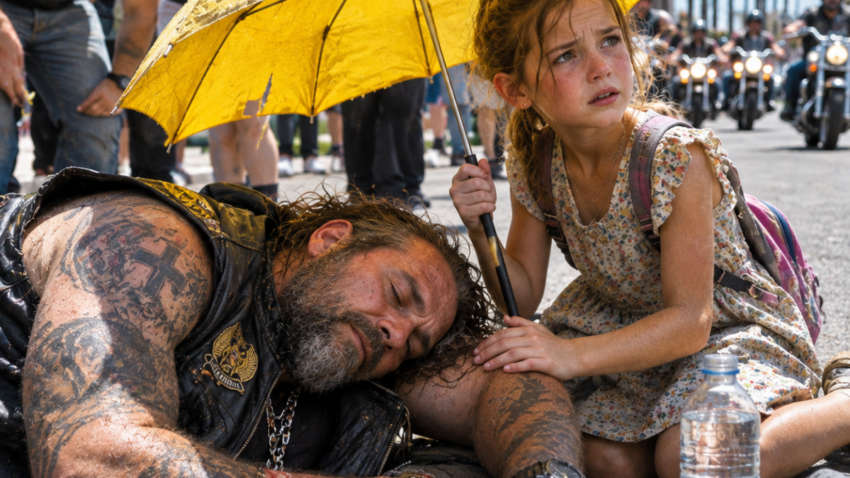
An 8-Year-Old Girl Held a Yellow Umbrella Over a Collapsed Biker Everyone Ignored—Then the Sound of Motorcycles Filled the Street.
By the time eight-year-old Lena Morales stepped into the blazing Fresno street, dozens of adults had already decided the tattooed biker on the pavement was dangerous, drunk, or simply not worth the risk of helping.
She was still trembling beneath her mother’s torn yellow umbrella when a stranger ordered her away from him, never realizing the unconscious man had sacrificed the last of his strength minutes earlier to protect Lena from something far worse than the heat.
Then forty-seven motorcycles appeared at the end of the road, and the people who had laughed at the little girl began to understand that the man they had judged was carrying a secret that would expose a cruelty none of them had noticed.
It was 12:47 on a Wednesday afternoon in Fresno, California, when the asphalt began to shimmer.
The temperature displayed outside Preston Community Bank read 108 degrees.
Nobody believed it.
It felt hotter.
Heat rose off Ventura Avenue in rippling waves, bending the shapes of parked cars and storefronts until the whole street looked as though it were underwater. Air conditioners rattled behind stucco buildings. Grocery carts burned beneath the palms of anyone foolish enough to grab them barehanded. Dogs were pulled quickly across sidewalks because the pavement could blister their paws.
Traffic crawled.
People were tired.
Irritable.
Impatient.
And that was why, when the large man in the black leather vest stumbled beside his motorcycle, almost nobody understood what they were seeing.
One driver behind him leaned on the horn.
“Move!”
The biker tried.
He really did.
He pushed the kickstand down with one boot, missed it, caught the motorcycle with his hip, and somehow managed to keep the nearly eight-hundred-pound machine from falling into traffic.
Then his knees buckled.
His shoulder hit the pavement first.
His head followed.
The motorcycle tipped against the curb.
And the man lay still.
Within seconds, three cars had pulled around him.
A pickup driver slowed long enough to look.
A woman in a white SUV raised her phone.
A teenager on the sidewalk said, “Dude just passed out.”
Nobody touched him.
Nobody except Lena Morales.
She had been standing beneath the narrow awning of a closed tax-preparation office half a block away.
Small for eight.
Thin shoulders.
Dark hair tied into two uneven braids her grandmother had done that morning.
White sneakers gray from dust.
A faded purple backpack.
And in her hands, a cheap yellow umbrella with one bent spoke and a strip of clear tape along the edge.
The umbrella had belonged to her mother.
Lena carried it everywhere.
Even when there was no rain.
Especially when there was no rain.
The biker had noticed her before he collapsed.
That was the part nobody on the street knew.
PART2:
He had noticed her because fifteen minutes earlier, he had stopped beside a bus shelter two blocks away and seen a little girl sitting alone beneath a metal bench while a man in a silver sedan watched her from across the intersection.
The biker’s name was Daniel Mercer.
Most people who knew him called him Bear.
He was fifty-two years old, six feet three inches tall, and built like a man who had spent half his life lifting transmissions, motorcycle engines, and injured people.
His forearms were covered with tattoos.
There was an old Marine Corps emblem near his right elbow.
Names circled his left wrist.
One belonged to his wife.
One belonged to a daughter who had lived only nine days.
On the back of his vest were three words embroidered in white:
VALLEY GUARDIANS RC.
The letters looked intimidating if you didn’t know what they meant.
Most people didn’t.
Lena didn’t either.
She only knew he had scared away the man in the silver sedan.
“Hey, kid.”
Lena had looked up.
Bear stood beside his motorcycle about twelve feet away, careful not to come closer.
“You waiting on somebody?”
“My grandma.”
“Where is she?”
“At the clinic.”
He glanced across the street.
PART3:
The silver sedan was still there.
The driver looked away.
“How long’s she been inside?”
Lena shrugged.
“A long time.”
Bear’s jaw tightened.
The bus stop provided almost no shade.
The metal roof had been vandalized months earlier and removed.
Lena was using the yellow umbrella instead.
Bear looked at the temperature gauge on his motorcycle.
Then at the clinic.
Then at the man in the sedan.
“You got a phone?”
Lena shook her head.
Bear took his own phone from his pocket.
“I can call the clinic for you.”
“My grandma said don’t talk to strangers.”
A faint smile appeared beneath his gray-black beard.
“Smart grandma.”
He remained where he was.
“Then don’t come near me. I’ll stay right here.”
He called the clinic, gave Lena’s grandmother’s name, and learned that Rosa Morales had been taken into the back for unexpected tests after becoming dizzy during a routine appointment.
The receptionist told him she would send someone outside.
Nobody came.
Five minutes passed.
Then seven.
The man in the silver sedan remained parked across the street.
Bear noticed something else.
The driver had raised his phone.
Pointed it toward Lena.
Bear crossed the street.
He didn’t threaten the man.
He didn’t pound on his window.
He simply walked toward the sedan, stopped near the front bumper, and looked directly at the driver.
The sedan pulled away so quickly it nearly clipped the curb.
When Bear returned, he was breathing harder.
Lena noticed.
“Are you okay?”
“Fine.”
“You don’t look fine.”
“Eight-year-olds aren’t supposed to be that observant.”
“My mom said I was born nosy.”
The words came out before Lena could stop them.
Her face changed immediately.
Bear heard the past tense.
He didn’t ask.
He sat on the curb, keeping several feet between them.
“You know what?” he said. “Nosy keeps people alive sometimes.”
Lena stared at the silver sedan disappearing through traffic.
“Was he bad?”
“I don’t know.”
“You scared him.”
“He scared himself.”
That made her smile.
Bear noticed the umbrella.
“Bright.”
“It was my mom’s.”
“Ah.”
“She liked yellow.”
“Good color.”
“She said yellow is what sunshine would look like if you could fold it.”
Bear looked at her.
For a second, his expression softened so completely that the dangerous-looking man disappeared and Lena saw someone else underneath.
Someone tired.
Someone sad.
“She sounds smart.”
“She was.”
Again, past tense.
This time Bear understood enough not to touch the wound.
He only nodded.
The clinic door finally opened.
A medical assistant stepped outside.
“Lena?”
The girl stood.
“Your grandmother needs a little longer, sweetheart. She asked if you could wait another twenty minutes.”
The assistant glanced at Bear.
Her expression tightened.
“Are you with her?”
“No.”
“Then why are you sitting here?”
“Making sure she wasn’t alone.”
The assistant looked at the leather vest.
Then the tattoos.
Then his motorcycle.
“You should probably move along.”
Bear stared at her.
“I will when someone stays with her.”
“I just told you she’s fine.”
“I didn’t ask if she was fine.”
Something in his voice made the assistant stiffen.
Bear pointed across the street.
“There was a man parked over there photographing her.”
The assistant’s expression changed.
“What?”
“Silver Altima. California plate, partial seven-Kilo-John.”
She finally looked at Lena.
“I didn’t know.”
“No,” Bear said quietly. “You didn’t.”
The assistant took Lena inside.
That should have been the end of it.
It almost was.
But as Bear walked back to his motorcycle, Lena ran out again.
“Wait!”
He turned.
The assistant called after her.
“Lena!”
The girl hurried toward Bear.
“You dropped this.”
She held out a small metal keychain.
It was shaped like a sun.
Old.
Scratched.
Bear stared at it.
For a moment he didn’t reach for it.
“Where’d you find that?”
“By your bike.”
Bear took it carefully.
His thumb moved across its worn surface.
There was something engraved on the back.
Lena couldn’t read it from where she stood.
Bear could.
FOR THE DAYS YOU FORGET THERE’S LIGHT.
His wife, Rebecca, had given it to him eleven years earlier.
Three months before the crash that nearly killed him.
He carried it everywhere.
“Thank you,” he said.
Lena nodded.
Then she noticed the medical bracelet beneath his wristwatch.
Red lettering.
HEAT-RELATED AUTONOMIC DYSFUNCTION.
“What does that say?”
Bear tucked his wrist down.
“Nothing exciting.”
“You said being nosy keeps people alive.”
He almost laughed.
“Fair point.”
He crouched so they were closer to eye level.
“I got hurt a long time ago. My body doesn’t handle heat the way it should.”
“You get sick?”
“Sometimes.”
“Then why are you wearing that big vest?”
“Because bikers are stupid.”
Lena giggled.
Bear lowered his voice.
“But if you ever see somebody collapse in this kind of heat, don’t crowd them. Call 911. Keep them in the shade if it’s safe.”
“Shade.”
“That’s right.”
She lifted the yellow umbrella.
“Like this?”
“Exactly like that.”
The assistant appeared at the door again.
“Lena, come inside now.”
Bear stood.
“Go.”
She took two steps.
Then turned.
“What if it’s you?”
Bear paused.
The question amused him at first.
Then he noticed how serious she was.
“If it’s me?”
She nodded.
He looked at the yellow umbrella.
“Then don’t let the sun touch me.”
Lena gave him a solemn little nod, the kind only children give when adults accidentally turn an ordinary sentence into a sacred promise.
Bear put the sun keychain back in his pocket.
“Deal?”
“Deal.”
He climbed onto his motorcycle and rode away.
He never made it three blocks.
By the time his vision began to blur, he knew exactly what was happening.
His heart rate surged.
Then dropped.
His hands went cold even though his skin was burning.
He tried to turn toward a shaded parking lot.
Traffic blocked him.
A horn blasted behind him.
Bear steadied the motorcycle.
His breathing became shallow.
He remembered his neurologist’s warning.
You can go from functional to critical faster than you think.
He remembered Rebecca.
He remembered the little yellow umbrella.
Then the street tilted.
And darkness swallowed him.
Lena heard the motorcycle before she saw him.
She had slipped out of the clinic again because she had realized her mother’s umbrella was still beside the bus bench.
The assistant thought she was using the restroom.
Lena wasn’t trying to disobey.
She was terrified of losing the umbrella.
It was one of only three things she still had that belonged to her mother.
So she ran back.
She found the umbrella.
Then she saw Bear’s motorcycle ahead.
Saw him fall.
And remembered his exact words.
Don’t let the sun touch me.
By the time the first adult approached, Lena was already standing over him.
Her little arms stretched upward.
The umbrella barely covered his face and upper chest.
She shifted it every few seconds as the angle of the sun changed.
People gathered.
A delivery driver.
Two construction workers.
A mother with a stroller.
A man leaving a barbershop.
Teenagers from a frozen yogurt place.
Phones appeared almost immediately.
Someone called 911.
Someone else said they already had.
A woman asked whether Bear had overdosed.
“He’s probably high,” another man said.
Lena stared straight ahead.
“He’s sick.”
Nobody heard her.
Or nobody listened.
The man from the barbershop, Curtis Hale, stepped closer.
He was thirty-nine, wearing khaki shorts and mirrored sunglasses.
“Kid, get away from him.”
Lena shook her head.
“He told me.”
“What?”
“He told me not to let the sun touch him.”
Curtis looked toward the others.
“She’s scared.”
“I’m not scared.”
“You should be. You don’t know this guy.”
“Yes, I do.”
“You met him for five minutes.”
Lena looked down at Bear.
One of his hands twitched.
“That’s longer than you did.”
A teenager snorted.
Curtis turned red.
“Listen, sweetheart, guys dressed like that can be dangerous.”
One of the construction workers looked uncomfortable.
“He’s unconscious, man.”
“That’s not the point.”
“What is the point?”
Curtis didn’t answer.
The woman filming zoomed in.
Her name was Amanda Pike, and within minutes the video was already being uploaded with the caption:
LITTLE GIRL WON’T LEAVE PASSED-OUT BIKER IN FRESNO. WHERE ARE HER PARENTS???
Lena had no idea.
She only knew the umbrella was getting heavy.
Her wrists hurt.
Sweat rolled down her face.
She changed hands.
Bear’s lips moved.
She bent closer.
“What?”
His voice was barely a breath.
“Shade.”
“I know.”
His fingers scraped weakly against the pavement.
“I know,” she whispered again. “I’m doing it.”
A car horn sounded.
Then another.
People complained that the motorcycle was blocking part of the lane.
A driver shouted, “Drag him out of the road!”
Nobody dragged him.
Nobody wanted to touch him.
Curtis finally said, “I’m moving the kid.”
He reached for Lena.
She jerked away.
“No!”
“Stop being difficult.”
“He told me!”
“Lena!”
The voice came from behind the crowd.
The clinic assistant, Jenna Parker, ran toward her.
She had discovered Lena missing less than two minutes earlier and followed the commotion.
“Oh my God.”
She grabbed Lena by the shoulders.
“What are you doing?”
“Don’t!”
“Your grandmother is losing her mind!”
“I have to stay!”
“No, you don’t.”
Jenna tried to pull her back.
The umbrella shifted.
Sunlight struck Bear’s face.
His entire body jerked.
It was subtle.
But Lena saw it.
So did one construction worker.
“Put the shade back.”
Jenna stared.
“What?”
“The guy moved when the sun hit him.”
Lena ripped herself free and repositioned the umbrella.
Bear’s breathing steadied slightly.
Jenna froze.
For the first time, she noticed the medical bracelet.
She crouched.
Read it.
Her face drained of color.
“Oh, God.”
“What?” Curtis asked.
Jenna looked up.
“He has a medical condition.”
Curtis shrugged.
“Doesn’t mean the kid should be here.”
“No, but it means she’s right about the shade.”
That was when the distant rumbling began.
At first it sounded like thunder.
Impossible thunder beneath a cloudless California sky.
Then the sound deepened.
Engines.
Many engines.
People turned.
A motorcycle appeared at the intersection.
Then another.
Then four.
Then ten.
Black cruisers.
Touring bikes.
A red Indian.
Two Harleys with saddlebags.
A battered Honda.
A three-wheeled trike ridden by an older man with a white beard.
They rolled toward the gathering slowly.
Forty-seven motorcycles in all.
Drivers on Ventura Avenue began pulling over.
Phones rose higher.
Curtis muttered, “Great.”
The first rider stopped ten yards away.
His name was Samuel Ortega.
Sixty-one.
Former firefighter.
Gray beard.
Sun-browned face.
President of the Valley Guardians Riding Club.
He killed his engine.
The others followed.
One after another.
The sudden silence felt heavier than the noise.
Samuel removed his helmet.
His eyes found Bear.
Then Lena.
Then the yellow umbrella.
He stopped moving.
“No,” he whispered.
A woman rider beside him, Tasha Reed, heard him.
“Sam?”
Samuel didn’t answer.
He walked toward Bear.
Curtis immediately stepped back.
So did Amanda with her phone.
The riders didn’t surround the crowd aggressively.
They simply spread out, clearing space and watching.
But leather and tattoos carried their own story in people’s minds.
Fear traveled faster than truth.
A mother pulled her son closer.
Someone whispered, “Gang.”
Another person said, “Don’t film their faces.”
Samuel knelt beside Bear.
“Daniel.”
No response.
He touched two fingers to Bear’s neck.
“Come on, brother.”
Lena’s arms were shaking.
Samuel looked at her.
“You been holding that the whole time?”
She nodded.
“He told me not to let the sun touch him.”
Samuel stared.
“What did you say?”
“He said if he fell down, keep him in the shade.”
Samuel looked at Bear’s medical bracelet.
His jaw clenched.
“You knew better.”
It sounded angry.
But his eyes were wet.
Tasha removed her denim riding shirt and stretched it above Bear’s legs.
Another rider copied her.
Then another.
Within seconds, six bikers had created a canopy from jackets and shirts, blocking the sun from Bear’s entire body.
The crowd watched in silence.
Curtis cleared his throat.
“An ambulance is coming.”
Samuel looked up.
“How long?”
“Maybe ten minutes.”
“He doesn’t have ten.”
Samuel pulled out his phone.
“I’ve got electrolytes and cooling packs in my saddlebag,” Tasha said.
“Get them.”
Jenna stepped forward.
“I’m a medical assistant.”
Samuel nodded.
“Then help.”
No ego.
No argument.
Just urgency.
Jenna knelt near Bear’s head.
“Sir? Daniel? Can you hear me?”
His eyelids fluttered.
Samuel looked at Lena.
“What happened?”
She explained in fragments.
The clinic.
The man in the silver car.
The keychain.
Bear warning her about the heat.
When she mentioned the sedan, Samuel’s expression changed.
“What kind?”
“Silver.”
“What kind of man?”
“I don’t know.”
“Did he say anything?”
“No.”
Jenna looked up.
“Why does that matter right now?”
Samuel’s face hardened.
“Because Daniel called me twelve minutes ago.”
Everyone close enough heard him.
“What did he say?” Tasha asked.
“He said he’d seen a man watching a kid outside Moreno Health.”
Lena swallowed.
“Me.”
Samuel looked at her.
“Yes.”
A new voice cut through the crowd.
“Everyone step back.”
Fresno police officer Marcus Reed approached from the cruiser that had just stopped behind the motorcycles.
His partner, Elena Cho, followed.
Both officers surveyed the scene.
Unconscious biker.
Nearly fifty riders.
Child.
Crowd.
Phones.
Marcus’s hand rested near his belt.
“Who’s in charge here?”
Samuel remained kneeling.
“Right now? The heat.”
“I need everybody away from the patient.”
“He needs shade.”
“We’ll handle it.”
“With what?”
Marcus looked annoyed.
“Sir.”
Jenna raised one hand.
“Officer, he’s right. Medical alert says heat-triggered autonomic dysfunction. His breathing gets worse when he’s exposed.”
Marcus hesitated.
That hesitation saved the situation.
He looked at the human canopy.
Then at Lena.
Then back at Jenna.
“Ambulance?”
“Delayed,” she said.
Marcus grabbed his radio.
“Dispatch, upgrade medical on Ventura. Adult male, altered consciousness, severe heat exposure, underlying autonomic condition.”
His partner began pushing traffic away.
“Move those cars. Give EMS a lane.”
Curtis stepped forward.
“Officer, the kid needs to be removed. These guys showed up and—”
Samuel slowly turned.
“These guys?”
Curtis immediately looked at Marcus.
“You see?”
Marcus held up a hand.
“Enough.”
Samuel stood.
He was four inches shorter than Bear but somehow seemed larger.
“You thought he was dangerous before we got here?”
Curtis folded his arms.
“I don’t know him.”
“Then why’d you decide what he was?”
“I didn’t.”
Amanda’s phone captured the exchange.
Lena said quietly, “He did.”
Curtis stared at her.
“Kid, I was trying to protect you.”
“From the man who protected me?”
Nobody spoke.
Curtis’s face reddened.
Marcus looked at Lena.
“What do you mean?”
And so, beneath a wall of leather jackets held against the Fresno sun, Lena told the police about the silver sedan.
This time, everyone listened.
She told them Bear had watched from a distance so she wouldn’t be scared.
That he had called the clinic.
That he had scared the silver car away without touching anybody.
That he had stayed until someone came outside.
That he had told her what to do if he collapsed.
“He knew?” Marcus asked.
Lena nodded.
“I asked what if it was him.”
Samuel looked down at Bear.
“Of course you did.”
Marcus asked Lena for the plate.
She didn’t know it.
Samuel did.
“Seven-Kilo-John, maybe three-one. Daniel texted the partial to me.”
Marcus looked sharply at him.
“You still have that?”
Samuel handed over his phone.
The message had been sent at 12:29.
SILVER ALTIMA. MALE 40s. WATCHING LITTLE GIRL OUTSIDE MORENO HEALTH. PARTIAL 7KJ31. KEEP EYES OPEN.
Below it was another message.
KID’S SAFE. I’M HEADING EAST.
And then, four minutes later:
NOT FEELING RIGHT.
That was the last thing Bear had sent.
Marcus read it twice.
Then gave the phone back.
The crowd had gone very quiet.
The siren finally came.
An ambulance turned through the intersection.
Everyone moved.
Paramedics took over.
Cold packs.
IV.
Oxygen.
Monitor leads.
One medic, a woman named Rachel, looked at the crowd of riders holding shade.
“Keep doing exactly that.”
Lena remained beside Bear until Rachel needed access.
“Sweetheart, I need you to step back.”
“He needs the umbrella.”
“We’ve got him.”
“You promise?”
Rachel looked at the girl’s exhausted arms.
“I promise.”
Lena slowly lowered the umbrella.
For the first time in nearly twenty minutes, she let someone else carry the weight.
Bear’s hand moved.
His fingers opened.
Lena saw the sun keychain in his palm.
Somehow he had been gripping it the entire time.
His eyes opened.
Barely.
“Hey,” Rachel said. “Daniel, stay with me.”
His gaze drifted.
Found Lena.
The corner of his mouth moved.
“You remembered.”
Lena burst into tears.
“I remembered.”
His eyes closed again.
They loaded him into the ambulance.
Samuel started toward his bike.
Rachel stopped him.
“Family?”
Samuel looked at Bear.
“Close enough.”
“Ride safe. Saint Agnes.”
He nodded.
Before leaving, he turned to Lena.
“You have somebody coming for you?”
“My grandma.”
“Where is she?”
“In the clinic.”
Jenna looked ashamed.
“I’ll take her back.”
Samuel studied her.
“You sure?”
“Yes.”
He glanced at Lena.
“Stay with her.”
“I will.”
He wasn’t asking.
Jenna knew that.
“So will I,” Officer Marcus said.
Samuel gave him a short nod.
Then forty-seven motorcycles left Ventura Avenue in groups of six, heading toward Saint Agnes Medical Center.
No one called them a gang anymore.
At least not out loud.
Rosa Morales came running out of the clinic ten minutes later with an adhesive monitor patch still attached beneath her blouse.
She was sixty-four and five feet tall, and she nearly knocked Marcus aside when she saw Lena.
“Dios mío!”
She grabbed her granddaughter.
“Where were you?”
Lena couldn’t answer.
She only held the umbrella between them.
Rosa saw the ambulance was gone.
Saw the police.
Saw the people still filming.
Her fear turned into anger.
“What happened?”
Jenna began explaining.
Rosa’s eyes changed as she listened.
“You let her leave?”
Jenna swallowed.
“Yes.”
“You didn’t notice?”
“I thought she was in the restroom.”
“You told me you were watching her.”
“I know.”
“You told me.”
“I know.”
Rosa’s voice cracked.
Lena grabbed her hand.
“Abuela.”
Rosa looked down.
“The man helped me.”
“What man?”
“The biker.”
Rosa looked toward the empty road.
Marcus explained what Bear had done.
The silver sedan.
The phone call.
The collapse.
The umbrella.
Rosa pressed one hand over her mouth.
“Someone was watching her?”
“We’re looking into it.”
“Looking into it?”
Marcus kept his voice calm.
“We have a partial plate and a description.”
“What if that man comes back?”
“He won’t get near her.”
“How can you promise me that?”
Marcus couldn’t.
Rosa saw it.
And that frightened her more.
The video began spreading online before Bear reached the hospital.
At first the posts were cruel.
DRUNK BIKER COLLAPSES IN FRESNO WHILE CHILD TRIES TO HELP.
WHERE ARE THIS GIRL’S PARENTS?
ONLY IN CALIFORNIA.
Comments arrived by the thousands.
People mocked Bear’s vest.
His tattoos.
His weight.
His motorcycle.
They blamed addiction without knowing whether he drank.
They blamed gangs without knowing the club.
They blamed Lena’s family without knowing her grandmother had been undergoing emergency cardiac testing.
But then Amanda Pike uploaded the longer version.
The one where Lena said:
“He told me not to let the sun touch him.”
The one where the bikers created shade.
The one where Bear whispered:
“You remembered.”
The tone changed.
Slowly at first.
Then violently.
WHO IS THIS MAN?
SOMEONE FIND HIM.
THAT LITTLE GIRL SAVED HIS LIFE.
WHY DID EVERYBODY JUST STAND THERE?
By 5:00 p.m., local television stations were calling Fresno police.
By 6:00, reporters were outside Saint Agnes.
By 7:30, the story had gone national.
Lena knew none of this.
She was sitting beside her grandmother at their small kitchen table, eating macaroni with butter because Rosa had been too exhausted to cook.
The yellow umbrella leaned against the refrigerator.
Rosa kept looking at it.
Finally she said, “Your mother would have been proud.”
Lena stared into her bowl.
“She would’ve helped him.”
“Yes.”
“She would’ve yelled at everyone.”
Rosa almost smiled.
“Yes.”
Lena pushed one noodle around.
“Do you think he’s going to die?”
Rosa reached across the table.
“I don’t know.”
“I promised.”
“You kept your promise.”
“What if it wasn’t enough?”
Rosa tightened her hand around Lena’s.
“That is not ours to decide.”
Lena nodded.
But she didn’t sleep.
At Saint Agnes, Bear’s condition stabilized shortly before midnight.
Severe heat illness.
Cardiac arrhythmia.
Dehydration.
Autonomic crisis.
His temperature had reached 104.6.
Rachel, the paramedic, later told Samuel that another ten minutes of direct sun might have changed everything.
“She kept him shaded?”
“The kid?”
“Yes.”
Rachel nodded.
“Probably made the difference.”
Samuel sat in the waiting room with Tasha and nine other riders.
None of them spoke.
Eventually a doctor came out.
“He’s awake.”
Samuel stood.
“Can I see him?”
“Briefly.”
Bear looked smaller in a hospital bed.
That bothered Samuel more than the monitors.
Men like Bear weren’t supposed to look small.
“You look terrible,” Samuel said.
Bear opened one eye.
“You always know what to say.”
“You scared forty-seven grown adults and one eight-year-old child.”
“Kid okay?”
Samuel stared at him.
“That your first question?”
“Kid okay?”
“Yes.”
“Good.”
Samuel pulled a chair closer.
“Silver Altima.”
Bear’s expression sharpened.
“What about it?”
“Police are checking.”
“Don’t let them drop it.”
“They won’t.”
“They might.”
“Why?”
Bear looked toward the window.
“Because I know that car.”
Samuel waited.
Bear swallowed.
“I saw it Monday.”
“Where?”
“Outside Hoover Elementary.”
Samuel sat straighter.
“You sure?”
“Same rear dent. Same sticker on the back glass.”
“What sticker?”
“Blue bulldog.”
“Why didn’t you tell me?”
“I wasn’t sure.”
“And today?”
“I was.”
Samuel cursed under his breath.
Bear turned toward him.
“Don’t tell Lena.”
“Obviously.”
“The guy wasn’t just watching her.”
Samuel froze.
“What did you see?”
Bear’s voice lowered.
“He took pictures. Then he got out.”
Samuel’s jaw hardened.
“How close?”
“Crosswalk.”
“And?”
“I started toward him. He went back to the car.”
“Did he say anything?”
“No.”
“Did Lena see him get out?”
“I don’t think so.”
Samuel leaned back.
“What the hell were you doing riding in this heat?”
Bear closed his eyes.
Samuel regretted the question immediately.
“You knew you were having symptoms.”
“I knew after I left.”
“You could’ve stopped.”
“I tried.”
“You could’ve called.”
“I texted.”
“You texted, ‘not feeling right.’ That’s not a call.”
Bear opened his eyes.
“You would’ve sent everybody.”
“Yes.”
“Exactly.”
Samuel stared at his oldest friend.
“You almost died because you didn’t want attention.”
Bear said nothing.
Samuel’s anger softened.
“You’ve got to stop doing that.”
“Doing what?”
“Acting like needing people is some kind of moral failure.”
Bear looked away.
That sentence landed somewhere deeper than either man intended.
Samuel knew why.
Rebecca had died three years earlier from ovarian cancer.
Bear had cared for her at home until the last week.
Afterward, people tried to care for him.
He refused almost all of it.
He sold their house.
Moved into a one-bedroom apartment above his repair shop.
Stopped attending Sunday dinners.
Rode alone more often.
And quietly began what he called neighborhood loops.
He checked bus stops during heat waves.
Delivered bottled water to homeless camps.
Helped stranded drivers.
Walked elderly people across the terrifying six lanes near Cedar Avenue.
Most people never knew his name.
That was how he preferred it.
“You know what the kid told everybody?” Samuel asked.
Bear looked at him.
“She said you ride around because somebody has to.”
Bear sighed.
“Kids talk too much.”
“She also said you told her bikers are stupid.”
“That part was accurate.”
Samuel almost laughed.
Then his face became serious.
“There’s something else.”
“What?”
“The video is everywhere.”
Bear groaned.
“How everywhere?”
“My sister in Ohio sent it to me.”
Bear closed his eyes.
“Kill me.”
“Nearly happened.”
“Not funny.”
“Little funny.”
Bear remained silent.
Then he asked, “What’s Lena’s last name?”
“Morales.”
Bear frowned.
“Morales?”
“Yeah.”
“Grandmother Rosa?”
Samuel stared.
“You know them?”
Bear’s heart monitor accelerated slightly.
He looked toward the door.
“Sam.”
“What?”
“Find my wallet.”
“Why?”
“Just find it.”
His wallet was inside a plastic hospital property bag.
Samuel handed it over.
Bear searched until he found an old photograph folded behind his driver’s license.
Samuel had seen the picture once before.
Rebecca.
Younger.
Standing beside another woman.
Both wearing pale blue scrubs.
The other woman had dark hair.
A bright smile.
And a yellow umbrella.
On the back, written in faded ink:
Rebecca & Sofia, County Hospital, 2015. Two stubborn women who refuse to quit.
Samuel looked from the photograph to Bear.
“No.”
Bear’s eyes were fixed on the woman.
“Sofia Morales.”
“Lena’s mother?”
“I think so.”
Samuel sat down.
“How?”
“Rebecca worked with her.”
“At County?”
“Yeah.”
“What happened to her?”
Bear rubbed his thumb over the photograph.
“Car accident.”
“When?”
“Two years ago, maybe.”
Samuel stared at the yellow umbrella in the picture.
The same color.
The same curved wooden handle.
The same tiny sunflower sticker near the tip.
“Bear.”
“I know.”
“You knew her mother.”
“Barely.”
“What aren’t you telling me?”
Bear looked toward the ceiling.
“Rebecca loved her.”
Samuel waited.
Bear’s voice became quiet.
“Sofia was a nurse on Rebecca’s oncology floor. When Rebecca got diagnosed, Sofia was one of the first people who treated her like a person instead of a chart.”
He paused.
“Later, when things got bad, Sofia started stopping by after her shifts.”
Samuel listened.
“She’d sit with Rebecca when I needed to shower. Bring groceries. Talk about stupid television shows. She made Rebecca laugh.”
“And Lena?”
“I saw her twice. Tiny kid. Three or four.”
Bear looked at the photograph again.
“I didn’t recognize her.”
“How would you?”
“I should’ve.”
“No. You couldn’t have.”
Bear didn’t answer.
Samuel understood what he was thinking.
The little girl who had held shade over him had been the daughter of a woman who once helped hold his life together.
People called things like that coincidence.
Bear never did.
At 8:12 the next morning, Marcus Reed received a call from Detective Alison Grant.
The partial plate had produced fourteen possible silver Nissan Altimas registered in Fresno County.
Nine were immediately excluded.
Three were owned by women.
One had been totaled six months earlier.
The final vehicle belonged to a man named Warren Pike.
Forty-three.
No relation to Amanda Pike, the woman who had filmed the incident.
Warren had no serious criminal record.
One trespassing citation.
Two dismissed harassment complaints.
A restraining order petition filed three years earlier by a former girlfriend, later withdrawn.
Marcus almost dismissed the result.
Then Alison told him where Warren worked.
“Private security contractor.”
“For who?”
“Mostly apartment complexes. Some school events.”
Marcus stopped writing.
“Which school events?”
“I’m pulling records.”
“You need Hoover Elementary.”
Silence.
“How’d you know?”
“Bear saw the car there Monday.”
“Who?”
“Daniel Mercer. The biker.”
“Did he tell patrol that yesterday?”
“No.”
“Why not?”
“He was unconscious.”
Alison sighed.
“Fair.”
By 9:00, detectives had security footage from a pharmacy across from Moreno Health.
Silver Altima.
Rear bumper dent.
Blue Fresno State bulldog sticker.
Driver sitting for seventeen minutes.
At 12:21, Lena appeared on camera.
At 12:24, the driver’s phone rose.
At 12:26, he opened the door.
At 12:27, Bear’s motorcycle entered frame.
Warren closed the door.
Bear parked.
Two minutes later, Bear crossed toward the Altima.
Warren drove away.
There was no crime in the video.
Not yet.
But then Alison found something else.
Warren’s security company had provided temporary traffic control during a children’s health fair three weeks earlier.
Lena had attended that health fair with Rosa.
And Warren had been assigned to the entrance.
They brought him in for questioning.
He smiled too much.
Said he didn’t remember Lena.
Then said maybe he’d seen her.
Said he parked near the clinic because he had a headache.
Said he photographed a mural.
There was no mural in the direction his phone had been pointing.
He said Bear had threatened him.
The video showed otherwise.
He said he had never been near Hoover Elementary.
Traffic camera footage placed his car one block away Monday afternoon.
Still, suspicion was not proof.
They released him.
That evening, someone threw a brick through Bear’s repair-shop window.
Attached to it with duct tape was a note.
MIND YOUR OWN BUSINESS.
Samuel found it first.
He called police.
Then he called Bear.
“No.”
That was Bear’s immediate response.
“You don’t even know what I’m asking.”
“Yes, I do.”
“Stay at my place until they catch this guy.”
“No.”
“Bear.”
“I am not hiding in your guest room because some coward owns a brick.”
“You’ve got stitches in your arm and a heart monitor stuck to your chest.”
“Temporary monitor.”
“Oh, good. Very tough.”
Bear was discharged the following afternoon.
Reporters waited outside.
Samuel tried to take him through a service exit.
Bear refused.
“Why?”
“Because hiding makes it bigger.”
“You hate cameras.”
“I hate bullies more.”
He walked through the main doors.
Microphones appeared instantly.
“Mr. Mercer!”
“Daniel!”
“Did the little girl save your life?”
“Are you part of a motorcycle gang?”
“Were you protecting her from a suspicious man?”
“Did someone target your business?”
Bear stopped.
Samuel cursed softly behind him.
Bear turned toward the cameras.
“My name is Daniel Mercer.”
The questions stopped.
“The Valley Guardians are not a gang. We’re plumbers, mechanics, firefighters, veterans, teachers, nurses, business owners, retired people, and one accountant nobody likes.”
Somebody laughed.
Samuel muttered, “That was my cousin.”
Bear continued.
“A little girl did help save my life.”
More cameras moved closer.
“She did it because I asked her to do something simple if I became sick. She remembered when a street full of adults were too busy deciding what kind of man I was to notice what condition I was in.”
Silence.
Bear’s voice remained calm.
“Some of those people did call 911. Some eventually helped. I’m grateful. This isn’t about shaming strangers.”
He looked directly toward one camera.
“But yesterday, I saw an eight-year-old girl alone in dangerous heat while a man watched her from a parked car. If you see a child who looks vulnerable, don’t assume somebody else is paying attention.”
A reporter shouted, “Was that man trying to abduct her?”
“I don’t know.”
“Is he under investigation?”
“Ask the police.”
“Did he attack your shop?”
“I don’t know.”
“What do you know?”
Bear looked tired.
“I know that little girl’s name is Lena Morales, and she deserves to go back to being eight years old instead of becoming a headline.”
Then he walked away.
The clip received twenty-three million views in four days.
But the most important person who saw it wasn’t a reporter.
Her name was Hannah Pike.
She lived in Visalia.
And she recognized Warren.
Not his face.
His behavior.
Hannah had been married to him for nine years.
She called Fresno police.
“I think you need to search my ex-husband’s storage unit.”
Detective Alison Grant asked why.
Hannah was quiet for a long time.
Then she said, “Because I should have told somebody five years ago.”
The storage unit was rented under Warren’s middle name.
Inside were boxes.
Cameras.
Hard drives.
Printed photographs.
Most were legal images taken in public places.
School gates.
Parks.
Clinics.
Playgrounds.
Children leaving dance classes.
Children walking home.
Some pictures had notes.
Times.
Names.
Pickup routines.
Vehicle descriptions.
Lena Morales had a folder.
Only four photographs.
All recent.
One from the health fair.
One outside Hoover Elementary.
Two outside Moreno Health.
On the back of one was written:
Lives with grandmother. Mother deceased.
Detectives stopped treating Warren like an irritating man with a camera.
They arrested him that night.
The investigation that followed uncovered something uglier than anyone expected.
Warren had been selling information.
Not children.
Information.
Addresses.
Schedules.
Photographs.
Details about families.
Most went to private investigators doing questionable custody work.
Some went to debt collectors.
A few went to people with restraining orders who were not legally supposed to know where former partners or children were living.
Warren told himself it wasn’t his responsibility what clients did with the information.
He had never physically harmed anyone.
That became his defense.
It was also the lie his entire life rested upon.
One of the buyers was a man under a protective order who had assaulted his former girlfriend three weeks earlier after Warren provided her workplace schedule.
Another had used photographs of children to harass a custody opponent.
The investigation widened.
Three arrests followed.
Then six.
Then eleven.
Local news stopped calling it “the biker and the umbrella story.”
They called it the Fresno surveillance case.
Bear hated that too.
Lena’s life became complicated.
Police cars visited the house.
Reporters knocked.
Rosa taped cardboard inside the front windows.
Hoover Elementary moved Lena’s pickup location.
For a week, she wasn’t allowed to walk anywhere alone.
Kids at school knew her from television.
Some wanted to be her friend.
Some called her Umbrella Girl.
One boy asked whether the bikers killed people.
Lena punched him.
Not hard.
But hard enough.
Rosa was called to the principal’s office.
“You cannot hit people,” Rosa told her afterward.
“He said Bear kills people.”
“You still cannot hit people.”
“He said his tattoos are prison tattoos.”
“You still cannot hit people.”
“He said—”
Rosa stopped walking.
They were halfway across the school parking lot.
“Lena.”
The girl looked down.
“You know what your mother used to do when somebody said something stupid?”
“What?”
“She would get very quiet.”
Lena frowned.
“That doesn’t sound like Mom.”
“Exactly. The quiet would scare everybody.”
Despite herself, Lena smiled.
Rosa crouched.
“Strength is not proving you can hurt someone.”
Lena kicked a pebble.
“What is it?”
“Knowing you could become cruel and choosing not to.”
Lena thought about Curtis telling her to move away from Bear.
“Some people deserve it.”
“Probably.”
“Abuela.”
Rosa shrugged.
“I didn’t say I’m a saint.”
For the first time in days, Lena laughed.
Bear didn’t see Lena again until two weeks after the collapse.
He was closing his repair shop when a faded Honda Civic stopped outside.
Rosa got out.
Then Lena.
Bear froze.
The shop window had been replaced, though a crack remained in the frame where the brick struck.
Lena carried the yellow umbrella.
Bear wiped his hands on a rag.
“Well.”
Lena ran toward him.
Then stopped three feet away as if remembering he was technically still a stranger.
Bear smiled.
“Hi.”
“Hi.”
Rosa approached more cautiously.
“Mr. Mercer?”
“Daniel.”
“I am Rosa Morales.”
“I know.”
She extended her hand.
He took it.
For several seconds Rosa said nothing.
Then her eyes filled.
“You saved my granddaughter.”
Bear shook his head.
“I made a phone call.”
“You noticed her.”
“So would anybody.”
“No.”
Rosa looked directly at him.
“We learned that isn’t true.”
Bear had no answer.
Lena lifted the umbrella.
“I saved you.”
Bear nodded solemnly.
“That you did.”
“Do you remember?”
“Most of it.”
“I told you I would.”
“I remember that.”
Rosa watched him carefully.
“Did you know my daughter?”
Bear’s expression changed.
Lena looked between them.
“You knew Mom?”
Bear glanced toward Rosa.
She nodded.
He opened the shop door.
“Come inside.”
His office was small and cluttered with receipts, motorcycle magazines, framed Marine photographs, and a coffeemaker old enough to vote.
On one wall hung a photograph of Rebecca.
Rosa noticed immediately.
“That is your wife?”
“Was.”
“I’m sorry.”
“Thank you.”
Bear took the old photograph from his wallet.
He handed it to Rosa.
Her knees nearly gave out.
“Sofia.”
Lena rushed closer.
“Mom?”
Rosa touched the picture.
“Oh, mi niña.”
Lena stared at her mother standing beside Rebecca beneath the yellow umbrella.
Her mother looked young.
Alive.
Laughing.
That hurt in a way Lena hadn’t expected.
She pressed both hands over her mouth.
Bear crouched beside her.
“I didn’t know who you were when I saw you.”
Lena touched the photo.
“She had my umbrella.”
“Yep.”
“Why?”
“Your mom used to carry it to work.”
“She hated rain.”
Bear smiled.
“She said she hated looking like a wet rat.”
Lena’s eyes widened.
“That sounds like her.”
Bear nodded.
“She was kind to my wife when Rebecca was sick.”
Rosa sat down.
“Sofia talked about a patient named Rebecca.”
“Yeah?”
“She said Rebecca’s husband frightened every intern in the hospital.”
Bear looked offended.
“I was charming.”
Rosa laughed through her tears.
“She said you stared at anyone who took too long with the IV.”
“That seems medically responsible.”
“She said you once followed a doctor into the hall because he said, ‘There’s nothing more we can do.’”
Bear’s smile disappeared.
Rosa touched his arm.
“She admired you.”
Bear looked away.
Rosa continued softly.
“My daughter came home from those shifts exhausted. Sometimes she cried in the driveway because she did not want Lena to see.”
Bear swallowed.
“She never showed Rebecca that.”
“That was Sofia.”
The room became very quiet.
Lena picked up the yellow umbrella.
“My mom helped your wife?”
“Yes.”
“And then you helped me?”
Bear nodded.
“And I helped you.”
Another nod.
Lena considered the chain of events with the seriousness of someone solving a difficult math problem.
“So everybody helped everybody.”
Bear looked at Rosa.
Rosa looked at him.
Then Bear smiled.
“Yeah, kid. I guess that’s what happened.”
Samuel arrived ten minutes later carrying three burritos and complaining that Bear had ignored six calls.
He stopped when he saw Lena.
“Well, there she is.”
Lena stared at his beard.
“You’re the old biker.”
Samuel looked wounded.
“Gray-bearded biker.”
“Same thing.”
Rosa laughed.
Bear pointed at Lena.
“See why I like her?”
Samuel handed Lena a small box.
“What is it?”
“Open it.”
Inside was a new umbrella.
Bright yellow.
Heavy-duty.
Wind-resistant.
Big enough for two people.
Lena stared at it.
Then at her mother’s torn umbrella.
“I don’t need a new one.”
Samuel immediately understood.
“Wasn’t replacing it.”
He pointed at the old one.
“That one’s history.”
Bear said, “New one is equipment.”
“Exactly.”
Lena opened the new umbrella inside the office.
It nearly knocked over a lamp.
Bear caught it.
“Maybe outside.”
On the handle was a small metal sun.
Lena touched it.
The same shape as Bear’s keychain.
On the back were four words.
KEEP A LITTLE SHADE.
Lena read them twice.
“Did you make this?”
Samuel pointed at Bear.
“His idea.”
Bear shook his head.
“Club’s idea.”
“Liar.”
Bear gave Samuel a look.
Lena hugged the umbrella to her chest.
“Thank you.”
Three months passed.
Warren Pike was indicted on multiple charges related to unlawful surveillance, stalking, unauthorized sale of protected personal information, and conspiracy connected to several of his clients.
His attorney went on television and insisted Warren had been misunderstood.
That word irritated Lena.
Misunderstood.
She had heard it too many times.
People said Bear was misunderstood.
The bikers were misunderstood.
Warren was misunderstood.
But Lena had learned there was a difference between people being judged for how they looked and people being judged for what they actually did.
Bear’s leather vest had never harmed anybody.
Warren’s polite smile had.
One afternoon, while Rosa watched the news, Lena asked, “Why does he keep saying he didn’t hurt anyone?”
Rosa muted the television.
“Because some people think if they don’t see the wound, it doesn’t count.”
“That’s stupid.”
“Yes.”
“Are you supposed to tell me hitting is wrong but calling people stupid is wrong too?”
Rosa considered.
“No. Some things are objectively stupid.”
Lena smiled.
Bear returned to riding, under protest from everyone who knew him.
His doctor imposed limits.
No riding above 95 degrees.
Hydration pack.
Cooling vest.
Automatic medical alert.
Location sharing with Samuel.
Bear argued against all of it.
Samuel threatened to remove the spark plugs from his motorcycle.
Bear complied.
The Valley Guardians also changed.
Before the incident, their community work had been informal.
A food delivery here.
A veteran ride there.
Water during heat waves.
After Lena, they created a registered nonprofit.
Shade Line Fresno.
Its first project was almost embarrassingly simple.
Umbrellas.
Cooling kits.
Water.
Volunteer check-ins at bus stops during extreme heat.
They put reflective canopies at three transit stops near clinics.
Then five.
Then twelve.
Local businesses donated.
The city eventually partnered with them.
The logo was designed by Lena.
A yellow umbrella over a black motorcycle wheel.
Bear complained the wheel looked like a doughnut.
Lena told him nobody asked.
At the dedication of the first permanent shade shelter, reporters gathered again.
This time Bear stayed behind the crowd.
He wanted Lena to speak.
She refused.
Samuel bribed her with frozen yogurt.
She still refused.
Rosa finally said, “Just tell them what you told me.”
So Lena stood beside the new shelter holding a microphone in both hands.
She was nine now.
Still small.
Still serious.
She looked at the cameras.
“When Bear fell down, lots of people were looking at him.”
She paused.
“But looking isn’t the same as helping.”
Bear lowered his head.
Lena continued.
“Some people were scared because he was big and had tattoos. Some people thought something bad about him before they knew anything.”
Curtis Hale stood at the edge of the crowd.
Nobody had expected him to come.
After the original incident, internet users identified him from the video.
He received threats.
People found his employer.
His address.
His wife’s Facebook page.
Bear publicly asked people to stop.
“Don’t answer judgment with more judgment,” he had said.
Curtis never contacted him.
Until the dedication.
Lena saw him.
So did Bear.
Curtis looked as though he might leave.
Bear walked over.
“You came.”
Curtis nodded.
“I wasn’t sure I should.”
“Free country.”
“I owe you an apology.”
Bear looked at him.
“Probably.”
Curtis laughed nervously.
“I thought you were drunk.”
“Most did.”
“I thought those riders were trouble.”
“They are. Just usually to me.”
Curtis looked at Lena speaking.
“I tried to pull her away.”
“You were scared.”
“I was wrong.”
Bear nodded.
“Both can be true.”
Curtis swallowed.
“I saw the guy in the silver car.”
Bear became completely still.
“What?”
“Not that day.”
“When?”
“Two weeks before.”
“Where?”
“Outside the elementary school.”
Bear stared at him.
“Did you tell police?”
“Yes. After the arrest.”
“What did you see?”
“Just him sitting there. I remember because he was parked in a loading zone and I thought he was an idiot.”
Bear looked toward Lena.
Curtis’s voice dropped.
“I could’ve said something.”
“You didn’t know.”
“Neither did you the first time.”
Bear met his eyes.
Curtis looked ashamed.
“I’ve thought about that every day.”
Bear didn’t offer easy forgiveness.
Some guilt needs to become useful before it becomes lighter.
“Then do something with it.”
Curtis nodded.
“What?”
Bear pointed toward the volunteers distributing water.
“Start there.”
Curtis spent the next two hours carrying cases of bottled water.
Nobody applauded.
Nobody filmed him.
That was probably why it mattered.
The criminal case against Warren took nearly a year.
Several charges were challenged.
Some evidence was excluded.
Lawyers argued.
Victims testified.
Hannah Pike testified against her former husband.
She described years of controlling behavior disguised as concern.
Warren checking mileage on her car.
Reading receipts.
Photographing neighbors.
Recording license plates.
He called it being careful.
She called it living inside a locked room without walls.
When Lena was asked to testify, Rosa nearly refused.
The prosecutor said they might not need her.
Bear said it should be Lena’s choice.
Rosa glared at him.
“She is a child.”
“I know.”
“She has already done enough.”
“I know.”
“Then why would you even suggest it?”
“I’m not suggesting anything.”
Bear sat across from Rosa in her kitchen.
“I’m saying everyone keeps making choices around her because we love her, and sometimes that starts looking like nobody believes she can have a choice.”
Rosa stared at him.
“You think I do not listen to my granddaughter?”
“I think you’re terrified.”
The words hit hard.
Rosa’s eyes flashed.
Bear continued carefully.
“And you’ve got every right to be.”
Rosa looked away.
Bear lowered his voice.
“But fear can protect a kid so tightly they can’t breathe.”
Rosa stood.
For a moment Bear thought she might throw him out.
Instead she walked to the sink.
“My daughter died driving home from work.”
Bear remained silent.
“It was raining.”
Rosa stared through the window.
“Sofia called me ten minutes before. She said the freeway was bad. I told her to pull over.”
Her voice shook.
“She said, ‘Mom, Lena is waiting for me.’”
Bear’s chest tightened.
“A truck lost control.”
Rosa wiped her face angrily.
“I could not protect my daughter.”
Bear stood.
“Rosa—”
“So now when Lena is five minutes late, I cannot breathe.”
“I understand.”
“No, you don’t.”
Bear absorbed that.
Then nodded.
“No. I don’t.”
Rosa turned.
He could see the years in her face.
“I know Rebecca died,” she said.
“Yeah.”
“Did you ever think if you had found another doctor, another trial, another hospital—”
“Every day.”
The answer came so fast Rosa stopped.
Bear looked down.
“Every day for three years.”
Their eyes met.
Something changed between them.
Not agreement.
Recognition.
The terrible fellowship of people who survived someone they couldn’t save.
Rosa sat down again.
Bear did too.
After a long silence she said, “I will ask Lena.”
Lena chose to testify.
She did not wear a dress.
She wore black pants, white sneakers, and a yellow cardigan.
The umbrella wasn’t allowed in the courtroom.
Bear waited in the hallway with it.
When Lena entered the witness stand, Warren looked at her.
For the first time since the street, she saw him clearly.
Average height.
Brown hair.
Clean blue shirt.
Glasses.
Nothing frightening.
That frightened her.
The prosecutor asked simple questions.
Did she remember the clinic?
Yes.
Did she remember a silver car?
Yes.
Did she see the man inside?
Yes.
Could she identify him?
Lena looked at Warren.
“Yes.”
Her voice trembled.
But it did not disappear.
The defense attorney was gentle at first.
“You were frightened that day, weren’t you?”
“A little.”
“Things can look different when we’re frightened.”
“Yes.”
“You only saw the man from across the street?”
“Yes.”
“And the large biker, Mr. Mercer, told you the man was suspicious.”
“No.”
The attorney paused.
“He didn’t?”
“He told me he didn’t know.”
“What?”
“I asked if the man was bad. Bear said he didn’t know.”
The prosecutor looked down to hide a smile.
The defense attorney tried another direction.
“You’ve spoken with Mr. Mercer many times since then.”
“Yes.”
“And he doesn’t like my client.”
“I don’t think so.”
“You admire Mr. Mercer?”
“Yes.”
“So when he says something, you believe him?”
Lena considered.
“Not everything.”
A few people laughed.
The judge silenced them.
The attorney smiled thinly.
“What doesn’t he tell the truth about?”
“He says his chili is good.”
More laughter.
Even the judge looked down.
Warren did not smile.
The attorney’s tone sharpened.
“Lena, you understand this is serious?”
“Yes.”
“Then let’s be serious.”
“I am.”
“Your grandmother was in the clinic.”
“Yes.”
“You left without permission.”
“Yes.”
“You were upset.”
“Yes.”
“You saw a stranger in a car.”
“Yes.”
“And later, when Mr. Mercer told police he believed that stranger had been watching you, you began remembering the situation as more frightening than it really was.”
Lena frowned.
“No.”
“Memory can change.”
“I know.”
“You know?”
“My counselor told me.”
The attorney stepped closer.
“So maybe yours changed.”
Lena looked at Warren.
Then back at the attorney.
“No.”
“How can you be so sure?”
Lena’s hands tightened.
“Because Bear didn’t tell me to be scared.”
The courtroom became still.
“He told me to go back inside.”
The prosecutor watched her.
Lena continued.
“He didn’t tell me the man wanted to hurt me. He didn’t even tell me the man was bad.”
“Then what did Mr. Mercer do?”
“He stayed.”
The attorney paused.
Lena looked at Warren again.
“And that man left.”
The cross-examination ended soon afterward.
Warren was convicted on the most serious conspiracy and stalking-related counts connected to multiple victims, along with unlawful handling and sale of protected personal information.
His sentence did not satisfy everyone.
No sentence ever did.
Some thought it was too little.
His attorney called it excessive.
Bear called it consequence.
Rosa called it closure.
Lena didn’t call it anything.
When the judge finished speaking, she asked Bear if they could get pancakes.
So they did.
That afternoon, five members of the Valley Guardians sat in a diner booth with one small girl and her grandmother, eating breakfast food at three in the afternoon.
Samuel raised his coffee cup.
“To Lena.”
Bear shook his head.
“No speeches.”
“To pancakes.”
Everyone agreed.
The years that followed did not transform everybody into perfect people.
Curtis still said stupid things sometimes.
Bear still refused help too often.
Rosa still called Lena three times if she was five minutes late.
Samuel still told the same Vietnam-era motorcycle story even though he had never served in Vietnam and had purchased his first bike in 1989.
Lena still became angry when people judged Bear.
Bear still became angry when people called Lena brave, because he believed children should not have to be brave because adults failed them.
But the little patch of Fresno where the story began changed.
The bus shelter outside Moreno Health gained a permanent canopy.
Then a bench.
Then a water station.
The city installed a security camera at the intersection.
The clinic created a policy that children could not be left unattended in the waiting area or outside.
Jenna Parker, the medical assistant who had failed to notice Lena leave, became one of Shade Line’s most reliable volunteers.
She never defended what happened.
When asked, she said simply, “I assumed somebody else was watching her.”
That sentence became part of volunteer training.
Never assume somebody else is watching.
Three years after the collapse, Bear stood beneath a shade structure at a community festival watching twelve-year-old Lena teach children how to recognize heat illness.
She had become taller.
Not much.
But enough to make Bear complain she was becoming inconveniently adult.
She held up a poster.
“If someone’s confused, dizzy, really hot, or stops sweating, you need an adult and you need to call 911.”
A boy pointed at Bear.
“Did he really almost die?”
Lena looked over.
Bear shook his head.
She ignored him.
“Yes.”
“Did you save him?”
Lena shrugged.
“I held an umbrella.”
“That saved him?”
“It helped.”
The boy thought about it.
“That seems too easy.”
Lena smiled.
“Helping is usually easy before everybody starts making excuses.”
Bear nearly choked on his water.
Samuel slapped his back.
“Your student.”
“Her grandmother taught her that.”
Rosa, sitting nearby, called out, “Do not blame me for everything!”
People laughed.
Late in the afternoon, clouds moved over Fresno.
Rain began.
Rare summer rain.
Light at first.
Then steady.
Families ran toward tents.
Vendors covered tables.
Motorcyclists rushed to protect electronics and leather seats.
Lena stood in the middle of the parking lot.
She opened her mother’s old yellow umbrella.
The fabric had been repaired twice.
One spoke remained crooked.
The handle had scratches from years of small hands.
Bear walked toward her.
“You know you have the expensive one.”
“This one’s better.”
“Leaks.”
“Character.”
“Broken spoke.”
“History.”
Bear stepped beneath it.
They stood shoulder to shoulder.
The umbrella barely covered either of them.
Bear looked up.
“You know, technically this thing has now protected people from sun and rain.”
“And you.”
“And me.”
Lena looked at him.
“Did you really know my mom?”
Bear had answered the question before.
But older children ask old questions differently.
“A little.”
“What was she like when I wasn’t there?”
Bear considered.
“She was funny.”
“I know that.”
“Bossy.”
“I know that.”
“Terrible coffee.”
“I know.”
“She cared about people after she was exhausted from caring about people all day.”
Lena became quiet.
Bear continued.
“She would sit with Rebecca when I couldn’t. She’d say things nobody else knew how to say.”
“Like what?”
Bear watched the rain.
“One night Rebecca asked if dying meant everybody would eventually stop talking about her.”
Lena’s face changed.
“What did Mom say?”
“She said, ‘People don’t disappear when they’re remembered inside the way somebody lives.’”
Lena swallowed.
Bear looked at the yellow fabric above them.
“I didn’t understand it then.”
“And now?”
“Now I think maybe your mom was right.”
Lena touched the wooden handle.
“Because of the umbrella?”
“No.”
Bear looked toward the Shade Line volunteers packing supplies.
Jenna carrying boxes.
Curtis directing cars.
Samuel arguing with a folding table.
Rosa handing towels to wet children.
Dozens of riders waiting beneath the pavilion.
“Because kindness travels.”
Lena watched them.
Bear continued.
“Your mom helped Rebecca.”
He pointed to himself.
“That changed me.”
Then he pointed at Lena.
“I happened to notice you.”
Lena lifted the umbrella slightly.
“And you remembered something I told you.”
He gestured toward the shelter.
“Now all this exists.”
Lena thought about it.
“So Mom did all this?”
Bear smiled.
“She’d probably claim credit.”
Lena laughed.
Then the laughter faded.
“I don’t remember her voice as much anymore.”
Bear’s chest tightened.
Lena stared at the rain.
“I used to hear it in my head.”
Bear didn’t try to fix it.
He knew better now.
“That’s scary.”
She nodded.
“I don’t want to forget.”
“You won’t forget everything.”
“What if I do?”
Bear thought about Rebecca.
Her laugh had faded first.
Then the exact sound of her footsteps.
Then the way she said his name when she was irritated.
For years he had treated every lost detail like a second death.
Eventually he understood memory was not an archive.
It was a fire.
Some pieces burned away.
Others gave heat.
“You’ll lose some things,” he said.
Lena looked at him.
“That’s horrible.”
“Yeah.”
“Why would you say that?”
“Because lying won’t make it less true.”
She frowned.
Bear continued.
“But you’ll keep other things without knowing you’re keeping them.”
“Like what?”
“Maybe the way you stop when somebody’s alone.”
Lena listened.
“Maybe the way you don’t believe a person’s appearance tells you their story.”
Rain tapped the umbrella.
“Maybe the fact that when everybody else is standing around waiting for someone to help, you’re the kind of person who raises the umbrella.”
Lena’s eyes filled.
Bear looked away to give her privacy.
After a moment she said, “You’re crying.”
“Rain.”
“We’re under an umbrella.”
“Bad umbrella.”
She laughed through her tears.
He smiled.
Years later, people in Fresno still told the story.
Like all stories repeated enough times, details changed.
Some claimed there were a hundred bikers.
Others said two hundred.
One version had Lena stopping traffic by herself.
Another said Bear fought off an attempted kidnapper.
He hadn’t.
Some said the yellow umbrella had belonged to Bear’s dead daughter.
It hadn’t.
Some said the motorcycle club arrived because Lena called them.
She didn’t.
The truth was less perfect.
And more important.
A man saw a child standing alone and paid attention.
A child saw a man collapse and remembered what he had told her.
A crowd saw leather, tattoos, and a motorcycle and allowed assumptions to become distance.
A grandmother trusted a clinic that made a mistake.
A medical assistant looked away for a few minutes.
A suspicious man relied on the certainty that strangers rarely interfere with what they don’t understand.
And a little yellow umbrella created just enough shade to buy another human being time.
That was all.
And somehow, it was everything.
On Lena’s sixteenth birthday, Bear gave her a box.
She opened it at Rosa’s kitchen table.
Inside was his old sun keychain.
The scratched one Rebecca had given him.
Lena stared at it.
“You carry this.”
“Used to.”
“You said it was important.”
“It is.”
“Then why are you giving it to me?”
Bear leaned back.
“Because important things don’t have to stay with one person forever.”
She turned it over.
FOR THE DAYS YOU FORGET THERE’S LIGHT.
She had never seen the inscription.
Her eyes lifted.
“Rebecca gave you this?”
“Yeah.”
“And Mom knew Rebecca.”
“Yeah.”
“And you had it when you met me.”
“Yeah.”
She closed her fingers around it.
“I don’t want you to forget there’s light.”
Bear smiled.
“I’ve got forty-seven idiots calling me every week, one terrifying grandmother, and a teenager who corrects my grammar.”
“Your grammar is awful.”
“My point.”
Lena looked at the keychain.
Then she stood and hugged him.
Bear froze.
He was still not good at being hugged unexpectedly.
Eventually he put one arm around her.
Rosa watched from the stove.
“You better not make my granddaughter cry on her birthday.”
“Too late.”
“I can still hit you with a spoon.”
“I believe you.”
Lena laughed.
The yellow umbrella stood beside the back door.
It no longer traveled with her every day.
It didn’t need to.
Some objects stop being shields once the person carrying them learns they are strong enough to walk without one.
But Lena never threw it away.
Neither did she repair the final bent spoke.
She left it exactly as it had been on that afternoon in Fresno.
Years later, when Shade Line opened its first permanent community cooling center, the umbrella was placed inside a simple glass display near the entrance.
No dramatic plaque.
No giant photograph.
Just a few lines beneath it.
THE YELLOW UMBRELLA
Held by Lena Morales, age 8.
July 17.
On a day when many people watched, one child chose to help.
Bear hated the wording.
“Too sentimental.”
Lena, now studying emergency medicine at Fresno State, rolled her eyes.
“You cried when you read it.”
“Dust.”
“Inside a glass building?”
“Construction dust.”
Samuel, much older and walking with a cane, whispered loudly, “He cried.”
Bear pointed at him.
“You’re replaceable.”
“No, I’m retired.”
Rosa sat nearby in a wheelchair, still alert enough to wave her cane threateningly when Bear complained.
Visitors stopped before the umbrella.
Some knew the story.
Some didn’t.
Children always noticed the color first.
Yellow.
Bright.
Impossible to ignore.
One afternoon, Lena watched a young boy read the plaque.
His mother stood behind him.
“Did that umbrella really save somebody?” he asked.
Lena knelt beside him.
“It helped.”
“Just an umbrella?”
“Just an umbrella.”
He looked skeptical.
“My mom has one in her car.”
“Then you’re prepared.”
He grinned.
His mother smiled.
As they walked away, Bear came up beside Lena.
“You always say that.”
“What?”
“It helped.”
“Because it did.”
“You saved my life.”
She looked at him.
“No.”
“Yes.”
“I didn’t know CPR.”
“Didn’t need it.”
“I didn’t know medicine.”
“Didn’t need that either.”
“I was eight.”
“Definitely noticed.”
Lena smiled.
Bear looked at the umbrella behind the glass.
“You know why people like this story?”
“Because bikers get clicks?”
“Unfortunately.”
“Because I was cute?”
“Debatable.”
She hit his arm.
Bear chuckled.
Then his expression became thoughtful.
“People like it because everybody wants to believe they’d be the one who helped.”
Lena turned toward him.
Bear continued.
“But most of us don’t know what we’ll do until something happens.”
He nodded toward the umbrella.
“You did.”
Lena looked through the cooling center windows at the street outside.
Fresno heat shimmered above the pavement just as it had years earlier.
People moved beneath shade structures.
Volunteers handed out water.
A Valley Guardians rider helped an elderly man adjust the footrest on his wheelchair.
Two teenagers refilled a cooler.
Curtis Hale, now bald and heavier, argued cheerfully with Jenna over where to stack supplies.
Nothing about it looked heroic.
That was the point.
“Maybe,” Lena said, “people think helping has to be something huge.”
Bear nodded.
“And?”
“Maybe that’s why they wait.”
“For what?”
“For somebody braver.”
Bear smiled.
“Smart kid.”
“I’m twenty-two.”
“Still kid.”
She looked at him.
“Old biker.”
“Gray-bearded biker.”
“Same thing.”
They stood together beneath the blast of the cooling center’s air conditioner.
Outside, another motorcycle pulled to the curb.
Then another.
Then another.
The rumble rolled down the block.
It no longer made the neighborhood nervous.
People knew that sound now.
Water deliveries.
Medical kits.
Someone checking the bus stops.
Someone making sure nobody was alone too long beneath the California sun.
Lena reached into her pocket.
Her fingers found the old metal keychain.
The little sun was almost smooth from years of being touched.
Sometimes when work was hard, she held it.
Sometimes when grief returned without warning, she held it.
Sometimes when she remembered her mother so clearly it hurt, she held it.
And sometimes when she couldn’t remember enough, she held it then too.
FOR THE DAYS YOU FORGET THERE’S LIGHT.
She finally understood why Rebecca had given those words to Bear.
Light was not always the thing shining down from above.
Sometimes light was a nurse staying after her shift with a dying woman.
Sometimes it was a biker noticing a child everyone else assumed belonged to somebody.
Sometimes it was a grandmother who kept raising a girl after losing her own daughter.
Sometimes it was forty-seven engines turning a corner.
Sometimes it was an apology followed by years of better behavior.
Sometimes it was a medical assistant admitting she had failed and returning every week to make sure someone else did better.
Sometimes it was a small hand refusing to let go.
And sometimes light looked exactly like shade.
A fragile yellow circle held above a stranger.
Two trembling arms.
A promise made beside a bus stop.
Don’t let the sun touch me.
She hadn’t.
Not when people laughed.
Not when adults told her she was foolish.
Not when someone tried to pull her away.
Not when her shoulders burned and her hands shook.
She had stayed because a man had once noticed that she was alone.
Years later, when people asked Lena what she remembered most about that day, they expected her to describe the motorcycles.
The sirens.
The crowd.
Bear opening his eyes.
She never did.
She remembered his hand.
Before he collapsed.
When he sat several feet away from her beneath the Fresno sun, refusing to come closer because he didn’t want to frighten her.
He had pointed to the clinic and said, “I’ll stay right here.”
That was what stayed with her.
Not every rescue required strength.
Sometimes the first act of saving another person was simply refusing to walk away.
And long after the cameras disappeared, after the court case ended, after the headlines were replaced by newer tragedies and newer heroes, Lena still believed the most important moment happened before anybody thought there was a story.
A tired man noticed a child.
A frightened child trusted a stranger.
A promise was made.
And when the moment came to keep it, the smallest person on the street stood beneath a brutal California sun, raised a torn yellow umbrella above a man everyone else had already judged, and quietly proved that compassion had never depended on size, appearance, age, reputation, or permission.
It depended on noticing.
It depended on staying.