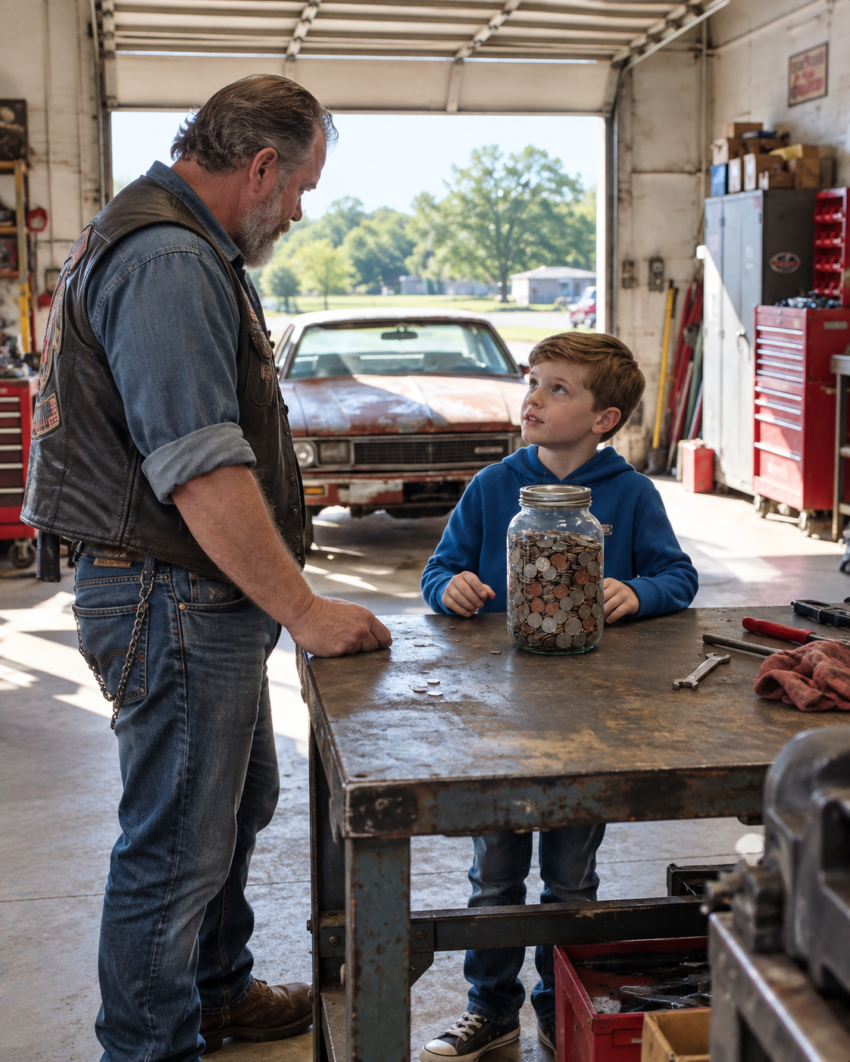
A 10-Year-Old Boy Walked Into a Biker Garage With $83.40 to Save His Mother’s Job — One Forgotten Quarter Changed More Lives Than Anyone Expected
The Boy With the Glass Jar
The first thing Russell Vance noticed was the little boy standing outside his motorcycle garage, holding a glass jar against his chest as though it contained something precious.
It was a chilly Tuesday morning in Roanoke, Virginia. The garage was already busy, with motorcycles waiting for service and the familiar sounds of tools echoing through the building.
Russell, a broad-shouldered mechanic in his late forties, had spent nearly twenty years repairing motorcycles. His gray-streaked beard and leather vest made him look intimidating to strangers, but the people who knew him understood that he rarely turned away someone who genuinely needed help.
The boy stood near the open garage door, wearing a faded green sweatshirt, worn sneakers, and a backpack that looked almost as big as he was.
Russell wiped his hands on a towel.
“You looking for somebody, buddy?”
The boy shook his head.
“I need someone to fix my mom’s car.”
Russell glanced toward the parking lot.
“Where’s your mom?”
“She’s at work. I came by myself.”
That answer immediately concerned Russell.
“How old are you?”
“Ten. My name’s Caleb.”
Russell crouched slightly so they could speak at eye level.
“Well, Caleb, this is mostly a motorcycle shop. Does your mom know you’re here?”
The boy lowered his eyes.
“Not yet. But I know where I am, and I can call her. I just wanted to find out something first.”
He carefully placed the jar on a workbench.
Inside were folded dollar bills, quarters, dimes, nickels, and pennies.
“How much car repair can I buy with eighty-three dollars and forty cents?”
Russell looked at the jar, then back at the boy.
There was something about the seriousness in Caleb’s voice that made him forget the motorcycle waiting behind him.
The Reason Caleb Needed the Car Fixed
Russell pulled over a stool and invited Caleb to sit while they called his mother.
Her name was Natalie Mercer, and she worked the early shift at a bakery on the other side of town.
For almost six years, Natalie had been raising Caleb alone. She worked long hours, carefully managed her bills, and tried to make sure her son never felt responsible for the family’s financial worries.
But children often notice more than adults realize.
Three days earlier, Natalie’s silver sedan had stopped running properly. The battery warning light had appeared, and the engine eventually stalled in their driveway.
A neighbor helped her get the vehicle to a repair shop, where a mechanic suspected the alternator needed replacing.
The estimated cost was more than Natalie could afford that week.
She had already missed one morning shift.
Her supervisor had been understanding, but the bakery was entering its busiest season, and reliable transportation was essential.
Caleb had overheard his mother speaking quietly on the telephone the previous evening.
“I understand, and I’m doing everything I can. I really can’t afford to lose these hours.”
Later, he saw her sitting at the kitchen table, staring at a repair estimate beside a stack of bills.
She hadn’t cried or complained.
She had simply rubbed her forehead and whispered that she would figure something out.
Caleb decided he couldn’t wait for someone else to solve the problem.
He emptied the jar where he had been saving birthday money, small allowances, and coins collected over nearly two years.
He counted everything three times.
Eighty-three dollars and forty cents.
To a ten-year-old boy, it seemed like a fortune.
And if it could keep his mother from losing her job, he was willing to spend every penny.
The Mechanics Who Stopped Working
By the time Caleb finished explaining, three other mechanics had gathered nearby.
One of them, a tall man named Brett Calloway, leaned against a toolbox.
“You saved all that yourself?”
Caleb nodded.
“I was going to buy a bike. But Mom needs her car more.”
Brett glanced toward Russell.
Neither man said anything for several seconds.
Finally, Russell asked for Natalie’s telephone number.
When she answered, she sounded startled.
“Caleb? Where are you?”
Russell introduced himself, explained that her son was safe inside the garage, and assured her that nobody had begun working on her vehicle.
Natalie was understandably upset that Caleb had gone there without telling her.
Russell agreed that she should know where her son was at all times.
Once she had spoken to Caleb and confirmed he was safe, she explained the situation with her car.
Russell listened carefully.
Then he asked whether she could arrange to have the sedan brought over so his team could inspect it.
“I don’t want to promise anything until we know what’s wrong,” he said. “But we can take a look and tell you what options you have.”
Natalie hesitated.
“I appreciate that, but I don’t have enough money for another expensive repair.”
Russell looked at Caleb’s jar.
“Let’s find out what the car needs before we worry about the bill.”
A Repair That Meant More Than Money
Later that morning, a local towing company brought Natalie’s sedan to the garage.
Russell had called a friend who operated an automotive repair business nearby. His friend, Patrick Sloane, agreed to help diagnose the problem using the proper equipment.
Caleb remained with his mother after she arrived.
He sat beside her in the small customer waiting area, watching through the glass as the mechanics inspected the car.
Patrick confirmed that the alternator had failed and that the battery also needed charging and testing.
Fortunately, the damage was limited.
The repair would still cost several hundred dollars at normal rates, but Patrick could supply a reliable replacement alternator at a discount, and Russell offered to cover the remaining cost.
Brett and another mechanic volunteered to contribute toward the parts.
When Natalie learned what they were planning, she shook her head.
“I can’t ask you gentlemen to do that.”
Russell smiled.
“You didn’t ask. Your son came in here with a plan, and we’re choosing to help.”
Natalie looked at Caleb.
“Honey, you shouldn’t have taken all your savings.”
Caleb’s face turned red.
“I just didn’t want you to lose your job.”
She pulled him close.
“Sweetheart, keeping our family going is my responsibility. You don’t have to carry that worry.”
Russell quietly returned the jar to the boy.
“Your mom’s right. You worked hard saving this money, and you should keep it.”
Caleb stared at the jar.
“But I came here to pay.”
“And you reminded us why helping someone matters. That’s worth something too.”
By late afternoon, the sedan was running smoothly again.
Natalie turned the key and listened as the engine started without hesitation.
For the first time in days, she smiled with relief.
The Quarter Left Behind
After Natalie and Caleb drove away, Russell began cleaning the workbench.
That was when he noticed a single quarter resting near a socket wrench.
It must have fallen from Caleb’s jar while the boy was counting his money.
Russell picked it up and examined it.
Twenty-five cents.
He could have placed it in a drawer and forgotten about it.
Instead, he remembered Caleb asking how much repair his savings could buy.
Brett walked over carrying a cup of coffee.
“What’s that?”
Russell held up the coin.
“The kid left a quarter.”
“You can give it back next time you see him.”
Russell nodded, but his thoughts had already moved somewhere else.
“You know what bothers me? That little boy thought it was his job to save his mother’s paycheck.”
Brett leaned against the counter.
“He loves his mom.”
“I know. But there are probably other families around here dealing with the same thing.”
Russell looked at an empty metal coffee can near the sink.
He washed it, dried it, and wrapped a strip of masking tape around the front.
Then he wrote four words in black marker.
NEXT FAMILY’S REPAIR FUND.
He dropped the quarter inside.
Brett raised an eyebrow.
“You’re starting a repair fund with twenty-five cents?”
Russell shrugged.
“It’s a beginning.”
Brett reached into his pocket and added a five-dollar bill.
Another mechanic contributed three dollars.
Before closing, two regular customers heard about the idea and donated a little money.
By the end of the day, the can held $52.25.
Russell opened a notebook and recorded every contribution.
He had no idea that the little container would soon become one of the most meaningful things in his garage.
The Phone Call Nobody Expected
The next morning, a woman named Rebecca Tolland called the shop.
Her voice was hesitant.
“Someone told me you helped a little boy get his mother’s car repaired yesterday.”
Russell confirmed the story.
Rebecca explained that her eight-year-old daughter, Maisie, used a wheelchair because of a mobility condition.
The chair’s brakes had recently stopped working properly.
Rebecca had borrowed a temporary replacement, but it was uncomfortable and difficult for Maisie to use at school.
A specialized repair company had estimated the cost at $320.
“I know you work on motorcycles,” Rebecca said. “But I wondered whether you might know someone who could help.”
Russell looked toward the coffee can.
He knew the fund didn’t have nearly enough money.
He also understood that a wheelchair required specialized knowledge and safety checks.
“We aren’t qualified to repair medical mobility equipment,” he explained. “But I know a technician who works with it every day. Would you like me to contact him?”
Rebecca agreed immediately.
That afternoon, Russell called a certified mobility equipment technician named Colin Pritchard.
After reviewing the wheelchair’s model and serial number, Colin discovered something unexpected.
The chair might still qualify for manufacturer warranty service.
Rebecca had never considered that possibility.
When Colin asked where the wheelchair had originally been purchased, Rebecca became quiet.
“My father bought it for Maisie,” she explained. “He wanted her to have something comfortable and reliable. He passed away last winter, and I never thought to look through the paperwork.”
Russell listened as she struggled to continue.
“He always said that helping somebody get where they needed to go was one of the most important things you could do.”
Those words stayed with Russell long after the conversation ended.
A Connection From Years Earlier
The following afternoon, Rebecca brought the wheelchair paperwork to Colin’s workshop.
Among the documents was a receipt, a warranty registration, and an old photograph of her father standing beside a white delivery van.
When Russell saw the photograph Rebecca had sent, he recognized the man.
His name was Walter Tolland.
Nearly fifteen years earlier, Russell had been traveling home from a motorcycle event when his truck broke down during a heavy rainstorm.
He had pulled onto the shoulder of a quiet highway, uncertain how he would get his equipment home.
A delivery driver stopped and offered assistance.
That driver was Walter.
He helped Russell contact a towing company, gave him a ride to a nearby service station, and refused payment.
Russell remembered offering him forty dollars for his trouble.
Walter had smiled and said something Russell never forgot.
“Keep it. Someday you’ll meet somebody who needs help more than I do. You can do something for them.”
Russell had thought about that encounter many times, but he never knew Walter’s full story.
Now, years later, he was speaking with the man’s daughter.
Rebecca was astonished when Russell explained the connection.
“Dad helped people all the time,” she said. “He never made a big deal about it.”
Colin eventually confirmed that the wheelchair qualified for a covered brake assembly replacement.
Maisie’s chair was repaired by a qualified technician at no charge to the family.
The repair fund hadn’t paid for the parts.
But Russell realized it had helped Rebecca find the right person and discover an option she hadn’t known existed.
Sometimes assistance meant money.
Other times, it meant making the right telephone call.
The Little Fund Begins to Grow
Over the following weeks, word spread among the garage’s regular customers and local motorcycle riders.
Russell made one thing clear from the beginning.
The fund would support essential transportation needs, but every repair had to be completed safely and by someone qualified to do the work.
Nobody would receive special treatment in exchange for publicity.
Families wouldn’t be expected to share private details online.
And children would never be asked to contribute their own savings.
A local auto parts supplier offered discounts on selected items.
Patrick’s automotive shop agreed to provide occasional reduced-cost labor.
Members of Russell’s riding group began leaving small contributions whenever they stopped by.
The fund’s first direct repair assistance went to a grocery store employee whose car needed a new starter.
A few weeks later, it helped an older man replace the battery in his wheelchair-accessible van.
Then came a father who depended on his delivery vehicle to support his children.
Russell kept careful records and made sure the money was used only for approved expenses.
Some requests were beyond the fund’s resources.
When that happened, he contacted local charities, service organizations, or other repair businesses instead of making promises he couldn’t keep.
The garage still operated as an ordinary business.
Motorcycles arrived every morning.
Customers asked about tires, oil changes, and engine problems.
Yet something had changed.
The mechanics no longer saw every repair as simply another invoice.
Sometimes, a working vehicle meant a parent could keep a job.
Sometimes, it meant an older person could attend an appointment.
And sometimes, it meant a child could return to school comfortably and safely.
The Boy Returns One Year Later
Almost exactly one year after his first visit, Caleb returned to the garage.
This time, he wasn’t carrying a glass jar.
He arrived on a bright blue bicycle.
Russell spotted him through the open doorway and immediately recognized the familiar brown hair and cheerful face.
“Well, look who’s here! That’s a nice bike you’ve got.”
Caleb grinned.
“I bought it with my own money.”
Russell examined the bicycle.
“Looks like you made a good choice.”
Natalie pulled into the parking lot behind him in her silver sedan.
The car was still running well.
She had kept her position at the bakery and had recently been promoted to shift supervisor.
With the additional income, she had finally started building an emergency savings account.
When she stepped out of the car, she walked straight toward Russell.
“I wanted to thank you again,” she said.
Russell smiled.
“You already thanked us plenty.”
Natalie shook her head.
“You fixed more than my car that day. You gave me enough breathing room to get back on my feet.”
Russell didn’t know what to say.
Caleb interrupted with a question.
“Do you still have the coffee can?”
Russell’s expression brightened.
“Come inside. There’s something I want to show you.”
Eleven Families and One Small Coin
On a shelf beside the customer counter sat the original coffee can.
Its masking tape had faded, but the words were still visible.
NEXT FAMILY’S REPAIR FUND.
Beside it was a small framed photograph of Walter Tolland standing next to his delivery van.
Under the picture, Russell had placed a simple message.
HELP THE NEXT PERSON GET HOME.
Caleb looked from the photograph to the can.
“Who’s that man?”
Russell told him about Walter, the rainy highway, and the stranger who had helped him years earlier.
Then he explained how Rebecca had contacted the garage and how Maisie’s wheelchair had been repaired.
Caleb listened without interrupting.
Finally, Russell opened the oil-stained notebook.
On the first page was the original entry.
$0.25.
Below it were dozens of donations, repair expenses, and service records.
“What’s all this?” Caleb asked.
“It’s what happened after you visited us last year.”
Russell turned several pages.
“We’ve helped eleven households so far. Some needed repairs, and others needed help finding the right service.”
Caleb stared at the notebook.
“Eleven families?”
Russell nodded.
“Eleven.”
“Because of my quarter?”
Russell smiled.
“Your quarter gave us the idea. But lots of people worked together to make it happen.”
Caleb thought about that.
“Did the other kids have to bring their savings too?”
Russell shook his head.
“No, buddy. That’s the whole point. We wanted families to get help without children feeling they had to pay for it.”
Caleb’s smile grew wider.
“Good. Because saving for a bicycle takes forever.”
Everyone laughed.
But Russell noticed the relief behind the boy’s innocent words.
A year earlier, Caleb had been willing to give up something he wanted because he was afraid of what might happen to his mother.
Now he was simply a child enjoying his new bicycle.
That was exactly how Russell wanted things to be.
A Thank-You Card Arrives
While they were talking, Brett entered the office carrying an envelope.
“Russell, another thank-you card came in.”
Inside was a handwritten note from a woman whose vehicle had recently received a replacement starter.
She explained that the repair had allowed her to return to work without missing another shift.
At the bottom of the card, she had written:
“When I’m able, I’ll find a way to help someone else.”
Russell handed the note to Caleb.
The boy read it twice.
“She sounds happy.”
“I think she’s relieved,” Russell replied. “Sometimes that’s even better.”
Natalie looked toward the coffee can.
“I’d like to contribute somehow. I can’t give much money right now, but maybe there’s something else I can do.”
Russell told her that donations weren’t the only way to help.
Natalie mentioned that the bakery occasionally had approved surplus bread and pastries at the end of the day.
With her manager’s permission and proper food handling arrangements, she might be able to provide refreshments for community volunteer events.
Russell thought it was an excellent idea.
Caleb listened to the conversation and looked pleased.
For the first time, he understood that helping people didn’t always require a full jar of coins.
Sometimes, it required a little time, a useful skill, or a willingness to ask the right question.
The Quarter Russell Had Kept
As Natalie prepared to leave, Russell remembered something.
“Caleb, wait a second. I’ve got something for you.”
He opened a small drawer beneath the counter and removed a clear plastic coin holder.
Inside was a quarter.
Caleb frowned.
“What’s that?”
“Remember the quarter you accidentally left on my workbench?”
Caleb nodded.
“I thought you put it in the coffee can.”
“I counted its value as the fund’s first contribution, but I kept the actual coin safe. I figured you might want it someday.”
Russell handed him the holder.
Caleb turned it over carefully.
“Why did you save it?”
Russell glanced at Natalie.
“Because that morning, you walked into a garage full of strangers carrying everything you’d saved, and you were ready to give it all away to help your mom.”
Caleb looked down.
Russell continued.
“You didn’t know how much the repair would cost, and you didn’t know whether we could help. You just knew somebody you loved needed something.”
The boy remained quiet.
“I wanted you to remember that your kindness mattered, even though fixing the car was never supposed to be your responsibility.”
Caleb held the quarter in his palm.
“Can I put it back in the fund?”
Russell smiled.
“You can, but you don’t need to. The fund already has its twenty-five cents recorded. Why don’t you keep this one?”
Caleb slipped the coin into his pocket.
“I think I’ll keep it in my room.”
“That sounds like a good place for it.”
The Sound of a Car Starting
A few minutes later, Caleb climbed onto his bicycle while Natalie settled into the driver’s seat of her sedan.
She turned the key.
The engine started immediately.
Russell stood near the garage entrance, listening to the familiar sound.
He remembered how nervous Natalie had looked the previous year.
He remembered Caleb’s worn sneakers, the heavy glass jar, and the determined expression of a child who believed eighty-three dollars and forty cents might be enough to save his mother’s job.
Now Natalie was smiling.
Caleb was laughing as he adjusted his bicycle helmet.
The car was running.
The family was moving forward.
Brett came outside and stood beside Russell.
“Hard to believe it’s been a year.”
Russell nodded.
“Feels like yesterday.”
Brett looked toward the office.
“Eleven families. Not bad for a coffee can that started with a quarter.”
Russell watched Caleb pedal slowly toward the sidewalk.
“It wasn’t really the quarter,” he said.
“What do you mean?”
“It was the people who decided to do something after they heard about it.”
Brett considered that.
“I guess you’re right.”
Russell smiled.
“The quarter just reminded us where to start.”
They returned to the garage, where another motorcycle waited for service.
The telephone rang.
A customer arrived to ask about a tire replacement.
Ordinary life continued.
But Russell glanced once more at the coffee can before picking up his wrench.
He knew the fund would never solve every family’s transportation problems.
He knew there would always be more requests than money available.
Still, eleven households had received meaningful help because a few people chose to work together.
And that was enough reason to keep going.
The Smallest Beginning Can Leave the Biggest Mark
That evening, after the garage closed, Russell sat at his desk and opened the notebook to its first page.
He studied the original entry.
Twenty-five cents.
He thought about Walter Tolland, who had once stopped beside a rainy highway to help a stranger.
He thought about Rebecca and Maisie, who had found a solution through an unexpected connection.
He thought about Natalie, whose steady job had helped her family regain financial security.
And he thought about Caleb, who had finally bought the bicycle he’d wanted for so long.
None of those moments had been planned.
They were connected by ordinary people making small decisions to care about someone else’s circumstances.
Russell closed the notebook and placed it beside the coffee can.
Then he turned off the office light.
He didn’t know who would need help next.
Perhaps it would be a parent trying to reach work, a caregiver driving to an appointment, or an older neighbor struggling with a vehicle repair.
Whatever happened, he knew one thing.
He would never forget the little boy who walked into his garage carrying a jar of coins and asking a question no mechanic could answer with a simple price.
“How much car repair can eighty-three dollars and forty cents buy?”
At the time, Russell had thought the boy wanted to know the cost of an alternator.
A year later, he understood that the answer had become something much greater.
Eighty-three dollars and forty cents had brought a worried child through the door.
One forgotten quarter had inspired an idea.
And a community of ordinary people had turned that idea into eleven opportunities for families to keep moving forward.
Because the most meaningful thing Russell repaired that year wasn’t a motorcycle, a car, or a mechanical part.
It was a little piece of hope that had almost disappeared from a family’s life.
And once that hope returned, it found its way to other people who needed it too.
Messages From the Heart
Sometimes the smallest act of kindness becomes the beginning of something extraordinary, not because it costs a great deal of money, but because it reminds others that compassion is still worth sharing.
A child should never have to carry the financial worries of an entire household, yet the love that inspires a child to offer everything they have can teach adults lessons they might otherwise forget.
When someone comes to us asking for help, the greatest gift we can offer may not be an immediate solution, but the patience to listen, understand their circumstances, and help them find a safe way forward.
True generosity is not measured by the size of a donation or the recognition it receives, but by the comfort, dignity, and opportunities it brings to people who need a little support.
One kind decision can travel far beyond the moment in which it is made, touching families, neighbors, and even strangers whose lives we may never personally know.
Parents work tirelessly to give their children security, but sometimes children remind us that love is also expressed through simple gestures, quiet sacrifices, and the desire to make another person’s day easier.
We may not have enough resources to solve every problem around us, but when people share their skills, time, knowledge, and compassion, even difficult situations can become more manageable.
The most beautiful form of helping is the kind that allows someone to maintain their dignity, protect their privacy, and move forward without feeling that they owe the world an explanation for their struggles.
Never underestimate the importance of a small beginning, because a single conversation, an unexpected phone call, or a forgotten coin can inspire people to create something meaningful together.
And perhaps the greatest lesson of all is that kindness does not need to change the entire world to matter; sometimes helping one family face tomorrow with a little less worry is already a wonderful achievement.