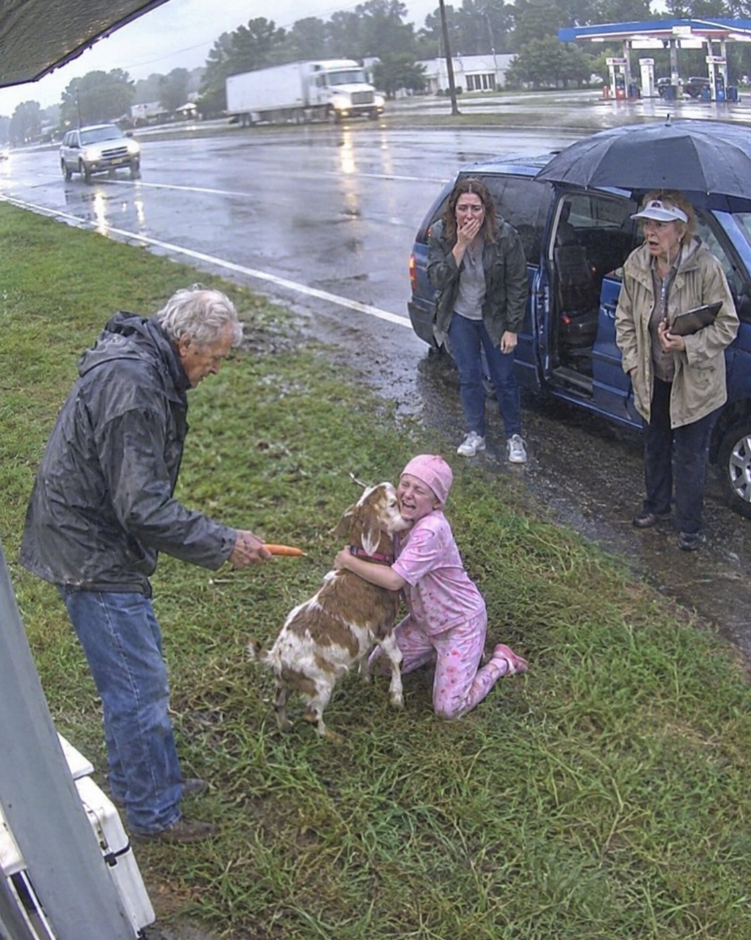
They Threatened to Take My Home for Saving a Stray Goat. Then a Little Girl Revealed the Truth Nobody Was Supposed to Know.
The first time a nine-year-old girl spoke in four weeks, she was kneeling in the pouring rain, holding a starving goat beside a Tennessee highway.
And the woman who had threatened to take my house was standing ten feet away.
I’ll never forget what happened next.
But to understand why a little girl’s voice brought a grown woman to her knees, I have to tell you about twenty-six mornings when I was the only person who seemed to notice a small brown-and-white animal fighting to stay alive.
My name is Tennyson Fairchild.
Most folks call me Ten.
I’m seventy-two years old, and I spent thirty-nine years delivering mail in Knoxville, Tennessee.
I’ve walked through thunderstorms, ice storms, and summers hot enough to melt the soles of your shoes. I’ve been chased by dogs, yelled at by homeowners, and bitten twice by the same miserable Chihuahua.
I thought I’d seen just about everything.
Then I retired.
And somehow, the hardest part of my life began.
My wife, Eleanor, passed away four years ago.
We were married forty-three years.
She used to tell me I couldn’t walk through a grocery store without finding somebody who needed help.
“Ten,” she’d say, laughing, “one of these days, you’re going to bring home an entire zoo.”
I’d tell her I was just being neighborly.
She’d kiss my cheek and say, “That’s what I love about you.”
After she died, the house became terribly quiet.
Our two children live far away. They call whenever they can, and they visit on holidays, but their lives are full of work, mortgages, and children of their own.
I don’t resent that.
Still, there’s something about waking up in a house where nobody else is breathing.
You become accustomed to hearing the refrigerator hum.
You start talking to the television.
Sometimes, you leave a light burning in the kitchen just to make the place feel occupied.
I developed a routine to keep myself moving.
Every morning at six, I’d walk to the gas station near the entrance to our neighborhood.
I’d buy a black coffee and a newspaper, exchange a few words with the cashier, and take the long way home.
It wasn’t much of a life.
But it was mine.
Then, one Tuesday morning in September, everything changed.
***
I was approaching the traffic light near the gas station when I noticed something standing in the grassy highway median.
At first, I thought it was a dog.
Then it turned sideways.
A goat.
A tiny brown-and-white goat with floppy ears, skinny legs, and a faded pink collar.
She stood surrounded by tall weeds between four lanes of traffic.
Eighteen-wheelers thundered past on both sides.
Whenever one approached, she lowered her head and trembled.
I stood there watching her for several minutes.
Something was terribly wrong.
Her ribs showed through her coat. Her little hooves were buried in mud. She kept turning in circles as though she couldn’t decide which direction was safe.
I counted seventeen vehicles passing without slowing.
Not one driver stopped.
I waited for the light to turn red, then carefully crossed to the median.
“Hello, sweetheart,” I said.
She backed away.
“It’s all right. I’m not going to hurt you.”
She stared at me with enormous, frightened eyes.
I reached out.
She flinched.
I could tell she’d been around people before, but whatever had happened to her had made her afraid of approaching anyone.
I returned to the gas station and bought baby carrots and a bottle of water.
The cashier, a young fellow named Lenny, watched me empty my coffee into a trash can.
“Coffee no good, Mr. Fairchild?”
“It’s fine. I just need the lid.”
I explained about the goat.
Lenny looked toward the highway.
“Seriously? Out there?”
“Right in the middle.”
“Somebody ought to call somebody.”
“I intend to.”
I carried the carrots and water across the road.
Using my coffee cup lid as a tiny bowl, I poured some water into it.
Then I scattered a handful of carrots beside the weeds.
The goat wouldn’t approach while I stood there.
So I backed away.
From across the road, I watched her sniff the food.
She ate one carrot.
Then another.
Then she lowered her head and drank.
**That was the first time I realized how thirsty she must have been.**
I called animal control as soon as I got home.
The woman on the phone took the information and promised to send someone.
I believed her.
The next morning, the goat was still there.
So I brought more food.
And the morning after that.
And the morning after that.
***
By the fifth day, I had started calling her Little Lady.
It suited her.
She’d approach the carrots with a dainty little step, take one from my fingers, then raise her chin as though expecting a waiter to bring the next course.
I knew carrots weren’t enough to keep a goat healthy. I tried bringing leafy greens and hay, but she was losing weight faster than I could help her.
Every day, I made another call.
Sometimes I reached animal control.
Sometimes I was transferred to a transportation department.
Once, a woman told me the highway median was outside her agency’s jurisdiction.
“Ma’am,” I said, “does the goat know that?”
There was a long silence.
Then she told me she’d forward my complaint.
Nobody came.
By the second week, Little Lady recognized me.
She would emerge from the weeds whenever she saw my gray jacket.
She’d trot toward me, her floppy ears bouncing.
For a few minutes every morning, she forgot to be afraid.
And, if I’m telling the truth, so did I.
The rest of my day might be lonely, but at six o’clock, somebody was happy to see me.
That felt like something.
One morning, Lenny came outside with an extra bottle of water.
“You’re still feeding that goat?”
“She’s still hungry.”
“Man, you’re going to get yourself killed crossing that road.”
“Probably not today.”
He shook his head.
“You know, I’ve seen a cream-colored SUV slowing down near that median a couple of times. Maybe somebody’s looking for her.”
I glanced toward the highway.
“Did they stop?”
“Not that I saw.”
I didn’t think much about it.
People slowed down to look at accidents and stranded animals all the time.
I had no reason to remember that conversation.
Not yet.
***
On the seventeenth morning, Little Lady nearly died.
I’d grown confident enough to scratch the top of her head.
She would stand perfectly still while I rubbed between her ears.
I noticed something beneath her faded pink collar, but she always twisted away when my fingers got close.
I wondered whether there was a tag with an owner’s telephone number.
That morning, I tried reaching for it.
The moment my fingers touched the collar, she bolted.
Straight toward the highway.
A semi-truck came around the bend.
The driver slammed his horn.
I screamed.
“NO! COME BACK!”
Little Lady disappeared behind the front of the truck.
For one terrible second, I couldn’t see her.
I fell to my knees.
Then, from the weeds, a little brown head appeared.
She was alive.
I stumbled toward her, my hands shaking.
She backed away again, frightened by my sudden movement.
So I sat in the grass.
I didn’t try to touch her.
I just cried.
At seventy-two, you don’t necessarily become less afraid of death.
You simply understand how quickly something precious can disappear.
I’d learned that beside Eleanor’s hospital bed.
And now I was learning it again on a highway median.
“I’m sorry, sweetheart,” I whispered. “I won’t grab you again.”
She watched me.
Eventually, she stepped forward and pressed her nose against my hand.
I made a decision that morning.
**I was going to find a way to bring that goat somewhere safe, even if I had to build the place myself.**
***
Three days later, I bought some inexpensive fencing.
My backyard wasn’t large, but it had a shady oak tree and a patch of grass that nobody used anymore.
I pictured a little shelter beneath the tree, some fresh hay, and Little Lady sleeping without trucks roaring past her head.
I knew I’d have to find veterinary care and a proper long-term home.
I wasn’t foolish enough to believe a goat could live on carrots and good intentions.
But I could give her a safe place while somebody figured things out.
I was halfway through setting the fence posts when Mrs. Ottoline Pemberton appeared.
She was sixty-five, president of our homeowners’ association, and the sort of woman who considered an improperly placed flowerpot a threat to civilization.
She wore a white visor, even on cloudy days.
She carried a clipboard everywhere.
She had once fined the Henderson family seventy-five dollars because their trash cans were the wrong shade of green.
“Mr. Fairchild,” she said, looking at the fence posts.
“Morning, Mrs. Pemberton.”
“I’ve received a complaint.”
“About what?”
“You’re constructing a livestock enclosure.”
I leaned against my shovel.
“Just a little pen.”
“For livestock.”
“For a goat.”
Her eyes narrowed.
“Goats are livestock.”
“This one’s somebody’s pet. She’s trapped on the highway with a pink collar around her neck.”
Something changed in her expression.
Only for an instant.
Her pen stopped moving.
“A pink collar?” she repeated.
“Yes, ma’am. Brown-and-white little thing. Floppy ears.”
She looked down at her clipboard.
Then she cleared her throat.
“That’s irrelevant. Section Four of our bylaws prohibits livestock.”
“She’s starving out there.”
“Then contact the appropriate authorities.”
“I have. Every morning.”
“Then you’ve done your part.”
“No,” I said. “I don’t believe I have.”
She stepped closer.
“Listen carefully, Mr. Fairchild. **Bring that filthy animal into this neighborhood, and I’ll fine you every single day until you lose your house.**”
For a moment, I couldn’t believe what I’d heard.
I looked past her toward my front window.
Eleanor had chosen those curtains.
She’d planted the roses beneath them.
Our children had taken their first steps in that living room.
That house contained the only life I’d ever truly wanted.
And Mrs. Pemberton knew it.
“You’d take an old man’s home over a goat?”
“I would enforce the rules.”
I waited for her to soften.
She didn’t.
Finally, I said, “Okay.”
She wrote something on her clipboard and walked away.
That afternoon, I took down the fencing.
Each post came out of the ground harder than it had gone in.
I stacked the lumber behind the garage.
Then I went inside, sat in Eleanor’s chair, and stared at the empty place beside me.
“Well, Ellie,” I whispered, “I tried.”
But the next morning, I woke before the alarm.
I made coffee.
Put carrots and water into a grocery bag.
And went back to the highway.
It was day twenty-six.
Little Lady came trotting from the weeds, her ears bouncing.
When she reached me, she leaned her forehead against my knee.
I scratched her head.
“I’m sorry, girl,” I said. “I haven’t figured it out yet.”
She stood beside me until it was time to leave.
I promised her I’d return.
***
Day twenty-seven arrived with rain.
The kind that seeps through your jacket and makes your bones ache.
The highway was slick, and the passing trucks threw sheets of dirty water across the grass.
I nearly stayed home.
But then I imagined Little Lady waiting in the weeds.
So I pulled on my raincoat.
At six fifteen, I was standing on the median, holding a carrot while she nibbled from my palm.
“Good girl,” I murmured.
Suddenly, tires screamed.
A blue minivan swerved across two lanes and stopped on the shoulder.
Horns blared behind it.
I jumped backward.
The sliding door flew open.
A little girl climbed out.
She wore pink pajamas, slippers, and a pink knitted hat that had slipped sideways.
She couldn’t have been more than nine.
Beneath the hat, her head was completely bald.
A hospital bracelet circled her wrist.
She stared at the goat.
For a second, she seemed unable to breathe.
Then she screamed.
**”DUMPLING!”**
The goat froze.
The carrot fell from her mouth.
She lifted her head.
And suddenly, she ran.
Not away.
Toward the little girl.
The child dropped to her knees in the wet grass, her arms stretched wide.
Dumpling practically leaped into them.
The girl wrapped both arms around the goat’s neck.
“Dumpling! Oh, Dumpling!”
She sobbed into the animal’s wet fur.
The goat pressed against her, making the softest little sounds I’d ever heard.
A woman stumbled out of the driver’s seat.
She covered her mouth with both hands.
“Oh, my God.”
She looked at the girl.
Then at me.
Then at the goat.
“Where did you find her?”
“She’s been right here,” I said. “I’ve been feeding her.”
“For how long?”
“Twenty-seven mornings.”
The woman started crying harder.
“My name is Rachel Mercer,” she said. “That’s my daughter, Mirna.”
She struggled to catch her breath.
“Dumpling disappeared the morning Mirna started chemotherapy.”
I looked at the child again.
Rachel wiped her cheeks.
“We’ve been looking for her for almost a month. Mirna stopped speaking after she disappeared. Four weeks. Not a single word.”
Her voice broke.
“Until now.”
I felt the hairs rise on my arms.
Then the front passenger door opened.
Someone stepped out beneath an umbrella.
I recognized the white visor immediately.
Mrs. Ottoline Pemberton.
She stopped when she saw the goat.
Then she looked at me.
Her face went white.
Mirna raised her head.
“Grandma,” she sobbed, pointing at me.
**”This man saved Dumpling.”**
***
Mrs. Pemberton gripped her umbrella so tightly I thought the handle might snap.
Rachel turned.
“Mom? You know him?”
“He’s a resident of my neighborhood.”
Rachel looked at my soaked clothes.
Then at Dumpling.
“He’s been keeping her alive?”
Ottoline didn’t answer.
Mirna pulled the goat closer.
“Grandma, you’re not going to take her away again, are you?”
Everything went quiet.
Even the traffic seemed to fade.
Rachel turned toward her daughter.
“Again?”
Mirna nodded.
“Grandma said Dumpling was going somewhere safe. She said I wasn’t supposed to tell you.”
Rachel’s face changed.
“Mom, what is she talking about?”
Ottoline shook her head.
“Mirna doesn’t understand.”
“I do!” Mirna cried.
She looked at Rachel.
“Grandma said you were already scared about my medicine. She said telling you would make you feel worse.”
Rachel stepped backward.
“You told me Dumpling escaped through the backyard gate.”
“Rachel, please.”
“Did you take her?”
Ottoline looked toward the road.
“I was trying to protect Mirna.”
“From what?”
“From getting sick!”
Her voice cracked.
“The doctors warned us about infections. They told us to be careful around animals. I thought—”
“You thought what, Mom?”
Another truck blasted past.
Dumpling startled.
I moved between the traffic and Mirna.
“Folks,” I said, “we need to get off this road before somebody gets hurt.”
Rachel nodded immediately.
She helped Mirna stand.
The little girl refused to release Dumpling.
“She comes with us,” Mirna insisted.
“Of course,” Rachel said.
I helped guide them toward the minivan during a break in traffic.
Mrs. Pemberton followed silently.
Just before Mirna climbed inside, she turned to me.
“Are you coming?”
I smiled.
“Where are we going, sweetheart?”
“Somewhere nobody can take her away.”
I looked toward her grandmother.
Then back at Mirna.
“That sounds like a mighty fine idea.”
***
We drove to an emergency veterinary clinic.
Rachel was worried about Dumpling’s condition and Mirna’s weakened immune system.
At the clinic, she called her daughter’s medical team for instructions while the veterinarian examined the goat.
Dumpling was dehydrated, underweight, and exhausted.
But she was alive.
The veterinarian said she’d need proper nutrition, treatment for parasites, and careful monitoring.
Mirna sat nearby, watching every movement.
When the veterinarian carried Dumpling into another room, the little girl started crying.
“Mommy, please. Don’t let her disappear.”
Rachel knelt beside her.
“She’s not disappearing, honey. They’re helping her.”
Mirna looked at me.
“Will you stay?”
I sat down beside her.
“Until they bring her back.”
For the next hour, she told me about Dumpling.
How she’d gotten her as a birthday present.
How Dumpling liked apples.
How she once escaped into the kitchen and ate half a dish towel.
She laughed when she told that last story.
Rachel heard it.
Her eyes filled with tears.
“I haven’t heard her laugh in a month,” she whispered.
I didn’t know what to say.
So I simply sat beside her while she cried.
***
Mrs. Pemberton had remained in the waiting room.
She sat with her clipboard on her lap, staring at the floor.
Eventually, Rachel approached her.
“I want the truth.”
Ottoline looked up.
“Rachel, I was scared.”
“We were all scared.”
“The doctors said Mirna’s immune system would be weakened. Animals can carry things that make people sick.”
“So you decided to get rid of her goat?”
“I arranged for a farm to take Dumpling.”
Rachel stared.
“What farm?”
“A place outside town.”
“What’s its name?”
Ottoline hesitated.
Then she said, “I don’t remember.”
Rachel’s expression hardened.
“You don’t remember the place where you took my daughter’s best friend?”
“I was overwhelmed.”
“Mom, where did Dumpling go?”
Ottoline’s eyes filled.
“She got away from me near the highway.”
There it was.
The explanation she’d apparently been holding back for four weeks.
She claimed she’d pulled over near a service road while transporting Dumpling.
The goat had panicked.
The door had opened.
And somehow she’d escaped.
“I searched,” Ottoline whispered. “I couldn’t find her.”
Rachel covered her face.
“Why didn’t you tell me?”
“Because Mirna was starting treatment. You were terrified. I couldn’t add one more thing.”
“You let me believe she ran away from home.”
Ottoline began crying.
“I thought I was doing the right thing.”
Rachel looked toward the examination room.
“My daughter stopped talking because she thought she’d lost the one creature that made her feel safe.”
Neither woman spoke for a long time.
Finally, Rachel said something I’ll never forget.
**”Mom, you didn’t protect us from the truth. You protected yourself from having to tell it.”**
Ottoline looked away.
I thought that was the worst of it.
I was wrong.
***
Two days later, Dumpling was strong enough to leave the clinic.
But there was a problem.
Rachel lived in a small townhouse without enough outdoor space for a goat.
And because of Mirna’s treatment, they needed to follow strict medical precautions about animal contact.
A goat couldn’t simply move into the living room.
The veterinarian recommended arranging safe housing and regular veterinary care.
I thought about my backyard.
About the fence posts stacked behind my garage.
And about Eleanor’s old oak tree.
“I have a place,” I said.
Rachel looked at me.
“Where?”
“My backyard. At least temporarily, while we work out something permanent.”
Mrs. Pemberton, who had come to the clinic with Rachel, immediately stiffened.
“Mr. Fairchild, the bylaws—”
I turned toward her.
“Mrs. Pemberton, I have listened to you for three weeks.”
She stopped talking.
“I’ve watched a frightened animal nearly get killed by trucks. I’ve spent twenty-seven mornings praying somebody would help her.”
My voice trembled.
“I’m too old to pretend rules matter more than compassion.”
Rachel stepped beside me.
“If this is an HOA issue, I’ll speak to the board.”
Ottoline opened her mouth.
But Rachel wasn’t finished.
“And Mom?”
“Yes?”
“You’re going to let me handle it.”
That seemed to shock her more than anything.
For years, Rachel later told me, her mother had been the person who handled everything.
The holidays.
The school decisions.
The family emergencies.
Always with a clipboard.
Always convinced she knew best.
Now her daughter was finally telling her no.
***
Word about Dumpling spread quickly.
Lenny from the gas station heard first.
Then the Hendersons.
Then half the neighborhood.
Somebody posted a photograph of Mirna hugging Dumpling outside the clinic.
Within a day, people were calling me.
A retired carpenter offered to help rebuild the pen.
A neighbor brought proper fencing supplies.
Another woman donated a small shelter.
The veterinarian helped coordinate Dumpling’s recovery plan.
The HOA board received enough requests to hold an emergency meeting.
I attended with Rachel.
Mrs. Pemberton sat at the head of the table, wearing her visor.
For once, her clipboard remained closed.
I told the board about the highway.
About the calls nobody answered.
About the truck that had nearly struck Dumpling.
Then I explained the temporary shelter arrangement, including the veterinary care and plans for a permanent home.
Rachel spoke next.
“My daughter is fighting cancer,” she said quietly.
She looked around the room.
“For weeks, she barely reacted to anything. She stopped talking. We were terrified of what was happening to her.”
Her voice shook.
“Then she saw that goat, and she screamed her name.”
Nobody interrupted.
“A man she’d never met had been keeping her alive.”
Rachel turned toward me.
“If Mr. Fairchild hadn’t gone out there every morning, I don’t know what would’ve happened.”
One board member asked whether they could grant a temporary exception.
Another agreed.
After a lengthy discussion, the board voted to authorize a supervised temporary rescue arrangement while Dumpling recovered.
The motion passed.
Four votes to one.
Mrs. Pemberton voted against it.
I don’t know why that surprised me.
But it did.
Still, the outcome was what mattered.
Dumpling had somewhere safe to go.
***
That Saturday, half the neighborhood helped rebuild my fence.
The Henderson boys carried lumber.
Lenny showed up with a truckload of hay.
Rachel brought lemonade.
Mirna sat in a lawn chair beneath the oak tree, wearing her pink knitted hat, watching everybody work.
She was tired from treatment, but she was smiling.
When the veterinarian approved a brief visit under the precautions recommended by her medical team, Mirna stood near the fence and talked to Dumpling.
Not for long.
But enough.
“That’s your new bedroom,” she explained, pointing to the shelter.
Dumpling chewed her hay.
“And Mr. Ten says you have to stop trying to eat everything.”
I laughed.
“She’s got a hard time following instructions.”
Mirna smiled at me.
“Like you?”
I raised an eyebrow.
“Who told you that?”
“Mommy said you wouldn’t listen when everybody told you to stop feeding her.”
“Well, your mommy’s not wrong.”
She thought about that.
Then she said, “I’m glad you didn’t listen.”
I had to turn away for a moment.
Some words are worth more than anything a person can give you.
***
For the next several days, things seemed to improve.
Dumpling gained weight.
The veterinarian was pleased with her progress.
Rachel began arranging long-term housing with a small animal sanctuary where Dumpling could have proper care and other goats for company.
Mirna continued her treatment.
Some days were harder than others.
But she was talking again.
She called me most evenings.
Sometimes she’d ask about Dumpling.
Sometimes she’d tell me about schoolwork.
Once, she wanted to know whether I’d ever delivered a letter to the president.
“No,” I said. “But I once delivered a birthday card to a man who’d been dead for twelve years.”
She laughed so hard Rachel had to take the phone away.
And for the first time since Eleanor died, I began looking forward to tomorrow.
I thought the story was finished.
A lost goat had found her family.
A little girl had found her voice.
An old man had found a reason to get up each morning.
But then Lenny called.
***
It was a little after seven one evening.
“Mr. Fairchild?”
“Evening, Lenny.”
“There’s something you need to see.”
His voice sounded strange.
“What is it?”
“Remember how I told you that cream-colored SUV kept slowing down near the goat?”
“Sure.”
“Well, our gas station has security cameras. One points toward the highway.”
I sat down.
“I know you’ve got cameras.”
“Yeah, but I didn’t realize how much that one could see. My boss was reviewing footage after everything happened, and we still had the recordings from before you first found her.”
I felt a cold sensation in my stomach.
“What did he find?”
Lenny went quiet.
Then he said, “I think you need to come down here.”
***
The gas station office was a cramped little room behind the counter.
There were boxes of receipts, an old desk, and a monitor showing grainy security footage.
Lenny’s boss, Mr. Watkins, sat beside him.
Both men looked uncomfortable.
Mr. Watkins turned toward me.
“Ten, I want you to know we’re saving copies of this. We’ve already contacted the appropriate authorities.”
“What are you talking about?”
He pressed play.
The screen showed the highway.
Morning traffic.
The gas station entrance.
Then a cream-colored SUV appeared.
It pulled onto the shoulder near the median.
I leaned forward.
There was a small blue heron decal on the rear window.
The same decal I’d seen on Mrs. Pemberton’s vehicle countless times.
The driver’s door opened.
A woman stepped out.
She wore a visor.
Even through the grainy footage, I recognized her.
**Ottoline Pemberton.**
She walked to the rear of the SUV.
Opened the hatch.
And lifted out a small brown-and-white goat.
My heart started pounding.
Dumpling.
Alive.
Healthy-looking.
Not yet starving.
She wore her pink collar.
I watched Ottoline lead the goat toward the median.
Dumpling resisted.
She tried following Ottoline back toward the vehicle.
But Ottoline pushed her gently away.
Then she returned to the SUV.
Dumpling trotted after her.
Ottoline climbed into the driver’s seat.
The goat stood beside the road.
For several seconds, the little animal watched the vehicle.
Then the SUV drove away.
Dumpling began running after it.
A truck horn sounded.
She scrambled into the median.
And the recording ended.
I couldn’t move.
For twenty-seven mornings, I’d imagined how Dumpling became trapped on that highway.
I’d pictured an open gate.
A broken fence.
A frightened animal escaping during a storm.
But the truth was on that screen.
**Dumpling hadn’t escaped onto the highway.**
**Someone had deliberately left her there.**
And that someone was the woman who had threatened to take my home if I rescued her.
***
I sat in silence for a long time.
Then I asked Lenny to play it again.
He did.
The second time hurt worse.
Because I noticed something I hadn’t seen before.
When Ottoline drove away, Dumpling didn’t immediately run into the weeds.
She stayed beside the roadway.
Watching the SUV disappear.
Waiting.
The same way she’d watched me leave every morning.
Only I always came back.
I pressed my hands together to stop them shaking.
“She knew,” I whispered.
Lenny nodded.
“There’s something else.”
He opened another recording.
This one was from the following week.
By then, I had already begun feeding Dumpling every morning.
The footage showed me crossing the highway carrying a grocery bag.
I watched myself kneel in the grass.
A cream-colored SUV approached.
It slowed down near the gas station.
Stopped.
Then remained there for nearly a minute.
I couldn’t see the driver’s face clearly.
But the vehicle was unmistakable.
The blue heron decal was visible.
The SUV pulled away.
Lenny looked at me.
“She saw you feeding her.”
I stared at the screen.
That was the moment the whole thing became unbearable.
I could almost understand a terrible decision made in panic.
I could imagine a frightened grandmother convincing herself she was doing something necessary.
But this wasn’t a single moment.
**Mrs. Pemberton had seen Dumpling alive after abandoning her.**
She’d seen me keeping the animal fed.
And later, when I tried to build a safe shelter, she’d threatened to punish me.
Not because of a rule.
Because bringing Dumpling home would expose what she’d done.
***
I took the footage to Rachel.
She watched it in her living room.
Once.
Then twice.
When the SUV pulled away, she paused the screen.
Her face crumpled.
“She told me Dumpling jumped out.”
I sat beside her.
Rachel stared at the image of her mother’s vehicle.
“She told me she’d searched.”
I didn’t answer.
“She was there at the hospital when Mirna stopped speaking,” Rachel whispered.
Tears streamed down her face.
“She watched my little girl cry every night.”
She pressed her hands against her mouth.
“And she knew where Dumpling was.”
For a long time, we sat without speaking.
Then Rachel stood.
“I need to talk to my mother.”
***
The confrontation happened the following afternoon.
Rachel asked me to come because I had been involved from the beginning.
Mrs. Pemberton answered her door wearing her usual visor.
When she saw us together, she stiffened.
“What’s happened?”
Rachel held up a copy of the video.
“We know.”
Ottoline stared at it.
Then she looked at me.
Her face lost its color.
“You had no right—”
“Don’t,” Rachel said.
Her voice was quiet.
But there was something in it I’d never heard before.
“Don’t make this about your rights.”
Ottoline lowered her eyes.
Rachel stepped closer.
“Why?”
Her mother said nothing.
“Why would you leave her on that highway?”
Ottoline’s mouth trembled.
“I was trying to keep Mirna safe.”
“You could have found a rescue.”
“I know.”
“You could have asked me.”
“You had enough to worry about.”
“You could have told me the truth!”
Ottoline began crying.
“I was frightened, Rachel. Everything was happening so fast. The treatments, the hospital, the doctors. I kept thinking that if I could just control one thing, everything else might be all right.”
She looked toward the floor.
“I planned to take Dumpling somewhere else. Then I panicked. I told myself someone would find her.”
Rachel shook her head.
“You didn’t just leave her.”
Ottoline looked up.
“You saw Mr. Fairchild feeding her afterward.”
Her mother went still.
“We saw that video too.”
For a long moment, Ottoline said nothing.
Then she whispered, “I know.”
Rachel stared at her.
“Then why did you threaten him?”
Ottoline covered her face.
“Because I was ashamed. Because I knew what I’d done. And I was terrified you’d find out.”
Rachel’s voice broke.
**”You let your shame matter more than Mirna’s happiness.”**
Ottoline sank into a chair.
There was no defense left.
***
The investigation into Dumpling’s abandonment continued after the footage was provided to authorities.
Mrs. Pemberton resigned as HOA president.
Rachel told her mother she needed time and that there would be no more decisions about Mirna made without Rachel’s knowledge.
Ottoline accepted that.
For once, she didn’t argue.
A few days later, I found an envelope in my mailbox.
Inside was a letter.
The handwriting was neat and careful.
It was from Mrs. Pemberton.
She apologized for threatening me.
For trying to stop me from helping Dumpling.
For allowing an innocent animal to suffer.
And for allowing her granddaughter to suffer too.
At the bottom, she’d written:
**”I spent years enforcing rules because I thought control made people safe. You showed me that sometimes safety begins with someone refusing to look away.”**
I read the letter three times.
Then I folded it and put it away.
An apology didn’t undo what had happened.
And it wasn’t mine alone to forgive.
But it was a beginning.
***
Several weeks later, Dumpling was healthy enough to move to the small sanctuary Rachel had arranged.
It was a beautiful place outside Knoxville, with green pastures, sturdy fencing, and several other goats.
Mirna would be able to visit when her medical team said it was safe.
I helped load Dumpling into the transport trailer.
For a moment, she resisted.
She planted her little hooves and looked at me.
I crouched beside her.
“Listen, Little Lady,” I whispered. “You’re going somewhere good this time.”
She nudged my hand.
I laughed.
“Yes, I brought carrots.”
Mirna stood a few feet away, smiling.
She was wearing her pink hat.
Rachel kept an arm around her shoulders.
“Mr. Ten?” Mirna asked.
“Yes, sweetheart?”
“Can I ask you something?”
“Anything.”
“Why did you keep going back?”
I looked at Dumpling.
Then at the little girl.
I thought about Eleanor.
About the empty house.
About twenty-six mornings when the world seemed to be rushing past something helpless.
“Because she was waiting for somebody,” I said.
Mirna thought about that.
Then she reached for my hand.
**”I think she was waiting for you.”**
I couldn’t answer.
Not right away.
***
I still walk to the gas station every morning.
I still buy my coffee and newspaper.
And I still look toward the highway median.
Sometimes I can almost see that little brown-and-white goat standing in the grass.
But these days, the median is empty.
There’s no frightened animal waiting between the trucks.
No tiny head appearing from the weeds.
And that’s the way it should be.
My house isn’t as quiet anymore.
Rachel calls regularly.
Mirna sends me drawings from the hospital.
Sometimes she draws Dumpling with enormous floppy ears and a crooked pink collar.
Sometimes she draws an old man carrying a bag of carrots.
In every picture, that old man is smiling.
One afternoon, Mirna mailed me a drawing with a note underneath.
The words were written in careful purple letters.
“Thank you for being Dumpling’s friend when I couldn’t be there.”
I hung it beside Eleanor’s photograph.
And something remarkable happened.
For the first time in four years, that corner of the room didn’t make me sad.
It made me feel grateful.
I had spent so long thinking the most important part of my life was behind me.
That all I had left were memories.
But a lost little goat taught me something I should have remembered from my thirty-nine years delivering mail.
You never really know what someone is carrying.
You never know whose heart is breaking behind a closed door.
And you never know what one small act of kindness might mean to a person you’ve never met.
Mrs. Pemberton had seen a problem she wanted to make disappear.
I’d seen a frightened creature that needed help.
And Mirna had seen her best friend.
Three people looked at the same goat.
Only one of us had understood what was truly at stake.
I didn’t save Dumpling because I knew she belonged to a sick little girl.
I didn’t cross that highway because I expected a reward.
I didn’t bring carrots because I thought somebody would call me a hero.
I did it because something helpless was standing in the path of danger.
And nobody else was stopping.
Eleanor used to say that kindness wasn’t complicated.
It was just deciding that somebody else’s trouble mattered to you.
For twenty-seven mornings, I thought I was keeping a little goat alive.
**I didn’t know I was protecting a promise between a frightened child and the one friend she believed would never abandon her.**
And I certainly didn’t know that the woman threatening to take my home was the very person who had put that friend in danger.
But that’s the thing about the truth.
You can hide it behind a clipboard.
You can bury it beneath rules.
You can pretend that doing something cruel is acceptable because you were frightened.
**But sometimes, the truth comes running out of the rain on four little hooves, straight into the arms of a child who has finally found her voice.**