The Woman They Thought Had Nothing Left
“I invited you because I wanted everyone to see what became of you after you walked away from me.”
Brooks Halstead’s voice carried across the terrace of his family’s estate outside Charleston, South Carolina, reaching nearly three hundred guests gathered beneath white canopies and strings of soft lights.
He stood near the stage with a glass in one hand and a confident smile on his face. Beside him was his mother, Dorothea Halstead, dressed in an expensive ivory gown as though the evening had been organized in her honor.
Both of them kept watching the main driveway.
They expected Mallory Keene to arrive alone.
Brooks had imagined her stepping out of an ordinary car in a modest dress, visibly uncomfortable among business leaders, journalists, donors, and members of Charleston’s wealthiest families. He had even arranged a small table for her near the service entrance.
He wanted the guests to see that leaving him had ruined her.
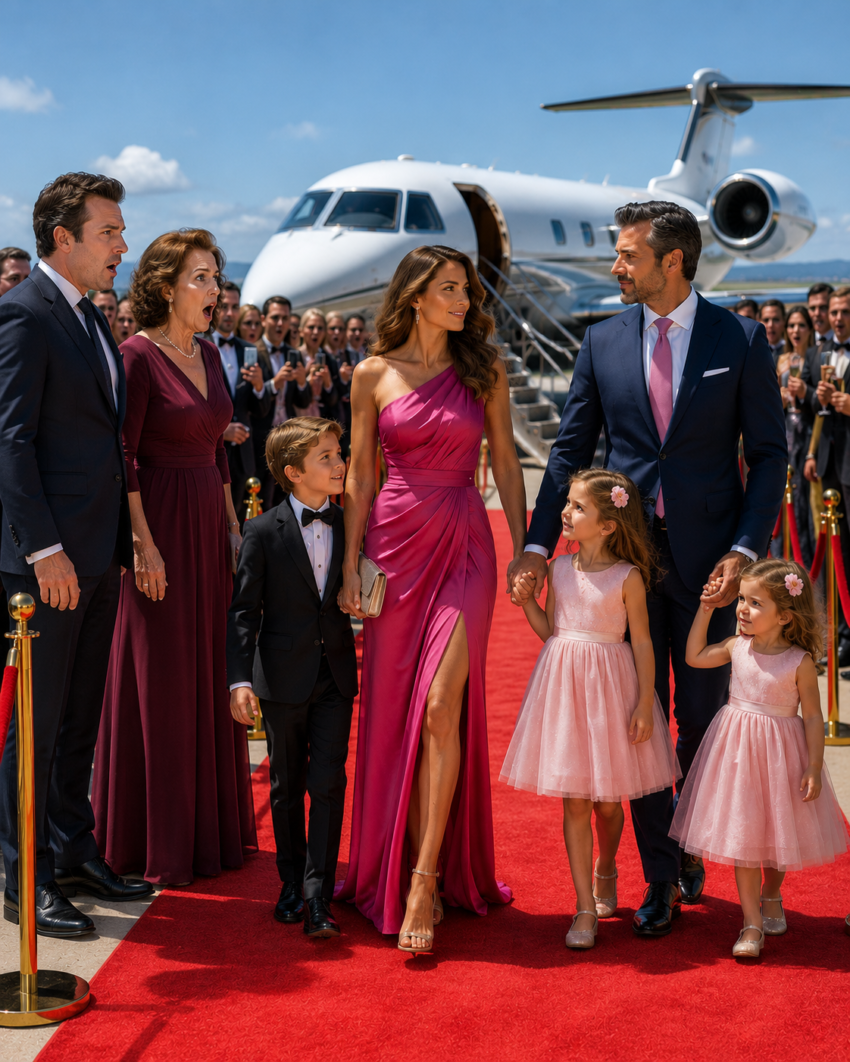
Then the low sound of helicopter blades rolled across the property.
Conversations stopped.
A sleek black helicopter descended onto the private field beyond the gardens. When the door opened, Mallory stepped out wearing a deep sapphire dress with hand-stitched silver details along the sleeves.
She looked calm, elegant, and completely at ease.
A tall man followed her. Several guests recognized him immediately as Everett Whitcomb, founder of Whitcomb Heritage Design, one of the most respected restoration and luxury craft companies in the country.
Three children climbed out behind them.
Two boys ran toward Mallory and wrapped their arms around her waist. A little girl reached for Everett’s hand before looking toward the glowing estate with wide, excited eyes.
Brooks’s smile disappeared.
Dorothea gripped the edge of the table beside her.
Neither of them understood that the woman they had once sent away with a single suitcase had returned with a life they could no longer dismiss.
The Dinner That Ended a Marriage
Seven years earlier, Mallory had prepared Brooks’s favorite meal in their home in Atlanta.
She had lit candles, set out the good dishes, and placed fresh flowers in the center of the dining table. She knew he had been distant for weeks, but she still hoped they could speak honestly.
They had been married for nearly six years.
For most of that time, they had hoped to become parents.
Mallory had repeatedly suggested that they both see a specialist. Brooks always refused.
“I don’t need a doctor to tell me what is obvious,” he would say.
Whenever she asked what he meant, he changed the subject.
Dorothea made the situation worse. At every family gathering, she shared photographs of other people’s babies, discussed nursery designs, and asked Mallory how much longer she intended to make Brooks wait.
Brooks never defended his wife.
He usually looked down at his phone or quietly left the room.
Mallory had given up a promising position at her grandmother’s restoration studio to support Brooks as he expanded Halstead Medical Supply across several states. She traveled with him, hosted business dinners, and attended events where she smiled until her cheeks hurt.
She believed marriage required sacrifice.
She did not realize that only one person in the marriage was expected to keep sacrificing.
That evening, Dorothea arrived without being invited.
Mallory knew something had already been decided.
After dinner, Brooks placed his napkin on the table and stared at the wall behind her.
“I want a divorce.”
Mallory slowly lowered her glass.
“Then look at me and say it.”
Brooks finally met her eyes.
“I want a divorce. I’ve waited long enough to have a real family.”
The words left Mallory unable to speak for several seconds.
“We could still get answers,” she said. “We could both be tested.”
“There is nothing wrong with me.”
Dorothea leaned back in her chair.
“My son deserves a woman who can give him children and carry on the family name.”
Mallory felt as though the room had grown smaller around her.
Still, she did not shout.
She simply asked the question she had asked many times before.
“Brooks, have you ever had a medical evaluation?”
He said nothing.
That silence told her everything.
One Suitcase in the Rain
Mallory packed one suitcase that night.
She left behind the jewelry Brooks had given her, the expensive coats Dorothea had chosen, and most of the furniture she had helped select.
She packed simple clothes, sketchbooks, restoration notes, and an old hand-painted fan that had belonged to her grandmother, Beatrice Keene.
Beatrice had spent her life repairing decorative boxes, antique fans, carved frames, and delicate wooden pieces in a small studio near Savannah.
On one wooden rib of the fan, she had painted a tiny live oak tree.
As Mallory closed it, the rough edge caught her finger.
She remembered her grandmother’s favorite saying.
“Beautiful work never comes from rushing what needs patience.”
Outside, rain covered the front steps.
Brooks did not help her carry the suitcase.
Dorothea stood in the hallway with her arms crossed.
“This is best for everyone,” she said.
Mallory turned back once.
“No. This is simply easier for you.”
She walked into the rain and did not look back again.
Before sunrise, Dorothea instructed the household staff to change the security codes.
By then, Mallory was asleep on the sofa in her closest friend’s apartment, unaware that Brooks was already signing papers designed to remove her from every part of his life.
The Truth She Should Have Heard Years Earlier
Mallory’s friend, Harper Sloan, refused to let her disappear into shame.
Harper scheduled an appointment with Dr. Wesley Grant, a respected specialist in Savannah.
Mallory almost canceled.
For years, she had been told that her body had failed, that she had disappointed her husband, and that she had somehow prevented the Halstead family from having the future it deserved.
The doctor reviewed her examination and laboratory results carefully.
Then he looked at her with a seriousness that made her hold her breath.
“Your results are normal.”
Mallory stared at him.
“What does that mean?”
“It means there is no clear reason you could not become a mother.”
Her eyes filled with tears.
“Are you certain?”
“Yes. Fertility concerns should be evaluated as a couple. You should never have carried the blame alone.”
Mallory did not cry because she was happy.
She cried because six years of shame suddenly had nowhere to stand.
For the first time, she understood that she had been judged without evidence.
Brooks had allowed her to believe she was the problem because he was too afraid to discover the truth about himself.
Returning to the Work She Loved
A week later, Harper brought Mallory to a small design gallery in downtown Savannah.
In the front window sat a damaged nineteenth-century fan. Its silk was faded, two wooden ribs were cracked, and most of the painted scene had nearly disappeared.
Harper pointed toward it.
“You used to know how to repair things like that.”
“That was a long time ago.”
“Your hands didn’t forget.”
A small card beside the fan announced that Whitcomb Heritage Design was looking for an assistant conservator.
Mallory applied.
At the interview, Cora Whitcomb, the company’s senior director, placed an even more damaged fan on the table.
“Everyone else has told me this piece cannot be saved,” Cora said. “What do you think?”
Mallory examined it without touching the fragile silk.
“It can be saved, but not if someone tries to make it look new.”
Cora raised an eyebrow.
“Explain.”
“The age is part of its story. The goal should be to strengthen it, recover what can be recovered, and preserve the marks that belong there.”
Cora smiled.
“When can you start?”
Mallory joined the company on a three-month trial contract.
Some employees doubted her because she did not have an advanced university degree in conservation. However, she had something equally valuable: years of practical knowledge passed down through her grandmother.
She could identify wood by scent and grain. She understood traditional adhesives, natural pigments, hand-painted fabrics, and the difference between repairing an object and erasing its history.
She also shared what she knew.
Mallory trained younger employees, wrote detailed restoration notes, and treated every damaged piece with dignity.
Cora’s son, Everett, first noticed her work after she restored the fan used during her interview.
“Who repaired this?” he asked.
Cora looked toward Mallory’s worktable.
“A woman who understands the value of what careless people throw away.”
A Love That Did Not Ask Her to Shrink
Everett did not immediately pursue Mallory.
He respected her work first.
He visited the studio to discuss exhibitions, preservation programs, and partnerships with community artists. When Mallory spoke, he listened without interrupting.
He never laughed at her ideas.
He never described her work as a hobby.
One evening, after a long day preparing pieces for a museum exhibition, Everett found her alone at the studio.
“You know you don’t have to finish everything tonight,” he said.
“I’m used to proving that I deserve to be in the room.”
Everett pulled out a chair but did not sit too close.
“You don’t have to prove that here.”
Mallory looked at him carefully.
“People often say that before they begin asking you to become someone else.”
“Then judge me by what I do, not by what I promise.”
That was how their relationship began.
Slowly.
Honestly.
Without pressure.
A year later, they married in Beatrice’s old garden near Savannah.
Their first child, Sadie, entered their lives through a family adoption. Her mother had been a young craftswoman who became seriously ill, and her elderly aunt could not raise a toddler alone.
Mallory and Everett welcomed Sadie with the full support of her relatives.
Two years later, after a straightforward treatment plan, Mallory gave birth to twin sons, Nolan and Bryce.
Their family did not look exactly like the one Mallory had once imagined.
It was better because it had been built with patience, truth, and choice.
Brooks Finally Faced the Truth
After the divorce, Brooks married a business consultant named Jocelyn Vale.
Dorothea approved of her immediately. Jocelyn came from a prominent family, dressed perfectly for every event, and understood how to impress investors.
When they decided to have children, Jocelyn insisted that they both complete medical evaluations.
Brooks agreed only because he wanted to prove that nothing was wrong with him.
The results left him shaken.
The doctor explained that Brooks had a long-standing condition that significantly reduced the likelihood of becoming a father without assistance.
He sat in the parking lot for nearly an hour, reading the report again and again.
He remembered Mallory asking him to attend an appointment.
He remembered her crying in the guest room after Dorothea compared her to another pregnant relative.
Most of all, he remembered remaining silent.
When Jocelyn found the medical report, she confronted him.
“Did your first wife know?”
“No.”
“Did you blame her anyway?”
Brooks looked away.
Jocelyn’s expression changed.
“Then the diagnosis is not the worst part of this story.”
Their marriage ended within a year.
Soon afterward, Halstead Medical Supply began losing major contracts. Brooks’s reputation weakened, and he became increasingly desperate to appear successful.
He organized a charity gala at his family estate, announcing that it would support the preservation of traditional American crafts.
Then he invited Mallory.
He was not planning to apologize.
He wanted to show everyone that she had failed without him.
The Guest of Honor
When Mallory entered the estate with Everett and the children, Brooks finally forced himself to approach them.
“Mallory.”
She stopped.
“Brooks.”
He glanced at Everett and then at the children.
“I didn’t know you would bring guests.”
“Your invitation said family members were welcome.”
Dorothea stepped closer.
“Family members?”
Mallory rested her hand gently on Sadie’s shoulder.
“My husband and our children.”
A quiet wave of whispers moved through the nearby crowd.
Dorothea looked at the twins.
“Those boys are yours?”
“All three children are ours,” Mallory replied.
Brooks lowered his voice.
“We should speak privately.”
Mallory held his gaze.
“You invited me publicly.”
Before Brooks could respond, the master of ceremonies walked onto the stage.
She announced that the evening’s featured honoree had helped restore more than four hundred historic pieces, established training centers for young artisans across Georgia and South Carolina, and created scholarship programs for women returning to the workforce.
Then she introduced Mallory Keene Whitcomb, artistic director of Whitcomb Heritage Design.
The guests rose in applause.
Brooks stood motionless.
On the large screens behind the stage appeared images of restored studios, museum exhibitions, community classrooms, and young artists learning traditional skills.
Mallory had built an entire career from the work Brooks once called unimportant.
The Speech No One Forgot
Mallory accepted the award and looked across the crowd.
For a brief moment, she saw the old version of herself standing in the rain with one suitcase.
Then she began.
“My grandmother taught me that restoration is not about hiding every crack. It is about making sure the damage does not become the end of the story.”
The audience grew silent.
“For a long time, I believed being a good wife meant accepting blame quietly. I thought loyalty required me to become smaller whenever someone else felt uncomfortable.”
Brooks lowered his eyes.
“I eventually learned that love without respect is only another form of loneliness. I also learned that beginning again does not mean you failed. Sometimes it means you finally stopped abandoning yourself.”
Dorothea’s face tightened.
Mallory continued.
“Tonight, I dedicate this honor to every person who has been told they were not enough without ever being given the truth. I dedicate it to those who left with very little but carried their dignity with them. And I dedicate it to the people who patiently helped them open their lives again.”
The applause lasted nearly a minute.
The event Brooks had arranged to restore his own image became a celebration of the woman he had underestimated.
The Old Fan
Later that evening, Brooks found Mallory near the garden fountain.
The children were playing beneath the live oak trees while Everett spoke with several museum directors nearby.
“Are the twins biologically yours?” Brooks asked.
Mallory looked at him with disbelief.
“That is the first question you chose?”
He immediately regretted it.
“I’m sorry. I just don’t understand.”
“Sadie joined our family through adoption. Nolan and Bryce were born after a simple treatment plan.”
Brooks took a slow breath.
“I finally went to a doctor.”
Mallory said nothing.
“The problem was mine.”
“The medical condition may have been yours,” she replied. “But blaming me without answers was a choice.”
He looked toward the children.
“Were you ever going to come back?”
“At first, I wanted you to call. Then I realized I was waiting for the person who hurt me to decide whether I deserved peace.”
“I am sorry.”
Mallory’s expression softened, but she did not move closer.
“I forgive you, Brooks. But forgiveness does not rebuild a marriage that was never protected.”
Dorothea approached them.
“Mallory, we should discuss this as a family.”
Mallory turned toward her.
“You made it clear years ago that I was not part of your family.”
“I was worried about my son’s future.”
“You changed the locks while I was outside in the rain.”
Dorothea looked down.
“A mother does what she believes is necessary.”
Mallory watched Sadie laughing with her brothers.
“Being a mother has taught me the opposite. I would never teach my children to protect themselves by humiliating someone else.”
Dorothea had no answer.
The Life She Chose
Sadie ran toward Mallory holding a small painted fan from one of the exhibition tables.
“Mom, look! It has a tree like Grandma Beatrice’s.”
Mallory opened the fan.
A tiny live oak had been painted near the edge.
She smiled and took the old fan from her handbag. She had carried it with her for years, not as a reminder of Brooks, but as proof of where she came from.
“This fan survived because someone believed it was worth repairing,” she told Sadie.
The little girl touched the painted tree.
“Like people?”
Mallory looked at Everett, who had come to stand beside them.
“Sometimes,” she said. “But people are not objects. We do not need someone else to restore us. We need the courage to believe our lives can still open.”
Before leaving, Mallory faced Brooks one last time.
“Your invitation said tonight was about second chances. Use yours to become more honest, not to reclaim what you chose to lose.”
She took Everett’s hand and walked toward the helicopter with their children.
Brooks remained in the garden as the aircraft rose into the night.
No one had needed to humiliate him.
The truth had done enough.
What Happened After the Gala
Several weeks later, Brooks stepped down from his position as chief executive and began working with a counselor.
He funded medical evaluations for couples who could not afford them, but he did so quietly, without attaching his name to the program.
He understood that one good decision could not erase years of harm.
Still, regret without change would have been nothing more than another performance.
Dorothea eventually sent Mallory a handwritten letter.
Mallory read it once, then placed it inside a drawer.
She did not respond.
Some apologies arrive too late to repair a relationship, but they can still become the beginning of accountability for the person who offers them.
Mallory continued leading Whitcomb Heritage Design.
She opened new training studios in Savannah, Asheville, and Charleston. Above the entrance of each one, she placed her grandmother’s words:
“Beautiful work never comes from rushing what needs patience.”
Years later, Mallory stood beside the old painted fan during an exhibition at the Smithsonian American Art Museum.
Sadie explained its history to visitors while Nolan and Bryce handed out paper fans painted by students from the community studios.
Everett joined Mallory near the display.
“What are you thinking about?”
“The woman who left Atlanta with one suitcase and believed she had lost everything.”
“What would you tell her now?”
Mallory smiled.
“I would tell her she was not losing her life. She was finally making room for it.”
Everett kissed her forehead.
Mallory looked at the old fan behind the glass.
Its cracks were still visible.
Its colors were not as bright as they had once been.
Yet it opened smoothly, proudly, beautifully.
Just like her.
A person’s worth should never be measured by their ability to meet someone else’s expectations, especially when those expectations are built on fear, pride, or assumptions rather than truth.
When someone repeatedly asks you to become smaller so they can remain comfortable, leaving may not mean that you failed them; it may mean you finally decided not to fail yourself.
Real love does not demand silent sacrifice from one person while allowing the other to avoid responsibility, because a healthy relationship requires honesty, courage, respect, and equal effort from both sides.
Being blamed for something without evidence can slowly change the way you see yourself, which is why learning the truth may become the first step toward recovering the confidence another person tried to take away.
Starting again with very little can feel frightening, but dignity, knowledge, kindness, and determination are often more valuable than the possessions left behind in a place where you were never truly respected.
Forgiveness can free your heart from bitterness, but it does not require you to reopen a door that someone repeatedly closed through neglect, silence, or humiliation.
The right partner will not ask you to abandon your talents, lower your voice, or hide your strength; they will stand beside you while you become more fully yourself.
Regret only becomes meaningful when it produces lasting change, because apologies without responsibility can easily become another way of asking the injured person to carry the burden.
The cracks in your past do not make your life less beautiful, because healing is not about pretending nothing happened; it is about refusing to let what happened decide everything that comes next.
Sometimes the life you once begged to preserve must end so that a more honest, peaceful, and loving life can finally begin, and one day you may look back and realize that walking away was not your greatest loss but your first true victory.