The Night A Biker Built A Safe Corner
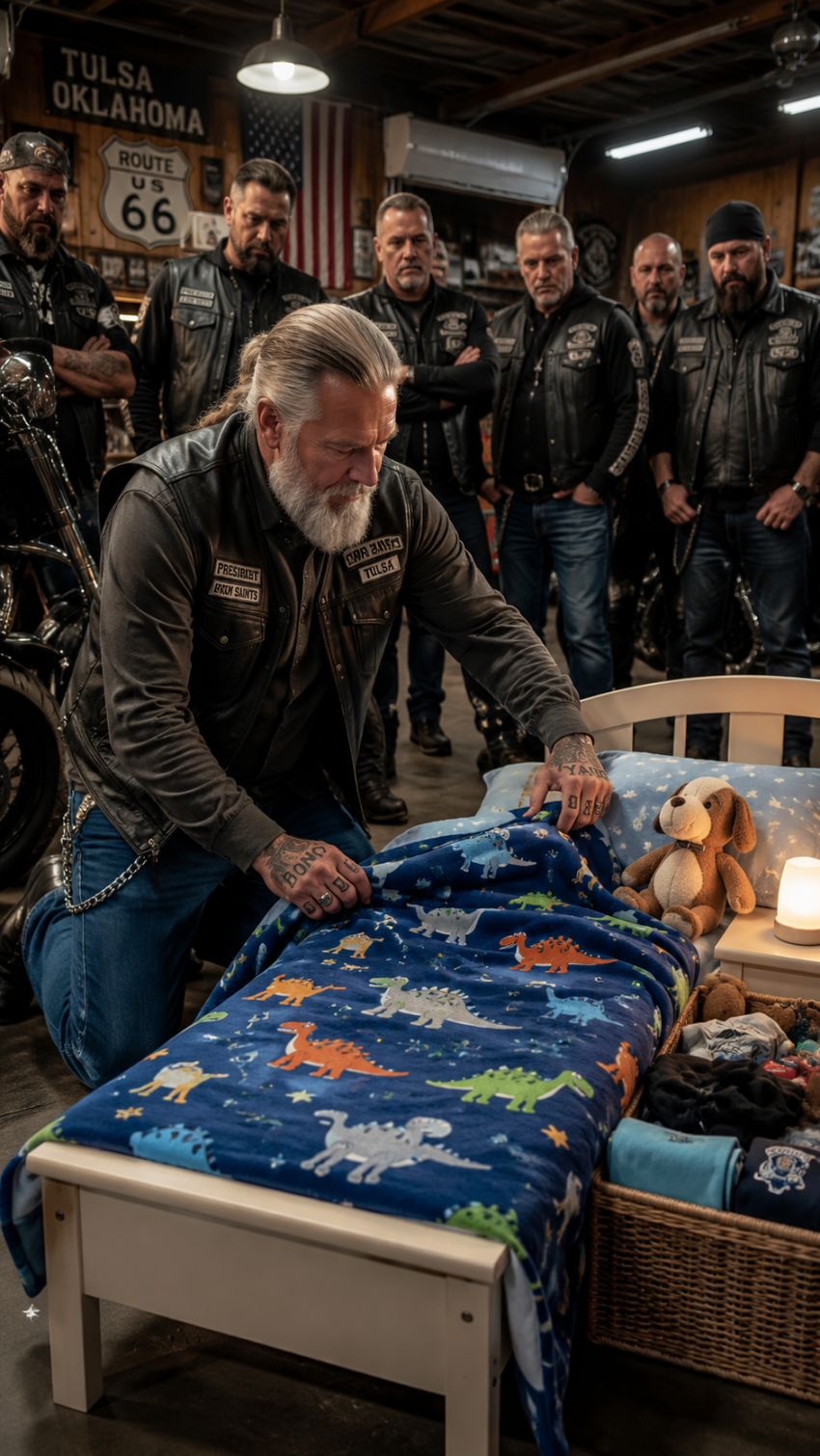
At midnight, inside a small motorcycle garage outside Tulsa, Oklahoma, a man everyone feared was kneeling beside a child’s bed.
His name was Howard “Hawk” Brennan.
He was sixty years old, broad-shouldered, gray-bearded, and quiet in a way that made people move carefully around him. Across both of his hands were old tattoos faded by years of sun, grease, and highway dust. His leather vest carried decades of patches, charity rides, memorial runs, and one small patch sewn on the inside where almost no one could see it.
A little white porch light.
Nobody in the club knew what it meant.
That night, six bikers stood behind him in complete silence while Hawk tucked a green blanket around a small pillow shaped like a turtle.
The garage usually smelled like motor oil, old coffee, leather, and rain-soaked boots. It was a place for tools, engines, hard laughter, and men who did not talk much about feelings.
But now there was a real child’s bed in the back corner.
White frame. Clean sheets. A tiny lamp. A basket of socks, hoodies, toothbrushes, coloring books, and stuffed animals.
Mason Pike, the club’s loudest member, finally cleared his throat.
“Hawk… is there something you forgot to tell us?”
Hawk kept smoothing the blanket.
“No.”
A younger rider named Colby tried to laugh.
“Looks like somebody’s getting ready to be a grandfather.”
Hawk looked over his shoulder once.
Colby stopped smiling.
I was standing near the door with two trays of leftover pot roast from my diner. My name is Elaine Porter, and I had served those men coffee for nearly fifteen years. I knew they looked rough. I knew people crossed the street when their motorcycles pulled in.
But I also knew Hawk.
He always paid for strangers who were short on cash. He fixed flat tires without waiting for thanks. He once sat quietly for twenty minutes beside a lost little boy outside my diner until the child’s mother came back from the restroom.
Still, even I did not understand the bed.
Then Hawk reached inside his vest and pulled out a small silver key tied to a strip of faded green cloth.
He placed it in my palm.
“If a child comes here and I’m not around,” he said, “open that cabinet.”
I looked at the locked cabinet beside the bed.
“What child?”
For a long moment, he said nothing.
Then he looked at the little lamp beside the bed.
“The kind who needs one door to open.”
The Boy At The Garage Door
Two nights later, the answer arrived in the back seat of a police car.
It was close to 11:30 when Hawk called me.
“Elaine,” he said quietly, “bring warm food. Something soft.”
That was all.
When I crossed the street from my diner, I saw blue and red lights flashing against the garage wall. A Tulsa County deputy stood near the open bay door with tired eyes and a folder in his hand.
Beside him stood a small boy.
He looked about seven years old. His brown hair was messy, his pajama shirt was too thin for the night air, and he held a striped pillow against his chest like it was the only thing he owned. There was a faint red mark on one cheek, but the worse thing was his silence.
He did not cry.
He did not ask where he was.
He only watched every hand in the room.
Hawk stood near the bed, but not too close. His hands were open at his sides. His voice was lower than I had ever heard it.
“My name’s Hawk.”
The boy stared at him.
“That’s a bird name.”
For the first time that night, Hawk almost smiled.
“Yeah. I guess it is.”
The deputy spoke softly to me.
The boy’s name was Owen. His mother had been taken to the hospital after a serious family emergency. There were no relatives answering. The children’s shelter nearby was full for the night. Hawk had already arranged with the local department to let the garage serve as a short emergency rest stop when no safe place was ready yet.
Mason stared at Hawk.
“You did paperwork for this?”
Hawk did not look at him.
“Enough.”
Colby whispered, “We passed background checks?”
Hawk gave him one dry look.
“Barely.”
No one laughed loudly. Not with Owen standing there.
Hawk slowly sat on the concrete floor, about eight feet from the bed.
“You don’t have to sleep,” he told the boy. “You don’t have to talk. You don’t have to explain anything. If you want soup, Elaine brought some. If you want the bed, it’s yours. If you want the floor, that’s fine too.”
Owen looked at the bed for a long time.
Then he asked, “Will you turn the light off?”
Something changed in Hawk’s face.
His jaw tightened. His eyes lowered. For a second, the toughest man in that garage looked like he had been pulled backward into another lifetime.
Then he shook his head.
“No, son. Not unless you ask me to.”
Owen held his pillow tighter.
Hawk’s voice became softer.
“Here, the light stays on until you’re ready.”
The Picture Inside The Cabinet
Owen fell asleep after midnight, still wearing his sneakers.
Hawk stayed seated on the floor where the boy could see him if he woke up. Mason kept watch near the door. Colby sat by the workbench with a paper cup of coffee he never drank. Another older biker named Russell stood near the window and pretended the cold air was bothering his eyes.
Around two in the morning, Owen woke up suddenly.
He did not scream. He simply opened his eyes and looked around fast, as if checking whether the room had changed while he slept.
When he saw the lamp still glowing, his shoulders lowered a little.
“I’m thirsty,” he whispered.
I brought him water.
After a few sips, he looked at the cabinet.
“What’s in there?”
Hawk nodded toward the key in my hand.
“Things kids might need.”
Owen asked, “Like cookies?”
Colby stood up immediately.
“I can go get cookies.”
Hawk raised one hand.
“Cabinet first.”
I unlocked it.
Inside were clean clothes, snacks, water bottles, children’s toothpaste, little flashlights, soft blankets, and several stuffed dogs. But taped to the inside of the cabinet door was an old photograph.
It showed a boy sitting in the cab of a pickup truck.
He was maybe eight. His knees were pulled to his chest. His hair was uneven. His shirt was too thin. In his lap was a pillow with a green stripe.
The same color as the cloth tied to Hawk’s key.
The garage went completely still.
Owen looked at the picture.
Then he looked at Hawk.
“Is that you?”
Hawk closed his eyes for one second.
“Yeah.”
Mason whispered, “Hawk…”
But Hawk shook his head.
Not because he was angry.
Because the story hurt.
Still, Owen kept looking at the picture in a way only a frightened child could understand. He recognized the folded shoulders. The guarded hands. The way a child tries to make himself smaller when the world feels too loud.
“Why were you in a truck?” Owen asked.
Hawk sat back down slowly.
“Because I knocked on a door once,” he said. “And nobody opened it.”
The Door That Never Opened
The story came out in small pieces.
Hawk had grown up outside Amarillo, Texas, in a small rental house near a two-lane road. His mother worked long shifts. The adults around him were not always safe. Neighbors heard things, teachers noticed too late, and one cold night, when Hawk was still just Raymond Brennan, he ran to a house with a bright white porch light.
He knocked.
A woman looked through the curtain.
She saw him.
He knew she saw him.
Then the porch light went dark.
He spent that night inside an old pickup behind a feed store with only a striped pillow and a thin jacket. The next morning, adults sent him back to the same place he had tried to escape.
Hawk did not tell us everything.
He did not have to.
The small porch-light patch inside his vest suddenly made sense.
The green cloth on the key made sense.
The bed made sense.
The lamp made sense.
Mason looked down at the concrete. Russell turned away. Colby wiped his face with his sleeve and pretended it was dust.
Then Hawk looked at his brothers.
“I built this because one night can follow a kid for the rest of his life.”
No one spoke.
He continued.
“I can’t fix every home. I can’t change what happened to me. But if one child needs a safe corner for a few hours, this place can be that corner.”
Mason slowly removed his leather vest and folded it over his arm.
“You should have told us.”
Hawk looked at him.
“I wasn’t sure you’d say yes.”
That hurt more than anger would have.
Because everyone knew it might have been true.
The club had always talked about loyalty. They had stood together in storms, funerals, hospital rooms, and hard seasons. But this was different. This asked them to be gentle. This asked them to lower their voices, clean their hands, and protect something small without needing praise for it.
Mason placed his vest on the floor near the bed.
“Then don’t let us fail the next child.”
One by one, the others did the same.
Not as a show.
As a promise.
Hawk looked at the leather vests on the concrete. His eyes shone, but he did not cry.
He only touched the faded green cloth tied to the key.
“Then we do it right.”
The Rules Of The Safe Corner
By sunrise, Owen’s mother was stable and asking for him.
When the caseworker arrived, she looked first at the motorcycles, then at the men, then at the small bed in the corner. I could see her trying to decide whether this garage could truly be safe.
Hawk did not try to charm her.
He simply handed her a folder.
Fire inspection. Emergency contacts. Clean bedding checklist. Food inventory. Approved adults. Shelter agreement. Police contact information.
The caseworker looked surprised.
“You keep a sheet log?”
Hawk shrugged.
“Kids deserve clean sheets.”
Owen did not want to leave at first.
He sat on the edge of the bed, holding the stuffed dog Hawk had given him.
“What if I have to come back?” he asked.
Hawk lowered himself to one knee, slowly, carefully.
“Then the bed stays here.”
“Promise?”
Hawk did not answer too quickly. He seemed to understand that promises could become heavy things for children.
Finally, he said, “I promise the bed stays.”
Owen nodded.
Then he walked over and hugged Hawk’s arm.
Not his chest. Not his waist. Just his arm.
Hawk froze, letting the boy decide when the hug began and when it ended. His hand lifted slightly, then lowered again. He did not touch Owen without permission.
That quiet respect broke my heart more than any speech could have.
After Owen left, the garage felt empty.
The blanket was wrinkled. A small sneaker mark was on the bed frame. The soup bowl sat half-finished on the workbench.
Nobody rushed to clean it.
Later that day, the bikers held a meeting.
No beer. No loud jokes. No engines roaring outside.
They made rules.
No drinking in the garage if a child was there.
No raised voices.
No sudden motorcycle starts after dark unless the child was warned first.
No touching unless the child reached out first.
No questions about home unless a caseworker or officer needed answers.
No pictures.
No posts.
No using kindness to make themselves look good.
Hawk wrote the rules down and taped them inside the cabinet.
Then he moved his old photograph lower, where a child could see it.
Beside it, he added a note in large block letters:
YOU ARE NOT THE FIRST.
YOU ARE NOT ALONE.
YOU DO NOT HAVE TO TALK.
When I asked him why he wanted children to see the picture, he wiped his hands on a clean rag and said, “Because when I was small, I thought I was the only one.”
The Light That Stayed On
Over time, the bed became part of the garage.
Not a big public project. Not something the bikers bragged about. Just a quiet safe corner known by the right people: police officers, shelter workers, nurses, school counselors, and sometimes desperate parents who needed one night to breathe.
Some nights no one came.
Hawk still checked the lamp.
He checked the lock.
He counted the socks, snacks, water bottles, hoodies, and toothbrushes.
Then he sat on the floor near the bed, hands open on his knees, waiting without complaint.
The club changed around that bed.
Mason learned how to heat soup without making a mess. Colby kept a list of favorite snacks. Russell installed better curtains so the corner felt private but not closed in. Elaine’s Diner became the emergency food contact, and I never once charged them for soup.
Owen came back two months later with his mother.
She stood near the door, nervous around the bikers, but Owen walked straight to the bed and looked at the stuffed dog still waiting there.
“You kept it,” he said.
Hawk nodded.
“Told you I would.”
Owen’s mother started crying quietly.
Hawk stepped back and gave her space.
That was what he did best.
He made room, then guarded the edges.
Years passed.
The bed held many children for many different reasons. Some stayed for one hour. Some stayed until morning. One teenage boy slept on the floor because beds made him nervous, so Hawk slept on the floor too, even though his knee bothered him badly.
The bikers never told those stories outside the garage.
They protected the children’s privacy as carefully as they protected the door.
Hawk is older now. His beard is almost white. His motorcycle takes longer to start on cold mornings. But every night, if you pass that small garage outside Tulsa, you might still see a soft lamp glowing in the back corner.
The motorcycles are still there.
The leather jackets are still there.
The men still look like the kind of men people judge too quickly.
But beside the tools and oil stains, there is a child’s bed with clean sheets.
And above it, the light stays on.
Because one man remembered what it felt like to stand outside a closed door.
And he decided that no child who came to him would ever have to wonder if someone saw them.
Sometimes the strongest people are not the ones who speak the loudest, but the ones who remember their own pain and quietly build a safer place for someone else.
A small act of kindness may look simple from the outside, but to a frightened child, one clean bed, one warm meal, and one gentle voice can feel like the whole world changing shape.
Not every hero wears a polished suit or stands in a perfect room; some heroes have grease on their hands, scars in their hearts, and enough love left to protect what is fragile.
When someone has been failed by the world, choosing to become a safe person for others is one of the bravest ways to heal.
A child does not always need a perfect answer in a hard moment; sometimes they only need a light that stays on and an adult who does not walk away.
True brotherhood is not only about standing together when life is loud, but also about learning how to be gentle when someone small and scared enters the room.
The past cannot be erased, but it can be transformed into shelter, patience, wisdom, and a promise that another child will not face the same night alone.
Kindness becomes more powerful when it is quiet, private, and given without asking for attention, applause, or praise.
One open door can change the story of a child who has been turned away too many times.
And sometimes, the person everyone fears is the very person who understands fear deeply enough to protect others from it.