PART3:
They ordered biscuits and gravy.
Black coffee.
Short stacks.
Bacon crisp.
Eggs over easy.
Pie, if Connie had not sold out by noon.
They left cash tips that made my mother’s Sundays worth working, even on mornings when she leaned against the counter when she thought no one could see because her feet already hurt before breakfast rush had finished.
I grew up watching them the way some children watch wild animals on television.
Fascinated.
A little afraid.
Certain there were rules I did not know.
The biggest one scared me most when I was small.
Gus Tanner.
He sat in the same booth by the front window every Sunday.
Seventy-one years old.
Built like somebody had poured him out of iron and only softened the edges after his beard turned silver.
He had shoulders too wide for the booth, hands broad enough to cover a dinner plate, and a voice that seemed to come from somewhere down near his boots.
A scar cut through his left eyebrow.
Reading glasses lived in his breast pocket, though I never saw him use them until much later.
His leather vest carried patches over his heart that made some customers lower their voices and others raise theirs too much.
Gus always ordered the same thing.
Black coffee.
Two eggs.
Bacon.
One biscuit.
No jam.
He always left a folded ten-dollar bill under his cup, even when the check was six dollars even.
I knew because I watched.
I watched everything.
Gus was the first one in that chapter who noticed I colored quietly instead of playing.
When I was five, he slid a paper placemat and a cup of crayons toward the edge of his table without saying a word.
I took them without looking directly at him.
After that, every Sunday, a placemat and crayons appeared near his booth.
He remembered my name before most regular customers did.
“Morning, Ruby,” he would say in that deep voice.
“Morning,” I would whisper, and then hide behind my coloring book like I had done something brave enough for one day.
I never really spoke to him.
Not more than thank you.
Not until the flyer.
The flyer came home from Meadowlark Elementary on a Thursday afternoon, folded crooked in my backpack between a math worksheet and a drawing of a horse with legs that bent wrong.
Family Heritage Day.
Friday, October 9th.
Bring a family member to share your story.
Parents, grandparents, aunts, uncles, and special family friends welcome.
I read it eleven times before Sunday.
I read it at the kitchen table while my mother counted tips.
I read it in bed with the lamp still on.
I read it in the bathroom while brushing my teeth because sometimes words hurt differently depending on where you stand.
Bring a family member.
I knew my mother could not simply leave a lunch shift at the Foothills without risking the job that kept lights on at the house on Val Vista Road.
I knew my grandmother in Ohio had not called since the funeral and was not going to fly out for a school project.
I knew my father was not coming.
Not that day.
Not any day.
I had mostly made peace with that in the practical way children sometimes do when grief becomes part of the furniture.
You do not stop missing someone.
You just learn where the missing sits so you do not trip over it every hour.
But Family Heritage Day put the missing right in the middle of my desk.
My classmates talked about who they were bringing.
Tyler Lindquist was bringing his father, who owned two trucks and a boat.
Emma Price was bringing her grandmother, who had lived in Germany and made cookies shaped like stars.
Mason Bell was bringing his uncle, a firefighter.
I said nothing.
On Sunday, the diner filled the way it always did after the chapter ride.
Motorcycles lined up along the curb in a row so long they stretched past the hardware store.
The glass rattled once when a late rider pulled in.
Connie shouted for more bacon.
My mother moved between tables with a coffee pot in one hand and a smile she had learned to keep balanced no matter how tired she was.
I sat in the back booth with my math worksheet.
The flyer lay on top.
I looked at it more than the numbers.
Gus Tanner sat by the window, folding his newspaper.
My mother topped off his coffee with the exhausted automatic warmth she gave regulars who did not make her life harder than it had to be.
Down the long table, leather-clad men laughed at something Connie said from behind the counter.
Cal Rutledge, the sergeant-at-arms, had a laugh big enough to fill the whole diner.
Dwayne Cross, the road captain, was telling a story with both hands.
Men with tattoos and beards and road-worn faces passed sugar, hot sauce, and napkins like uncles at a crowded family table.
Family.
The word did something inside me.
Not all at once.
More like it had been quietly building for fourteen months out of loneliness, stubbornness, and the particular bravery only children possess—the kind that has not yet learned every reason not to try.
I slid out of the booth before I fully decided to move.
My mother was at the register.
She did not see me until I was halfway across the floor.
Conversation faded as I walked.
Not because anyone knew what I was about to do.
Because a child walking alone toward a table full of Hells Angels will make even a diner hold its breath.
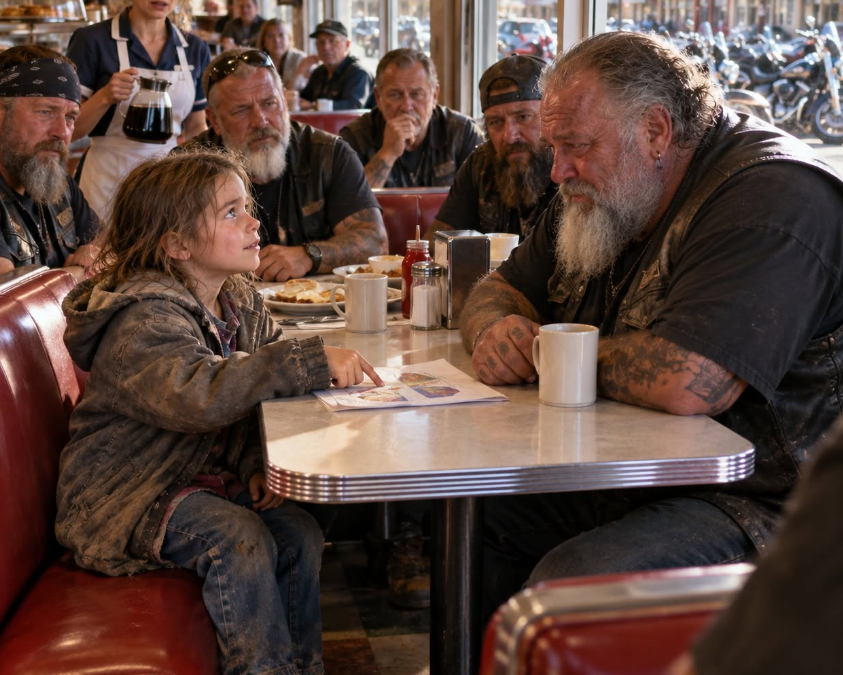
I climbed onto the red vinyl bench across from Gus Tanner without being invited.
The seat stuck to the backs of my legs.
My hands were cold.
I placed the flyer on the table in front of three hundred pounds of leather and silence.
Gus looked at it.
Then at me.
His reading glasses stayed in his pocket.
“Can you be my family?” I asked.
My voice sounded small, but it did not break.
“Just for one day?”
The diner went quiet enough to hear the coffee machine ticking.
For three full seconds, nobody at that table moved.
Dwayne Cross set his coffee cup down without a sound.
Cal Rutledge stopped smiling.
My mother froze by the register with the coffee pot going cold in her hand.
Before anyone spoke, I already knew I had done something larger than I meant to do.
That is another thing children learn too late.
A true question is sometimes heavier than a grown-up can lift quickly.
Gus Tanner finally leaned forward.
When he spoke, his enormous voice had gone soft in a way I had never heard.
“Say that again.”
My courage wavered.
From across the diner, I could feel my mother’s mortification moving toward me like weather.
I could feel every adult face turned in our direction.
I could see the scar through Gus’s eyebrow and the tiny scratches on his coffee cup.
I pushed the flyer another inch toward him.
“It’s Family Day at my school. Friday, October 9th. You’re supposed to bring somebody.” I looked down at the paper. “I don’t have anybody who isn’t working.”
My mother reached the booth in four long strides.
“Ruby, honey,” she said, too bright and too breathless, “these gentlemen are trying to have breakfast.”
“It’s all right,” Gus said.
Something about the way he said it made my mother stop apologizing.
He looked at me again.
Not like I was cute.
Not like I was embarrassing.
Like I had asked a serious question and deserved the dignity of a serious answer.
“You’re asking the club,” he said, “not just me.”
I nodded.
“That’s a big ask.”
“I know.”
“You know what people in this town think when they see us.”
“I know.”
“And you still came over here?”
I swallowed.
“I don’t think that.”
Cal laughed first.
Not meanly.
It broke something loose at the table.
Within a minute, half the Big Horn chapter had leaned in to look at the flyer like it was a map to a place none of them had been before.
“Family Heritage Day,” Dwayne read, squinting. “What exactly are we supposed to do? Wear ties?”
“You don’t own a tie,” Cal said.
“I own one. Court tie.”
“That tie was evidence.”
“Only briefly.”
Someone laughed.
But Gus raised one hand.
The table quieted.
“We’ll talk about it,” he told me. “As a club. That’s how we do things.”
My heart sank a little.
Adults often said we’ll talk when they meant no.
Gus must have seen that.
“I’m not promising what I can’t deliver,” he said. “But I’ll bring it to church Tuesday night.”
I did not know then that church was what the club called its weekly meeting in the back room of a machine shop on the east side of town.
I pictured stained glass.
Maybe a pastor.
Maybe all those men in leather sitting in pews looking uncomfortable.
I only nodded, slid down from the booth, and returned to my math worksheet as if I had not detonated something enormous in the middle of Sunday breakfast.
My mother followed me back.
She crouched beside the booth.
“Ruby.”
“I’m sorry.”
She closed her eyes.
That scared me more than if she had scolded me.
“I know why you asked,” she said quietly.
I stared at the flyer.
“I didn’t want to go alone.”
Her hand came over mine.
“You won’t.”
But I knew she did not know how to keep that promise.
News in Sheridan moved faster than any highway leading out of it.
By Tuesday morning, half of Coffin Avenue had heard some version of what the waitress’s little girl had asked the Hells Angels.
In one version, I had invited the whole club to take over the elementary school.
In another, Gus had threatened the principal.
In one especially creative version, my mother was trying to get free childcare from an outlaw motorcycle gang.
Adults add lies to facts the way children add sprinkles to ice cream.
Too much, and then they call it better.
The version that reached Nadine Coyle, principal of Meadowlark Elementary, arrived by way of a parent’s phone call before first bell.
The parent used the phrase motorcycle gang trying to attend a school function.
That phrase was enough to ruin Principal Coyle’s coffee.
I did not dislike Mrs. Coyle.
That matters to say.
She had been principal for six years.
She wore sensible shoes, kept emergency binders in color-coded order, and took school safety seriously in the specific procedural way of someone who had once called a lockdown over what turned out to be a false alarm and never wanted to feel that fear again.
She did not know Gus Tanner.
She knew the patch on the back of his vest.
She knew the regional news segment from two years earlier about outlaw motorcycle clubs and organized crime in the Mountain West.
It had lasted ninety seconds, which was apparently long enough to outlive every actual conversation she had never had with the men involved.
At the machine shop that Tuesday night, the Big Horn chapter meeting ran two hours longer than usual.
I learned about that later from Gus himself.
He said Dwayne Cross argued first that showing up at an elementary school was a public relations gamble the club did not need.
Not with the county still touchy after the noise ordinance fight.
Not with half the town waiting for them to rev an engine too loud, park in the wrong place, or confirm a fear.
Cal Rutledge argued the opposite.
“A bunch of grown men refusing to show up for a grieving seven-year-old because it might look bad,” he said, “is exactly why half this town thinks we’re heartless.”
The room got loud.
Apparently, motorcycle clubs and second-grade school events generate more debate than you would expect.
Gus let them argue.
That was how he was.
He could sit inside noise without being ruled by it.
Then he stood.
“I’ve buried a wife,” he said.
The room quieted.
“I’ve buried two brothers from this table. I know what it costs when nobody shows up.”
He looked around at men who had ridden through blizzards for each other, shown up at hospitals, funerals, repossessions, courtrooms, roadside breakdowns, bad news, and worse news.
“That little girl asked us for one day,” he said. “We’ve given strangers less for worse reasons.”
The vote was not close.
What Gus did not tell them that night was why my question had cut so deep.
Not then.
Not yet.
On Wednesday, Principal Coyle called my mother into the school office.
My mother had come straight from the diner, uniform smelling faintly of coffee and fryer oil, hair pinned up badly from rushing.
She sat across from Mrs. Coyle with her hands folded, bracing herself the way poor parents do in school offices, because even kindness from authority can feel like a bill you did not expect.
Mrs. Coyle was polite.
She believed she was being careful, responsible, and not unkind.
She explained that the school’s Family Day policy required approved guardians or documented family relationships for any adult attending as a child’s designated family member.
She mentioned liability.
District insurance.
Public reputation.
Safety concerns.
Optics.
Adults love the word optics when they mean fear but want it dressed for work.
“For now,” Mrs. Coyle said, “I can’t approve Ruby’s request.”
My mother drove home that afternoon with the radio off.
I knew before she said anything.
Children can read bad news in the shape of a mother’s shoulders.
She set her purse down.
I was at the kitchen table with the flyer in front of me.
“No?” I asked.
She closed her eyes for half a second.
“For now.”
That meant no, but with adults still talking.
I nodded.
I tried to be grown about it.
That lasted until Thursday.
By then, the complaint had reached the school board.
It had traveled through four phones, two counters, and a neighborhood Facebook group before growing teeth.
A parent named Sharon Lindquist, whose son Tyler sat two seats behind me in Ms. Delgado’s second-grade class, posted a photograph of motorcycles parked outside the Foothills Diner with a caption asking whether Meadowlark Elementary intended to let known gang members walk the halls with the district’s youngest students.
By Thursday night, the post had ninety-one comments.
Most of them were fear dressed as concern.
I did not see the post.
I saw what it did.
At recess, Tyler Lindquist told me his mom said my biker gang was going to get arrested if they came to school.
Two other kids laughed.
Not because they understood.
Because laughing at someone else’s strange situation is easier than sitting with it.
I did not cry at recess.
I waited until I got home, because children who have already lost one parent often learn to save their breaking for private rooms.
My mother made macaroni because it was fast and cheap and I liked it.
I sat at the kitchen table.
The first bite stuck in my throat.
“I shouldn’t have asked them,” I said.
My mother turned from the stove.
“What?”
“Everybody’s making fun of me now.” The words came out ugly and wet. “I made it worse.”
She knelt beside my chair.
For a moment, I know now, she considered letting it go.
Calling the principal.
Withdrawing the request.
Keeping her job safe.
Keeping me quiet.
Keeping our heads down the way her own mother had taught her.
Some fights are not worth having.
Get through the week.
Do not make yourself harder to help.
Do not invite trouble when trouble already knows your address.
But she looked at my face—blotchy, stubborn, and too much like my father’s for her heart to defend itself—and she could not say the easy thing.
“You didn’t make anything worse,” she told me.
“I did.”
“No, baby.” She wiped my cheek with her thumb. “You told the truth about what you needed. That’s never the wrong thing.”
“Then why is everybody mad?”
“Because sometimes the truth makes people uncomfortable, and that’s their problem to carry. Not yours.”
She did not know how she was going to fix it.
She only knew she would not be the one to take it away from me.
That evening, at the machine shop, the mood in the Big Horn chapter’s back room was different.
Dwayne Cross had seen the post and half a dozen replies from people he recognized—people whose cars he had pulled off icy shoulders, whose tires he had changed, whose sons the club had quietly kept from driving drunk more than once without ever asking for credit.
Something about the ingratitude sat in him like a stone.
Cal Rutledge, usually the loudest man alive indoors, sat with arms crossed and said almost nothing.
Gus stood at the front of the room.
He asked for quiet.
Then he told them who he used to be.
“Before most of you knew me,” he said, “I sat on the bench in Sheridan County Juvenile and Family Court for twenty-seven years.”
The room went still.
Men who had ridden beside him for more than a decade stared like he had removed his own face.
“I retired the year I buried Helen,” Gus said. “Never told you boys because it never seemed to matter. Road’s the road. Whatever you did before, you get on it and ride.”
He placed one hand on the folded flyer.
“But it matters now. Because I know exactly what that school district’s liability language says. I know what Wyoming’s education code says about a child’s right to designate a support person for a school activity. And I know a principal scared of a Facebook post is not the same thing as a principal who has looked at the law.”
Dwayne let out a breath that almost became a laugh.
“Twenty-seven years, and you let me win every argument about jurisdiction at the VFW?”
Gus looked at him.
“You needed the confidence.”
That broke the tension enough for laughter to move through the room.
But his confession cost him something.
Later that night, alone in the small house on Luke Street he had shared with Helen for thirty-one years, Gus sat with her photograph longer than usual.
I did not know that then.
I learned it years later, sitting at his kitchen table when I was old enough to understand that a second life can save a person and still leave him lonely in places nobody else can see.
He had joined the Big Horn chapter four years after retiring from the bench at fifty-nine.
He had spent nearly three decades watching families fail each other in rooms where every chair carried a child’s future.
Custody battles.
Foster placements.
Neglect hearings.
Grandparents raising children whose parents could not.
Children in dress shirts too tight at the neck, waiting for adults to explain whether anyone wanted them badly enough to fight.
After Helen died, Gus did not want rooms like that anymore.
He wanted road noise.
Weather.
Brothers who measured a man by whether he showed up, not by what he used to sign.
He had never expected to need the old life again.
But he drafted the letter to the school board that night in careful handwriting, citing statutes from memory because some things, it turns out, a person never actually forgets.
Family Day was now less than a week away.
The district still had not reversed its decision.
Mrs. Coyle scheduled an emergency school board session for Thursday evening, October 8th, to review the policy question formally.
She made no promises.
The calendar on the classroom wall became cruel.
Every morning, I counted the days without telling anyone.
Wednesday.
Thursday.
Friday, October 9th.
Family Heritage Day.
I stopped talking about the flyer at home.
That worried my mother more than crying would have.
The Meadowlark Elementary library smelled like new carpet and old paper.
By six o’clock on Thursday evening, the folding chairs were nearly full.
Word of the emergency session had spread the same way the complaint had—badly and fast—and now half the parents from the Facebook thread had shown up to argue in person.
Sharon Lindquist sat in the second row with her arms folded.
Tyler sat beside her, swinging his feet and trying to look proud of a fight he did not understand.
My mother sat near the aisle with my coat in her lap, twisting the sleeve without noticing.
I sat beside her, small enough that my feet did not touch the floor.
Deputy Perry Ellison stood near the back doors in uniform, not because anyone expected trouble exactly, but because Mrs. Coyle had asked the sheriff’s office to have a presence.
That request told its own story.
At 6:04, the Big Horn chapter arrived.
Only twelve members.
Gus had insisted on that.
Leave the cuts on, he told them.
Come in quiet.
Sit in the back.
Let me talk.
The double doors opened.
Twelve men in leather entered the school library carrying helmets under their arms.
They did not laugh.
Did not swagger.
Did not fill the room with noise.
They took the back row like men entering church late.
Deputy Ellison straightened when he saw them.
One hand drifted toward his belt out of habit before he realized it.
Gus caught his eye.
Nodded once.
Then sat down like anyone’s grandfather attending a school meeting.
The deputy’s hand came back down.
Almost no one noticed.
I did.
Mrs. Coyle opened the session at 6:09 by reading the district’s family activity policy in its exact language.
By 6:11, Sharon Lindquist was on her feet.
“No insurance company in this state,” she said, “would cover a school event that included documented outlaw motorcycle club members.”
She had clearly practiced the phrase in the car.
A board member two seats down asked whether anyone had confirmed that claim with the district’s carrier.
The silence afterward suggested nobody had.
In the back row, Dwayne leaned toward Cal and murmured something I could not hear.
Cal’s mouth moved like he was trying not to smile at the worst possible time.
At 6:12, Gus Tanner stood.
He did not raise his voice.
He did not need to.
The room quieted the way rooms do for people who are used to being listened to, even when nobody yet understands why.
“My name is Augustus Tanner,” he said. “Most people call me Gus.”
He looked toward me.
“I’m Ruby Sawyer’s neighbor at the Foothills Diner counter.”
A small ripple moved through the room.
Then Gus turned back to Mrs. Coyle.
“I am also the retired presiding judge of Sheridan County Juvenile and Family Court. Twenty-seven years on the bench. Appointed in 1992. Retired in 2019.”
The library went so quiet I could hear the fluorescent lights buzzing overhead.
Mrs. Coyle’s face changed.
So did Deputy Ellison’s.
So did my mother’s.
Gus reached into his vest and unfolded a paper.
“Ms. Coyle,” he said, “you cited board policy 4118 in your letter to Mrs. Sawyer. Guardian designation, Section C. The one addressing alternative support persons for school activities.”
He placed his reading glasses on his nose.
I had never seen him do that before.
“That language was added to the Wyoming Education Code in 2011 specifically so children without traditional family structures—children in foster placement, children raised by non-relative caregivers, children who have lost a parent—are not excluded from events meant to include them.”
He paused.
“I wrote a version of that language myself twenty years ago in a custody reform working group out of Cheyenne, back when I still wore a robe instead of a cut.”
Nobody moved.
“I understand this room is afraid of something,” Gus continued. “I’ve spent thirty years of my life in rooms exactly like this one, watching people be afraid of things that, on closer look, were considerably smaller than the fear itself.”
He glanced back at the twelve men sitting behind him.
“I am not going to stand here and tell you my brothers have never done wrong in their lives. Some of us have. I sentenced men for less when that was my job, and I did it seriously, and I do not regret a single lawful sentence.”
The men behind him remained still.
“But I will tell you what I know for a fact, because I spent three decades reading case files on exactly this question. Family is not just the people who share your blood. Family is the people who show up every single time without being asked twice, for as long as it takes.”
My mother stopped twisting my coat sleeve.
Gus looked toward the board.
“That little girl has one person who has shown up for her every day of her life. And on the day her school asked her to bring more, twelve strangers on motorcycles did not hesitate for one second.”
He let the silence hold.
“I’d like this board to explain to me what exactly about that is supposed to be dangerous.”
For a long moment, nobody said anything.
Then one of the board members exhaled.
It sounded almost like relief.
As if the decision had just become easier than fear wanted it to be.
Mrs. Coyle was the one who broke the silence.
“Judge Tanner,” she said.
The title seemed to cost her something.
And to matter for that exact reason.
“I owe you an apology. I made a decision based on a fear I had not properly examined, and I let a photograph of motorcycles do the thinking that should have been mine.”
She looked past him toward my mother.
“Mrs. Sawyer, I’m reversing the decision effective tonight. Your daughter’s family is welcome at Meadowlark tomorrow.”
My breath stopped.
Mrs. Coyle looked at the back row.
“All of it.”
Then she crossed the library floor in front of everyone, extended her hand to Gus Tanner, and shook it firmly.
Deputy Ellison removed his hat.
Sharon Lindquist did not applaud.
But she did not object either.
For one evening in a school library, that was probably as much progress as anyone could reasonably ask from her.
Word moved through Wyoming and Montana chapters that night.
A phone call here.
A message there.
The particular telegraph of a brotherhood spread across highways.
By midnight, riders from Billings, Casper, Rapid City, and towns smaller than any map cares about had already started fueling bikes for morning.
Not because anyone organized it formally.
Because that was what the club did when someone said a little girl needed family for one day.
Gus made exactly one call before bed.
To a chapter president two hundred miles north, a man he had known since before either of them had gray in their beards.
“A little girl in Sheridan needs a family for one day,” Gus said. “I intend to make sure she gets a big one.”
By the time he hung up, the man on the other end was already pulling on his boots.
Friday, October 9th, broke clear and cold over the Big Horn Mountains.
The sky looked scrubbed clean.
Every sound carried farther than it should.
I woke before my alarm and put on my best dress, the blue one my mother had ironed twice.
She brushed my hair so carefully neither of us spoke for fear something might shake loose.
At 7:10, she tied my ribbon.
At 7:12, she untied it and tied it again.
At 7:15, I asked, “Do you think they’ll come?”
My mother looked at me in the mirror.
“Yes,” she said.
She did not say I hope.
She did not say maybe.
She said yes.
By 8:30, Coffin Avenue had become something Sheridan had never quite seen before.
The sound came first.
Low.
Steady.
Not engines gunned for show.
Engines held with discipline.
A procession of motorcycles two and three hundred strong rolled into town from Billings, Casper, Rapid City, and the smaller roads between.
They filled both lanes, spilling onto Main Street, moving at a walking pace because Gus had told them to ride it the way you ride into church.
Deputy Perry Ellison, who two nights earlier had kept one hand near his belt at the sight of twelve leather cuts in a school library, stood at Coffin and Main blocking cross traffic so the procession could pass without a single stoplight breaking its line.
He waved each rider through with the calm, almost proud authority of a man directing a parade instead of policing a threat.
People came out onto porches.
At first, they filmed from behind curtains.
Then doorways.
Then sidewalks.
By the fourth or fifth minute, fear on many faces had started to loosen into wonder.
The hardware store owner next to the diner, who had signed the petition against the club years earlier and never thought much about it since, stood in his own doorway with a mug of coffee going cold in his hand.
Two hundred motorcycles rolled past his store at a respectful crawl, and in that moment, he could not entirely remember what he had been so afraid of.
At Meadowlark Elementary, Principal Coyle stood at the front doors in a blazer she had chosen with more care than she wanted to admit.
When the first riders entered the gym, helmets under their arms, boots quiet on the polished floor, she revised her opinion for the second time that week.
They were not chaos.
They were careful.
That surprised more than one parent who had come expecting a spectacle.
I did not know what Family Day would look like until I walked into the gym holding my mother’s hand.
I had imagined Gus sitting awkwardly in a folding chair while I gave my presentation.
Maybe Dwayne.
Maybe Cal.
I had not imagined bleachers filling on both sides with more leather-clad riders than the gym had ever held.
I had not imagined sergeants-at-arms from three states introducing themselves to me one by one with the particular gentleness large men sometimes reserve for very small children.
I had not imagined Tyler Lindquist standing near the wall with his mouth slightly open, looking for the first time all week like he understood he had made a mistake.
Gus stood near the classroom door.
Silver beard combed.
Cut freshly brushed.
Too large for every elementary school chair in Wyoming.
He looked at me and nodded once.
I nodded back.
Family Heritage Day followed a simple format.
Each student stood at the front of the classroom with their family member beside them and shared one thing about who they came from.
Emma’s grandmother talked about Germany.
Mason’s uncle talked about being a firefighter.
Tyler’s father talked about running a business, though he spent too much time mentioning boats for a presentation not about boats.
Then my turn came.
At 11:19 that morning, I stood in front of Ms. Delgado’s second-grade class with Gus Tanner beside me.
Someone had placed a little wooden chair for him, but he looked at it once and decided standing was safer for both him and the furniture.
My hands were damp.
My paper trembled slightly.
My mother stood near the door with one hand pressed flat to her chest.
Behind her, Dwayne and Cal stood with a few others from the chapter.
In the hallway beyond, riders filled the walls quietly, waiting their turns to peek in like uncles who did not know how schools worked but were determined to behave.
“This is Gus,” I said.
My voice came out clearer than I expected.
“He’s not my grandpa, and he’s not really my family, except he is, because family is people who show up.”
I had practiced that part with my mother the night before at the kitchen table.
It still sounded rehearsed.
It also sounded true.
“He used to be a judge for twenty-seven years. Nobody knew that until he told everyone at my school so I could come today.”
Gus looked down at his boots.
“And every Sunday,” I continued, “he leaves my mom a ten-dollar tip, even when the food only costs six dollars. I don’t think he knows I know that, but I do.”
A ripple of quiet laughter moved through the room.
Gus Tanner, who had faced attorneys, appeals, angry fathers, exhausted mothers, broken families, and motorcycle club votes without so much as changing expression, needed a moment before he trusted his voice.
“She’s got it backward,” he told the class.
Everyone looked at him.
“She is not the one who got lucky today,” Gus said. “We are.”
At the back of the classroom, Cal Rutledge wiped his face and pretended his eye itched.
Dwayne Cross elbowed him and whispered something that made Cal glare.
My mother did not speak.
She did not need to.
By early afternoon, Meadowlark Elementary no longer looked like a place invaded by fear.
It looked like a place enlarged by kindness.
Bikers sat cross-legged on gym mats while children asked questions about motorcycles, road trips, tattoos, state lines, helmets, and whether leather got hot in summer.
One rider from Casper showed a class how to read a map.
Another from Billings talked about growing up on a ranch.
A woman from Rapid City explained that yes, girls could ride too, and by the end of her answer half the second-grade girls looked ready to demand motorcycles for Christmas.
Gus spoke with Mrs. Coyle near the trophy case.
I could not hear everything, but I saw her listen in the way adults listen when they know they are being corrected and are trying to become worthy of it.
At one point, Sharon Lindquist came to pick up Tyler and found herself standing at the edge of the gym for nearly an hour.
She said nothing to anyone on her way out.
But she posted nothing more that week.
The following spring, she quietly signed her name to the guest list for the club’s annual toy drive.
For a woman like Sharon, that was its own kind of apology.
The riders left in groups through the afternoon.
Engines rose up Coffin Avenue in long, fading cords.
Not loud enough to scare.
Loud enough to remember.
My mother and I walked back to the Foothills Diner the long way, past the hardware store and the old video rental place with its half-lit sign.
I wanted to tell Connie everything from the beginning.
Twice, if she wanted.
The dinner rush had not started yet.
The vinyl booths sat mostly empty in fading gold light.
Connie looked up when the bell over the door rang, already reaching for the coffee pot from twenty-six years of habit before she even finished seeing why we were smiling.
“Well?” she said.
I climbed onto a stool.
“They all came.”
Connie looked at my mother.
My mother nodded.
“All of them,” she said.
Connie set down two cups nobody had ordered.
Coffee for my mother.
Hot chocolate with three sugars for me.
Then she flipped the sign in the window from closed to open because it was that time of day and there was, as there always would be, a diner to run.
It was exactly the kind of ordinary Sheridan evening my mother had once feared we would never get again.
Nothing dramatic.
A bell over a door.
A booth waiting.
Coffee pouring.
The mountains catching the last light.
That was the day most people remember.
The motorcycles.
The school board.
Judge Tanner standing in a library and making fear look foolish.
But the story did not end there.
Stories that matter almost never end where the crowd stops watching.
After Family Day, Gus became part of my life in ways nobody voted on.
It started small.
A fresh placemat on Sundays.
Extra crayons.
A quiet nod when I came in after school.
Then one Sunday, he asked how my math was going because apparently Dwayne had told him I hated multiplication.
I said multiplication hated me first.
Gus took a napkin, borrowed a pencil from Connie, and taught me the nines trick using my fingers.
A former judge, a Hells Angel, and a seven-year-old girl sat in a diner booth counting fingers over cold toast while half the chapter pretended not to watch.
By Christmas, Gus came to my school concert.
He sat three rows from the back, wearing a dark coat over his vest because my mother had gently suggested not every room needed to learn all its lessons at once.
He clapped too loudly after every song.
Tyler Lindquist stared at him more than he stared at the stage.
By spring, Gus came to Career Day.
Principal Coyle invited him officially.
He wore a suit.
No one recognized him for almost five full minutes.
When he stood at the front of the classroom and talked about listening to children in courtrooms, I saw Ms. Delgado wipe her eyes.
Gus did not make it soft.
He did not make it pretty.
He told us that sometimes adults break things and children have to be believed when they point to the pieces.
I understood some of it.
Not all.
Enough.
My mother and Gus became friends in the steady, unshowy way tired adults become friends when neither has energy for pretending.
He fixed our porch step without mentioning it.
She brought him pie after Helen’s birthday because Connie had made too many and because grief, my mother said, sometimes needs sugar to sit beside it.
When rent got raised on our house, Gus did not pay it.
My mother would not have accepted that.
Instead, he introduced her to a woman from his court days who worked in tenant advocacy and knew exactly which fees the landlord had no right to add.
My mother stayed up two nights reading paperwork.
Then she marched into the office with copies, citations, and a calm voice I had never heard from her before.
The rent went back down.
Gus told me later that dignity lasts longer when people get to stand up with their own legs.
I did not know what he meant then.
I do now.
The Big Horn chapter changed too, or maybe the town finally noticed what had already been there.
The toy drive grew.
The noise ordinance disappeared quietly from council discussion.
The Foothills Diner became the unofficial neutral ground where ranchers, deputies, teachers, bikers, waitresses, mechanics, and old women with opinions could sit under the same roof without anyone pretending they were all the same.
They were not.
That was the point.
Family is not everyone matching.
Family is people showing up anyway.
Gus told me about Helen one snowy Sunday when I was ten.
The diner had emptied after church rush, and my mother was in the back counting change.
I sat across from him with a hot chocolate and a spelling list.
He was turning his wedding ring around his finger, slowly, the way people touch old pain when they think nobody sees.
“Was Helen your wife?” I asked.
He looked at me.
Children ask questions adults step around.
“Yes.”
“Did she like motorcycles?”
“No.”
I blinked.
“She hated them?”
“With focus.”
“Then why did you ride?”
“I didn’t. Not then.”
That surprised me so much I forgot my marshmallows.
“You didn’t?”
“No. I wore suits. I drove a Buick. I owned too many ties. Your friend Dwayne would say I lived a tragic life.”
I giggled.
Gus looked toward the window.
“Helen said I spent so many years holding families together in court that I forgot to come home whole myself. After she died, the house got too quiet. One day I heard bikes outside a gas station and followed them for no good reason.”
“You joined the club because it was loud?”
“At first.”
“And then?”
He stirred his coffee.
“Then they showed up.”
That was all.
I understood.
When I was twelve, my mother finally took a day shift off without apologizing to the whole world.
We went to Casper for school shoes and lunch.
It was the first time since my father died that I saw her buy something for herself before paying a bill.
It was a red scarf.
She wore it to the diner the next Sunday.
Gus said, “Nice scarf.”
My mother blushed.
I had never seen that before and immediately wished I had not.
Life went on.
Not easily.
Not perfectly.
Bills still came.
My father stayed gone.
Some townspeople still whispered when motorcycles gathered outside the diner.
Principal Coyle still had moments of being more policy than person.
Sharon Lindquist still folded her arms when she felt morally useful.
But something fundamental had shifted.
The line between us and them had gotten harder to draw.
And once a line gets smudged by kindness, fear has to work harder to redraw it.
When I was fourteen, a boy at school said my biker grandpa probably belonged in jail.
I punched him.
Not hard enough to do serious damage.
Hard enough to earn two days of suspension and a conversation with my mother that began with her closing her eyes and saying, “Ruby Anne Sawyer, I swear you inherited every ounce of your father’s temper and none of his timing.”
Gus heard about it by dinner.
He waited until I came into the Foothills with my arms crossed and my face set in the expression of a girl determined to feel righteous because guilt had not yet found a crack.
“Sit,” he said.
I sat.
“You throw the first punch?”
“He said—”
“You throw the first punch?”
“Yes.”
“Then you were wrong.”
I stared at him.
“He insulted you.”
“I’ve survived insult.”
“He said you belonged in jail.”
“I’ve heard worse from lawyers with better shoes.”
My throat tightened.
“He was wrong.”
“Yes,” Gus said. “And you gave him control of your hands for free.”
That made me angrier because I understood it.
He leaned forward.
“You want to defend people? Good. Do it with your feet planted and your head clear. Not because some fool found the right button and pressed it.”
I looked down.
“My dad would have punched him.”
Gus was quiet.
Then he said, “Maybe. Or maybe your dad would have wanted his daughter to learn there are better ways to make a man regret opening his mouth.”
The next day, I wrote a three-page report about Judge Augustus Tanner’s career in juvenile court and read it aloud in class.
The boy never brought up jail again.
When I was sixteen, I asked Gus why he had said yes.
Not the legal answer.
Not the club answer.
The real one.
We were sitting outside the diner after closing.
My mother was inside helping Connie with receipts.
The mountains were dark against a purple sky.
Gus had a coffee in one hand, though it was too late for coffee and he knew it.
“Why did you say yes to Family Day?” I asked.
He did not pretend not to understand.
“I told you. You asked.”
“You didn’t say yes to everything people asked.”
“No.”
“So why me?”
He watched a truck roll through the empty intersection.
“Because when you climbed into that booth, you looked like every child I ever saw in court who had figured out the adults around them were failing at something and decided to try one honest question before giving up.”
I said nothing.
“I spent twenty-seven years on the bench,” he continued. “You learn to recognize that look.”
“Did you help them?”
“Sometimes.”
“Not always?”
“No.”
That answer hurt more because it was honest.
“The hard part about that job,” Gus said, “was learning that being right and having power still doesn’t let you save everybody. Some children walked out of my courtroom safer. Some didn’t. Some came back. Some disappeared into systems with too many forms and not enough arms.”
His voice lowered.
“When Helen died, I thought I was finished being useful to children. Then one sat across from me in a diner and asked for family.”
My eyes burned.
“I didn’t mean to make you sad.”
“You didn’t,” he said. “You reminded me I wasn’t finished.”
That stayed with me.
Longer than most things.
Gus died when I was twenty-two.
His heart.
Quietly, in his chair at home, one hand resting near Helen’s photograph.
By then, I was in college in Laramie, studying social work because apparently children who grow up around waitresses, judges, bikers, and school board meetings sometimes become exactly who everyone should have expected.
The funeral filled Sheridan beyond anything the town had seen since Family Day.
Not three hundred riders.
More.
They came from Wyoming, Montana, South Dakota, Colorado, Idaho.
Engines rolled in for nearly half an hour, low and respectful.
The Foothills Diner closed for the service, which Connie said Gus would have hated because “dead or not, people still need lunch.”
But she closed anyway.
Principal Coyle came.
Retired by then.
She wore the same blazer from the school board meeting.
Deputy Ellison came in dress uniform.
Sharon Lindquist came too and brought a casserole nobody trusted because she had never been known for seasoning.
My mother sat beside me in the church, holding my hand.
Dwayne Cross spoke first.
Cal Rutledge tried and failed twice before getting through his part.
Then I stood.
The church blurred when I reached the front.
So many patches.
So many faces.
So many people who had once been afraid of him and now had grief sitting openly in their laps.
I unfolded a piece of paper.
Then I folded it again.
I did not need it.
“When I was seven,” I said, “I asked Gus Tanner to be my family for one day.”
My voice shook.
“He said yes as a club, because that was how they did things. But he kept saying yes after the day was over. He said yes when I needed help with math. He said yes when my mother needed someone to remind her she had rights. He said yes when I was angry. He said yes when I was wrong. He said yes when showing up was inconvenient, and he said yes when nobody was watching.”
I looked toward his coffin.
“I thought I was asking for someone to stand beside me at school. I did not understand I was asking what family meant.”
My mother squeezed her eyes shut.
“Gus taught me that family is not always the people who arrive with your name. Sometimes family is the person who sees an empty chair and refuses to let you sit beside it alone.”
I stopped there because anything else would have broken me.
After the funeral, Dwayne handed me Gus’s reading glasses.
“He wanted you to have these,” he said.
I laughed through tears.
“I don’t need glasses.”
“Neither did he half the time. Wore them to look official when fools needed convincing.”
Inside the case was a folded copy of the Family Day flyer.
The original.
Creased from his vest pocket.
Kept all those years.
On the back, in his careful handwriting, he had written one line.
That little girl asked us for one day, and gave me back the rest of my life.
I still have it.
I keep it framed in my office.
I became a social worker in Sheridan County.
Some people said that was because of Gus.
They were right.
Some said it was because of my father.
They were right too.
Some said it was because I grew up watching my mother survive systems that were never designed for exhausted women with children and rent due.
They were especially right.
Every October, Meadowlark Elementary still holds Family Heritage Day.
They changed the flyer.
The new one reads:
Bring someone who shows up for you.
Parents, grandparents, relatives, neighbors, mentors, caregivers, and chosen family welcome.
Principal Coyle made that change herself before she retired.
I keep a copy of that flyer too.
Every year, at least a few members of the Big Horn chapter attend.
Not hundreds anymore.
Usually two or three.
Sometimes Dwayne, though he moves slower now.
Sometimes Cal, still too loud in the hallway and too gentle in classrooms.
Sometimes a younger rider who never knew Gus except through stories and understands that showing up for children is part of the inheritance.
The children ask questions.
Do motorcycles go fast?
Why do you wear leather?
Does your beard itch?
Are you scary?
The riders answer honestly.
Sometimes.
Only to bugs.
Ask my ex-wife.
Not if you need help.
And every time, somewhere in the room, I see an adult revise a fear they inherited without examining.
That is how towns change.
Not all at once.
Not cleanly.
One room.
One child.
One uncomfortable truth.
One person willing to be seen more closely than rumor allows.
When I think back to that Sunday at the Foothills, I can still feel the vinyl booth under my legs.
I can hear the coffee machine ticking in the silence after my question.
I can see my mother standing frozen by the register, frightened not because I had asked something wrong, but because I had told the truth too publicly for a world that punishes need when it comes from the wrong people.
I can see Gus Tanner looking down at that flyer.
A man everyone had mistaken for danger.
A retired judge hiding beneath a leather vest.
A widower still carrying Helen’s absence.
A biker president surrounded by men who knew how to ride two hundred miles for loyalty but had never been asked to sit in an elementary school gym for a grieving child.
I was seven.
I did not know the law.
I did not know reputation.
I did not know policy numbers, insurance language, custody reform, club votes, petitions, or how adults dress fear as responsibility.
I only knew my father was dead, my mother was working, and a school flyer had asked me to bring family I did not have.
So I looked around my little world for people who showed up.
And there they were every Sunday.
Loud outside.
Quiet inside.
Coffee black.
Tips folded.
Crayons waiting.
I asked the scariest man in Sheridan if he could be my family for one day.
He said he would talk to his brothers.
Then he stood in a school library and reminded a town that family is not proven by blood, paperwork, church pews, or clean reputations.
Family is proven by showing up.
That lesson has carried me farther than any motorcycle ever could.
It carried my mother through widowhood.
It carried Gus out of the loneliness he thought had become permanent.
It carried a chapter of men into an elementary school gym where children saw them before fear could teach otherwise.
And it carried me into every hard room I have entered since.
Courtrooms.
Classrooms.
Hospital waiting rooms.
Tiny apartments where a child’s backpack sits by the door and a mother is trying not to cry over a bill.
When a child asks for something true, the adults in the room have a choice.
They can make policy out of fear.
Or they can make room.
Gus Tanner made room.
The Big Horn chapter made room.
Eventually, even Sheridan made room.
And all because a little girl in a coat two sizes too big climbed into a diner booth, placed a wrinkled school flyer in front of a man everyone had already judged, and asked the question no one in that room was ready to answer.
“Can you be my family?”
Just for one day.